Entomology and
Applied Science Letters
Applied Science Letters
 2025
Volume 12
Issue 1
2025
Volume 12
Issue 1

Chilo suppressalis is considered one of the destructive pests of rice in many rice-producing countries. Given the adverse effects of the use of chemical pesticides in the rice agroecosystem against the stem-eating pest, pheromones are also considered expensive pest management tools. The present study was conducted to investigate the effectiveness of using sex pheromones in population control and reducing damage to Chilo suppressalis in rice fields. In this study, five treatments including sex pheromone with one trap per hectare, sex pheromone with three traps per hectare, sex pheromone with five traps per hectare, sex pheromone with seven traps per hectare, and control (granular spraying with 10% diazinon at a rate of 15 kg per hectare) were conducted in the research farm. The results of the present study showed that a concentration of two milligrams of the active ingredient of the sex pheromone of Chilo suppressalis with 5 to 7 traps per hectare accounted for the lowest number of dead central buds, bleached panicles, counted larvae, and also the highest crop yield. Also in this study, the highest number of dead central buds, bleached clusters, counted larvae, and the lowest yield were observed in the treatments of one and three traps per hectare. According to the present study, it seems that the management of Chilo suppressalis using sex pheromones offers a promising prospect in the form of an integrated pest management program.
INTRODUCTION
Chilo suppressalis Walker is one of the most important pests of rice worldwide. The damage caused by this pest is particularly significant in temperate rice-growing regions of Asia such as Japan, Korea, and China. In the Middle East, this pest causes serious damage to rice crops, while in Europe it is only considered a pest of rice in Spain [1-3]. This pest attacks rice plants at various stages of growth and development, causing damage such as the death of central buds and whitened panicles [4, 5].
In the rice agroecosystem, if pesticides are used, the water of the fields contains chemical pesticide residues that can enter the food chain and cause great harm to living organisms, especially animals living in these areas. Therefore, today, the use of insecticides in the control of insect pests is problematic. Although chemical insecticides are of particular importance in the control of harmful insects of agricultural products, the use and selection of compounds with less or no effect on natural enemies and the environment, such as sex pheromones, is of particular importance. Therefore, it is necessary to review the efficiency and use of low-risk, safe, and environmentally friendly compounds in the rice field to reduce the process of developing pest resistance to common insecticides in the rice field [6-8].
Since Chilo suppressalis is considered an important pest in rice fields, it is necessary to control the abundance of this pest and maintain the rice crop. Chemical pesticides, especially granular insecticides. Also, if not managed properly, this pest can reduce rice yield by one-third. On the other hand, to control this pest, between 4000 and 8000 tons of granular insecticides are introduced into the rice agroecosystem annually [9-11]. The Integrated Rice Pest Management Program in Indonesia in 1986, by decree of the then president, banned the use of 57 insecticides in rice fields and, by training millions of farmers in non-chemical pest management, ultimately reduced the use of chemical insecticides by 60% [12, 13]. Therefore, rice farmers need to introduce and use new and usable compounds. One of the safe and appropriate methods of combating Chilo suppressalis is the use of synthetic sex pheromones, which is now considered one of the main foundations of mass pest management.
In recent decades, due to population growth and the need to ensure food security, pressure on natural resources has increased, especially in developing countries, which has resulted in increased agricultural production in many parts of the world through the use of high-yielding seeds, inorganic fertilizers, pesticides, and water, which in turn has led to an increase in production costs. Also, excessive and inappropriate use of agricultural chemicals has caused water pollution and reduced genetic diversity of living organisms, and soil quality [14, 15]. One of the most successful methods is the use of chemical communicators for pest control, which has been used in recent decades. This method involves the release of large amounts of synthetic pheromones to prevent or delay the mating of pest insects. This method was first used about 30 years ago to control the pest Trichoplusia ni (Hubner) [16].
Vacas et al. [3] showed that the effectiveness of 3 pheromone diffusers per hectare or a batch of inactive diffusers (total dose: 6.6 to 7.9 g/ha) was as effective as 30 pheromone diffusers per hectare (5 g/ha). They also reported that disruption of Chilo suppressalis mating reduced damage caused by the pest to less than 10%. The results of field experiments showed that the synthetic sex pheromone mixture was very effective for hunting Chilo suppressalis. The results of Raut et al. field study on the use of sex pheromones showed that the use of sex pheromones can reduce egg laying and also damage the pest in the vegetative and reproductive stages. Also, their observations showed that the average egg mass index in pheromone-treated plots in the rice field was significantly less than in the plots where the farmer had not used the pheromone [17, 18].
The present study aimed to determine the effectiveness of the Chilo suppressalis sex pheromone by mass trapping as a control method in the form of integrated management of Chilo suppressalis in the rice agroecosystem.
MATERIALS AND METHODS
This experiment was conducted in a rice research field. Thus, five treatments were performed, including sex pheromone with 1 trap per hectare, sex pheromone with 3 traps per hectare, sex pheromone with 5 traps per hectare, sex pheromone with 7 traps per hectare, and control (granular spraying with diazinon 10% at a rate of 15 kg per hectare). The concentration of Chilo suppressalis sex pheromone for all treatments was 2 mg.
For the present study, sampling was carried out in different generations and different stages of the rice plant. The first sampling was carried out from the dead central buds of the rice plant in the vegetative stage of the rice plant and the first generation of the pest. For sampling at this stage, 10 plants were randomly selected and examined from each experimental plot with a 1×1 meter square.
Sampling was carried out in the reproductive stage and the second generation of the pest from the white heads of rice one week to ten days before harvest. The operation of this sampling stage was similar to the sampling of dead central buds. The desired pheromone traps were installed from the beginning of the emergence of Chilo suppressalis in the experimental field until the rice harvest stage. After installing the traps, the number of moths caught by the traps was counted daily.
Pheromone traps were installed in the field on an area equivalent to 5 hectares. To carry out this experiment, pheromone traps were installed in a delta shape and the desired number in the field on wooden stands and slightly above the level of the rice plant. The height of the traps was adjusted according to the growth of the rice plant and the increase in plant height using a wooden stand. In this study, for the treatment of one trap, one trap containing the desired sex pheromone was installed in the middle of the one-hectare field, for three traps at three points in the field, for five pheromone traps at five points, and for seven traps at seven points of the experimental field (the distance between the traps was 1000 meters).
Collection of adult insects from traps continued from the first catch to the last catch of moths in each generation in the field. Also, the duration of attraction of traps, the duration of durability, and the stability of pheromones were investigated in this experiment. In this study, the control treatment was separated from the control treatment by spraying 10% diazinon granules at a rate of 15 kg/ha and without pheromone traps in the field and was carried out at a distance. In addition, all practices including the type of rice variety, nursery, preparation of rice seedlings, planting time of rice seedlings, irrigation, weed control, and control of plant pathogens were carried out according to the conventional program. In addition, the number of live larvae inside the stem was randomly determined in 10 frames in experimental plots with a size of 1×1 meters, and then the number of live larvae inside the infected stems was counted. To determine the yield of the crop, the plants were uprooted from each plot with an area of 5 square meters from 5 points and collected in the field after one day of sun exposure. Next, the threshed rice clusters were weighed with a digital scale with an accuracy of 0.01. The weight moisture of the product was determined with a moisture meter, and then based on the weight percentage table (14%), the final weight of each plot was taken.
The graphs were drawn using Excel software. Statistical calculations and data analysis related to the tested treatments were performed using the T-test in SAS ver. 9 software.
RESULTS AND DISCUSSION
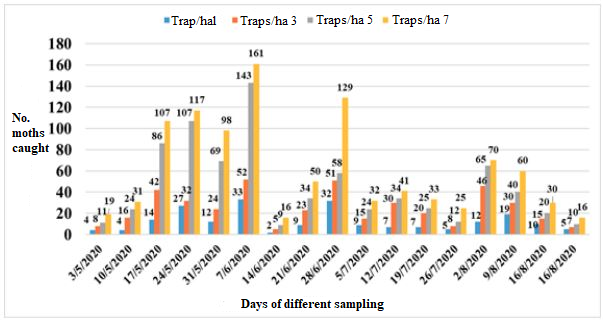
The results of this study showed that the largest population of Chilo suppressalis caught by pheromone traps was during the third to sixth week, and the peak flight of the first generation was 161, which can be seen in Figure 1.
|
|
|
Figure 1. Number of Chilo suppressalis moths caught by pheromone traps on different sampling days. |
According to Figure 1, the largest number of moths caught by the treatment with seven traps per hectare was in the sixth week, and after that, it was associated with five pheromone traps per hectare (143). The lowest number of moths caught was associated with the spraying treatment (trap without pheromone). In this regard, it should be noted that the number of moths caught in the spraying treatment was very low (one to two). In the same figure and the first generation, the three-trap treatment attracted 52 Chilo suppressalis. Also, the treatment with one trap in the same generation attracted 33 moths. In the second generation of the pest, the highest number of moths caught by pheromone traps was in the ninth week with seven pheromone traps per hectare and 129 moths. The five-trap pheromone treatment in the same generation attracted 58 moths. The three-trap treatment also caught 51 moths and the one-trap pheromone treatment caught 32 moths. The peak flight of the third-generation Chilo suppressalis moths occurred in the fourteenth week (70 Chilo suppressalis) (Figure 1). According to Figure 1, the lowest number of captured Chilo suppressalis moths in all generations was related to the treatment sprayed without pheromone traps.
In this regard, the results of Kanno et al. [19] studies comparing pheromone bait traps with light traps showed that the number of Chilo suppressalis moths caught by pheromone traps was very high over two generations. They also stated that the number of moths caught in pheromone traps was about three to five times higher than in light traps.
Table 1 shows the comparison of the average data. As can be seen, the dead central buds in the tested treatments are significantly different from each other at the 0.01 probability level. The highest percentage of dead central buds in the treatments of one and three pheromone traps per hectare was 26.31% and 26.2%, respectively, and they were classified in group a. The percentage of dead central buds infection in the treatment of five and seven pheromone traps per hectare was 17.15% and 16.57%, respectively, and statistically, the two traps were not significantly different from each other and were placed in group ab. The results of this study showed that the infection of dead central buds in the control treatment (spraying with diazinon granules) had the lowest value (11.18%) and was placed in group b.
The results of Table 1 showed that with the increase in the number of pheromone traps per hectare, the percentage of dead central buds decreased and a negative slope was observed (-3.19). Also, the linear equation showed that R2 = 0.85 and there was a positive relationship between the number of traps and the decrease in the percentage of infection in the first generation of the pest. Also, Table 1 shows the infection of whitened clusters related to the traps. In this table, the highest percentage of bleached clusters contamination related to the treatment with one pheromone trap with 20.66%, followed by the treatment with three pheromone traps with 15.36% contamination were placed in two groups a and b, respectively, and the treatment with 5 and 7 pheromone traps along with the control treatment were placed in one group, and the lowest amount of contamination was 8.57% and 7.79%, respectively, in group c.
Table 1. Comparison of the evaluated indicators averages.
|
No. of trap/ha |
Yield (Kg/h) |
No. of larva/ha |
White heads (%) |
Dead hearts (%) |
|
1 |
3468.60 ± 91.43b |
127 ± 0.66a |
20.66 ± 9.12a |
26.31 ± 11.01a |
|
3 |
3511 ± 29.08b |
116 ± 0.91a |
15.36 ± 7.38b |
26.25 ± 8.94a |
|
5 |
3899.20 ± 82.73a |
79 ± 0.47b |
8.57 ± 2.75c |
17.51 ± 51ab |
|
7 |
3933.5 ± 47.01a |
78 ± 1.01b |
7.79 ± 3.29c |
16.57 ± 9.62ab |
|
Control (Spraying) |
3977.39 ± 44.14a |
39 ± 0.65c |
5.85 ± 1.87c |
11.2 ± 4.36b |
|
Reg. line equation |
Y = -145.91x + 3324 |
Y = -154x + 140 |
Y = -3.519x + 22.40 |
Y = -3.99x + 31.54 |
*Means with the same letter or letters in each column are not significantly different at the 0.01 probability level.
The results of the regression line from the use of pheromone traps with bleached clusters showed that with an increase in the number of pheromone traps, the percentage of contamination in the second generation of the pest also decreased and had a negative slope (-3.52). Also, the linear equation shows the relationship between the percentage of bleached clusters and the number of pheromone traps, which was R2 = 0.87. Thus, a positive relationship was observed between the number of pheromone traps with a decrease in the percentage of contamination in the second generation of Chilo suppressalis (Table 1). In the same table, the number of larvae in infected stems per hectare in the treatments with one and three pheromone traps had the highest number of larvae with 127 and 116 larvae, respectively, and were statistically placed in group a. Also, the number of larvae in the treatments with five and seven pheromone traps were statistically placed in group (b) with 79 and 78 numbers, respectively. In the same table, the number of larvae in the control treatment had the lowest number (39) and was statistically placed in group c.
Table 1 shows the relationship between the number of Chilo suppressalis larvae in the second generation of the pest in the tested treatments. This table shows that with the increase in the number of pheromone traps, the number of larvae in the second generation of the pest also decreased and had a negative slope (-15.4). According to the results of the present study in Table 1, it can be seen that among the rice crop yields, the treatments with one and three pheromone traps were calculated with 3468.60 and 3511 kg per hectare, respectively and were statistically in group b with the lowest yield. In the same table, the rice yield in five and seven pheromone traps with the control treatment (with poison) was not statistically significantly different and all were in group a with the highest yield of 3899.20, 3933.5, and 3977.39 kg/ha, respectively. Also, Table 1 shows the relationship between the rice yield and the tested treatments. This table showed that with the increase in the number of pheromone traps, the yield had an increasing trend and had a positive slope (145.91). In the same table, according to the linear equation, R2 was 0.85, which showed that there was a positive relationship between the number of pheromone traps and the yield of the treatments.
|
|
|
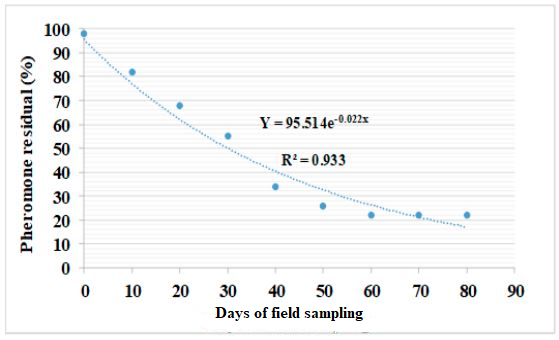
Figure 2. Decreasing trend of pheromone levels in the farm. |
Figure 2 shows the relationship between the percentage of pheromone retention and durability in the field and the tested pieces. In this figure, it can be seen that the effective substance of the pheromone had the longest duration until the first two days of use in the field, and as time passed and it continued in the field, its durability and stability decreased, and this decreasing trend continued until 50 days. In the period of 50 to 80 days, the amount of pheromone reached a level where the number of moths caught by the pheromone traps remained constant. As a result, the amount of pheromone approached its lowest value (Figure 2).
In this regard, the results of Raut and Satpath [17] showed that the persistence of sex pheromone in the field in 2012 and 2013 was between 55-65 and 85-90 days, respectively. The results of this study showed that the number of five and seven pheromone traps per hectare was not statistically significantly different from each other in terms of the percentage of dead central buds, the percentage of bleached panicles, the number of larvae, and the amount of yield. Liu et al. [20] showed that the attraction of Chilo suppressalis by pheromone substances formulated as a paste and released over a long time can lead to the predation of adult insects for at least two months so that male Chilo suppressalis individuals were effectively attracted without reduction. While the predation by pheromone substances embedded in thin plastic tubes showed a decreasing trend after one month of use in the field. The use of pheromones for mating disruption began in 1986, and plastic dispensers containing eight milligrams of the active ingredient pheromone were used at 2,500 dispensers per hectare, and the effectiveness of these dispensers for mating disruption was close to 100%. Also, in the use of sex pheromones to disrupt the mating of Chilo suppressalis, 45 dispensers per hectare in rice fields resulted in 80% pest control [21].
Studies by Yang et al. [22] in northeastern Chinese rice fields using sprays containing the sex pheromone of Chilo suppressalis showed that high doses (750 sprays/ha) resulted in 84.9% pest control. Studies by Alfaro et al. [9] and Vacas et al. [3] in the control of Chilo suppressalis in the Valencia region (Spain) showed that sex pheromones were an effective alternative to insecticides. Their studies showed that controlling the first emerging Chilo suppressalis was crucial for efficacy and that applying sex pheromones before the first flight of male Chilo suppressalis was more effective in reducing plant damage. The results of this study, namely hunting Chilo suppressalis in the field, were consistent with the results of Alfaro et al. [9] and Vacas et al. [3] in reducing rice stem borer damage in the field. The present study showed that pheromone-mediated mating disruption is an important tool for the management of Chilo suppressalis in terms of reducing insecticide use in rice fields to produce healthy rice. In addition, chemical control, in addition to being a threat to the ecosystem and natural enemies, is also not economically viable in the rice agroecosystem. Pheromones do not negatively affect non-target organisms in rice cultivation, and this method is fully compatible with the objectives of integrated pest management (IPM) [7, 23-25].
Chen et al. [26] stated that the use of sex pheromones provides significant cost savings and acceptable control is achieved at lower costs using pheromones. In addition to having adverse effects on natural enemies and environmental pollution, chemical control is not economically viable in the rice agroecosystem. Therefore, the possibility of controlling the pest with sex pheromones promises a promising prospect for the use of these compounds in the form of an integrated management program for rice stem borer.
CONCLUSION
The present study was conducted to investigate the effectiveness of using sex pheromones in population control and reducing damage to Chilo suppressalis in rice fields. The results of the present study showed that a concentration of two milligrams of the active ingredient of the sex pheromone of Chilo suppressalis with 5 to 7 traps per hectare accounted for the lowest number of dead central buds, bleached panicles, counted larvae, and also the highest crop yield. Also in this study, the highest number of dead central buds, bleached clusters, counted larvae, and the lowest yield were observed in the treatments of one and three traps per hectare. According to the present study, it seems that the management of Chilo suppressalis using sex pheromones offers a promising prospect in the form of an integrated pest management program.
ACKNOWLEDGMENTS: None
CONFLICT OF INTEREST: None
FINANCIAL SUPPORT: None
ETHICS STATEMENT: None