Entomology and
Applied Science Letters
Applied Science Letters
 2025
Volume 12
Issue 4
2025
Volume 12
Issue 4

Biological-control agents are commonly characterized by species identity, developmental stage, physiological condition, reproductive performance, infectivity, or target-suppression capacity, whereas their associated microbial communities are rarely treated as potential determinants of product reliability. This omission matters because predators, parasitoids, entomopathogens, and their hosts carry microorganisms that may influence nutrition, development, host resistance, infection processes, environmental persistence, and higher-trophic interactions. This research-agenda article integrates evidence concerning microbiomes of predatory arthropods, parasitoid-associated microorganisms, microbiota of entomopathogens and their hosts, microbial effects on fitness and virulence, microbiome instability during rearing and release, and implications for biological-control quality assurance. The strongest defensible synthesis is that microbial context can modify biologically important traits in particular agent–host–environment combinations, but the available evidence does not support universal microbiome-performance rules or taxonomic release specifications. Community composition varies with species identity, diet, landscape, host or prey source, life stage, generation, rearing conditions, infection status, and analytical workflow. Functional evidence is stronger where microorganisms have been perturbed, reintroduced, transmitted, or tested through controlled host–pathogen challenges, yet laboratory effects remain insufficient to establish post-release persistence or operational effectiveness. The article therefore proposes a staged research logic that separates detection from colonization, function, causality, persistence, performance linkage, and prospective decision validation. Its central implication is that microbiome information should initially support surveillance, source attribution, causal investigation, and targeted pathogen exclusion rather than immediate lot acceptance or rejection. Progress requires compartment-specific sampling, production-source controls, longitudinal rearing-to-release designs, representative host-background challenges, reproducible analytical workflows, and prospective validation against biological-control outcomes.
INTRODUCTION
Biological control depends on living agents whose performance emerges from interactions among genotype, physiology, host or prey availability, environment, production history, and ecological context. Predators, parasitoids, entomopathogenic fungi, bacteria, and nematodes are therefore not fixed technical inputs equivalent to chemically uniform products. Their efficacy depends on biological condition and on whether traits measured during development or production remain expressed under deployment conditions. Contemporary biological control offers substantial opportunities through both invertebrate and microbial agents, but the reliability of these interventions requires greater attention to sources of biological heterogeneity that are not captured by species identity or routine performance measures alone [1]. Agent-associated microorganisms represent one such source because they may function as nutritional partners, defensive symbionts, pathogens, transient dietary acquisitions, environmental passengers, or components of more complex infection systems.
The decision relevance of this microbial dimension is already apparent in parasitoid systems. Facultative symbionts in aphids can alter host susceptibility to parasitoid attack, creating biologically meaningful variation among pest populations that would appear identical under conventional taxonomic classification [2]. This evidence establishes that microbial associates can modify a natural-enemy interaction, but it does not justify the broader claim that every microbiome difference changes parasitoid efficacy. Protective effects depend on the identities and genotypes of the host, symbiont, and parasitoid, as well as on experimental and environmental conditions. Consequently, microbiome association must not be treated as equivalent to causal control-agent performance. The relevant question is not merely whether microorganisms are present, but whether a defined microbial feature is stably associated with the relevant biological compartment, changes a mechanistically plausible agent or host trait, and alters suppression under the intended context of use.
Mass rearing further complicates interpretation because it creates an artificial ecological system in which diet, host or prey supply, density, sanitation, water, substrate, handling, and colony continuity are deliberately controlled for production [3]. These conditions can improve output while simultaneously selecting microbial states that differ from those encountered in wild populations or after release. Such differences may be benign, adaptive, detrimental, or technically generated. A microbial profile measured in a production colony is therefore a description of that colony under a particular sampling and analytical regime, not evidence of post-release stability. Equally, a shift between generations or production lots is not evidence of lost efficacy unless it exceeds technical variation, is reproducible, and is linked to a relevant biological outcome. These distinctions are essential because microbiome instability could otherwise become an imprecise label applied to any statistically detectable community difference.
The central aim of this article is to develop an evidence-grounded research agenda for determining when microbiomes of predators, parasitoids, entomopathogens, and their hosts matter for the reliability and transferability of biological control. The analysis proceeds from agent-group evidence to functional outcomes, production instability, causal validation, and quality-assurance implications. Its argument is that transferability must be treated as a conditional biological property rather than a fixed characteristic of an agent species, because control interactions can change across generations and environments through ecological and evolutionary processes [4]. The proposed contribution is not a validated framework, operational standard, or release protocol. It is a structured scholarly synthesis that separates microbial detection, biological presence, functional activity, causal influence, temporal persistence, performance relevance, and decision validation while preserving uncertainty at each transition.
Microbiomes of predatory arthropods
Evidence from predatory arthropods shows that measured microbial communities are shaped by both the predator and the ecological context in which it feeds or develops. Across mobile predators sampled in agricultural landscapes, larval ladybirds exposed to cannibalism or intraguild predation, and populations of the zoophytophagous biological-control agent Nesidiocoris tenuis, community composition varied with landscape setting, species identity, trophic acquisition, geography, and host-plant or rearing context [5–7]. These studies establish that predator microbiomes are structured rather than random, but they remain primarily compositional. Landscape-associated differences may reflect environmental acquisition, prey consumption, habitat filtering, host genotype, or technical batch effects. Likewise, bacteria detected after a particular diet may represent transient food-associated organisms rather than stable colonizers. The evidence therefore supports context-stratified description but not a universal predator microbiome or a direct inference from compositional difference to predatory performance.
A stronger functional precedent comes from commercial predatory mites infected by Acaricomes phytoseiuli. Detection, challenge, and transmission evidence showed that this bacterium can produce detrimental effects and spread through operationally relevant production pathways [8]. This case is important because it demonstrates a specific and causally credible microbial hazard within a biological-control agent. However, it should not be generalized into the proposition that deviation from a reference community is inherently harmful. Targeted exclusion of a diagnosed pathogen is conceptually different from rejecting a production lot because its broader microbiome differs in relative abundance. Quality interpretation must therefore distinguish verified pathogens from resident commensals, transient prey-associated organisms, contaminants, and unresolved taxa. It must also determine whether the organism is localized within the agent, remains detectable across generations, and affects survival, reproduction, predation, or another operationally relevant trait.
Predatory-mite evidence further indicates that both host identity and diet shape bacterial communities, reinforcing the need to stratify baselines by species and feeding regime [9]. The most plausible synthesis is that predator microbiomes emerge from interacting sources: host filtering, diet or prey acquisition, production inputs, environmental exposure, and health status. Each source can generate similar taxonomic patterns while implying different interventions. A diet-associated shift may require no corrective action, whereas a transmissible pathogen may require source tracing and exclusion. Conversely, a recurrent taxon should not be promoted as beneficial without perturbation, reintroduction, colonization confirmation, and a relevant performance assay. The evidence dimensions and interpretive boundaries for microbiomes of predatory arthropods are summarized in Table 1.
Table 1. Microbiomes of Predatory Arthropods: Microbial Functions, Causal Evidence, Agent Performance, Rearing Stability, Field Transferability, and Quality-Assurance Requirements
|
Control agent and microbiome component |
Proposed function |
Evidence required |
Causal test |
Rearing or release sensitivity |
Performance implication |
Quality-control need |
Interpretive boundary |
|
Mobile arthropod predators and landscape-associated gut communities |
Environmental acquisition, dietary signal, or host-filtered community assembly |
Replicated sampling across predator species, landscapes, diets, and processing batches |
Environmental or dietary manipulation followed by microbial and predation measurements |
Sensitive to habitat, prey availability, season, and collection context |
May indicate ecological exposure but does not establish altered prey suppression |
Record landscape, prey, species, stage, sampling compartment, and batch controls |
Landscape association is not microbial causation or a universal predator baseline |
|
Harmonia axyridis larval gut community under cannibalism and intraguild predation |
Trophic acquisition and diet-dependent community restructuring |
Controlled diet comparisons with temporal profiling and performance endpoints |
Microbial depletion or defined-community reintroduction under matched diets |
Sensitive to prey identity, cannibalism, developmental stage, and diet transition |
Could affect nutrition or development, but performance mediation remains unproven |
Standardize diet history and sample prey or conspecific food sources |
Diet-induced variation is not demonstrated loss or improvement of efficacy |
|
Nesidiocoris tenuis bacterial community |
Population-associated resident, environmental, plant-derived, or endosymbiont-related community |
Multi-population, compartment-resolved, contamination-controlled sampling |
Candidate-taxon removal or reintroduction with fitness and predation assays |
Sensitive to geography, host plant, colony history, and field versus laboratory origin |
Population differences may limit transfer of a single reference profile |
Use population-specific baselines and verify candidate localization and function |
Taxonomic detection is candidate-discovery evidence, not a quality specification |
|
Commercial predatory mites carrying Acaricomes phytoseiuli |
Agent-directed pathogenicity and colony transmission |
Specific diagnosis, transmission tracing, prevalence assessment, and health outcomes |
Controlled exposure with recovery of the organism and replicated detrimental effects |
Sensitive to infected source material and production transmission pathways |
Can directly compromise agent condition and commercial quality |
Targeted pathogen exclusion, source tracing, and colony-health surveillance |
A validated pathogen hazard does not make ordinary community variation harmful |
|
Predatory-mite bacterial communities under different hosts and diets |
Host filtering and diet-dependent microbial acquisition |
Species- and diet-stratified profiling linked to reproduction and predation |
Reciprocal diet transfer, microbial perturbation, and rescue under matched host backgrounds |
Sensitive to predator species, feeding regime, and production diet |
May influence comparability among facilities, but causal performance effects remain unresolved |
Maintain diet-specific reference ranges and complete production metadata |
A statistically distinct community is not evidence of reduced biological control |
Parasitoid-associated microorganisms
Parasitoid-associated microbial evidence spans several biologically distinct compartments that should not be combined into a single “parasitoid microbiome” category. Microorganisms may reside in the parasitoid, occur as heritable symbionts of the host, change in response to parasitism, or influence higher-trophic organisms that attack the parasitoid. In Nasonia, genome-resolved studies of gut bacteria have supported host-associated microbial structure and a role for bacteria in hybrid dysfunction. In caterpillar systems, endoparasitism altered internal microbial communities more clearly than external communities, while associated changes in bacteria and odours influenced host location by a hyperparasitoid [10–12]. Together, these findings show that parasitoid-related microbial effects can extend from host physiology to behavioral interactions across trophic levels. They do not, however, establish that every parasitism-induced community change benefits or harms the primary parasitoid.
The clearest biological-control performance evidence concerns defensive symbionts of aphid hosts. Prior adaptation of parasitoids to symbiont-protected aphids improved suppression in experimental populations, indicating that evolutionary history can partly overcome a microbiome-mediated barrier [13]. This result strengthens the argument that microbial context should be considered when parasitoid performance varies among pest populations. Nevertheless, the effect remained specific to particular host–symbiont–parasitoid combinations. Adaptation could also alter nonmicrobial parasitoid traits correlated with success, and improved suppression under controlled conditions does not establish durable performance across other symbiont strains, crop environments, or release schedules. The defensible implication is therefore to use representative host-symbiont challenge panels when compatibility is a plausible concern, rather than to assign a general resistance status to all symbiont-bearing pests.
A useful research classification should separate four evidence classes. The first is parasitoid-resident microorganisms, for which localization, persistence, and effects on parasitoid development or reproduction must be tested. The second is host defensive symbionts, for which reciprocal host–symbiont–parasitoid combinations and suppression outcomes are required. The third is a parasitism-response microbiome, where community change may be a consequence of venom, immune suppression, tissue damage, or reduced feeding rather than a causal mediator. The fourth is a higher-trophic microbial pathway, in which parasitism-associated bacteria or volatiles alter hyperparasitoid behavior and may impose indirect costs. Evidence from Nasonia, parasitized caterpillars, and adapted aphid parasitoids supports these distinctions [10]. It does not justify using taxonomic detection alone as a parasitoid quality marker, because population identity, host genotype, developmental stage, sampling compartment, and ecological context remain competing explanations [11]. Even where behavioral consequences are observed, the contribution of particular bacterial taxa may remain only partly resolved [12]. Performance claims must therefore remain bounded to the tested biological system and outcome [13].
Microbiota of entomopathogens and their hosts
Entomopathogen microbiome research requires a distinction between microorganisms carried by the control agent and microorganisms carried by the target host. Entomopathogenic nematodes illustrate why a simple one-agent–one-symbiont description may be incomplete. Evidence synthesized under a pathobiome perspective indicates that nematodes can carry bacterial assemblages beyond the canonical obligate partner, potentially including organisms associated with development, infection, competition, cadaver exploitation, or environmental acquisition [14]. Yet the presence of additional taxa does not establish that they are stable colonizers or contributors to insect killing. Some may be passengers, contaminants, opportunists, or organisms acquired during host infection. The pathobiome concept should therefore be treated as a testable organization of candidate relationships rather than as proof that every detected member contributes to virulence.
Host microbiota can also modify entomopathogen outcomes. In mosquito–fungus and lepidopteran–Bacillus thuringiensis systems, microbial perturbation supported a contributory role for gut communities in accelerating host mortality. In contrast, work with an aphid-pathogenic fungus showed both that protective host symbionts could reduce the virulence of spores against subsequent hosts and that virulence loss during laboratory passage occurred without a corresponding community-level bacterial explanation [15–17]. These results are important because they provide convergent evidence that microbial context can matter while simultaneously rejecting a simple universal mechanism. Host-associated bacteria may facilitate pathogen-induced mortality in one system, protect the host or create carry-over effects in another, or fail to explain culture-associated changes in pathogen performance.
The resulting interpretive model must partition host-associated microbiota, pathogen-associated microbiota, and environmental microbial reservoirs. A credible causal claim requires more than detecting a taxon during infection. It requires localization, temporal persistence, perturbation, recovery or rescue, and a relevant infectivity or suppression outcome. The entomopathogenic-nematode literature supports broadening the biological unit under investigation, but the functional identity of many associates remains unresolved [14]. Similarly, the aphid–fungus evidence demonstrates that compositional stability is not equivalent to functional stability because virulence changed even when the measured bacterial community did not provide a sufficient explanation [17]. For biological-control development, pathogen profiling should therefore remain paired with conventional potency assays, representative host-background challenges, passage history, dose, and environmental context. Microbial variation may help explain efficacy, but it cannot replace direct evidence of infectivity, persistence, or target suppression.
Effects on fitness, virulence, and environmental persistence
The strongest evidence for microbiome-dependent agent fitness comes from studies that move beyond community description and perturb microbial function. In the predatory ladybird Micraspis discolor, antibiotic treatment and bacterial reintroduction linked gut bacteria to the ability to use pollen, a dietary function that may support predator maintenance when preferred prey is scarce [18]. This finding demonstrates that a defined predator trait can depend on microbial activity, but its operational meaning remains conditional. Antibiotics may have direct physiological effects, bacterial reintroduction may incompletely reconstruct the original community, and improved use of an alternative food does not necessarily increase prey suppression after release. A microbiome-dependent nutritional trait is therefore relevant to agent fitness without being equivalent to field effectiveness. Comparable caution applies to the pathogenic effects of Acaricomes phytoseiuli in predatory mites, where a specific microbial hazard has stronger causal support than any general claim that community-level variation predicts agent quality [8].
Microbiota can also modify target-host susceptibility and entomopathogen virulence. Experimental manipulation of enterobacteria altered Colorado potato beetle susceptibility to Bacillus thuringiensis and avermectins, showing that gut microbial context can influence toxicological outcomes without establishing a universal direction or magnitude of effect [19]. Conversely, bacterial-community differences in Bacillus thuringiensis-resistant western corn rootworm lines remained associated with resistance rather than proven to cause it [20]. Host genotype, selection history, diet, immune condition, and microbiome composition may all covary in resistant colonies. These studies therefore occupy different evidentiary positions: microbial manipulation supports a context-bound causal contribution, whereas comparative profiling identifies a candidate relation requiring transfer, depletion, rescue, or other intervention-based validation. The distinction is important because resistance-associated taxa could otherwise be converted prematurely into diagnostic or management markers.
Environmental persistence is a separate construct from both function and virulence. Pseudomonas protegens acquired from plant roots persisted through developmental stages of an insect and was transported to new host plants, demonstrating that microbial associates can survive temporal transitions and alter spatial exposure [21]. Nevertheless, later detection can arise through continuous colonization, repeated acquisition, surface carriage, or environmental reservoirs. Persistence must therefore be demonstrated with source-resolved, preferably strain-resolved longitudinal evidence, and retained function must be tested independently. Evidence from an entomopathogenic fungus further shows that virulence can change while the measured bacterial community remains comparatively stable [17]. Thus, microbial composition cannot substitute for direct measurements of agent survival, reproduction, infectivity, suppression, or environmental establishment. The strongest defensible synthesis is that microorganisms can influence these outcomes in defined systems, but the relation is contingent on agent identity, microbial function, host background, life stage, exposure history, and environment.
Sources of microbiome instability during rearing and release
Microbiome instability should be defined as reproducible biological change across a specified time interval or transition, after technical variation has been characterized, rather than as any statistically significant difference between samples. Longitudinal evidence from Harmonia axyridis shows that diet, developmental stage, and generation produce repeatable changes in gut-community structure [22]. Such variation may reflect normal developmental succession, dietary acquisition, host filtering, or colony adaptation. It does not by itself demonstrate deterioration. A meaningful instability claim must specify the microbial compartment, the expected baseline for the relevant stage and diet, the magnitude of technical variation, and the biological outcome that the change is hypothesized to affect. Without these elements, normal microbial plasticity can be mislabeled as harmful drift.
Production inputs create additional sources of variation. The bacterial microbiota of the predatory mite Neoseiulus cucumeris partially overlapped with that of its factitious prey, Tyrophagus putrescentiae, implicating prey and the shared rearing environment as potential microbial sources [23]. Overlap does not determine whether transmission is from prey to predator, from the common environment to both organisms, or through laboratory contamination. Wild and mass-reared New World screwworms also differed in microbial diversity and composition, demonstrating that production colonies can occupy microbial states distinct from those of wild populations [24]. However, deviation from a wild reference is not automatically a defect. Mass-reared insects experience standardized diets, high densities, sanitation regimes, limited environmental exposure, and repeated colony bottlenecks. These conditions may remove environmentally acquired taxa, enrich production-adapted organisms, or alter relative abundance without reducing biological performance.
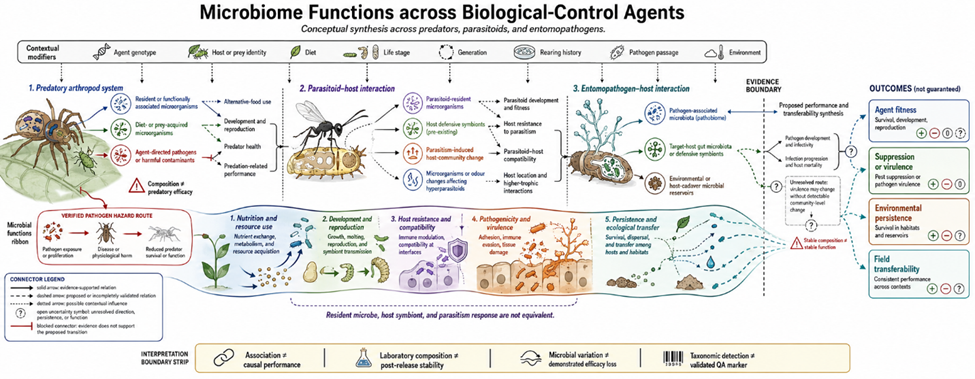
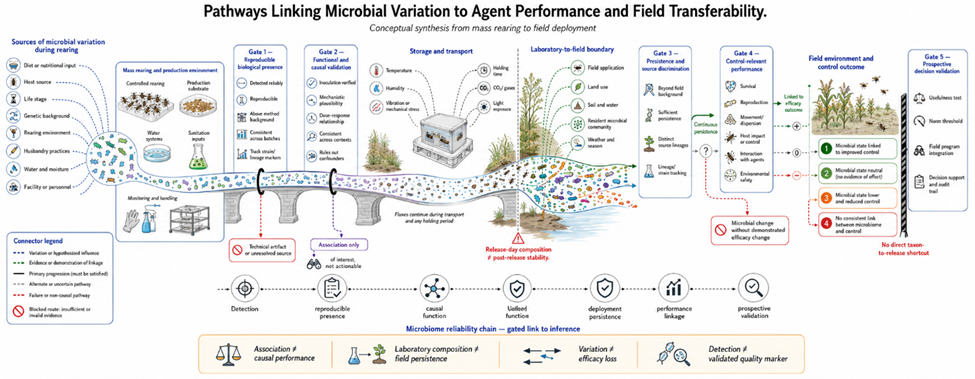
Intentional manipulation introduces another layer of instability. Diet and bacterial supplementation changed both the microbiota and life-history performance of Orius strigicollis, but the direction and apparent benefit depended on the treatment regime [25]. Supplementation therefore cannot be evaluated from the identity or abundance of the added bacterium alone. Its localization, persistence, interaction with the existing community, direct dietary effects, and consequences for development, reproduction, predation, and post-release survival must be separated. Release adds further transitions involving storage, transport, temperature, humidity, starvation, environmental acquisition, and a switch from production food to field prey. Direct longitudinal evidence across these transitions remains limited, so laboratory composition cannot be treated as post-release stability. Figure 1 maps microbiome functions across biological-control agents within the analytical logic developed in this section. Figure 2 shows pathways linking microbial variation to agent performance and field transferability within the analytical logic developed in this section.
|
|
|
Figure 1. Microbiome functions across biological-control agents |
Alt text: A structured conceptual diagram that maps microbiome functions across biological-control agents, with labelled components, directional relations, contextual modifiers, uncertainty points, and a clear boundary between observed evidence and proposed synthesis.
The evidence dimensions and interpretive boundaries for sources of microbiome instability during rearing and release are summarized in Table 2.
Table 2. Sources of Microbiome Instability during Rearing and Release: Microbial Functions, Causal Evidence, Agent Performance, Rearing Stability, Field Transferability, and Quality-Assurance Requirements
|
Control agent and microbiome component |
Proposed function |
Evidence required |
Causal test |
Rearing or release sensitivity |
Performance implication |
Quality-control need |
Interpretive boundary |
|
Harmonia axyridis gut microbiota across diets, stages, and generations |
Developmental succession, dietary acquisition, and colony-associated community change |
Repeated sampling across matched generations, stages, diets, and processing batches |
Manipulate diet or candidate taxa and test recovery, reproduction, and predation |
Sensitive to life stage, diet, generation, and colony history |
May alter nutritional physiology, but efficacy consequences remain unproven |
Stage- and diet-specific baselines with longitudinal lot metadata |
Temporal variation is not harmful drift unless it exceeds technical variation and predicts a relevant outcome |
|
Neoseiulus cucumeris and factitious-prey microbiota |
Transfer from prey, shared-environment acquisition, or parallel exposure |
Parallel sampling of predator, prey, diet, substrate, water, and production environment |
Controlled prey replacement or microbial source intervention followed by source tracking |
Sensitive to factitious prey, shared substrate, sanitation, and facility conditions |
May affect agent-associated profiles without affecting predation or reproduction |
Sample production inputs alongside the predator and retain source records |
Shared taxa do not establish transfer direction, stable colonization, or function |
|
Wild and mass-reared Cochliomyia hominivorax communities |
Colony adaptation, loss of environmental taxa, or enrichment under artificial rearing |
Paired wild, colony, transport, release, and post-release sampling with performance measures |
Transfer or reconstruction of candidate communities under matched genetic and dietary backgrounds |
Sensitive to artificial diet, density, sanitation, bottlenecks, and environmental exposure |
Production-associated differences may be neutral, adaptive, or detrimental |
Do not use wild similarity as an automatic acceptance criterion |
Difference from wild populations is not demonstrated loss of release performance |
|
Orius strigicollis microbiota under diet and bacterial supplementation |
Nutritional support, community restructuring, or direct treatment effects |
Microbial localization, persistence, treatment controls, and life-history plus predation assays |
Remove and reintroduce the candidate bacterium under identical diets |
Sensitive to supplement identity, dose, diet, existing community, and duration |
Laboratory fitness effects may not persist or improve field suppression |
Qualify intentional supplementation through functional and persistence testing |
Taxonomic addition is not proof of beneficial colonization or operational value |
|
Commercial predatory-mite pathogen contamination |
Transmission of an agent-directed bacterial pathogen through production materials |
Specific diagnosis, source tracing, colony prevalence, and replicated health effects |
Controlled exposure and transmission interruption |
Sensitive to infected stock, shared materials, and sanitation pathways |
Can directly reduce agent health and production reliability |
Targeted pathogen exclusion and health surveillance |
A specific pathogen hazard does not validate community-wide release thresholds |
|
Entomopathogenic-fungus microbiota during laboratory passage |
Possible microbial contribution to infectivity or culture degeneration |
Serial-passage profiling paired with potency, growth, and reinfection assays |
Removal, addition, or transfer of candidate associates with virulence rescue |
Sensitive to culture medium, passage history, host passage, and storage |
Virulence can change independently of measured community composition |
Retain direct potency assays throughout production |
Compositional stability is not functional stability |
|
Microbial associates across transport and environmental release |
Persistence, loss, replacement, reacquisition, or dispersal |
Pre-release, transport, immediate post-release, and longitudinal recapture sampling |
Source-resolved tracking with repeated functional testing |
Sensitive to abiotic stress, starvation, field diet, habitat, and environmental reservoirs |
Persistence may condition transferability, but direct agent evidence is limited |
Treat post-release microbiome assessment as a separate validation study |
A release-day profile is not evidence of post-release stability |
Proposed research agenda
The proposed research agenda begins with measurement validity because causal interpretation cannot be recovered from an inadequately defined or poorly controlled microbiome dataset. Variation in sampling, extraction, amplification, sequencing, filtering, and analysis can alter the apparent structure of bacterial communities and the biological conclusions drawn from them [26]. Low-biomass control-agent samples are particularly vulnerable to microorganisms introduced through reagents, laboratory handling, and processing environments [27]. Statistical contaminant-identification methods can improve reproducibility when negative controls and DNA-concentration information are available, but they cannot replace experimental controls or biological verification [28]. End-to-end best practice therefore requires coordinated study design, metadata, controls, molecular processing, bioinformatics, statistics, and reporting [29]. These requirements form the methodological foundation of the proposed Microbiome Reliability Chain: define the biological unit and compartment; establish reproducible presence; test causal function; stress-test persistence across production and release; link the feature to relevant agent performance; and prospectively validate any proposed decision use.
Across agent groups, the same microbial signal can occupy different functional positions. In predators, a bacterium may be a transient dietary acquisition, a nutritional contributor, an environmental passenger, or a pathogen. In parasitoid systems, the relevant microorganism may reside in the parasitoid, protect the host, arise as a consequence of parasitism, or influence a higher trophic level. In entomopathogen systems, microbial effects may originate from the pathogen, the target host, the host cadaver, or an environmental reservoir. These relations are further conditioned by agent genotype, host or prey identity, diet, life stage, production history, passage, storage, transport, and release environment. A verified pathogen such as Acaricomes phytoseiuli supports targeted exclusion [8], whereas parasitoid adaptation to a defensive-symbiont background supports context-specific compatibility testing [13]. Fungal evidence shows that microbial context can affect virulence while also demonstrating that community composition may fail to explain degeneration [17]. Persistence evidence shows that microorganisms can move through developmental and spatial transitions, but such transfer must be demonstrated directly rather than inferred [21].
|
|
|
Figure 2. Pathways linking microbial variation to agent performance and field transferability |
Alt text
A structured conceptual diagram that shows pathways linking microbial variation to agent performance and field transferability, with labelled components, directional relations, contextual modifiers, uncertainty points, and a clear boundary between observed evidence and proposed synthesis.
The chain is intended to function as a series of evidentiary gates rather than as a linear assumption that every microbial feature progresses toward a quality marker. Failure at an early gate is informative. A taxon that cannot be distinguished from contamination should not proceed to biological interpretation. A reproducible resident taxon that lacks a measurable function may remain useful for ecological description but not for performance prediction. A functionally active organism that disappears during transport may be unsuitable as a release-stage intervention. A microbial feature that affects a laboratory fitness trait but does not improve suppression or establishment should not become a lot-release criterion. Conversely, failure of one taxonomic hypothesis does not demonstrate that microbiomes are irrelevant; it may indicate that the operative mechanism lies below the taxonomic resolution measured, in microbial activity rather than abundance, or in the host-associated rather than agent-associated compartment. The proposed components, evidence bases, boundary conditions, failure modes, and validation requirements are organized in Table 3.
Table 3. Proposed Research Agenda: Components, Evidence Basis, Relations, Boundary Conditions, Failure Modes, and Validation Requirements
|
Proposed component |
Purpose |
Evidence basis |
Relation or mechanism |
Input or precondition |
Expected output |
Boundary condition or failure mode |
Validation requirement |
|
Define the biological unit and compartment |
Prevent conflation of agent, host, prey, diet, surface, gut, internal tissue, and environment |
Compartment-specific parasitoid and predator evidence |
The meaning of a taxon depends on where and when it is measured |
Prespecified agent, stage, compartment, source samples, and ecological context |
A bounded sampling and interpretation unit |
Whole-body detection may combine residents, diet-associated organisms, and contaminants |
Replicated compartment-resolved sampling with complete metadata |
|
Establish reproducible biological presence |
Separate true signals from contamination and batch effects |
Low-biomass contamination and analytical-control evidence |
Repeated detection must exceed technical and reagent-associated variation |
Negative controls, randomized processing, reference material, biomass information, and replicate lots |
A reproducible candidate microbial feature |
Reagent contaminants may dominate low-biomass samples |
Independent extraction and sequencing batches plus contaminant analysis |
|
Test causal microbial function |
Determine whether a feature changes a biologically relevant trait |
Functional predator, parasitoid, and entomopathogen examples |
Perturbation and rescue distinguish microbial contribution from correlation |
Candidate localization, removal or depletion method, reintroduction, and off-target controls |
A context-limited causal statement |
Antibiotic, diet, genotype, or handling effects may mimic microbial causation |
Orthogonal perturbation, rescue, dose response, and replicated performance assays |
|
Stress-test rearing and deployment stability |
Determine whether the feature persists through production, storage, transport, and release |
Multi-generation, diet, prey-source, culture-passage, and transfer evidence |
Production and environmental transitions can remove, replace, select, or disperse microorganisms |
Longitudinal lot design, source sampling, archived material, and recapture plan |
A trajectory of persistence, loss, replacement, or reacquisition |
Detection at separated time points may not show continuous colonization |
Strain-resolved longitudinal tracking with environmental-source controls |
|
Link microbial function to control-agent performance |
Connect microbial activity to survival, development, reproduction, predation, virulence, suppression, or establishment |
Function-linked and contradictory performance evidence |
A microbial effect matters operationally only when connected to a relevant agent outcome |
Validated biological assay, representative host or prey background, and exposure context |
A bounded microbiome–performance relation |
A laboratory life-history trait may not predict operational effectiveness |
Blinded performance tests across relevant genotypes, diets, hosts, and environments |
|
Prospectively validate decision use |
Determine whether a marker improves surveillance, investigation, or lot decisions |
Reproducibility, analytical-robustness, and standards evidence |
Decision value depends on prospective accuracy, robustness, and consequences of error |
Locked workflow, predefined marker, decision rule, outcome, and failure cost |
A validated and limited decision use |
Retrospective associations and method-sensitive taxa may fail prospectively |
Multi-lot, multi-facility, blinded validation against predefined outcomes |
Implications for biological-control quality assurance
Microbiome information should enter biological-control quality assurance through staged and restricted uses rather than immediate pass–fail specifications. The first priority is measurement assurance: defined sampling compartments, negative controls, reference materials, production metadata, reproducible workflows, and archived lot samples. Efforts to develop microbiome standards emphasize that comparability depends on connecting reference materials, protocols, metadata, and reporting across the measurement chain [30]. Yet standardized measurement is not equivalent to a validated biological marker. A laboratory can reproducibly measure a microbial difference that has no effect on agent performance. The initial quality-assurance role of community profiling should therefore be surveillance and root-cause investigation, especially when unexpected changes coincide with rearing modifications, declining fitness, suspected contamination, or altered pathogen potency.
The second priority is analytical and biological robustness. Differential-abundance methods can identify different candidate taxa in the same datasets, meaning that a proposed lot marker may depend on the selected statistical pipeline [31]. Candidate features should therefore survive prespecified sensitivity analyses and independent processing before biological interpretation. Population surveys of Telenomus parasitoids demonstrate the value of documenting microbial diversity and variation, but such profiles remain candidate-discovery baselines rather than validated quality specifications [32]. Progress would be shown by replication across colonies and facilities, localization to a defined compartment, stability within the intended production stage, a plausible and experimentally tested function, and consistent association with a prespecified performance outcome. Without these steps, taxonomic detection should not determine lot acceptance.
The third priority is to integrate microbiome data with existing health and performance controls rather than replace them. Parasitism altered the gut microbiota of a predatory ladybird, showing that hidden biological status can confound comparisons among predator lots [33]. A microbial difference could therefore indicate latent parasitism, pathogen infection, dietary change, environmental exposure, or analytical contamination rather than an intrinsic change in agent quality. A proposed tiered system would assign different decision rights to different evidence levels: measurement and provenance control; exploratory surveillance; causally qualified functional markers; and, only after blinded prospective validation, narrowly defined release criteria. Progress toward the highest tier would require evidence that a marker is reproducible across facilities, robust to analytical choices, stable or predictably dynamic across the relevant production interval, independently associated with a predefined biological outcome, and demonstrably useful for avoiding a specific decision failure. Until such evidence exists, microbiome findings should trigger investigation or targeted testing rather than automatic rejection or approval.
CONCLUSION
Microbiomes of predators, parasitoids, entomopathogens, and their hosts are plausible and, in selected systems, demonstrated contributors to biological-control-agent nutrition, health, compatibility, virulence, susceptibility, ecological interaction, and microbial persistence. Their importance, however, is conditional rather than universal. Community composition varies with species, genotype, diet, prey or host source, life stage, generation, landscape, production conditions, infection status, and analytical procedure. The highest-priority implication is therefore not to add undifferentiated microbiome profiles to routine release specifications, but to build a causal and longitudinal evidence chain that begins with valid measurement and ends with prospective decision validation. Microbiome association is not equivalent to causal control-agent performance; laboratory composition is not equivalent to post-release stability; microbial variation is not equivalent to demonstrated loss of efficacy; and taxonomic detection is not equivalent to a validated quality-assurance marker. Biological-control microbiome research will become operationally informative only when it identifies the relevant compartment, discriminates resident organisms from sources and contaminants, tests microbial function through perturbation and rescue, measures persistence across rearing and deployment transitions, and links the resulting evidence to agent performance under the intended context of use.
ACKNOWLEDGMENTS: None
CONFLICT OF INTEREST: None
FINANCIAL SUPPORT: None
ETHICS STATEMENT: None