Entomology and
Applied Science Letters
Applied Science Letters
 2026
Volume 13
Issue 2
2026
Volume 13
Issue 2

Urban mosquito control is commonly allocated through surveillance detections, complaints, historical service patterns, operational convenience, or administratively defined risk zones. These inputs are useful but can distribute protection unevenly when observation systems underrepresent particular places, neighbourhood conditions shape both mosquito ecology and residents’ capacity to avoid exposure, agencies possess unequal delivery capacity, and politically visible demands receive faster attention. This article develops a proposed, non-validated equity-centred model of urban vector-service allocation. It integrates urban mosquito exposure inequity, surveillance coverage and data visibility, housing and infrastructure mechanisms, neighbourhood vulnerability, institutional capacity, service allocation, community voice, procedural fairness, and allocation evaluation. The synthesis indicates that equitable allocation cannot be derived from a single socioeconomic proxy or mosquito indicator. Instead, expected harm must be disaggregated into mosquito hazard, human contact, susceptibility, capacity to avoid exposure, and access to effective protection, while the observation process that makes these conditions visible must be evaluated separately. The model therefore treats corrected burden evidence, structural vulnerability, delivery feasibility, and procedural control as distinct inputs to a transparent allocation decision, followed by verification of what was delivered, whether it changed entomological conditions, and how protection was distributed. The evidence remains context-dependent across species, pathogens, seasons, urban forms, surveillance methods, and governance systems; many relations are observational, proxy-based, or model-derived rather than causal. Progress consequently requires locally calibrated indicators, sentinel surveillance in under-visible areas, explicit reasons and appeal mechanisms, independent quality assurance, and evaluations that separate reported activity from effective and equitable protection.
INTRODUCTION
Urban mosquito-control agencies must decide not only which interventions to use, but where, when, and for whom limited surveillance and control capacity should be deployed. Allocation becomes an equity problem when avoidable differences in exposure or protection arise from the interaction of mosquito ecology, housing and infrastructure, social vulnerability, data visibility, institutional reach, and political attention. A systematic review found that socioeconomic associations with Aedes presence and arboviral outcomes were heterogeneous across settings, indicating that disadvantage should be treated as a context-sensitive exposure pathway rather than a universal proxy for mosquito burden [1]. Equity-centred allocation must therefore begin by specifying the harm to be reduced rather than presuming that a demographic category, complaint count, or trap index already represents that harm.
This specification is scientifically consequential because urban mosquito indicators represent different stages of a risk process. Adult or immature abundance, pathogen-positive vectors, human–vector contact, infection susceptibility, and residents’ ability to avoid exposure are related but non-equivalent. Across multiple U.S. cities, mosquito distributions varied with socioeconomic and environmental traits, supporting city-specific allocation inputs rather than a single national deprivation rule [2]. A technically equal distribution of traps, inspections, treatments, or staff can consequently remain inequitable when ecological opportunity, baseline protection, barriers to reporting, or the resources required to achieve comparable protection differ among neighbourhoods.
The decision problem is also spatially and institutionally broader than residential abundance. Mixed-method evidence from Bengaluru showed that measured mosquito abundance and residents’ experienced exposure can diverge, especially through everyday mobility and vulnerability in shared outdoor spaces [3]. Surveillance visibility is therefore not equivalent to underlying mosquito burden, just as a record of service is not evidence that an intervention was delivered with sufficient fidelity or produced effective and equitably distributed protection. Likewise, community consultation may provide information without granting communities procedural control over priorities, reasons, contestation, or revision.
Existing evidence supports the components of a more accountable allocation logic but does not validate a transferable algorithm. Recent scholarship jointly indicates that socioeconomic patterning, environmental moderation, and lived mobility make urban mosquito exposure context-dependent [1–3]. This article therefore develops an original, explicitly non-validated model that separates latent burden from observation, translates housing and infrastructure variables into ecological mechanisms, represents institutional capacity as both a constraint and a remediable deficit, and requires procedural and outcome verification. Its central argument is that equal allocation is not equivalent to equitable allocation: justified service decisions must target avoidable protection deficits while preserving uncertainty, safety, feasibility, transparency, and opportunities for affected communities to influence and challenge the decision process.
Urban mosquito exposure as an equity problem
Urban mosquito exposure inequity cannot be reduced to the claim that poorer neighbourhoods consistently contain more mosquitoes. In Maricopa County, Aedes aegypti abundance increased with socioeconomic status and tree cover, directly contradicting the assumption that lower-income neighborhoods always carry the highest vector burden [4]. Mosquito infection with West Nile virus was higher in lower-income Baltimore neighborhoods, showing that inequity can concern pathogen-positive vector hazard rather than abundance alone [5]. These findings are not mutually exclusive: socioeconomic patterning may differ by species, pathogen, vegetation, heat, built form, water availability, and the indicator selected. Higher abundance in an affluent, vegetated area does not negate inequity elsewhere, while pathogen-positive mosquitoes in a lower-income area identify ecological hazard rather than individual infection incidence or a causal effect of income.
Spatial aggregation creates a second source of error. Fine-scale surveillance in a low-income Brazilian community found substantial spatial heterogeneity in Aedes aegypti density, cautioning against treating an administratively uniform neighborhood as an exposure-homogeneous unit [6]. Across sites in Colombia, Ecuador and Argentina, household-level determinants of Aedes density varied by context, demonstrating that the same observable housing feature may not carry a stable allocation weight across cities [7]. Local studies thus reveal contrasting socioeconomic gradients and substantial fine-scale heterogeneity in abundance or infected-vector hazard [4–6]. Apparent differences can arise from ecological mechanisms, unequal sampling effort, the spatial unit of analysis, or different meanings of household wealth and infrastructure; evidence of association should not be converted into a universal causal or allocation coefficient.
An equity-centred exposure construct should instead represent unequal expected harm as the combination of mosquito hazard, human contact, susceptibility, capacity to avoid exposure, and access to protection. Each element requires an appropriate scale and observation process: traps may identify local adult activity, pathogen testing may refine hazard, household assessment may reveal container mechanisms, and mobility or social evidence may identify contact outside the sampled residence. A coverage audit is needed before interpreting spatial patterns, and housing variables should be translated into explicit mechanisms such as storage, shade, maintenance, drainage, or constrained access to remediation. Neighbourhood categories should retain within-area uncertainty rather than assign collective responsibility to residents. The evidence dimensions and interpretive boundaries for urban mosquito exposure as an equity problem are summarized in Table 1.
Table 1. Urban Mosquito Exposure as an Equity Problem: Technical Evidence, Ecological Safeguards, Governance Requirements, Monitoring, Residual Risk, and Decision Boundaries
|
Decision Stage or Safeguard |
Evidence Required |
Technical Function |
Ecological Function |
Governance Requirement |
Failure or Escape Risk |
Monitoring or Learning Need |
Decision Boundary |
|
Define Exposure Inequity |
Hazard, contact, susceptibility, avoidance, and protection indicators |
Keep distinct risk constructs separate |
Preserve species-, pathogen-, season-, and scale-specificity |
Publish the protected outcome and denominator |
A single proxy hides affected groups or pathways |
Track discordance among indicators |
Deprivation is not mosquito burden |
|
Calibrate Local Socioeconomic Patterning |
Paired entomological, environmental, and socioeconomic data |
Estimate local rather than transported relations |
Represent vegetation, heat, and built-form moderation |
Explain why each variable affects allocation |
Imported weights misclassify need |
Re-estimate relations across seasons and areas |
Association is not a universal gradient |
|
Include Experienced Exposure |
Residential sampling, mobility, shared-space, and vulnerability evidence |
Link residence-based and activity-space information |
Capture contact beyond sampled parcels |
Protect privacy and represent mobile or marginalised groups |
Residential-only data omit exposure pathways |
Compare measured and reported experience |
Measured abundance is not total exposure |
|
Test Counter-Directional Gradients |
Repeated trap data with land-cover context |
Compare alternative socioeconomic specifications |
Identify amenity- or vegetation-linked habitat |
Prevent deprivation-only automatic targeting |
Stereotyping obscures affluent high-burden areas |
Monitor direction and stability of gradients |
Affluence-related abundance does not erase other inequities |
|
Separate Infection from Abundance |
Pathogen testing alongside abundance measures |
Add a pathogen-positive hazard layer |
Distinguish infected-vector ecology from density |
Communicate uncertainty without implying human incidence |
Infection evidence is overtranslated into disease risk |
Track abundance and infection jointly |
Infected vectors are not individual disease incidence |
|
Preserve Micro-Spatial Heterogeneity |
Fine-scale, repeated habitat and density observations |
Support within-neighbourhood allocation |
Identify clustered productive conditions |
Report uncertainty below administrative averages |
Area means allow micro-sites to escape attention |
Test temporal persistence of clusters |
A neighbourhood label is not homogeneous burden |
|
Translate Housing Features Into Mechanisms |
Containers, maintenance, environment, and household constraints |
Build mechanism-specific local indicators |
Connect features to water, shade, productivity, and species ecology |
Avoid blaming households for structural constraints |
Visible features become universal vulnerability proxies |
Recalibrate determinants across cities |
The same feature need not carry the same weight |
Surveillance coverage and data visibility
Surveillance is not a transparent window onto mosquito burden; it is a measurement system that filters ecological conditions through site selection, effort, participation, technology, validation, and institutional attention. Citizen-science reports can extend mosquito surveillance at scale and correspond with professional observations, but participation-dependent visibility remains distinct from underlying burden [8]. Socioeconomic spatial sampling bias in citizen-science mosquito data can be measured and partially corrected, showing that absence of reports cannot be interpreted as absence of mosquitoes without a reporting-process model [9]. Correction can reduce known bias, but it cannot recover unobserved burden without assumptions about participation and the covariates that explain missingness.
The same distinction applies when surveillance platforms are combined. Integrating multiple citizen-science platforms expands geographic and taxonomic coverage, while differences in platform participation, validation and data structure require explicit harmonisation before allocation use [10]. Citizen-science systems can therefore scale surveillance, but platform participation and socioeconomic sampling processes shape what becomes visible [8–10]. Community-based surveillance in western Kenya captured broad seasonal patterns but differed from expert teams in catch and identification performance, indicating that expanded coverage does not remove quality-assurance requirements [11]. The transferable lesson is institutional rather than biological: broader reach should be accompanied by training, supervision, retraining, reference sampling, and transparent performance checks.
An equity-centred allocation process should score coverage and quality separately. Geographic reach, temporal continuity, taxonomic validity, effort denominators, digital access, language access, and the probability of participation should be documented before surveillance outputs trigger service. Low-reporting areas should not be penalised; where correction is weak, sentinel sampling should be added and residual uncertainty retained rather than replaced by confident imputation. More observations are not automatically more representative, integrated data are not automatically interoperable, and community coverage is not equivalent to expert-level accuracy. Allocation records should therefore distinguish observed detections, model-corrected visibility, unsampled areas, and the decisions made under each degree of uncertainty.
Housing, infrastructure, and neighbourhood vulnerability
Housing and infrastructure affect mosquito exposure through mechanisms, not through their labels alone. In Tucson, immature Aedes habitat was associated with both household behaviours and socioeconomic conditions, illustrating that infrastructure and practice interact rather than operate as interchangeable vulnerability indicators [12]. Water-holding containers become habitat only under species-, season-, water-, shade-, access-, and maintenance-specific conditions, and household practices may reflect constrained water supply, tenure, waste services, or the absence of public assistance. Immature habitat is not equivalent to adult biting or transmission, and a household association does not establish individual blame. Allocation should therefore separate modifiable practices from structural inability to act and avoid substituting behavioural messaging for public remediation.
Citywide infrastructure mapping can extend inspection capacity, but its outputs require calibrated interpretation. Remote sensing distinguished water tanks and swimming pools whose distributions were socially patterned, but detected containers remained habitat proxies rather than direct measures of productive mosquito burden [13]. Combining satellite and street-view imagery enabled high-resolution mapping of likely breeding-site conditions, yet model-derived suitability requires local entomological calibration before service decisions [14]. Object detection, image availability, access permissions, image age, and neighbourhood appearance can all shape predictions. An algorithm may identify a visible structure, learn a socioeconomic visual signature, or miss informal and private spaces without establishing that a site contains water, produces adults, or contributes materially to human exposure.
Mechanism-specific vulnerability assessment should consequently combine structural indicators with micro-scale field verification. Remote sensing can guide inspection and remediation, but it should not automatically assign burden or service; predicted and observed layers must remain separate in the allocation record. Confidence should decrease where imagery, household access, or ground-truth coverage is socially patterned, and weights should be recalibrated when species ecology, weather, infrastructure use, or intervention context changes. Neighbourhood vulnerability should describe the concentration of habitat opportunities and constraints on avoidance or remediation, not an intrinsic property of residents. Equal scores or equal service amounts are not equitable by default when the effort required to remove comparable risk differs across housing and infrastructure conditions.
Institutional capacity and service allocation
A global assessment of malaria programmes identified capacity constraints across strategy, financing, workforce, logistics and information systems, providing a transferable institutional diagnostic rather than an urban Aedes performance estimate [15]. For urban mosquito control, institutional capacity should therefore be understood as the interdependent ability to maintain surveillance, interpret evidence, select appropriate interventions, reach intended locations, verify delivery, and revise action. Formal plans or technical equipment do not demonstrate that these functions operate continuously or equitably. Capacity is an input to protection, not protection itself, and a high-capacity agency may still allocate services according to historical precedent, political pressure, administrative convenience, or incomplete surveillance.
Everyday-governance evidence from Bengaluru showed that households differed in their ability to secure water and mosquito control, making institutional access and local power part of the exposure pathway rather than background context [16]. Residents may compensate for weak public provision through purchased repellents, private pest control, protected housing, water-management adaptations, or repeated contact with authorities. Such coping can obscure service deficits because lower observed exposure among well-resourced households may reflect private protection rather than equitable public allocation. Conversely, apparent household non-compliance may reflect insecure tenure, inaccessible premises, unreliable water supply, limited mobility, or an inability to perform repeated source reduction. Allocation assessment must therefore document both public provision and the unequal resources required to compensate when that provision is insufficient.
Florida’s local governance landscape shows that jurisdictional design can generate differences in mosquito-control funding, expertise and service quality, making administrative boundaries part of exposure protection [17]. Adjacent populations with comparable ecological need may receive different surveillance intensity, response times, intervention options, or quality assurance because they fall under different fiscal and administrative arrangements. These differences should not be normalised as unavoidable background conditions. Institutional capacity must be represented both as a feasibility constraint and as an equity object: where present capacity cannot deliver justified protection, the allocation record should disclose unmet need, identify the limiting function, and distinguish temporary operational constraint from an acceptable distribution of protection. Reported expenditure, treatment counts, or service coverage remain insufficient without evidence of delivery fidelity and outcomes.
Community voice and procedural fairness
A neighborhood intervention demonstrated that coordinated participation can improve container-mosquito control, but voluntary cooperation does not itself confer community authority over agency decisions [18]. Community knowledge can reveal unreported nuisance, inaccessible habitats, mobility-related exposure, practical barriers, and concerns about pesticides or non-target effects. Participation may also improve intervention fit and collective action. However, programmes that allocate attention according to complaint volume, meeting attendance, volunteer activity, or digital reporting can privilege communities with greater time, trust, connectivity, organisational capacity, and access to officials. Low participation should therefore never be interpreted automatically as low need or consent to reduced service.
A scoping review found limited empirical evidence for empowerment-oriented Aedes management in high-income settings, reinforcing the distinction between consultation and durable decision control [19]. Procedural fairness requires more than opportunities to provide information. It concerns who participates, which alternatives are open to influence, how evidence and thresholds are explained, whether reasons are published, how disagreement is recorded, and whether affected communities can request review or correction. An agency may consult extensively while retaining complete control over problem definition, acceptable risk, intervention choice, timing, and evaluation. Community consultation is therefore not equivalent to procedural control over decisions.
Focus-group participants identified transparency, accessible information, environmental concern and practical assistance as conditions of acceptable mosquito control, while their expressed preferences remained evidence of voice rather than procedural control [20]. An equity-centred process should provide multilingual and accessible information, material support for requested household actions, clear disclosure of surveillance uncertainty, and a documented response to community concerns. It should also examine who remains absent and whether participation is captured by organised or politically visible interests. Procedural legitimacy cannot be inferred from satisfaction alone: communities may accept a decision without having meaningful influence, while disagreement may persist even after a fair process. The relevant evaluation question is whether affected groups had a realistic and consequential opportunity to shape, understand, contest, and revisit the allocation.
Proposed equity-centred allocation model
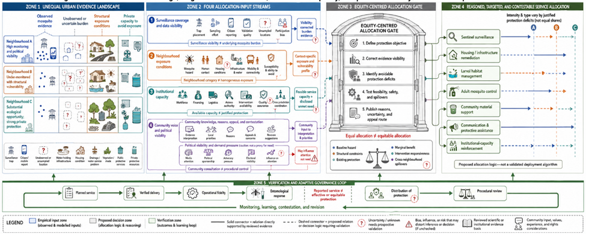
Comparative analysis of U.S. abatement programmes identifies recurrent operational components—surveillance, integrated control, workforce, financing, regulation and public communication—that can serve as model inputs but not as proof of equitable performance [21]. The proposed model organises these inputs into four analytically separate domains: visibility-corrected evidence of mosquito burden; neighbourhood conditions affecting habitat, contact, vulnerability, and capacity to avoid exposure; institutional capacity to deliver appropriate and safe services; and procedural evidence concerning representation, political visibility, reasons, and contestability. Political visibility is treated as a contextual modifier of institutional attention rather than a legitimate proxy for need. These domains feed a transparent allocation decision that identifies the protection objective, records uncertainty, distinguishes structural from household-remediable conditions, and states why marginal service effort is directed to a particular place or population.
Figure 1 shows how surveillance coverage, neighbourhood conditions, institutional capacity, and political visibility influence mosquito-control allocation within the analytical logic developed in this section.
|
|
|
Figure 1. How surveillance coverage, neighbourhood conditions, institutional capacity, and political visibility influence mosquito-control allocation |
Alt text
A structured conceptual diagram that shows how surveillance coverage, neighbourhood conditions, institutional capacity, and political visibility influence mosquito-control allocation, with labelled components, directional relations, contextual modifiers, uncertainty points, and a clear boundary between observed evidence and proposed synthesis.
Published mosquito-control action thresholds vary widely in definition, evidence base and operational context, so the proposed model treats thresholds as locally justified decision rules rather than universal constants [22]. A threshold should specify the measured construct, target species or pathogen, spatial and temporal scale, response objective, uncertainty tolerance, intervention options, and conditions under which action is reconsidered. Raw complaints or detections should not independently trigger allocation where reporting opportunities differ. Instead, observation data should be accompanied by coverage and validation information, and under-visible neighbourhoods should receive sentinel surveillance rather than a presumption of low burden. Decision rules must also retain professional judgement and public reasons; numerical thresholds can structure accountability but should not create false precision.
Municipal larval-control programmes in Connecticut showed heterogeneous community-wide effects on West Nile virus risk indicators, illustrating why reported treatment activity cannot substitute for measured protection [23]. A cluster-randomized experiment in Réunion treated mosquito abatement as a public good and identified behavioural spillovers, supporting allocation logic that considers cross-household effects as well as direct recipients [24]. The model therefore links planned allocation to verified delivery, operational fidelity, entomological effect, and the distribution of residual protection. It also considers externalities: control in one location may affect neighbouring exposure, while public provision can change private protective behaviour. Equal treatment quantities are not necessarily equitable when baseline hazard, structural constraints, intervention responsiveness, and spillovers differ.
The model is a proposed scholarly structure rather than a validated scoring system or deployment-ready framework. Its principal failure modes include confident burden estimation from socially biased data, conversion of housing characteristics into resident blame, normalisation of low service because institutional capacity is weak, political capture by highly visible constituencies, and evaluation that stops at activity counts. Validation would require prospective comparison with historical, equal-share, complaint-led, and need-only allocation approaches across contrasting cities and mosquito systems. Testing should examine calibration, subgroup error, implementation feasibility, ecological spillovers, procedural legitimacy, and whether avoidable protection deficits narrow without transferring risk to less visible populations.
Policy and evaluation implications
Field implementation of sterile-male releases in Recife showed that handling and release frequency can alter operational performance, demonstrating that biological plausibility must be evaluated separately from delivered effectiveness [25]. Although the intervention is technology-specific, the implementation lesson is general: allocation evaluation must test whether the intended intervention reached the intended place, time, frequency, coverage, and quality before interpreting entomological outcomes. A programme should pre-specify the primary protection objective, document deviations and access failures, and distinguish technology failure from delivery failure. Housing assistance, structural remediation, larval management, adult control, surveillance expansion, and community support may require different fidelity measures and different periods before effects can reasonably be observed.
Public-health experts in Europe and the United States identified fragmentation, limited resources and modelling constraints as barriers to surveillance-to-control translation, indicating that policy evaluation must test institutional delivery pathways [26]. Progress should therefore be assessed through a linked chain: underlying need, surveillance visibility, allocation decision, delivered service, operational fidelity, entomological response, human exposure implications, distribution of protection, and procedural legitimacy. Each link can fail independently. More detections after sentinel expansion may indicate improved visibility rather than worsening ecology, while unchanged burden after reported treatment may indicate inadequate coverage, inappropriate intervention choice, ecological replacement, or weak implementation. Evaluation should retain these competing explanations rather than treating uncertainty as evidence of no effect.
Quality-management scholarship separates programme planning, implementation verification and outcome evaluation, supporting an audit trail that tests what was delivered and achieved rather than equating reported activity with protection [27]. Initial application of the proposed model should therefore occur as bounded, reversible testing with predefined review, stopping, and revision rules rather than policy-wide adoption. Agencies should publish surveillance-to-action logs, audit data gaps and model error, verify structural remediation separately from household participation, and report outcomes by relevant micro-area and population group. Independent review and community contestation should be built into change control. Evidence of progress would include improved measurement in under-visible areas, reduced unexplained jurisdictional differences, higher delivery fidelity, narrower avoidable protection deficits, and documented influence by affected communities—not merely greater spending, more treatments, or higher participation.
CONCLUSION
Who receives mosquito control and who remains exposed are determined by more than mosquito abundance. Allocation emerges from the interaction of ecological hazard, human contact, housing and infrastructure, surveillance visibility, institutional reach, private coping capacity, community influence, and the rules through which evidence becomes action. The strongest defensible synthesis is that equitable allocation requires these constructs to remain separate long enough to identify where protection is being lost: visibility is not burden, reported service is not effective or equitable protection, equal allocation is not equitable allocation, and consultation is not procedural control. The proposed model offers a transparent structure for correcting observation bias, identifying avoidable protection deficits, exposing capacity constraints, incorporating consequential community influence, and verifying outcomes. Its relations remain context-dependent and non-validated across mosquito species, pathogens, seasons, urban forms, interventions, and governance arrangements. The immediate priority is therefore prospective, reversible, independently reviewed testing against existing allocation practices, with success judged by whether effective protection becomes more equitable rather than whether administrative activity becomes more uniform.
ACKNOWLEDGMENTS: None
CONFLICT OF INTEREST: None
FINANCIAL SUPPORT: None
ETHICS STATEMENT: None