Entomology and
Applied Science Letters
Applied Science Letters
 2025
Volume 12
Issue 4
2025
Volume 12
Issue 4

Botanical insecticides are often advanced on the strength of chemically characterized plant extracts, essential oils, or purified constituents that demonstrate insecticidal, repellent, antifeedant, or development-disrupting activity under controlled conditions. However, active-ingredient potency does not determine whether an applied product will remain chemically intact, disperse predictably, reach the intended biological interface, withstand environmental stress, and maintain a useful exposure profile without creating disproportionate non-target risk. This design article addresses the resulting gap between active-chemistry discovery and environmentally effective pest control by developing an evidence-grounded, explicitly non-validated formulation-by-design approach. The analysis integrates botanical-source variability, chemical identity, solubility, volatility, chemical stability, encapsulation, carrier function, controlled release, deposit formation, target exposure, environmental fate, and non-target effects. The synthesis indicates that formulation should be treated as an exposure architecture rather than as a late-stage product adjustment. Encapsulation may protect a payload but does not establish its bioavailable delivery; longer persistence may extend control but does not establish environmental safety; and storage stability does not predict robustness after dilution, spraying, deposition, weathering, or biological contact. Evidence remains constrained by heterogeneous botanical materials, formulation methods, target species, exposure routes, endpoints, and laboratory conditions, with relatively limited integration of chemical mass balance, deposit behavior, ecological exposure, and field-relevant stress testing. The principal implication is that botanical insecticide development should begin with a defined product identity and a diagnosed delivery failure, followed by formulation choices linked to explicit mechanisms, boundary conditions, safety requirements, and prospective validation tests. This approach reframes formulation as the process that determines whether promising chemistry survives the complete journey to justified pest-control use.
INTRODUCTION
Botanical insecticides occupy an important but difficult position between natural-product discovery and operational crop protection. Plant-derived compounds and mixtures can produce acute toxicity, repellence, feeding disruption, developmental interference, or indirect ecological effects, yet these activities are frequently demonstrated under conditions that minimize the losses occurring between preparation and biological contact. Recent scholarship shows that botanical insecticides may possess useful biological activity while still failing to become dependable products because chemical variability, instability, delivery limitations, and product-definition problems interrupt translation from active chemistry to field exposure [1-3]. The central development problem is therefore not simply whether a plant-derived substance is biologically active, but whether a reproducible formulation can deliver an appropriate chemical identity to the intended target at the required place, concentration, physical state, and duration.
Formulation is sometimes treated as a downstream technical step applied after an active substance has been selected. This sequence assumes that potency is an intrinsic property that formulation merely preserves. In practice, product architecture can change how botanical activity is expressed by altering constituent ratios, interfacial behavior, vapor release, surface contact, retention, penetration, and exposure duration. A deliberately constructed plant-oil mixture altered locust-control performance, demonstrating that product architecture can materially change how botanical activity is expressed [4]. Such findings do not mean that every mixture or carrier improves efficacy. They show instead that the formulated product, rather than the isolated active ingredient, is the operational unit through which exposure and biological response are produced.
The evidentiary gap arises because chemical characterization, laboratory bioactivity, formulation stability, residual activity, and field performance are often interpreted as though they represented successive measurements of one construct. They do not. Chemical identity describes what is present; potency describes a response under a specified assay; formulation performance describes how a product behaves during preparation and application; and operational effectiveness depends on whether exposure remains sufficient under variable biological and environmental conditions. These distinctions are particularly important for volatile, poorly water-dispersible, oxidation-prone, or compositionally variable botanical materials. A favorable result at one stage cannot substitute for evidence at the next, and failure at a later stage does not necessarily invalidate the active chemistry.
This article develops an original formulation-by-design synthesis for botanical insecticides. Its scope extends from botanical-source and chemical-identity control through solubility, volatility, stability, encapsulation, carrier behavior, controlled release, deposit performance, environmental fate, and non-target exposure. The central argument is that formulation decisions should be selected prospectively according to a diagnosed failure mechanism and an intended exposure pathway. The proposed organization is evidence grounded but not empirically validated as an integrated framework. It therefore specifies relations, decision points, failure modes, and validation requirements while preserving uncertainty about transferability across plant sources, target insects, life stages, application methods, environmental conditions, and formulation classes.
Why active chemistry alone does not determine performance
The first limitation of chemistry-centred development is that a botanical active is rarely a completely fixed input. Seasonal shifts in the composition and biological activity of Mesosphaerum suaveolens essential oil demonstrate that the material entering formulation development may vary before any carrier or delivery system is introduced [5]. This variability may reflect plant genetics, phenological stage, environmental conditions, harvesting, storage, extraction, or differential degradation. Moreover, one chemically characterized oil can generate toxic, repellent, and antifungal outcomes across different assays, confirming that measured performance is endpoint- and exposure-dependent [6]. Comparative testing of Lauraceae essential oils likewise showed that botanical source, constituent profile, and assay context jointly shaped potency patterns [7]. These studies directly support chemical-identity control, but they do not establish a universal constituent–effect relation because minor constituents, mixture interactions, target susceptibility, and exposure geometry may provide competing explanations.
A second limitation is that bioactivity emerges from the interaction between chemistry and the route by which the target encounters it. In a stored-commodity system, the insecticidal effects of Illicium verum and Eugenia caryophyllus oils varied with oil identity, concentration, and exposure conditions rather than following from the presence of a nominally active constituent alone [8]. Fumigant action, direct contact, treated-surface contact, ingestion, repellence, and interference with reproduction represent different exposure pathways. A product optimized for vapor-phase activity may fail if rapid atmospheric loss prevents sustained target exposure, whereas the same volatility may be advantageous in a confined storage environment. Consequently, potency measured through one route cannot be transferred automatically to another application system, pest stage, crop surface, or microclimate.
Safety and translation are also product-level rather than origin-level properties. Selected spice oils produced target toxicity while showing favorable results in tested non-target invertebrates, but the conclusion remains bounded by the species, stages, doses, routes, and endpoints examined [9]. Absence of observed harm in a selected laboratory assay is not equivalent to environmental safety, just as biological activity is not equivalent to operational effectiveness. Formulation may reduce target dose requirements, but it may also increase persistence, penetration, dispersal, or contact with beneficial organisms. Resistance implications are similarly conditional: chemical complexity or multiple modes of action may diversify selection pressure, but resistance-management value cannot be claimed without evidence on cross-resistance, exposure heterogeneity, heritable responses, and repeated use. The evidence dimensions and interpretive boundaries for active chemistry alone does not determine performance are summarized in Table 1.
Table 1. Why Active Chemistry Alone Does Not Determine Performance: Chemical Identity, Mechanism, Standardization, Formulation, Safety, Resistance, and Translation Requirements
|
Candidate or product factor |
Chemical or biological basis |
Required characterization |
Potential contribution |
Formulation implication |
Safety implication |
Resistance implication |
Development boundary |
|
Botanical source and chemotype |
Genetics, season, environment, and harvest conditions can alter constituent profiles |
Authenticated source, collection conditions, chemical fingerprint, and marker constituents |
Defines a reproducible starting material |
Formulation optimization must use material within a controlled identity range |
Source variability may change hazard as well as efficacy |
Variable exposure may create inconsistent selection pressure |
A species name is not a product specification |
|
Constituent composition and ratios |
Major and minor compounds may contribute additively, synergistically, antagonistically, or independently |
Constituent-resolved analysis across representative batches |
Supports mechanistic hypotheses and batch comparability |
Carrier compatibility and release may differ among constituents |
Degradation products and minor constituents may require assessment |
Multiple constituents do not automatically prevent resistance |
Correlation between abundance and activity does not establish causation |
|
Biological endpoint |
Toxicity, repellence, feeding effects, development, and reproduction represent different responses |
Target species, life stage, exposure route, duration, and endpoint definition |
Clarifies the intended pest-control function |
Delivery should be matched to the endpoint and required contact pathway |
Non-lethal behavioral or physiological effects may occur in non-targets |
Endpoint diversity is not evidence of delayed resistance |
Activity in one assay cannot represent general efficacy |
|
Mixture or product architecture |
Blending changes constituent ratios, spreading, contact, and possibly mechanism |
Composition, physical properties, mixture controls, and component comparisons |
May improve exposure or broaden biological action |
The mixture is a formulation variable, not an inert container |
Interactions can alter both target and non-target responses |
Resistance benefit requires repeated-selection evidence |
Improved laboratory activity does not establish durable field control |
|
Exposure route |
Fumigant, contact, ingestion, and treated-surface pathways deliver different effective doses |
Applied dose, retained dose, route, exposure duration, and target interface |
Aligns product behavior with pest ecology |
Volatility, solubility, droplet behavior, and deposit state must fit the intended route |
Off-target exposure routes must be considered separately |
Uneven delivery may expose survivors to subeffective doses |
Nominal concentration is not the dose reaching the target |
|
Selected non-target profile |
Organism sensitivity depends on species, stage, route, dose, and endpoint |
Representative acute, sublethal, behavioral, and functional tests |
Identifies bounded selectivity under defined conditions |
Formulation changes the exposure on which selectivity depends |
Botanical origin cannot justify an intrinsic-safety claim |
Non-target selectivity does not establish resistance-management value |
Favorable selected-species findings cannot be generalized ecosystem-wide |
|
Standardization and translation |
Reproducible products require controlled identity, manufacture, stability, efficacy, and safety evidence |
Product specifications and linked analytical and biological quality controls |
Enables interpretable comparison among batches and studies |
Formulation must be integrated before pivotal performance testing |
Risk assessment applies to the final use pattern and product |
Claims require evidence beyond theoretical chemical diversity |
Promising active chemistry is not a field-ready or registrable product |
Solubility, volatility, and chemical stability
Solubility and volatility determine how much of an applied botanical active remains available for transport to the target, but their effects are neither uniformly beneficial nor uniformly detrimental. Post-application temperature altered the insecticidal activity of Thymus vulgaris essential oil, indicating that nominal dose was not equivalent to the dose retained and biologically available after application [10]. Temperature may alter evaporation, vapor pressure, diffusion, deposit drying, insect physiology, or several processes simultaneously. The result therefore supports a temperature-dependent exposure mechanism without identifying volatility as the sole cause. Nanoemulsification of Pimpinella anisum oil improved aqueous dispersion and enabled insecticidal exposure against Tribolium castaneum, but improved dispersion under controlled conditions does not establish persistence after dilution, application, or environmental weathering [11]. Solubility, colloidal stability, and bioavailability must consequently be measured as related but non-equivalent properties.
Chemical stability introduces an additional distinction between retaining material and retaining biologically relevant chemical identity. A Cedrela odorata nanoemulsion linked surfactant balance and droplet size to storage stability and larvicidal activity against Spodoptera frugiperda, providing evidence that physical formulation properties can support a more uniform and usable preparation [12]. Nevertheless, laboratory storage stability does not establish field robustness. Dilution water, nozzle shear, sunlight, oxygen, temperature cycling, drying, plant-surface chemistry, and rainfall can alter a formulation after the storage test has ended. Chitosan encapsulation of peppermint oil produced defined particle, loading, and encapsulation characteristics together with insecticidal effects against stored-grain pests, but these metrics require explicit connection to release, recovered active chemistry, and target exposure [13]. High loading or encapsulation efficiency may coexist with insufficient release, selective constituent retention, or loss of accessible active material.
Controlled protection can extend activity when a relevant loss process is successfully modified. Chitosan nanoparticles prolonged the larvicidal action of Siparuna guianensis essential oil in an aquatic mosquito system, illustrating that persistence can be engineered through release control while still requiring exposure and selectivity assessment [14]. This evidence is strongest for the studied aquatic context and should not be transferred directly to foliar deposits, stored commodities, or other pest–environment combinations. Longer residual activity may indicate controlled release, reduced degradation, altered partitioning, or simple retention within a carrier; discriminating among these explanations requires chemical recovery and release measurements under use-relevant conditions. Formulation-by-design should therefore separate storage stability, dilution stability, deposit stability, environmental transformation, and biological availability. The appropriate objective is not maximum stability, but sufficient preservation of the intended chemical identity until an effective and bounded target exposure has occurred.
Encapsulation, carriers, and controlled release
Encapsulation is valuable when it corrects an identified delivery failure rather than when it is adopted as a generic marker of technological advancement. Polymeric nanospheres reduced photodegradation of Zanthoxylum rhoifolium essential oil and preserved effects against Bemisia tabaci in screenhouse testing, directly linking the carrier to a named environmental stressor [15]. This relationship is more informative than particle size alone because it connects a formulation attribute to a chemical failure mechanism and a biological consequence. Even so, screenhouse performance is not equivalent to robustness across seasons, canopy structures, rainfall patterns, application equipment, or environmental compartments. Nanoencapsulated lemongrass oil also affected survival, development, and reproduction of Spodoptera frugiperda, showing that formulation may alter the temporal pattern and demographic expression of biological activity rather than only its peak acute toxicity [16]. These effects remain specific to the formulation, target, exposure conditions, and measured population parameters.
Carrier-mediated improvements must also be interpreted against carrier-dependent exposure and safety. Polymeric nanoparticles loaded with essential oils produced bioefficacy against pest insects while allowing comparison with selected terrestrial and aquatic non-target organisms, demonstrating why target delivery and non-target exposure should be evaluated together [17]. A carrier that increases retention or prolongs release may improve pest contact but also extend exposure for predators, pollinators, decomposers, or aquatic organisms. Conversely, reduced free-active concentration may lower immediate off-target exposure while maintaining target activity through controlled release. These possibilities cannot be resolved from encapsulation efficiency, particle diameter, or nominal persistence alone. Evidence from chitosan-based insecticide formulations identifies protection, release, adhesion, biodegradability, manufacturing reproducibility, scale-up, field testing, and regulation as separate design requirements [18]. Carrier choice therefore has physicochemical, biological, environmental, and production consequences.
The central interpretive boundary is that encapsulation is not equivalent to bioavailable delivery. A complete evaluation requires comparison of the unformulated active, unloaded carrier, loaded formulation, and relevant co-formulants; characterization of free and associated fractions; constituent-specific recovery; dilution and aggregation behavior; release under target-relevant media and stresses; and measurement of the dose reaching the biological interface. Controlled release should be optimized against an intended exposure window rather than maximized without qualification. Rapid release may be necessary for short-lived or mobile pest stages, whereas sustained exposure may be useful where residual contact is required. In either case, incomplete release, burst release, carrier aging, selective constituent partitioning, and persistence outside the target compartment are plausible failure modes. The defensible design question is therefore not whether encapsulation improves a botanical insecticide, but which carrier property corrects which delivery problem, under what conditions, and with what evidence that protection, release, efficacy, and environmental exposure remain appropriately aligned.
Adhesion, coverage, penetration, and rainfastness
After dilution and atomization, a botanical insecticide must still form a deposit that reaches the biologically relevant surface. Wetting is produced by an interaction between formulation properties and leaf-surface chemistry or morphology, rather than by either component alone [19]. Contact angle, spreading, droplet capture, and retained volume therefore need to be interpreted for the intended crop, leaf side, canopy position, and pest microhabitat. Greater spreading may increase surface coverage, but excessive spreading can reduce local deposit concentration, promote runoff, or extend exposure beyond the intended target. Adjuvant performance likewise varies among leaf surfaces, meaning that a formulation capable of improving wetting in one crop cannot be assumed to improve useful delivery in another [20]. Coverage is thus a physical exposure condition, not evidence of penetration, biological availability, or pest control.
Deposit engineering can nevertheless be approached prospectively. Interfacial formulation properties have been adjusted to improve pesticide-droplet deposition on rice foliage, supporting the use of deposit mechanics as an upstream design objective rather than a post hoc explanation for efficacy [21]. For botanical products, the relevant measurements should include droplet-size distribution, dynamic surface tension, spread area, retained mass, constituent recovery after drying, and the distribution of the deposit relative to the target insect. Penetration must also be localized: movement into a plant cuticle, pest integument, feeding site, or protected plant structure represents different exposure pathways. Increased penetration may improve target contact, but it may also increase crop uptake, residue persistence, or exposure of organisms that interact with treated tissues.
Rainfastness represents a further and independent performance requirement. A laboratory spray device coupled with a rainfall simulator demonstrated how wash-off can be tested under controlled spray and rainfall conditions [22]. Such methods are important because storage stability cannot predict whether a dried deposit will remain attached, redistribute, dissolve, or be removed after rainfall. Rain quantity, intensity, droplet impact, drying interval, leaf orientation, formulation cohesion, and active partitioning can each affect the retained and bioavailable fraction. A visible residue may contain degraded or inaccessible material, whereas partial wash-off may still leave a biologically effective deposit. The evidence dimensions and interpretive boundaries for adhesion coverage penetration and rainfastness are summarized in Table 2.
Table 2. Adhesion, Coverage, Penetration, and Rainfastness: Chemical Identity, Mechanism, Standardization, Formulation, Safety, Resistance, and Translation Requirements
|
Candidate or product factor |
Chemical or biological basis |
Required characterization |
Potential contribution |
Formulation implication |
Safety implication |
Resistance implication |
Development boundary |
|
Leaf-surface interaction |
Waxes, roughness, hairs, surface energy, and leaf orientation alter droplet behavior |
Crop, cultivar, leaf side, developmental stage, and contact-angle behavior |
Improves alignment between spray properties and target surface |
Wetting must be optimized for a defined plant surface |
Excess spreading may enlarge off-target contact |
Uneven deposits may create subeffective exposure zones |
Wetting on one surface does not predict wetting on another |
|
Adjuvant selection |
Surfactants alter dynamic surface tension, spreading, retention, and drying |
Adjuvant identity, concentration, dilution water, and formulation compatibility |
Can increase capture or redistribution of droplets |
Adjuvants should be selected by deposit objective |
Greater penetration or spread can alter crop and non-target exposure |
Improved delivery may change selection intensity |
An adjuvant is not universally beneficial |
|
Droplet deposition |
Interfacial properties influence impact, rebound, adhesion, and retained volume |
Droplet spectrum, impact behavior, retained mass, and canopy distribution |
Increases the fraction reaching the intended surface |
Formulation and application equipment must be co-designed |
Drift and runoff remain possible competing pathways |
Patchy deposition may expose pests inconsistently |
Deposition is not equivalent to biological uptake |
|
Penetration and redistribution |
Lipophilic constituents and co-formulants partition across biological interfaces |
Constituent-specific surface recovery, uptake location, and time course |
May improve access to protected pest sites |
Release and penetration must be balanced |
Crop uptake or movement into edible tissues may increase |
Persistent low exposure may affect resistance selection |
Total disappearance from the surface does not prove target uptake |
|
Rainfastness |
Deposit adhesion, cohesion, solubility, and re-dispersion determine wash-off |
Defined rainfall amount, intensity, timing, and post-rain chemical recovery |
Maintains useful exposure after weathering |
Rainfastness must be tested on the final formulation |
Washed material may enter soil or water compartments |
Partial wash-off may generate sublethal residues |
Storage stability does not establish rainfastness |
|
Dried-deposit chemistry |
Evaporation and selective constituent loss can change mixture identity |
Marker-constituent recovery before and after drying |
Clarifies the active composition remaining on the target |
The dried state must be characterized, not inferred from tank properties |
Transformation products may have different hazards |
Changes in mixture ratios may alter selection pressure |
Applied composition is not necessarily retained composition |
Environmental fate and non-target exposure
A formulation that improves delivery to a pest also changes how the active ingredient and carrier move through environmental compartments. Methyl benzoate showed activity against Spodoptera frugiperda and favorable outcomes in selected non-target tests, but those findings describe hazard under defined experimental conditions rather than exposure under every application pattern [23]. Volatilization, runoff, photodegradation, plant uptake, adsorption, carrier transport, and transformation can transfer material among air, foliage, soil, water, and organisms. Disappearance from the treated surface should therefore not be interpreted automatically as environmental elimination. Rapid degradation may reduce persistence, but it may also produce transformation products or require repeated applications that alter cumulative exposure.
Non-target assessment should include ecological function as well as survival. Siparuna guianensis essential oil controlled aphids without impairing the tested survival and predatory abilities of ladybeetles under the studied conditions, providing evidence for bounded compatibility with an important beneficial function [24]. A laboratory comparison involving a stingless bee similarly found lower impairment from selected botanical treatments than from organosynthetic comparators, while retaining clear dependence on the tested bee species, exposure scenario, and behavioral endpoints [25]. Such findings are useful because they move beyond acute mortality, but they cannot establish ecosystem-wide safety. Pollinators, predators, parasitoids, aquatic organisms, soil communities, and decomposers differ in route, timing, metabolism, and ecological sensitivity.
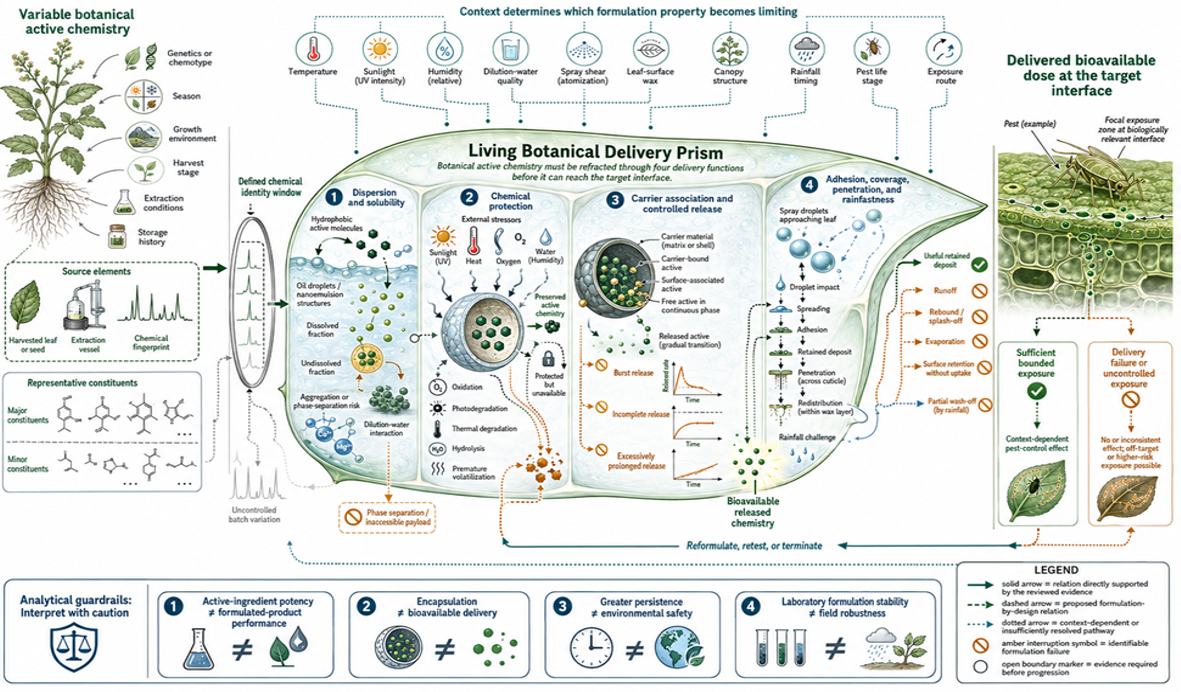
Botanical origin is particularly weak as a safety surrogate when formulations alter persistence or biological availability. Sublethal azadirachtin exposure caused multiple detrimental effects in a non-target insect model, demonstrating that apparently natural provenance does not remove the need for product-specific toxicological interpretation [26]. Encapsulation can lower the immediately free fraction while extending exposure duration; increased adhesion can reduce runoff while prolonging contact on foliage; and improved solubility can increase homogeneous target delivery while also increasing transport into water. Greater persistence is therefore not equivalent to environmental safety. Figure 1 shows the relationship between active chemistry and delivery design within the analytical logic developed in this section.
|
|
|
Figure 1. The relationship between active chemistry and delivery design |
Alt text
A structured conceptual diagram that shows the relationship between active chemistry and delivery design, with labelled components, directional relations, contextual modifiers, uncertainty points, and a clear boundary between observed evidence and proposed synthesis.
Proposed formulation-by-design strategy
The proposed strategy begins by defining the botanical product identity and diagnosing the dominant delivery failure before selecting a carrier. Nanoencapsulation research indicates that carrier selection should be tied to a named instability, transport, release, or manufacturing problem rather than treated as a generic efficacy upgrade [27-29]. The required sequence is: establish a reproducible chemical identity; define the target organism, life stage, and exposure pathway; identify whether performance is limited primarily by dispersion, volatilization, degradation, deposition, penetration, wash-off, or insufficient exposure duration; and select formulation attributes capable of correcting that limitation. The relationship is conditional because one carrier may protect an active while restricting release, and one property may improve delivery in one environment while increasing non-target exposure in another.
The second stage maps the complete environmental journey of the formulated product. This requires separate hypotheses for the material in storage, after dilution, during atomization, within the wet droplet, in the dried deposit, after weathering, at the target interface, and in non-target compartments. Broad reviews of nanoencapsulated essential oils emphasize that scalable manufacture and application-specific validation remain unresolved even when chemical protection and controlled release appear promising [30]. A critical synthesis of nano-bioformulations likewise supports keeping efficacy, environmental exposure, beneficial-organism effects, and long-term safety as independent criteria rather than collapsing them into a single readiness judgment [31].
The final stage converts the exposure hypothesis into explicit development gates. A candidate should proceed only when its botanical identity is reproducible, the dominant delivery failure is supported by evidence, the selected carrier has a causal role, release is sufficient but bounded, deposit performance matches the target surface, and relevant environmental and non-target pathways have been investigated. Failure at any gate should trigger redesign or termination rather than automatic escalation to more complex formulation. Validation must compare the unformulated active, carrier-only control, complete formulation, and relevant co-formulants under chemical, physical, biological, and environmental endpoints.
Translation and regulatory implications
Translation requires the formulated product to become a reproducible evidentiary object. Differences among major crop-growing regions show that scientific promise does not move automatically into commercial availability under divergent authorization systems, product categories, and data expectations [32-34]. Botanical complexity intensifies this challenge because raw-material variation, multi-constituent chemistry, carrier attributes, free-active fractions, degradation products, and release behavior may all influence the identity of the material being tested. Progress should therefore be demonstrated through validated chemical fingerprints, marker-constituent ranges, manufacturing controls, representative batch testing, and stability studies that distinguish shelf life, dilution behavior, deposit behavior, and environmental transformation.
A second priority is to align pivotal efficacy studies with exposure and safety evidence. The formulation used in target testing should be chemically and physically comparable to the formulation used in environmental-fate, residue, and non-target studies. Otherwise, the data package may describe several related prototypes rather than one product. Evidence of progress would include constituent-resolved recovery through preparation and application, batch comparability after scale-up, release measurements under use-relevant conditions, and non-target studies based on plausible routes and durations. Regulatory and governance interpretation should remain proportionate: the proposed strategy does not determine legal sufficiency, approve a product, or replace jurisdiction-specific assessment.
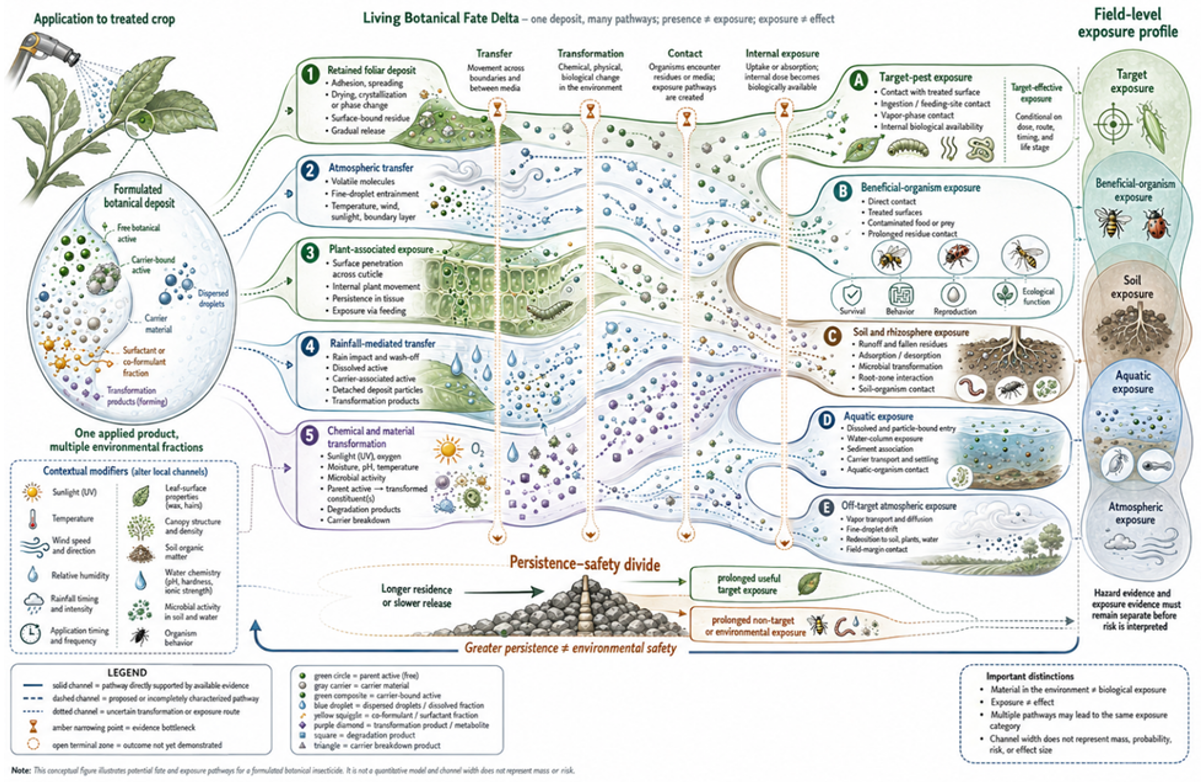
The highest implementation priority is early integration rather than late correction. Regional experience with botanical biopesticides indicates that standardization, formulation, evidence quality, regulation, and commercial feasibility must align before promising chemistry becomes a usable product [35]. Development programmes should therefore establish decision gates before extensive efficacy optimization: Is the botanical source reproducible? Is the delivery failure identified? Does the carrier correct that failure? Is the released chemistry measurable? Does persistence remain bounded? Are environmental compartments and non-target functions represented? Can manufacturing preserve the critical product attributes? Evidence that these questions have been answered would support progression, whereas unresolved product identity, inaccessible payload, uncontrolled persistence, or uncharacterized ecological exposure should trigger redesign or termination. Figure 2 maps the environmental fate pathways that determine field-level exposure within the analytical logic developed in this section.
|
|
|
Figure 2. The environmental fate pathways that determine field-level exposure |
Alt text
A structured conceptual diagram that maps the environmental fate pathways that determine field-level exposure, with labelled components, directional relations, contextual modifiers, uncertainty points, and a clear boundary between observed evidence and proposed synthesis.
CONCLUSION
Botanical insecticide formulation-by-design should be understood as the disciplined construction of a reproducible and environmentally bounded exposure pathway. Active chemistry is indispensable, but potency alone cannot determine whether a botanical product will disperse, survive application, form an appropriate deposit, reach the target, withstand relevant stress, and avoid disproportionate non-target exposure. Encapsulation can protect a payload but does not prove bioavailable delivery; extended persistence can support residual control but does not establish environmental safety; and stability under laboratory storage does not establish robustness after dilution, spraying, deposition, weathering, or biological contact. The strongest defensible synthesis is therefore that formulation must begin with controlled chemical identity and a diagnosed delivery failure, proceed through mechanism-linked carrier and release decisions, and remain subject to separate efficacy, fate, safety, manufacturing, and translation gates. This synthesis is proposed rather than validated, and its transferability remains conditional on botanical source, target species, life stage, application route, environmental setting, and evidence quality. The highest-priority implication is to replace formulation-by-fashion with prospective, failure-oriented design supported by chemical mass balance, realistic deposit testing, exposure-relevant non-target assessment, and explicit redesign or stopping decisions.
ACKNOWLEDGMENTS: None
CONFLICT OF INTEREST: None
FINANCIAL SUPPORT: None
ETHICS STATEMENT: None