Entomology and
Applied Science Letters
Applied Science Letters
 2025
Volume 12
Issue 1
2025
Volume 12
Issue 1

Botanical insecticides offer chemically diverse starting points for insect control, but evidence of plant-derived bioactivity frequently fails to mature into reproducible, safe, and registrable bioproducts. The central problem is not a shortage of promising plants; it is the fragmentation of evidence across source selection, chemical identity, mechanism, standardization, formulation, stability, non-target assessment, and regulatory translation. This original scoping review maps those evidence domains and examines where apparently continuous development pathways contain non-equivalent evidentiary steps. The review uses predefined questions and boundaries to chart recent peer-reviewed evidence by material type, biological scale, study design, translation stage, inferential strength, and principal limitation. The synthesis indicates that ethnobotanical knowledge and laboratory screening can prioritize candidates, while chemical profiling, fraction or constituent testing, and target-oriented experiments can progressively strengthen attribution. However, crude-extract activity does not establish an identified active principle, and mechanistic plausibility does not by itself establish reproducible product performance. Likewise, formulation can improve delivery or persistence while simultaneously changing exposure and safety requirements. The literature is limited by heterogeneous materials and assays, mortality-centred endpoints, incomplete provenance and chemotype reporting, laboratory dominance, and sparse linkage between chemical specifications and retained efficacy under realistic conditions. A defensible development strategy therefore requires stage-gated evidence in which botanical identity, quantitative chemistry, biological performance, formulation behaviour, non-target effects, and regulatory requirements are evaluated as connected but distinct constructs. Reliable botanical bioproducts will depend less on accumulating additional activity reports than on producing interoperable evidence that supports reproducibility, bounded claims, and transparent decisions at each translation stage.
INTRODUCTION
Plants remain a major source of structurally and functionally diverse compounds with potential value in insect management, yet the developmental significance of a positive bioassay is easily overstated. Candidate extracts may vary with taxonomy, plant part, provenance, harvest conditions, extraction procedure, storage, and test system, while laboratory exposure can bear little resemblance to application in crops or stored commodities. The central development problem is not discovering plant activity but converting variable laboratory findings into reproducible products that function under farming conditions [1]. This translation problem requires a chain of evidence that connects the tested botanical material to an intended use, measurable chemical attributes, reproducible biological performance, feasible delivery, and decision-relevant safety.
Source discovery is often informed by traditional use, farmer practice, local availability, or ecological observation. Such knowledge can improve the relevance and efficiency of candidate selection, especially where locally available pesticidal plants are already embedded in pest-management practice. Ethnobotanical use can improve source prioritization, but customary preparation alone does not establish composition, dose, safety or product reproducibility [2]. The same plant name can conceal distinct chemotypes and processing histories, and a locally effective preparation may not be transferable across seasons, locations, pest stages, or production systems. Use history should therefore be treated as contextual evidence for prioritization rather than as validation of a standardized intervention.
Commercial precedents demonstrate that botanical origin is compatible with durable crop-protection products, but they also show that success depends on coordinated development rather than on biological activity alone. The persistence of pyrethrum- and neem-based products shows that botanical insecticides can succeed, but only when chemistry, formulation, efficacy, safety and regulation are aligned [3]. These requirements are cumulative: an extract can be biologically active yet chemically unstable; a defined constituent can have a plausible target yet lack an acceptable delivery profile; and a formulation can be technically feasible while remaining unsuitable for regulatory submission, economical manufacturing, or farmer use. Formulation feasibility is therefore not equivalent to regulatory or commercial readiness.
The available literature does not distribute evidence evenly across this pathway. Discovery studies and short-duration laboratory assays are common, whereas longitudinal batch characterization, stability-linked potency testing, realistic exposure assessment, and documentation of failed translation are comparatively limited. The evidence base is vulnerable to publication bias, heterogeneous methods and overrepresentation of laboratory mortality endpoints, which limits translation-oriented inference [4]. This scoping review consequently asks what recent evidence establishes, leaves uncertain, or contradicts across discovery, chemical characterization, mechanistic verification, standardization, formulation, storage stability, non-target safety, and regulatory translation. Its central argument is that plant-to-product development should be evaluated as a sequence of connected but non-equivalent evidence transitions, with claims bounded by the material tested, organism and life stage, exposure context, analytical method, and development stage.
Scoping review questions and evidence boundaries
The review was structured to map concepts, evidence classes, translation stages, and unresolved gaps rather than to calculate a pooled estimate of insecticidal effectiveness. It asked how botanical sources were selected; how crude materials, fractions, essential oils, purified constituents, and formulated products were defined; what evidence linked chemistry to phenotype or target; how standardization and stability were evaluated; how non-target effects were tested; and which barriers separated laboratory discovery from product registration and adoption. The review will report its questions, eligibility boundaries, information sources, selection logic and charting procedures in accordance with scoping-review reporting guidance [5]. These reporting elements improve transparency, but they do not replace source-level assessment of material identity, exposure realism, controls, endpoint relevance, and inferential limits.
A scoping design is appropriate because the objective is to map evidence classes, translation stages and gaps rather than estimate a pooled treatment effect [6]. Eligible evidence comprised peer-reviewed laboratory, field, chemical, mechanistic, formulation, ecotoxicological, and translation-oriented journal articles, together with rigorous reviews, perspectives, and meta-research that supported a specific analytical claim. The biological boundary covered plant-derived materials intended for agricultural or stored-product insect control and relevant beneficial arthropods. Human pharmacology, antimicrobial-only studies, undefined plant preparations, and sources lacking insect-control relevance were excluded. Crude extracts, fractions, essential oils, purified compounds, and finished formulations were charted as distinct interventions; mortality, behavioural effects, mechanism, chemical reproducibility, stability, non-target effects, and translation outcomes were likewise treated as separate outcome constructs.
Search logic combined botanical-material terms with insect targets and terms for discovery, screening, characterization, mechanism, standardization, formulation, stability, ecotoxicology, regulation, or commercialization. A core PubMed search was supplemented by article-level DOI, journal, and claim verification. Title and abstract relevance was followed by full-text or full-metadata assessment, and a source was retained only when its design, context, limitation, and exact manuscript use could be charted. Evidence was classified as observation, mechanistic evidence, model-based inference, contextual support, proposed synthesis, or decision implication; no pooled risk-of-bias score was assigned. Instead, limitations were recorded for each source and synthesized across domains, with particular attention to publication bias, laboratory dominance, material ambiguity, unrealistic exposure, and surrogate-outcome inflation. The review questions, eligibility boundaries, search and screening logic, evidence-classification rules, and bias controls are specified in Table 1.
Table 1. Scoping Review Questions and Evidence Boundaries: Review Questions, Eligibility Boundaries, Search Logic, Screening Rules, Evidence Classification, and Bias Controls
|
Review-method element |
Operational definition |
Inclusion rule |
Exclusion rule |
Search or screening implementation |
Evidence-classification rule |
Bias-control measure |
Reporting requirement |
|
Review questions and constructs |
Map what evidence establishes, leaves uncertain, or contradicts across discovery, chemistry, formulation, safety, and translation. |
Evidence must support a named question and translation stage. |
Topically adjacent evidence without a claim-specific role. |
Assign each retained source to a predefined domain and exact manuscript claim. |
Separate direct evidence, qualified support, contextual support, and synthesis. |
Prevent substitution of activity for product readiness. |
State the construct, context, inferential level, and boundary of each claim. |
|
Biological and use-system boundary |
Plant-derived insecticidal materials for agricultural or stored-product pests, including relevant beneficial organisms. |
Defined pest or non-target organism, life stage, crop or commodity, and use setting. |
Human pharmacology, antimicrobial-only evidence, or no insect-control relevance. |
Screen for biological system, use case, and exposure route. |
Treat organism-, stage-, and system-specific findings as bounded. |
Avoid cross-species and cross-setting generalization. |
Report organism, life stage, setting, and exposure context. |
|
Intervention boundary |
Crude extracts, fractions, essential oils, purified constituents, and formulations are distinct test materials. |
Material identity, preparation, exposure, and comparator are sufficiently described. |
Undefined extracts or exposures that prevent interpretation. |
Chart the exact material and processing step tested. |
Do not pool or equate unlike intervention classes. |
Flag material ambiguity and missing provenance. |
Name what was tested rather than using “botanical” as a uniform category. |
|
Outcome boundary |
Bioactivity, chemical identity, mechanism, stability, safety, and translation are separate constructs. |
Endpoint and measurement context permit qualitative interpretation. |
Promotional statements or unsupported inference. |
Extract endpoint, time scale, method, and biological scale. |
Observation is not mechanism; efficacy is not operational effectiveness. |
Flag mortality-only and surrogate-endpoint dependence. |
Report what the endpoint can and cannot establish. |
|
Eligible evidence designs |
Laboratory, field, chemical, mechanistic, formulation, and ecotoxicological studies, plus rigorous syntheses and meta-research. |
Peer-reviewed journal evidence within the predefined recent window and with verifiable metadata. |
Non-peer-reviewed sources, unverifiable records, or designs without claim-relevant information. |
Screen article type, design, DOI, journal standing, and claim fit. |
Weight inference by design rather than article label alone. |
Balance primary studies with methodological and translation-oriented evidence. |
Identify design-specific limitations in the text. |
|
Search concept blocks |
Botanical material AND insect target or use AND one or more translation-stage concepts. |
Meaningful combinations of system, intervention, outcome, and evidence type. |
Repetition of disconnected title terms. |
Use a core PubMed query spanning discovery to commercialization, followed by article-level verification. |
Search relevance does not establish evidential relevance. |
Guard against low precision, low recall, and confirmation-driven selection. |
Report resources, search logic, filters, and verification procedures. |
|
Screening and conflict resolution |
Progress from relevance screening to full claim-fit assessment. |
A specific supported sentence, context, and limitation can be assigned. |
Keyword similarity without extractable support. |
Retain uncertain records only after claim-level verification; document exclusion reasons. |
Classify support as direct, qualified, or contextual. |
Do not retain a source solely because it supports the preferred argument. |
Make selection decisions reproducible and auditable. |
|
Evidence classification |
Distinguish observation, mechanism, model-based inference, synthesis, and decision implication. |
Inferential level can be identified from design and endpoint. |
Claims that collapse association, mechanism, and product performance. |
Chart design, endpoint, scale, and causal basis. |
Use calibrated causal and translational language. |
Require explicit boundaries for extrapolation. |
Label proposed relations as synthesis rather than validation. |
|
Quality and bias appraisal |
Chart design limitations without producing an invented aggregate score. |
Every source has an identified limitation and strength of inference. |
Unqualified reliance on authors’ conclusions. |
Assess controls, material identity, exposure realism, analytical specificity, and endpoint relevance. |
Confidence remains domain- and claim-specific. |
Synthesize publication bias, laboratory dominance, and reporting weaknesses. |
Report residual uncertainty rather than treating absent evidence as no effect. |
Botanical source selection and bioactivity discovery
Botanical source selection is most informative when it is tied to an intended pest-management use rather than driven only by taxonomic novelty or ease of access. Ethnobotanical records, farmer practice, ecological signals, and local supply can identify plausible candidates, but reproducible discovery additionally requires authenticated species, defined plant part, provenance, harvest context, processing, and a defensible comparator. Field experiments show that selected pesticidal-plant extracts can suppress crop pests under realistic management, although preparation variability prevents treating those extracts as standardized products [7]. Such evidence strengthens use relevance because it moves beyond isolated laboratory exposure, yet its transferability remains conditional on crop, pest complex, season, preparation, and local practice. Field performance of a farmer-prepared extract is therefore evidence for a bounded intervention, not proof that all preparations from the same species are chemically or biologically equivalent.
Bioactivity-guided discovery should progressively reduce uncertainty about both the tested material and the origin of its effects. Initial assays can compare crude extracts or oils under controlled exposure, after which chemical profiling and fraction or constituent testing can investigate whether activity tracks a reproducible chemical feature. Coupling essential-oil profiling with bioassays narrows candidate chemistry, but activity of a characterized mixture is not equivalent to identification of a causal active principle [8]. A chromatographic profile defines the material more precisely than a plant name alone, but correlations between abundant peaks and mortality may reflect co-variation, minor constituents, synergy, antagonism, or matrix effects. Chemical fingerprints should consequently be interpreted as reproducibility tools and hypothesis generators unless activity is retained through fractionation, depletion, recombination, or direct testing of authenticated compounds.
Component-level assays provide a stronger bridge from phenotype to chemical attribution, although they still operate within species-, life-stage-, dose-, and exposure-specific boundaries. Testing major constituents separately can distinguish broad mixture activity from component-associated effects, while also showing that potency may vary among pest species [9]. Conversely, accessible screening of aqueous or otherwise farmer-compatible preparations can identify candidates relevant to local management even when their chemistry remains incompletely resolved. Bioactivity-guided screening of farmer-accessible plants can prioritize candidates against fall armyworm, but crude-extract activity remains preparation- and context-bound [10]. The strongest discovery programmes therefore combine practical relevance with analytical traceability: they retain information on mixture effects, use controls that distinguish solvent and handling artefacts, and predefine the evidence needed before a candidate advances from promising source to chemically specified development material.
Chemical characterization and mechanistic verification
Chemical characterization answers what material was tested; mechanistic verification addresses how that material may produce a biological effect. These tasks are connected but not interchangeable. Reliable characterization should move from authenticated botanical source and processing history to fit-for-purpose fingerprints, quantitative markers, reference-standard confirmation, and batch information. Pyrethrum illustrates that reliable botanical development depends on defining biosynthetic origin, extraction effects, analyte identity and quantitative determination rather than relying on plant name alone [11]. The appropriate analytical depth depends on the claim: a discovery screen may require a reproducible fingerprint, whereas standardization or registration requires quantitative specifications linked to biological performance and degradation. A list of tentatively identified peaks is not a product specification, and chemical consistency alone does not establish biological equivalence.
Mechanistic evidence becomes more causally informative as it moves from broad phenotypes toward direct perturbation of a defined target, while retaining organism-level relevance. Behavioural avoidance, feeding inhibition, developmental disruption, physiological stress, tissue injury, biochemical change, and target-level activity occupy different evidentiary levels. Target-level electrophysiology with purified pyrethrins provides stronger mechanistic evidence than whole-extract mortality because it directly tests modulation of insect sodium channels [12]. Even this direct target evidence remains bounded by the purified compounds, expressed channel, and heterologous assay; it does not reproduce absorption, metabolism, mixture interactions, formulation, or field exposure in a whole insect. Mechanistic verification should therefore be described as a graded chain of evidence rather than a binary designation.
Species and assay context further constrain mechanistic generalization. Mechanistic claims should remain species-specific because even closely related drosophilids can differ in behavioral and physiological responses to the same plant volatiles [13]. Multi-endpoint studies can reduce reliance on a single mortality measure by connecting chemical profiles with deterrence, toxicity, physiology, or tissue effects. Combining oviposition behavior, toxicity and histological observations strengthens mechanistic plausibility, but tissue damage remains associative unless a causal molecular target is independently verified [14]. Accordingly, proposed mechanisms should be labelled by evidential level, computational or histological findings should be presented as hypotheses unless experimentally resolved, and mixture-versus-component uncertainty should remain explicit. Chemical identity supports reproducibility, while target-oriented evidence supports causal explanation; neither alone establishes a standardized, safe, or operationally effective bioproduct.
Standardization, formulation, and storage stability
Standardization begins before formulation because a delivery system cannot compensate for an undefined or unstable active material. Botanical provenance, plant part, harvest conditions, extraction procedure, chemical fingerprint, quantitative markers, impurities, and baseline biological performance should be documented before formulation comparisons are interpreted. Nanoemulsification can enhance delivery of anise essential oil and laboratory activity, but formulation feasibility remains distinct from shelf-life, field effectiveness, and registration evidence [15]. Apparent formulation gains may reflect improved dispersion, altered contact, surfactant effects, or changes in exposure rather than an inherent increase in active-compound potency. Comparative studies should therefore include the unformulated active material, blank carrier, suitable conventional comparator, and a consistent bioassay capable of tracking potency across production batches.
Formulation also changes the unit for which safety and performance must be demonstrated. Encapsulation, nanoemulsification, inclusion complexes, and other delivery systems may alter droplet size, release, persistence, penetration, environmental transport, and organism exposure. Formulation is part of the hazard and exposure profile: pyrethrum nanocarriers require product-specific bee assessment rather than safety inference from botanical origin [16]. A carrier that increases target exposure may also increase exposure among pollinators, predators, aquatic organisms, or handlers. Consequently, formulation characterization should extend beyond particle size or encapsulation efficiency to include release behaviour, carrier controls, active loading, batch reproducibility, and changes in target and non-target effects. Natural origin is not equivalent to non-target safety, and greater delivery efficiency cannot automatically be interpreted as greater sustainability.
Storage stability requires linked chemical and biological measurements because initial activity does not establish retained product performance. Volatile and oxidation-prone constituents may be affected by light, oxygen, temperature, humidity, packaging, and interactions with carriers or co-formulants. Controlled-delivery systems may mitigate volatility, degradation, and poor persistence, but sustainability claims require concurrent evaluation of carrier fate, exposure, and non-target effects [17]. Similarly, cyclodextrin inclusion can improve essential-oil delivery, yet in silico target predictions remain hypotheses until confirmed by biochemical or physiological experiments [18]. Accelerated and real-time storage studies should therefore track marker compounds, degradation products, physical properties, release behaviour, and retained bioactivity under predefined conditions. Initial encapsulation efficiency is not equivalent to storage stability, and formulation feasibility is not equivalent to regulatory or commercial readiness. The evidence dimensions and interpretive boundaries for standardization formulation and storage stability are summarized in Table 2.
Table 2. Standardization, Formulation, and Storage Stability: Chemical Identity, Mechanism, Standardization, Formulation, Safety, Resistance, and Translation Requirements
|
Candidate or product factor |
Chemical or biological basis |
Required characterization |
Potential contribution |
Formulation implication |
Safety implication |
Resistance implication |
Development boundary |
|
Botanical raw material |
Species, chemotype, plant part, provenance, harvest, and processing determine starting composition. |
Voucher identity, source history, plant part, harvest conditions, extraction procedure, and batch fingerprint. |
Improves traceability and reduces uncontrolled input variation. |
Undefined raw material prevents meaningful formulation comparison. |
Known use history can guide testing but cannot establish safety. |
Variable mixtures may alter selection pressure unpredictably. |
A potent source is not automatically a scalable or reproducible input. |
|
Chemical identity |
Active constituents, marker compounds, impurities, and degradants define the tested material. |
Validated fingerprinting, reference-standard confirmation, quantitative markers, and impurity or degradation profiles. |
Supports reproducibility, quality control, and causal interpretation. |
Formulation should preserve the relevant chemical specification. |
Product-specific hazards may arise from minor constituents or degradants. |
Mechanistic diversity cannot be assumed from chemical complexity alone. |
A chromatographic profile is not equivalent to a validated product specification. |
|
Mechanistic evidence |
Behavioural, physiological, biochemical, histological, or target-level effects explain activity at different evidential levels. |
Orthogonal organism- and target-level tests appropriate to the claim. |
Supports candidate differentiation and resistance hypotheses. |
Delivery may change which mechanism dominates at the achieved exposure. |
Mechanism may identify hazards but does not replace toxicity assessment. |
Defined targets can inform cross-resistance assessment. |
In silico or tissue evidence alone does not validate a molecular target. |
|
Standardization strategy |
Controlled composition and biological performance permit lot comparison. |
Marker ranges, manufacturing controls, potency assay, and predefined acceptance criteria. |
Reduces batch-to-batch uncertainty. |
Finished-product specifications should include carrier and active attributes. |
Consistent composition enables reproducible exposure assessment. |
Stable composition permits more interpretable resistance monitoring. |
Fixed marker content does not automatically establish biological equivalence. |
|
Nanoemulsion or nanocarrier |
Dispersion, release, penetration, and persistence may change delivered dose. |
Droplet or particle properties, loading, release profile, blank-carrier control, comparative bioactivity, and batch reproducibility. |
May improve delivery of poorly soluble or volatile materials. |
Benefits must be demonstrated against unformulated active and suitable benchmarks. |
Increased delivery may increase target and non-target exposure. |
Prolonged exposure could alter selection intensity. |
Carrier novelty is not evidence of field effectiveness, shelf life, or safety. |
|
Inclusion complex |
Host–guest interaction can alter volatility, solubility, or release. |
Complex confirmation, loading, release, comparative bioactivity, and retained chemistry. |
May protect volatile constituents and improve handling. |
Performance should be tested under realistic environmental conditions. |
Carrier and altered exposure require product-level assessment. |
Changed release may modify exposure duration. |
Improved delivery does not validate computationally proposed targets. |
|
Storage stability |
Light, oxygen, temperature, moisture, packaging, and carrier interactions can change composition and potency. |
Accelerated and real-time studies linking chemistry, physical stability, degradants, and retained bioactivity. |
Establishes whether specifications remain valid through storage. |
Packaging and formulation should be evaluated as an integrated system. |
Degradation products may require separate consideration. |
Declining or uneven dose can create inconsistent selection pressure. |
Initial activity or encapsulation efficiency is not equivalent to shelf life. |
|
Finished-product safety |
Risk depends on the active material, carrier, co-formulants, route, timing, and exposed organism. |
Product-specific lethal, sublethal, behavioural, and exposure-relevant tests. |
Prevents safety claims based solely on botanical origin. |
Safety testing must follow the final formulation where feasible. |
Delivery systems can change environmental distribution and organism exposure. |
Safety-driven dose restrictions may affect resistance-management options. |
Safety of the source does not establish safety of the formulation. |
|
Translation specification |
Chemistry, potency, stability, safety, manufacturing, and intended use must remain mutually compatible. |
Dossier-compatible methods, scalable production controls, use-pattern evidence, and documented uncertainty. |
Supports decisions about advancement, reformulation, or discontinuation. |
Formulation should satisfy an intended product profile, not only laboratory novelty. |
Safety requirements must be incorporated before late-stage investment. |
Mode-of-action and use-pattern evidence should inform stewardship. |
Formulation feasibility is not equivalent to regulatory or commercial readiness. |
Non-target safety and regulatory evaluation
Non-target safety is a product- and exposure-specific property rather than an attribute conferred by botanical origin. Relevant assessment begins by distinguishing intrinsic hazard from exposure and by identifying organisms likely to encounter the material through spray, residue, contaminated food, soil, water, drift, or treated commodities. Comparative assays show that pest activity and predator selectivity are separable properties, so efficacy cannot serve as a proxy for ecological safety [19]. Early screening against predators, parasitoids, pollinators, and other beneficial organisms can remove broadly toxic candidates before extensive formulation investment. Nevertheless, a favourable result for one species, life stage, route, or acute endpoint cannot establish community-level safety or exclude chronic, reproductive, behavioural, developmental, or mixture effects.
Field observations can strengthen ecological relevance by integrating pest suppression, crop response, beneficial insects, preparation, and local management, but they remain bounded by site and use pattern. Field evidence can integrate pest suppression, yield, product quality, and beneficial-insect observations, but such outcomes remain conditional on crop, location, preparation, and exposure [20]. Low observed harm may reflect limited exposure, application timing, avoidance, environmental dissipation, or insufficient sensitivity rather than intrinsic selectivity. Conversely, laboratory hazard may overpredict field risk where realistic exposure is low. Interpretation should therefore combine effect and exposure evidence while preserving differences among crude extracts, purified constituents, and finished formulations.
Chemical specificity improves hazard attribution but does not complete regulatory evaluation. Even when insecticidal activity is assigned to named constituents, target-pest toxicity does not establish non-target safety, acceptable exposure, or regulatory suitability [21]. Bee evidence contradicts the assumption that botanical origin guarantees benign non-target effects, particularly when species, formulation, dose, and exposure route differ [22]. Regulatory evaluation consequently requires a defined product identity, manufacturing controls, efficacy evidence, toxicology, ecotoxicology, exposure characterization, storage information, and an intended use pattern appropriate to the jurisdiction. The relevant unit is the marketed formulation, including impurities, carriers, co-formulants, and degradants. A review can identify these evidence requirements and gaps, but it cannot infer registration, approval, acceptable risk, or compliance for an individual product.
Translation bottlenecks from extract to registered product
Plant-to-product translation is a cumulative attrition process rather than a continuous extension of laboratory bioactivity. A candidate may fail because its source cannot be authenticated or supplied consistently, activity cannot be reproduced across batches, causal chemistry remains unresolved, formulation is unstable, non-target effects are unacceptable, manufacturing is impractical, or the intended market cannot support development. Natural-product commercialization is an attrition process in which biological promise can fail at manufacturing, formulation, toxicology, regulation, cost, or market adoption [23]. Because unsuccessful candidates are less visible in published literature, discovery success is systematically easier to observe than developmental failure. Translation-oriented research should therefore define stage-specific advancement criteria and record why candidates are reformulated, redirected, or discontinued.
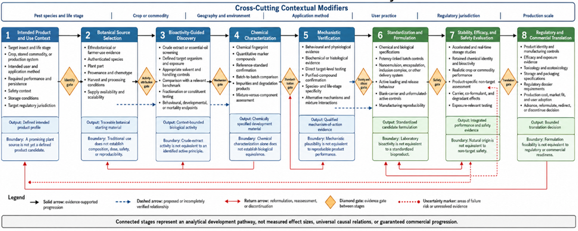
The pathway should begin with an intended product profile that connects pest, crop or commodity, user, application method, performance requirement, safety context, storage condition, and target jurisdiction. Discovery, characterization, mechanism, standardization, formulation, safety, and regulatory planning then provide distinct decisions rather than interchangeable demonstrations of promise. Botanical substitution is constrained by variable composition, limited persistence, formulation needs, user practices, and regulatory requirements rather than efficacy alone [24]. Figure 1 maps the plant-to-product translation pathway within the analytical logic developed in this section.
|
|
|
Figure 1. The plant-to-product translation pathway |
Alt text
A structured conceptual diagram that maps the plant-to-product translation pathway, with labelled components, directional relations, contextual modifiers, uncertainty points, and a clear boundary between observed evidence and proposed synthesis.
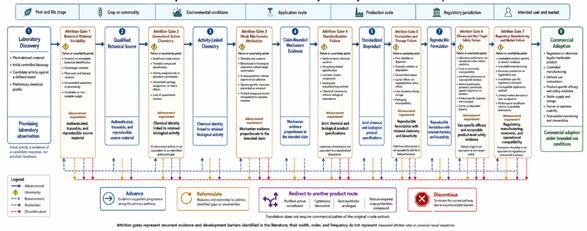
Translation does not require every candidate to remain an unchanged crude extract. A promising natural molecule may reach crop protection through optimization or synthetic inspiration rather than direct commercialization of the original extract [25]. Translation requires simultaneous optimization of potency, selectivity, physicochemical properties, manufacturability, and use pattern, which explains why discovery success alone is an insufficient predictor [26]. Extract-based, purified-active, semisynthetic, and nature-inspired routes should therefore be compared according to the intended use rather than ranked by perceived naturalness. Major attrition points arise where evidence fails to connect across stages: activity without chemical identity, identity without scalable supply, mechanism without realistic performance, formulation without stability, efficacy without safety, and technical feasibility without regulatory or economic viability. Figure 2 illustrates the major attrition points between laboratory discovery and commercial adoption within the analytical logic developed in this section.
|
|
|
Figure 2. The major attrition points between laboratory discovery and commercial adoption |
Alt text
A structured conceptual diagram that illustrates the major attrition points between laboratory discovery and commercial adoption, with labelled components, directional relations, contextual modifiers, uncertainty points, and a clear boundary between observed evidence and proposed synthesis.
Scoping synthesis and development priorities
The strongest convergent finding is that botanical materials can generate biologically credible insect-control candidates, but translation depends on solving use-specific delivery and persistence problems. For aphid control, essential oils remain promising, but development priorities must address volatility, persistence, delivery, crop compatibility, and realistic field testing [27]. This boundary applies more widely: laboratory activity establishes a candidate response under defined conditions, not operational effectiveness across crops, environments, application methods, or pest stages. Development studies should therefore use suitable comparators, report the tested material precisely, and link laboratory endpoints to the intended use without treating mortality as a universal measure of product value.
Botanical identity must also be resolved at a level capable of explaining chemical and biological variability. Mentha-based evidence shows why botanical identity must include species, chemotype, plant part, harvest, and extraction conditions rather than a genus label alone [28]. Similar names can encompass chemically distinct materials, while processing and storage may create additional divergence. Source selection should consequently combine ethnobotanical relevance with voucher identification, provenance, supply feasibility, and fit-for-purpose chemical profiling. Where activity depends on mixtures, standardization may require several markers or a validated biological assay rather than reliance on one abundant compound.
Formulation research provides important tools for improving solubility, dispersion, protection, release, and persistence, but novelty of the carrier is not the relevant endpoint. Across essential-oil research, innovations in delivery are meaningful only when they improve reproducibility, realistic efficacy, storage behaviour, and safety together [29]. Comparative formulation studies should include the active material, blank carrier, appropriate benchmark, realistic exposure, stability-linked potency, and product-specific non-target assessment. Mechanistic claims based on modelling should be experimentally tested, while lifecycle questions concerning carrier fate, manufacturing, packaging, and disposal should be integrated before sustainability conclusions are made.
The most consequential gap is the mismatch between a large discovery literature and a comparatively thin body of interoperable translation evidence. The literature remains concentrated in selected phytochemical classes, pest taxa, and laboratory endpoints, producing a large discovery record but a thinner translation evidence base [30]. Priorities should therefore include preregistered or prospectively specified comparisons, negative-result reporting, batch-linked chemistry and potency, depletion or recombination tests for mixture attribution, real-time stability studies, relevant non-target species, and stage-gated development decisions. Stored-grain applications demonstrate that development priorities must be use-case specific, incorporating commodity quality, persistence, residue, scale-up, and storage conditions [31]. The convergent findings, context-dependent results, methodological limitations, and remaining uncertainties are synthesized in Table 3.
Table 3. Scoping Synthesis and Development Priorities: Convergent Findings, Context Dependence, Methodological Limitations, Evidence Confidence, and Residual Uncertainty
|
Evidence domain |
Convergent finding |
Contradictory or context-dependent finding |
Study-design basis |
Main methodological limitation |
Strength of inference |
Residual uncertainty |
Implication |
Representative supporting reference(s) |
|
Insecticidal plant discovery |
Many plants, extracts, and essential oils show activity under controlled conditions. |
Response varies by pest species, life stage, material, extraction, exposure, and endpoint. |
Laboratory screening and field-oriented studies. |
Positive-result bias, mortality-centred endpoints, and heterogeneous controls. |
Supports existence of candidate activity under defined conditions. |
Transferability to realistic use and repeatability across batches. |
Add standardized comparators and developability filters at discovery. |
[30] |
|
Botanical source selection |
Ethnobotanical knowledge and local use can improve candidate relevance. |
Customary use does not guarantee reproducible composition, safety, or efficacy. |
Reviews, local-use evidence, and field studies. |
Incomplete voucher, provenance, chemotype, and harvest reporting. |
Provides contextual support for prioritization. |
Generalizability across locations, seasons, and supply chains. |
Combine use history with authenticated identity and supply feasibility. |
[28] |
|
Bioactivity-guided discovery |
Fraction and constituent tests can narrow plausible active chemistry. |
Minor constituents, synergy, antagonism, or matrix effects can defeat simple attribution. |
Chemical profiling and component-level bioassays. |
Emphasis on major compounds and limited recombination testing. |
Stronger when retained activity follows fractionation and direct testing. |
Causal contribution of individual and interacting constituents. |
Use depletion, recombination, and orthogonal confirmation. |
[9] |
|
Chemical characterization |
Defined fingerprints and quantitative markers improve reproducibility. |
Profiles vary with chemotype, extraction, processing, and storage. |
Analytical studies and phytochemical reviews. |
Tentative identification and inconsistent quantitative validation. |
Direct for identity when authenticated standards and methods are used. |
Which marker ranges predict retained biological performance. |
Link chemical specifications to potency and degradation. |
[11] |
|
Mechanistic verification |
Purified-compound and target-level tests can strengthen causal inference. |
Behavioural, histological, physiological, and computational evidence vary in specificity. |
Electrophysiology, organism assays, histology, and modelling. |
Model-system extrapolation and biomarker overinterpretation. |
Claim-specific and strongest where target perturbation is directly demonstrated. |
Relevance to whole-insect exposure, mixtures, formulation, and field dose. |
Use a graded mechanistic hierarchy and validate computational hypotheses experimentally. |
[12] |
|
Standardization |
Reliable products require controlled composition and performance. |
A single chemical marker may not represent mixture-dependent activity. |
Reviews, analytical evidence, and formulation studies. |
Scarcity of longitudinal batch and potency-linked datasets. |
Strong conceptual basis with product-specific empirical limits. |
Acceptable chemical and biological variability ranges. |
Develop joint chemistry and potency specifications. |
[17] |
|
Formulation |
Delivery systems can improve dispersion, release, or protection of unstable constituents. |
The same changes may increase non-target exposure or carrier-related effects. |
Nanoemulsion, inclusion-complex, and ecotoxicological studies. |
Laboratory dominance, novelty bias, and limited benchmark comparisons. |
Supports formulation-specific effects under tested conditions. |
Scale-up, realistic performance, carrier fate, and finished-product safety. |
Require active, blank-carrier, benchmark, stability, and safety comparisons. |
[16] |
|
Storage stability |
Volatility, oxidation, light, temperature, and packaging can affect delivered dose. |
Initial physical stability may not predict retained biological activity or commercial shelf life. |
Formulation experiments and critical reviews. |
Short-duration studies and weak linkage between chemistry and potency. |
Supports degradation as a development constraint. |
Real-time shelf life and effects of degradants. |
Combine accelerated and real-time studies with chemical and biological assays. |
[29] |
|
Non-target safety |
Some materials can be selective under specific exposure conditions. |
Bee, predator, and formulation evidence shows product- and species-dependent harm. |
Comparative toxicity, field studies, and safety reviews. |
Limited taxa, acute endpoints, and exposure realism. |
Bounded to the tested organism, formulation, route, and endpoint. |
Chronic, reproductive, mixture, and community-level effects. |
Evaluate the finished product across relevant exposure routes and beneficial taxa. |
[22] |
|
Regulatory translation |
Product identity, manufacturing quality, efficacy, safety, exposure, and stability must converge. |
Evidence requirements differ by jurisdiction, use pattern, and product classification. |
Industry perspectives and translation-focused reviews. |
Limited access to proprietary dossiers and unsuccessful cases. |
Supports general evidence requirements, not individual approval conclusions. |
Comparative time, cost, and jurisdiction-specific evidence burdens. |
Define the intended jurisdiction and use early in development. |
[23] |
|
Commercial attrition |
Technical, supply, safety, regulatory, manufacturing, cost, and adoption constraints interact. |
A promising extract may be abandoned, reformulated, purified, or converted into an optimized derivative. |
Cross-domain and industry-oriented syntheses. |
Survivorship bias and underreporting of failed candidates. |
Supports multifactorial attrition without establishing exact attrition rates. |
Which constraints dominate for particular product classes and markets. |
Use stage-gated decisions and document negative or redirected development outcomes. |
[26] |
|
Application-specific translation |
Product requirements depend on crop or commodity, user, environment, storage, and application method. |
Evidence from one use system may not transfer to another. |
Use-focused reviews and application studies. |
Narrow system coverage and inconsistent operational endpoints. |
Strong for the need to bound claims by intended use. |
Transferability among field crops, protected systems, and stored products. |
Build product specifications around the intended operational context. |
[31] |
CONCLUSION
Botanical insecticide development is best understood as a chain of connected but non-equivalent evidence transitions. Plant use history and laboratory bioactivity can identify candidates, but crude-extract activity is not equivalent to an identified active principle. Chemical characterization and mechanistic experiments can strengthen reproducibility and causal attribution, but laboratory bioactivity is not equivalent to a standardized bioproduct. Formulation can improve delivery and persistence while changing exposure, and natural origin is not equivalent to non-target safety. Reliable translation therefore requires product-specific evidence linking botanical identity, quantitative chemistry, biological performance, manufacturing control, storage stability, non-target assessment, and intended use. The highest-priority shift is from accumulating isolated activity reports toward stage-gated, interoperable evidence that supports explicit advancement or discontinuation decisions. Such an approach will not eliminate biological, regulatory, or market uncertainty, but it can prevent promising observations from being mistaken for product readiness and can direct investment toward candidates whose chemistry, efficacy, safety, supply, and use context remain mutually compatible.
ACKNOWLEDGMENTS: None
CONFLICT OF INTEREST: None
FINANCIAL SUPPORT: None
ETHICS STATEMENT: None