Entomology and
Applied Science Letters
Applied Science Letters
 2026
Volume 13
Issue 2
2026
Volume 13
Issue 2

Entomological innovation is expanding the range of interventions available for vector control, including engineered genetic systems, microbial approaches, biological control, spatial repellents, and improved delivery technologies. However, scientific novelty frequently advances faster than the evidence and institutional arrangements needed to determine whether an intervention is technically robust, operationally feasible, ecologically governable, socially legitimate, and capable of producing durable population-level protection. This article develops an original, explicitly non-validated evidence-to-action pathway for evaluating entomological innovations before wider adoption. The approach integrates scientific and technical readiness, operational feasibility, scalability, ecological safeguards, social and institutional governance, failure detection, and post-deployment learning as distinct but connected decision domains. The central synthesis is that readiness cannot be represented by a single maturity label or inferred from success at an earlier evidentiary stage. Mechanistic function must be distinguished from technical reproducibility; technical reproducibility from scalable delivery; deployment from effective and equitably distributed protection; and readiness assessment from authorization by competent institutions. Evidence from genetic, microbial, behavioural, and conventional vector-control innovations further indicates that performance may vary with construct design, vector population, environmental exposure, logistics, coverage, programme capacity, and monitoring quality. The proposed pathway therefore uses conditional progression, explicit boundary conditions, predefined failure signals, and iterative learning rather than linear assumptions of technological advancement. Its limitations include heterogeneous intervention classes, uneven evidence maturity, context-dependent findings, and limited validation of cross-domain decision structures. Future research should test whether structured, domain-specific readiness assessments predict operational performance, identify emerging failure, strengthen governance accountability, and support reversible or adaptive adoption decisions.
INTRODUCTION
Vector control remains a central means of reducing vector-borne disease, but the contribution of any intervention depends on its fit with the target vector, transmission pathway, delivery environment, and public-health objective. Vector control remains indispensable to reducing vector-borne disease, but its contribution depends on intervention fit, delivery conditions, and the epidemiological objective being pursued [1]. The problem addressed here is therefore not whether innovation is needed, but how evidence about an innovation should be translated into decisions about further development, bounded testing, operational deployment, or wider adoption.
The emerging intervention landscape is heterogeneous. Microbial replacement, population suppression, behavioural modification, biological control, and other approaches differ in biological mechanism, persistence, infrastructure, and relationship to existing control programmes. Emerging mosquito-control strategies differ in mechanism, maturity, implementation burden, and dependence on existing control systems, so they cannot share a single evidentiary shortcut to adoption [2]. A result that supports one class of intervention may consequently be irrelevant or insufficient for another, particularly where interventions differ in reversibility, spatial reach, repeated-delivery requirements, or potential for autonomous persistence.
The translation problem begins before field implementation. Mechanistic discoveries can generate powerful intervention concepts, yet biological insight must be translated through evidence that the relevant mechanism persists under natural transmission conditions [3]. Laboratory effects may be sensitive to genetic background, life stage, environmental exposure, population structure, assay design, or interactions with pathogens and ecological communities. Observation of an intended biological effect therefore supports a bounded scientific claim; it does not by itself demonstrate a reproducible technical product, an operationally deliverable intervention, or a reduction in human exposure or disease.
Next-generation approaches combine substantial promise with intervention-specific pitfalls involving durability, ecological interaction, and delivery, making staged evaluation essential [4]. This article develops an evidence-grounded but non-validated scholarly pathway for that staged evaluation. Its central argument is that scientific novelty is not equivalent to technical readiness, technical readiness is not equivalent to scalable operational feasibility, successful deployment is not equivalent to population protection, and readiness assessment is not equivalent to authorization for wider adoption. These distinctions organize the subsequent analysis of the translation gap, readiness, feasibility, governance, monitoring, learning, and adoption.
The translation gap in entomological innovation
The translation gap emerges because intervention development, surveillance, implementation capacity, and public-health decision making often progress as separate activities rather than as one evidence chain [5]. Discovery programmes may optimize a mechanism without specifying its intended operational use, whereas control programmes may seek scalable products without access to evidence that explains how performance could fail. Translation improves when an innovation is developed against an explicit use case, target population, delivery system, and complementary role within an existing control portfolio [6]. The proposed synthesis therefore begins with a bounded problem definition and causal pathway rather than with the technological platform alone.
Context dependence is a second source of disconnection. Biological control illustrates how ecological plausibility may remain separated from routine use when delivery, persistence, regulation, and context-specific performance are insufficiently resolved [7]. Novel mosquito-control strategies occupy different positions along the discovery-to-use continuum, and their evidence requirements diverge according to mechanism, persistence, and delivery [8]. Accordingly, the proposed structure does not treat readiness as a single score. It organizes evidence into scientific, technical, operational, ecological, social, institutional, and learning domains, each of which can independently constrain progression.
The structure further separates intermediate outputs from final protection. For self-sustaining genetic control, the gap is especially consequential because genetic spread, entomological effect, epidemiological benefit, and governance oversight are distinct evidentiary stages [9]. The same logic applies, with intervention-specific modifications, to self-limiting and repeatedly delivered tools. Each stage requires defined inputs, expected outputs, uncertainties, failure modes, and evidence sufficient for the next decision. This organization is an original synthesis rather than a validated framework: its value must ultimately be tested by whether it improves evidence traceability, predicts operational difficulties, detects unsafe extrapolation, and supports decisions that can be revised when assumptions fail.
Scientific and technical readiness
Scientific readiness concerns whether the proposed mechanism is sufficiently supported under conditions relevant to the intended claim. It includes causal plausibility, reproducibility, alternative explanations, and sensitivity to biological variation. Scientific readiness must include tests for evolutionary failure because resistant alleles can arise and be selected across generations even when an engineered drive initially functions [10]. Complete cage-population suppression demonstrates biological capability under controlled conditions, but it does not establish equivalent performance in genetically and ecologically heterogeneous field populations [11]. These findings are not contradictory: one demonstrates that a construct can produce a strong controlled effect, whereas the other shows why durability cannot be inferred from initial function.
Technical readiness concerns whether a particular construct and its supporting production and measurement systems can reproduce the intended function. Alternative drive architectures may achieve suppression through different mechanisms, so readiness claims must be tied to the tested construct rather than generalized to gene drive as a class [12]. Technical readiness also requires construct-level evidence on inheritance, fitness, resistance, and cargo stability because population modification depends on more than drive frequency alone [13]. Relevant evidence may include identity, stability, quality-control performance, assay validity, environmental stress response, and reproducibility across genetic backgrounds. A platform name cannot substitute for evidence about the specific product configuration proposed for further testing.
Models can connect laboratory observations to larger spatial, seasonal, and epidemiological processes, but they cannot remove uncertainty through simulation alone. Model-based readiness evidence can connect genetic performance to seasonal, spatial, and epidemiological consequences, but its conclusions remain conditional on model structure and parameter validity [14]. Models are most useful when they expose assumptions, identify discriminating measurements, and compare plausible failure scenarios. They are less defensible when presented as independent confirmation of field performance. Scientific novelty therefore remains distinct from technical readiness, while both remain distinct from operational feasibility and regulatory authorization. The evidence dimensions and interpretive boundaries for scientific and technical readiness are summarized in Table 1.
Table 1. Scientific and Technical Readiness: Technical Evidence, Ecological Safeguards, Governance Requirements, Monitoring, Residual Risk, and Decision Boundaries
|
Decision stage or safeguard |
Evidence required |
Technical function |
Ecological function |
Governance requirement |
Failure or escape risk |
Monitoring or learning need |
Decision boundary |
|
Mechanism confirmation |
Replication and testing of causal alternatives |
Confirms that the intended mechanism produces the observed intermediate effect |
Tests sensitivity to relevant vector or pathogen conditions |
Transparent statement of intended claim and uncertainty |
Assay artefact or restricted biological background |
Repeat testing across relevant conditions |
Mechanistic support does not establish technical readiness |
|
Evolutionary robustness |
Multigenerational inheritance, fitness, and resistance evidence |
Tests persistence of the engineered function |
Identifies selection that may alter population response |
Predefined criteria for investigating resistance |
Resistant variants or loss of function |
Genotype and phenotype surveillance |
Initial function does not establish durable function |
|
Construct-specific performance |
Evidence tied to the exact architecture and product configuration |
Establishes reproducible construct behaviour |
Clarifies context dependence of mating, inheritance, or suppression |
Prevents class-wide claims from one construct |
Architecture-specific failure or fitness cost |
Construct-level comparison and replication |
Evidence for one design cannot validate an entire platform |
|
Modification integrity |
Inheritance, cargo stability, fitness, and functional-effect evidence |
Tests whether the drive and intended effector remain linked and active |
Examines whether ecological conditions could alter performance |
Defines acceptable uncertainty before further testing |
Cargo loss, resistance, or reduced fitness |
Joint surveillance of inheritance and function |
Inheritance alone is not evidence of transmission blocking |
|
Model-supported extrapolation |
Transparent structure, calibrated parameters, uncertainty analysis, and external comparison |
Connects component evidence across scales |
Represents seasonality, dispersal, and population structure |
Documentation of assumptions and decision use |
Structural error or invalid parameter transfer |
Update models with empirical observations |
Simulation does not constitute empirical validation |
|
Readiness integration |
Coherent scientific and technical dossier with unresolved gaps stated |
Combines mechanism, construct, production, and measurement evidence |
Identifies ecological conditions requiring later testing |
Independent review without implying authorization |
Strong evidence in one domain conceals a critical gap |
Maintain an explicit uncertainty register |
Readiness assessment does not authorize release or adoption |
Operational feasibility and scalability
Operational feasibility concerns whether a complete product–delivery configuration can reproduce meaningful effects in its intended programme and population. A cluster-randomized trial showed that operationalized wMel deployment can reduce dengue outcomes in a defined urban setting, providing stronger evidence than entomological establishment alone [15]. Quasi-experimental city deployment indicates that public-health benefit can coexist with heterogeneous Wolbachia establishment, making coverage and local implementation variation part of the effectiveness question [16]. Together, these findings support operational potential while showing that public-health outcomes, establishment, and implementation fidelity remain analytically distinct.
Scalability introduces conditions that may be absent or controlled during a pilot. Multi-city release experience shows that scaling is an adaptive operational process because establishment trajectories can differ across neighbourhoods despite a common intervention platform [17]. Scalability depends on mundane but decisive logistics because storage time and temperature can alter the quality of biological material before release [18]. Manufacturing volume is therefore an incomplete indicator of scale readiness. Supply-chain integrity, workforce capability, local ecology, release or distribution coverage, surveillance density, programme financing, and corrective capacity may all change as an intervention expands.
Operational evidence is also specific to the delivery mode. Operational feasibility must be assessed for the complete product–delivery configuration because effectiveness can depend on household use, coverage, housing, and local transmission conditions [19]. A weak field result may arise from biological failure, inadequate delivery, poor adherence, ecological mismatch, or insufficient surveillance, while successful delivery may still fail to produce population protection. Scalable feasibility should therefore be inferred only when technical quality, implementation reach, context-specific performance, monitoring capacity, and governance obligations can be reproduced across intended settings. The evidence dimensions and interpretive boundaries for operational feasibility and scalability are summarized in Table 2.
Table 2. Operational Feasibility and Scalability: Technical Evidence, Ecological Safeguards, Governance Requirements, Monitoring, Residual Risk, and Decision Boundaries
|
Decision stage or safeguard |
Evidence required |
Technical function |
Ecological function |
Governance requirement |
Failure or escape risk |
Monitoring or learning need |
Decision boundary |
|
Operational pilot |
Process, coverage, entomological, and health-outcome evidence |
Tests the complete intervention and delivery configuration |
Establishes performance in the intended transmission setting |
Defined responsibilities, permissions, and corrective options |
Trial support may exceed routine capacity |
Link implementation indicators to outcomes |
Trial efficacy is not universal effectiveness |
|
Heterogeneous implementation |
Spatially resolved establishment, coverage, and outcome evidence |
Identifies local variation in delivered performance |
Detects neighbourhood-level ecological differences |
Requires transparent handling of uneven coverage |
Aggregate results conceal local failure |
Compare zones and investigate divergence |
City-wide deployment does not mean uniform protection |
|
Multi-site expansion |
Reproducibility across sites, teams, and release histories |
Tests whether production and delivery remain consistent |
Evaluates spatial variation in establishment or effect |
Coordinates local institutions and communities |
Scale creates new context-specific failure modes |
Site-specific longitudinal surveillance |
Scaling is not multiplication of pilot size |
|
Supply-chain integrity |
Storage, transport, lot-quality, and point-of-release evidence |
Preserves biological-material quality before use |
Prevents environmentally induced loss before field exposure |
Assigns quality-control responsibility across the chain |
Temperature or time damages intervention material |
Pre-release quality testing and traceability |
Successful transport does not establish field performance |
|
User- and setting-dependent delivery |
Coverage, adherence, housing, and local transmission evidence |
Tests whether the product is used as intended |
Accounts for exposure conditions and vector behaviour |
Ensures accessible and acceptable delivery |
Low adherence or unsuitable settings reduce effect |
Combine use, exposure, and outcome indicators |
Product efficacy is not effective or equitable protection |
|
Scale-readiness decision |
Cross-site quality, cost, coverage, monitoring, and governance evidence |
Confirms reproducibility of the delivery system |
Defines ecological limits and variation |
Requires capacity for oversight, learning, and response |
Expansion outpaces surveillance or corrective capacity |
Sequential review before further expansion |
Technical readiness is not scalable operational feasibility |
Ecological, social, and institutional governance
Ecological, social, and institutional governance should not be treated as a final administrative checkpoint reached only after technical development has been completed. Governance must be treated as a system of interacting actors, rules, resources, and decision arenas rather than as an approval step appended after technical development [20]. Within the proposed synthesis, ecological governance defines the valued entities, spatial boundaries, temporal horizons, protection goals, and response options relevant to potential harm. Social governance concerns whose knowledge, interests, and lived exposure inform those choices. Institutional governance specifies which bodies possess the authority, capacity, resources, and accountability to evaluate evidence, impose conditions, detect non-compliance, and respond to changing circumstances. These components interact, but they cannot substitute for one another: technically sophisticated risk analysis cannot compensate for unclear authority, and broad consultation cannot compensate for absent ecological evidence.
Participation is especially vulnerable to conceptual reduction. Social governance requires empowered and analytically diverse social-science roles, not the reduction of participation to episodic consultation around a predetermined technical pathway [21]. Engagement cannot be assumed from the existence of guidance because risk-assessment documents may prescribe only vague or narrow roles for affected publics and stakeholders [22]. The relevant question is therefore not merely whether engagement occurred, but when it occurred, who could influence the problem definition, which alternatives remained open, what resources supported participation, and how contributions altered decisions. Consultation that begins after the intervention and evaluation pathway are fixed may communicate information or record preferences, but it does not necessarily provide procedural influence over research priorities, protection goals, containment expectations, acceptable uncertainty, or conditions for withdrawal.
Institutional governance begins before formal submission because developers, assessors, communities, funders, public-health agencies, and environmental authorities make consequential framing decisions throughout technology and assessment development. Risk governance begins before a formal submission because developers and assessors make consequential framing decisions throughout technology and assessment development [23]. The proposed synthesis therefore treats governance as a continuous set of decision functions: early problem framing, ecological protection-goal definition, social deliberation, institutional capacity assessment, authorization, monitoring oversight, data access, responsibility for anomalous signals, and revision or termination of prior permissions. This organization is evidence grounded but remains non-validated.
Monitoring, failure detection, and post-deployment learning
Monitoring should test whether the assumptions supporting a decision remain valid rather than merely document that an intervention was released or detected. Post-deployment monitoring must resolve spatial heterogeneity because local spread can depart from a uniform wave even after successful introduction [24]. Spatial averages may conceal areas of weak establishment, excessive spread, low coverage, or unequal protection. Monitoring design should therefore follow the causal pathway of the intervention and combine the indicators needed to distinguish product presence, retained biological function, implementation reach, ecological distribution, and population-level outcome. The appropriate combination will differ between persistent, self-limiting, repeatedly applied, and user-dependent interventions.
Failure detection also requires indicators that are sufficiently close to the function at risk. Failure detection requires monitoring of functional traits, not only infection presence, because environmental stress can weaken cytoplasmic incompatibility under particular field conditions [25]. Yet a deviation from expected performance does not automatically establish durable failure. Monitoring should distinguish transient perturbation from durable failure because heatwaves can depress Wolbachia frequency and density without necessarily causing permanent loss [26]. A tiered response is therefore preferable to a binary classification: an initial signal should trigger verification of data quality, functional assessment, investigation of alternative explanations, and evaluation of spatial or temporal persistence before a decision to correct, pause, contain, or withdraw.
Longitudinal evidence can reduce uncertainty where relevant biological and operational functions remain stable, but its interpretation must remain context bounded. Longitudinal evidence can support durability claims when infection and functional phenotypes remain stable, but such evidence remains bounded to the monitored populations and environments [27]. Technologies without equivalent field histories require prospective planning of what will be observed, by whom, for how long, and with what response authority. For technologies without deployment experience, post-release learning must be designed prospectively by connecting protection goals to specific indicators, responsibilities, durations, and response options [28]. Post-deployment learning occurs only when results are returned to prior assumptions, models, thresholds, delivery systems, governance conditions, and permissions. Data collection without a defined route to decision revision is surveillance, but it is not an adaptive learning system.
Proposed evidence-to-action pathway
The proposed evidence-to-action pathway begins with a defined public-health or ecological problem, an intended use case, and an explicit causal pathway. Evidence is then qualified according to the purpose for which it will be used. The proposed pathway begins with evidence qualification because an assay result should support a decision only after the method’s intended use and performance characteristics have been validated [29]. Progression to pilot release should be conditional on explicit go/no-go criteria covering baseline knowledge, production quality, release design, monitoring, and evaluation [30]. Decision thresholds must also be treated as context-bound rules rather than universal constants because mosquito-control programmes use heterogeneous indicators with uneven validation [31]. These steps create a domain-specific readiness profile rather than a composite maturity score.
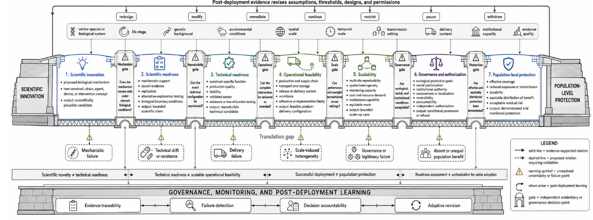
The pathway then integrates technical robustness, operational feasibility, scalability, ecological governance, social legitimacy, institutional authority, and capacity for failure detection. A governance gate should assess procedural robustness as well as technical risk by making framing choices, uncertainties, expertise, and value judgments visible and contestable [32]. Containment should likewise be evaluated as a probabilistic, ecology-dependent property because threshold-dependent designs may be more controllable without being predictably localized in every landscape [33]. The resulting progression is conditional: evidence sufficient for a contained experiment may be inadequate for a pilot, and evidence sufficient for a pilot may be inadequate for expansion. Authorization remains an independent institutional decision, not the automatic output of a readiness assessment. Figure 1 depicts the progression from scientific innovation to population-level protection within the analytical logic developed in this section.
|
|
|
Figure 1. The progression from scientific innovation to population-level protection |
Alt text
A structured conceptual diagram that depicts the progression from scientific innovation to population-level protection, with labelled components, directional relations, contextual modifiers, uncertainty points, and a clear boundary between observed evidence and proposed synthesis.
Adoption decisions and research implications
Adoption appraisal should compare an innovation with realistic alternatives and account for opportunity cost, uncertainty, and programme constraints. Adoption appraisal should incorporate opportunity cost and uncertainty because favourable cost-effectiveness can depend on assumed effectiveness, targeting, programme cost, and disease burden [34]. Economic evidence is most decision-relevant when it compares explicit targeting strategies and exposes how results change under alternative efficacy, cost, and scale assumptions [35]. Cost-effectiveness is therefore one decision input rather than a sufficient decision rule. It does not establish budget affordability, institutional capacity, ecological acceptability, distributive fairness, public legitimacy, or legal authorization.
Institutional mapping is a second priority because authority over research, environmental release, health protection, monitoring, and transboundary effects may be distributed among different bodies. Adoption decisions require mapped institutional authority because overlapping global, national, and local bodies may hold different mandates for research, release, health protection, and environmental oversight [36]. Progress would be demonstrated by explicit responsibility maps, enforceable monitoring conditions, data-access arrangements, escalation procedures, and documented authority to modify or withdraw permissions. Research should test whether institutional readiness can be assessed reproducibly and whether identified gaps predict delays, unaddressed failures, or weak accountability.
The highest-priority research need is prospective validation of the complete evidence-to-action pathway. Research priorities after an apparently favourable adoption appraisal should include prospective measurement of real implementation cost, durability, distributional benefit, and displacement of alternative services [37]. Comparative studies should examine whether domain-specific readiness profiles predict technical attrition, operational heterogeneity, ecological divergence, inequitable protection, or governance failure. Methodological work should validate functional indicators and context-specific action thresholds. Implementation research should distinguish biological failure from delivery failure. Governance research should evaluate how participation and institutional design alter decisions rather than merely documenting their presence. Adoption should remain conditional until evidence shows that the intervention can be delivered, monitored, governed, and revised under the conditions in which population protection is expected.
CONCLUSION
Evidence-to-action translation in entomological innovation requires a disciplined separation of scientific capability, technical reproducibility, operational feasibility, scalable delivery, governance legitimacy, and population-level protection. The strongest defensible synthesis is that no earlier stage can serve as a complete proxy for the next: scientific novelty is not equivalent to technical readiness, technical readiness is not equivalent to scalable operational feasibility, successful deployment is not equivalent to population protection, and readiness assessment is not equivalent to authorization for wider adoption. The proposed pathway organizes these distinctions into conditional gates, explicit uncertainties, failure-detection functions, and post-deployment learning loops, while remaining an original and non-validated scholarly structure. Its applicability is bounded by intervention mechanism, persistence, reversibility, vector and pathogen system, spatial and temporal scale, implementation context, evidence quality, and institutional capacity. The highest-priority implication is to validate readiness and governance structures prospectively against real decision outcomes so that wider adoption is guided not by technological momentum, but by evidence that protection can be achieved, monitored, distributed responsibly, and revised when assumptions fail.
ACKNOWLEDGMENTS: None
CONFLICT OF INTEREST: None
FINANCIAL SUPPORT: None
ETHICS STATEMENT: None