Entomology and
Applied Science Letters
Applied Science Letters
 2025
Volume 12
Issue 3
2025
Volume 12
Issue 3

Biological-control programmes frequently begin with taxonomic identification and evidence that a predator, parasitoid, or entomopathogen can attack a target organism. These criteria are necessary for candidate characterization but are insufficient for predicting whether an agent will locate susceptible targets, reproduce under the intended environmental conditions, persist after release, suppress pest populations, and remain compatible with crops, management practices, non-target organisms, and surrounding landscapes. This theory article addresses the absence of an integrated selection logic linking measurable natural-enemy traits to successive biological-control outcomes. It develops a proposed Trait–Context–Transition theory by synthesizing evidence concerning foraging, dispersal, host-finding, reproductive, thermal, developmental, persistence, interaction, and environmental-compatibility traits across predators, parasitoids, and entomopathogens. The synthesis indicates that functional suitability is relational rather than taxonomically predetermined: trait effects depend on the target population, crop or habitat, spatial configuration, seasonal conditions, management exposure, and the traits of co-occurring organisms. Favourable individual traits may improve particular processes but cannot establish that a candidate possesses a high-performing trait combination. Likewise, controlled performance cannot demonstrate post-release establishment, and establishment cannot demonstrate effective or environmentally compatible suppression. The proposed theory therefore organizes candidate assessment around sequential transitions from encounter and attack to demographic growth, establishment, persistence, suppression, and benefit–risk evaluation. Its principal limitations are the heterogeneity of trait definitions, inconsistent outcome boundaries, scarcity of prospective multi-context comparisons, and frequent substitution of laboratory or short-term endpoints for population-level outcomes. The central implication is that agent selection should combine operational trait measurement, explicit context matching, interaction testing, uncertainty reporting, and transition-specific validation rather than relying on taxonomy, isolated performance measures, or unvalidated composite rankings.
INTRODUCTION
Biological-control programmes must decide which candidate organisms are sufficiently promising to justify further screening, production, release, and post-release evaluation. Taxonomic identity remains indispensable for distinguishing species, strains, populations, and microbial isolates, but identity alone does not specify how an organism will function in a particular crop, host population, climate, landscape, or management regime. Recent synthesis indicates that no single natural-enemy trait consistently predicts establishment and control across programmes, supporting a shift toward context-dependent trait combinations [1]. The decision problem is therefore not simply whether a taxon has previously acted as a natural enemy, but whether a defined candidate possesses a configuration of traits capable of supporting the successive processes required in the intended use context.
Conceptual ambiguity further limits candidate comparison. Biological control may involve predators consuming prey, parasitoids locating and developing within hosts, or microorganisms infecting insects through environmentally conditioned pathways. A mechanism-based definition of biological control separates the identity of the agent from the ecological process by which suppression is produced [2]. This distinction matters because nominally similar outcomes, such as mortality observed in a bioassay or the presence of an agent after release, can arise through different mechanisms and provide different levels of decision evidence. Observation of attack is not equivalent to demonstration of population suppression, while detection or colonization is not necessarily evidence of functionally important activity.
The problem becomes more pronounced when evidence from different natural-enemy groups is compared. Recent opportunities span both invertebrate and microbial agents, but their biological and operational requirements differ enough to preclude a single taxonomic shortcut for candidate selection [3]. Predators may require prey switching, retention within crop patches, and compatibility with other natural enemies. Parasitoids may depend on host-stage synchronization, adult resources, and successful development after host location. Entomopathogens may require an appropriate formulation, favourable temperature and humidity, persistence on plant or soil surfaces, and sufficient contact with susceptible insects. These differences do not prevent a common selection theory, but they require that shared decision transitions be separated from agent-group-specific measurements.
The present article develops an original, non-validated Trait–Context–Transition theory for selecting biological-control agents. Its central argument is that candidate suitability should be represented as a sequence of conditional transitions: traits influence encounter and attack; behavioural and developmental performance influence reproduction; reproduction and environmental tolerance influence establishment and persistence; and persistence interacts with target, community, management, and landscape conditions to determine suppression and environmental compatibility. The theory does not claim that these relationships form a universally validated predictive model. Instead, it provides a structured basis for defining constructs, comparing heterogeneous evidence, identifying failure points, and designing prospective validation. Throughout the article, taxonomic identity is distinguished from functional suitability, single-trait favourability from combination performance, laboratory response from post-release establishment, and establishment from effective and environmentally compatible suppression.
Limitations of taxonomy-led agent selection
Taxonomy-led selection commonly assumes that related organisms, historically successful groups, or species with established natural-enemy status will share functionally useful characteristics. Such information can narrow a candidate pool, but it may conceal substantial variation within and among taxa. Across invertebrate predator assemblages, functional diversity explained prey suppression more directly than taxonomic richness alone, although most contributing studies did not test long-term establishment [4]. This finding supports functional characterization, but it does not establish that functional diversity will always improve control or that the same traits will be important across systems. Trait measurements may capture complementarity under one prey distribution or experimental design while failing to represent retention, reproduction, disturbance tolerance, or compatibility under another.
Evidence concerning natural-enemy diversity illustrates why taxonomic and functional indicators cannot be interpreted as universal predictors. Natural-enemy diversity does not yield a uniformly positive control effect because complementarity, redundancy and antagonism vary among communities and environments [5]. Predator assemblages are most defensible when complementary functions and environmental responses are demonstrated rather than inferred from species membership [6]. A taxonomically diverse assemblage may broaden prey use or stabilize responses to environmental variation, but it may also contain ecologically redundant agents, competitors, intraguild predators, or organisms that disrupt one another’s searching and reproductive performance. Conversely, a taxonomically narrow assemblage can sometimes provide multiple functions when constituent populations differ in behaviour, phenology, environmental tolerance, or prey-stage use. Taxonomic richness and functional complementarity are therefore related descriptors, not interchangeable constructs.
The strongest supported inference is that taxonomy should function as an initial biological descriptor rather than a sufficient decision rule. Theory further indicates that establishment and suppression are distinct ecological transitions, each governed by processes that taxonomic identity can only imperfectly proxy [7]. Candidate assessment must consequently separate the ability to survive and reproduce after release from the ability to reduce target abundance or damage, and it must evaluate environmental compatibility independently of both outcomes. Residual uncertainty remains substantial because trait definitions, temporal scales, population origins, environmental regimes, and suppression endpoints differ among studies. The convergent findings, context-dependent results, methodological limitations, and remaining uncertainties are synthesized in Table 1.
Table 1. Limitations of Taxonomy-Led Agent Selection: Convergent Findings, Context Dependence, Methodological Limitations, Evidence Confidence, and Residual Uncertainty
|
Evidence domain |
Convergent finding |
Contradictory or context-dependent finding |
Study-design basis |
Main methodological limitation |
Strength of inference |
Residual uncertainty |
Implication |
|
Single-trait prediction |
Isolated traits rarely predict success consistently across biological-control contexts. |
A trait associated with performance in one system may become neutral or disadvantageous under another target, environment, or release strategy. |
Cross-system scholarly synthesis |
Sparse standardized multi-trait datasets and inconsistent outcome definitions |
Qualified synthesis |
Minimum sufficient trait set remains unidentified. |
Treat traits as context-dependent relations rather than universal scores. |
|
Agent identity and mechanism |
Agent classification does not specify the ecological mechanism producing suppression. |
Similar labels can encompass direct consumption, parasitism, infection, induced effects, or indirect interactions. |
Conceptual framework and mechanism synthesis |
Classification cannot itself predict efficacy or persistence. |
Direct conceptual support |
The most decision-relevant mechanism may change across life stages and environments. |
Define agent, mechanism, intervention, and outcome separately. |
|
Cross-agent comparison |
Predators, parasitoids, and microorganisms can all support biological control. |
Their production, delivery, persistence, host-contact, and environmental requirements differ. |
Broad disciplinary review |
Evidence is heterogeneous across agent groups and use strategies. |
Contextual synthesis |
Which shared measurements can validly span agent groups remains unresolved. |
Use common decision transitions with agent-specific operational measures. |
|
Functional diversity |
Functional differences among predators can improve prey suppression beyond taxonomic richness. |
Positive effects may depend on assemblage composition, prey distribution, and experimental design. |
Meta-analysis |
Long-term establishment and crop-level outcomes were not consistently assessed. |
Meta-analytic association |
Transferability to persistent field control is uncertain. |
Evaluate functional composition rather than species number alone. |
|
Natural-enemy diversity |
Complementarity can enhance biological control. |
Redundancy, antagonism, and intraguild interactions can eliminate or reverse benefits. |
Critical review of community evidence |
Diversity is frequently used as a proxy for unmeasured mechanisms. |
Qualified synthesis |
Conditions separating complementarity from interference remain incompletely specified. |
Test interaction mechanisms instead of assuming richness benefits. |
|
Predator complementarity |
Different predator functions and environmental responses may stabilize control. |
Complementarity can be offset by competition, disruption, or intraguild predation. |
Review and theoretical synthesis |
Evidence varies in duration, spatial scale, and community composition. |
Qualified synthesis |
Persistence of complementarity under field variation remains uncertain. |
Screen combinations for both functional complementarity and interference. |
|
Establishment and suppression |
Establishment and target suppression are distinct ecological outcomes. |
An established agent may exert weak control, while temporary releases may sometimes suppress pests without long-term establishment. |
Biological-control theory review |
Theoretical relations require system-specific parameterization and validation. |
Theoretical support |
Programme-specific thresholds for establishment and acceptable suppression are unresolved. |
Use separate transition criteria for establishment, persistence, suppression, and compatibility. |
Foraging, dispersal, and host-finding traits
Foraging, dispersal, and host-finding traits determine whether an agent can convert its intrinsic capacity to attack a pest into realized encounters within a heterogeneous agroecosystem. These constructs should not be collapsed into a single measure of mobility or search efficiency. Foraging includes decisions concerning patch entry, residence, prey or host acceptance, switching, and allocation of time among feeding, searching, and reproduction. Dispersal concerns movement among release points, crop patches, refuge habitats, and surrounding landscape elements, whereas host finding concerns the detection and use of information that leads to contact with susceptible target stages. Parasitoid community assembly across agricultural and natural habitats was structured by life-history traits and phenology, showing that habitat occurrence cannot be reduced to family or species identity [8]. Nevertheless, community occurrence remains an association with habitat filtering and does not itself establish persistence, parasitism, or pest suppression.
Behavioural traits can also be plastic rather than fixed properties of a species or strain. Foraging performance can be plastic: prey-experienced Amblyseius swirskii founders produced faster population growth and stronger thrips suppression than inexperienced founders under controlled conditions [9]. This evidence indicates that rearing and prior experience may influence release quality, prey recognition, and early population development. It does not demonstrate that learning will persist across generations, remain beneficial when alternative prey are present, or overcome adverse crop and climate conditions. Chemical information provides another potential route to enhanced encounter. Chemical cues can alter natural-enemy attraction and host or prey location, but increased attraction alone does not establish realized attack or population suppression [10]. A reliable selection protocol should therefore distinguish cue detection, orientation, contact, acceptance, attack, successful development, and subsequent population effects.
Movement traits are similarly conditional on spatial configuration. Dispersal capacity and other predator traits were filtered by field size, edge position and agri-environment management, indicating that movement traits are meaningful only relative to spatial configuration [11]. High movement capacity may facilitate colonization of dispersed pest patches and recolonization after disturbance, but it may also increase emigration from release sites or movement into habitats where target prey are absent. Low dispersal may improve local retention while limiting coverage of large or fragmented fields. Body size, feeding guild, wing morphology, locomotor capacity, and behavioural propensity can also covary, making a single proxy difficult to interpret causally. The relevant selection question is therefore not whether an agent disperses rapidly, but whether its movement and retention profile matches release density, target distribution, field geometry, resource continuity, and the time window in which suppression is required.
Reproductive, thermal, and developmental traits
Reproductive, thermal, and developmental traits determine whether successful encounters are converted into population growth under the environmental conditions experienced after release. These traits include development rate, survival, fecundity, sex allocation, generation time, diapause, maturation, reproductive longevity, and stage-specific tolerance of temperature and moisture. Thermal suitability is a seasonal relation rather than a single optimum because diapause, development and host–parasitoid synchrony can shift differently under climatic change [12]. An agent may survive at a particular temperature yet develop too slowly to track the target population, emerge outside the susceptible host stage, or fail to reproduce during the operational control window. Accordingly, thermal survival, developmental timing, reproductive output, and synchronization with the target must be treated as related but non-equivalent constructs.
Comparisons among candidate parasitoids demonstrate the limits of taxonomic inference. Closely related parasitoid candidates displayed different thermal performance profiles, demonstrating that taxonomic proximity cannot substitute for candidate-specific developmental measurements [13]. Even comparative reaction curves obtained under common laboratory conditions require cautious interpretation because constant temperatures omit daily fluctuations, microclimatic refuges, resource limitation, host quality, acclimation, and behavioural thermoregulation. Population means may also conceal variation among geographic sources or rearing colonies. Candidate assessment should therefore examine the overlap among agent and target reaction norms across the intended season, while reporting uncertainty arising from life stage, population origin, and environmental variability.
Performance-relevant variation can also occur within a species or among microbial isolates. Artificial selection within Orius laevigatus enhanced service-related traits, showing that substantial functional variation can occur below the species level while leaving field persistence untested [14]. Selection for body size, predation, fecundity, or rearing efficiency may improve a particular laboratory endpoint while generating correlated costs, reduced genetic variation, domestication, altered dispersal, or increased plant feeding. Entomopathogenic fungal isolates differed in temperature tolerance and humidity requirements, making isolate-level environmental fit a prerequisite rather than a consequence of species identification [15]. Yet tolerance measured under controlled conditions is not equivalent to persistence on crop surfaces, contact with susceptible hosts, successful infection, or field suppression. Reproductive and thermal screening must therefore evaluate complete reaction profiles and their demographic consequences rather than treating favourable single measurements as evidence of an establishment-ready agent.
Compatibility with crops, landscapes, and management
Agent performance is filtered by the environment in which traits are expressed. Natural pest-control resilience after insecticide exposure depended on invertebrate community structure, indicating that pesticide compatibility must be treated as a performance trait rather than an external afterthought [16]. Survival alone is insufficient: agents must retain searching, attack, reproduction, and recovery functions under the chemical and physical disturbances expected in the intended production system.
Habitat interventions can provide floral resources, refuges, alternative prey, or recolonization routes, but their effects are not uniform. Flower strips and hedgerows can enhance pest-control services, yet heterogeneous outcomes show that resource dependence and habitat response must be matched to the planned crop and landscape intervention [17]. In rice systems, pesticide pressure and land-cover heterogeneity jointly structured arthropod functional groups, so compatibility cannot be assigned from crop identity or landscape composition in isolation [18].
Microbial agents illustrate the same principle through different mechanisms. For entomopathogenic fungi, virulence is insufficient without environmental competence because survival, dispersal, host contact, and infection are jointly filtered by the crop microenvironment [19]. Compatibility should therefore be defined as an agent–target–environment relation incorporating abiotic tolerance, resource continuity, management exposure, non-target interaction, and the spatial and temporal conditions required for function.
Trait combinations and performance trade-offs
Trait-based selection becomes misleading when favourable attributes are added into an unvalidated composite score. Aphid-control efficiency was not explained by functional diversity in one predator–parasitoid system, demonstrating that favourable aggregate scores may fail when they omit interaction identity and mechanism [20]. Essential transitions should instead be treated as conditional: failure to locate targets, reproduce, persist, or tolerate management cannot automatically be compensated for by high performance elsewhere.
Interactions among agents can create complementarity or interference. The coexistence of Orius laevigatus and Amblyseius swirskii depended on prey switching, diet diversification, and intraguild predation, making compatibility an emergent property of the food environment [21]. Broad diet, rapid attack, or high mobility may be beneficial in isolation but disadvantageous when they increase intraguild predation, emigration, non-target feeding, or competition for limiting resources.
Microbial and parasitoid evidence reinforces the importance of target and context heterogeneity. Entomopathogenic fungi can act through several plant- and insect-associated pathways, but colonization or multitrophic association does not by itself demonstrate the functional activity responsible for suppression [22]. Intraspecific variation in host protective traits can also create partial refuges from biological control, showing that an agent’s favourable traits cannot be interpreted independently of target-population heterogeneity [23].
Proposed trait-based selection theory
The proposed Trait–Context–Transition theory represents candidate suitability as a sequence rather than a taxonomic label or additive score. Agent traits influence target encounter, attack or infection, demographic conversion, establishment, persistence, suppression, and environmental compatibility. Contextual filters—including target variation, climate, crop structure, management exposure, landscape configuration, and interacting organisms—operate at every transition. Traits must also be treated as evolving distributions because adaptation and eco-evolutionary feedback can alter persistence, exploitation, and suppression after release [24].
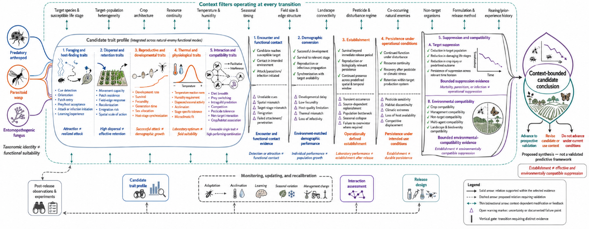
Figure 1 maps natural-enemy traits to establishment, persistence, prey suppression, and environmental compatibility within the analytical logic developed in this section.
|
|
|
Figure 1. Natural-enemy traits to establishment, persistence, prey suppression, and environmental compatibility |
Alt text
A structured conceptual diagram that maps natural-enemy traits to establishment, persistence, prey suppression, and environmental compatibility, with labelled components, directional relations, contextual modifiers, uncertainty points, and a clear boundary between observed evidence and proposed synthesis.
The first component is a candidate profile containing operational measurements rather than broad descriptors. Genetic and genomic tools can characterize or improve relevant traits, but genomic association or selection response is not equivalent to stable field performance [25]. Candidate profiles must therefore specify population or isolate origin, rearing history, life stage, trait definition, measurement context, uncertainty, and evidence scale.
The second component is a transition architecture. Genomic information may identify variation associated with natural-enemy performance, yet its decision value depends on validated links among genotype, phenotype, and deployment environment [26]. Each transition should generate a distinct output: encounter evidence, successful attack or infection, reproductive conversion, operationally defined establishment, persistence under disturbance, target suppression, and compatibility evidence.
The third component is a stage-gated decision logic. Foraging theory suggests relations between patch-use behaviour and post-establishment host reduction, but those relations remain hypotheses until tested across release contexts [27]. Essential transitions should permit veto decisions when evidence is absent or incompatible. Uncertainty must remain visible rather than being concealed within a single ranking. The proposed components, evidence bases, boundary conditions, failure modes, and validation requirements are organized in Table 2.
Table 2. Proposed Trait-Based Selection Theory: Components, Evidence Basis, Relations, Boundary Conditions, Failure Modes, and Validation Requirements
|
Proposed component |
Purpose |
Evidence basis |
Relation or mechanism |
Input or precondition |
Expected output |
Boundary condition or failure mode |
Validation requirement |
|
Candidate definition |
Identify the biological unit being compared. |
Mechanism-based classification and agent-group evidence |
Separates species identity from population, strain, isolate, and functional mechanism. |
Verified identity, origin, life stage, and intended use |
Bounded candidate profile |
Taxonomic identity may conceal functional variation. |
Replicated population- or isolate-level characterization |
|
Operational trait profile |
Replace broad labels with measurable constructs. |
Trait-selection synthesis |
Links each trait to a defined transition and scale. |
Standardized trait definitions and protocols |
Comparable trait evidence |
Non-equivalent measures may be treated as the same trait. |
Measurement-validity and repeatability studies |
|
Encounter and attack transition |
Determine whether agents locate and exploit targets. |
Behavioural and foraging evidence |
Cue use, learning, movement, acceptance, attack, or infection occur sequentially. |
Target distribution, reliable cues, susceptible stage |
Encounter-to-attack evidence |
Attraction or movement may not produce attack. |
Sequential behavioural and functional assays |
|
Demographic-conversion transition |
Test whether exploitation generates population growth. |
Thermal, developmental, and reproductive evidence |
Survival, development, fecundity, and synchrony convert attacks into recruitment. |
Suitable thermal, moisture, host, and resource conditions |
Environment-matched demographic profile |
Laboratory optima may not represent field fluctuation. |
Reaction-norm and seasonal demographic validation |
|
Establishment and persistence transition |
Separate transient presence from sustained populations or activity. |
Biological-control theory and environmental-competence evidence |
Reproduction, retention, resource continuity, and disturbance tolerance determine persistence. |
Programme-specific spatial and temporal definition |
Operational establishment and persistence evidence |
Detection, colonization, or short-term abundance may be transient. |
Repeated spatial and temporal post-release assessment |
|
Interaction and trade-off gate |
Test multi-agent and multitrophic compatibility. |
Diversity, intraguild, and multitrophic evidence |
Complementarity, redundancy, prey switching, competition, and interference modify performance. |
Relevant agent combinations and resource states |
Compatibility-adjusted combination profile |
Favourable single traits may form a poor combination. |
Factorial multi-agent tests across resource conditions |
|
Suppression transition |
Determine whether biological activity reduces the target outcome. |
Predator, parasitoid, and host-variation evidence |
Encounter, attack, demography, and persistence must translate into target reduction. |
Defined pest-density, damage, or crop-protection endpoint |
Bounded suppression evidence |
Mortality or establishment may not produce operational control. |
Prospective population and crop-outcome evaluation |
|
Context and compatibility gate |
Evaluate performance under the intended agroecosystem. |
Landscape, pesticide, habitat, and competence evidence |
Crop, climate, landscape, management, and non-target conditions filter every transition. |
Defined recipient environment and management regime |
Environmentally bounded suitability conclusion |
Context matching does not itself prove effectiveness or safety. |
Multi-context field validation and independent compatibility assessment |
|
Uncertainty and updating layer |
Prevent premature conversion of evidence into readiness claims. |
Evolutionary, genomic, and theoretical evidence |
Candidate profiles are updated as traits, populations, targets, and environments change. |
Explicit uncertainty and monitoring variables |
Revisable decision record |
Static scores may become obsolete after adaptation or environmental change. |
Prospective prediction, recalibration, and external validation |
Implications for agent screening and release
Screening should begin with a bounded question specifying the candidate population or isolate, target organism and life stage, intervention strategy, recipient crop or habitat, management context, and desired outcome. Release decisions should culminate in an explicit benefit–risk analysis that separates expected target benefit, establishment uncertainty, and environmental harm rather than treating efficacy as sufficient authorization [28]. Establishment, suppression, and environmental compatibility must therefore remain independent decision domains.
Evidence eligibility should be determined by claim fit rather than topical proximity. Appropriate designs may include comparative laboratory experiments, semi-field and field studies, population observations, evidence syntheses, and theoretical analyses, but each should support only the inference permitted by its design. Extraction should record biological unit, trait definition, comparator, environmental conditions, temporal and spatial scale, target endpoint, uncertainty, and the distinction between direct, qualified, and contextual support.
Quality appraisal should examine selection bias, confounding, measurement validity, environmental realism, duration, transferability, and outcome substitution. Laboratory evidence is valuable for isolating mechanisms, but it should not be cited as establishment evidence without post-release population data. Likewise, establishment should not be treated as proof of suppression or environmental compatibility. Screening outputs should remain revisable candidate dossiers rather than deployment-ready scores, with advancement contingent on transition-specific evidence and transparent uncertainty.
CONCLUSION
Trait-based selection offers a stronger basis for biological-control decisions than taxonomy-led inference only when traits are defined operationally, matched to context, and connected to distinct ecological transitions. The most defensible synthesis is that persistence and performance emerge from interacting behavioural, demographic, environmental, and community characteristics rather than from taxonomic identity or any favourable single trait. The proposed theory consequently separates encounter, attack, reproduction, establishment, persistence, suppression, and compatibility while preserving uncertainty at each stage. Its highest-priority implication is the need for prospective, standardized, multi-context tests that evaluate trait combinations and transition failures rather than retrospectively associating isolated laboratory measures with broadly defined success.
ACKNOWLEDGMENTS: None
CONFLICT OF INTEREST: None
FINANCIAL SUPPORT: None
ETHICS STATEMENT: None