Entomology and
Applied Science Letters
Applied Science Letters
 2025
Volume 12
Issue 1
2025
Volume 12
Issue 1

Biological control is increasingly expected to reduce pesticide dependence while sustaining crop protection, yet apparently similar interventions often produce different outcomes across agroecosystems. The central evidence gap is not whether natural enemies can suppress pests, but why particular agents, assemblages, and habitat or management interventions generate effective, stable control in some settings and weak, transient, or counterproductive effects in others. This Original Realist Review Article examines that problem through context–mechanism–outcome reasoning. It integrates evidence concerning natural-enemy traits and functional performance, trophic complexity and intraguild interactions, landscape structure and resource continuity, and management history and ecological legacy effects. The strongest defensible synthesis is that biological-control performance is an emergent property of configurations rather than an intrinsic property of an agent or intervention. Traits influence encounter, establishment, persistence, and attack only after being filtered by prey or host characteristics, interaction networks, resource distributions, disturbance histories, and deployment conditions. Diversity can support control when functional roles are complementary, but species richness alone does not establish complementarity; similarly, laboratory attack rates do not establish field suppression or crop protection. Interpretation is limited by heterogeneous trait definitions, mismatched spatial and temporal scales, reliance on abundance or attack proxies, incomplete trophic networks, bundled management categories, and limited prospective testing of proposed mechanisms. Biological-control design should therefore begin with an explicit intended outcome and a testable programme theory, identify rival mechanisms and failure pathways, and measure the full chain from agent performance to pest suppression and crop response. Progress depends on comparative, multi-context studies that treat uncertainty, non-target effects, and transferability as design requirements rather than post hoc qualifications.
INTRODUCTION
Biological control is often described through the identity of a predator, parasitoid, pathogen, or other biologically derived agent. That description is insufficient because the relevant claim concerns an intended intervention, a target, and an ecological mechanism that changes pest pressure or damage. A biologically derived intervention qualifies as biological control only when its intended mechanism and target relationship are specified; agent identity alone does not establish control performance [1]. A natural enemy may contribute to background regulation without being the object of an intervention, while a released or conserved enemy may fail if it does not establish, encounter the target, survive disturbance, or act at the relevant crop stage. Biological control must therefore be evaluated as a conditional ecological process, not as a property conferred by agent presence.
The intervention space includes invertebrate and microbial agents, rearing and release strategies, habitat manipulation, and integration with crop management. The breadth of biological-control options expands design opportunities, but it also makes performance conditional on agent production, deployment strategy, crop environment, and supporting ecological conditions [2]. These conditions affect survival, behavioural expression, access to prey or hosts, interactions with resident enemies, pesticide exposure, and resource continuity. An intervention can therefore be biologically plausible in a controlled assay yet operationally ineffective when the limiting mechanism lies elsewhere. The practical question is not simply which agent has demonstrated activity, but which agent–target–crop–network configuration can sustain the required outcome.
Evidence syntheses demonstrate both potential and variability. Even where biological control reduces pest abundance and damage on average, effect sizes remain heterogeneous across intervention types, crop–pest systems, farm conditions, and landscapes [3]. Such averages cannot determine whether a specific intervention will work in a particular field or season. Heterogeneity may reflect ecological moderation, but also differences in study design, outcome definition, spatial scale, exposure history, or reliance on proxies. Laboratory mortality, enemy abundance near habitat, plot-level pest reduction, and avoided crop damage occupy different positions in the outcome chain. Treating them as equivalent obscures how biological activity becomes operational effectiveness.
The unresolved problem is explanatory: under what conditions do natural-enemy traits, trophic relations, landscape resources, and management legacies activate mechanisms that lead to reliable suppression, and when do they generate weak, unstable, or counterproductive outcomes? This Original Realist Review Article develops linked context–mechanism–outcome propositions while separating demonstrated mechanisms from plausible interpretation and original synthesis. The analysis proceeds from review logic to traits, trophic complexity, landscape structure, management history, and design. Four boundaries govern the argument: agent identity is not equivalent to context-independent performance; laboratory attack rate is not equivalent to field suppression; natural-enemy diversity is not equivalent to complementarity; and a context–mechanism–outcome proposition is not equivalent to a universal causal law.
Realist review logic and explanatory questions
A realist review asks how mechanisms operate for particular organisms, settings, and exposure histories, rather than only whether an intervention is associated with an outcome. The organizing question is which configurations of natural-enemy traits, trophic context, landscape resources, and management history explain variation in establishment, persistence, pest suppression, crop protection, and stability. A realist search should be iterative and theory led, with explicit records of how emerging programme theories alter search terms, sources, and stopping decisions [4]. Search concepts were therefore organized around biological system, intervention or exposure, mechanism, outcome, context, and evidence type, with theory-refining searches used to examine rival explanations rather than to treat frequently cited propositions as causal laws.
Construct and outcome boundaries were fixed before synthesis. Eligible evidence concerned predators, parasitoids, natural-enemy assemblages, and directly relevant multitrophic or bottom-up pathways in agricultural or transferable systems. Exposures included agent traits, conditioning or release histories, habitat resources, trophic interactions, disturbance, and management regimes. Outcomes were separated into establishment, persistence, encounter, attack, pest suppression, crop damage, yield, stability, and non-target effects. Abundance, visitation, and laboratory attack were treated as intermediate indicators unless directly linked to suppression or crop response. Evidence appraisal should distinguish methodological rigour from relevance and explanatory richness, because a technically strong study may still contribute little to a particular context–mechanism–outcome proposition [5].
Evidence was classified as direct, qualified, or contextual support and further distinguished as association, mechanism-focused evidence, model-based inference, or proposed synthesis. Reviews and meta-analyses informed convergence and heterogeneity; controlled studies isolated pathways but did not establish field transferability; field studies captured realistic configurations while remaining vulnerable to confounding. Screening required each source to support a defined claim, comparison, limitation, or implication and to report sufficient organismal, contextual, exposure, outcome, and scale information. Bias control relied on preserving construct distinctions, recording rival mechanisms, and using the weakest defensible causal language. The review questions, eligibility boundaries, search and screening logic, evidence-classification rules, and bias controls are specified in Table 1.
Table 1. Realist Review Logic and Explanatory Questions: Review Questions, Eligibility Boundaries, Search Logic, Screening Rules, Evidence Classification, and Bias Controls
|
Review-method element |
Operational definition |
Inclusion rule |
Exclusion rule |
Search or screening implementation |
Evidence-classification rule |
Bias-control measure |
Reporting requirement |
|
Review question and construct definition |
Explain variation through configurations of traits, trophic context, resources, and history. |
Evidence maps to a named construct, mechanism, and outcome. |
Generic pest management without a biological-control relation. |
Screen against article-specific explanatory questions. |
Direct, qualified, or contextual support. |
Separate agent identity from realized performance. |
State construct, context, scale, and limit. |
|
Biological system boundary |
Predators, parasitoids, enemy assemblages, and relevant multitrophic or bottom-up pathways. |
Agricultural or transferable ecological systems. |
Chemical-only control or agent records without functional evidence. |
Record agent, target, crop or habitat, and life stage. |
System-specific or cautiously transferable evidence. |
Avoid taxonomic overgeneralization. |
Qualify claims by organism and setting. |
|
Exposure and mechanism boundary |
Traits, conditioning, release, resources, interactions, disturbance, and management. |
Identifiable exposure, mechanism, or comparator. |
Broad labels without interpretable exposure detail. |
Extract exposure sequence and proposed pathway. |
Association, mechanism evidence, or programme theory. |
Separate bundled interventions from components. |
Report confounding and rival pathways. |
|
Outcome boundary |
Establishment, persistence, attack, suppression, crop response, stability, and non-target effects. |
Measure, timing, and scale are recoverable. |
Abundance or attack presented as definitive crop protection. |
Map measures along the outcome chain. |
Intermediate indicator or operational outcome. |
Prevent proxy-to-outcome inflation. |
State whether crop protection was measured. |
|
Eligible designs |
Reviews, meta-analyses, field studies, controlled mechanistic studies, and realist-method papers. |
Design supports a planned claim within stated limits. |
Opaque or unverifiable evidence. |
Classify design before comparison. |
Design-specific strength of inference. |
Do not treat unlike designs as equivalent. |
Link claims to suitable designs. |
|
Evidence-source boundary |
Peer-reviewed journal evidence with verifiable metadata and methods. |
Claim relevance and sufficient appraisal detail. |
Topical proximity without extractable support. |
Verify metadata and inferential role. |
Eligible or ineligible for the proposed use. |
Exclude unsupported inferential roles. |
Describe limitations without implying exhaustive coverage. |
|
Search logic |
Combined system, exposure, mechanism, outcome, context, and evidence terms. |
Terms test or refine a programme theory. |
Disconnected title fragments. |
Iterate when new mechanisms or rivals emerge. |
Theory-building, refining, or testing retrieval. |
Record conceptual changes. |
Explain search evolution. |
|
Screening rule |
Relevance screening followed by claim-level appraisal. |
Sufficient context for the planned claim. |
No match to a claim, limitation, or implication. |
Resolve uncertainty against the programme theory. |
Include, exclude, or retain contextually. |
Apply consistent construct boundaries. |
Report flow only from a reproducible screening ledger. |
|
Evidence classification |
Contribution to a context–mechanism–outcome explanation. |
Clarifies convergence, contradiction, context, or uncertainty. |
No defensible inferential bridge. |
Extract result, context, mechanism claim, and limitation. |
Direct, qualified, contextual, or proposed synthesis. |
Use weakest defensible causal language. |
Separate observation from inference. |
|
Bias and quality appraisal |
Claim-specific relevance, richness, rigour, confounding, measurement, and transferability. |
Sufficient information to assess cited use. |
Unresolvable validity problem. |
Examine sampling, comparator, scale, and reporting. |
Qualitative, conditional strength of inference. |
Do not substitute prestige for validity. |
Report the material limitation. |
Natural-enemy traits and functional performance
Trait-based reasoning explains performance through measurable characteristics rather than taxonomic identity alone. Diet breadth, host finding, handling behaviour, development, stress tolerance, dispersal, reproduction, phenology, learning, and pesticide susceptibility can influence encounter, establishment, persistence, and resilience. Yet these traits are filtered by prey stage, crop architecture, climate, rearing, release timing, and community composition. Trait-based prediction is more informative than agent identity alone, but current inference is restricted by inconsistent trait definitions, sparse comparative data, and trait-by-environment trade-offs [6]. Rapid attack may coexist with poor persistence, broad diet may support survival while diverting feeding from the target, and mobility may aid colonization while increasing emigration. The explanatory unit is therefore the trait-by-context configuration, not the species label or an isolated assay value.
Comparative spider evidence illustrates this conditionality. Global spider evidence indicates that functional performance varies with hunting strategy, target-pest identity, crop, climate, and geography, so laboratory attack potential cannot be generalized as field suppression [7]. Hunting mode can alter encounter, but agronomic consequences also depend on prey accessibility, crop structure, alternative prey, seasonal synchrony, and the scale of measurement. Meta-analysis can identify average tendencies and moderators, yet spider-specific evidence and heterogeneous efficacy metrics constrain transfer to other enemy groups. Attack rate is only one component of a mechanism; field suppression also integrates survival, movement, prey choice, density dependence, disturbance, and exposure duration, while crop protection requires a further link to avoided damage.
Traits are also shaped by developmental, rearing, and selection histories. Experience-dependent behaviour can modify establishment and top-down performance, showing that functional traits are expressed through developmental and release history rather than fixed agent identity [8]. Controlled greenhouse evidence supports this mechanism within the studied predator–prey system, but not broad transferability. Artificial selection can enhance predator performance, but gains observed under controlled or protected-crop conditions require field-relevant validation and assessment of correlated trade-offs [9]. Selection may improve predation while altering dispersal, reproduction, stress tolerance, prey breadth, or compatibility. Improvement should therefore be assessed against a defined deployment context and the complete outcome chain, not assumed from enhanced laboratory or protected-crop performance.
Trophic complexity and intraguild interactions
Natural enemies operate within food webs, not isolated predator–prey or parasitoid–host pairs. Additional enemy species may broaden prey-stage coverage and response diversity, but can also intensify competition, intraguild predation, or behavioural disruption. Natural-enemy richness is not a direct measure of complementarity because control can strengthen, remain unchanged, or weaken according to functional identity and interaction structure [10]. Identical richness can represent redundant enemies, complementary partitioning, or antagonistic assemblages. Complementarity therefore requires evidence that combined enemies improve the relevant outcome under realistic densities, timing, prey communities, and environmental conditions; species counts alone cannot establish the mechanism.
Mechanistic expectations depend on resource partitioning and enemy encounter. Complementarity depends on partitioning of prey, space, or time and can be offset by intraguild predation, behavioural interference, or shared-resource competition [11]. Temporal or spatial separation may connect control across pest stages and crop strata, while diet differentiation may reduce competition. Conversely, alternative prey can dilute target pressure or sustain an intraguild predator. Net effects can change with density, pest abundance, crop architecture, refuge, and release sequence. Pairwise assays identify potential antagonism but may omit avoidance, prey switching, and spatial segregation. Compatibility is therefore a realized network property that must be tested under deployment-relevant conditions.
Trophic mechanisms also include effects without consumption. Trophic effects include non-consumptive risk pathways that can alter pest movement, feeding, development, and exposure, making attack-rate measurements incomplete predictors of crop protection [12]. Risk may reduce feeding, but it may also displace pests into refuges or alter interactions with other enemies. Enemy complementarity can emerge through behavioural avoidance of intraguild risk, but this mechanism is contingent on network structure and cannot be inferred from diversity counts alone [13]. The field-network evidence identifies a plausible mechanism, yet transfer from a forest-associated network to managed crops remains uncertain. Where avoidance reduces harmful overlap while preserving target access, multiple enemies may complement one another; where intraguild predation or displacement dominates, the same assemblage may fail. This is a testable context–mechanism–outcome proposition, not a universal causal law.
Landscape structure and resource continuity
Landscape effects are inconsistent partly because studies use different spatial scales, habitat indicators, focal taxa, and trophic units rather than a common causal construct [14]. Semi-natural habitat can supply refuges, prey, nectar, or recolonization sources, but its relevance depends on whether those resources are accessible to the focal enemy during the vulnerable pest period. Landscape area alone therefore does not establish functional connectivity or control.
Agri-environmental habitats can support predators in adjacent crops, but benefits decay with distance and vary among trait groups, so habitat presence is not equivalent to spatially continuous control [15]. Mobility, overwintering strategy, phenology, and matrix permeability determine whether supported enemies reach pest patches. Abundance near a field edge remains an intermediate indicator unless linked to pest suppression across the crop.
Resource continuity is similarly organism specific. Different flower-strip mixtures and successional stages generate taxon-specific responses, making plant identity and phenological sequence central design variables [16]. Native plants may strengthen local adaptation and seasonal support, but attraction does not alone demonstrate reproduction, persistence, pest suppression, or agronomic benefit [17]. Resource interventions must therefore be evaluated for use by focal enemies, possible support of pests, spatial reach, and crop outcomes.
Management history and ecological legacy effects
Management history creates ecological legacies by altering enemy persistence, recolonization sources, prey availability, and interaction structure before a focal intervention is applied [18]. Repeated pesticide exposure, tillage, harvest, vegetation removal, and habitat restoration can filter traits and rewire food webs. The same intervention may consequently enter communities with different recovery capacities, making baseline history an active context rather than background description.
Specific practices may explain control better than broad labels such as “conservation” or “conventional,” indicating that history should be represented as an exposure sequence rather than a category [19]. A proposed assessment should record practice timing, intensity, duration, and recovery intervals, then relate these inputs to trait composition, recolonization, resource gaps, and suppression. Failure arises when coarse labels conceal opposing practices or when present abundance is mistaken for functional resilience.
Organic management can strengthen natural pest control on average, but the label bundles multiple pathways and cannot identify which exposure generated an outcome [20]. Management legacies can also operate through soil–plant resistance rather than top-down predation [21]. The proposed synthesis therefore requires rival-mechanism tests, including enemy exclusion, plant-defence measures, repeated suppression outcomes, and longitudinal or quasi-experimental comparisons before attributing control to natural enemies.
Context–mechanism–outcome synthesis
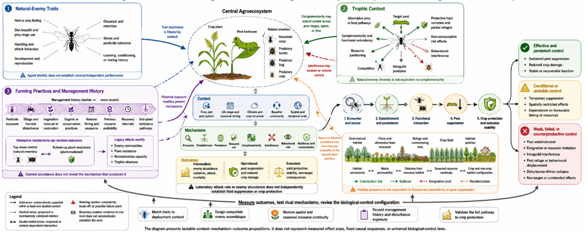
Uneven outcomes emerge when traits, trophic networks, landscape resources, and management legacies alter encounter, establishment, persistence, complementarity, interference, and resilience. Under insecticide exposure, community composition and dominance can determine whether pest-control function resists, recovers, or collapses [22]. Figure 1 shows how biological-control outcomes emerge from interactions among natural-enemy traits, trophic context, farming practices, and landscape conditions within the analytical logic developed in this section.
|
|
|
Figure 1. How biological-control outcomes emerge from interactions among natural-enemy traits, trophic context, farming practices, and landscape conditions |
Alt text
A structured conceptual diagram that shows how biological-control outcomes emerge from interactions among natural-enemy traits, trophic context, farming practices, and landscape conditions, with labelled components, directional relations, contextual modifiers, uncertainty points, and a clear boundary between observed evidence and proposed synthesis.
Within-species host variation can create partial refuges after enemy encounter, so mean susceptibility or laboratory attack may overstate field-wide suppression [23]. This mechanism explains one form of residual pest persistence without assuming enemy failure. Its generality remains uncertain because protective traits, their frequency, and enemy responses vary among host populations and environments.
A functional perspective links contexts to mechanisms more clearly than intervention labels, but each proposed relation remains a programme theory until tested against rival explanations and outcomes [24]. Convergence across evidence classes supports configuration-based explanation; disagreement often concerns which mechanism dominates, at what scale, and whether an intermediate response reaches crop protection.
Predators can reduce pests and improve yield across systems, yet heterogeneous effects across crops, climates, and designs show that average success is not a universal causal law [25]. The strongest inference is therefore conditional effectiveness, not uniform efficacy. The convergent findings, context-dependent results, methodological limitations, and remaining uncertainties are synthesized in Table 2.
Table 2. Context–Mechanism–Outcome Synthesis: Convergent Findings, Context Dependence, Methodological Limitations, Evidence Confidence, and Residual Uncertainty
|
Evidence domain |
Convergent finding |
Contradictory or context-dependent finding |
Study-design basis |
Main methodological limitation |
Strength of inference |
Residual uncertainty |
Implication |
|
Natural-enemy traits |
Traits influence establishment and attack. |
Expression changes with environment and history. |
Synthesis and controlled studies. |
Sparse cross-system validation. |
Context-qualified. |
Predictive trait combinations. |
Validate traits across deployment environments. |
|
Trophic complexity |
Partitioning can support complementarity. |
Interference or intraguild predation can reverse effects. |
Reviews and network studies. |
Incomplete interaction measurement. |
Mechanistically plausible. |
Conditions producing net benefit. |
Test mixtures under realistic densities and timing. |
|
Landscape and resources |
Accessible habitat can support persistence and spillover. |
Responses vary by scale, taxon, plant identity, and season. |
Landscape reviews and field studies. |
Abundance often substitutes for suppression. |
Context-dependent field support. |
Effective spatial and phenological reach. |
Measure movement, resource use, and crop outcome. |
|
Management and legacy |
Disturbance history alters control capacity. |
Broad management labels combine competing pathways. |
Reviews, field studies, and meta-analysis. |
Bundled exposure and confounding. |
Qualified synthesis. |
Duration and reversibility of legacies. |
Record exposure sequences and baseline states. |
|
Community resilience |
Composition affects persistence after disturbance. |
Dominance may support or weaken recovery. |
Field community study. |
Residual environmental confounding. |
Direct but contextual. |
Transfer across systems and disturbances. |
Monitor function before and after exposure. |
|
Host refuges |
Protective variation can preserve susceptible subpopulations. |
Frequency and effect differ among populations. |
Mechanistic case study. |
Case-system specificity. |
Strong within system. |
Prevalence across taxa. |
Measure trait distributions, not only mean susceptibility. |
|
Integrated outcome |
Biological control can reduce pests and improve yield. |
Magnitude varies across crops, climates, and designs. |
Meta-analysis. |
Heterogeneous interventions and outcomes. |
Strong average, conditional transfer. |
Stability and uncommon failures. |
Measure the full pathway to crop protection. |
Implications for biological-control design
Habitat interventions should target identified resource bottlenecks, focal-enemy traits, pest risks, spatial reach, and crop outcomes rather than apply generic diversification [26]. Each design should specify the intended context, mechanism, outcome, rival explanation, and failure criterion. Progress is shown by replicated evidence that resources are used, enemies persist and reach pests, suppression occurs, and crop damage declines without unacceptable non-target effects.
Improvement programmes should define deployment conditions before selecting traits and should test genetic gain against trade-offs, rearing adaptation, and field performance [27]. Genomics may strengthen trait discovery and post-release monitoring, but molecular association is not equivalent to validated effectiveness or ecological safety [28]. Multi-environment trials, behavioural and demographic monitoring, and explicit stopping rules are therefore required before improved lines are treated as operationally reliable.
Biological-control design should restore functional diversity and cross-scale resource continuity while testing whether configurations deliver stable suppression rather than merely increasing species counts [29]. The priority is prospective, multi-context comparison of pre-specified programme theories using common trait, interaction, exposure, suppression, crop, and non-target measures. Such designs would distinguish transportable mechanisms from local correlations and support adaptive revision when outcomes diverge.
CONCLUSION
Biological control works unevenly because agent traits are expressed within trophic networks, resource landscapes, and management legacies that alter encounter, persistence, interference, resilience, and crop-level consequences. No agent, diversity measure, laboratory attack rate, or context–mechanism–outcome proposition independently establishes reliable control. The most defensible strategy is to design and test explicit configurations, measure the complete pathway to crop protection, examine rival top-down and bottom-up mechanisms, and treat transferability, uncertainty, and non-target effects as core evidence requirements.
ACKNOWLEDGMENTS: None
CONFLICT OF INTEREST: None
FINANCIAL SUPPORT: None
ETHICS STATEMENT: None