Entomology and
Applied Science Letters
Applied Science Letters
 2026
Volume 13
Issue 2
2026
Volume 13
Issue 2

Genetic mosquito control can amplify an intervention through inheritance, creating a distinctive mismatch between the location of release and the eventual scale of exposure. This article develops a containment-first decision architecture for assessing genetic strategies before environmental release. The contribution is conceptual and evidence-grounded rather than empirically validated. It distinguishes temporal self-limitation, release-threshold dependence, spatial localization, molecular interruption, ecological recovery, and institutional authorization as related but non-equivalent constructs. The analysis argues that containment cannot be inferred from a construct label or a successful cage outcome. Instead, a defensible claim requires evidence about multigeneration persistence, migration sensitivity, threshold robustness, ecological pathways, evolutionary failure, countermeasure feasibility, monitoring power, and governance capacity. A sequence of pre-release gates is proposed to convert these evidence domains into explicit decision records while preserving a separate authorization boundary. The architecture also links post-release observations to redesign, pause, stop, remediation, and recovery obligations. Its central proposition is that genetic mosquito control should move toward open-environment testing only when the expected exposure envelope, residual uncertainty, and feasible response options are jointly specified. The architecture remains non-validated and should be evaluated through retrospective case analysis, prospective contained studies, and jurisdiction-specific governance research.
INTRODUCTION
Mosquito genetic control has moved from a narrow focus on sterile releases toward a diverse set of suppression and population-modification strategies. Genetic control now encompasses suppression and population-modification systems with materially different inheritance, persistence, and governance profiles [1]. Gene-drive approaches are therefore better understood as a family of inheritance-biasing strategies whose suitability depends on construct behavior, target population, and release context [2]. This diversity matters because identical public labels can conceal very different requirements for release size, persistence, movement, resistance management, and post-release response.
Responsible development consequently requires scientific performance claims to be joined to staged risk evaluation, public reasoning, and institutional accountability [3]. The distinctive policy problem is that the same inheritance systems designed to amplify an intervention may also weaken the correspondence between a release decision and the eventual spatial extent of exposure [4]. A conventional trial can often be delimited by enrolled participants, treated plots, or a specified operational period. A heritable intervention may instead move through mating networks, connected populations, and generations that are not coextensive with the initial trial boundary.
This article develops an original containment-first decision architecture for genetic mosquito control. It is not an empirical study, a validated risk framework, a regulatory guideline, or an authorization instrument. Its purpose is to organize evidence into a sequence of construct definitions, failure questions, decision gates, and monitoring obligations that can be tested and revised. Four non-equivalence rules govern the analysis: self-limitation is not zero environmental spread; threshold dependence is not spatial confinement; molecular reversibility is not ecological reversibility; and passing a scientific decision gate is not authorization for release. These distinctions allow containment to be treated as a bounded, evidence-dependent claim rather than a reassuring label.
Genetic mosquito control and the problem of unbounded spread
The first analytical problem is not whether every genetic strategy will spread without limit. It is whether the proposed mechanism can disconnect a small release from the eventual exposure area strongly enough that boundedness must be demonstrated rather than assumed. Population-genetic analysis indicates that low-threshold CRISPR drives can spread from small releases under broad parameter ranges, making invasiveness a default hypothesis to test rather than a remote exception [5]. This finding is model-based and does not establish universal spread, but it shifts the burden of evidence: low initial frequency or a small release site cannot, by itself, define a small environmental intervention.
Contained experiments establish different propositions. A doublesex-targeting construct achieved complete suppression in caged Anopheles gambiae populations, establishing biological efficacy under controlled conditions without establishing field-bounded exposure [6]. Large-cage suppression experiments add ecological complexity and expose performance variation, but they remain evidentiary bridges rather than demonstrations of environmental confinement [7]. Cage outcomes can reveal inheritance, mating, density, and resistance processes under specified conditions. They cannot reproduce open migration, uncertain population boundaries, institutional response delays, or every ecological interaction that may determine exposure and recovery.
Mechanism also changes the relevant failure pathway. Sex-distorter drives show that suppression may be produced through mechanisms other than female infertility, so containment analysis must follow the actual inheritance and demographic pathway of each construct [8]. The appropriate evidence for a sex-ratio distorter, a fertility-targeting homing drive, and a replacement system will not be interchangeable. Each requires a product-specific description of the intended genetic state, the demographic pathway to control, the persistence mechanism, and the conditions under which the intervention is expected to decline, stabilize, or expand.
Spatially explicit modeling links gene-drive performance to movement, seasonality, and transmission dynamics, while also showing that modeled elimination is conditional on assumptions rather than an observed operational outcome [9]. The containment problem is therefore a coupled problem of genetics, demography, space, and decision capacity. A construct may be technically effective yet difficult to bound; a spatially limited release may fail to achieve control; or an intervention may remain genetically detectable after its public-health benefit has changed. Containment-first analysis does not rank safety above efficacy in the abstract. It requires the two claims to be made separately so that neither can borrow support from the other.
Self-limiting and threshold-dependent strategies
Self-limiting and threshold-dependent systems are often proposed as alternatives to low-threshold autonomous drives because they can reduce persistence or make establishment release-dependent. Threshold-dependent systems require an introduced frequency above a system-specific threshold before they increase, offering a potential brake on low-frequency invasion but not a geographic border [10]. The threshold is a dynamical property produced by relative fitness, inheritance, population structure, and migration. It can vary between places and over time, and it can be crossed by deliberate release, cumulative immigration, or demographic disturbance.
Comparative models show that spatially self-limiting systems differ in release requirements, migration sensitivity, and persistence, so the label self-limiting cannot carry a uniform containment meaning [11]. A system may eventually disappear while still moving beyond the release population before decay. Repeated releases can also maintain exposure that a single-release analysis would classify as transient. Temporal self-limitation should therefore be reported through a persistence distribution, a credible maximum exposure before loss, and sensitivity to repeated introduction rather than through a binary designation.
Engineered reciprocal translocations provide experimental evidence for high-threshold population replacement and genetic remediation in Drosophila, but transfer to mosquitoes and field landscapes remains inferential [12]. A toxin-antidote CRISPR system demonstrates how drive architecture can be tuned toward regional modification, although regional behavior still depends on release frequency, fitness, and migration [13]. These studies support the design logic of threshold control, but they do not make all high-threshold systems equivalent or establish that a regional intervention will remain within an administrative region.
Spatially explicit Aedes aegypti models indicate that threshold systems can be locally established and remediated under specified movement and fitness conditions, not that threshold dependence alone guarantees confinement [14]. Their decision value lies in identifying parameters that discriminate between bounded and expanding trajectories. Empirical work should therefore prioritize movement distributions, local effective population size, seasonality, genotype-specific fitness, and the feasibility of a counter-release. Table 1 summarizes the construct distinctions that must remain explicit when a containment claim is prepared.
Table 1. Construct distinctions and non-equivalence conditions for containment-first genetic mosquito control
|
Construct |
What the construct may establish |
What it does not establish |
Minimum evidence for a bounded claim |
|
Self-limitation |
Active components decline or segregate over generations under specified conditions. |
Zero movement before decline; absence of repeated-release accumulation; ecological recovery. |
Multigeneration decay, outward dispersal before loss, repeated-release sensitivity, and clearance criteria. |
|
Threshold dependence |
The construct increases only above a context-dependent local frequency. |
A geographic border, permanent isolation, or robustness to demographic disturbance. |
Threshold surfaces across fitness and migration scenarios, empirical parameter ranges, and crossing conditions. |
|
Spatial localization |
Exposure is expected to remain concentrated within connected target populations. |
Molecular interruption, ecological recovery, or alignment with administrative boundaries. |
Population connectivity, dispersal tails, uncertainty zones, buffer design, and surveillance reach. |
|
Molecular reversibility |
A countermeasure can halt, replace, inhibit, or delete the genetic construct. |
Restoration of the prior ecological state or universal countermeasure coverage. |
Countermeasure compatibility, timing, delivery, resistance, residual construct, and independent ecological endpoints. |
Note: Entries define evidence boundaries and do not authorize release.
Spatial localization and molecular reversibility
Localization has two separable objects: the genetic construct and the consequences produced while that construct is active. A split-drive design in Aedes aegypti shows that separating drive components can limit autonomous persistence, yet component decay does not preclude temporary dispersal beyond a release site [15]. The relevant spatial question is therefore not only whether an element remains indefinitely. It is how far active components, modified mosquitoes, and associated ecological effects can move before the construct falls below detection or activity thresholds.
Reversibility also contains multiple endpoints. Model comparisons of reversal strategies show that genetic restoration, drive replacement, and drive suppression are distinct outcomes with different release demands and failure conditions [16]. Active neutralizing elements can halt or delete a target drive in experimental systems, providing a molecular interruption principle rather than evidence that prior ecological effects will automatically reverse [17]. A restored allele frequency, removal of Cas9 activity, and recovery of a mosquito population or ecological interaction are different observations and should not be collapsed into one reversal claim.
A genetically encoded anti-CRISPR can constrain drive spread and avert suppression in controlled populations, illustrating a countermeasure whose effectiveness is contingent on timing, frequency, and genetic compatibility [18]. Countermeasures must therefore be analyzed as second interventions. They introduce their own inheritance, delivery, off-target, resistance, monitoring, and governance requirements. A claimed rescue that cannot reach affected populations, cannot be deployed promptly, or creates a new persistent genetic element is not a fully specified response option.
A multiplexed confinable drive propagated in caged Aedes aegypti populations, supporting construct feasibility while leaving open how migration, environmental heterogeneity, and intervention cessation shape localization [19]. For that reason, containment should be treated as a layered claim rather than as a property conferred by any single molecular design.
Exact placement: Section 6, immediately after the paragraph ending, “For that reason, containment should be treated as a layered claim rather than as a property conferred by any single molecular design.”
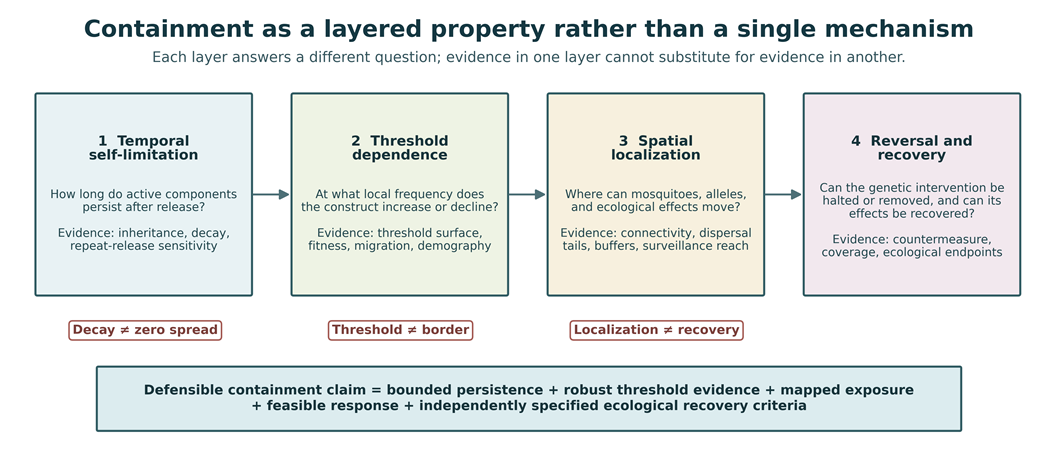
Figure 1 separates temporal self-limitation, threshold dependence, spatial localization, and reversal with ecological recovery as distinct layers of a defensible containment claim.
|
|
|
Figure 1. Containment as a layered property rather than a single mechanism |
Alt text
Four adjacent layers represent temporal self-limitation, threshold dependence, spatial localization, and reversal with recovery. Boundary labels state that decay is not zero spread, a threshold is not a border, and localization is not recovery. A lower band defines defensible containment as the combination of bounded persistence, robust threshold evidence, mapped exposure, feasible response, and independent ecological recovery criteria.
Figure 1 clarifies why the evidence package must remain layered. Temporal decline addresses duration; threshold behavior addresses establishment; spatial analysis addresses movement and connected populations; and reversal plus recovery addresses response after deviation. A containment claim becomes defensible only when these layers are integrated around a named construct, species, landscape, release regime, and monitoring capacity. None can be inferred from the others.
Ecological containment and evolutionary failure
Ecological containment concerns whether the intervention remains compatible with protection goals and whether deviations can be detected and managed before consequences become unacceptable. Genetic boundedness may reduce exposure, but it does not define ecological effect size, direction, duration, or recoverability. The relevant unit of analysis can include target mosquito abundance, pathogen transmission, predator-prey relations, competitive release, hybridization, and the distribution of effects across connected habitats.
Evolution can undermine both efficacy and containment assumptions. Multigeneration experiments in malaria mosquitoes demonstrate that drive-resistant mutations can be generated and selected, making evolutionary escape a foreseeable failure pathway rather than a purely theoretical concern [20]. Experiments across genetically diverse populations show that resistance formation and drive efficiency depend on construct design and genetic background, limiting extrapolation from a single strain [21]. Evidence from a homogeneous laboratory background should therefore be treated as a starting condition, not as a stable species-wide parameter.
Evolutionary models predict that resistance can arise through standing variation, end joining, or fitness-mediated selection, with the dominant pathway depending on target and population parameters [22]. Models of driving-Y suppression show that resistance can evolve at molecular or mating-system levels, so evolutionary failure analysis must extend beyond cleavage-site mutation [23]. Behavioral change, assortative mating, sex-specific fitness, altered density dependence, and migration can modify trajectories even when the targeted sequence remains susceptible. Monitoring plans that focus only on the target site may therefore miss functionally important resistance.
Adverse ecological outcomes must be specified as detectable causal pathways linked to protection goals, because absence of an observed signal is not equivalent to absence of ecological change [24]. A pathway should identify the initiating genetic or demographic event, intermediate ecological changes, the protected endpoint, plausible alternative explanations, and the measurement needed to discriminate among them. Table 2 translates this logic into containment-relevant failure domains. The table is not a probability ranking; it is a structured record of what must be tested, monitored, or retained as residual uncertainty.
Table 2. Evidence-to-decision interpretation across ecological containment and evolutionary failure
|
Failure domain |
Evidence that would increase confidence |
Failure signal |
Interpretive boundary |
|
Resistance and loss of function |
Diverse genetic backgrounds, multigeneration inheritance, target-site and functional assays. |
Increasing resistant alleles, reduced inheritance bias, altered sex ratio, fertility, or mating success. |
Target-site stability alone does not exclude behavioral, demographic, or polygenic resistance. |
|
Spatial escape |
Empirical movement data, connected-population analysis, seasonal scenarios, surveillance sensitivity. |
Modified mosquitoes or alleles beyond the expected exposure zone; repeated boundary crossings. |
Low frequency outside the site does not prove non-establishment or future decline. |
|
Ecological deviation |
Baseline variation, causal indicators, comparators, protection-goal thresholds, recovery measures. |
Persistent non-target, community, or ecosystem change inconsistent with the expected pathway. |
No detected signal may reflect low power, wrong timing, or an unsuitable indicator. |
|
Countermeasure failure |
Pretested compatibility, deployment logistics, coverage estimates, resistance analysis. |
Failure to halt spread, incomplete deletion, new persistence, or delayed ecological recovery. |
Molecular interruption does not establish ecological restoration. |
|
Institutional failure |
Named authority, funding, reporting rules, cross-border coordination, action triggers. |
Delayed disclosure, unclear responsibility, inability to pause, remediate, or sustain monitoring. |
A technically available response is not an operationally feasible response. |
Note: Entries define evidence boundaries and do not authorize release.
Decision gates before environmental release
A containment-first approach requires decision gates that stop evidence from being converted directly into release momentum. Environmental risk assessment for malaria gene drive requires problem formulation, explicit protection goals, plausible pathways to harm, and evidence proportionate to the proposed release [25]. Each gate should test a necessary condition, preserve uncertainty, and generate a written decision record. A favorable gate outcome means only that the specified condition has been addressed sufficiently for the next stage of evaluation.
Field-site selection is itself a containment decision because population structure, movement, surveillance access, ecological comparators, and community context affect both exposure and interpretability [26]. A site should not be selected only because it is remote, administratively convenient, or burdened by disease. The relevant question is whether biological connectivity is sufficiently understood, surveillance can detect departures from expected behavior, response can reach affected populations, and governance responsibilities extend across the plausible exposure zone.
Problem formulation can translate broad concerns into testable pathways to harm, but the resulting pathway map remains a decision aid rather than a prediction that a harm will occur [27]. Risk management for environmental releases should combine preventive design, spatial and temporal restrictions, monitoring, and responsive measures rather than rely on a single molecular safeguard [28]. Gates should therefore be cumulative. A strong molecular countermeasure cannot compensate for an uninterpretable site, and intensive monitoring cannot compensate for a failure mode that would become unmanageable before detection.
First field trials of low-threshold drives require an unusually demanding evidentiary and governance case because trial scale may not bound biological exposure in the manner of a conventional intervention trial [29]. Passing the gates proposed here would not authorize release. Authorization remains an external legal and political decision made by competent institutions under applicable rules, with its own conditions, accountability, and rights of review. Table 3 defines the proposed gates and their non-authorization scope.
Table 3. Proposed pre-release decision gates, minimum evidence, failure triggers, and non-authorization scope
|
Gate |
Minimum evidence |
Failure trigger |
Decision output |
|
1. Construct definition |
Product-specific endpoint, inheritance, persistence, target organism, component dependencies, and intended control pathway. |
Generic platform claims substitute for product evidence; target or genetic endpoint is ambiguous. |
Revise construct dossier or proceed to contained characterization. |
|
2. Temporal and threshold behavior |
Multigeneration decay, release-frequency response, fitness costs, repeat-release sensitivity, and threshold uncertainty. |
Persistence or threshold behavior exceeds the stated envelope; key parameters lack credible bounds. |
Redesign, collect discriminating evidence, or proceed with a bounded performance claim. |
|
3. Spatial exposure |
Population connectivity, dispersal tails, seasonal movement, uncertainty zones, buffer and surveillance reach. |
Plausible exposure extends beyond monitoring or response jurisdiction; model cannot discriminate trajectories. |
Reject site, expand evidence and coordination, or proceed with a mapped exposure envelope. |
|
4. Reversal and recovery |
Countermeasure endpoint, compatibility, timing, deployment coverage, residual construct, ecological recovery measures. |
Countermeasure is infeasible, creates unbounded secondary exposure, or lacks recovery endpoints. |
Redesign response strategy or proceed with explicit residual uncertainty. |
|
5. Eco-evolutionary failure |
Resistance pathways, ecological pathways to harm, baseline data, indicators, comparators, and detection power. |
Foreseeable deviation is undetectable or cannot be acted on before unacceptable consequence. |
Stop, redesign, or proceed with predefined monitoring and action triggers. |
|
6. Governance readiness |
Independent review, engagement record, responsible authorities, funding, reporting, cross-border arrangements, and stop authority. |
Roles, legitimacy, resources, or action authority are unresolved. |
Do not release; or submit a complete gate record to the separate authorization process. |
Note: Entries define evidence boundaries and do not authorize release.
Proposed containment-first architecture
The proposed architecture integrates the preceding distinctions into six linked components and an external authorization boundary. It is a scholarly structure to be tested, not a validated framework. Natural-population dynamics depend jointly on density dependence, space, and sex, requiring containment claims to be evaluated as system properties rather than construct labels [30]. The architecture therefore begins with a product-specific construct profile: intended endpoint, inheritance mechanism, persistence dependencies, target organism, release regime, and the causal pathway from genotype to vector-control effect.
The second component estimates temporal decay and threshold behavior across plausible fitness, migration, demographic, and repeat-release conditions. The third maps spatial exposure, including connected populations, dispersal tails, uncertainty zones, surveillance coverage, and jurisdictional reach. The fourth specifies molecular interruption and ecological recovery as separate response problems. It records what a countermeasure changes genetically, how it would be delivered, what resistance could occur, and which ecological endpoints would demonstrate recovery.
The fifth component maintains an eco-evolutionary failure register. Preliminary hazard workshops show the value of structuring risk questions before product definition is complete, while also demonstrating that a generic hazards list must later be localized and product-specific [31]. Regional problem-formulation consultations identify protection goals and concern pathways that technical teams may otherwise omit, supporting an architecture in which social and ecological questions shape evidence generation early [32]. The register should connect each concern to a mechanism, indicator, alternative explanation, detection limit, action threshold, and responsible authority.
Species complexes complicate the definition of the target organism and the boundary of exposure, so taxonomic uncertainty must be resolved before localization claims can be interpreted [33]. Eco-evolutionary models can organize uncertainty, identify discriminating measurements, and compare failure pathways, but they should update decision records rather than serve as stand-alone proof of safety [34]. The sixth component records gate outcomes, unresolved uncertainty, and any dissent before the architecture reaches the external authorization boundary.
Exact placement: Section 9, immediately after the paragraph ending, “The sixth component records gate outcomes, unresolved uncertainty, and any dissent before the architecture reaches the external authorization boundary.”
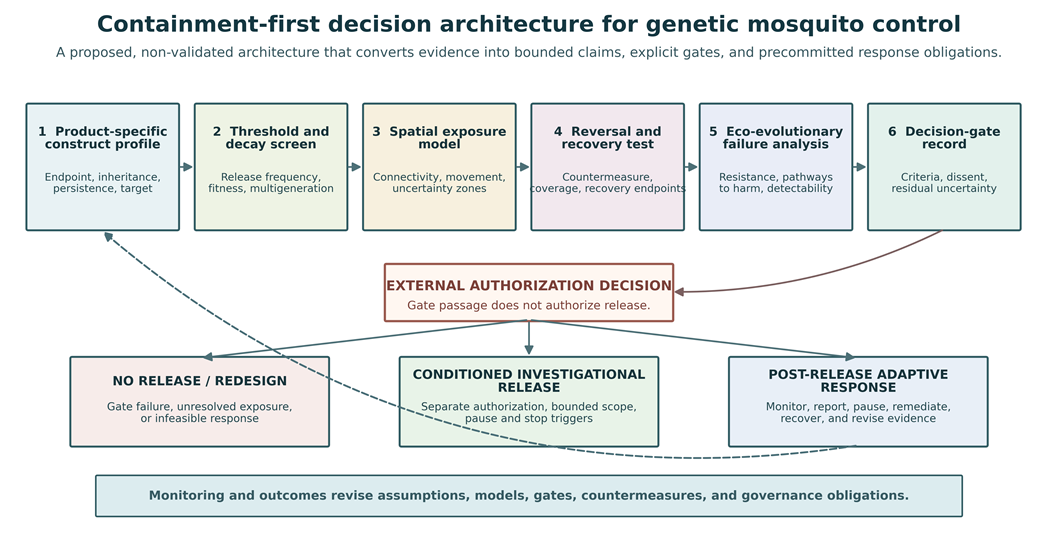
Figure 2 shows how the proposed architecture converts construct evidence into cumulative gates while preserving a separate authorization decision and a feedback path from monitoring to redesign.
|
|
|
Figure 2. Containment-first decision architecture for genetic mosquito control |
Caption
Original non-validated decision architecture. Six evidence components produce a gate record that can support redesign, non-release, or submission to an external authorization process. Authorization is not granted by the architecture. Where a conditioned investigational release is separately authorized, monitoring and outcomes feed back to assumptions, models, countermeasures, gates, and governance obligations. Arrows denote proposed decision relations, not empirically validated causal effects.
Alt text
Six modules run left to right: product-specific construct profile, threshold and decay screen, spatial exposure model, reversal and recovery test, eco-evolutionary failure analysis, and decision-gate record. The record points to an external authorization decision. Three outcomes appear below: no release or redesign, conditioned investigational release, and post-release adaptive response. A feedback arrow returns monitoring and outcomes to the first module.
Figure 2 makes two boundaries visible. First, the architecture can recommend redesign or non-release before authorization is considered. Second, a separately authorized investigational release remains conditional on monitoring, reporting, pause, stop, remediation, and recovery capacities. Evidence is not consumed when a gate is passed. It remains revisable, and new observations must return to the assumptions and models that justified the action.
Governance, monitoring, and research implications
Containment is partly an institutional capability. A molecular safeguard that cannot be deployed, a surveillance signal that has no responsible recipient, or a stop rule without legal and financial capacity is not an effective control. Knowledge engagement broadens governance beyond one-way communication by treating local, scientific, and institutional knowledge as inputs to how research questions and uncertainties are framed [35]. This is especially important where affected communities may identify movement patterns, ecological relationships, political histories, or practical response barriers that are absent from a technical dossier.
Stakeholder engagement for area-wide vector control is most defensible when it begins early, differentiates stakeholder roles, documents influence, and continues across development stages [36]. Engagement should not be represented as consent by default, nor should consultation substitute for independent assessment or public authority. Its evidentiary value lies in revealing protection goals, contested assumptions, distributional concerns, response feasibility, and the conditions under which institutions will be trusted to act.
Ugandan stakeholder accounts show that hopes and concerns extend across effectiveness, ecology, consent, accountability, and political trust, making legitimacy a substantive evidence domain rather than a final communication task [37]. A post-release monitoring pathway should connect protection goals, indicators, responsibilities, reporting thresholds, and response options from contained research through implementation [38]. Table 4 converts this principle into a monitoring structure that spans genetic, spatial, ecological, operational, and legitimacy signals.
Research should now test the architecture rather than merely repeat its components. Retrospective analysis can ask whether earlier programs would have produced different decisions if non-equivalence rules and cumulative gates had been explicit. Prospective contained studies can compare predicted and observed decay, threshold behavior, resistance, and countermeasure performance. Spatial research should quantify dispersal tails and uncertainty zones rather than only mean movement. Governance research should evaluate whether decision records preserve disagreement, whether affected knowledge changes study design, and whether monitoring thresholds reliably trigger action. The architecture should be revised when these tests reveal redundant components, missing pathways, or infeasible obligations.
Table 4. Monitoring indicators and adaptive governance responses across release phases
|
Domain |
Illustrative indicators |
Decision threshold |
Precommitted response |
|
Genetic state |
Construct and component frequencies, inheritance bias, target-site variants, functional resistance, countermeasure markers. |
Trajectory leaves the approved persistence or threshold envelope; resistance compromises expected control or response. |
Increase sampling; pause further release; update model; activate redesign or countermeasure review. |
|
Spatial exposure |
Modified mosquitoes or alleles inside buffers, at boundaries, and in connected populations; seasonal movement. |
Detection beyond the expected exposure zone or repeated crossings inconsistent with decline assumptions. |
Notify affected jurisdictions; expand surveillance; pause release; reassess response reach and authorization conditions. |
|
Ecological protection goals |
Target abundance, non-target indicators, community interactions, pathogen transmission, recovery endpoints. |
Persistent or accelerating deviation beyond baseline and comparator expectations, or loss of detection power. |
Investigate causal pathway; intensify monitoring; mitigate; pause or stop; initiate recovery plan. |
|
Operational capacity |
Sampling completion, laboratory turnaround, data quality, funding continuity, response readiness, reporting delay. |
Monitoring gaps prevent timely inference or responsible authority cannot implement a required action. |
Suspend release activity; restore capacity; disclose gap; reassess whether continued exposure is defensible. |
|
Legitimacy and accountability |
Documented concerns, access to information, grievance handling, institutional trust, cross-border communication. |
Material concerns are excluded from decisions, obligations are not met, or affected institutions cannot exercise oversight. |
Reopen engagement and review; publish decision rationale; adjust governance conditions; pause where legitimacy affects safe action. |
Note: Entries define evidence boundaries and do not authorize release.
CONCLUSION
Containment-first genetic mosquito control begins by refusing four substitutions: decay for zero spread, threshold behavior for a border, molecular interruption for ecological recovery, and scientific gate passage for authorization. The proposed architecture converts these distinctions into a product-specific evidence system spanning temporal behavior, spatial exposure, countermeasure feasibility, eco-evolutionary failure, cumulative gates, and adaptive monitoring. Its contribution is not a claim that environmental release can be made risk-free. It is a method for making the expected exposure envelope, residual uncertainty, response obligations, and institutional limits visible before release momentum becomes difficult to reverse. The architecture should remain provisional until its components and decision relations are tested across constructs, species, landscapes, and governance settings.
ACKNOWLEDGMENTS: None
CONFLICT OF INTEREST: None
FINANCIAL SUPPORT: None
ETHICS STATEMENT: None