Entomology and
Applied Science Letters
Applied Science Letters
 2025
Volume 12
Issue 2
2025
Volume 12
Issue 2

Genome editing can transform insect control by changing traits that influence fertility, sex ratio, pathogen competence, or inheritance across generations. Its significance, however, lies precisely in the possibility that a molecular intervention may become a population-level and ecological process whose spatial reach, persistence, and consequences are difficult to delimit. The central governance problem is therefore not whether an edit can be constructed, but under what conditions a heritable intervention can be considered sufficiently controllable, ecologically bounded, evolutionarily informed, and publicly legitimate to justify progression. This article develops an original, non-validated governance synthesis for responsible and reversible insect genome editing. It integrates architecture-specific technical evidence, differentiated meanings of molecular reversibility, spatial and ecological containment, evolutionary escape, long-term uncertainty, public legitimacy, consent, decision gates, and adaptive assurance. The synthesis shows that strong performance in laboratory or cage populations can establish biological plausibility without establishing operational effectiveness, environmental localization, ecosystem recoverability, or social authorization. Reversal tools may inhibit, overwrite, or dilute an engineered genotype, yet none necessarily restores a prior population or ecological state. Likewise, localized-drive designs remain dependent on migration, demography, fitness, taxonomic boundaries, and monitoring capacity. The evidence base is constrained by limited environmental experience, context-dependent models, incomplete ecological baselines, and the absence of direct demonstrations of post-release ecological reversibility. Responsible progression consequently requires layered safeguards that convert broad principles into claim-specific evidence requirements, stopping rules, independent review, continuing public governance, and funded response capacity. Genome editing should advance as a conditional and revisable research proposition, not as a technically enabled presumption of ecological or institutional readiness.
INTRODUCTION
Contemporary gene-drive systems are not a single intervention class but a family of architectures that differ in inheritance logic, intended biological endpoint, expected persistence, susceptibility to resistance, and potential for localization. Suppression drives seek to reduce or eliminate a target population, whereas population-modification systems seek to spread traits such as reduced pathogen competence while retaining the population. Split, threshold-dependent, self-exhausting, rescue, and inhibitory designs further alter how an engineered element may propagate or be controlled. Because these architectures can convert a molecular edit into a population process, their evaluation must extend beyond construct performance to encompass spatial reach, evolutionary durability, ecological consequence, and institutional responsibility. The possibility of spread beyond the initiating release area makes safety architecture and governance preconditions rather than downstream additions [1–3].
The decision context is unusually demanding because evidence, uncertainty, values, and authority cannot be cleanly separated. Questions about acceptable persistence, target-population reduction, indirect ecological change, transboundary exposure, and responsibility for future monitoring are not resolved by explaining the molecular mechanism more clearly. Gene-drive communication therefore operates in a setting where scientific uncertainty coexists with contested values, unequal power, and potentially distributed consequences [4]. Public reasoning must address not only what a system is designed to do, but also who defines the problem, which alternatives are compared, whose protection goals shape assessment, who may authorize progression, and which institutions remain accountable if assumptions fail.
A persistent conceptual gap follows from the tendency to compress distinct evaluative questions into broad labels such as safety, control, reversibility, or acceptance. Technical editability is often treated as if it establishes ecological acceptability; a molecular countermeasure is described as reversal even when it merely substitutes one engineered state for another; containment in insectaries or cages is allowed to stand in for localization in connected landscapes; and consultation is sometimes interpreted as consent despite uncertain representation, phase specificity, or transboundary exposure. These substitutions weaken evidence-to-action translation because they obscure the precise claim being tested and the scale at which it could be supported. A responsible governance structure must therefore preserve non-equivalence among molecular function, population dynamics, ecosystem effects, operational feasibility, and legitimate authorization.
This article develops an original responsible genome-editing governance synthesis organized around seven linked domains: the insect-control proposition, molecular reversibility, spatial and ecological containment, evolutionary escape, long-term uncertainty, public legitimacy, and staged assurance. Its central argument is that responsible progression depends on architecture-specific evidence and explicit decision boundaries rather than on a generalized balance of anticipated benefit and risk. The proposed structure is scholarly and non-validated: it does not claim regulatory status, universal applicability, or deployment readiness. Its purpose is to clarify which evidence supports which decision, which uncertainties remain material, where inference changes scale, and when a research programme should advance, be revised, pause, or stop.
Genome editing as an insect-control proposition
Genome editing becomes an insect-control proposition only when a molecular change is connected to a defined population or disease-control endpoint. Controlled studies illustrate both the power and diversity of this connection. A homing drive targeting the conserved doublesex locus demonstrated strong suppression of caged Anopheles gambiae populations; subsequent work in larger, age-structured cages tested suppression under more complex behavioural and demographic conditions; and population-modification research demonstrated a distinct strategy in which antiparasite traits are driven through mosquito populations rather than reducing vector abundance [5–7]. These findings establish biological plausibility for different intervention classes, but they do not establish equivalent forms of effectiveness. Cage suppression is not field suppression, successful inheritance is not epidemiological impact, and neither result determines whether ecological change is acceptable.
Mechanistic distinctions within suppression strategies also matter. A sex-distorter drive combines biased inheritance with X-chromosome shredding to produce male-biased progeny, creating a pathway to population decline that differs from fertility disruption [8]. The two mechanisms may generate different selection pressures, demographic trajectories, failure modes, and monitoring signals. Accordingly, the relevant unit of evaluation is not “gene drive” in the abstract but a specified construct operating in a defined species, genetic background, life stage, mating system, and ecological context. Evidence should connect editing fidelity, inheritance, phenotype, fitness, and resistance to the intended control endpoint while preserving uncertainty about transfer beyond the experimental setting.
Population modification requires an equally explicit evidence chain. Dual-effector strains in African malaria-vector mosquitoes integrate biased inheritance with antiparasite activity, but the public-health proposition remains conditional on cargo expression, parasite inhibition, mosquito fitness, resistance, population structure, and transmission assumptions [9]. A construct can therefore be technically functional while the overall intervention remains ecologically, epidemiologically, or operationally indeterminate. Responsible evaluation should compare the proposed genome-editing strategy with plausible alternatives, identify the protection goal, specify the intended duration and geographic reach, define failure and escape pathways, and state what evidence would justify the next research stage. The evidence dimensions and interpretive boundaries for genome editing as an insect-control proposition are summarized in Table 1.
Table 1. Genome Editing as an Insect-Control Proposition: Technical Evidence, Ecological Safeguards, Governance Requirements, Monitoring, Residual Risk, and Decision Boundaries
|
Decision stage or safeguard |
Evidence required |
Technical function |
Ecological function |
Governance requirement |
Failure or escape risk |
Monitoring or learning need |
Decision boundary |
|
Architecture specification |
Defined inheritance mechanism, target, cargo, intended endpoint, persistence, and alternatives |
Distinguishes suppression, modification, localized, and countermeasure systems |
Prevents ecological inference from an undifferentiated technology label |
Require architecture-specific justification before comparison or progression |
Misclassification hides distinct spread and failure pathways |
Update the intervention description when construct behaviour changes |
A generic “gene-drive” label is insufficient for an advancement decision |
|
Controlled suppression proof |
Verified editing, inheritance, target phenotype, fitness effects, and population response |
Tests whether the drive can generate the intended suppressive phenotype |
Provides no direct evidence of ecosystem response |
Treat cage efficacy as proof of biological proposition only |
Laboratory adaptation, simplified mating, or target-site resistance may distort performance |
Track inheritance, fertility, sex-specific effects, and resistance |
Strong cage suppression does not establish field effectiveness or ecological acceptability |
|
Large-cage transition |
Performance under greater behavioural, demographic, and environmental complexity |
Stress-tests construct function beyond small-cage conditions |
Improves ecological realism without creating an open ecosystem |
Predefine which uncertainties a larger cage is intended to reduce |
Apparent robustness may remain facility- or population-specific |
Compare model predictions with observed life-history and population dynamics |
Large-cage success is an intermediate evidence stage, not environmental validation |
|
Population-modification proof |
Stable inheritance, effector activity, fitness, and pathogen-related phenotype |
Spreads a disease-refractory trait without necessarily suppressing the vector |
Retains the target population but may alter ecological and evolutionary relations |
Evaluate modification separately from suppression and compare alternatives |
Cargo loss, resistance, fitness costs, or insufficient pathogen blocking |
Monitor cargo integrity, infection phenotype, fitness, and population spread |
Molecular and cage performance do not establish epidemiological benefit |
|
Mechanism-specific suppression assessment |
Sex ratio, fertility, mating competitiveness, inheritance, and resistance evidence |
Links a defined reproductive mechanism to population decline |
Supports mechanism-specific ecological scenarios |
Require failure analysis tailored to the reproductive pathway |
Compensation, mating effects, resistance, or demographic rebound |
Monitor sex ratio, reproductive output, and genotype-specific fitness |
Different suppression mechanisms cannot share an unqualified safety or efficacy claim |
|
Integrated modification proposition |
Joint evidence for inheritance, dual-effector function, fitness, and conditional transmission impact |
Couples drive propagation with antiparasite activity |
Connects vector modification to a prospective disease-control function |
Make epidemiological assumptions and uncertainty visible to decision-makers |
Effect decay, genetic-background effects, parasite adaptation, or model dependence |
Integrate genomic, entomological, parasitological, and epidemiological learning |
Technical functionality is necessary but insufficient for operational or public-health readiness |
Reversibility and molecular control
Reversibility should be treated as a set of specified endpoints rather than as a binary property. At minimum, governance must distinguish prevention of further drive activity, reduction of drive frequency, genetic overwriting, restoration of a prior genotype, recovery of population abundance, and recovery of ecological function. Anti-CRISPR mosquitoes provide evidence that genetically encoded inhibition can constrain a CRISPR-based drive and prevent suppression in controlled populations [10]. This is an important molecular countermeasure, but it supports a claim about inhibiting drive action, not a claim that the original allele distribution, demographic state, or ecosystem condition has been restored. Molecular reversal is therefore not equivalent to recoverable ecosystem effects.
Component separation offers another route to molecular control. A transcomplementing architecture can make drive activity dependent on the presence of separated genetic elements, improving experimental control and enabling staged investigation [11]. Split-drive systems can likewise lose autonomous propagation as components segregate, thereby reducing the potential for indefinite spread under specified conditions [12]. Yet self-limitation at the construct level does not guarantee spatial localization: components or linked cargo may persist, movement may carry them beyond the intended area, and performance observed in Drosophila cannot be transferred without qualification to mosquito species with different population structures and ecologies. Molecular confinement must therefore be tested as a mechanism, while ecological containment remains a separate claim.
Rescue drives further demonstrate why endpoint precision matters. A rescue system in Anopheles stephensi displaced a preceding population-modification configuration in cages, showing that genetic overwriting can be deliberately engineered [13]. Large-cage anti-CRISPR experiments also indicate that countermeasure performance can be challenged under more demanding behavioural and demographic conditions [14]. These advances strengthen the case for predesigned response options, but their assurance value depends on timing, release feasibility, mating competitiveness, spatial reach, countermeasure evolution, and the sensitivity of detection systems. A responsible programme should therefore define the adverse condition that activates a response, the molecular and ecological state the response is expected to achieve, the evidence required before relying on it, and the residual effects that remain after apparent control. No countermeasure should be described as reversible without naming the baseline, endpoint, spatial scale, temporal horizon, and validation test.
Spatial and ecological containment
Spatial outcomes arise from the interaction of drive architecture with movement, demography, seasonality, release strategy, and population connectivity rather than from inheritance performance alone. Spatially explicit malaria models show that geographic and temporal structure can change predicted intervention effects, national-scale models demonstrate the importance of migration and heterogeneous population dynamics, and daisy-chain designs propose self-exhausting inheritance as a route toward local alteration [15–17]. Together, these approaches support localization as a testable population-ecological proposition, not as an intrinsic label. Their predictions remain conditional on parameter quality, model structure, release geometry, fitness, and the correspondence between simulated and actual movement. Laboratory containment is not equivalent to environmental localization.
Threshold-dependent toxin-antidote systems offer a related strategy by making spread conditional on introduction frequency and population structure [18]. Such behaviour may support regional modification, but the threshold is not a universal constant: it can shift with migration, fitness costs, resistance, spatial heterogeneity, and temporal fluctuations in abundance. Environmental localization therefore requires convergent evidence from architecture-specific experiments, spatial models, field-derived movement data, and surveillance designs capable of detecting low-frequency spread beyond the intended area. A containment claim must also anticipate failure modes, including hidden connectivity, repeated human-mediated transport, delayed wave fronts, demographic refugia, or countermeasure failure. Administrative borders and release-site monitoring cannot substitute for biologically defined exposure boundaries.
Ecological containment extends beyond geographic restriction to the organisms, functions, and protection goals that could be affected. In species complexes, nominal taxonomy may not correspond to reproductive or ecological boundaries; hybridization, introgression, and geographically variable gene flow can change which populations qualify as target organisms [19]. The proposed synthesis therefore links four components: molecular architecture, spatial population dynamics, target-organism definition, and ecological pathways of effect. Required inputs include geographically representative dispersal and seasonality data, wild genetic diversity, ecological baselines, plausible receptors, and explicit protection goals. The expected output is not a declaration of containment but a bounded, revisable claim with stated residual uncertainty. Advancement should pause when target boundaries are unresolved, models are structurally underdetermined, monitoring lacks adequate coverage or sensitivity, or response capacity cannot plausibly reach escaped populations. Validation requires independent spatial-model comparison, field-relevant parameterization, sentinel surveillance beyond the intended release area, and longitudinal testing of direct and indirect ecological endpoints.
Evolutionary escape and long-term uncertainty
Evolutionary escape is not an external complication added after construct design; it is generated by the intervention’s own selection pressures. Multi-generation experiments in Anopheles gambiae documented resistant alleles capable of undermining a suppression drive, showing that high initial inheritance does not guarantee durable control [20]. Resistance may arise through end-joining repair, standing target-site variation, fitness differences, or selection acting on construct components. Evidence of short-term drive performance must therefore be accompanied by an explicit account of the evolutionary conditions under which performance may decay.
Theoretical analyses similarly show that gene-drive trajectories depend on the interaction among inheritance advantage, fitness cost, resistance formation, population structure, and release strategy [21]. Experiments with genetically diverse populations further indicate that resistance mechanisms and drive efficiency can vary across backgrounds rather than remaining properties of a construct alone [22]. Evolutionary robustness should consequently be evaluated across representative genetic diversity, not inferred from a single laboratory strain. Alternative explanations for apparent stability—including insufficient duration, low diversity, or weak ecological realism—must remain visible.
Multiplexed targeting and guide-design strategies can reduce some routes to resistance, but they do not eliminate evolutionary uncertainty [23]. Non-functional resistant alleles, parental deposition effects, and stage-specific cleavage can alter both suppression dynamics and inheritance predictions [24]. Long-term assurance therefore requires surveillance for target-site change, cargo degradation, compensatory evolution, altered fitness, and population rebound. A responsible claim is not that escape has been prevented permanently, but that plausible escape pathways have been characterized, monitored, and connected to predefined stopping or response rules.
Public legitimacy, consent, and governance
Public legitimacy requires more than information delivery. Experience from gene-drive research for malaria control shows that knowledge engagement must be iterative, locally grounded, and connected to the evolving scientific programme [25]. Engagement should allow affected communities to shape questions, identify valued ecological and social outcomes, challenge assumptions, and influence whether or how research progresses. Consultation that merely explains a predetermined project cannot establish enduring authorization.
Guidance for area-wide vector-control research further emphasizes early engagement, stakeholder mapping, transparency, responsiveness, and continuity across development stages [26]. These practices are necessary because potentially mobile organisms can affect communities beyond a release site. Consent cannot therefore be reduced to a single local approval event. Governance must distinguish individual participation, community authorization, institutional permission, regional coordination, and transboundary legitimacy, while acknowledging that no single mechanism represents every affected interest.
Public perceptions can vary with perceived benefit, trust, controllability, fairness, and uncertainty [27]. Experience with a non-gene-drive mosquito release in Burkina Faso also illustrates that engagement is a learning process whose quality must be assessed rather than assumed [28]. Legitimacy is therefore relational and revisable: it depends on whether institutions remain accountable, disclose uncertainty, respond to concerns, and preserve opportunities to pause or withdraw support. The evidence dimensions and interpretive boundaries for public legitimacy consent and governance are summarized in Table 2.
Table 2. Public Legitimacy, Consent, and Governance: Technical Evidence, Ecological Safeguards, Governance Requirements, Monitoring, Residual Risk, and Decision Boundaries
|
Decision stage or safeguard |
Evidence required |
Technical function |
Ecological function |
Governance requirement |
Failure or escape risk |
Monitoring or learning need |
Decision boundary |
|
Problem definition |
Documented local priorities and alternatives |
Aligns design with the stated control problem |
Identifies valued species, functions, and protection goals |
Include affected communities before design choices harden |
Technology-led framing excludes relevant harms or options |
Record changing priorities and unresolved disagreement |
No progression when the problem definition lacks legitimate local grounding |
|
Stakeholder identification |
Mapping of affected, vulnerable, mobile, and transboundary groups |
Clarifies who may influence or experience the intervention |
Extends attention beyond the release site |
Use transparent and revisable representation processes |
Powerful institutions may displace less visible interests |
Audit representation, participation barriers, and exclusions |
Consultation with a narrow group cannot stand for broad consent |
|
Information and deliberation |
Accessible explanation of mechanism, uncertainty, alternatives, and reversibility limits |
Supports informed assessment of technical claims |
Makes ecological uncertainty discussable |
Enable questioning, dissent, and independent advice |
Communication may become promotional or selectively reassuring |
Evaluate comprehension, trust, concern, and unresolved questions |
Information delivery alone does not establish legitimacy |
|
Phase-specific authorization |
Evidence that support remains meaningful at each research stage |
Links authorization to the actual intervention stage |
Reassesses changing exposure and ecological scope |
Renew engagement as evidence, design, or geography changes |
Early support may be treated as permanent permission |
Track changing views and reasons for support or opposition |
Prior consultation cannot authorize materially different later actions |
|
Accountability and learning |
Publicly defined commitments, response routes, and feedback mechanisms |
Connects technical decisions to responsible institutions |
Supports response to unexpected ecological observations |
Report decisions, uncertainties, incidents, and corrective actions |
Trust erodes when commitments are vague or unenforceable |
Independently assess engagement quality and institutional response |
Progression stops when accountability and remedy mechanisms are absent |
Proposed responsible genome-editing principles
The proposed synthesis begins with purpose proportionality: the scale, persistence, and uncertainty of an intervention should be proportionate to the seriousness of the problem and the limitations of available alternatives. Ethical analysis of gene drives in conservation shows that anticipated benefits cannot displace questions about ecological value, responsibility, uncertainty, and intervention legitimacy [29]. Each programme should therefore state the protection goal, comparison set, intended duration, affected population, and acceptable residual uncertainty before technical performance is interpreted.
The second principle is differentiated readiness. Technical readiness, ecological readiness, operational feasibility, and governance legitimacy should be evaluated separately. A procedurally robust risk-assessment approach supports explicit problem formulation, plural perspectives, iterative review, and transparency about value-laden choices [30]. High construct performance cannot compensate for an undefined target population, inadequate monitoring, unavailable countermeasures, or unresolved authority. Progression requires all decision-relevant domains to meet their own evidence conditions.
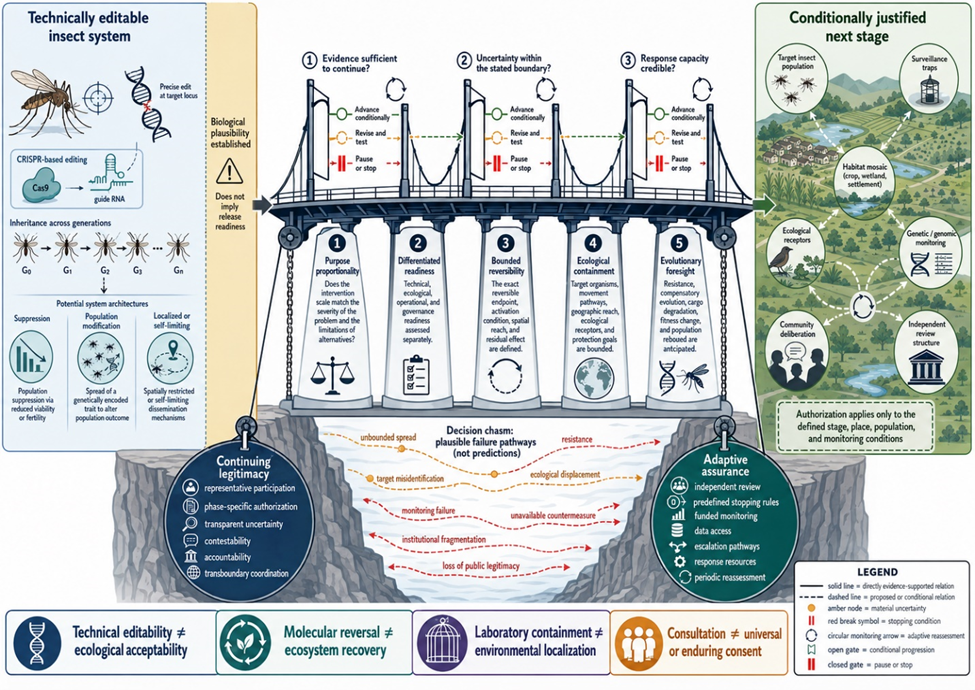
The third and fourth principles are bounded reversibility and continuing legitimacy. Ethical scholarship on non-human genome editing emphasizes welfare, ecological, relational, and responsibility considerations that extend beyond technical feasibility [31]. Governance proposals grounded in local institutions show that global consequences require locally legitimate and internationally connected decision processes [32]. Community-guided work on genetically altering mice further illustrates how problem definition, design choice, and public reasoning can be linked from the outset [33]. Figure 1 shows the technical-to-governance decision pathway within the analytical logic developed in this section.
|
|
|
Figure 1. The technical-to-governance decision pathway |
Alt text
A structured conceptual diagram that shows the technical-to-governance decision pathway, with labelled components, directional relations, contextual modifiers, uncertainty points, and a clear boundary between observed evidence and proposed synthesis.
The fifth principle is adaptive assurance. Evidence obligations should increase as containment decreases, ecological exposure expands, and consequences become harder to reverse. Monitoring must be treated as an intervention component, with defined indicators, baselines, responsibility, duration, data access, escalation routes, and response resources. The proposed principles do not create a validated framework or universal formula. They organize distinct claims so that scientific evidence, uncertainty, ecological protection, and legitimate authorization remain connected without being treated as interchangeable. The proposed components, evidence bases, boundary conditions, failure modes, and validation requirements are organized in Table 3.
Table 3. Proposed Responsible Genome-Editing Principles: Components, Evidence Basis, Relations, Boundary Conditions, Failure Modes, and Validation Requirements
|
Proposed component |
Purpose |
Evidence basis |
Relation or mechanism |
Input or precondition |
Expected output |
Boundary condition or failure mode |
Validation requirement |
|
Purpose proportionality |
Match intervention scale to the problem and alternatives |
Ethical analysis of gene-drive intervention |
Connects expected benefit, persistence, uncertainty, and alternatives |
Defined protection goal and comparison set |
Justified intervention scope |
Benefit claims dominate ecological or ethical uncertainty |
Independent comparison with feasible alternatives |
|
Differentiated readiness |
Prevent technical performance from substituting for broader readiness |
Procedurally robust assessment |
Separates technical, ecological, operational, and governance judgments |
Domain-specific evidence requirements |
Transparent readiness profile |
Strong evidence in one domain masks weakness in another |
Independent review of each readiness domain |
|
Bounded reversibility |
Specify what can be stopped, overwritten, restored, or recovered |
Molecular-control evidence and ethical limits |
Links countermeasure function to a defined endpoint |
Baseline, activation rule, response capacity, and monitoring |
Qualified reversibility claim |
Molecular control is presented as ecosystem restoration |
Controlled and field-relevant testing of stated endpoints |
|
Ecological containment |
Bound intended organisms, places, pathways, and effects |
Spatial models, localized systems, and target-definition evidence |
Integrates movement, demography, taxonomy, and ecological pathways |
Representative movement, genetic, and ecological data |
Revisable containment case |
Hidden connectivity or unresolved target boundaries |
External model comparison and beyond-boundary surveillance |
|
Evolutionary foresight |
Anticipate resistance, compensation, and performance decay |
Experimental and theoretical evolutionary evidence |
Connects design choices to selection and long-term surveillance |
Diverse backgrounds and plausible evolutionary scenarios |
Explicit escape and adaptation plan |
Short-term stability is treated as permanence |
Multi-generation testing and genomic monitoring |
|
Continuing legitimacy |
Keep authorization responsive to changing evidence and scope |
Engagement, governance, and community-guided evidence |
Links participation to staged decisions and accountability |
Representative engagement and accessible uncertainty disclosure |
Revisable social authorization |
Consultation is treated as universal or enduring consent |
Independent evaluation of representation and responsiveness |
|
Adaptive assurance |
Increase safeguards with exposure and irreversibility |
Proposed synthesis across the evidence base |
Connects decision gates, monitoring, stopping rules, and response |
Defined indicators, responsibilities, resources, and review |
Conditional progression or pause |
Monitoring is unfunded, insensitive, or institutionally weak |
Prospective exercises and periodic assurance review |
Decision gates and assurance requirements
Decision gates translate broad responsibility into evidence-linked choices. Problem formulation for investigational releases of population-suppression gene drives demonstrates how plausible pathways to harm can be identified before environmental exposure [34]. A gate should specify the claim under review, evidence required, uncertainty that remains acceptable, responsible decision body, stopping condition, and consequence of failure. Passing one gate authorizes only the next bounded stage; it does not establish general safety or future release entitlement.
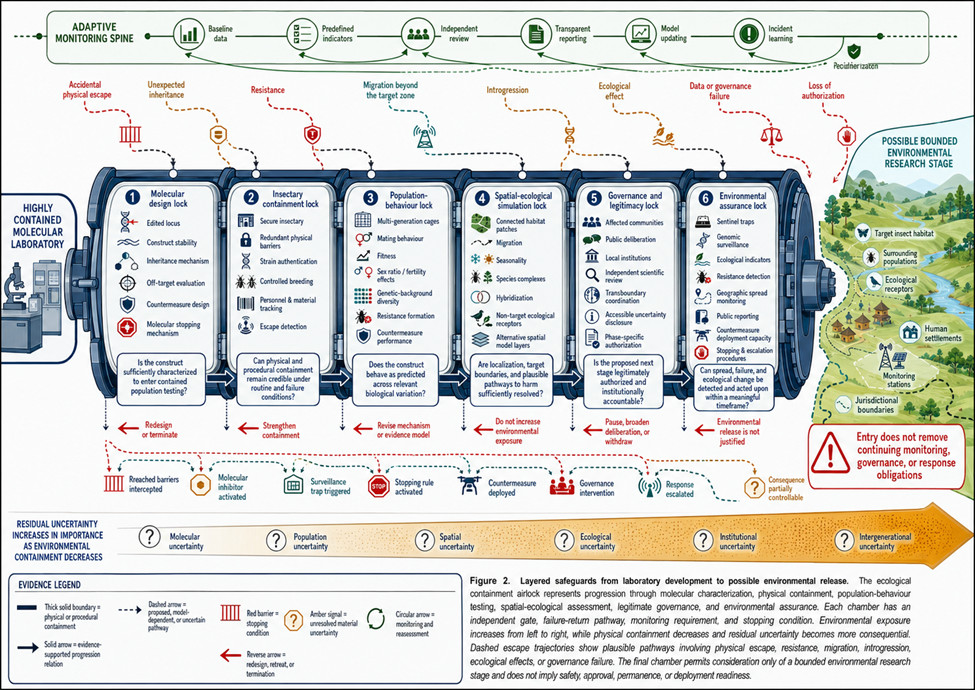
Preliminary hazard-list workshops for population-modification mosquitoes illustrate the value of structured, multidisciplinary anticipation of potential harms [35]. Core commitments proposed for gene-drive field trials similarly emphasize transparency, engagement, risk assessment, monitoring, governance, and accountability [36]. These sources support layered assurance rather than a single approval event. Evidence should accumulate from molecular characterization through controlled populations, ecological modelling, contained semi-field work, and only then any possible environmental release. Figure 2 presents layered safeguards from laboratory development to possible environmental release within the analytical logic developed in this section.
|
|
|
Figure 2. Layered safeguards from laboratory development to possible environmental release |
Alt text
A structured conceptual diagram that presents layered safeguards from laboratory development to possible environmental release, with labelled components, directional relations, contextual modifiers, uncertainty points, and a clear boundary between observed evidence and proposed synthesis.
Assurance must continue after any release rather than ending at authorization. Proposed post-release monitoring pathways for gene-drive mosquitoes emphasize surveillance, governance coordination, data interpretation, and response planning across extended periods [37]. Monitoring should detect intended spread, off-target geographic movement, resistance, phenotype decay, population recovery, ecological change, and unexpected effects. Advancement should stop when critical assumptions cannot be tested, monitoring is not sufficiently sensitive, response measures are infeasible, responsibility is fragmented, or public authorization is materially unresolved. The evidence dimensions and interpretive boundaries for decision gates and assurance requirements are summarized in Table 4.
Table 4. Decision Gates and Assurance Requirements: Technical Evidence, Ecological Safeguards, Governance Requirements, Monitoring, Residual Risk, and Decision Boundaries
|
Decision stage or safeguard |
Evidence required |
Technical function |
Ecological function |
Governance requirement |
Failure or escape risk |
Monitoring or learning need |
Decision boundary |
|
Problem-formulation gate |
Defined protection goals, alternatives, pathways to harm, and decision scope |
Frames construct-specific technical questions |
Identifies ecological receptors and exposure pathways |
Include multidisciplinary and affected-party input |
Relevant harm pathways may be omitted |
Revise pathways as evidence or design changes |
No progression with unresolved critical harm pathways |
|
Molecular-characterization gate |
Editing specificity, inheritance, phenotype, stability, and countermeasure evidence |
Establishes construct function under controlled conditions |
Supports only preliminary ecological hypotheses |
Independent verification and transparent reporting |
Off-target effects, instability, or ineffective control |
Monitor construct integrity and emergent resistance |
Technical function does not establish ecological readiness |
|
Contained-population gate |
Multi-generation, diverse-background, behavioural, and demographic evidence |
Tests drive and countermeasure performance |
Adds realism without open environmental exposure |
Predefine success, failure, and stopping criteria |
Facility-specific results may be overgeneralized |
Compare observed dynamics with model predictions |
Cage success cannot authorize environmental release by itself |
|
Ecological-assurance gate |
Spatial models, target boundaries, ecological baselines, and monitoring design |
Connects architecture to predicted spread |
Tests localization and pathways to ecological effect |
Require independent review and transboundary coordination |
Hidden connectivity or weak baseline data |
Surveillance beyond the intended intervention boundary |
Pause when localization or ecological detection is not credible |
|
Legitimacy gate |
Representative, informed, continuing, and accountable engagement |
Clarifies the authorized research stage |
Incorporates locally valued ecological protections |
Separate consultation, permission, consent, and public accountability |
Early engagement may be treated as permanent approval |
Reassess views as scope, evidence, or uncertainty changes |
No progression when materially affected groups lack meaningful participation |
|
Release and monitoring gate |
Operational readiness, response capacity, funded surveillance, and reporting |
Enables controlled implementation of the specified stage |
Detects spread, resistance, rebound, and ecological change |
Assign durable responsibility, data access, and escalation authority |
Delayed detection or unavailable response may make effects uncontrollable |
Longitudinal technical, ecological, and social monitoring |
Release is unjustified without feasible detection and response capacity |
CONCLUSION
Responsible insect genome editing requires more than a functional construct or a plausible control benefit. It requires explicit separation of technical editability from ecological acceptability, molecular reversal from ecosystem recovery, laboratory containment from environmental localization, and consultation from universal or enduring consent. The strongest defensible synthesis is therefore conditional: progression may be justified only when architecture-specific performance, spatial and ecological boundaries, evolutionary escape pathways, countermeasure limits, monitoring capacity, institutional accountability, and continuing public legitimacy are jointly examined through staged decision gates. The proposed structure is not a validated or deployment-ready framework; it is an evidence-grounded organization of responsibilities, claims, and stopping conditions. Its principal implication is that reversibility must be designed as a multilayered capacity to prevent, detect, inhibit, respond, learn, and remain accountable—not as a single molecular feature. Where consequences may spread across populations, ecosystems, generations, or jurisdictions, the burden of assurance should increase rather than diminish as environmental exposure becomes harder to contain.
ACKNOWLEDGMENTS: None
CONFLICT OF INTEREST: None
FINANCIAL SUPPORT: None
ETHICS STATEMENT: None