Entomology and
Applied Science Letters
Applied Science Letters
 2026
Volume 13
Issue 2
2026
Volume 13
Issue 2

Insect-associated microorganisms contribute to nutrition, development, immunity, detoxification, reproduction, pathogen susceptibility, and ecological adaptation, making microbiome manipulation a potentially powerful route for studying and modifying insect phenotypes. Conventional community-level interventions, however, often lack the taxonomic and functional resolution needed to alter a selected bacterial population without producing broader ecological disturbance. Bacteriophages offer a potentially more precise intervention class because their host-recognition structures, infection programmes, lytic activity, and capacity to deliver programmable genetic cargo can be adapted to bacterial strains or functions. This article develops an evidence-grounded safety-by-design agenda for phage-guided editing of insect microbiomes. It integrates evidence concerning phage targeting, bacterial specificity, symbiont function, resistance evolution, community restructuring, reversibility, containment, environmental exposure, and governance. The synthesis indicates that phages can support targeted bacterial depletion, sequence-specific genetic alteration, and functional manipulation, but the meaning of precision changes across molecular, bacterial, community, host, and environmental scales. Narrow activity in culture does not establish ecological specificity; phage susceptibility does not demonstrate stable functional editing; removal or inactivation of a genetic payload does not ensure community recovery; and targeted manipulation does not itself establish environmental safety. These distinctions are especially important in insects because microbial localization, host life stage, vertical or horizontal transmission, environmental reacquisition, and population connectivity can alter intervention outcomes. The proposed agenda therefore organizes development around explicit target definitions, causal validation, resistance forecasting, community monitoring, reversibility testing, layered containment, and staged ecological evaluation. It is a non-validated conceptual synthesis intended to guide experimental design and responsible evaluation rather than a deployment-ready framework.
INTRODUCTION
Insect microbiomes range from transient environmental assemblages to highly integrated symbioses that influence host physiology and ecological performance. This variation matters because the presence of a microbial sequence or cultured isolate does not establish that the organism is a persistent resident, performs a stable function, or is accessible to intervention. Experimental work in Drosophila has shown that persistent association must be distinguished from repeated environmental reacquisition when assigning host-related function to a bacterial symbiont [1]. The distinction is central to phage-guided editing: an intervention directed at a transient dietary bacterium presents different biological and ecological questions from one directed at a bacterium that colonizes a defined gut niche, circulates among nestmates, or is transmitted across host generations. A target must therefore be defined not only taxonomically but also by its anatomical location, temporal persistence, mode of transmission, and contribution to the host phenotype under investigation.
The functional diversity of insect-associated bacteria further complicates intervention design. Gut bacteria have been implicated in digestion, essential nutrient provisioning, detoxification, immune modulation, development, and protection from natural enemies, but the strength and type of evidence supporting these roles vary substantially among insect systems [2]. Genomic potential, differential abundance, metabolite association, bacterial removal, recolonization, and direct genetic manipulation represent different levels of causal support. Treating them as interchangeable can produce circular reasoning: a bacterium is selected as an editing target because it correlates with a host phenotype, and a subsequent change in that phenotype is then attributed to the bacterium without demonstrating the intervening mechanism. Phage-guided manipulation can strengthen causal analysis when it changes a nominated bacterial population or gene while preserving suitable comparators, but it can also introduce new confounding through bacterial lysis, released cellular material, altered competition, or selection for resistant variants.
The biological accessibility of the candidate symbiont is equally important. Insect-associated bacteria may occupy the gut lumen, gut epithelium, specialized bacteriocytes, haemolymph, reproductive tissues, intracellular compartments, external secretions, or environmentally maintained reservoirs. They may be acquired from food, transferred socially, transmitted maternally, or repeatedly recolonized from habitat. These differences determine whether a phage can encounter the bacterium, whether receptor expression is maintained in vivo, whether the phage can replicate or deliver genetic cargo, and whether modified bacteria can persist. Comparative work on engineering insect symbionts therefore emphasizes that extracellular gut associates, intracellular endosymbionts, and vertically inherited bacteria are not equivalent engineering substrates [3]. A successful phage platform for a cultivable gut bacterium cannot be assumed to function against a bacteriocyte-associated symbiont or a microorganism protected within reproductive tissues.
Against this background, the central problem is not simply whether phages can attack insect-associated bacteria. It is whether phages can produce a specified and causally interpretable microbial change while limiting unintended evolutionary, community, host, and environmental consequences. This article addresses that problem by developing a safety-by-design agenda for targeted and potentially reversible manipulation of insect symbionts. The analysis proceeds from the sources of phage precision to target recognition, functional editing, resistance, community effects, containment, ecological safety, and governance. Throughout, four boundaries organize interpretation: bacterial specificity in vitro is not equivalent to ecological specificity; phage susceptibility is not equivalent to stable functional editing; genetic reversibility is not equivalent to community recovery; and targeted manipulation is not equivalent to environmental safety. The proposed structure is an original, non-validated scholarly synthesis intended to define what evidence would be required before stronger claims about precision, reversibility, or safety could be justified.
Why phages offer precision in microbiome manipulation
Phages offer precision because bacterial infection depends on a sequence of selective interactions rather than indiscriminate antimicrobial exposure. Encounter, adsorption, receptor compatibility, intracellular defence evasion, replication, lysis, and cargo delivery can each restrict activity to particular bacterial populations. This selectivity can be used for direct depletion, ecological perturbation, or delivery of sequence-programmable systems. In a defined gut community, targeted lytic phages reduced nominated bacterial populations but also altered non-target taxa and community metabolites, demonstrating both the power and the limitation of phage selectivity [4]. The direct target response was comparatively narrow, yet its ecological consequences propagated through the community. Phage-delivered CRISPR systems have provided an additional layer of sequence specificity by enabling strain-selective depletion and genomic deletion in colonized hosts [5]. Such systems can discriminate among closely related bacteria when the delivery phage reaches the intended cells and the genetic target is present, but escape can occur through loss or inactivation of the targeting machinery.
The intervention output can also extend beyond killing. Phage-derived delivery particles have produced targeted bacterial base edits in the gut, with edited cells persisting after treatment even when the delivery vehicle itself was not maintained [6]. This separates two forms of reversibility that are often conflated. A phage particle or genetic payload may be transient, while the induced bacterial genotype remains stable; conversely, the edited strain may decline while community-level effects persist through altered competition or resource use. Engineered phages combining modified host-recognition structures with CRISPR-mediated antibacterial activity have also broadened strain coverage and reduced intestinal bacterial burden in animal models [7]. These findings establish that phage platforms can be programmed at both the delivery and cargo levels. They do not establish that equivalent activity will occur in insects, where smaller bacterial populations, discontinuous feeding, moulting, metamorphosis, gut compartmentalization, social transmission, and environmental reacquisition may alter phage–bacterium encounters.
Precision should therefore be treated as a multidimensional claim rather than a single attribute. Molecular precision concerns receptor binding or sequence recognition; bacterial precision concerns discrimination among strains; functional precision concerns alteration of a nominated microbial pathway; community precision concerns the absence or boundedness of indirect effects; host precision concerns restriction of the resulting phenotype to the intended biological process; and ecological precision concerns containment across individuals, generations, associated species, and environmental reservoirs. Evidence at one level cannot substitute for evidence at another. A phage may display narrow lytic activity in culture while producing substantial community effects after removal of a dominant bacterium. A sequence-specific editor may modify only the intended locus while the edited phenotype changes bacterial fitness, transmission, or competition. The evidence dimensions and interpretive boundaries for phages offer precision in microbiome manipulation are summarized in Table 1.
Table 1. Why Phages Offer Precision in Microbiome Manipulation: Host Context, Microbial Functions, Causal Evidence, Community Stability, Ecological Risk, and Interpretive Boundaries
|
Microbial component or intervention |
Host context |
Proposed function |
Evidence required |
Causal test |
Stability or transmission issue |
Ecological risk |
Interpretive boundary |
|
Persistent resident bacterium |
Defined insect gut niche |
Nutrition, development, immune modulation, or colonization resistance |
Repeated detection, localization, host-associated persistence, and exclusion of continuous environmental reacquisition |
Removal followed by controlled recolonization or functional rescue |
Persistence may vary with diet, life stage, moulting, or habitat exposure |
Replacement by ecological competitors or altered host dependence |
Bacterial detection is not evidence of stable residency or function |
|
Functionally inferred gut community member |
Diverse insect gut systems |
Digestion, detoxification, or essential nutrient provision |
Concordant genomic, expression, metabolite, and phenotype evidence |
Targeted removal or genetic disruption with appropriate controls |
Function may depend on community partners or host developmental stage |
Loss of complementary functions or compensatory expansion of other taxa |
Functional potential is not demonstrated causal function |
|
Engineered insect symbiont |
Gut, intracellular, reproductive, or vertically transmitted association |
Delivery of a host-modifying or pathogen-limiting function |
Localization, cultivability, transmission, expression, and host-phenotype evidence |
Isogenic engineered and non-engineered symbiont comparison |
Vertical and horizontal transmission may extend persistence beyond treated insects |
Spread among untreated hosts or into environmental reservoirs |
Engineering feasibility in one symbiont class is not transferable to another |
|
Lytic phage targeting a nominated bacterium |
Host-associated microbial community |
Selective bacterial depletion |
Target and non-target abundance, phage kinetics, and community-function measurements |
Cognate phage compared with non-targeting phage and phage-free controls |
Target rebound may follow refuges, resistance, or reacquisition |
Competitive release and altered metabolite production |
Targeted depletion is not an ecologically isolated intervention |
|
Phage-delivered CRISPR antimicrobial |
Colonized bacterial population |
Strain-selective killing or genomic deletion |
Delivery efficiency, target-sequence confirmation, bacterial burden, and escape analysis |
Targeting versus non-targeting guide with matched delivery vehicle |
Targeting elements may be lost; resistant cells may expand |
Selection for escape variants or altered strain competition |
Sequence specificity is not stable functional editing |
|
Phage-derived bacterial base editor |
Gut-associated target strain |
Precise nucleotide alteration without broad bacterial killing |
Edit frequency, off-target sequencing, phenotype, and longitudinal persistence |
Editor, inactive editor, non-targeting guide, and revertant comparison |
Delivery vehicle may disappear while the edited genotype persists |
Durable fitness, transmission, or community changes |
Genetic payload reversibility is not reversal of the bacterial edit |
|
Engineered host-range phage combination |
Diverse strains of a target bacterial species |
Expanded strain coverage and reduced target burden |
Representative strain panels, receptor analysis, in vivo activity, and resistance monitoring |
Component phages and combination tested independently |
Differential replication may shift cocktail composition |
Expanded host range may expose untested non-target bacteria |
Broader target coverage is not evidence of ecological safety |
|
Phage-resistant target derivative |
Insect-associated bacterial population under selection |
Survival under phage exposure |
Resistance mechanism, stability, fitness, symbiont function, and transmission |
Resistant isolate compared with susceptible ancestor in the insect host |
Resistance may be transient, costly, compensable, or vertically transmitted |
New host phenotypes, cross-resistance, or altered community competition |
Resistance is not merely restoration of the pre-intervention state |
Target recognition and bacterial specificity
Phage specificity begins with recognition, but recognition is only one part of a conditional infection phenotype. Host range emerges from adsorption to bacterial surface structures, compatibility with intracellular machinery, evasion of restriction, abortive-infection and CRISPR-associated defences, and the ability to complete productive infection under the prevailing physiological conditions. It may also shift through receptor variation, phase-variable surface expression, bacterial stress, spatial structure, co-infection, and reciprocal evolution. Recent synthesis therefore characterizes host range as a dynamic property rather than a fixed phage label [8]. This distinction is especially important for insect-associated bacteria, because isolates tested in nutrient-rich culture may express different capsules, pili, lipopolysaccharides, membrane proteins, or metabolic states from bacteria residing in the insect gut. A positive plaque assay demonstrates productive infection under the assay conditions; it does not establish that the same interaction will occur within an insect or that the phage will remain restricted to the intended target after environmental exposure.
Ecological specificity is consequently broader than bacterial specificity measured in vitro. Molecular and ecological analyses show that realized host range is determined jointly by receptor compatibility, bacterial defence, local environmental conditions, encounter probability, community structure, and evolutionary change [9]. An apparently narrow phage may infect additional strains under different physiological conditions, while a broadly active phage may reach only a small fraction of susceptible bacteria because targets are spatially protected or numerically rare. Specificity assessment for insect applications should therefore include bacterial isolates from the intended host population, different host life stages, physiologically relevant growth states, co-resident community members, and environmentally encountered bacteria. Negative evidence is as important as positive coverage: demonstrating activity against the nominated strain is insufficient without testing plausible non-targets and explaining how the test panel represents the exposure environment.
Structural studies illustrate the molecular basis of recognition while also showing why receptor identity alone is an incomplete predictor. The long tail fibre of bacteriophage T4 contains coordinated receptor-binding elements that interact with distinct bacterial surface structures during attachment [10]. Productive infection nevertheless requires successful progression beyond adsorption. Engineering these structures can modify bacterial range. Tail-fibre mutagenesis has generated phage variants with altered host recognition and has, in some contexts, delayed the emergence of bacterial resistance [11]. Yet host-range expansion changes the intervention’s ecological opportunity set: a variant designed to capture resistant target strains may also interact with previously excluded bacteria. Safety-by-design assessment must therefore connect structural modification to empirical host-range mapping, sequence-level cargo specificity, bacterial defence profiling, and community-level testing. Bacterial specificity in vitro is not equivalent to ecological specificity because the latter depends on where the phage travels, which bacteria it encounters, how host physiology alters susceptibility, and how infection changes subsequent community and evolutionary dynamics.
Functional editing of insect symbionts
Functional editing requires more than reducing the abundance of a bacterial target. It requires evidence that a specified microbial property has changed and that this change causally explains the intended host or ecological outcome. Insect systems provide strong evidence that phage-associated genes can control consequential symbiont functions. Experimental transfer of the APSE3 bacteriophage into a phage-free strain of the aphid symbiont Hamiltonella defensa conferred the ability to disrupt parasitoid development [12]. This establishes a direct route from a phage-associated genetic element to defensive symbiosis. It also demonstrates why ecological interpretation cannot stop at the bacterial phenotype: altering such a function may change parasitoid survival, aphid population dynamics, food-web interactions, and selection on both symbiont and natural enemy. A successful microbial edit can therefore be biologically precise while producing intentionally or unintentionally broad ecological consequences.
Direct application of phage in an insect host has also shown that bacterial suppression is possible but context-dependent. In an experimental insect-gut system, phage exposure reduced the density of antibiotic-resistant bacteria, although it did not overcome continued positive selection imposed by antibiotic treatment [13]. The gut altered phage–bacterium dynamics relative to culture, underscoring the roles of spatial protection, host conditions, and competing selection. This type of intervention is targeted bacterial depletion rather than stable functional editing. A decline in bacterial abundance can alter host function, but it does not reveal whether the same result could be achieved by changing a particular microbial gene while retaining the organism. Nor does susceptibility demonstrate that the effect will persist. Reacquisition, resistant survivors, protected bacterial subpopulations, or continued environmental selection can restore the target population after phage pressure declines.
Other insect symbioses show both the potential scale and the diversity of functionally engineered outcomes. Prophage WO genes can recapitulate and enhance Wolbachia-associated cytoplasmic incompatibility, linking phage-derived factors to a reproductive phenotype with potential population-level consequences [14]. Engineered Snodgrassella alvi can recolonize the honey-bee gut and deliver RNA-interference functions that activate host immunity and limit pathogens or parasites [15]. The latter system does not use a phage as the engineering vehicle, but it demonstrates that a resident insect symbiont can be converted into a durable functional chassis. Together, these findings support the biological plausibility of manipulating insect-associated bacteria while emphasizing that phage susceptibility is not equivalent to stable functional editing. A defensible claim requires verification of the microbial genotype or abundance change, expression of the intended function, persistence under relevant host conditions, effects on the surrounding microbiome, and causal connection to the host phenotype. It must also distinguish transient delivery from durable editing and individual-host effects from transmission across colonies, populations, generations, or environmental reservoirs.
Phage resistance and community-level effects
Phage susceptibility measured under controlled conditions does not guarantee complete or durable bacterial removal within an insect. Spatial heterogeneity can generate protected microhabitats in which susceptible bacteria remain physically separated from phages, allowing phage-sensitive and phage-exposed populations to coexist. In a spatially structured gut, bacterial refuges limited predation sufficiently to sustain susceptible populations despite continuing phage activity [16]. Comparable effects may arise in insect foregut structures, gut crypts, biofilms, intracellular compartments, food-associated reservoirs, or socially exchanged microbiota. Consequently, bacterial rebound after treatment may reflect recolonization from protected populations rather than genetically encoded resistance. These mechanisms require different responses: resistance may motivate receptor diversification or phage combinations, whereas spatial refuge may require reformulated delivery, repeated exposure, altered timing, or recognition that the target is not operationally accessible.
Community context further changes phage–bacterium ecology. Additional microbial species can alter resource availability, bacterial growth, encounter rates, defensive traits, and the strength of selection imposed by a phage. Experimental evidence shows that the identity of community members can change focal bacterial and phage densities and redirect ecological and evolutionary trajectories [17]. In an insect microbiome, reduction of one symbiont may therefore affect organisms that were never infected. A competitor may expand after target removal, a metabolite-dependent partner may decline, or a function may be maintained through redundancy. Conversely, removal of a low-abundance but functionally central bacterium may produce a disproportionate host effect. Community analysis should therefore measure not only taxonomic composition but also functional outputs, spatial organization, interaction structure, and recovery after phage pressure is removed.
Heritable resistance may arise through receptor alteration, surface masking, intracellular defence, abortive infection, or other mechanisms, and its consequences depend on both the bacterial background and the phage used. Comparative evidence demonstrates that resistance mechanisms, cross-resistance patterns, and fitness costs vary among bacterial strain–phage combinations [18]. Resistance can reduce bacterial competitiveness or virulence, but compensatory evolution can weaken these costs, and receptor changes may alter symbiont colonization, transmission, immune interaction, or host benefit. Community experiments further show that phage-mediated suppression of a dominant bacterium can release competitors and reorganize the microbial assemblage [19]. Resistance and community restructuring must therefore be evaluated together. A resistant descendant is not simply the original symbiont restored to its pre-intervention state, and recovery of total bacterial abundance does not establish restoration of community composition or function.
Reversibility, containment, and environmental safety
Reversibility must be defined separately at the intervention, genetic, bacterial, community, host, and ecological levels. A non-replicating phage particle may disappear rapidly while the genetic alteration it introduced remains stable. A lytic phage may cease replicating after depletion of its host while resistant or refuge-associated bacteria retain altered ecological relationships. Synthetic kill switches illustrate how intervention persistence can be deliberately constrained, but they also show that containment is probabilistic. Rationally designed microbial kill switches can improve evolutionary stability and reduce escape, yet rare surviving variants remain possible and become increasingly important as population size, treatment duration, and environmental heterogeneity increase [20]. Reversibility should therefore be demonstrated through longitudinal measurements rather than inferred from disappearance of the delivery vehicle.
Layered containment is preferable to reliance on one safeguard. Redundant CRISPR-based kill switches have produced killing both within the gut and after bacterial excretion, supporting the use of orthogonal controls across host and external environments [21]. Broader synthetic-biology evidence similarly indicates that genetic safeguards, genome recoding, nutrient dependence, controlled delivery, physical barriers, and post-release surveillance address different failure pathways [22]. For phage-guided insect-microbiome editing, containment may need to cover both the phage and the edited bacterium. Relevant controls include replication-defective delivery particles, restricted host range, dependence on engineered receptors, transient cargo expression, environmentally unstable formulations, treatment limited to contained insect populations, and monitoring of waste, food, substrate, nest material, plants, and associated organisms.
Environmental safety cannot be inferred from taxonomic targeting alone. A narrowly active phage may persist outside the treated insect, transfer among hosts, encounter related bacteria, carry unintended genes, or impose selection that changes bacterial traits. Likewise, an edited symbiont may be horizontally transmitted or environmentally reacquired after release. Comparative testing of microbial kill-switch systems demonstrates that lethality, stability, and escape can trade off against one another [23]. Strong initial killing may create intense selection for circuit failure, while a more stable system may provide incomplete elimination. Safety assessment must therefore specify anticipated exposure routes, persistence limits, genetic mobility, non-target bacterial panels, community recovery criteria, and procedures for intervention withdrawal. Genetic reversibility is not equivalent to community recovery, and targeted manipulation is not equivalent to environmental safety.
Proposed safety-by-design agenda
The proposed agenda organizes phage-guided editing around six linked requirements: target definition, recognition validation, functional causality, evolutionary forecasting, ecological containment, and staged decision-making. These elements are supported individually by existing phage and microbial-engineering evidence, but their integration for insect microbiomes is an original and non-validated synthesis. Phage-development literature shows that host range, bacterial resistance, pharmacology, manufacturing, and surveillance are interdependent rather than separable technical concerns [24]. Applied to insects, this means that the intended target must be defined as a bacterial population occupying a specified host, tissue, life stage, ecological setting, and transmission pathway. The intervention must also be classified clearly as depletion, transient expression, stable genetic editing, functional replacement, or evolutionary steering because each output creates different evidence and containment requirements.
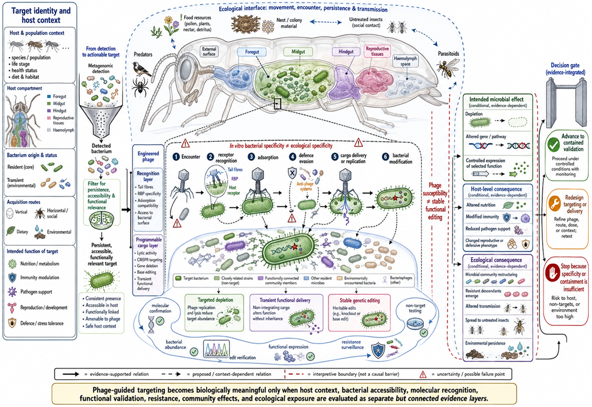
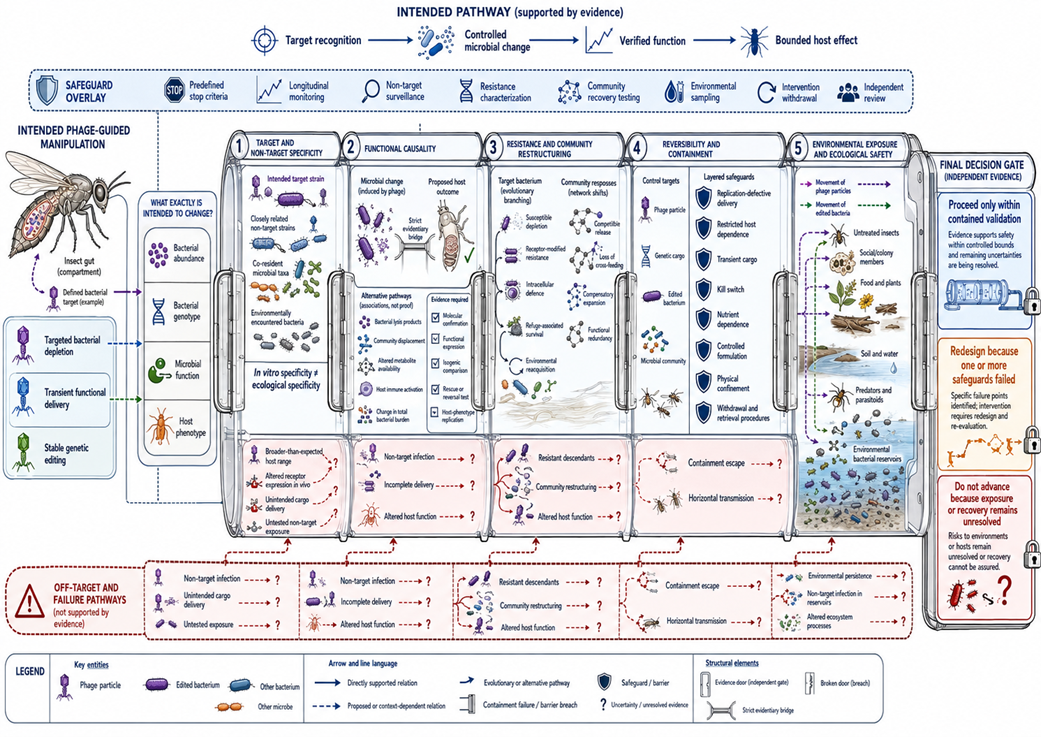
Evidence from engineered-phage use demonstrates technical feasibility but also illustrates the limits of inference. Administration of engineered phages in a compassionate clinical case provided evidence that designed phage combinations can be produced and delivered, but such an observation cannot establish generalized efficacy or ecological safety [25]. Evolutionary-trap strategies propose selecting bacterial receptors whose loss produces a predictable cost, such as reduced virulence or restored drug susceptibility [26]. A comparable strategy could direct resistance in an insect symbiont toward reduced colonization or loss of an undesirable function, but only if the resulting bacterial phenotype does not create a different host, community, or environmental hazard. The proposed relations among target definition, delivery, editing, resistance, host effects, and validation are represented in Figure 1, while the intended and unintended pathways requiring safeguards are represented in Figure 2.
Figure 1 shows phage-guided targeting of insect-associated bacteria within the analytical logic developed in this section.
|
|
|
Figure 1. Phage-guided targeting of insect-associated bacteria |
Alt text
A structured conceptual diagram that shows phage-guided targeting of insect-associated bacteria, with labelled components, directional relations, contextual modifiers, uncertainty points, and a clear boundary between observed evidence and proposed synthesis.
Validation should proceed through staged evidence gates rather than a single readiness score. An intervention should not advance merely because it reduces the target bacterium or produces the intended molecular edit. It should also demonstrate causal microbial function, bounded non-target activity, resistance characterization, community monitoring, host-phenotype specificity, withdrawal behaviour, containment performance, and environmental-exposure control. Failure at one gate should redirect design or restrict the context of use rather than be averaged against success elsewhere. The proposed components, evidence bases, boundary conditions, failure modes, and validation requirements are organized in Table 2.
Table 2. Proposed Safety-by-Design Agenda: Components, Evidence Basis, Relations, Boundary Conditions, Failure Modes, and Validation Requirements
|
Proposed component |
Purpose |
Evidence basis |
Relation or mechanism |
Input or precondition |
Expected output |
Boundary condition or failure mode |
Validation requirement |
|
Target identity and residency gate |
Establish that the bacterium is a biologically meaningful intervention target |
Persistent residency and functional attribution |
Separates resident symbionts from transient environmental organisms |
Localization, persistence, transmission, and baseline-function evidence |
Defined bacterial target in a defined insect context |
Detection without residency or causal function |
Longitudinal localization, removal, recolonization, and functional rescue |
|
Recognition and delivery gate |
Confirm that the phage reaches and enters the intended bacterium |
Dynamic host range and receptor biology |
Links receptor recognition to productive infection or cargo delivery |
Application-relevant bacterial phenotype and non-target panel |
Verified target access under insect-relevant conditions |
Culture-specific susceptibility, altered receptor expression, or untested non-targets |
In vivo adsorption, infection, delivery, and negative host-range testing |
|
Intervention-class declaration |
Distinguish depletion, transient expression, deletion, base editing, or functional replacement |
Phage-delivered CRISPR and base-editing studies |
Connects intervention mechanism to the claimed outcome |
Explicit molecular target and intended duration |
Precisely defined microbial change |
Killing described as editing or transient delivery described as reversal |
Molecular confirmation, off-target analysis, persistence testing, and revertant comparison |
|
Functional-causality gate |
Show that the microbial change causes the intended host effect |
Phage-associated symbiont functions and engineered insect symbionts |
Links microbial genotype or abundance to function and host phenotype |
Appropriate controls and mechanistic endpoints |
Causally interpretable host or pathogen outcome |
Host effect caused by lysis, inflammation, or community change rather than intended edit |
Isogenic comparison, rescue, pathway measurement, and host-phenotype replication |
|
Resistance and refuge assessment |
Anticipate survival, rebound, and altered descendant phenotypes |
Spatial coexistence and resistance evolution |
Separates spatial protection from heritable resistance |
Longitudinal exposure and resistant-isolate recovery |
Classified failure mechanism and response strategy |
Apparent resistance caused by delivery failure or reacquisition |
Genomic, receptor, fitness, transmission, and spatial analyses |
|
Community-consequence gate |
Detect indirect ecological effects within the microbiome |
Community-dependent ecology and competitive release |
Connects target perturbation to network and functional changes |
Baseline community structure and function |
Bounded and interpretable community response |
Expansion of competitors, loss of dependent taxa, or functional instability |
Multi-time-point taxonomic, functional, metabolomic, and recovery assessment |
|
Reversibility and layered containment |
Limit persistence of phage, cargo, or edited bacteria |
Kill switches and next-generation biocontainment |
Combines independent genetic and operational safeguards |
Defined withdrawal endpoint and escape scenarios |
Controlled intervention termination |
Payload loss without edit reversal, circuit mutation, or environmental persistence |
Escape-frequency, circuit-stability, excretion, transfer, and environmental-survival tests |
|
Environmental-exposure gate |
Bound spread beyond treated insects and settings |
Environmental-release design and governance evidence |
Links persistence, dispersal, transmission, and monitoring |
Exposure model covering host, substrate, associated organisms, and waste |
Context-specific ecological safety case |
Horizontal transfer, non-target infection, environmental reservoir formation, or uncontrolled spread |
Mesocosm testing, environmental surveillance, retrieval criteria, and predefined stop rules |
|
Staged decision and governance gate |
Prevent molecular success from being treated as deployment readiness |
Translational phage-development evidence |
Requires independent satisfaction of biological, ecological, manufacturing, and governance criteria |
Transparent evidence dossier and uncertainty record |
Restricted, revisable decision appropriate to evidence maturity |
Unsupported readiness claims or aggregation into an unvalidated score |
Independent review, traceable evidence, uncertainty disclosure, and post-intervention monitoring |
Research and governance implications
The highest research priority is to establish insect-specific evidence rather than extrapolating from mammalian gut, clinical, or environmental systems. Environmental-release research on engineered bacteria shows that persistence, genetic stability, exposure routes, and ecological risk must be considered together [27]. For insect applications, this requires representative host species, developmental stages, diets, temperatures, gut compartments, social structures, and environmental reservoirs. Studies should compare laboratory isolates with bacteria recovered directly from insects, distinguish vertically transmitted symbionts from environmentally acquired bacteria, and examine whether edited or resistant descendants retain altered transmission or host effects. Progress would be demonstrated by replicated causal chains connecting phage delivery, bacterial change, microbial function, host phenotype, community response, and recovery after withdrawal.
Governance should develop alongside experimental capability. Translation of phage interventions has been slowed by variability in production, characterization, dosing, trial design, evidence standards, and regulatory pathways [28]. Insect-microbiome applications introduce additional uncertainties because treated insects may move, reproduce, interact socially, or exchange microorganisms with food, plants, soil, water, predators, parasitoids, pollinators, livestock, or humans. Governance should therefore be proportional to exposure and persistence rather than based solely on whether the phage or bacterium is naturally occurring. A contained laboratory perturbation, a managed colony intervention, and an environmentally released transmissible symbiont represent different decision contexts. Each requires explicit responsibility for manufacturing quality, genetic characterization, containment verification, environmental monitoring, data stewardship, withdrawal procedures, and communication of uncertainty.
Operational models must also accommodate the distinctive population biology of phages. Phage pharmacokinetics and pharmacodynamics are shaped by adsorption, bacterial density, replication, clearance, route of administration, tissue distribution, immune interactions, and resistance [29]. These relations may be particularly nonlinear in insects because target populations can be small, compartmentalized, periodically lost during moulting or metamorphosis, and replenished through feeding or social contact. Future models should therefore be linked to empirical measurements rather than used as evidence of effectiveness. The proposed agenda would be strengthened by standardized reporting of target identity, receptor and defence profiles, phage preparation, delivery route, editing efficiency, target and non-target dynamics, resistant descendants, community functions, host outcomes, environmental persistence, and intervention withdrawal. Such reporting would make evidence comparable without converting heterogeneous outcomes into an unsupported universal readiness score. Figure 2 maps intended effects, off-target pathways, resistance, and ecological safeguards within the analytical logic developed in this section.
|
|
|
Figure 2. Intended effects, off-target pathways, resistance, and ecological safeguards |
Alt text
A structured conceptual diagram that maps intended effects, off-target pathways, resistance, and ecological safeguards, with labelled components, directional relations, contextual modifiers, uncertainty points, and a clear boundary between observed evidence and proposed synthesis.
CONCLUSION
Phage-guided editing could provide a powerful means of interrogating and modifying insect-associated bacteria because phages can combine receptor-mediated targeting with programmable depletion or genetic alteration. The available evidence nevertheless supports conditional possibility rather than general readiness. Precision must be demonstrated separately at molecular, bacterial, functional, community, host, and ecological levels. In vitro bacterial specificity does not establish ecological specificity; susceptibility does not demonstrate stable functional editing; removal of a genetic payload does not ensure community recovery; and targeted manipulation does not establish environmental safety. The most defensible path forward is a staged safety-by-design process that links target residency, causal function, recognition, resistance, community effects, reversibility, containment, environmental exposure, and governance. Its immediate value lies not in certifying an intervention but in making unsupported equivalences visible and identifying the evidence required before stronger conclusions can be justified.
ACKNOWLEDGMENTS: None
CONFLICT OF INTEREST: None
FINANCIAL SUPPORT: None
ETHICS STATEMENT: None