Entomology and
Applied Science Letters
Applied Science Letters
 2026
Volume 13
Issue 2
2026
Volume 13
Issue 2

Climate change is altering the environmental conditions in which mosquito-control programmes must anticipate vector emergence, select interventions, interpret resistance, and maintain protection across increasingly variable seasons. The central problem is not simply that warmer conditions increase mosquito abundance or control failure, but that shifting temperature, rainfall, extreme-weather patterns, land use, and human exposure can destabilize previously reliable relations among mosquito phenology, transmission risk, intervention timing, and insecticide performance. This article develops an original, evidence-grounded conceptual synthesis for climate-resilient mosquito control. It integrates climate-driven instability, nonlinear mosquito population dynamics, temperature-dependent insecticide responses, seasonal mismatch, resistance planning, and the complementary roles of redundancy, flexibility, and contingency planning. The synthesis indicates that climatic change can expand, contract, redistribute, or fragment periods of vector and transmission suitability, while the effectiveness of control remains conditional on species, life stage, local habitat, resistance mechanism, intervention type, delivery quality, and operational capacity. Seasonal forecasts can improve preparedness, but they do not provide inherently reliable local deployment dates. Similarly, redundant control options can preserve critical functions when one intervention becomes poorly timed, resisted, unavailable, or operationally compromised, but redundancy must represent mechanistic and logistical complementarity rather than unnecessary duplication. Important limitations include incomplete local validation of climate models, weak integration between entomological and operational surveillance, inconsistent reporting of thermal conditions in insecticide assays, and limited prospective evaluation of adaptive intervention portfolios. Climate resilience should therefore be treated as a proposed, revisable decision architecture that links probabilistic foresight to observed mosquito conditions, resistance evidence, predefined alternatives, accountable decision rules, and multi-season validation rather than as a fixed or deployment-ready programme.
INTRODUCTION
Mosquito control increasingly operates within environmental conditions that are both warmer on average and less stable in their seasonal expression. Temperature affects mosquito development, survival, biting, pathogen incubation, and intervention response, while rainfall, water storage, urban infrastructure, land use, mobility, and public-health capacity shape whether climatic suitability becomes realized exposure. Climate change therefore alters the spatial, seasonal, and ecological conditions under which mosquito-borne disease prevention and control must operate, but its effects are heterogeneous across vectors, pathogens, and settings [1–3]. This heterogeneity is crucial because a control programme can face earlier mosquito emergence in one setting, prolonged seasonal activity in another, reduced suitability during extreme heat elsewhere, or rapid alternation between favourable and unfavourable conditions within the same year.
The scientific problem is consequently broader than projecting where mosquitoes or pathogens may become climatically suitable. Control decisions depend on whether changing environmental conditions modify the timing, abundance, age structure, behaviour, resistance phenotype, or accessibility of the local vector population. They also depend on whether surveillance detects these changes early enough for procurement, staffing, community engagement, larval-source management, adult control, or resistance-response measures to be adjusted. A model that correctly identifies a broad seasonal tendency may still be inadequate for deciding when a specific intervention should begin, how long it should persist, or whether an apparent loss of efficacy reflects resistance, temperature, mistimed delivery, incomplete coverage, behavioural avoidance, or an unrelated ecological change.
Current evidence is often interpreted through categories that should remain distinct. Climatic suitability is not equivalent to realized mosquito abundance; mosquito abundance is not equivalent to infectious-vector density; laboratory susceptibility is not equivalent to operational effectiveness; and a projected seasonal shift is not equivalent to a dependable local intervention date. These distinctions matter because control failure can emerge from several interacting pathways. A programme may deploy an otherwise effective intervention after the most influential biological window, continue using a product against a resistant population, misinterpret temperature-dependent bioassay results, or lack a feasible alternative when weather disrupts routine delivery. Treating these pathways as interchangeable conceals the specific evidence needed to diagnose and correct them.
This article develops an original climate-resilient mosquito-control synthesis organized around three linked requirements: seasonal foresight, resistance planning, and intervention redundancy. Its scope is restricted to evidence that clarifies climate-related mosquito-control instability, shifting seasonality and population dynamics, temperature-dependent insecticide performance, intervention timing, seasonal mismatch, flexibility, and contingency planning. The central argument is that climate resilience does not arise from a fixed programme or a single predictive model. It arises from the capacity to anticipate plausible seasonal conditions, verify those expectations through mosquito and resistance surveillance, adjust interventions within predefined limits, and preserve essential control functions through complementary alternatives when the expected pathway fails.
Climate change and mosquito-control instability
Climate change can destabilize mosquito-control conditions by altering the relation between environmental cues, vector biology, pathogen development, and human exposure. Observed and projected changes in temperature, rainfall, and weather variability can destabilize vector-borne disease risk, yet the direction and magnitude of change depend on local ecology, vector competence, and public-health capacity [4–6]. Temperature may accelerate mosquito development or pathogen incubation within suitable ranges, but excessive heat can reduce survival. Rainfall may generate aquatic habitat, flush immature stages, or have little effect where household water storage dominates larval production. The resulting control problem is not a uniform increase in risk but a loss of confidence in assumptions about where, when, and through which ecological pathway intervention demand will arise.
Model-based evidence further shows that climate change may redistribute Aedes-borne virus transmission suitability across regions and seasons rather than simply expanding risk everywhere [7]. Such redistribution can expose previously less-prepared populations, shift the months in which surveillance and control must intensify, or reduce suitability in locations that exceed thermal limits. However, projected transmission suitability remains conditional on mosquito establishment, habitat availability, imported infection, population immunity, human behaviour, and existing control capacity. It should therefore be used to identify changing possibilities and preparedness needs, not to infer that local mosquito-control failure has already occurred.
Seasonal foresight can support preparedness under these conditions, but climate information must be interpreted at the scale of the decision. Broad projections may justify strengthening surveillance or diversifying intervention capacity, whereas local timing decisions require near-term weather information, mosquito observations, habitat conditions, and knowledge of intervention persistence. Climate-driven instability should therefore be understood as uncertainty in the relation among environmental conditions, biological response, exposure, and programme performance. This framing preserves an important boundary: warmer conditions are not equivalent to uniformly greater mosquito-control failure, and uncertainty in a climate projection is not evidence that climate has no control relevance. The evidence dimensions and interpretive boundaries for climate change and mosquito-control instability are summarized in Table 1.
Table 1. Climate Change and Mosquito-Control Instability: Vector Systems, Biological Mechanisms, Exposure Pathways, Evidence Requirements, Uncertainty, and Interpretive Boundaries
|
Vector or transmission domain |
Environmental or operational driver |
Biological mechanism |
Human-exposure pathway |
Evidence required |
Context dependency |
Uncertainty |
Interpretive boundary |
|
Mosquito-borne disease systems |
Interacting climate, land-use, urbanisation, and mobility changes |
Altered vector distribution, abundance, seasonal activity, and host contact |
Changes in the frequency and location of human–vector encounters |
Integrated ecological, entomological, epidemiological, and social evidence |
Vector, pathogen, settlement pattern, and control capacity |
Relative contribution of interacting drivers |
Climate effects cannot be isolated from human and ecological change without appropriate attribution |
|
Climate-sensitive transmission |
Observed and projected temperature and rainfall change |
Modified survival, development, biting, and pathogen development |
Longer, shorter, earlier, later, or redistributed periods of infectious-vector exposure |
Observational trends linked to mechanistic or validated transmission models |
Disease system, region, timescale, and baseline climate |
Model structure, data quality, and confounding |
Projected suitability is not observed transmission or operational failure |
|
Climate-impact modelling |
Scenario choice, climate model, spatial resolution, and biological assumptions |
Translation of climatic variables into vector or transmission suitability |
Identification of populations potentially entering or leaving suitable conditions |
Model comparison, out-of-sample validation, and uncertainty reporting |
Spatial scale, parameterisation, and surveillance coverage |
Structural disagreement among models |
Broad forecast skill does not guarantee reliable local timing |
|
Weather-sensitive outbreaks |
Short-term temperature and rainfall variability |
Temporary changes in habitat, abundance, competence, or contact |
Episodic increases or decreases in exposure |
Time-resolved weather, vector, and disease observations |
Lag structure, baseline immunity, habitat, and intervention context |
Attribution to weather versus concurrent social or ecological changes |
Uncertainty is not evidence of no climatic influence |
|
Aedes-borne virus suitability |
Climate-change scenarios |
Redistribution of thermally suitable transmission conditions |
New or altered seasonal exposure in susceptible populations |
Climate-driven projections verified against establishment and surveillance data |
Species presence, urban habitat, mobility, and local control |
Difference between potential suitability and realized transmission |
Redistribution includes gains and losses rather than universal expansion |
|
Mosquito phenology |
Changing seasonal temperature and rainfall patterns |
Shifted development, emergence, biting, and overwintering dynamics |
Misalignment between mosquito activity and routine control calendars |
Longitudinal life-stage and abundance surveillance with microclimate data |
Species, habitat, diapause, and local water management |
Sparse sampling and unmeasured microclimates |
Calendar change cannot be inferred from regional temperature averages alone |
|
Programme preparedness |
Forecast lead time, surveillance continuity, staffing, and intervention availability |
Timely or delayed alignment of control with biologically influential periods |
Prevention or persistence of human exposure during seasonal amplification |
Decision-linked forecast evaluation and operational process data |
Institutional capacity and intervention logistics |
Whether predicted conditions produce actionable lead time |
Seasonal forecasting is not equivalent to a reliable local deployment date |
Shifting seasonality and population dynamics
Mosquito seasonality is produced by interacting temperature-dependent traits rather than by a single climatic threshold. Survival, development, fecundity, biting, vector competence, and pathogen incubation often respond nonlinearly to temperature, so transmission potential can increase toward an optimum and decline beyond it. Thermal effects on mosquito survival, development, biting, and pathogen incubation are nonlinear, creating bounded transmission optima rather than a monotonic increase in risk with warming [8–10]. A warmer season may therefore begin earlier or permit faster development, but extreme temperatures may shorten adult survival or reduce the duration for which mosquitoes remain capable of sustaining transmission.
These nonlinear responses also complicate population forecasting. Mosquito abundance depends not only on individual thermal traits but also on density dependence, larval habitat persistence, rainfall timing, nutrition, predation, dispersal, and cohort replacement. Several temperate arboviruses have been estimated to reach their highest transmission suitability within an intermediate temperature range, illustrating why warming can move a system toward or away from favourable conditions [11]. Such thermal windows are analytically useful, but they do not function as universal outbreak thresholds. Field populations experience daily fluctuations, shaded and indoor microclimates, heterogeneous breeding sites, and changing host availability that may differ substantially from regional air-temperature summaries.
For control programmes, the main implication is that phenology and population state should be observed directly whenever possible rather than inferred solely from climate. A climate model may indicate an earlier period of suitability, but entomological surveillance is needed to determine whether target life stages are present, whether abundance is rising, and whether the population occupies habitats accessible to the proposed intervention. Seasonal foresight should thus identify plausible biological windows and trigger intensified observation, staged resources, or provisional readiness. It should not automatically initiate a fixed intervention on a forecast date. This approach distinguishes uncertainty from absence of effect and helps separate true seasonal mismatch from failures caused by inadequate coverage, unsuitable tools, resistance, or dispersal from untreated areas.
Temperature effects on insecticides and resistance
Temperature can influence both mosquito biology and the phenotype recorded during insecticide-resistance testing. In Anopheles arabiensis, elevated rearing temperature altered life-history traits and the expressed resistance phenotype, demonstrating that thermal history can affect how susceptibility is observed [12]. This finding does not establish that warmer field conditions uniformly increase resistance or control failure. It instead indicates that the physiological state of the mosquito, its developmental environment, and the temperature at which exposure occurs can modify the measured response. Resistance surveillance that omits these conditions may classify differences as genetic resistance even when developmental plasticity or thermal acclimation contributes to the phenotype.
The direction of temperature-dependent toxicity is also not consistent across insecticides or vector species. Experimental bioassays involving Anopheles arabiensis and Anopheles funestus showed that insecticide toxicity changed with test temperature and differed by compound and species [13]. Larval environmental conditions have likewise been shown to alter subsequent adult susceptibility, indicating that nutrition, density, and developmental temperature can influence the phenotype measured during adult testing [14]. These findings support more complete assay metadata and, where operationally justified, sensitivity analyses across locally relevant temperatures. They do not justify a universal correction factor or the assumption that one laboratory temperature–mortality relation predicts field product effectiveness.
Recent multi-scale evidence in Aedes aegypti further indicates that pyrethroid toxicity may depend on insecticide, target-site genotype, genetic background, temperature, and assay scale, while formulated-product performance may be less temperature-sensitive under some tested exposure conditions [15]. The distinction among neural response, topical toxicity, standardized bioassay mortality, and formulated-product performance is therefore essential. A temperature-associated change in one endpoint cannot be transferred automatically to another, and biological efficacy cannot be treated as equivalent to operational effectiveness. Climate-resilient resistance planning should instead record thermal history and test conditions, distinguish phenotypic plasticity from inherited resistance where possible, connect assay findings to the actual intervention and vector population, and retain alternative tools when the operational meaning of a result remains uncertain.
Intervention timing and seasonal mismatch
Intervention timing becomes consequential when transmission is concentrated within a limited seasonal period or when mosquito populations amplify rapidly after suitable conditions emerge. Modelling in high-endemic malaria settings indicates that intervention success can vary with the concentration and heterogeneity of seasonal transmission, even when the intervention itself is unchanged [16]. Timing should therefore be defined relative to the target mechanism: larval control must precede or overlap immature-stage production, whereas adult control must coincide with periods when epidemiologically relevant adults are accessible.
Climate services may improve preparation by estimating plausible periods of elevated dengue risk, but their usefulness depends on local surveillance, model updating, and operational interpretation [17]. A forecast is therefore an input to readiness rather than a guaranteed deployment date. Programmes should link forecast probabilities to staged actions such as confirming vector activity, checking supplies, reviewing resistance information, and preparing personnel before authorizing full intervention.
Seasonal mismatch occurs when a planned control calendar no longer overlaps the biological window in which the selected intervention can exert its greatest effect. Climate-responsive modelling suggests that preventive early-season larviciding can outperform later treatment under particular rainfall, temperature, and breeding-site conditions [18]. Comparative modelling also indicates that the relative performance of sterile-male releases and other suppression methods differs between temperate and tropical climates [19]. These findings support adaptive timing, but they do not establish that earlier intervention is always superior or that modelled suppression equals reduced disease transmission.
Redundancy, flexibility, and contingency planning
Climate-resilient mosquito control requires preservation of essential control functions when one pathway becomes ineffective, mistimed, unavailable, or poorly matched to local vector behaviour. Vector-control evidence supports the use of complementary approaches because no single tool consistently addresses all vector species, habitats, life stages, and exposure pathways [20]. Redundancy should therefore describe functional independence among options rather than the accumulation of similar products that share the same susceptibility to resistance, weather disruption, or delivery failure.
Resistance makes such independence particularly important. Evidence across major Aedes vectors shows extensive geographic heterogeneity in resistance phenotypes and mechanisms, limiting reliance on a single insecticidal mode of action [21]. Resistance patterns also change over time, and continental mapping of African malaria vectors demonstrates why static or geographically borrowed assumptions may become misleading [22]. Flexibility consequently requires updated local evidence, defined authority to modify deployment, and alternatives that remain feasible within procurement, staffing, safety, and community constraints.
Contingency planning converts alternative capacity into an executable response. Comparative intervention evidence indicates that combining insecticidal nets with other control measures may improve entomological outcomes under resistance, but performance depends on product composition, resistance mechanism, vector behaviour, and setting [23]. A contingency plan should therefore specify the monitored failure, activation threshold, responsible decision-maker, substitute intervention, delivery pathway, and follow-up endpoint. The evidence dimensions and interpretive boundaries for redundancy flexibility and contingency planning are summarized in Table 2.
Table 2. Redundancy, Flexibility, and Contingency Planning: Vector Systems, Biological Mechanisms, Exposure Pathways, Evidence Requirements, Uncertainty, and Interpretive Boundaries
|
Vector or transmission domain |
Environmental or operational driver |
Biological mechanism |
Human-exposure pathway |
Evidence required |
Context dependency |
Uncertainty |
Interpretive boundary |
|
Integrated vector control |
Failure or inaccessibility of one intervention |
Complementary tools act on different life stages, habitats, or contact pathways |
Continued reduction of human–vector contact despite disruption |
Comparative effectiveness and implementation evidence |
Vector behaviour, habitat, coverage, and delivery capacity |
Correlated failure among tools |
Additional tools do not automatically create resilience |
|
Aedes resistance planning |
Heterogeneous resistance mechanisms |
Reduced susceptibility to particular insecticide classes |
Survival of vectors after chemical exposure |
Local phenotype, genotype, and product-performance data |
Species, population, compound, and assay method |
Uneven surveillance coverage |
Resistance detection does not directly quantify disease-control failure |
|
Malaria-vector resistance surveillance |
Spatial and temporal change in resistance |
Changing survival after insecticide exposure |
Reduced protection from treated surfaces or nets |
Repeated, uncertainty-aware resistance mapping |
Sampling density and assay comparability |
Areas with sparse or outdated observations |
Mapped resistance is not a direct estimate of local operational effectiveness |
|
Intervention combinations |
Product composition and resistance profile |
Mechanistically distinct effects on mortality, feeding, or contact |
Reduced successful blood feeding or vector survival |
Product-specific comparative field or semi-field evidence |
Local resistance and vector behaviour |
Transferability between products and settings |
Combination is not synonymous with complementarity |
|
Flexible deployment |
Seasonal change, supply disruption, or forecast revision |
Bounded adjustment of timing, allocation, or intervention choice |
More timely maintenance of protective coverage |
Documented decision rules and implementation monitoring |
Governance, staffing, procurement, and community acceptance |
Delayed authorization or limited substitute capacity |
Flexibility is not unstructured improvisation |
|
Contingency response |
Threshold breach or intervention failure |
Activation of a predefined alternative pathway |
Prevention of prolonged exposure during programme disruption |
Trigger, ownership, substitute action, and outcome monitoring |
Local resources and intervention feasibility |
Whether thresholds identify the true cause of failure |
A written contingency is not validated until tested |
Proposed climate-resilience principles
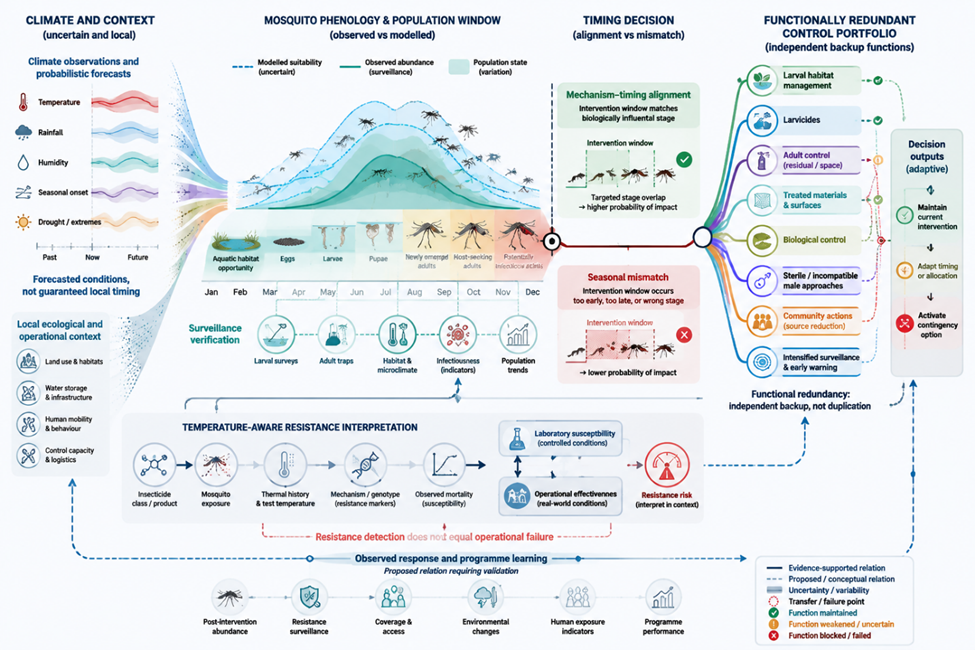
The proposed synthesis organizes climate-resilient mosquito control around a sequence of distinct but connected functions: probabilistic seasonal foresight, observation of mosquito phenology and population state, temperature-aware interpretation of intervention performance, resistance-informed selection, adaptive timing, and functionally independent alternatives. Climate information should enter the decision process as one evidence stream rather than as a standalone trigger; its relevance depends on the vector, disease mechanism, surveillance capacity, and decision lead time [24]. Figure 1 connects climate uncertainty with mosquito phenology, intervention timing, resistance risk, and the need for redundant control options within the analytical logic developed in this section.
|
|
|
Figure 1. Climate uncertainty with mosquito phenology, intervention timing, resistance risk, and the need for redundant control options |
Alt text
A structured conceptual diagram that connects climate uncertainty with mosquito phenology, intervention timing, resistance risk, and the need for redundant control options, with labelled components, directional relations, contextual modifiers, uncertainty points, and a clear boundary between observed evidence and proposed synthesis.
A second principle is that forecasts should be connected to predefined actions and evaluated for decision value, not accuracy alone. Functional early-warning systems require uncertainty representation, integrated data, validation, and explicit links between forecast outputs and public-health decisions [25]. Appropriate outputs may include readiness levels, intensified surveillance, provisional resource movement, or confirmatory field assessment. Failure occurs when a statistically credible warning has no responsible owner, feasible response, or agreed interpretation.
A third principle is that adaptation requires governance and continuity. Evidence on climate-informed warning systems identifies fragmented data, limited local validation, weak institutional integration, and unclear response protocols as recurring implementation barriers [26]. Flexibility must therefore be bounded by documented decision rights, safety requirements, resource constraints, and monitoring obligations. Similarly, redundancy should be assessed by functional independence: alternatives should differ meaningfully in mechanism, target, delivery pathway, supply vulnerability, or resistance profile.
A fourth principle is that the proposed structure must remain revisable and empirically testable. Operational experience with dengue early-warning systems shows that routine data flows, user training, threshold interpretation, and timely response determine whether prediction becomes actionable [27].
Operational and research implications
The first priority is prospective validation across contrasting climate regimes and multiple seasons. Projections that climate change may accelerate the invasion potential of Aedes aegypti support anticipatory surveillance, but invasion potential is not equivalent to establishment, abundance, or transmission [28]. Progress would therefore be demonstrated by studies that connect climate projections to observed establishment, phenology, intervention demand, and operational response while preserving uncertainty at each transition.
The second priority is to evaluate the decision value of climate and transmission models under real programme constraints. Climate-driven chikungunya projections show that suitability can shift by region and season, but outputs remain conditional on scenario, vector ecology, and model assumptions [29]. Research should compare alternative forecast-linked decisions, measure false alarms and missed windows, and determine whether additional lead time improves procurement, surveillance, intervention timing, or epidemiological outcomes rather than merely improving predictive metrics.
The third priority is integration across ecological, infrastructural, toxicological, and governance evidence. Urban mosquito risk emerges through interactions among landscape structure, water infrastructure, human behaviour, vector ecology, and institutional capacity [30]. Environmental change can also participate in feedbacks with disease burden and human activity, as demonstrated by evidence linking Amazonian deforestation and malaria transmission in both directions [31]. Progress therefore requires longitudinal designs that distinguish suitability, abundance, exposure, intervention delivery, resistance, and disease outcomes; examine feedbacks rather than one-way climatic effects; and test whether redundant options preserve control functions during anomalous seasons.
CONCLUSION
Climate-resilient mosquito control requires more than extending existing programmes into a warmer future. The strongest defensible synthesis is that climate and weather can alter mosquito phenology, population dynamics, transmission opportunity, resistance interpretation, and intervention timing, but their effects remain nonlinear and conditional on biological, ecological, spatial, methodological, and operational context. Seasonal forecasting can support preparation but cannot guarantee reliable local timing; temperature-dependent susceptibility cannot be translated automatically into operational failure; and redundancy is valuable only when alternatives provide genuinely independent control functions. The proposed architecture therefore treats resilience as a revisable capacity to anticipate plausible conditions, verify them through surveillance, interpret resistance within its thermal and methodological context, adjust interventions through accountable rules, and activate predefined alternatives when expected pathways fail. Its highest-priority requirement is prospective, multi-season validation that separates biological efficacy, operational effectiveness, and epidemiological outcome rather than presenting the synthesis as a fixed or deployment-ready programme.
ACKNOWLEDGMENTS: None
CONFLICT OF INTEREST: None
FINANCIAL SUPPORT: None
ETHICS STATEMENT: None