Entomology and
Applied Science Letters
Applied Science Letters
 2026
Volume 13
Issue 2
2026
Volume 13
Issue 2

Botanical insecticides and living biological-control agents are increasingly considered complementary components of integrated pest management, but their shared natural or biologically derived origin does not ensure that they can be combined without compromising pest suppression or beneficial-organism function. The central evidence gap is the absence of a sufficiently discriminating compatibility concept that separates target-pest efficacy from effects on predators, parasitoids and microbial agents across realistic exposure conditions. This original non-empirical article develops an evidence-grounded, explicitly non-validated compatibility synthesis by integrating evidence on natural-enemy selectivity, entomopathogenic fungi and bacteria, exposure timing, dose, formulation, behaviour, interaction classification and sublethal effects. The synthesis indicates that compatibility is not an intrinsic property of a botanical active ingredient or biological-control agent. It is a conditional relation among the exact product, living agent, exposure route, application sequence, environmental context and biological function being protected. Acute survival therefore cannot substitute for measurements of predation, parasitism, reproduction, development, microbial viability or virulence. Likewise, laboratory selectivity cannot be treated as evidence of field-programme compatibility, and increased mortality under a pairwise combination cannot alone demonstrate durable integrated-pest-management benefit. Interpretation is limited by heterogeneous assay methods, narrow taxonomic coverage, sparse chronic and multitrophic studies, and weak linkage between laboratory endpoints and ecosystem-service delivery. The principal implication is that programme design should proceed through staged, agent-specific and exposure-specific testing that preserves target efficacy while evaluating functional and ecological costs. Compatibility should consequently be expressed as a bounded evidence profile requiring prospective validation rather than as a universal safe–unsafe label.
INTRODUCTION
Botanical insecticides occupy an increasingly important position between conventional synthetic chemistry and biologically based pest management. Their diverse active compounds, often rapid environmental degradation and potential for local production can make them attractive where resistance, residue concerns or limited access to conventional products constrain pest control. These characteristics, however, describe product origin and environmental behaviour rather than compatibility with organisms expected to provide biological control. Botanical insecticides offer useful pest-management properties, but natural origin alone does not establish ecological compatibility [1]. A programme that replaces a synthetic insecticide with a plant-derived product without testing beneficial-organism responses may therefore change the source of exposure while preserving the same underlying ecological conflict.
The conflict is particularly important because botanical products may influence beneficial arthropods through more pathways than immediate mortality. Essential-oil biopesticides can affect natural enemies and other non-target invertebrates through lethal and sublethal pathways [2]. Changes in locomotion, host or prey location, feeding, development, fecundity and population growth may weaken biological control even when exposed individuals survive an acute assay. Recent bioinsecticide evidence likewise shows that favourable safety assumptions cannot replace direct testing of natural-enemy performance [3]. Product labels such as botanical, natural or biological are consequently poor substitutes for measurements that connect exposure to the ecological function expected from a predator, parasitoid or microbial agent.
The second conceptual difficulty is that living biological control is not a single intervention class. Predators suppress pests through consumption, parasitoids depend on host location and successful immature development, and entomopathogenic fungi and bacteria require persistence, infection or toxin-mediated activity under suitable environmental and host conditions. Living biological control comprises mechanistically distinct agents, so compatibility must be defined against a specified agent and function [4]. A botanical treatment may be compatible with one predator under residual exposure yet harmful to a parasitoid developing inside treated hosts, or may preserve adult natural enemies while suppressing fungal germination. Compatibility claims that omit the living agent, exposure route and protected function therefore combine non-equivalent biological questions.
This article addresses that problem by developing an original scholarly synthesis for determining when botanical insecticides and living control agents may share an integrated pest-management programme. The analysis focuses on programme-level integration, effects on predators and parasitoids, compatibility with entomopathogenic fungi and bacteria, exposure timing, dose, formulation, behaviour, synergy, antagonism and sublethal effects. Its central argument is that compatibility should be represented as a conditional relationship among product identity, agent identity, exposure architecture and preserved biological-control function. The proposed organization is not a validated decision framework and does not establish universal compatibility classifications. Instead, it identifies the evidence distinctions, failure modes and validation requirements needed to prevent natural origin from being equated with compatibility, acute survival with preserved function, laboratory selectivity with field-programme performance, or pairwise synergy with durable integrated pest-management benefit.
The need to integrate botanical and biological control
The case for integration begins at programme rather than product level. Integrated pest management is weakened when individual tactics are selected independently and combined only after their separate efficacy has been demonstrated. Effective IPM requires programme-level integration rather than the simple substitution of one control product for another [5]. Within such a programme, the relevant question is not merely whether a botanical insecticide kills the pest, but whether its use preserves or enhances the contribution of natural enemies across the application period. Selective pesticide use can conserve biological control, although selectivity remains conditional on species, rate, timing and exposure [6]. Thus, integration requires explicit decisions about which agent is being protected, when exposure occurs, what function must be retained and how target suppression will be attributed among programme components.
Integration can also extend beyond the co-application of two pest-control products. Some non-crop vegetation may provide floral or habitat resources for natural enemies while supplying plant material with insecticidal activity. Non-crop plants may jointly support natural enemies and provide botanical insecticides, but this multifunctionality is plant- and system-specific [7]. The broader ecological setting similarly determines whether biological-control services persist when direct interventions are introduced. Diversified production systems can support multiple ecosystem services without a necessary yield penalty, providing an ecological basis for integration [8]. Neither finding proves that a particular botanical formulation is compatible with a particular natural enemy; instead, they show that product-pair decisions are embedded within resource, habitat and management conditions capable of strengthening or weakening the biological-control contribution.
A proposed integration logic should therefore treat botanical efficacy and living-agent performance as separate but connected evidence streams. Inputs include the exact botanical product, formulation, rate, target pest, living agent, exposure route, timing and ecological setting. Expected outputs include target suppression together with preserved predation, parasitism, development, reproduction, microbial viability or pathogen virulence, depending on the agent. Failure may occur when low exposure is mistaken for intrinsic selectivity, when survival is measured without function, or when one effective component obscures impairment of another. Because predators can suppress pests and improve yield across crop systems, preserved predator function is a more relevant endpoint than survival alone [9]. This proposed synthesis remains non-validated: its components require agent-specific laboratory testing, ecologically realistic exposure assessment and prospective field-programme evaluation before they can support an operational compatibility decision.
The proposed components, evidence bases, boundary conditions, failure modes, and validation requirements are organized in Table 1.
Table 1. The Need to Integrate Botanical and Biological Control: Components, Evidence Basis, Relations, Boundary Conditions, Failure Modes, and Validation Requirements
|
Proposed component |
Purpose |
Evidence basis |
Relation or mechanism |
Input or precondition |
Expected output |
Boundary condition or failure mode |
Validation requirement |
|
Programme-level architecture |
Prevent simple product substitution from being treated as integration |
Integrated pest-management synthesis and selective-use evidence |
Botanical intervention and biological control are coordinated around a shared pest-suppression objective |
Defined target pest, management objective and living-agent contribution |
Complementary control without avoidable loss of biological-control function |
One component may appear successful while another is impaired or unnecessary |
Compare combined, separate and untreated programme conditions using efficacy and functional endpoints |
|
Relation-specific compatibility |
Define compatibility as a relationship rather than a product attribute |
Botanical-insecticide and non-target evidence |
Outcome depends on the exact botanical product, agent, route and biological function |
Verified product composition and living-agent identity |
A bounded compatibility statement |
“Natural” or “biological” terminology may be used as a safety proxy |
Replicate testing for the specified product–agent combination |
|
Living-agent identity |
Prevent mechanistically distinct agents from being collapsed into one class |
Biological-control classification |
Predators, parasitoids and microbial agents require different performance endpoints |
Explicit agent category, species or strain and life stage |
Agent-appropriate compatibility endpoint |
A result for one agent type may be transferred incorrectly to another |
Use mechanism-specific endpoints and avoid class-wide extrapolation |
|
Natural-enemy function |
Preserve the ecological service rather than acute survival alone |
Predator-function and selective-use evidence |
Exposure can alter behaviour, reproduction or suppression without causing immediate mortality |
Relevant life stage, exposure route and function measure |
Retained predation, parasitism or population performance |
Survival-only screens may produce false compatibility conclusions |
Link laboratory effects to pest suppression and population performance |
|
Multifunctional plant-resource integration |
Connect habitat support and botanical sourcing without assuming equivalence |
Field evidence on non-crop plants |
Plant resources may support natural enemies while also supplying botanical material |
Locally suitable plant species and natural-enemy assemblage |
Resource provisioning combined with selective pest intervention |
Plant effects are species-, crop- and system-specific |
Confirm botanical activity and natural-enemy responses in the intended system |
|
Ecological-context gate |
Recognize that compatibility is modified by the production system |
Diversification and ecosystem-service evidence |
Habitat, resource availability and management diversity influence biological-control resilience |
Defined crop, landscape and management context |
Integration that protects multiple ecosystem services |
Product-pair results may fail under different ecological conditions |
Validate across relevant seasons, habitats and management regimes |
|
Exposure specification |
Prevent low or absent exposure from being misclassified as biological compatibility |
Non-target and selective-use syntheses |
Rate, timing, residues and route determine received exposure |
Operational rate, application schedule and realistic contact pathway |
Exposure-bounded compatibility profile |
Artificially low exposure or protected stages may create false safety |
Reproduce direct, residual, dietary and host-mediated exposure where relevant |
|
Prospective validation |
Separate the proposed synthesis from demonstrated field-programme performance |
Convergent programme, non-target and ecological evidence |
Evidence progresses from identity and acute effects to function and programme outcomes |
Completed product-, agent- and exposure-specific assessments |
Defensible conditional programme decision |
Laboratory selectivity may not persist under field weather, behaviour or ecological interactions |
Independent semi-field and field-programme testing with functional follow-up |
Effects on predators and parasitoids
Direct selectivity studies demonstrate why target-pest toxicity and natural-enemy compatibility must be treated as separate properties. Essential oils that control a target pest differ in their selectivity to its parasitoid, demonstrating that efficacy and compatibility are separate properties [10]. This evidence supports comparative target–non-target testing but does not establish that a product judged selective in one laboratory system will preserve parasitism under field residues, alternative host stages or repeated applications. A parallel predator study shows the same analytical distinction: botanical compounds may show favourable differential toxicity between a pest and predator, but that margin must be established experimentally [11]. Differential toxicity is therefore a screening result tied to a specified compound, dose and organism, not a general endorsement of the botanical class.
Parasitoid and predator responses also change with concentration and formulation. The selectivity of an essential oil to a parasitoid changes with concentration and cannot be inferred from plant origin [12]. Concentration determines not only mortality but the residue encountered during host searching, oviposition and immature development. Formulation further changes how the active chemistry is delivered and persists. Nanoformulation can alter both target activity and predator exposure, making formulation identity part of the compatibility claim [13]. Consequently, evidence generated with an isolated active ingredient cannot automatically be transferred to an emulsion, commercial mixture or nanoformulation, even when the named botanical compound is unchanged. Carrier composition, adherence and persistence may alter the received dose and the duration over which predators or parasitoids contact treated surfaces, prey or hosts.
The most consequential limitation of acute selectivity testing is its incomplete representation of biological-control function. Sublethal essential-oil exposure can impair a predator despite limited acute mortality, so preserved biological-control function must be measured directly [14]. Relevant outcomes may include prey consumption, host searching, developmental time, emergence, reproduction, longevity and demographic performance. However, detecting a laboratory change in one endpoint is not automatically evidence of field-level control failure; effects may be transient, compensated or moderated by habitat and resource conditions. The correct interpretation is therefore bounded in both directions: survival does not prove preserved function, but a statistically detectable sublethal response does not by itself establish operational incompatibility. Predator and parasitoid compatibility should be expressed for the tested product, concentration, formulation, route, life stage and time horizon, with field-programme inference reserved for studies that connect those conditions to natural-enemy population performance and pest suppression.
Compatibility with entomopathogenic fungi and bacteria
Compatibility with microbial control agents requires a different evidentiary structure from compatibility with arthropod natural enemies. For entomopathogenic fungi, botanical chemistry may influence conidial germination, vegetative growth, sporulation, adhesion, host penetration or persistence, while the botanical treatment may independently stress the pest and alter susceptibility to infection. Entomopathogenic-fungal performance varies with strain, plant association and environmental context, limiting blanket compatibility claims [15]. Evidence from a single in vitro mixture therefore cannot determine whether a fungal agent will remain infective under foliar residues, plant-mediated exposure or field temperature and humidity. In addition, microbial biopesticides should not themselves be presumed ecologically benign: entomopathogenic biopesticides can impose lethal, behavioural and multitrophic risks on beneficial insects [16]. The botanical–fungal question must consequently distinguish effects on fungal viability and virulence from effects on predators, parasitoids and other beneficial organisms sharing the treated system.
Bacterial agents illustrate how compatibility can be demonstrated positively when exposure pathways and functional endpoints are specified. A bacterial entomopathogen and predator can be compatible under specified direct and prey-mediated exposure routes [17]. In the evaluated system, direct feeding and consumption of treated prey provided route-specific evidence concerning predator survival, development and reproduction. Such a result is valuable because it tests more than nominal co-occurrence, yet its inference remains limited to the bacterial strain, predator, prey pathway and controlled exposure regime examined. It does not establish compatibility for other bacterial species, formulations, predators or botanical co-exposures. Positive microbial–predator evidence should therefore be recorded as a bounded compatibility profile rather than transferred to the bacterial-entomopathogen class.
Conversely, bacterial compatibility can fail through chronic and host-mediated pathways that acute direct tests do not represent. Chronic or host-mediated exposure to a bacterial bioinsecticide can affect parasitoid emergence and longevity even when behavioural avoidance is absent [18]. A parasitoid may therefore accept treated hosts while still experiencing reduced performance through altered host quality, developmental conditions or prolonged dietary exposure. This finding does not demonstrate that all bacterial products are incompatible with parasitoids, nor does it directly establish the effect of combining the bacterial product with a botanical insecticide. It instead identifies a necessary test domain for future botanical–bacterial programmes: direct exposure, treated-prey or treated-host exposure, chronic development and adult function must be evaluated separately. Fungal and bacterial agents should also remain analytically distinct because their persistence, infection processes and non-target pathways differ. Laboratory compatibility is informative only within the tested strain, formulation, host, route and environment; programme compatibility requires concordant evidence that microbial efficacy and beneficial-organism function are preserved under the intended application sequence.
Exposure timing, dose, formulation, and behaviour
Compatibility is partly created by the order and interval of exposure rather than by the identities of two interventions alone. Sequence and timing can change the interaction between an insecticide and an entomopathogenic fungus, showing that synergy is schedule-dependent [19]. Although this evidence involved a synthetic insecticide, it establishes a transferable mechanistic boundary: prior chemical stress, residue decline and fungal establishment may change the subsequent response. Simultaneous application therefore cannot represent every possible botanical–microbial programme. Compatibility claims should specify whether agents were applied together, sequentially or after a defined residue-decay period.
Dose defines both pest efficacy and the non-target margin. The rate of a botanical essential oil jointly determines target efficacy and parasitoid selectivity [20]. A low rate may preserve a parasitoid but fail to control the pest, whereas a higher rate may improve target mortality while narrowing ecological selectivity. Acute survival may also conceal physiological stress. Molecular stress responses can reveal latent predator costs that are not captured by acute survival assays [21]. Dose assessment should therefore connect target suppression with mortality, development, reproduction, behaviour and physiological disruption in the living agent.
Formulation and behaviour determine the exposure actually received. A stabilising azadirachtin formulation can prolong foliar persistence, thereby changing the exposure window that compatibility testing must reproduce [22]. Improved stability may support efficacy but extend contact with natural enemies or microbial agents. Carriers, emulsions and nano-delivery systems are consequently active parts of the compatibility domain rather than neutral containers. Behaviour may further increase or reduce exposure through repellency, feeding avoidance, host searching or treated-prey consumption. Compatibility should thus be reported for the actual product, rate, residue profile, route and application schedule, not for active chemistry in isolation.
Synergy, antagonism, and sublethal effects
Botanical–fungal interactions range from supportive to inhibitory because botanical products may alter fungal viability, host susceptibility or both. Botanical–fungal combinations vary from compatible to deleterious according to product, isolate and concentration [23]. A higher combined mortality than either intervention alone is therefore insufficient to identify the mechanism. Formal interaction assessment must distinguish expected additivity from synergy and separate pest sensitisation from direct enhancement of fungal performance. Antagonism likewise requires diagnosis through germination, growth, sporulation, virulence and host-response endpoints.
Programme benefit also depends on higher-trophic effects. An additive botanical–fungal effect on pest mortality does not by itself establish durable programme benefit, particularly when natural-enemy behaviour may also change [24]. A combination may increase short-term pest mortality while disrupting parasitoid searching, predator feeding or food availability. Pairwise efficacy should therefore be interpreted alongside living-agent function and subsequent pest suppression. Pairwise synergy is not equivalent to durable integrated pest-management benefit because persistence, recolonisation, ecological compensation and repeated exposure may alter the net outcome.
Sublethal responses further resist binary classification. Sublethal azadirachtin exposure can alter immune function in a beneficial insect despite the absence of overt mortality [25]. Such changes may influence pathogen susceptibility or later performance without producing an immediate lethal signal. Responses may also be inhibitory, neutral or stimulatory. Sublethal pesticide responses may be inhibitory, neutral or stimulatory, making binary safe–unsafe classifications biologically incomplete [26]. Apparent stimulation should not automatically be considered beneficial because its duration, energetic cost and population-level relevance may remain unknown.
The evidence dimensions and interpretive boundaries for synergy antagonism and sublethal effects are summarized in Table 2.
Table 2. Synergy, Antagonism, and Sublethal Effects: Exposure Conditions, Efficacy, Sublethal Effects, Synergy, Antagonism, Ecological Compatibility, and IPM Sequencing
|
Botanical–agent combination |
Exposure conditions |
Compatibility mechanism |
Evidence required |
Efficacy implication |
Sublethal or ecological risk |
Timing or formulation adjustment |
IPM boundary |
|
Botanical product with entomopathogenic fungus |
Exact product, isolate, concentration and application order |
Botanical chemistry may alter fungal viability or host susceptibility |
Fungal germination, growth, sporulation, virulence and factorial pest-mortality tests |
Combination may be additive, synergistic or antagonistic |
Reduced fungal performance may be hidden by botanical pest mortality |
Separate applications or modify concentration when direct mixture impairs the fungus |
No class-wide botanical–fungal compatibility label |
|
Pyrethrum with Metarhizium and a parasitoid |
Combined pest treatment with natural-enemy behavioural assessment |
Complementary pest effects may coexist with behavioural modification |
Expected-additivity analysis plus parasitoid searching or choice endpoints |
Additive mortality may improve short-term suppression |
Altered natural-enemy behaviour may weaken longer-term control |
Adjust sequence or dose to reduce behavioural interference |
Pairwise efficacy does not establish programme durability |
|
Azadirachtin with a beneficial insect |
Repeated sublethal dietary or residue exposure |
Immune and physiological modulation below overt lethality |
Immune, enzyme, microbiome, survival and functional endpoints |
Target efficacy may coexist with hidden non-target costs |
Altered immunity may change resilience or pathogen interactions |
Reduce exposure overlap or use lower-risk timing where supported |
Acute survival is not equivalent to preserved function |
|
Low-dose botanical exposure with parasitoids or predators |
Multiple doses across relevant life stages |
Stress responses may be inhibitory, neutral or stimulatory |
Multi-dose life-table, behaviour, reproduction and control-function assays |
Low-dose stimulation may appear beneficial |
Hormesis may be temporary, costly or method-dependent |
Avoid selecting schedules from a single low-dose response |
Stimulation is not proof of durable compatibility |
|
Botanical–biological programme |
Repeated and field-realistic exposure across programme stages |
Net outcome combines pest mortality and living-agent performance |
Factorial, multitrophic and longitudinal field evaluation |
Short-term gains may not persist |
Food depletion, delayed toxicity or reduced recovery may emerge |
Adapt formulation and spacing to preserve agent establishment |
Pairwise synergy is not equivalent to durable IPM benefit |
Proposed compatibility-assessment logic
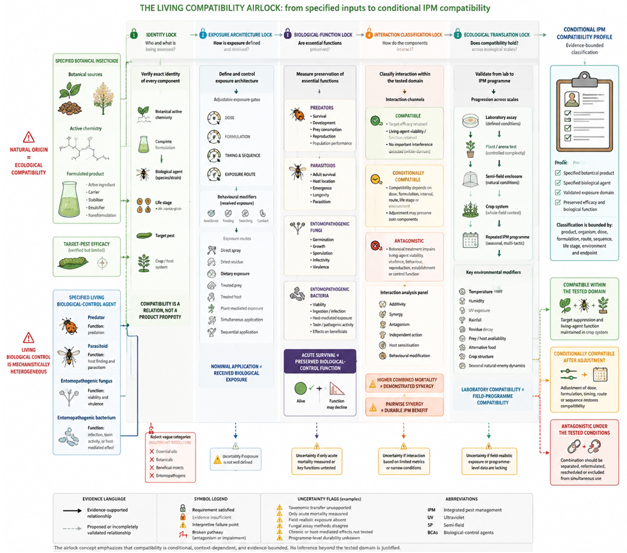
The proposed compatibility-assessment logic defines compatibility as a product × living agent × exposure × function relationship. Its first gate specifies botanical identity, formulation, agent species or strain, life stage, route, dose and schedule. Its second gate evaluates target efficacy and direct harm. Its third assesses preserved function through predation, parasitism, reproduction, microbial viability or virulence. Meta-analytic evidence from predatory mites shows that compatibility estimates depend on taxon, endpoint and mode of action [27]. Figure 1 classifies compatible, conditionally compatible, and antagonistic relationships between botanical insecticides and biological-control agents within the analytical logic developed in this section.
|
|
|
Figure 1. Compatible, conditionally compatible, and antagonistic relationships between botanical insecticides and biological-control agents |
Alt text
A structured conceptual diagram that classifies compatible, conditionally compatible, and antagonistic relationships between botanical insecticides and biological-control agents, with labelled components, directional relations, contextual modifiers, uncertainty points, and a clear boundary between observed evidence and proposed synthesis.
Observed compatibility must next pass an assay-design gate. Exposure duration, temperature and test method are major determinants of observed pesticide–biocontrol-agent compatibility [28]. A “compatible” classification is therefore conditional on whether the assay reproduces realistic residues, routes and environmental conditions. The logic rejects survival-only classifications and requires functional endpoints. It also separates laboratory screening from field inference because a persistent challenge is translating laboratory selectivity into changes in field populations and whole spray programmes [29]. Laboratory compatibility is not equivalent to field-programme compatibility.
Microbial combinations require an additional method-concordance gate. For entomopathogenic fungi, conventional medium-amendment assays can disagree with direct conidial exposure and in vivo efficacy [30]. No combination should therefore be excluded or accepted solely from one in vitro method. The proposed output is a conditional profile: compatible when efficacy and living-agent function are preserved under concordant conditions; conditionally compatible when adjustment of dose, formulation or timing is required; and antagonistic when the botanical product impairs agent viability, virulence or ecological function within the tested domain. This organization remains a non-validated synthesis requiring prospective testing.
The proposed components, evidence bases, boundary conditions, failure modes, and validation requirements are organized in Table 3.
Table 3. Proposed Compatibility-Assessment Logic: Components, Evidence Basis, Relations, Boundary Conditions, Failure Modes, and Validation Requirements
|
Proposed component |
Purpose |
Evidence basis |
Relation or mechanism |
Input or precondition |
Expected output |
Boundary condition or failure mode |
Validation requirement |
|
Identity gate |
Prevent class-wide inference |
Endpoint and taxon heterogeneity |
Compatibility begins with exact product and agent identities |
Botanical product, formulation, agent species or strain and life stage |
Defined assessment domain |
Transfer to another product or agent may be invalid |
Independent replication with specified identities |
|
Exposure-domain gate |
Define received rather than nominal exposure |
Metadata-based compatibility evidence |
Duration, temperature, route and schedule shape the observed response |
Dose, residue profile, route, interval and environment |
Exposure-bounded interpretation |
Low overlap may create false compatibility |
Compare realistic direct, residual, dietary and trophic routes |
|
Target-efficacy gate |
Confirm that ecological selectivity does not eliminate pest control |
Direct botanical efficacy evidence |
Compatibility requires adequate target effect before non-target trade-offs are interpreted |
Operationally relevant botanical treatment |
Demonstrated pest suppression within the tested system |
A harmless but ineffective treatment is not programme-compatible |
Target dose–response and persistence assessment |
|
Function-preservation gate |
Move beyond acute survival |
Natural-enemy and microbial-function evidence |
Predation, parasitism, reproduction, viability or virulence must be retained |
Agent-appropriate functional endpoints |
Preserved biological-control contribution |
Survival-only false-positive classification |
Link individual endpoints to pest suppression or agent performance |
|
Method-concordance gate |
Prevent assay-dependent fungal misclassification |
Comparative in vitro and in vivo evidence |
Multiple methods are compared before classification |
Medium, direct conidial and in vivo assays |
Concordant microbial compatibility profile |
A single method may generate false exclusion or acceptance |
Repeat across strains, formulations and realistic environments |
|
Interaction-classification gate |
Distinguish additivity, synergy and antagonism |
Factorial interaction evidence |
Joint effects are compared with an explicit independent-action expectation |
Exact pair, dose and sequence |
Classified interaction with mechanism hypothesis |
Higher mortality may be mislabelled synergy |
Replicated factorial analysis and mechanism testing |
|
Field-programme gate |
Separate laboratory compatibility from operational compatibility |
Laboratory-to-field synthesis |
Population recovery, residues, weather and repeated use modify outcomes |
Completed lower-tier tests and a defined programme |
Conditional field-programme inference |
Laboratory selectivity may not predict population or service outcomes |
Semi-field and field trials using functional endpoints |
|
Conditional decision output |
Avoid universal safe–unsafe labels |
Integrated evidence from all gates |
Evidence produces compatible, conditionally compatible or antagonistic profiles |
Concordant identity, exposure, efficacy and function evidence |
Domain-bounded programme decision |
Overgeneralisation beyond the tested domain |
Prospective validation and reassessment after programme changes |
IPM design and research implications
Research should replace static binary labels with dynamic, endpoint-rich assessments. A robust compatibility assessment must incorporate dynamic stress, mixtures and sublethal effects rather than rely on static acute-toxicity labels [31]. Progress would be demonstrated by studies that report actual formulations, residue histories, repeated exposures and biological-control functions alongside target efficacy. Predator and parasitoid studies should link survival, behaviour, reproduction and population recovery to pest suppression, while microbial studies should connect viability and virulence assays to realistic host and environmental conditions.
Hidden physiological pathways require greater attention. Immune modulation offers a plausible hidden pathway through which pesticides alter beneficial insects and host–pathogen–parasitoid interactions [32]. Research should therefore determine whether immune or molecular changes predict later reductions in predation, parasitism, development or resilience. Delivery architecture also requires explicit testing. Living-agent performance may depend on delivery architecture and plant-mediated host physiology, as shown for endophytic and foliar Bacillus thuringiensis use [33]. Endophytic, foliar and trophic routes should not be treated as interchangeable.
Implementation evidence must finally connect technical compatibility to programme uptake and adaptive management. Durable uptake of biological control requires evidence that is ecologically credible, operationally relevant and communicable to decision-makers [34]. Progress would include field programmes that document product identity, timing, environmental conditions, natural-enemy recovery and reasons for management adjustment. These studies should not seek one universal interval or compatibility score. They should establish where a combination works, where it fails, and whether formulation or sequencing changes preserve efficacy without transferring unacceptable costs to living agents.
CONCLUSION
Botanical insecticides and living control agents can share an integrated pest-management programme, but compatibility cannot be inferred from natural origin or demonstrated by target mortality alone. It exists only when a specified product, agent, formulation, dose, route and schedule preserve both pest-control efficacy and the biological function expected from the living agent. Acute survival is not equivalent to preserved control function, laboratory compatibility is not equivalent to field-programme compatibility, and pairwise synergy is not equivalent to durable programme benefit. The strongest defensible approach is therefore a staged, conditional assessment that separates identity, exposure, efficacy, sublethal function, microbial viability, interaction class and field translation. Its highest-priority requirement is prospective validation through realistic, multitrophic and function-based programme studies.
ACKNOWLEDGMENTS: None
CONFLICT OF INTEREST: None
FINANCIAL SUPPORT: None
ETHICS STATEMENT: None