Entomology and
Applied Science Letters
Applied Science Letters
 2026
Volume 13
Issue 2
2026
Volume 13
Issue 2

Biological control is commonly designed and evaluated around individual agents, even though pest suppression emerges within agroecosystems containing interacting predators, parasitoids, pathogens, endophytes, host plants, herbivores, resident microbiota, and environmental conditions. This separation creates a conceptual and decision problem: the presence or isolated efficacy of several beneficial organisms does not establish that they interact functionally, remain compatible, or produce stable network-level control. This theory article develops an evidence-grounded, explicitly non-validated synthesis for interpreting biological control as a conditional multi-kingdom process. It integrates natural-enemy diversity, food-web structure, predator and parasitoid traits, entomopathogenic and endophytic functions, plant-mediated defence, insect-associated microbiota, cross-kingdom feedback, and environmental moderation. The central synthesis is that each biological component must remain analytically distinct and should enter a multi-kingdom theory only through traceable mechanisms, directional relations, defined inputs, measurable outputs, and explicit boundary conditions. Complementarity may strengthen suppression, but interference, hyperparasitism, intraguild predation, unstable colonization, misleading plant signals, protective symbionts, and environmental mismatch can reverse expected benefits. Evidence is uneven across organisms, scales, experimental settings, and management contexts, while many mechanistic findings remain concentrated in simplified systems. Consequently, the proposed theory should not be interpreted as a validated programme architecture or deployment-ready framework. Progress requires factorial and temporally explicit experiments, complete life-cycle and network outcomes, verified microbial and endophytic states, multi-site validation, and independent evaluation of efficacy, compatibility, persistence, environmental sensitivity, and operational feasibility.
INTRODUCTION
Biological control is often described through the identity, abundance, release rate, or isolated performance of a predator, parasitoid, pathogen, or microbial antagonist. Yet pest suppression is produced within communities in which multiple enemies attack different pest stages, compete for shared resources, alter prey quality, respond to plant signals, and experience environmental constraints. Natural-enemy diversity can improve biological control through complementarity and insurance, but its effect is contingent on enemy traits and ecological context [1]. Richness is therefore a possible source of functional diversity rather than a sufficient indicator of control.
The spatial setting of these interactions is equally important. Dispersal, habitat arrangement, crop boundaries, resource continuity, and the timing of disturbance influence whether enemies encounter pests and whether indirect trophic pathways become ecologically important. Landscape configuration can reorganize natural-enemy access and indirect trophic pathways, so local agent composition cannot be interpreted independently of spatial scale [2]. A combination that appears complementary in a confined assay may consequently become redundant, disconnected, or antagonistic when organisms operate across heterogeneous fields and seasons.
Diversified farming can increase ecological opportunities for natural enemies, microbial processes, and plant-mediated regulation. However, greater ecological opportunity should not be confused with evidence that organisms from different kingdoms form a functional control network. Agricultural diversification can create broader ecological opportunity for pest regulation, yet service-level gains do not by themselves demonstrate functional interaction among control kingdoms [3]. Co-occurrence may reflect a shared response to habitat, management, or pest density, while observed suppression may still be generated primarily by one dominant pathway.
This article therefore proposes a multi-kingdom theory in which predators, parasitoids, entomopathogens, endophytes, host plants, induced defence, herbivores, and resident microbiota remain distinct biological states. The theory connects them only when evidence identifies a plausible direction of influence, mechanism, context, and measurable consequence. Its central boundaries are explicit: co-occurrence is not functional interaction; pairwise benefit is not network-level control; induced plant defence is not natural-enemy compatibility; and a proposed multi-kingdom theory is not a validated biological-control programme. The aim is to organize existing evidence into a testable conceptual architecture rather than to claim universal synergy or operational readiness.
Moving beyond single-agent biological control
Moving beyond a single agent requires evidence that added enemies contribute functional complementarity rather than merely increasing richness or interference [4, 5]. Complementarity may arise when agents attack different pest stages, occupy different microhabitats, respond differently to environmental variation, or remain active at different times. The same combination may nevertheless fail through niche redundancy, intraguild predation, disrupted host finding, or competition for shared prey. Agent addition is therefore justified only when the joint function is distinguishable from the sum of isolated effects and remains meaningful across the spatial and temporal conditions in which control is expected.
Network structure adds a second analytical requirement. Field evidence shows that species diversity and food-web structure can jointly shape parasitism, hyperparasitism, and pest suppression [6]. Higher trophic levels may remove primary parasitoids, prey selection may change after parasitism, and indirect interactions may alter the effective contribution of each agent. Evaluation must therefore extend beyond counts of predators, parasitoids, or parasitized hosts to include successful emergence, hyperparasitism, pest survival, plant damage, and the topology through which effects are transmitted. Pairwise benefit cannot be extrapolated directly to community-level performance.
A broader control theory must connect plant defence, beneficial organisms, soil and habitat processes across scales without collapsing them into one undifferentiated intervention [7]. The proposed synthesis treats functional complementarity, interaction structure, environmental context, persistence, and validation as separate components. Its output is a network-level control hypothesis, not a validated programme. Each proposed relation requires an observable precondition, a mechanism-specific outcome, a defined applicability domain, and a test capable of distinguishing the relation from competing explanations. The proposed components, evidence bases, boundary conditions, failure modes, and validation requirements are organized in Table 1.
Table 1. Moving beyond Single-Agent Biological Control: Components, Evidence Basis, Relations, Boundary Conditions, Failure Modes, and Validation Requirements
|
Proposed component |
Purpose |
Evidence basis |
Relation or mechanism |
Input or precondition |
Expected output |
Boundary condition or failure mode |
Validation requirement |
|
Functional complementarity |
Determine whether an additional agent contributes a distinct function |
Natural-enemy diversity can generate complementarity but also interference |
Partitioning of prey stages, habitats, resources, or activity periods |
Demonstrably different traits or attack niches |
Broader or more stable suppression hypothesis |
Redundancy, intraguild predation, or one dominant agent |
Factorial single-agent and combined-agent comparisons |
|
Spatial-temporal fit |
Prevent local compatibility from being generalized across scales |
Landscape complexity changes access, timing, and encounter structure |
Dispersal and management timing moderate interaction strength |
Relevant spatial configuration and temporal overlap |
Context-bounded complementarity |
Agents fail to encounter pests or one another at useful times |
Multi-scale and seasonally repeated testing |
|
Food-web structure |
Account for indirect and higher-trophic effects |
Diversity and network topology jointly influence control outcomes |
Parasitism, hyperparasitism, vulnerability, and network generality |
Quantified trophic links and complete enemy pathways |
Net rather than nominal suppression |
Hyperparasitism or indirect release of pests |
Quantitative food-web, exclusion, and emergence measurements |
|
Cross-kingdom interfaces |
Connect plant, microbial, herbivore, and enemy processes without merging them |
Tritrophic defence can operate across organizational scales |
Plant-mediated signalling and biologically mediated changes in pest susceptibility |
Evidence for each directional relation |
Mechanistically traceable interaction hypothesis |
Decorative aggregation without causal evidence |
Sequential perturbation and mediation experiments |
|
Environmental context |
Define where an interaction is expected to hold |
Landscape configuration moderates direct and indirect pathways |
Habitat, dispersal, weather, and management alter relation strength |
Measured environmental covariates |
Domain of applicability |
Context reversal or poor transferability |
Replicated multi-site validation |
|
Evidence-defined integration |
Prevent richness or co-occurrence from being treated as network function |
Trait and context dependence explain variable diversity effects |
Integration occurs only after functions and interactions are demonstrated |
Claim-specific evidence for identity, mechanism, and outcome |
Testable network architecture |
Association mistaken for interaction |
Factorial tests with pest, enemy, plant, and interaction outcomes |
Predators and parasitoids
Predators and parasitoids are frequently treated as compatible because they attack the same pest population through different modes. However, parasitoid development changes host physiology, behaviour, size, mobility, and nutritional quality, potentially altering predator choice. Predators may discriminate between parasitized and unparasitized prey, creating interaction effects that cannot be inferred from each enemy’s separate efficacy [8]. Consumption of parasitized hosts may reduce successful parasitoid emergence, whereas avoidance may preserve parasitoid function but alter the predator’s effective prey base. Compatibility must therefore be evaluated using host-stage-specific and direction-specific interaction tests.
Predator function is also state dependent. Predator performance can depend on prior experience, showing that agent identity alone is insufficient to predict population and plant-level outcomes [9]. Learning, developmental history, hunger, prey conditioning, and previous exposure may influence search behaviour, consumption, reproduction, and persistence. These traits can produce cascading effects from individual behaviour to pest density and plant performance, but evidence from controlled systems does not establish transferability across release strategies, crop structures, alternative-prey communities, or environmental regimes. Multi-kingdom theory must therefore represent predator state and functional traits rather than treating predators as fixed mortality coefficients.
Parasitoid contributions are constrained by organisms above and beside them in the trophic network. Hyperparasitoids can suppress primary parasitoids and therefore constitute a distinct failure pathway that requires its own monitoring and management logic [10]. In parallel, reciprocal predation among commercially used predators demonstrates why compatibility cannot be assumed from their shared status as beneficial organisms [11]. The direction and severity of antagonism may differ among species combinations, developmental stages, prey densities, and habitat structures. Consequently, parasitoid mummies, predator abundance, or separate efficacy estimates are incomplete endpoints; evaluation should include parasitoid emergence, hyperparasitism, predator demography, pest survival, plant outcomes, and the persistence of interactions under field-realistic complexity.
Entomopathogens and endophytes
Entomopathogenic fungi may operate as externally encountered pathogens, internal plant colonists, or both, creating direct and plant-mediated routes of influence. Endophytic entomopathogenic fungi may act through direct pathogenicity and plant-mediated effects, but their persistence and compatibility remain fungus-, plant-, and context-dependent [12–14]. Colonization can alter pest performance, plant physiology, defence signalling, or the quality of herbivores encountered by predators and parasitoids. Nevertheless, fungal application is not equivalent to successful endophytic colonization, detection is not equivalent to functional persistence, and a plant-mediated effect is not automatically beneficial to the wider natural-enemy assemblage.
Variation among fungal isolates and inoculation routes shows that colonization, plant growth promotion, and pest suppression are separable outcomes [15]. Isolate identity, inoculation method, plant tissue, host genotype, pest stage, and microclimate act as biological preconditions rather than minor technical details. An isolate that produces mortality after direct exposure may not colonize plant tissues consistently, whereas an isolate that promotes plant growth may not generate meaningful pest suppression. Controlled evidence therefore supports conditional functions, not a general claim that an endophytic entomopathogen will simultaneously establish, improve plant performance, suppress pests, and remain compatible with other enemies.
For multi-kingdom theory, entomopathogens and endophytes must be represented through distinct state variables: infection exposure, internal colonization, tissue distribution, duration, plant response, herbivore response, and natural-enemy response. Compatibility requires more than short-term survival or unchanged consumption; it should include predator and parasitoid behaviour, reproduction, complete parasitoid development, population consequences, and plant-level outcomes. Likewise, laboratory pathogenicity is not operational effectiveness, and growth promotion is not pest control. Progress requires verified colonization, longitudinal persistence measurements, route-specific functional assays, multitrophic factorial designs, and environmental validation capable of separating direct infection, plant-mediated effects, altered prey quality, and background plant-vigour responses.
Host plants and induced defence
Host plants are active biological interfaces rather than passive substrates on which pests and natural enemies merely encounter one another. Herbivore-induced plant volatiles can mediate natural-enemy recruitment, but signal reliability and control consequences depend on the plant, herbivore, enemy, and environment [16]. Volatile production, release, perception, and behavioural response may vary with genotype, tissue, plant age, nutrition, weather, herbivore identity, and prior damage. Attraction alone is therefore insufficient evidence of control unless it is linked to successful attack, pest reduction, and plant protection.
Induced defence comprises perception, signalling, and downstream chemical or structural responses, so it cannot be treated as one interchangeable construct [17]. Direct resistance against herbivores and indirect recruitment of enemies may operate simultaneously, sequentially, or antagonistically. A defence response that reduces herbivore performance may also change prey quality, host suitability, or the cues used by predators and parasitoids. Consequently, increased expression of a defence marker is not equivalent to improved biological control, and induced plant defence is not equivalent to compatibility with natural enemies.
Plant-mediated relations can also transmit effects initiated at higher trophic levels. Parasitoid-associated symbionts can alter plant-mediated interactions among herbivores, linking internal enemy microbiology to community-level plant defence [18]. Parasitoid-induced changes in herbivore elicitors can likewise feed back to plant defence and plant fitness, demonstrating a bidirectional trophic relation [19]. These findings support a dynamic representation of plant state, but their transferability remains bounded by the particular plant, herbivore, parasitoid, symbiont, developmental stage, and temporal sequence examined.
Resident microbiota and cross-kingdom feedback
Insect-associated microbes should be classified by demonstrated function, acquisition, transmission, composition, and context rather than by residence time alone. Insect-associated microbes, whether transient or heritable, can alter host function and natural-enemy exposure, yet their effects depend on transmission, host genotype, and ecological context [20–22]. A transient microorganism may have a consequential metabolic or signalling function, whereas a consistently detected resident may have no established role in control. Detection, therefore, is not equivalent to functional mediation.
Microbial symbionts can modify parasitoid competition through direct host effects and plant-mediated pathways, creating cross-level feedbacks [23]. Protective microorganisms may alter host immunity, physiology, nutritional quality, behaviour, volatile-mediated communication, or susceptibility to pathogens. Such changes can benefit the herbivore, an enemy, or neither, depending on the interacting strains and environmental conditions. Microbiota should consequently enter the proposed theory as compositional and functional states rather than as a single richness measure or an assumed source of host health.
Cross-kingdom feedback requires evidence of reciprocal influence, not merely a one-way cascade. A microbial state may change plant signalling and parasitoid attraction [21], while parasitoid selection may subsequently restructure the prevalence of protective symbionts within the host population [22]. Establishing feedback therefore requires temporal ordering, perturbation, return effects, and exclusion of shared environmental causes. Microbiome association alone does not establish a biological-control mechanism, and experimentally demonstrated protection in one host–symbiont–enemy system should not be generalized across taxa or management settings.
Proposed multi-kingdom theory
The proposed theory represents host plants, herbivorous insects, predators, parasitoids, entomopathogens, endophytes, resident microbiota, and environmental conditions as separate biological states connected by conditional relations. Plant signals can alter herbivore susceptibility to natural pathogens, illustrating a conditional pathway that crosses plant, insect, microbial, and pathogen domains [24]. Each relation must specify direction, biological mechanism, input state, expected output, context, uncertainty, and a test capable of distinguishing the proposed pathway from direct toxicity, shared environmental response, or another competing explanation.
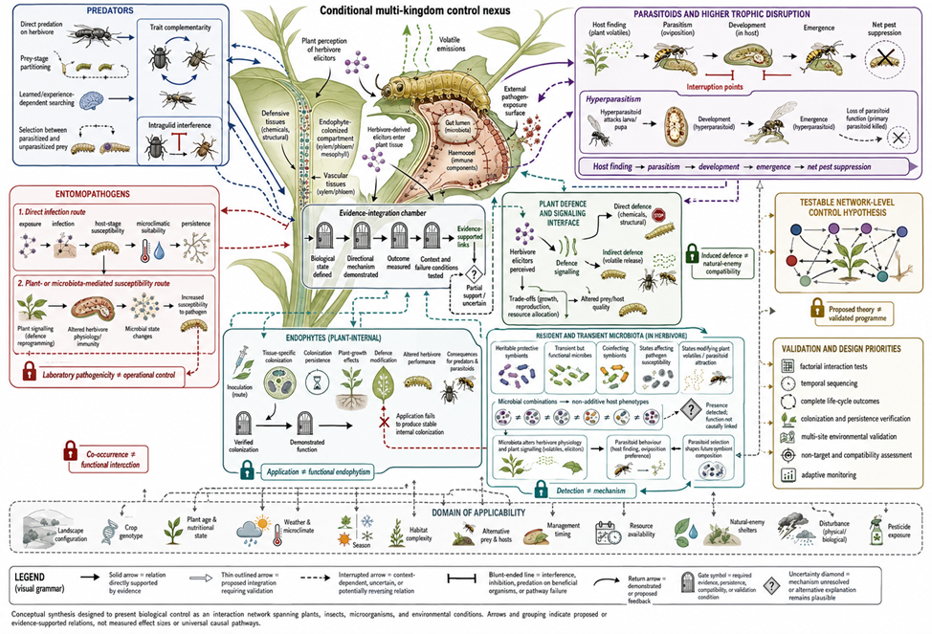
Figure 1 presents biological control as an interaction network spanning plants, insects, microorganisms, and environmental conditions within the analytical logic developed in this section.
|
|
|
Figure 1. Biological control as an interaction network spanning plants, insects, microorganisms, and environmental conditions |
Alt text
A structured conceptual diagram that presents biological control as an interaction network spanning plants, insects, microorganisms, and environmental conditions, with labelled components, directional relations, contextual modifiers, uncertainty points, and a clear boundary between observed evidence and proposed synthesis.
The theory distinguishes mechanism identity from functional equivalence. Distinct parasitoid-associated viral symbionts can converge on similar plant-mediated foraging outcomes, supporting a theory that separates mechanism identity from functional equivalence [25]. Similar outputs may therefore be represented as comparable functions only after convergence has been demonstrated. Shared outcomes cannot be presumed from taxonomic similarity, and mechanistic convergence observed in selected systems does not establish universal field benefit.
Within-host microbial composition forms another independent state. Coinfection among protective symbionts can generate non-additive host phenotypes, so microbial community state must be represented compositionally rather than as a simple richness score [26]. The same logic applies to natural-enemy assemblages: the effect of a combination depends on identity, relative abundance, sequence, interaction direction, and context. Pairwise benefit cannot be multiplied into a network-level prediction without evidence that indirect interactions and higher trophic levels preserve the expected effect.
Finally, the theory requires explicit definitions and mechanism-based boundaries. A multi-kingdom theory should use explicit definitions and mechanism-based classifications so that living-agent effects are not conflated with every biologically influenced form of pest reduction [27]. Its output is a set of testable, evidence-tagged relations and failure hypotheses. It is not a validated programme, a composite readiness score, or evidence that including more kingdoms necessarily improves control. The proposed components, evidence bases, boundary conditions, failure modes, and validation requirements are organized in Table 2.
Table 2. Proposed Multi-Kingdom Theory: Components, Evidence Basis, Relations, Boundary Conditions, Failure Modes, and Validation Requirements
|
Proposed component |
Purpose |
Evidence basis |
Relation or mechanism |
Input or precondition |
Expected output |
Boundary condition or failure mode |
Validation requirement |
|
Evidence-tagged interaction network |
Integrate distinct biological states without collapsing them |
Conditional cross-domain mechanisms |
Directional relations among plant, herbivore, enemy, pathogen, and microbial states |
Defined constructs and a supported relation |
Testable network hypothesis |
Co-occurrence mistaken for interaction |
Factorial perturbation and mediation testing |
|
Predator state |
Represent predation beyond agent identity |
Learning and prey-state effects |
Experience, traits, and prey condition alter predation |
Trait and behavioural measurements |
State-dependent predation function |
Laboratory behaviour fails in complex habitats |
Population- and field-scale validation |
|
Parasitoid pathway |
Distinguish nominal parasitism from successful control |
Higher-trophic and host-mediated losses |
Host finding, development, hyperparasitism, and emergence |
Complete life-cycle observations |
Net successful parasitism |
Mummy counts overestimate suppression |
Emergence, hyperparasitism, pest, and plant outcomes |
|
Entomopathogen state |
Separate infection from operational suppression |
Direct and mediated pathogen effects |
Exposure, infection, host state, and environment determine disease |
Verified exposure and infection |
Conditional pathogen-mediated suppression |
Microclimate or host stage prevents infection |
Persistence and field-exposure validation |
|
Endophyte state |
Separate application from functional colonization |
Tissue- and route-dependent colonization |
Internal persistence alters plant or herbivore state |
Verified tissue colonization over time |
Conditional plant-mediated effect |
Surface contamination or unstable colonization |
Longitudinal colonization and causal assays |
|
Plant-defence state |
Represent plants as dynamic mediators |
Direct resistance and indirect signalling |
Induction changes herbivores, enemies, and plant outcomes |
Pathway-specific plant measurements |
Recipient-specific defence output |
Trade-offs or enemy deterrence |
Defence-by-agent factorial tests |
|
Microbial community state |
Represent microbiota compositionally |
Non-additive symbiont combinations |
Identity, titre, acquisition, and transmission alter host phenotype |
Perturbation and composition evidence |
Contextual susceptibility or protection |
Presence mistaken for function |
Controlled removal and reinoculation studies |
|
Environmental and programme boundary |
Prevent universal or readiness claims |
Context changes relation strength and feasibility |
Landscape, weather, management, and evidence quality moderate outcomes |
Multi-scale contextual data |
Domain of applicability |
Context reversal or compensatory scoring |
External validation and independent decision gates |
Implications for biological-control design
The first design priority is to test communication pathways before manipulating them. Chemical-ecology interventions should be designed around signal specificity, persistence, climatic sensitivity, and consequences for both target and non-target organisms [28]. Progress would be demonstrated by linking a defined signal to enemy behaviour, successful attack, pest suppression, and plant outcomes across realistic climatic and crop conditions. Signal attraction without sustained control, or a response that disrupts non-target organisms, should be treated as a failed design pathway rather than partial programme success.
The second priority is to treat habitat manipulation as conditional infrastructure. Natural-enemy shelters should be treated as conditional infrastructure because the same habitat feature can support enemies, divert attacks, harbor pests, or intensify antagonistic interactions [29]. Design should therefore specify the intended beneficiary, resource supplied, seasonal function, expected movement pathway, and plausible adverse users. Evidence of progress would include replicated measurements of occupancy, enemy persistence, pest use, interaction changes, suppression, and plant outcomes across local and landscape contexts.
The third priority is staged validation with independent decision gates. Model-based analyses can identify plausible multi-enemy regimes and failure conditions, but implementation decisions require empirical parameterization and staged field validation [30]. Efficacy, compatibility, persistence, environmental transferability, non-target consequences, operational feasibility, and monitoring capacity should remain separate judgments because strength in one domain cannot compensate for critical failure in another. Advancement requires predefined stopping criteria, transparent uncertainty, and sequential laboratory, semi-field, field, and adaptive-monitoring evidence rather than a single readiness score.
CONCLUSION
Biological control is most defensibly understood as a conditional multi-kingdom process in which predators, parasitoids, pathogens, endophytes, host plants, herbivores, microbiota, and environmental conditions can influence one another through distinct mechanisms. The strongest synthesis is not that greater biological complexity automatically improves suppression, but that traceable functional complementarity and cross-kingdom feedback may improve control when interference, persistence, scale, and context are explicitly tested. Co-occurrence remains different from interaction, pairwise benefit from network-level control, induced defence from natural-enemy compatibility, and theory from programme validation. The highest priority is therefore to replace agent inventories and assumed synergies with factorial, temporally explicit, mechanism-specific, and context-bounded validation.
ACKNOWLEDGMENTS: None
CONFLICT OF INTEREST: None
FINANCIAL SUPPORT: None
ETHICS STATEMENT: None