Entomology and
Applied Science Letters
Applied Science Letters
 2025
Volume 12
Issue 2
2025
Volume 12
Issue 2

Economic thresholds remain central to integrated pest management because they connect pest observation with the timing of economically justified intervention. Yet many operational thresholds were developed under assumptions of relatively stable pest development, crop response, production costs, market conditions, monitoring capacity, and intervention performance. Climate volatility increasingly destabilizes these assumptions by altering pest phenology, overwintering survival, voltinism, dispersal, host–pest synchrony, crop tolerance, and natural-enemy regulation. This methodological perspective examines how economic-threshold logic can be reformulated without treating dynamic adjustment as already validated practice. It integrates evidence concerning the historical assumptions of thresholds, climatic effects on pest development, crop-value variation, farmer capacity, unequal exposure to decision error, natural-enemy activity, monitoring costs, forecasting, and advisory-system design. The synthesis indicates that pest abundance alone cannot represent expected economic injury and that climatic forecasts cannot determine intervention timing without information on crop state, injury potential, control feasibility, ecological regulation, and decision uncertainty. A climate-responsive threshold should therefore be understood as a conditional decision structure rather than a universally transferable pest-density value. Its components require repeated updating, explicit uncertainty representation, and separation between biological warning, economic justification, and feasible action. Important limitations include inconsistent threshold evidence, species- and location-specific climate responses, unequal monitoring resources, uncertain transferability, and limited field validation of integrated dynamic rules. The principal implication is that future threshold systems should be co-designed as transparent, updateable decision processes whose recommendations remain conditional on local ecological and socioeconomic evidence. Such systems could improve intervention timing, but their benefits must be evaluated before they are represented as locally effective or operationally equitable.
INTRODUCTION
Integrated pest management was intended to replace routine suppression with coordinated decisions that combine prevention, monitoring, ecological regulation, and selective intervention. Within this logic, an economic threshold is not simply a count of insects but a decision boundary indicating when expected injury justifies action. Stenberg’s conceptual formulation emphasizes that integrated pest management must connect multiple ecological and management components rather than reduce crop protection to isolated control tactics [1]. Thresholds are therefore meaningful only within a broader system that links pest pressure to crop condition, natural enemies, intervention options, and management objectives. When these relationships are compressed into a fixed pest-density rule, the apparent precision of the threshold can conceal substantial uncertainty about the process it is meant to govern.
Climate change strengthens the need for such systemic interpretation because pest risks emerge from interacting farm, landscape, and institutional conditions. Climate-smart pest management frames adaptation as a coordinated effort involving surveillance, prevention, ecological management, responsive control, extension, research, and enabling support rather than as a narrow correction to spray timing [2]. This wider view is important for economic thresholds: warming, rainfall variability, drought, extreme events, and changing seasonal duration can modify pest occurrence, but the management consequence depends on whether crops are vulnerable, natural enemies remain functional, farmers can monitor fields, and appropriate interventions are accessible. A biologically plausible increase in pest pressure does not by itself establish either economic injury or the feasibility of a timely response.
The practical history of integrated pest management also shows a persistent gap between ecological principles and farm-level implementation. Reviews of contemporary practice identify conceptual inconsistency, continued reliance on prophylactic chemical control, inadequate integration of ecology, and weak translation of integrated pest management principles into operational decisions [3]. Static thresholds can contribute to that gap when they are circulated as durable technical constants despite changes in cultivars, commodity prices, production costs, pesticide efficacy, resistance, pest complexes, weather, and advisory capacity. Conversely, simply adding climate data to an old threshold does not resolve the underlying decision problem. A historical economic threshold is not equivalent to a climate-stable decision threshold, and a climate-adjusted pest forecast is not equivalent to a justified intervention recommendation.
This article develops a methodological perspective for reconsidering pest intervention timing in dynamic and unequal agroecosystems. Its purpose is not to validate a new threshold algorithm or prescribe a universal operational programme. Instead, it identifies the evidence-supported components that a climate-responsive threshold would need, clarifies the relations among biological, economic, ecological, and feasibility inputs, and specifies where uncertainty and validation requirements must remain visible. The central argument is that economic thresholds should be reconstructed as conditional and updateable decision processes. Such processes must separate pest detection from injury estimation, biological forecasting from farmer feasibility, and conceptual dynamic adjustment from demonstrated local benefit.
Origins and assumptions of economic thresholds
Economic thresholds traditionally translate pest observation into a recommendation to intervene before populations or injuries reach an economically damaging level. Their apparent simplicity depends on several embedded assumptions: the sampled pest indicator adequately represents damaging pressure; the relationship between pest abundance and crop loss is sufficiently stable; the crop’s compensatory capacity is known; intervention will act within the relevant biological window; and expected crop-value protection exceeds monitoring and control costs. A review of thresholds for invertebrate pests in UK arable crops found that many operational thresholds lacked a strong peer-reviewed foundation and frequently failed to incorporate crop tolerance or the type and amount of injury caused [4]. This finding challenges the treatment of threshold values as universally established evidence. More recent on-farm research confirms that threshold use can reduce insecticide applications while preserving production, yet its economic attractiveness depends partly on monitoring effort, labour costs, commodity prices, crop type, and insecticide costs [5]. Pest abundance is therefore not equivalent to expected economic injury, because equivalent counts can carry different consequences across crop stages, production systems, and economic settings.
A second assumption is that the threshold can ignore ecological regulation occurring before and after intervention. Natural enemies can reduce the probability that a recorded pest population will continue towards economic injury, while insecticide application can suppress both the target pest and organisms contributing to future biological control. A theoretical analysis of dynamic thresholds demonstrated how natural-enemy density and the movement of pests and beneficial organisms across field boundaries can alter predicted treatment frequency and farm revenue [6]. The important methodological contribution is not a universal instruction to raise thresholds whenever natural enemies are present. Rather, it shows that a decision boundary changes when the expected trajectory of pest pressure is conditioned by ecological regulation and recolonization. Such adjustment remains dependent on reliable monitoring, appropriate natural-enemy identification, intervention selectivity, spatial connectivity, and the validity of the underlying population model. Dynamic adjustment is consequently not equivalent to validated local benefit.
A third assumption concerns timing. Thresholds may be evaluated at different pest or crop stages, but an earlier warning does not necessarily generate a better economic decision. Comparative analysis of early- and late-stage thresholds for soybean aphid showed that management value depends on the probability of recovering intervention costs and on the relationship among infestation timing, treatment strategy, and expected return [7]. Early action may preserve more response time, yet it may also increase intervention against populations that would not have produced sufficient injury. Later action may improve diagnostic confidence while narrowing the period in which control can prevent loss. The methodological requirement is therefore to evaluate when information becomes decision-relevant, not merely when a pest can first be detected. Conventional threshold assumptions, their ecological qualifications, and their adaptive requirements must be made explicit before climatic modifiers are introduced. The evidence dimensions and interpretive boundaries for origins and assumptions of economic thresholds are summarized in Table 1.
Table 1. Origins and Assumptions of Economic Thresholds: Pest Targets, Ecological Mechanisms, Intervention Timing, Context Dependence, Trade-Offs, and Adaptive Management Requirements
|
IPM component |
Target pest or guild |
Ecological or behavioural mechanism |
Timing and sequence |
Expected contribution |
Context dependency |
Trade-off or failure risk |
Monitoring or adaptation need |
|
Pest-density threshold |
Sampled invertebrate pest population |
Observed density is used as a proxy for future injury |
Sample before the expected damaging stage and intervene before economic injury |
Links field observation to an intervention decision |
Crop stage, sampling method, pest distribution, cultivar tolerance, and injury relationship |
Density may poorly represent injury; outdated values can create false precision |
Reassess sampling validity, crop tolerance, and pest–injury relationships |
|
Crop-injury interpretation |
Feeding guilds causing direct or indirect damage |
Crop loss depends on injury type, timing, intensity, and compensatory capacity |
Interpret pest observations relative to vulnerable crop stages |
Distinguishes detectable presence from economically consequential pressure |
Crop physiology, water or nutrient stress, yield potential, and recovery capacity |
The same pest count can generate different yield effects |
Integrate crop condition and injury indicators with pest counts |
|
Monitoring-based intervention |
Pests of cereals and oilseed rape |
Repeated field inspection determines whether a threshold has been crossed |
Monitoring precedes treatment and may be repeated across the season |
Can reduce unnecessary insecticide use while protecting production |
Pest complex, crop type, labour availability, prices, and monitoring costs |
Monitoring expense may exceed recoverable benefit in some settings |
Reduce monitoring burden and document labour and knowledge requirements |
|
Natural-enemy-conditioned threshold |
Pests regulated by predators or parasitoids |
Biological control alters expected pest population growth and injury risk |
Assess pests and natural enemies before selecting treatment timing |
May defer or avoid insecticide use where ecological regulation is sufficient |
Natural-enemy identity, density, efficacy, dispersal, and insecticide selectivity |
Misidentification or weak regulation may delay needed control |
Monitor beneficial organisms and validate their relation to future pest suppression |
|
Spatially dynamic threshold |
Mobile pests and natural enemies |
Immigration, emigration, and recolonization connect treated and untreated fields |
Consider landscape movement before and after intervention |
Accounts for recovery or reinvasion that static field counts omit |
Field configuration, surrounding habitats, dispersal rates, and neighbouring management |
Ignoring movement may overestimate treatment durability or biological control |
Incorporate spatial surveillance and periodically update movement assumptions |
|
Stage-specific economic threshold |
Soybean aphid and comparable stage-dependent pests |
Intervention value changes with infestation timing and expected cost recovery |
Compare early warning with later, more certain evidence of damaging pressure |
Aligns response time with the probability of economic return |
Pest growth, crop stage, treatment cost, yield value, and control performance |
Early treatment may be unnecessary; late treatment may miss the protective window |
Update economic inputs and compare decision performance across infestation stages |
|
Integrated decision architecture |
Multiple crop-pest-management combinations |
Pest, crop, ecological, and intervention components jointly determine action |
Prevention and monitoring precede selective response and evaluation |
Prevents a threshold from functioning as an isolated spray trigger |
Local production objectives, available tactics, resistance risk, and advisory support |
Fragmented use can reproduce calendar-based chemical control |
Record the complete decision sequence and evaluate interactions among components |
|
Climate-smart adaptation context |
Existing and emerging pest threats |
Climate interacts with farm and landscape resilience, surveillance, and prevention |
Long-term preventive adaptation supports short-term responsive control |
Positions threshold decisions within wider adaptation and resilience planning |
Climate exposure, farm resources, landscape ecology, and institutional support |
Climate information without actionable support may not alter outcomes |
Link pest and climate monitoring with extension, prevention, and feasible response options |
Climate variability and shifting pest development
Climate-responsive threshold design first requires recognition that pest development is driven not only by average seasonal conditions but also by variability around those averages. Phenological forecasts based solely on mean temperatures can misrepresent development when daily or episodic thermal fluctuations change accumulated development differently from a constant-temperature assumption [8]. This matters because a threshold recommendation is temporally useful only when monitoring and intervention occur relative to the pest stage that causes injury and the crop stage that determines vulnerability. At broader scales, modelling based on temperature-dependent insect population growth and metabolic demand has projected increased losses in major grain crops under warming, especially where warming jointly favours insect population performance and consumption [9]. Such projections establish that climatic change can alter the expected burden of pests, but they do not supply local intervention thresholds. Their management value depends on translation across scales—from climatic exposure to field microclimate, pest stage, crop injury, and feasible response.
Nor does warming produce a uniform directional effect across pest species or agroecosystems. Comparative evidence across globally important phytophagous pests shows that responses can include range change, altered life histories, modified population dynamics, and disrupted trophic interactions, with many species displaying mixed rather than consistently harmful or beneficial responses [10]. A warmer period may accelerate one developmental stage while heat stress, drought, host deterioration, or asynchronous natural-enemy activity constrains another. Seasonal effects may also differ from responses to short extreme events, and regional range expansion may coexist with local suppression. Consequently, the climatic modifier in a dynamic threshold cannot be a generic warming coefficient. It must represent the biologically relevant exposure, its timing, and the response function for the particular pest–crop–natural-enemy system.
Climate variability can further alter overwintering survival, voltinism, migration, plant-mediated interactions, and the effectiveness of biological control [11]. These mechanisms can shift both when damaging populations appear and whether a sampled population is likely to increase, stabilize, disperse, or decline. Yet climatic suitability remains only one part of the intervention decision. A biologically credible forecast may justify intensified surveillance without justifying treatment; similarly, detected phenological advancement may change the monitoring calendar without changing the economic injury relationship. This distinction protects the threshold from becoming a direct conduit from climate prediction to pesticide application. A climate-responsive system should instead use climatic evidence to update the timing and uncertainty of pest observation, after which crop vulnerability, ecological regulation, expected injury, intervention efficacy, and feasibility must still be evaluated.
Crop value, farmer capacity, and unequal risk
Economic injury is inseparable from the value and vulnerability of the crop being protected. Expert-based global assessment demonstrates that pathogens and pests impose substantial but heterogeneous losses across major food crops and production regions [12]. This heterogeneity means that neither a global estimate nor a crop-wide average can establish the loss expected in an individual field. Marketable yield, quality penalties, production purpose, crop stage, replacement possibilities, input costs, and expected price can all alter the point at which injury becomes economically consequential. Climate volatility adds further uncertainty by changing attainable yield and crop stress: a pest population that is tolerable in a vigorous crop may become consequential when heat or water limitation reduces compensatory capacity, while low yield potential can also reduce the recoverable value of intervention. A dynamic threshold must therefore update crop-value and crop-condition inputs without assuming that higher biological risk automatically produces a positive economic return from control.
Farmer capacity determines whether a technically appropriate recommendation can be observed, interpreted, financed, and implemented in time. Research with smallholder vegetable farmers in Southeast Asia found heavy pesticide dependence alongside limited ability to distinguish beneficial from harmful arthropods and strong reliance on pesticide-oriented advice [13]. Wider synthesis similarly associates deficient ecological literacy with low recognition of natural enemies and greater dependence on synthetic pesticides [14]. These findings do not imply that farmer knowledge alone causes pesticide use; product availability, labour constraints, market standards, risk aversion, credit, extension access, and exposure to crop loss can also shape decisions. They do show why biological forecasting is not equivalent to farmer feasibility. A threshold requiring frequent scouting, taxonomic discrimination, digital access, or rapid acquisition of selective products may be unusable for producers lacking those resources, even when its ecological logic is sound.
Unequal capacity also creates unequal exposure to threshold error. Producers with financial reserves may tolerate delayed action, additional scouting, or a false warning, whereas resource-constrained farmers may face severe consequences from either preventable crop loss or an unnecessary input purchase. Evidence from commercial arable farms indicates that pesticide reductions can often coexist with productivity and profitability, but the opportunity varies among production situations and cannot be assumed for every farm [15]. The implication for dynamic thresholds is not that economic or ecological diversification will always pay, but that decision systems should make distributional conditions visible. Validation should compare who bears monitoring costs, who can act within the recommended window, whose crop value is protected, and who carries the risk when forecasts fail. Climate responsiveness without these feasibility and equity checks could improve biological precision while worsening practical exclusion.
Dynamic threshold components
A climate-responsive threshold requires state variables that can change through time rather than a single pest-density value applied uniformly across seasons. At minimum, the decision structure must distinguish pest developmental stage, crop susceptibility, natural-enemy activity, recent and forecast climatic exposure, expected intervention delay, and uncertainty in the observations used. Evidence from pear systems illustrates why phenological relationships among crops, pests, and natural enemies may shift differently under changing climatic conditions, producing mismatches that cannot be represented adequately by a static calendar or historical average [16]. The relevant threshold input is therefore not “temperature” in isolation but the estimated effect of recent conditions on the timing and overlap of biologically consequential stages. These estimates should modify surveillance intensity and the expected trajectory of injury, while remaining separate from the economic and feasibility tests required before intervention.
Developmental models can provide a second dynamic component by updating the expected emergence or activity of damaging stages. Modelling diapause termination and phenology in Popillia japonica, for example, demonstrates how temperature-dependent processes can be translated into forecasts of seasonal development [17]. Such models can improve the timing of monitoring, but their usefulness depends on local calibration, the quality of weather or microclimate data, the stability of response functions, and the correspondence between predicted development and actual crop injury. Model output should therefore enter the threshold as a probabilistic biological warning rather than as an automatic treatment command. When prediction uncertainty is high, the appropriate response may be intensified sampling or delayed reassessment rather than immediate intervention. This distinction preserves the boundary between biological forecasting and economically justified action.
A third component is an explicit update rule specifying how new information changes the decision boundary. Dynamic threshold research in cotton shows that intervention rules can be adjusted over the season to reflect changing crop stage and pest risk rather than relying on one invariant density [18]. Work on pear psylla similarly demonstrates the value of considering both pest and natural-enemy observations when defining management-relevant boundaries [19]. Together, these studies support a structure in which pest density, crop vulnerability, natural-enemy regulation, expected loss, control cost, and response time are updated iteratively. They do not establish a universally transferable formula. A defensible dynamic threshold must state which variables are measured, how uncertainty is propagated, when reassessment occurs, and under what conditions the recommendation is suspended because the evidence is insufficient or the proposed action is infeasible.
Proposed climate-responsive intervention logic
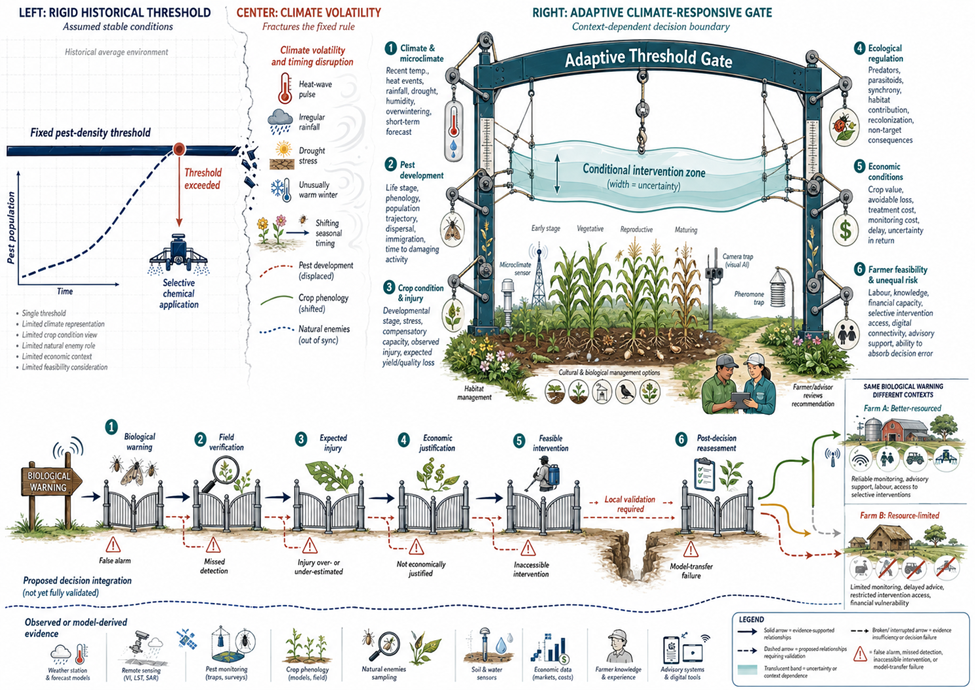
The proposed intervention logic begins with a separation of functions. Climatic and phenological information estimates when pest pressure may emerge; field monitoring determines whether the predicted pressure is present; crop-state information estimates whether observed pressure is likely to produce consequential injury; ecological information modifies the expected trajectory through natural-enemy activity and dispersal; economic information evaluates whether avoidable loss exceeds the costs and risks of intervention; and feasibility information determines whether an appropriate action can be implemented in time. Agricultural pest-impact modelling already demonstrates the need to connect biological processes with crop-system outcomes rather than treating pest occurrence as an isolated endpoint [20]. Climate-sensitive forecasting of cereal stemborers and their natural enemies further shows that the expected effectiveness of management may shift when pest and beneficial-organism distributions respond differently to changing conditions [21]. The original contribution proposed here is the organization of these elements into sequential decision gates: biological warning, verified field pressure, expected injury, economic justification, feasible intervention, and post-action reassessment. Figure 1 contrasts conventional static thresholds with climate-responsive and context-sensitive intervention thresholds within the analytical logic developed in this section.
|
|
|
Figure 1. Conventional static thresholds with climate-responsive and context-sensitive intervention thresholds |
Alt text
A structured conceptual diagram that contrasts conventional static thresholds with climate-responsive and context-sensitive intervention thresholds, with labelled components, directional relations, contextual modifiers, uncertainty points, and a clear boundary between observed evidence and proposed synthesis.
The logic must also account for interactions that are not captured by pest counts alone. A whole-ecosystem approach to pear psyllid management emphasizes the combined relevance of pest biology, natural enemies, habitat, crop management, and climate-sensitive ecological relations [22]. Within the proposed structure, natural-enemy observations modify expected pest progression only where their identity, abundance, timing, and suppressive relevance can be interpreted with reasonable confidence. Monitoring technology can expand the frequency and spatial coverage of observations, but camera-equipped traps remain subject to limitations in detection, classification, maintenance, representativeness, and translation from captured individuals to field injury [23]. Automated detection should therefore be treated as one evidence stream rather than as a substitute for crop assessment or economic interpretation. A failure at any earlier gate—unreliable detection, uncertain pest identity, weak injury linkage, or inadequate natural-enemy information—should reduce recommendation confidence and trigger additional observation rather than be concealed by a precise numerical output.
The final decision gate concerns action feasibility and learning. A recommendation should specify the intervention window, available management options, likely delay before control, expected selectivity, resistance implications, and consequences of acting or not acting. Where an effective and acceptable intervention is unavailable, the system should communicate biological risk without implying that the farmer possesses a feasible solution. After action, the system should compare predicted pest development, observed injury, intervention timing, ecological effects, and crop outcome so that locally relevant assumptions can be revised. This feedback function converts the threshold from a fixed rule into an adaptive decision process, but it does not demonstrate that the process improves outcomes. Validation must compare the proposed logic with existing practice across contrasting climates, crops, farm capacities, and pest complexes, using outcomes that include avoidable injury, unnecessary intervention, economic return, natural-enemy conservation, resistance pressure, monitoring burden, and distribution of decision risk. The proposed components, evidence bases, boundary conditions, failure modes, and validation requirements are organized in Table 2.
Table 2. Proposed Climate-Responsive Intervention Logic: Components, Evidence Basis, Relations, Boundary Conditions, Failure Modes, and Validation Requirements
|
Proposed component |
Purpose |
Evidence basis |
Relation or mechanism |
Input or precondition |
Expected output |
Boundary condition or failure mode |
Validation requirement |
|
Climate and phenology update |
Anticipate changes in pest timing |
Temperature variability and climate-sensitive pest development affect phenology |
Recent and forecast exposure updates the expected timing of damaging stages |
Relevant weather or microclimate data and a biologically appropriate response model |
Revised surveillance window and developmental-risk estimate |
Regional weather may not represent field exposure; extreme events may violate model assumptions |
Compare predicted and observed life-stage timing across sites and seasons |
|
Field verification gate |
Confirm that forecast pressure is present |
Monitoring is necessary before threshold-based intervention |
Direct observations update pest presence, density, and stage |
Valid sampling design, correct identification, and documented effort |
Field-specific pest-pressure estimate |
Detection error, uneven distribution, trap bias, or insufficient sampling |
Test sensitivity, specificity, representativeness, and sampling burden |
|
Crop-injury gate |
Distinguish abundance from expected damage |
Threshold evidence is weakened when crop tolerance and injury relationships are omitted |
Pest observations are interpreted relative to crop stage, condition, and injury pathway |
Crop-state and injury indicators linked to the target pest |
Conditional estimate of expected injury |
Pest density may not predict yield or quality loss under current conditions |
Validate pest–injury–loss relations under contrasting crop and climate states |
|
Ecological-regulation modifier |
Account for natural-enemy suppression and recolonization |
Pest trajectories may change with predators, parasitoids, and movement |
Natural-enemy evidence modifies expected pest growth and treatment urgency |
Reliable identification, density estimates, and knowledge of suppressive relevance |
Adjusted probability that pest pressure will progress |
Natural enemies may be asynchronous, ineffective, or vulnerable to intervention |
Compare predictions with pest trajectories under measured natural-enemy activity |
|
Economic-justification gate |
Determine whether intervention is expected to recover its costs |
Crop value, expected loss, monitoring expense, and treatment costs alter economic return |
Avoidable injury is compared with the full cost and uncertainty of action |
Current production costs, expected crop value, and control-performance assumptions |
Conditional economic case for intervention or continued observation |
Volatile prices, uncertain yield potential, or unmeasured quality effects |
Test decision performance across price, cost, and yield scenarios |
|
Feasibility and equity gate |
Determine whether the recommended action is practically accessible |
Farmer knowledge, labour, finance, advice, and product access shape implementation |
Biological recommendation is filtered through actual response capacity |
Timely access to understandable advice and appropriate management options |
Feasible action, alternative response, or explicit statement of constraint |
Technically optimal advice may be inaccessible or unaffordable |
Measure adoption burden, timing constraints, and distribution of benefits and errors |
|
Intervention selection gate |
Choose the least disruptive effective option |
IPM requires integration rather than automatic chemical response |
Prevention, biological control, cultural tactics, and selective chemicals are sequenced conditionally |
Available tactics, expected efficacy, selectivity, and resistance information |
Context-appropriate intervention plan |
Inappropriate sequencing may disrupt natural enemies or accelerate resistance |
Compare efficacy, non-target effects, recurrence, and resistance outcomes |
|
Post-decision learning loop |
Update local assumptions and improve transparency |
Dynamic systems require reassessment after forecasts and interventions |
Predicted and observed outcomes are compared to revise future decisions |
Documented observations, actions, timing, and outcomes |
Locally updated parameters and uncertainty estimates |
Missing outcome data can reinforce incorrect assumptions |
Prospective evaluation across repeated seasons and heterogeneous farms |
Implications for forecasting and advisory systems
Forecasting systems should be designed to support distinct decisions rather than deliver undifferentiated risk scores. Agricultural decision-support platforms can integrate heterogeneous data and provide recommendations, but their utility depends on the quality of their underlying knowledge, the transparency of their rules, and their fit with farm-level decisions [24]. For climate-responsive thresholds, this means separating outputs into at least three layers: a biological alert indicating when pest development or migration is plausible; a field-verification request specifying what must be observed; and a conditional management recommendation explaining why action is or is not economically justified. Progress should be evaluated by whether users can trace each recommendation to its inputs, identify uncertainty, and understand which missing information would change the decision—not merely by whether the system produces an answer.
Long-range forecasting may help advisory services allocate surveillance and prepare management resources before pest arrival. Seasonal forecasting of brown planthopper migration demonstrates that biologically and meteorologically informed models can provide advance indications of pest pressure over substantial spatial scales [25]. However, forecast lead time creates a governance problem as well as a technical opportunity. Advisory systems must prevent early warnings from being interpreted as treatment instructions before local evidence is available. Validation should therefore measure calibration, false alarms, missed events, spatial transferability, and the consequences of acting on forecasts at different confidence levels. An effective system would show progress when early warnings improve the timing and targeting of monitoring while reducing unsupported preventive intervention.
Remote sensing and automated monitoring can extend observation beyond conventional scouting, especially where pest injury, crop stress, or landscape patterns can be detected repeatedly [26]. Yet these technologies may confuse pest effects with drought, nutrient limitation, disease, or other sources of canopy change, and their cost or connectivity requirements can exclude farms with fewer resources. Microclimate-based modelling offers a complementary route because pest development often responds to local conditions that differ from standard weather-station measurements [27]. The research priority is therefore not maximal data accumulation but evaluation of which data materially improve decisions. Advisory systems should be tested across farm sizes, climatic zones, crops, pest guilds, and levels of digital access. Governance should require documentation of model provenance, uncertainty, update frequency, user override, data stewardship, and responsibility for harmful recommendations. Evidence of progress would include improved timing, fewer unnecessary interventions, lower monitoring burden, preserved natural-enemy function, and more equitable access without assuming that a technically dynamic threshold is already locally beneficial.
CONCLUSION
Historical economic thresholds remain valuable because they impose a decision discipline between pest observation and intervention, but their usefulness declines when embedded assumptions are treated as stable under changing climatic, ecological, and socioeconomic conditions. The strongest defensible synthesis is that climate-responsive thresholds should be structured as transparent, sequential, and updateable decision processes rather than as universally adjusted pest-density values. Climatic and phenological information can refine surveillance timing; field observations can verify pest pressure; crop and injury information can estimate consequence; natural enemies can modify expected progression; and economic and feasibility tests can determine whether action is justified and possible. None of these relations removes the need for local validation. A historical economic threshold is not equivalent to a climate-stable decision threshold; pest abundance is not equivalent to expected economic injury; biological forecasting is not equivalent to farmer feasibility; and dynamic adjustment is not equivalent to validated local benefit. The highest-priority implication is therefore to evaluate complete decision sequences across heterogeneous farms and environments, with explicit attention to uncertainty, monitoring burden, ecological effects, resistance risk, and unequal exposure to decision error. Climate-responsive intervention logic should be judged not by its computational sophistication but by whether it produces traceable, timely, economically defensible, ecologically restrained, and practically accessible decisions.
ACKNOWLEDGMENTS: None
CONFLICT OF INTEREST: None
FINANCIAL SUPPORT: None
ETHICS STATEMENT: None