Entomology and
Applied Science Letters
Applied Science Letters
 2025
Volume 12
Issue 4
2025
Volume 12
Issue 4

Resistance ratios and laboratory susceptibility classifications are central to mosquito insecticide-resistance surveillance, but their operational interpretation remains uncertain. A quantitative or statistically significant shift in toxicological response does not, by itself, establish the probability of mosquito-control failure, the magnitude of lost protection, or the appropriate public-health response. This perspective article examines the methodological and conceptual gap between laboratory resistance metrics and real-world control outcomes. It integrates evidence concerning resistance measurement, assay design, biological mechanisms, mosquito behaviour, human–vector contact, intervention coverage, product performance, epidemiological outcomes, uncertainty, and institutional accountability. The synthesis indicates that operational meaning emerges only when a valid resistance measurement is connected to the biological phenotype expressed in the target population, the exposure actually produced by a specific intervention, and the entomological or epidemiological outcome of interest. Laboratory susceptibility is therefore evidence about a defined toxicological response under imposed conditions, not a substitute for field exposure or intervention effectiveness. Conversely, uncertainty in translation should not be used to dismiss resistance signals or to declare control failure without corroborating evidence. The article develops a non-validated interpretive structure in which measurement validity, biological relevance, exposure equivalence, intervention-system performance, and public-health consequence are assessed as separate but related domains. Its principal implication is that resistance surveillance should be designed around explicit decisions rather than isolated assay outputs. Progress requires prospectively linked toxicological, behavioural, product-quality, implementation, and outcome data, together with transparent attribution rules that identify what is known, what remains uncertain, what alternative explanations remain plausible, and which actor is responsible for obtaining the next level of evidence.
Such heterogeneity establishes resistance as a major vector-control concern, yet it also cautions against treating a single ratio, mortality proportion, or marker frequency as a universal measure of public-health consequence. A resistance result describes a response under specified conditions; its operational significance depends on what was measured, how the intervention exposes mosquitoes, and which outcome the decision is intended to protect.
The same problem is evident in malaria-vector surveillance. Spatiotemporal mapping of African Anopheles resistance phenotypes shows substantial geographical variation and temporal change, while also revealing the influence of uneven sampling and model-based interpolation [2]. A statistically detectable difference between populations can therefore be scientifically credible without being operationally decisive. Statistical significance does not identify the degree of lost control, the probability of transmission resurgence, or the intervention change that should follow. Those conclusions require additional evidence connecting the measured phenotype to effective exposure, product performance, population-level mosquito responses, and epidemiological conditions.
The central gap is not the absence of resistance measurements but the weak linkage between measurement systems and operational outcomes. Resistance bioassays are commonly used as warning instruments, yet comparatively few surveillance structures prospectively connect their outputs to product-specific efficacy, behavioural exposure, implementation quality, or disease outcomes [3]. This gap encourages two opposite errors: resistance may be minimized because control failure has not yet been demonstrated, or control failure may be attributed to resistance before product quality, coverage, mosquito behaviour, ecological change, and other explanations have been examined. Uncertainty supports neither unqualified reassurance nor unqualified alarm.
This article therefore reframes resistance ratios as one component of a broader interpretation problem. Experimental and theoretical work on insecticide-treated nets indicates that resistance can reduce mosquito mortality while leaving other protective effects partly intact, with outcomes varying by mosquito phenotype, product, exposure, and analytical assumptions [4]. The aim is to develop an evidence-grounded perspective on how laboratory susceptibility data should be interpreted for real-world mosquito-control decisions and public-health accountability. The central argument is that movement from resistance measurement to operational judgment requires explicit transitions across analytical validity, biological meaning, exposure equivalence, intervention performance, and public-health consequence. The proposed organization is conceptual rather than validated and is intended to clarify claims, evidence requirements, failure modes, and research priorities.
Resistance ratios and their analytical foundations
A resistance ratio is a comparative toxicological quantity, usually expressing a dose or concentration response relative to a reference population. Its meaning depends on the reference strain, exposure method, endpoint, mosquito condition, dose–response model, and precision of the estimate. Resistance-intensity assays can reveal phenotypic differences concealed by a single diagnostic concentration, but their interpretation requires benchmarking against phenotypes that have demonstrable biological or operational relevance [5]. Field investigation in western Kenya, for example, associated greater permethrin-resistance intensity with reduced net bioefficacy, while stopping short of establishing a universally transferable threshold for control failure [6]. The evidence supports resistance intensity as a potentially informative comparative signal, not as a direct probability estimate for intervention failure.
Analytical thresholds are likewise method- and compound-specific. Work establishing discriminating concentrations for broflanilide illustrates that a susceptibility boundary must be derived for the insecticide, species group, assay platform, and endpoint under consideration [7]. The resulting threshold cannot automatically be transferred to another active ingredient or testing system. Testing modality can itself alter measured efficacy: evaluations of chlorfenapyr-containing nets produced different mortality estimates depending on whether the assay allowed the mosquito activity needed for metabolic activation [8]. Laboratory susceptibility is therefore not a fixed property revealed independently of method. It is an observed response generated by the interaction of mosquito biology, test design, chemical mode of action, and imposed exposure.
Mechanistic evidence can deepen interpretation but does not remove these dependencies. Cytochrome P450-mediated metabolism may explain reduced susceptibility and indicate potential cross-resistance, yet detection of a molecular or biochemical mechanism does not establish its expressed magnitude under field conditions or its consequence for a particular product [9]. Biological meaning requires evidence that the mechanism is functionally expressed in the target population, while operational meaning requires evidence that mosquitoes receive a relevant exposure and that intervention performance changes as a result. Resistance ratios, diagnostic-dose mortality, resistance-intensity classifications, delayed mortality, behavioural responses, and molecular markers should consequently be treated as distinct measurement objects. Their analytical credibility and decision relevance must be evaluated separately.
The evidence dimensions and interpretive boundaries for resistance ratios and their analytical foundations are summarized in Table 1.
Table 1. Resistance Ratios and Their Analytical Foundations: Vector Systems, Biological Mechanisms, Exposure Pathways, Evidence Requirements, Uncertainty, and Interpretive Boundaries
|
Vector or transmission domain |
Environmental or operational driver |
Biological mechanism |
Human-exposure pathway |
Evidence required |
Context dependency |
Uncertainty |
Interpretive boundary |
|
Malaria-vector toxicology |
Diagnostic concentration and resistance-intensity testing |
Survival across increasing insecticide exposure |
Indirect; assay outcome may affect intervention contact consequences |
Valid reference population, replicated dose or concentration response, defined endpoint |
Species, physiological condition, insecticide, laboratory protocol |
Precision of estimates and operational relevance of assay multiples |
Resistance intensity is not a universal failure threshold |
|
Pyrethroid-treated net systems |
Product contact and residual insecticide availability |
Reduced mortality after contact |
Human protection during net use |
Product-specific bioefficacy testing linked to resistance phenotype |
Net type, age, mosquito population, contact conditions |
Association between resistance intensity and protection loss |
Reduced assay mortality is not identical to lost epidemiological protection |
|
New insecticide susceptibility testing |
Establishment of discriminating concentrations |
Compound-specific toxicological response |
Potential exposure through future vector-control products |
Compound-, species-, and method-specific threshold derivation |
Mode of action, assay platform, endpoint timing |
Cross-resistance and transferability to field exposure |
A threshold validated for one compound or method cannot be generalized |
|
Chlorfenapyr-containing interventions |
Mosquito activity during testing |
Metabolic activation influences mortality |
Contact with treated net during host seeking |
Assay modality that reproduces relevant activity and contact |
Mosquito activation state, test chamber, exposure duration |
Difference between imposed assay contact and natural encounter |
Laboratory bioefficacy depends on whether the assay represents the chemical mechanism |
|
Anopheles and Aedes metabolic resistance |
Insecticide use and selection pressure |
Cytochrome P450-mediated detoxification |
Survival after intervention contact |
Molecular, biochemical, and functional phenotype evidence |
Gene expression, genetic background, insecticide and formulation |
Marker penetrance and contribution relative to other mechanisms |
Mechanism detection does not establish operational effect size |
|
Spatial resistance surveillance |
Uneven insecticide use and sampling coverage |
Population-level change in susceptibility |
Variable exposure across intervention areas |
Repeated standardized sampling with spatial and temporal metadata |
Local species composition, intervention history, sampling density |
Unsampled areas and temporal gaps |
Mapped phenotype is not a direct map of control failure |
|
Multi-endpoint resistance interpretation |
Endpoint definition and observation period |
Knockdown, recovery, delayed mortality, and survival |
Potentially different consequences for biting and transmission |
Clearly specified endpoints and follow-up intervals |
Chemical action, mosquito condition, recovery environment |
Which endpoint best predicts intervention performance |
Binary resistant–susceptible labels may conceal biologically distinct trajectories |
Biological meaning versus operational meaning
Biological resistance concerns a mosquito population’s altered response to an insecticide, whereas operational meaning concerns whether that response materially changes the performance of a specific intervention under a defined implementation context. These constructs are related but not equivalent. In Tanzania, piperonyl butoxide-treated nets improved malaria-control outcomes in an area with pyrethroid-resistant vectors, demonstrating that resistance to one active ingredient did not predetermine the performance of a product designed to counter a relevant metabolic mechanism [10]. A pragmatic trial in Uganda likewise found stronger protection from piperonyl butoxide nets than from conventional pyrethroid-only nets under national distribution conditions [11]. The operational implication arose from the interaction among resistance mechanism, product chemistry, delivery, coverage, and transmission setting rather than from the resistance phenotype alone.
Evidence from dual-active-ingredient nets reinforces this product-specific interpretation. Comparative trial results in Tanzania showed that nets incorporating different active ingredients produced different epidemiological outcomes under the same broad condition of pyrethroid resistance [12]. Conversely, health-facility data from Benin did not reveal a simple monotonic relationship between the frequency of phenotypic resistance and malaria incidence [13]. That absence cannot be interpreted as proof that resistance was irrelevant, because observational outcomes may be shaped by intervention use, vector composition, diagnostic practices, ecological variation, and spatial mismatch between entomological and clinical data. It does show that biological resistance and operational failure cannot be treated as interchangeable classifications.
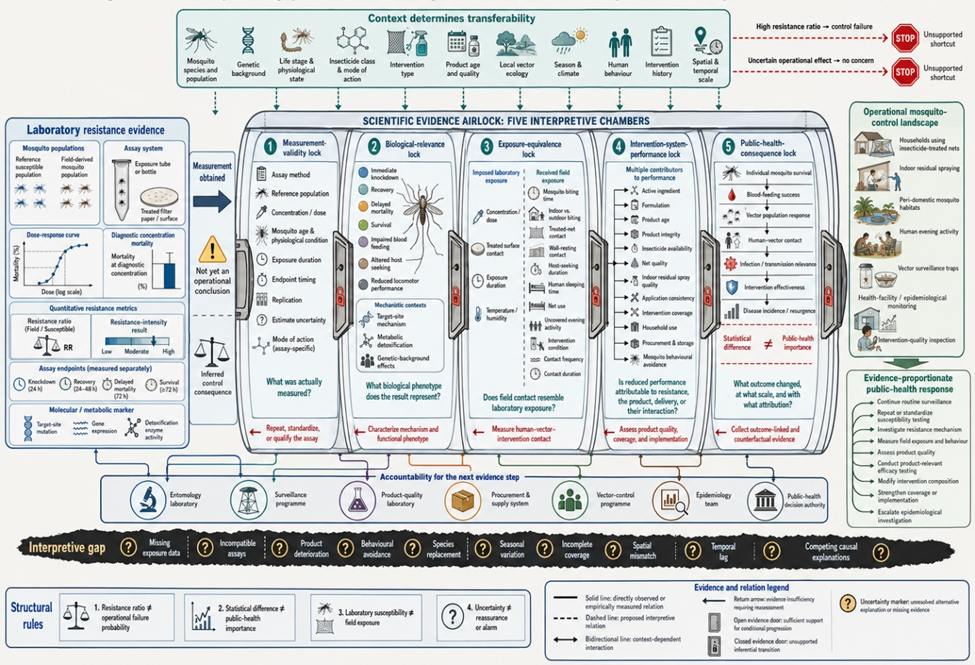
The proposed synthesis therefore separates four questions. First, is the resistance measurement analytically valid? Second, what biological phenotype or mechanism does it represent? Third, does the intervention produce an exposure capable of expressing that phenotype under field conditions? Fourth, is a change observed in product performance, mosquito behaviour, transmission-related function, or epidemiological outcome? These questions define inputs, transitions, and decision points rather than a single readiness score. Failure at one stage does not invalidate the preceding observation; it limits the claim that may be made from it. The structure remains non-validated and requires prospective testing with linked assay, exposure, product, behavioural, and outcome data. Its purpose is to prevent a biologically meaningful result from being overstated as operational proof while also preventing uncertain operational translation from being used to dismiss an emerging resistance signal [3].
Exposure, behaviour, and intervention coverage
Field exposure is the contact that mosquitoes actually experience and that humans actually avoid through intervention use; it is not the nominal dose imposed in a laboratory assay. Operational exposure must therefore be estimated from the overlap of mosquito biting time and location, human presence and activity, sleep patterns, intervention use, and product availability [14]. A mosquito may possess a resistance phenotype but encounter little treated material because it bites outdoors, feeds before people enter nets, rests on untreated surfaces, or occupies locations with limited intervention coverage. Conversely, even partial contact may affect feeding, survival, or subsequent behaviour. The relevance of a resistance ratio is consequently conditional on the frequency, duration, route, and biological consequences of contact.
Across African settings, variation in feeding time and location can sustain residual exposure despite extensive use of indoor interventions [15]. Household-level evidence from Tanzania further demonstrates that human routines determine when and where mosquito biting becomes epidemiologically important [16]. These findings expose a scale problem: laboratory assays generally standardize contact, while operational systems contain heterogeneous contact opportunities. Nominal coverage, ownership, or distribution does not equal effective coverage if products are not used consistently, are physically degraded, are poorly located, or fail to overlap with vector activity. Exposure assessment must therefore combine entomological observations with human behaviour and intervention-condition data rather than infer protection from any one component.
Mosquito behaviour may also change in response to intervention pressure. Longitudinal evidence from areas of high net coverage in Tanzania is consistent with behavioural avoidance strategies that reduce contact with treated surfaces [17]. Such patterns can preserve survival without requiring a change in laboratory susceptibility and can therefore resemble resistance-mediated failure at the programme level. The competing explanation is equally important: apparent behavioural avoidance may reflect species replacement, seasonal ecology, host availability, or altered sampling. Direct behavioural measurement is needed to discriminate among these possibilities. Operational interpretation should consequently treat resistance, behaviour, exposure, and coverage as interacting but separately observed domains. Laboratory susceptibility becomes decision-relevant only after the intervention-specific exposure pathway has been demonstrated, while incomplete exposure evidence should trigger additional investigation rather than automatic reassurance or a declaration of control failure [14].
Control failure, uncertainty, and accountability
Operational control failure must be defined at a specified outcome scale rather than inferred from a laboratory phenotype. Reduced mosquito mortality, diminished product bioefficacy, increased vector density, persistent transmission, and disease resurgence are related but non-equivalent outcomes. In Papua New Guinea, declining bioefficacy of long-lasting insecticidal nets coincided with malaria resurgence, but the evidence implicated deterioration in product performance rather than insecticide resistance alone [18]. Such observations justify investigation while leaving several causal pathways open, including product quality, intervention ageing, coverage, vector ecology, health-service conditions, and changing human exposure.
This distinction creates a public-health accountability problem. When protection declines, attributing the outcome prematurely to mosquito resistance can conceal failures in manufacturing, procurement, storage, distribution, application, monitoring, or replacement. Evidence concerning long-lasting insecticidal-net quality shows that product variability and insufficient quality control can undermine expected protection independently of a newly intensified mosquito phenotype [19]. Accountability therefore requires the decision-maker to specify the outcome judged to have failed, identify plausible contributing mechanisms, document the evidence supporting each attribution, and assign responsibility for obtaining the next evidence needed.
Resistance management also operates within constrained intervention portfolios and histories of insecticide use. For Aedes control, heterogeneous surveillance methods, limited active ingredients, and incomplete links between mechanisms and operational outcomes restrict the certainty of management decisions [20]. Global patterns of public-health insecticide use additionally shape selection pressure and should inform interpretation of local trends [21]. These conditions support proportionate action: a credible resistance signal should not be dismissed because operational failure remains unproven, but neither should statistical change be presented as established public-health importance. Uncertainty should define monitoring intensity, contingency planning, product evaluation, and reassessment triggers rather than function as evidence of safety or failure.
Proposed resistance-interpretation principles
The proposed synthesis begins by separating the measurement object from its possible consequences. Genomic analysis of permethrin resistance in Aedes aegypti demonstrates that knockdown, recovery, and death can represent distinct post-exposure trajectories within mosquitoes classified broadly as resistant [22]. Pyrethroid-resistant Anopheles may also survive treated-net contact while experiencing impaired feeding performance [23]. Operational experiments further indicate that common knockdown-resistance genotypes do not produce uniform responses across intervention methods [24]. These findings support a multidimensional phenotype description rather than a single resistant–susceptible label.
The second principle is that operational meaning must remain product-specific and time-dependent. In Benin, chlorfenapyr–pyrethroid nets provided stronger protection than pyrethroid-only nets in a pyrethroid-resistant setting, demonstrating that the consequence of resistance depends on intervention chemistry and mode of action [25]. Extended follow-up in Uganda showed that the relative benefit of piperonyl-butoxide nets changed over time, adding intervention age and temporal horizon to interpretation [26]. Together, the evidence supports five sequential domains: measurement validity, biological relevance, exposure equivalence, intervention-system performance, and public-health consequence. Failure to establish one domain should restrict progression to the next rather than erase evidence obtained at an earlier stage.
Figure 1 illustrates the interpretive gap between laboratory resistance metrics and operational mosquito-control outcomes within the analytical logic developed in this section.
|
|
|
Figure 1. The interpretive gap between laboratory resistance metrics and operational mosquito-control outcomes |
Alt text
A structured conceptual diagram that illustrates the interpretive gap between laboratory resistance metrics and operational mosquito-control outcomes, with labelled components, directional relations, contextual modifiers, uncertainty points, and a clear boundary between observed evidence and proposed synthesis.
The third principle is evidence triangulation without construct collapse. Phenotypic assays, molecular mechanisms, mosquito behaviour, effective exposure, product quality, intervention coverage, entomological outcomes, and epidemiological outcomes answer different questions. Convergence across these domains strengthens attribution, whereas disagreement should be investigated rather than averaged into a composite resistance score. A valid laboratory result may justify intensified surveillance even when epidemiological consequences remain unknown. Conversely, declining control performance should prompt assessment of resistance alongside product, delivery, ecological, and behavioural explanations.
The fourth principle is accountable uncertainty. Every interpretation should state the supported claim, the unsupported extension, the principal alternative explanations, the responsible decision-maker, and the evidence that would trigger reassessment. The proposed structure is not a validated predictive framework and does not assign universal thresholds or failure probabilities. Validation would require prospective studies linking standardized toxicological measurements with field exposure, product condition, mosquito behaviour, intervention implementation, transmission-relevant outcomes, and epidemiological change across multiple vector–product systems. Until such evidence exists, the structure should be used to discipline inference rather than automate decisions.
The proposed components, evidence bases, boundary conditions, failure modes, and validation requirements are organized in Table 2.
Table 2. Proposed Resistance-Interpretation Principles: Components, Evidence Basis, Relations, Boundary Conditions, Failure Modes, and Validation Requirements
|
Proposed component |
Purpose |
Evidence basis |
Relation or mechanism |
Input or precondition |
Expected output |
Boundary condition or failure mode |
Validation requirement |
|
Define the measurement object |
Prevent interchangeable use of distinct resistance metrics |
Resistance-intensity benchmarking |
Assay design determines the construct measured |
Defined method, comparator, endpoint, and uncertainty |
Measurement-level interpretation |
Method-specific output is generalized to another assay or decision |
Interlaboratory reproducibility and construct-validity studies |
|
Preserve scale transitions |
Separate individual toxicological response from population and public-health outcomes |
Experimental and modelling evidence |
Effects may change across mortality, feeding, population, and transmission scales |
Explicit target outcome and inferential pathway |
Scale-bounded claim |
Individual survival is treated as direct epidemiological effect |
Prospectively linked multi-scale outcome studies |
|
Establish exposure equivalence |
Determine whether field contact resembles imposed laboratory exposure |
Human–vector exposure methodology |
Behaviour and intervention use determine received exposure |
Time- and location-resolved human, mosquito, and intervention data |
Exposure-qualified interpretation |
Nominal product availability is treated as actual contact |
Linked behavioural and contact-measurement studies |
|
Separate resistance from product or delivery failure |
Avoid premature single-cause attribution |
Product-quality and field-performance evidence |
Product chemistry, condition, application, and coverage alter performance |
Product-quality, deployment, coverage, and efficacy information |
Bounded attribution of performance loss |
Product deterioration or implementation failure is misclassified as resistance |
Independent quality assurance and prospective operational assessment |
|
Describe multidimensional biological response |
Replace binary classification with relevant post-exposure trajectories |
Genomic and phenotypic evidence |
Knockdown, recovery, death, and functional impairment may diverge |
Multiple biological endpoints and mechanism data |
Structured phenotype profile |
One marker or endpoint is treated as complete biological meaning |
Functional validation across genetic backgrounds and interventions |
|
Maintain product and temporal specificity |
Prevent transfer of conclusions across products or follow-up periods |
Comparative intervention trials |
Active ingredients and ageing determine operational performance |
Identified product, mode of action, condition, and time horizon |
Product-specific operational conclusion |
Class-wide or permanent inference from one product or period |
Comparative and longitudinal effectiveness studies |
|
Attach uncertainty to accountable action |
Convert uncertainty into proportionate investigation and reassessment |
Quality-control and governance evidence |
Evidence gaps determine monitoring, contingency, and responsibility |
Named decision, responsible actor, alternatives, and trigger |
Transparent action and reassessment plan |
Uncertainty is used as reassurance, alarm, or absence of effect |
Implementation studies testing decision consequences and accountability |
Implications for surveillance and decision-making
Surveillance should move from isolated phenotype monitoring toward intervention-linked longitudinal designs. Trial-associated evidence from Benin shows that deployment of dual-active-ingredient nets can be examined alongside subsequent changes in resistance phenotypes and mechanisms [27]. Progress would be demonstrated by surveillance systems that preserve assay comparability while linking intervention history, product condition, vector species, mechanism data, exposure conditions, and relevant outcomes over time. Such designs would help distinguish pre-existing resistance, intervention-driven selection, species replacement, and methodological variation.
Molecular and epidemiological information should also be collected within compatible spatial and temporal frames. In Uganda, trial-linked monitoring connected intervention allocation with parasite infection, vector composition, and resistance-marker patterns [28]. The priority is not to replace phenotypic testing with genotyping but to determine when different evidence streams converge or diverge. Progress would be indicated by prospective datasets in which phenotype, mechanism, human exposure, intervention coverage, product performance, and infection outcomes are measured in the same populations and analysed under prespecified attribution rules.
Finally, assay choice should follow the operational question. A multi-assay assessment of Culex pipiens showed how screening results can lead to more product-relevant testing and a structured local decision process [29]. National surveillance in Papua New Guinea further demonstrates the importance of species-specific interpretation across malaria and arbovirus vectors within a shared public-health system [30]. The highest-priority implementation gap is the absence of explicit escalation pathways: programmes need criteria for when a screening signal requires resistance-intensity testing, mechanism investigation, behavioural assessment, product-quality evaluation, operational efficacy testing, or epidemiological investigation. Progress would be visible when surveillance reports identify not only resistance status but also the permissible inference, unresolved alternatives, responsible actor, next evidence requirement, and reassessment point.
CONCLUSION
Mosquito resistance ratios are valuable toxicological indicators, but they are not probabilities of operational failure. Their public-health meaning depends on analytical validity, biological expression, field exposure, mosquito and human behaviour, intervention coverage, product chemistry and condition, implementation quality, and the outcome scale under consideration. Statistical difference is not equivalent to public-health importance, and laboratory susceptibility is not equivalent to field exposure. Equally, incomplete translation should not be used to dismiss resistance or to declare failure without corroborating evidence. The strongest defensible approach is therefore a conditional, evidence-linked interpretation in which distinct measurement, biological, exposure, intervention, and outcome domains are examined without being collapsed into a single score. The immediate priority is to build prospective surveillance systems that connect standardized resistance measurements to product-specific contact, behavioural response, implementation, and public-health outcomes while assigning explicit responsibility for resolving uncertainty.
ACKNOWLEDGMENTS: None
CONFLICT OF INTEREST: None
FINANCIAL SUPPORT: None
ETHICS STATEMENT: None