Entomology and
Applied Science Letters
Applied Science Letters
 2025
Volume 12
Issue 2
2025
Volume 12
Issue 2

Insect phenotypes emerge through regulatory processes that connect genome organization to temporally and environmentally contingent biological functions, yet these connections are often inferred from chromatin profiles or transcriptional measurements without direct demonstration of organism-level causality. This article develops an original molecular systems synthesis of chromatin-to-phenotype regulation across insect development, metamorphosis, reproduction, immunity, stress responses, behaviour, and environmental plasticity. The approach integrates evidence concerning three-dimensional genome organization, histone variants and modifications, DNA methylation, chromatin accessibility, hormone-responsive regulatory elements, and experimentally perturbed molecular regulators. The strongest defensible synthesis is that chromatin states operate as context-sensitive regulatory constraints and opportunities: they can delimit transcription-factor access, stabilize or reorganize regulatory neighbourhoods, and condition the timing or tissue specificity of gene activation, but they do not independently determine phenotype. Developmental transitions provide the clearest mechanistic evidence because hormonal signals, chromatin accessibility, transcription-factor binding, and tissue transformation can be aligned in time and experimentally perturbed. Evidence for reproduction, immune defence, stress adaptation, behavioural plasticity, and environmental memory is informative but more heterogeneous in species, tissues, exposures, and causal depth. Four interpretation boundaries therefore organize the analysis: chromatin state is not equivalent to causal gene regulation; gene-expression change is not equivalent to organismal phenotype; epigenetic persistence is not equivalent to transgenerational inheritance; and a cross-level systems model is not equivalent to experimental validation. The principal implication is that molecular targets for insect genetic control should be prioritized through staged, tissue-resolved validation that links perturbation, chromatin change, transcriptional consequence, physiological mechanism, and phenotype while testing reversibility, context dependence, and unintended effects.
INTRODUCTION
Insects combine extensive phenotypic diversity with genomes whose regulatory potential is repeatedly reused across cell types, life stages, social contexts, and environmental conditions. Chromatin provides one molecular interface through which this reuse becomes possible: DNA methylation, histone modifications and variants, nucleosome positioning, noncoding regulatory processes, and higher-order genome organization can alter the accessibility, neighbourhood, or persistence of genomic information. Recent insect epigenetic scholarship consequently treats chromatin not as a static packaging layer but as part of the machinery through which cellular differentiation and developmental plasticity are produced [1]. That formulation is scientifically useful only when its causal limits remain explicit. A mapped chromatin state may mark regulatory activity, reflect transcription already in progress, or arise from another upstream process; it is therefore not, by itself, evidence that the state caused a change in gene regulation.
The connection is especially consequential during post-embryonic development, when endocrine signals must be translated into precisely timed and tissue-specific gene programmes. Insects reorganize tissues, metabolic allocation, reproductive competence, and behaviour across molts and metamorphosis, creating a natural systems context in which environmental and hormonal inputs converge on genome regulation. Evidence reviewed for post-embryonic development identifies DNA methylation, histone modification, chromatin-remodelling machinery, and noncoding regulation as candidate mediators of these transitions, while also emphasizing substantial differences among insect lineages and developmental systems [2]. For molecular-target discovery, this variation matters: a regulatory dependency demonstrated in one tissue or species cannot be assumed to provide the same leverage, specificity, or phenotypic consequence elsewhere.
A second difficulty is that the molecular layers commonly grouped under “epigenetic regulation” operate at different scales. Three-dimensional chromosome folding influences contacts among genomic regions; insulator and Polycomb-associated proteins can constrain or reinforce selected regulatory interactions; histone variants and modifications alter local chromatin properties; and accessible cis-regulatory elements create opportunities for transcription-factor binding. Drosophila research has made these layers unusually tractable and shows that chromatin organization is dynamic across nuclear, developmental, and genomic scales [3]. Nevertheless, organization, accessibility, occupancy, transcription, physiology, and phenotype remain distinct constructs. Treating them as interchangeable compresses a multistep biological pathway into a correlation and obscures where experimental evidence is strong, conditional, or missing.
Environmental exposures add a further layer of complexity because they may modify chromatin-associated processes while simultaneously acting through toxicity, endocrine disruption, metabolism, oxidative stress, or selection. Reviews of anthropogenic contamination describe associations between pesticide exposure, insect epigenetic mechanisms, developmental or physiological responses, and possible resistance-related consequences [4]. Such evidence supports investigation of chromatin as part of environmentally responsive regulation, but it does not establish that every exposure-induced chromatin difference is adaptive, persistent, or inherited. The aim of this article is therefore to connect chromatin dynamics to insect phenotypes through a bounded cross-level argument. It proposes that credible chromatin-to-phenotype inference requires aligned evidence across regulatory state, molecular perturbation, transcriptional consequence, physiological mediation, and organismal outcome, interpreted within species, tissue, life-stage, temporal, and environmental context.
Chromatin organization in insect molecular biology
Three-dimensional genome organization provides a structural context for regulation rather than a universal causal code. High-resolution contact mapping in Drosophila identified compartmental domains corresponding closely to active and inactive chromatin compartments and showed that transcriptional state strongly predicts contact patterns across several eukaryotic systems [5]. This finding supports a close relationship between genome folding and regulatory activity, but the direction of influence cannot be inferred from contact maps alone. Early embryogenesis sharpens that distinction. Chromatin architecture emerges around zygotic genome activation, with topologically associating domain boundaries forming near early expressed loci, yet experimental analyses indicate that boundary formation can occur independently of transcription and that the pioneer factor Zelda contributes to insulation at selected loci [6]. Thus, temporal coincidence between genome organization and transcriptional activation does not make one process a complete proxy for the other.
Specific architectural mechanisms also differ in scope. Polycomb-associated contacts can contribute to stable repression by bringing silenced regions into regulatory configurations that reinforce developmental gene control [7]. By contrast, eliminating maternal and zygotic CCCTC-binding factor in Drosophila did not prevent embryonic or larval progression, although it disrupted appropriate Hox expression, produced homeotic defects, and prevented normal adult emergence [8]. The comparison is instructive: an architectural protein may be important for selected gene domains and later viability without being globally required for every transcriptional programme or developmental stage. Redundancy among insulator proteins, locus-specific dependence, maternal contribution, and developmental timing are therefore alternative explanations that must be tested before assigning broad phenotypic control to a single architectural factor.
Histone composition adds another regulatory layer to this architecture. In Drosophila embryos, H2A.Z enrichment precedes widespread zygotic transcription, and depletion of the maternally supplied Domino remodelling ATPase reduces H2A.Z deposition, downregulates many housekeeping genes, compromises three-dimensional chromatin establishment, and impairs embryonic completion [9]. This perturbation supplies stronger causal evidence than chromatin profiling alone because it links a molecular regulator to chromatin, transcriptional, architectural, and developmental consequences. Even here, Domino has functions within a larger remodelling complex, and the resulting phenotype cannot be attributed to a single downstream gene or structural feature without additional rescue and locus-specific tests. The evidence dimensions and interpretive boundaries for chromatin organization in insect molecular biology are summarized in Table 1.
Table 1. Chromatin Organization in Insect Molecular Biology: Molecular Layers, Targets, Phenotypic Connections, Validation Evidence, Evolutionary Implications, and Interpretive Boundaries
|
Molecular layer or target |
Biological process |
Required evidence |
Phenotypic connection |
Validation need |
Evolutionary or resistance implication |
Uncertainty |
Interpretive boundary |
|
Compartmental domains and chromosome contacts |
Spatial genome organization |
Contact maps integrated with transcriptional and chromatin-state data |
Potential coordination of active and inactive regulatory neighbourhoods |
Perturb domains or boundary determinants and test locus-specific expression and phenotype |
Conserved organizing principles may coexist with lineage-specific proteins and domain logic |
Directionality between transcriptional state and folding |
Chromatin contact is not equivalent to regulatory causation |
|
Zygotic topological-domain formation |
Maternal-to-zygotic transition |
Developmental time-series contact mapping plus transcriptional inhibition or factor perturbation |
Correct establishment of early embryonic regulatory architecture |
Separate effects of transcription, Zelda-dependent insulation, cell cycle, and nuclear maturation |
Early architectural dependencies may constrain developmental robustness |
Simultaneous emergence of several processes complicates causal ordering |
Temporal coincidence is not mechanistic equivalence |
|
Polycomb-associated looping |
Developmental gene silencing |
Loss-of-function or element deletion linked to contacts and target-gene derepression |
Maintenance of appropriate developmental expression states |
Rescue contacts and repression independently to test whether looping is necessary and sufficient |
Altered repression may expose developmental variation but does not predict adaptive value |
Looping may accompany other Polycomb-mediated biochemical effects |
Repressive contact is not equivalent to the complete silencing mechanism |
|
CCCTC-binding factor and insulator activity |
Hox-domain regulation and boundary control |
Maternal–zygotic depletion with expression and morphological analysis |
Homeotic patterning and adult viability |
Test redundancy with other insulator-binding proteins across tissues and stages |
Architectural redundancy may buffer regulatory evolution |
Limited global expression effects despite clear locus-specific phenotypes |
Essentiality at selected loci is not genome-wide regulatory dominance |
|
H2A.Z deposition by Domino |
Zygotic genome activation and chromatin reorganization |
Histone-variant mapping, remodeller perturbation, nascent transcription, architecture, and developmental outcome |
Housekeeping-gene activation and embryonic completion |
Domain-specific rescue and separation of H2A.Z-dependent from other Domino functions |
Histone-variant deployment may support conserved developmental transitions |
Pleiotropy of the remodelling complex |
Perturbation-linked phenotype does not identify a single causal downstream route |
Epigenetic regulation of development and metamorphosis
Metamorphosis demonstrates how endocrine timing can be converted into changing regulatory competence. In Drosophila wings, hormone-induced transcription factors control temporal gene expression by opening and closing regulatory elements, and the ecdysone-induced factor E93 is required for the normal sequence of genome-wide accessibility changes [10]. This evidence connects a defined upstream signal and transcription factor to altered chromatin accessibility and developmental temporal identity. It does not imply that every accessible region is functionally required, nor that accessibility alone specifies adult morphology. The stronger inference is conditional: developmental hormones activate regulatory factors that reshape the set of genomic elements available for tissue-specific transcription, while downstream networks and cellular processes mediate the eventual phenotype.
Genome-wide studies of metamorphosis support a sequential model rather than a single chromatin switch. Evidence synthesized across accessibility assays indicates that cis-regulatory modules are repeatedly activated and deactivated as larval tissues remodel and adult structures differentiate, with systemic hormone signalling providing an important trigger for genome-scale transitions [11]. Yet receptor binding and accessibility are not interchangeable mechanisms. Tissue-specific ecdysone receptor occupancy is strongly associated with pre-existing open chromatin and directly contributes to enhancer activity, but experimental results indicate that the receptor does not generally create accessibility at its genomic targets [12]. This distinction assigns different roles to endocrine input, prior tissue state, receptor binding, and secondary transcription factors: the hormone-responsive receptor can select among accessible regulatory opportunities, whereas other factors may establish or remodel those opportunities.
Comparative accessibility analysis in the lady beetle Harmonia axyridis and Drosophila melanogaster identified stage-associated regulatory changes enriched near processes involving morphogenesis, tissue remodelling, and hormone signalling [13]. Cross-species convergence supports the proposition that dynamic accessibility is a recurring feature of holometabolous development, while differences in genome annotation, sampled stages, tissues, and regulatory-element conservation limit one-to-one transfer of candidate loci. Moreover, enrichment and coordinated expression remain inferential until individual elements or regulators are perturbed and linked to defined developmental outcomes. The developmental evidence therefore supports a layered pathway—hormonal cue, tissue-conditioned accessibility, factor occupancy, transcriptional programme, cellular remodelling, phenotype—rather than equivalence between any adjacent layers.
Reproduction, immunity, and stress responses
Reproduction illustrates why an epigenetic enzyme can be phenotypically essential without operating through the expected transcriptional mechanism. RNA-interference depletion of Dnmt1 in the large milkweed bug Oncopeltus fasciatus reduced DNA methylation, disrupted ovarian follicular nuclei, impaired egg production, and yielded inviable embryos; however, loss of gene-body and transposon-body methylation did not provide a direct causal link to steady-state somatic messenger-RNA abundance [14]. The result establishes a requirement for Dnmt1 in reproductive function in that system but leaves open whether the decisive mechanism involves methylation maintenance, DNA-replication-associated functions, chromosome stability, germline-specific transcription, or another molecular role. Consequently, Dnmt1 essentiality is not equivalent to proof that DNA methylation broadly controls insect gene expression.
A more explicit methylation-to-regulation pathway has been reported in Bombyx mori, where intragenic methylation near ovarian gene transcription-start regions was linked to enhanced expression and where an MBD/Tip60-associated mechanism contributed to ovarian and embryonic development [15]. This evidence supports context-specific regulatory activity of gene-body methylation, but it does not resolve the contrast with Oncopeltus by establishing a universal insect mechanism. Species, genomic methylation architecture, tissue, developmental stage, and experimental endpoint may all explain divergent findings. Immune defence is similarly heterogeneous. Current synthesis implicates DNA methylation, histone modification, and small-RNA-associated processes in insect–pathogen interactions and immune priming, while emphasizing that direct causal chains from pathogen-induced chromatin change to durable protection remain uncommon [16]. Immune-associated chromatin signatures must therefore be separated from altered cell composition, infection severity, metabolic state, and transcriptional consequences of immune activation itself.
Stress-responsive development provides a clearer perturbational bridge but remains context bounded. In Culex pipiens, experimental elevation of the repressive H3K27me3 mark through inhibition or suppression of its demethylase disrupted lipid and glycogen accumulation and reduced survival during adult diapause [17]. The study connects a chromatin regulator to metabolic and survival phenotypes within a defined photoperiodic and tissue context, strengthening the case that chromatin modification can participate in seasonal plasticity. It does not establish that H3K27me3 alone initiates diapause, that the same direction of effect applies to other tissues or insects, or that the manipulated pathway is an immediately suitable control target. Across reproduction, immunity, and stress responses, the defensible synthesis is therefore functional specificity rather than epigenetic uniformity: causal claims become strongest when a defined molecular perturbation changes a chromatin feature, a physiological mechanism, and an organismal outcome in the same biological context.
Behavioural plasticity and environmental memory
Behavioural responses can coincide with rapid chromatin-associated changes, but temporal association does not establish that chromatin initiated the behaviour. Following territorial intrusion, honey-bee workers displayed brain DNA-methylation differences that increased over time and occurred near genes associated with neural plasticity, chromatin remodelling, and hormone signalling [18]. In the same social-challenge system, altered aggression was accompanied by temporally distinct transcriptional responses in mushroom bodies, including early cytoskeletal-remodelling signals and later hormone-, stress-, and transcription-factor-associated programmes [19]. Together, these findings support dynamic neurogenomic embedding of social experience, while leaving unresolved whether methylation drives, stabilizes, or merely records the behavioural response.
Olfactory conditioning provides a related but distinct context. Genome-wide analysis identified methylation differences between trained and untrained honey bees and linked differentially methylated genes to previously observed learning-associated transcriptional changes [20]. The evidence is compatible with methylation participating in memory-related regulation, but several alternatives remain: neural activity may independently alter transcription and methylation; sampled brains may contain changing cell-state mixtures; or methylation may follow transcription rather than control it. Demonstrating causality therefore requires targeted manipulation of candidate methylated regions or their modifying enzymes in relevant neural cells, followed by measurement of regulatory activity, circuit function, learning acquisition, memory retention, and behavioural specificity.
Environmental memory must also be distinguished from inheritance. Paternal methylation patterns were reported to be transferred to daughters in honey bees, providing evidence for intergenerational continuity of selected DNA-methylation marks [21]. This result does not by itself demonstrate environmentally induced transgenerational inheritance because the observed generation had direct parental germline exposure, sequence variation may covary with methylation, and phenotypic consequences were not established for every transferred mark. Epigenetic persistence is therefore not equivalent to transgenerational inheritance. A credible inheritance claim requires exposure-defined pedigrees, genetic controls, replication across unexposed generations, tissue- and locus-resolved molecular measurements, and corresponding phenotypes.
Cross-level connections from regulation to phenotype
Cross-level inference becomes stronger when structural perturbation is connected to a specific developmental consequence. Depletion experiments established that heterochromatin protein 1a contributes to de novo three-dimensional genome organization during early Drosophila development [22]. This finding identifies a molecular requirement for heterochromatic compartment formation, but altered architecture cannot automatically be interpreted as altered phenotype through a single route. Heterochromatin protein 1a also participates in local repression and chromosomal processes, while developmental outcomes may arise from combined structural, transcriptional, and genome-stability effects. Architectural disruption must therefore be linked to defined regulatory targets and rescued independently before a specific chromatin-to-phenotype pathway can be claimed.
Inherited chromatin information offers a more temporally resolved example. Maternally supplied H3K27me3 restricts premature enhancer activation during the maternal-to-zygotic transition, and disruption of this inherited repression causes inappropriate regulatory activity and developmental failure [23]. Single-cell multiomic analysis further indicates that opposing H3K27 methylation and acetylation programmes, mediated through Polycomb-associated and acetyltransferase activities, organize cis-regulatory-element states associated with emerging embryonic cell identities [24]. These studies support a pathway from chromatin modification to enhancer regulation and developmental patterning. They do not show that an individual histone mark independently specifies cell fate, because transcription factors, maternal determinants, nuclear position, signalling, and chromatin accessibility act concurrently.
Residue-level genetic resources can help separate these interacting functions. A Drosophila histone H2A and H2B point-mutant library identified mutations with essential in vivo consequences and provides a route for testing how particular histone surfaces contribute to development, genome stability, immunity, and regulation [25]. Such libraries move beyond descriptive profiling, but phenotypic effects may reflect pleiotropy, altered nucleosome integrity, or developmental lethality rather than a discrete regulatory pathway. Cross-level validation consequently requires molecular specificity, temporal control, tissue restriction, downstream rescue, and organism-level measurement. The evidence dimensions and interpretive boundaries for cross-level connections from regulation to phenotype are summarized in Table 2.
Table 2. Cross-Level Connections from Regulation to Phenotype: Molecular Layers, Targets, Phenotypic Connections, Validation Evidence, Evolutionary Implications, and Interpretive Boundaries
|
Molecular layer or target |
Biological process |
Required evidence |
Phenotypic connection |
Validation need |
Evolutionary or resistance implication |
Uncertainty |
Interpretive boundary |
|
Heterochromatin protein 1a and three-dimensional organization |
Early genome compartment formation |
Protein depletion, contact mapping, spatial imaging, and transcriptional analysis |
Embryonic regulatory organization |
Locus-specific rescue separating architectural and local functions |
Structural buffering may affect developmental robustness |
Pleiotropic chromosomal functions |
Architectural change is not equivalent to a defined gene-regulatory mechanism |
|
Germline-inherited H3K27me3 |
Maternal-to-zygotic transition |
Germline perturbation, enhancer-state mapping, expression, and developmental outcome |
Prevention of premature lineage-gene activation |
Distinguish inherited mark effects from maternal proteins and later mark restoration |
Maternal chromatin information may constrain early developmental variation |
Persistence duration and locus specificity |
Intergenerational persistence is not transgenerational inheritance |
|
H3K27 methylation–acetylation balance |
Cis-regulatory control of cell identity |
Single-cell joint chromatin and transcriptome profiling with regulator perturbation |
Emergence of embryonic cell states |
Functional tests of individual enhancers and downstream rescue |
Regulatory-element turnover may preserve or diversify developmental programmes |
Concurrent signalling and transcription-factor effects |
Cell-state association is not proof that a mark independently specifies fate |
|
Histone H2A and H2B residues |
Nucleosome-dependent regulation |
Defined point mutations with molecular, cellular, and organismal phenotyping |
Development, viability, genome stability, and immunity |
Conditional and tissue-specific alleles plus biochemical rescue |
Histone constraints may limit evolvability while selected variants enable regulatory change |
Structural disruption and pleiotropy |
A mutant phenotype does not identify a single downstream causal route |
|
Hormone-responsive accessibility and receptor occupancy |
Metamorphic regulatory transitions |
Time-resolved accessibility, receptor binding, perturbation, and tissue phenotype |
Stage- and tissue-specific remodelling |
Test individual regulatory elements across tissues |
Regulatory reuse may support developmental diversification |
Pre-existing accessibility and secondary factors |
Accessibility and receptor occupancy are distinct constructs |
|
DNA methylation and behavioural state |
Learning, aggression, and environmental response |
Neural-cell-resolved methylation, perturbation, transcription, circuit, and behaviour data |
Behavioural plasticity or memory |
Targeted editing with behavioural rescue and persistence tests |
Experience-responsive regulation could influence adaptive plasticity |
Reverse causation and cell-composition effects |
Methylation difference is not equivalent to behavioural causation |
Proposed chromatin-to-phenotype systems model
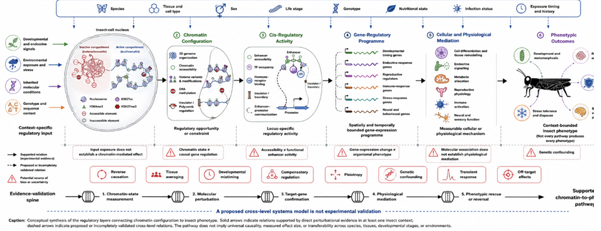
The proposed model begins with four classes of input: developmental signals, environmental exposures, inherited molecular conditions, and genotype. These inputs act within tissue- and stage-specific regulatory competence defined by chromatin architecture, accessibility, histone state, and DNA modification. In Nasonia vitripennis, reducing Dnmt1a disrupts gene-body methylation, zygotic-genome regulation, cellularization, and embryonic morphogenesis [26]. In Blattella germanica, Dnmt1-dependent methylation prevents prolonged ftz-f1 expression and thereby supports appropriate ecdysteroid signalling, choriogenesis, and fertilization [27]. These systems exemplify evidence-supported relations, but neither establishes a universal insect pathway.
Figure 1 represents regulatory layers from chromatin to phenotype within the analytical logic developed in this section.
|
|
|
Figure 1. Regulatory layers from chromatin to phenotype |
Alt text
A structured conceptual diagram that represents regulatory layers from chromatin to phenotype, with labelled components, directional relations, contextual modifiers, uncertainty points, and a clear boundary between observed evidence and proposed synthesis.
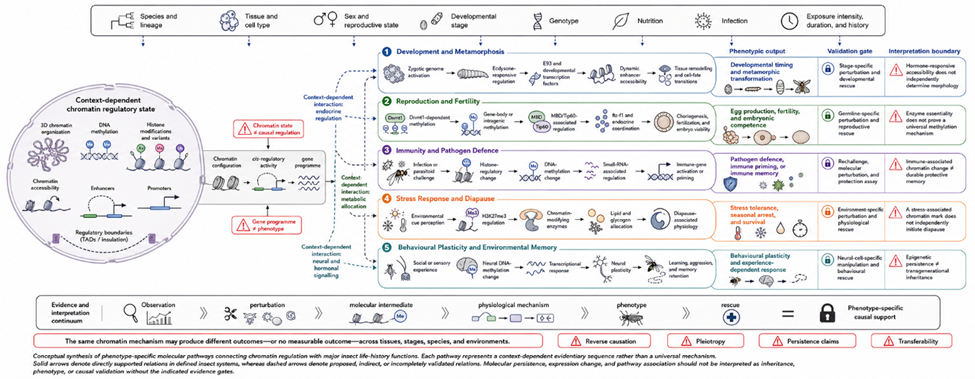
The second model dimension separates phenotype-specific pathways rather than assuming that one chromatin mechanism controls all insect functions. Parasitoid oviposition in Galleria mellonella is associated with reprogramming of host immune and developmental genes alongside changes in histone-regulatory and microRNA-related processes [28]. Evidence concerning insect immune memory similarly identifies DNA methylation and histone acetylation as plausible contributors, while emphasizing the limited number of mechanistically complete studies [29]. More broadly, analyses of methylation and phenotypic plasticity show that causal inference requires a continuous chain from environmental input through methylation and transcription to a defined phenotype [30].
Figure 2 shows phenotype-specific molecular pathways across insect life-history functions within the analytical logic developed in this section.
|
|
|
Figure 2. Phenotype-specific molecular pathways across insect life-history functions |
Alt text
A structured conceptual diagram that shows phenotype-specific molecular pathways across insect life-history functions, with labelled components, directional relations, contextual modifiers, uncertainty points, and a clear boundary between observed evidence and proposed synthesis.
Within each pathway, the model distinguishes five evidentiary transitions: input to chromatin response; chromatin response to regulatory activity; regulatory activity to gene-expression change; gene expression to cellular or physiological mechanism; and physiological mechanism to phenotype. Each transition is a decision point rather than an assumed arrow. Failure modes include reverse causation, tissue averaging, developmental mistiming, compensatory regulation, pleiotropic perturbation, genetic confounding, transient exposure effects, and phenotype measurement that is disconnected from the manipulated tissue. Contextual modifiers—species, sex, genotype, nutritional state, infection, life stage, and exposure history—may alter any transition.
The model is intended for hypothesis organization and target prioritization, not as an experimentally validated framework. A candidate target advances only when perturbation establishes necessity, rescue tests specificity, molecular measurements confirm the expected intermediate change, and organism-level assays demonstrate a bounded phenotype. Sufficiency, reversibility, persistence, off-target effects, and ecological context require separate tests. The proposed components, evidence bases, boundary conditions, failure modes, and validation requirements are organized in Table 3.
Table 3. Proposed Chromatin-to-Phenotype Systems Model: Components, Evidence Basis, Relations, Boundary Conditions, Failure Modes, and Validation Requirements
|
Proposed component |
Purpose |
Evidence basis |
Relation or mechanism |
Input or precondition |
Expected output |
Boundary condition or failure mode |
Validation requirement |
|
Context definition |
Bound the inference |
Species-, tissue-, stage-, and exposure-dependent findings |
Specifies where a proposed pathway may operate |
Defined organism, tissue, stage, sex, and environment |
Testable biological context |
Transfer across systems without validation |
Replication across relevant contexts |
|
Regulatory input |
Identify initiating conditions |
Hormonal, environmental, inherited, and infection-related evidence |
Signal exposure alters regulatory competence or regulator activity |
Measured cue with appropriate timing |
Defined upstream perturbation |
Unmeasured co-exposures or developmental mismatch |
Controlled exposure or inducible manipulation |
|
Chromatin configuration |
Characterize regulatory opportunity |
Architecture, accessibility, histone-state, and methylation evidence |
Modifies contacts, occupancy opportunities, or repression |
Relevant regulator and genomic locus |
Measured chromatin-state change |
State may be consequence rather than cause |
Temporal profiling plus targeted perturbation |
|
Cis-regulatory activity |
Connect chromatin to transcription |
Enhancer, receptor-binding, and accessibility studies |
Regulatory elements integrate chromatin and transcription-factor activity |
Competent cell state and available factor |
Locus-specific regulatory activity |
Accessibility without functional enhancer activity |
Element deletion, editing, or reporter validation |
|
Transcriptional response |
Establish molecular consequence |
Perturbation-linked expression changes |
Altered regulatory activity changes defined transcripts |
Correct tissue and developmental window |
Directional target-gene response |
Cell averaging, secondary responses, or compensation |
Nascent and cell-resolved transcription plus rescue |
|
Physiological mediator |
Prevent direct gene-to-phenotype inference |
Metabolic, endocrine, reproductive, neural, and immune evidence |
Molecular changes alter a measurable biological process |
Verified downstream pathway |
Defined cellular or physiological change |
Expression change lacks functional consequence |
Functional assay between transcript and phenotype |
|
Phenotypic output |
Test organism-level relevance |
Developmental, reproductive, survival, immune, and behavioural outcomes |
Physiological change contributes to bounded phenotype |
Appropriate organismal assay |
Reproducible phenotype |
Pleiotropy or unrelated toxicity |
Tissue-specific perturbation and phenotypic rescue |
|
Persistence and inheritance gate |
Separate duration from heredity |
Behavioural-memory and intergenerational methylation evidence |
Regulatory states may persist within or across generations |
Longitudinal or pedigree design |
Defined persistence interval |
Direct germline exposure or genetic confounding |
Unexposed-generation testing and phenotype linkage |
|
Target-assessment gate |
Evaluate genetic-control relevance |
Molecular perturbation evidence across insect systems |
Compares specificity, reversibility, and unintended effects |
Validated causal chain |
Bounded target hypothesis |
Essentiality mistaken for safe or operational utility |
Conditional alleles, off-target analysis, and ecological testing |
Research and methodological implications
The first priority is to replace tissue-averaged correlation with temporally aligned, cell-resolved causal designs. Integration of chromatin accessibility and transcription in Anopheles gambiae demonstrates how regulatory landscapes can be mapped in a vector species and used to nominate regulatory elements and biological processes [31]. Progress requires pairing such maps with perturbations performed in the same cells, developmental stage, and exposure context. A successful study should show that manipulating a regulator or element changes the predicted chromatin feature, modifies a defined transcriptional target, alters an intermediate physiological process, and produces a rescuable phenotype.
The second priority is to improve regulatory-element assignment. Spatial integration of single-cell transcriptomic and epigenomic information can associate accessible regions with cell identities and candidate enhancers [32]. Large-scale analysis of the Drosophila brain further demonstrates that single-cell accessibility and expression can reconstruct cell-type-specific regulatory networks and connect candidate transcription factors with neuronal identities [33]. These approaches narrow the search space but remain partly inferential. Candidate enhancers require direct perturbation, and inferred transcription-factor–target relations require occupancy, temporal response, and rescue evidence before they can support genetic-control decisions.
The third priority is methodological transparency about uncertainty and transferability. Probabilistic topic modelling can identify co-accessible regulatory programmes and cell states from sparse single-cell chromatin data [34], but computational stability is not biological validation. Analyses should report alternative peak-to-gene assignments, sensitivity to cell filtering and annotation, replicate concordance, developmental timing, and uncertainty in inferred networks. Target prioritization should then incorporate reversibility, pleiotropy, sex and stage specificity, evolutionary conservation, resistance potential, and ecological consequence. Progress is demonstrated not by larger molecular catalogues alone, but by reproducible closure of the evidence gaps between chromatin state, regulation, physiology, phenotype, and intended intervention context.
CONCLUSION
Chromatin dynamics contribute to insect phenotypes by shaping regulatory opportunities across development, reproduction, immunity, stress adaptation, behaviour, and environmental response. The strongest evidence comes from context-specific perturbations that connect a chromatin regulator or modification to transcriptional, physiological, and organismal consequences. Even these findings do not justify universal pathways: chromatin state is not equivalent to causal gene regulation, gene-expression change is not equivalent to phenotype, and epigenetic persistence is not equivalent to transgenerational inheritance. The proposed systems model therefore treats each cross-level relation as a testable evidentiary transition whose validity depends on species, tissue, life stage, environment, timing, and method. Its highest-priority implication is the adoption of staged, cell-resolved perturbation and rescue designs that evaluate specificity, reversibility, pleiotropy, and ecological context before chromatin-associated regulators are interpreted as molecular targets. The model organizes this validation logic but does not constitute experimental validation.
ACKNOWLEDGMENTS: None
CONFLICT OF INTEREST: None
FINANCIAL SUPPORT: None
ETHICS STATEMENT: None