Entomology and
Applied Science Letters
Applied Science Letters
 2025
Volume 12
Issue 2
2025
Volume 12
Issue 2

Vector-borne disease surveillance increasingly draws on entomological sampling, pathogen assays, environmental observations, human and animal health records, mobility indicators, and socioeconomic data. Yet the coexistence of these data streams does not ensure that they describe compatible biological processes, operate at comparable spatial or temporal scales, or support defensible public-health decisions. This article develops an original One Health medical-entomology information architecture that treats surveillance as a structured process for converting heterogeneous observations into qualified evidence about vector populations, pathogen circulation, host exposure, and emerging transmission risk. The analysis integrates five connected domains: vector ecology and population intelligence; pathogen detection and transmission indicators; host vulnerability and exposure context; environmental observation and early warning; and governance and interoperability. The strongest synthesis is that surveillance value depends less on the volume of accumulated data than on the explicit preservation of distinctions among observation, biological interpretation, epidemiological inference, and decision use. Vector occurrence does not establish population persistence, vector detection does not demonstrate transmission, pathogen-positive arthropods do not by themselves prove local transmission, and predictive alerts do not become validated decision rules without external evaluation and operational calibration. The proposed architecture therefore organizes evidence through linked but non-equivalent layers, with contextual modifiers, uncertainty statements, provenance information, and validation gates maintained throughout. Its principal limitation is that the supporting literature spans different vectors, pathogens, surveillance objectives, and implementation settings, preventing universal specification of thresholds or causal relations. The central implication is that future One Health systems should be designed around semantic alignment, biological interpretability, cross-sector governance, and prospective evaluation rather than simple technical aggregation.
INTRODUCTION
Medical entomology increasingly operates within a surveillance environment in which changes in vector distribution, pathogen movement, climate suitability, urban growth, trade, travel, land use, and host contact can interact across multiple scales. Arbovirus emergence, for example, is rarely attributable to a single environmental or biological cause; it more often reflects the convergence of vector competence, population abundance, susceptible hosts, ecological opportunity, pathogen introduction, and mobility-mediated exposure. Information systems that isolate one of these dimensions may accurately document a component of risk while failing to represent the process through which that component becomes epidemiologically consequential. A One Health information-science perspective is therefore needed not simply to combine records, but to preserve the biological meaning, spatial context, temporal relevance, and inferential limits of each record as it moves from observation to interpretation [1].
The surveillance problem also changes over the course of vector-borne disease emergence. Evidence that is informative during an initial phase of possible introduction may be insufficient once a vector has become locally established or when sporadic pathogen detections begin to occur. Adaptive surveillance frameworks developed for emerging tick-borne zoonoses illustrate why objectives, sampling strategies, geographical resolution, and response expectations should evolve with the stage of emergence rather than remain fixed [2]. This principle is applicable beyond ticks: detecting an arthropod in a new locality, documenting repeated seasonal occurrence, establishing reproductive persistence, identifying pathogen infection, and confirming human or animal transmission represent distinct evidentiary states. An information architecture must therefore encode these states separately so that surveillance outputs do not collapse occurrence, establishment, infection, infectiousness, exposure, and disease into a single undifferentiated category of “risk.”
The decision value of medical-entomology surveillance further depends on coordination among entomological, veterinary, environmental, laboratory, epidemiological, and public-health functions. Cross-sector collaboration is not an optional administrative addition to surveillance; it determines whether observations collected by one sector can be interpreted and acted upon by another. Work linking vector-borne disease surveillance with broader sustainable-development and One Health objectives shows that surveillance systems must connect ecological monitoring to defined decision needs, institutional responsibilities, and intervention capacity [3]. This requirement shifts the analytical focus from whether data are available to whether the data are biologically interpretable, semantically aligned, timely for the intended decision, and accompanied by enough contextual information to support or limit inference.
New modes of distributed observation may expand surveillance reach but also demonstrate why data acquisition alone cannot solve the architecture problem. Citizen-science mosquito surveillance in a resource-constrained setting showed that community participation can increase geographical coverage and local engagement, yet the usefulness of the resulting observations still depends on specimen identification, participant retention, reporting consistency, spatial representation, and integration with professional surveillance [4]. Comparable limitations arise with automated traps, remote sensing, genomic sequencing, syndromic indicators, and digital mobility data. The objective of this article is consequently to develop a proposed One Health medical-entomology information architecture that connects vector ecology, pathogen detection, host vulnerability, environmental observation, and decision processes while preserving the distinctions among empirical observation, biological interpretation, transmission inference, and operational action.
Fragmentation in contemporary medical-entomology surveillance
Fragmentation first appears institutionally. Entomological units may monitor vector presence and abundance, diagnostic laboratories may detect pathogens, environmental agencies may collect climatic or land-cover data, and human or animal health services may document cases without a shared structure for defining questions, exchanging metadata, or interpreting discordant signals. A matrix developed to evaluate multisectoral One Health surveillance demonstrates that collaboration must be assessed across organizational, functional, and operational dimensions rather than inferred from the nominal participation of multiple sectors [5]. Participatory surveillance-design research likewise indicates that stakeholders need to agree on system objectives, expected outputs, responsibilities, information flows, and decision uses before technical integration can become meaningful [6]. Without that agreement, datasets may be merged while the underlying surveillance purposes remain incompatible.
Fragmentation also occurs conceptually because sectors classify related observations differently. A mosquito record may be treated as an ecological occurrence, an invasive-species alert, an operational control trigger, or an indirect disease-risk indicator. A positive pathogen assay may be viewed as laboratory confirmation of infection in a captured arthropod, although public-health interpretation may silently elevate it to evidence of local transmission. One Health surveillance-development guidance emphasizes that effective systems require coordinated detection, verification, assessment, communication, and response across human, animal, and environmental domains [7]. Systems leadership and governance scholarship similarly shows that implementation depends on reciprocal relationships among institutional capacity, shared understanding, leadership, and public engagement [8]. These findings support an architecture in which each observation retains its original construct definition and provenance while its permissible interpretations are specified separately.
A third form of fragmentation is evaluative. Surveillance programmes frequently report outputs such as numbers of traps, specimens, tests, reports, meetings, or participating agencies, but these measures do not necessarily demonstrate better detection, earlier warning, more accurate risk classification, or more appropriate intervention. A systematic review of evaluation tools applicable to One Health surveillance found that existing approaches remain heterogeneous and often require adaptation to the complexity of integrated systems [9]. The absence of common evaluation logic makes it difficult to compare systems or determine whether apparent integration improves decisions. A defensible architecture must therefore link each surveillance component to a stated function, expected information product, uncertainty condition, and validation requirement rather than assuming that greater connectivity is inherently beneficial.
The evidence dimensions and interpretive boundaries for fragmentation in contemporary medical-entomology surveillance are summarized in Table 1.
Table 1. Fragmentation in Contemporary Medical-Entomology Surveillance: Vector Systems, Biological Mechanisms, Exposure Pathways, Evidence Requirements, Uncertainty, and Interpretive Boundaries
|
Vector or transmission domain |
Environmental or operational driver |
Biological mechanism |
Human-exposure pathway |
Evidence required |
Context dependency |
Uncertainty |
Interpretive boundary |
|
Vector occurrence and geographic expansion |
Climate suitability, transport, land-use change, surveillance intensity |
Introduction, survival, dispersal, or repeated seasonal arrival |
Potential future contact with humans or animals |
Verified identification, location, date, sampling method, repeated observations where establishment is claimed |
Species biology, season, sampling coverage, habitat suitability |
Non-detection, identification error, transient introduction |
Detection does not establish a persistent local population |
|
Vector population surveillance |
Trap placement, sampling frequency, local resources, reporting systems |
Variation in abundance, phenology, age structure, and reproductive activity |
Changing probability of vector–host contact |
Standardized sampling metadata, denominator information, temporal continuity, ecological context |
Trap type, habitat, weather, species, operational objective |
Sampling bias and imperfect correspondence between trap counts and biting pressure |
Trap abundance is not automatically equivalent to human exposure or transmission intensity |
|
Pathogen testing in vectors |
Laboratory capacity, assay choice, pooling strategy, specimen condition |
Detection of pathogen nucleic acid, antigen, or viable pathogen in an arthropod |
Possible exposure where infected vectors contact susceptible hosts |
Validated assay, contamination controls, specimen identity, infection location where relevant, epidemiological context |
Pathogen, vector competence, infection stage, collection timing |
False positives, residual nucleic acid, inability to infer infectiousness |
Pathogen detection is not equivalent to local transmission |
|
Host vulnerability and exposure |
Housing, occupation, mobility, access to prevention, animal contact |
Differential encounter, susceptibility, care access, or reporting |
Bites, occupational exposure, domestic exposure, travel-associated contact |
Exposure histories, demographic and socioeconomic context, compatible spatial and temporal resolution |
Behaviour, immunity, age, occupation, settlement form, health-system access |
Under-reporting and ecological fallacy |
Population vulnerability cannot be inferred from vector presence alone |
|
Multisector surveillance coordination |
Governance arrangements, mandates, funding, data ownership |
Information exchange, joint interpretation, escalation, and response |
Indirectly shapes prevention and speed of intervention |
Defined roles, shared objectives, communication pathways, decision authority, accountability |
Administrative structure, trust, resources, legal environment |
Participation may be nominal rather than functional |
Multiple participating sectors do not by themselves constitute integrated surveillance |
|
Participatory or community-based surveillance |
Community engagement, digital reporting, specimen submission logistics |
Expansion of observation networks and local detection capacity |
Earlier reporting of nuisance or potentially important vectors |
Verification procedures, training, feedback, representation analysis, linkage to professional surveillance |
Digital access, motivation, geography, local knowledge |
Uneven participation and spatial clustering |
Reporting volume is not equivalent to representative surveillance coverage |
|
Surveillance evaluation |
Programme objectives, available indicators, evaluation culture |
Assessment of timeliness, sensitivity, acceptability, usefulness, integration, and decision effects |
Indirectly affects the reliability of prevention and response |
Objective-linked indicators, baselines, process and outcome measures, explicit counterfactual or comparison where possible |
Surveillance purpose, maturity, disease context, resources |
Attribution of outcomes to surveillance integration |
Activity counts do not establish improved health or control outcomes |
Vector ecology and population intelligence
Vector population intelligence requires more than a static map of reported occurrence. It should characterize whether a vector population is present, reproductively established, seasonally active, increasing, dispersing, or changing in ways that alter contact with hosts. Local environmental variables can influence these processes differently. Modelling of Aedes aegypti abundance has shown that relative humidity and precipitation-driven egg hatching can improve representation of population dynamics, but the resulting relationship remains dependent on local climate, container ecology, sampling design, and the biological lag between rainfall and adult emergence [10]. Temperature similarly affects multiple components of Zika virus transmission, including mosquito survival, development, biting, and viral incubation, producing nonlinear effects that cannot be represented by a simple assumption that warmer conditions uniformly increase risk [11]. Population intelligence must therefore preserve the mechanisms and time lags connecting environmental exposure to observed vector outcomes.
Thermal suitability is especially useful for illustrating the distinction between mechanistic knowledge and realized transmission. Comparative work on mosquito-borne disease demonstrates that transmission-related traits often operate within bounded and pathogen-specific temperature ranges [12]. Climate-driven projections of changing Aedes-borne virus suitability can identify areas where environmental conditions may become more permissive, but these projections do not establish that competent vectors, pathogens, susceptible hosts, and effective contact will coexist at the required place and time [13]. Environmental suitability should consequently be represented as one contextual layer within the architecture, not as a substitute for entomological observation or epidemiological confirmation. The same principle applies to land cover, drought, vegetation, water storage, urban form, and other environmental variables: each may alter vector ecology, yet its interpretation depends on species-specific biology and the local pathways through which people or animals encounter vectors.
Operational forecasting can extend population intelligence from retrospective description to prospective situational awareness. Forecasts of relative Aedes abundance have been developed to assist mosquito-control operations by combining surveillance and environmental information [14]. Such approaches are potentially valuable because they can identify periods or locations where intensified observation may be warranted. Nevertheless, forecast output remains conditional on model specification, calibration data, surveillance continuity, transferability, and the decision horizon for which it was designed. A population forecast is not itself a transmission forecast, and neither becomes an operational rule until performance has been assessed prospectively under the intended conditions of use. The proposed architecture therefore treats population models as qualified analytical products accompanied by provenance, validation history, uncertainty, and a clearly stated relationship to the decisions they are intended to inform.
Pathogen detection and transmission indicators
Pathogen surveillance in arthropods can identify circulation earlier than clinical case detection, reveal unexpected microbial diversity, and direct attention to vector–pathogen combinations that warrant further investigation. Advances in mosquito-borne arbovirus surveillance include targeted molecular assays, virus isolation, high-throughput sequencing, saliva-based approaches, and other strategies for detecting rare signals within large collections [15]. Metabarcoding can simultaneously support mosquito identification and broad biological characterization, increasing efficiency where morphological identification is difficult or specimen volumes are high [16]. These methods expand what surveillance can observe, but their information value depends on whether the detected material represents contamination, a blood-meal remnant, an infected vector tissue, a disseminated infection, or a pathogen capable of being transmitted.
Metatranscriptomic surveillance further illustrates the trade-off between breadth and inferential specificity. Its sensitivity and specificity can support broad detection of known and unexpected viruses, yet performance is affected by RNA quality, sequencing depth, bioinformatic classification, background organisms, and confirmatory testing [17]. Xenosurveillance, in which blood-feeding arthropods are analysed as samplers of vertebrate-associated pathogens, can reflect some signals identified through conventional human sampling and may be useful where access to clinical surveillance is constrained [18]. However, a pathogen sequence recovered from a mosquito blood meal provides information about pathogen presence in a vertebrate host population, not necessarily about infection of the mosquito or its capacity to transmit that pathogen. The architecture must therefore record specimen type, tissue or pool composition, feeding status, analytical method, confidence of identification, and the biological state that the assay can legitimately support.
Transmission indicators should be constructed as an evidentiary progression rather than a binary extension of pathogen detection. Relevant states may include pathogen presence in the environment or host population, acquisition by a vector, infection of the midgut, dissemination beyond the gut, salivary-gland infection, infectious saliva, compatible vector–host contact, and observed human or animal cases. Different methods resolve different positions along this progression. A positive pooled assay may justify intensified sampling or confirmatory investigation, but it cannot alone determine where infection was acquired, whether the vector was infectious, or whether local transmission occurred. Likewise, absence of detection may reflect low prevalence, inadequate sample size, unsuitable timing, assay limitations, or incomplete spatial coverage rather than true absence. A One Health information architecture should consequently retain pathogen detection as a high-value but bounded observation, attach explicit uncertainty and alternative explanations, and require additional entomological, host, temporal, and epidemiological evidence before elevating the signal to a claim of transmission.
Host vulnerability and exposure context
Vector presence and environmental suitability become epidemiologically meaningful only when they intersect with susceptible hosts under conditions that permit contact. Human mobility can connect areas of vector abundance with populations that would otherwise remain spatially separated, altering where exposure occurs and where infections are subsequently detected. Analyses of urban mosquito-borne disease systems show that commuting, travel, and routine movement can redistribute contact beyond residential neighbourhoods and complicate attribution of infection to a single location [19]. An information architecture should therefore avoid treating residence as an automatic proxy for exposure. It should distinguish place of residence, place of work or study, travel history, activity space, vector habitat, probable infection window, and diagnostic location whenever the supporting data permit that resolution.
Socioeconomic and environmental conditions further shape exposure through housing quality, water storage, waste management, vegetation, occupational activity, access to prevention, and health-service use. Comparative dengue research in Chinese cities indicates that natural and socioeconomic determinants may contribute differently across urban contexts, meaning that a factor associated with transmission in one city may not retain the same importance elsewhere [20]. Bayesian spatial analysis in tropical Australia similarly demonstrates that climate variability interacts with socio-ecological conditions rather than operating independently of them [21]. These findings argue against a universal vulnerability index assembled from context-free indicators. Host vulnerability should instead be represented as a conditional construct whose components, measurement scales, causal assumptions, and applicability are recorded explicitly.
Human infectiousness is another frequently missing layer. Vector infection risk depends not only on the existence of reported cases but also on when infected people are viraemic, how infectiousness varies across the course of illness, whether competent vectors feed during that interval, and whether subsequent vector survival permits transmission. Direct mosquito feeding on people infected with dengue virus has demonstrated that human-to-mosquito infectiousness is dynamic and cannot be inferred solely from a binary clinical diagnosis [22]. Clinical case counts therefore remain essential but incomplete transmission indicators. A One Health information architecture should connect case data to symptom onset, sampling date, likely exposure interval, pathogen characteristics, host infectiousness evidence, vector activity, and spatial uncertainty while avoiding the unsupported inference that every reported infection generated local onward transmission.
Environmental observation and early warning
Environmental observation can improve surveillance when variables are connected to biologically plausible mechanisms and interpreted over suitable time lags. Rainfall may create larval habitat in one setting while flushing breeding sites in another; drought may suppress some aquatic habitats yet increase domestic water storage; temperature may accelerate development within a viable range but reduce survival beyond physiological limits. Modelling of dengue in Barbados identified nonlinear and delayed climatic associations, illustrating that contemporaneous correlations may miss the timing through which environmental conditions affect vectors, pathogens, and host contact [23]. Environmental data should therefore enter the architecture with explicit spatial resolution, temporal aggregation, lag structure, source, preprocessing history, and the mechanism through which each variable is expected to influence a surveillance outcome.
Forecasting systems can combine environmental and epidemiological information to estimate near-term disease risk, but predictive success is not automatically transferable across seasons, locations, or decision contexts. A probabilistic seasonal dengue-forecasting system developed for Vietnam used a superensemble approach to accommodate multiple model structures and uncertainty sources [24]. Dynamic ensemble methods applied in Brazil likewise incorporated weather and population-susceptibility cycles to forecast epidemic years [25]. These studies support the value of model diversity and probabilistic output, but they also show why a forecast must be interpreted relative to its training period, prediction horizon, calibration, validation geography, surveillance quality, and intended operational response. A model that discriminates high- and low-risk periods may still be unsuitable for determining when or where a particular control action should begin.
Early warning becomes operationally meaningful only when environmental and entomological signals are connected to a defined decision process. A nationwide Brazilian case study used primary-health-care data to support earlier detection of dengue outbreaks, demonstrating the potential value of routinely collected health information when transformed into timely surveillance indicators [26]. Nevertheless, an early-warning signal is not equivalent to a validated decision rule. The usefulness of an alert depends on timeliness, false-alarm costs, missed-event consequences, action capacity, communication pathways, and prospective evidence that acting on the signal improves an identified outcome. The architecture should therefore distinguish raw observations, derived indicators, model-generated alerts, analyst interpretation, authorized escalation, and completed action, with performance evaluated at each transition.
The evidence dimensions and interpretive boundaries for environmental observation and early warning are summarized in Table 2.
Table 2. Environmental Observation and Early Warning: Vector Systems, Biological Mechanisms, Exposure Pathways, Evidence Requirements, Uncertainty, and Interpretive Boundaries
|
Vector or transmission domain |
Environmental or operational driver |
Biological mechanism |
Human-exposure pathway |
Evidence required |
Context dependency |
Uncertainty |
Interpretive boundary |
|
Climate-sensitive vector dynamics |
Temperature, rainfall, humidity, drought |
Development, survival, breeding-site formation, biting, pathogen incubation |
Changes in the timing and intensity of vector–host contact |
Mechanistically justified variables, lag specification, local vector observations, temporal alignment |
Vector species, pathogen, habitat, season, local infrastructure |
Nonlinearity, delayed effects, measurement resolution |
Climatic association does not alone establish transmission causation |
|
Seasonal disease forecasting |
Climate indicators, case history, population susceptibility |
Joint influence on vector abundance, pathogen amplification, and susceptible-host availability |
Increased probability of infectious contact during forecast risk periods |
Out-of-sample calibration, probabilistic uncertainty, defined forecast horizon, data provenance |
Surveillance quality, model period, region, reporting practices |
Model instability and changing relationships |
Forecast skill in one setting does not establish transferability elsewhere |
|
Ensemble epidemic prediction |
Weather and recurrent susceptibility cycles |
Combination of partially informative predictors |
Population-level exposure during epidemic years |
Transparent model ensemble, validation strategy, sensitivity analysis, operational threshold evaluation |
Disease endemicity, reporting consistency, temporal coverage |
Predictor collinearity and regime change |
Epidemic-year prediction is not equivalent to local action guidance |
|
Primary-care early warning |
Routine consultations, syndromic or diagnostic records |
Earlier detection of unusual disease activity |
Recognition of rising infection before conventional reporting is complete |
Timely data feeds, stable case definitions, geographic resolution, alert evaluation |
Health-service access, care-seeking, coding practices |
Reporting artefacts and uneven health-care use |
Earlier signal generation does not prove that an alert improves response outcomes |
|
Environmental suitability mapping |
Climate and landscape layers |
Estimation of conditions permissive for vector or pathogen processes |
Identification of places where contact may become possible |
Local entomological confirmation, uncertainty surfaces, temporal relevance |
Scale, species traits, microclimate, urban form |
Extrapolation outside observed conditions |
Suitability is not equivalent to vector presence, establishment, or transmission |
|
Vector abundance forecasting |
Weather, surveillance history, operational data |
Prediction of changes in relative vector populations |
Potential change in biting pressure |
Repeated standardized sampling, model validation, interpretable uncertainty |
Trap system, intervention history, species, habitat |
Trap-index error and intervention effects |
Predicted abundance is not automatically a transmission forecast |
Proposed one health information architecture
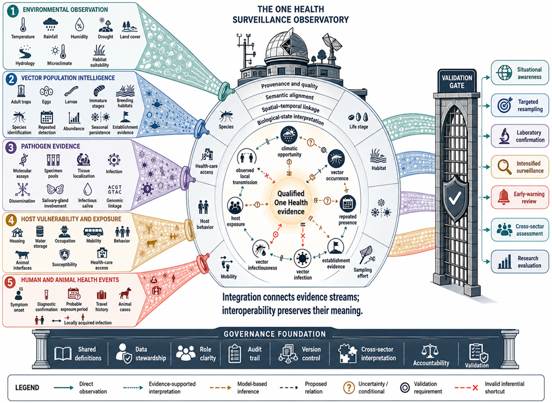
The proposed architecture begins with an observation layer that keeps environmental, entomological, pathogen, host, and health-system records distinct while attaching provenance and context to each item. A contemporary One Health data-integration framework for real-time pathogen surveillance and applied genomic epidemiology demonstrates the value of connecting heterogeneous sources through defined workflows, shared infrastructure, and cross-sector interpretation [27]. For medical entomology, the observation layer should record what was measured, where, when, by whom, with which protocol, and under which sampling conditions. It should also record what was not observed only when sampling effort and detection limits make non-detection interpretable. Environmental suitability, trap capture, species confirmation, breeding evidence, pathogen assay results, host exposure, clinical diagnosis, and genomic linkage should remain separate evidence objects rather than being prematurely compressed into a single risk score.
The second layer provides biological and semantic interpretation. Technical connectivity allows data to move, but interoperability requires that receiving systems preserve the meaning of variables, units, classifications, and relationships. Digital-health scholarship has emphasized that interoperability includes technical, syntactic, semantic, and organizational dimensions rather than mere data exchange [28]. In the proposed architecture, each evidence object is therefore linked to an ontology or controlled definition, a spatial and temporal scale, an inferential category, and an uncertainty statement. A vector-presence record may support occurrence; repeated records plus immature stages may support establishment; a pathogen-positive vector may support infection or circulation; salivary evidence may strengthen infectiousness inference; and locally acquired compatible cases may support transmission. These states are connected, but no state is automatically substituted for the next.
Figure 1 depicts the integrated information architecture within the analytical logic developed in this section.
|
|
|
Figure 1. The integrated information architecture |
Alt text
A structured conceptual diagram that depicts the integrated information architecture, with labelled components, directional relations, contextual modifiers, uncertainty points, and a clear boundary between observed evidence and proposed synthesis.
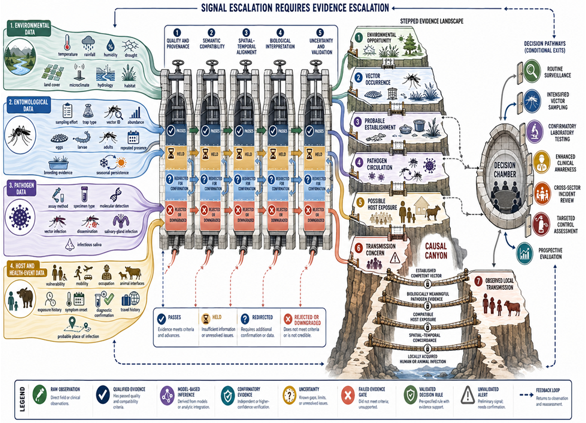
The third layer converts classified evidence into qualified decision signals. FAIR maturity frameworks show why data should be findable, accessible, interoperable, and reusable through transparent, community-governed assessment rather than through unexamined claims of openness [29]. Community approaches to standards and repositories further demonstrate that reusable information depends on shared descriptions of data structures, reporting expectations, and domain conventions [30]. Within this architecture, a decision signal is generated only after the relevant evidence has passed defined checks for provenance, comparability, biological meaning, spatial–temporal compatibility, uncertainty, and decision relevance. The resulting signal should identify its evidentiary basis and specify whether it supports routine observation, intensified surveillance, confirmatory testing, targeted communication, intervention consideration, or formal incident assessment.
Figure 2 shows how environmental, entomological, pathogen, and host data become decision signals within the analytical logic developed in this section.
|
|
|
Figure 2. How environmental, entomological, pathogen, and host data become decision signals |
Alt text
A structured conceptual diagram that shows how environmental, entomological, pathogen, and host data become decision signals, with labelled components, directional relations, contextual modifiers, uncertainty points, and a clear boundary between observed evidence and proposed synthesis.
The fourth layer is governance and learning. A generalizable One Health framework for zoonotic-disease control highlights the need to connect surveillance with coordinated assessment, prevention, response, and evaluation across sectors [31]. The architecture therefore includes named decision owners, escalation criteria, documentation of dissent or uncertainty, version control for definitions and models, feedback from interventions, and periodic reassessment of whether the information products remain useful. This layer prevents analytical outputs from being detached from accountability. It also creates a learning cycle in which false alarms, missed detections, data gaps, implementation constraints, and unexpected outcomes become inputs for redesign rather than being hidden within a final risk category.
The proposed components, evidence bases, boundary conditions, failure modes, and validation requirements are organized in Table 3.
Table 3. Proposed One Health Information Architecture: Components, Evidence Basis, Relations, Boundary Conditions, Failure Modes, and Validation Requirements
|
Proposed component |
Purpose |
Evidence basis |
Relation or mechanism |
Input or precondition |
Expected output |
Boundary condition or failure mode |
Validation requirement |
|
Evidence-object layer |
Preserve distinct observations and provenance |
Heterogeneous One Health surveillance data require structured integration |
Stores observations without collapsing biological meaning |
Defined metadata, sampling protocol, time, location, source |
Traceable environmental, vector, pathogen, host, and health records |
Missing denominator, uncertain identity, incompatible scale |
Completeness, reproducibility, provenance and quality audits |
|
Semantic and biological interpretation layer |
Align definitions while preserving non-equivalent states |
Interoperability requires more than technical exchange |
Links variables to controlled meanings and biological-state categories |
Agreed definitions, units, ontologies, classification logic |
Comparable but non-collapsed evidence states |
Shared fields with divergent meaning; category substitution |
Cross-sector semantic testing and expert adjudication |
|
FAIR and standards layer |
Improve discoverability, accessibility, reuse, and transparency |
FAIR maturity and community standards support reusable data ecosystems |
Applies structured metadata, persistent identifiers, and shared standards |
Governance, repositories, access rules, documentation |
Reusable and auditable information products |
Formal FAIR compliance without biological interpretability |
Automated and human maturity assessment under real use cases |
|
Spatial–temporal linkage layer |
Connect evidence collected at different places and times |
Transmission inference requires compatible exposure windows and scales |
Aligns lagged environmental, vector, pathogen, mobility, and case information |
Georeferencing, temporal resolution, exposure windows |
Context-qualified linkage among evidence streams |
Ecological fallacy, residence-as-exposure assumption, temporal mismatch |
Retrospective linkage analysis and prospective case reconstruction |
|
Biological-state ladder |
Prevent occurrence, establishment, infection, infectiousness, and transmission from being treated as synonyms |
Vector and pathogen observations resolve different biological states |
Requires additional evidence at each transition |
Valid identification, repeated sampling, life-stage evidence, assay context |
Explicitly classified evidentiary state |
Unsupported upward inference from a weaker state |
Independent confirmatory evidence for each transition |
|
Early-warning layer |
Convert qualified observations into alerts |
Forecasting and routine health data may support earlier recognition |
Generates probabilistic signals with documented uncertainty |
Calibrated models, stable data feeds, defined horizon |
Alert for review or intensified surveillance |
Alert treated as automatic action rule |
Prospective calibration, utility assessment, false-alarm analysis |
|
Decision and escalation layer |
Connect signals to accountable actions |
Surveillance is useful only when information reaches a defined response pathway |
Routes signals to designated decision owners |
Mandates, thresholds for review, available response capacity |
Documented surveillance or response decision |
Unclear authority, delayed review, action disconnected from evidence |
Process evaluation and outcome-linked decision audit |
|
Governance and learning layer |
Maintain accountability and system adaptation |
One Health control requires coordinated assessment and evaluation |
Feeds implementation experience back into definitions and models |
Cross-sector governance, audit trail, version control |
Revised protocols, models, roles, and evidence rules |
No feedback, hidden disagreement, institutional silos |
Periodic independent evaluation and documented revision history |
Governance, interoperability, and decision implications
Governance should begin with harmonized reporting rather than attempting to repair ambiguity after data exchange. The One Health Consensus Report Annotation Checklist was designed to support cross-sector consistency in the annotation of surveillance reports, showing how shared descriptors can improve the interpretability and comparability of information produced by different sectors [32]. Medical-entomology systems need equivalent agreement on taxonomic certainty, specimen state, trap type, sampling effort, assay result, pathogen nomenclature, spatial resolution, exposure classification, and transmission terminology. Progress would be demonstrated not merely by the adoption of common fields, but by testing whether independent users interpret the same records consistently and reach appropriately similar conclusions about what the evidence does and does not support.
Integrated vector management offers a natural operational setting in which to test the proposed architecture. A One Health approach to monitoring and evaluation has emphasized that vector-management assessment should connect ecological, epidemiological, social, operational, and governance dimensions [33]. Yet collaboration may be constrained by incompatible mandates, resource asymmetries, organizational cultures, data-ownership concerns, and uncertainty about the practical benefits of sharing. Qualitative evidence from cross-sector surveillance collaboration indicates that durable integration depends on trust, recognized mutual benefit, leadership support, communication routines, and workable institutional arrangements [34]. Architecture development should therefore include governance testing alongside technical development. Useful indicators would include completeness of metadata exchange, time to joint interpretation, proportion of signals receiving documented review, resolution of conflicting classifications, and evidence that feedback changes subsequent surveillance design.
Evaluation should examine integration as a multidimensional construct rather than a binary programme characteristic. A conceptual framework for assessing One Health integration distinguishes dimensions such as organization, operational coordination, resource sharing, data collection, analysis, interpretation, dissemination, and governance [35]. Applied to medical entomology, this means that a system could be technically connected yet biologically incoherent, semantically aligned yet operationally unused, or collaboratively governed yet inadequately validated. Future work should therefore compare architecture components prospectively, evaluate transfer across vector–pathogen systems, examine consequences of missing or discordant data, and determine whether qualified signals improve the timeliness, proportionality, and transparency of decisions. No architecture should be considered validated merely because its components are plausible or because stakeholders can exchange data through a common platform.
CONCLUSION
Medical entomology can function as a One Health information science only when heterogeneous observations are connected without erasing their biological, spatial, temporal, and inferential differences. The strongest defensible synthesis is that environmental suitability, vector occurrence, population establishment, pathogen detection, host vulnerability, infectiousness, and observed transmission form related but non-equivalent evidence states. Their value depends on provenance, sampling effort, semantic alignment, contextual interpretation, uncertainty, and linkage to accountable decision processes. The proposed architecture organizes these requirements through evidence-object, interpretation, interoperability, early-warning, decision, and governance layers, but it remains a scholarly synthesis rather than a validated operational framework. Its principal boundary condition is the heterogeneity of vector species, pathogens, settings, surveillance objectives, and institutional capacities. The highest-priority implication is therefore prospective, context-specific evaluation of whether biologically interpretable and transparently governed information flows produce better surveillance judgments than technical aggregation alone.
ACKNOWLEDGMENTS: None
CONFLICT OF INTEREST: None
FINANCIAL SUPPORT: None
ETHICS STATEMENT: None