Entomology and
Applied Science Letters
Applied Science Letters
 2025
Volume 12
Issue 3
2025
Volume 12
Issue 3

Botanical insecticides are increasingly investigated as alternatives or complements to conventional pest-management products, yet the biological material described by a plant name rarely represents a chemically stable or operationally uniform intervention. Genetic provenance, chemotype, cultivation environment, harvest timing, post-harvest handling, extraction, analytical methods, formulation, storage, application, and environmental exposure can each alter the composition and performance of the tested product. This article develops an original, evidence-grounded, and explicitly non-validated standardization approach for managing this variability across botanical-insecticide development. It integrates plant-source qualification, chemotype and harvest control, processing and extraction specifications, assay-linked chemical characterization, formulation stability, environmental exposure, biological performance, and safety assessment. The central synthesis is that variability should be treated as a propagated product property rather than as experimental noise addressed only after efficacy testing. Botanical species identity cannot establish chemical equivalence; a reported analytical profile cannot establish batch standardization; repeatable laboratory activity cannot establish field performance; and natural origin cannot establish predictable exposure or environmental safety. The available evidence nevertheless remains heterogeneous across botanical materials, target organisms, extraction systems, formulations, endpoints, and environmental contexts. Associations between chemical markers and bioactivity are frequently context-dependent, while replicated batch series, interlaboratory comparisons, realistic exposure studies, and chemically qualified field evaluations remain limited. Product development should therefore move from identity-based candidate descriptions toward traceable evidence chains connecting source, process, chemical composition, formulation state, delivered exposure, efficacy, crop compatibility, and non-target effects. Such a structure can guide prospective validation and decision making, but its components and acceptance criteria must be established separately for each defined product class, intended use, target, formulation, and exposure scenario.
INTRODUCTION
Botanical insecticides occupy an important but unsettled position between traditional plant use, natural-product discovery, formulation science, and operational pest management. Their attraction arises from extensive phytochemical diversity, multiple potential modes of action, renewable biological sources, and the possibility of developing products that complement existing control strategies. These advantages, however, are often discussed at the level of a plant species, extract category, or dominant compound, even though the entity delivered to an insect, crop, worker, or non-target organism is a chemically and physically specific product. Botanical insecticides can provide useful pest-management functions, but their promise depends on replacing identity-based assumptions with chemically and operationally defined products [1]. The central scientific problem is therefore not simply whether a plant preparation can produce biological activity. It is whether the material can be defined, reproduced, formulated, stored, delivered, and evaluated with sufficient consistency for its efficacy and safety claims to remain interpretable across batches and use conditions.
Discovery-oriented studies commonly begin with laboratory mortality, repellency, feeding inhibition, developmental disruption, or another target-organism endpoint. These experiments are valuable for identifying biological potential, but they rarely resolve whether the same chemical entity can be produced repeatedly or whether its activity will persist after formulation, storage, dilution, application, and environmental exposure. Laboratory activity is therefore only the beginning of product development, because formulation, persistence, application context, and farm-level performance remain separate evidentiary questions [2]. A botanical preparation that performs strongly in a controlled assay may lose volatile constituents, separate during storage, deposit unevenly, degrade rapidly, injure the treated crop, or expose beneficial organisms through routes absent from the discovery experiment. Conversely, a preparation with moderate acute toxicity may provide useful crop protection through repellency, feeding deterrence, developmental effects, or repeated low-intensity exposure. Laboratory potency, product performance, and operational effectiveness must consequently remain analytically distinct.
A further difficulty is that evidence is accumulated across non-equivalent materials and methods. Studies may use different plant organs, accessions, harvest seasons, drying conditions, extraction solvents, concentration units, exposure routes, target stages, observation periods, and endpoint definitions while applying the same species or extract label. The evidence base also contains recurrent taxonomic, methodological, and reporting biases that can conceal product-level heterogeneity and overstate generalizability [3]. A pooled category such as “essential oils,” for example, may include chemically distinct mixtures delivered by fumigation, contact exposure, treated surfaces, emulsions, or nanocarriers. Apparent disagreement among studies may therefore reflect genuine biological heterogeneity, uncontrolled chemical variation, exposure differences, or incompatible outcome measures rather than simple experimental error. Meaningful synthesis requires the tested entity and its context to be reconstructed before results are compared.
This article addresses that gap by treating chemical variability as a product-development determinant generated across the complete botanical-insecticide chain. Its scope extends from botanical provenance and chemotype through harvest, processing, extraction, analytical characterization, formulation, degradation, environmental exposure, reproducibility, safety, and field-level performance. The central argument is that standardization cannot be reduced to taxonomic authentication, a dominant-marker assay, a chromatographic fingerprint, or a single potency test. It must connect controlled inputs and processes to measured chemical attributes, formulation behavior, delivered exposure, target performance, and relevant safety outcomes. The proposed contribution is an original scholarly organization of these relations rather than a validated universal standard. Its purpose is to identify the distinctions, decision points, failure modes, and validation requirements needed to transform a biologically active botanical material into a chemically interpretable and prospectively testable product class.
Sources of chemical variability in botanical materials
Chemical variability begins before extraction or bioassay and may be embedded in the source material through taxonomy, accession, genotype, cultivation, collection, phenology, geography, and supply-chain history. A reproducible botanical product begins with authenticated provenance and a controlled supply chain, because local use records do not by themselves define a chemically equivalent material [4]. Ethnobotanical knowledge can identify useful species and preparation traditions, but vernacular identity and historical efficacy cannot establish that material collected from different regions, populations, or production systems has the same metabolite distribution. Source qualification therefore requires taxonomic authentication, plant-part definition, voucher or reference material, accession traceability where relevant, and documentation of cultivation or collection conditions. These controls establish provenance, not chemical equivalence; the chemical output of each qualified source must still be measured.
Within a single named species, essential-oil profiles and activity can vary materially among sources, demonstrating that species identity is not a chemical-equivalence criterion [5]. Variation may involve the presence or absence of constituents, shifts in the ratios among major compounds, changes in low-abundance metabolites, or differences in total recoverable oil or extract. Some compositional differences may alter penetration, volatility, target binding, mixture interactions, formulation compatibility, or degradation behavior. However, a correlation between a profile and an insecticidal response does not establish that the most abundant constituent caused the observed effect. Covarying compounds, extraction yield, exposure conditions, or assay sensitivity may provide competing explanations. Chemical markers should therefore be treated as provisional indicators until they demonstrate predictive relevance across independent batches and target-specific assays.
Preparation and environmental history further determine which chemical material reaches extraction. Preparation method is itself a source of chemical variability, and incomplete descriptions of plant state, solvent, ratio, duration, filtration, and dose prevent faithful replication [6]. Drying temperature, light, oxygen, moisture, storage duration, milling, transport, and contamination can alter volatile and non-volatile constituents before the formal extraction step begins. Geographic location, accession, and season can shift the composition of harvested botanical material even before extraction begins [7]. These influences may interact rather than operate independently: an accession may respond differently across seasons, while post-harvest processing may amplify or obscure source-related variation. The appropriate development response is not to presume that one favorable collection defines the species, but to specify a source-and-process envelope and verify each production lot against measured chemical attributes.
The evidence dimensions and interpretive boundaries for sources of chemical variability in botanical materials are summarized in Table 1.
Table 1. Sources of Chemical Variability in Botanical Materials: Chemical Identity, Mechanism, Standardization, Formulation, Safety, Resistance, and Translation Requirements
|
Candidate or product factor |
Chemical or biological basis |
Required characterization |
Potential contribution |
Formulation implication |
Safety implication |
Resistance implication |
Development boundary |
|
Botanical identity and provenance |
Taxon, plant part, accession, geography, and production history constrain the starting chemical population |
Voucher or reference material, plant-part confirmation, accession and chain-of-custody records |
Prevents substitution and supports investigation of source-related deviations |
Qualified source material reduces uncontrolled payload shifts but does not ensure formulation compatibility |
Misidentification or source substitution may change hazardous constituents and exposure |
Source consistency is required before resistance effects can be interpreted |
Authentication establishes origin, not chemical or biological equivalence |
|
Within-species chemical variation |
Biosynthetic and environmental differences alter constituent identities and ratios |
Multi-lot chromatographic fingerprinting, marker content, yield, and linked potency assays |
Makes lot heterogeneity visible and supports product-specific acceptance regions |
Variable constituent ratios may alter solubility, emulsification, encapsulation, release, and degradation |
Similar species labels may conceal different target and non-target profiles |
Changing mode-of-action mixtures may change selection pressure, but this must be tested |
One species name or one representative profile cannot define a stable product |
|
Preparation method |
Plant state, solvent, ratio, extraction duration, filtration, and applied concentration determine the tested material |
Complete preparation and dose metadata with retained samples where feasible |
Enables replication and distinguishes process variation from biological variation |
Preparation inconsistency complicates later formulation and scale-up |
Uncontrolled concentration or contaminants may alter user, crop, and ecological hazards |
Variable exposure prevents defensible resistance comparisons |
Traditional repeatability is not equivalent to controlled manufacturing reproducibility |
|
Geography, accession, and season |
Genotype-by-environment and seasonal regulation modify secondary metabolism |
Repeated sampling across locations and seasons with compositional profiling |
Supports risk-based source qualification and harvest planning |
Seasonal payload shifts may alter carrier requirements and stability |
Seasonal profiles may change hazardous or irritating constituents |
Resistance relevance cannot be inferred without stable exposure and mode-of-action evidence |
Compositional variation alone does not establish corresponding efficacy variation |
|
Chemotype |
Recurring profile classes reflect biosynthetic differences but retain within-class variation |
Replicated chemotype classification, marker panel, reference material, and batch history |
Narrows source heterogeneity and supports stratified specifications |
Distinct chemotypes may require separate formulation or comparability studies |
Chemotype identity does not define selectivity or environmental safety |
Chemotype-specific mode balance may matter, but empirical selection studies are required |
Chemotype is an input stratum, not a final release criterion |
|
Whole mixture versus dominant marker |
Mixture activity may differ from the activity of a major constituent through additive, antagonistic, or synergistic relations |
Whole-product fingerprint, marker assay, constituent comparison, and endpoint-specific bioassays |
Prevents unjustified single-marker standardization |
Formulation may affect constituents differently and change mixture relations |
A marker’s safety cannot substitute for assessment of the complete product |
Resistance claims based on presumed multi-target activity require direct evidence |
Dominant abundance does not establish biological equivalence to the whole oil |
|
Extraction process |
Solvent and operating conditions selectively recover or transform chemical fractions |
Locked process parameters, mass balance, fingerprint, marker recovery, impurities, and linked assays |
Defines the extract as a process-specific chemical product |
Materially different extracts may require separate product and formulation classes |
Extraction can concentrate hazardous constituents or introduce residual-process concerns |
Non-equivalent extracts cannot support pooled resistance conclusions |
Equal crude yield does not mean equal chemical composition or activity |
Chemotypes, harvest conditions, and plant processing
Chemotype classification is often proposed as a practical bridge between botanical identity and chemical specification. It can reduce heterogeneity by separating populations or accessions with recurrent compositional patterns, but it does not freeze constituent concentrations within a class. Chemotype classification narrows, but does not eliminate, within-source variability because constituent abundance can continue to shift across seasonal harvests [8]. A useful chemotype designation therefore requires replicated classification across locations, seasons, and production lots rather than assignment from one sample or one dominant peak. It should also be connected to the intended biological function. A chemically stable class may still lack predictive value if the distinguishing markers do not explain or forecast target activity, formulation behavior, degradation, or safety.
The convenience of a dominant chemical marker creates a particular standardization risk. A dominant constituent may be analytically convenient without being biologically equivalent to the whole oil, so a single-marker specification requires target-specific validation [9]. Whole mixtures can produce target-dependent effects that are not reproduced by the isolated major component, because minor constituents may alter penetration, volatility, metabolism, receptor interactions, or the effective ratio among active components. The opposite is also possible: a dominant constituent may account for much of the observed activity in one assay but not in another. Standardization should consequently combine marker content with a broader fingerprint and a relevant biological assay unless prospective evidence demonstrates that the marker reliably predicts whole-product performance across representative and edge-of-specification batches.
Harvest and post-harvest controls must also be interpreted in relation to the use environment and endpoint. The same applied material can produce different outcomes under different temperatures, showing that a batch specification cannot substitute for an exposure-context specification [10]. Temperature can influence volatilization, persistence, penetration, insect physiology, and effective exposure duration without changing the nominal dose. Processing introduces additional variability through drying, storage, milling, oxidation, moisture, light, and hold time. Chemical characterization must be paired with endpoint-specific testing because toxicity, repellency, and other functions are not interchangeable measures of performance [11]. A product that meets a mortality specification may not meet a repellency, ovicidal, crop-protection, or residual-performance specification. Source qualification, harvest envelopes, controlled processing, chemical release tests, and endpoint definitions must therefore be designed as connected controls rather than independent labels.
Extraction and analytical characterization
Extraction is the transition at which variable botanical material becomes a defined oil, fraction, crude extract, or purified product. It should not be treated as a neutral laboratory preparation step. Extraction should be treated as a controlled manufacturing operation because it determines which chemical fraction enters all subsequent characterization and efficacy tests [12]. Solvent polarity, plant-to-solvent ratio, particle size, temperature, pressure, duration, mixing, distillation conditions, and separation procedures can change recovery, transform unstable constituents, or create materially different products. Reproducibility therefore requires specified critical process parameters, mass balance, yield, complete chemical profiling, impurity assessment, and retained samples where feasible. Scale-up must be assessed separately because equipment geometry, heat transfer, solvent recovery, residence time, and separation efficiency may change the product even when the nominal procedure remains similar.
Analytical characterization must be matched to the entity being evaluated. For formulated botanicals, analytical characterization must include both the chemical payload and the delivery system because droplet or particle properties can change release and exposure [13]. Chemical identity, marker content, fingerprint similarity, impurities, degradation products, carrier composition, particle or droplet distribution, encapsulation, interfacial properties, and release behavior answer different questions. No single measurement can establish all of them. Solvent and extraction design can change both the recovered chemical profile and the apparent spectrum of activity, so extraction equivalence must be demonstrated rather than presumed [14]. Extracts prepared by materially different processes should be classified as separate product entities unless bridging studies demonstrate comparable chemistry, biological performance, formulation behavior, and safety.
The principal interpretive boundary is the difference between describing a batch and standardizing a product. A credible specification should connect an analytical fingerprint to a defined biological assay, while avoiding the inference that either one alone proves batch standardization [15]. A chromatogram can reveal identity and variation, but standardization also requires validated methods, representative batch history, prespecified acceptance criteria, sampling rules, measurement uncertainty, deviation investigation, and evidence that accepted variation remains compatible with relevant potency and safety outcomes. Likewise, a repeatable bioassay can indicate biological consistency without identifying chemical drift or explaining a future failure. Analytical and biological methods should therefore operate as complementary components of an assay-linked specification. The required acceptance region must remain product-, target-, formulation-, and endpoint-specific, and its predictive value must be established prospectively rather than assumed from retrospective agreement.
Formulation, degradation, and environmental exposure
Formulation is the point at which a chemically characterized botanical payload becomes a finished delivery system, and the transformation can change both biological performance and environmental behavior. Formulation is not merely a convenience layer: it can alter degradation, persistence, deposition, release, and the environmental compartments that receive the active material [16]. Emulsifiers, encapsulating matrices, carriers, interfacial properties, droplet or particle distributions, viscosity, adhesion, and release kinetics influence how much material reaches the target, how long it remains available, and which non-target receptors are exposed. A finished product must therefore be identified by the botanical payload and its qualified chemical range together with its formulation composition, physical state, storage condition, container, dilution procedure, application method, and intended exposure envelope. Greater laboratory potency after formulation may represent improved dispersion or exposure rather than increased intrinsic toxicity.
Once an oil is converted into a nanoemulsion, the product is no longer defined by the oil alone because the interfacial system and droplet properties become determinants of exposure and activity [17]. Formulation development must consequently evaluate chemical and physical stability as related but non-equivalent properties. Oxidation, hydrolysis, volatilization, constituent redistribution, aggregation, phase separation, or carrier degradation can change the delivered dose even when the product retains an acceptable appearance. Formulation stability and target toxicity are complementary outcomes: neither can be used as a proxy for the other, and both require prespecified acceptance criteria [18]. Shelf-life and in-use specifications should therefore be supported by stability-indicating chemical methods, appropriate physical measurements, release or deposition assessment, and a relevant potency assay. A formulation tested with one chemically favorable payload lot cannot be presumed robust to the full accepted range of botanical variability.
Environmental exposure extends the standardization problem beyond the container. Application rate, spray quality, temperature, humidity, rainfall, ultraviolet radiation, crop surface, soil, water, air movement, pest location, and receptor behavior determine the dose that reaches target and non-target organisms. Hazard and exposure must remain separate: a laboratory hazard does not by itself quantify field risk, but missing exposure data cannot be interpreted as evidence of safety. A formulation that increases target activity may still fail product development if it creates unacceptable crop injury or other exposure-dependent harms [19]. Intended-use scenarios should therefore specify crop or storage system, application route, environmental conditions, relevant receptors, and plausible exposure pathways. Natural origin is not equivalent to predictable environmental exposure, and labels such as natural, green, or eco-friendly cannot replace product-specific evidence on residues, fate, crop compatibility, worker contact, beneficial organisms, and other relevant environmental compartments.
Reproducibility, safety, and performance consequences
Chemical variability is propagated rather than erased as botanical material moves from source qualification through extraction, characterization, formulation, storage, application, and environmental exposure. Variability at an upstream stage can be attenuated by effective controls, amplified by formulation or environment, or concealed when only one biological endpoint is measured. Field evidence can demonstrate crop protection, yield, and beneficial-arthropod outcomes that are invisible to laboratory mortality assays, although uncontrolled batch chemistry still limits reproducibility [20]. Reproducibility should therefore be evaluated as agreement among defined chemical products under specified exposure conditions, not merely as repeated mortality within one assay. It includes within-laboratory repeatability, between-batch comparability, interlaboratory reproducibility, stability over time, and performance across relevant environments.
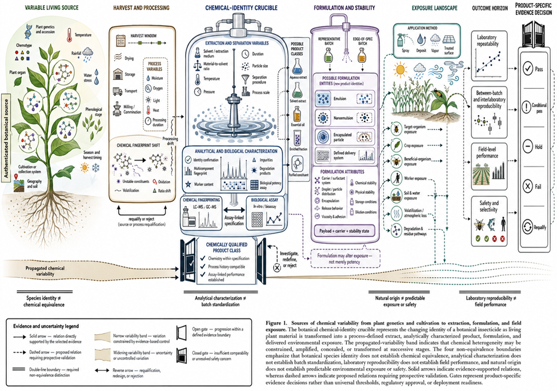
Figure 1 traces sources of chemical variability from plant genetics and cultivation to extraction, formulation, and field exposure within the analytical logic developed in this section.
|
|
|
Figure 1. Sources of chemical variability from plant genetics and cultivation to extraction, formulation, and field exposure |
Alt text
A structured conceptual diagram that traces sources of chemical variability from plant genetics and cultivation to extraction, formulation, and field exposure, with labelled components, directional relations, contextual modifiers, uncertainty points, and a clear boundary between observed evidence and proposed synthesis.
The practical meaning of reproducibility depends on matching the chemical profile, exposure route, target stage, and endpoint. Reproducibility requires matching chemical profile, exposure route, target stage, and endpoint because essential-oil performance is not a product-invariant property [21]. A batch may be repeatable in a contact-mortality assay yet differ in repellency, fumigant action, residual persistence, ovicidal activity, or crop-system performance. Product comparisons should therefore retain batch identifiers, analytical results, formulation state, application conditions, target stage, exposure route, observation period, and endpoint definition. Common reference materials and predefined comparability criteria are needed to separate product drift from assay imprecision. One successful replication cannot establish broader reproducibility, and a statistically similar mean cannot demonstrate equivalence when chemically important variation or endpoint-specific failures remain unresolved.
Safety and field performance further expand the relevant outcome space. A botanical treatment can influence crop growth and yield through pathways not captured by insect mortality, so product performance must be evaluated as a crop-system outcome [22]. Such effects may represent pest suppression, altered feeding, physiological plant responses, formulation effects, or interactions that cannot be inferred from acute mortality alone. Natural origin and target efficacy do not establish environmental safety, as an effective botanical nanoformulation can still produce consequential pollinator toxicity [23]. Hazard findings must be connected to realistic exposure before field risk is inferred, but beneficial-organism survival in one field context likewise cannot be generalized to all formulations, rates, crops, seasons, or receptors. Reproducibility, efficacy, crop compatibility, selectivity, and environmental safety are therefore related product attributes that require separate evidence and an explicit intended-use context.
The evidence dimensions and interpretive boundaries for reproducibility safety and performance consequences are summarized in Table 2.
Table 2. Reproducibility, Safety, and Performance Consequences: Chemical Identity, Mechanism, Standardization, Formulation, Safety, Resistance, and Translation Requirements
|
Candidate or product factor |
Chemical or biological basis |
Required characterization |
Potential contribution |
Formulation implication |
Safety implication |
Resistance implication |
Development boundary |
|
Field performance |
Crop protection depends on pest pressure, crop condition, application, environment, and product chemistry |
Chemically qualified batch, field protocol, pest endpoints, yield or damage outcomes, and beneficial-organism observations |
Demonstrates outcomes unavailable from laboratory mortality alone |
Delivery and persistence must remain suitable under field application |
Beneficial-organism outcomes require product- and context-specific interpretation |
Field exposure quality must be known before selection pressure can be assessed |
One field result cannot validate chemically uncontrolled batches or other environments |
|
Reproducibility across batches and assays |
Chemistry, target stage, exposure route, endpoint, and method contribute separate variance components |
Batch fingerprints, potency assays, common protocols, reference material, and variance reporting |
Distinguishes product drift from technical imprecision |
Formulation lots must be compared alongside payload chemistry |
Reproducible target activity does not prove reproducible safety |
Consistent exposure is required for interpretable resistance studies |
Technical replicate agreement is not product reproducibility |
|
Crop-system performance |
Botanical preparations may affect pest pressure, plant physiology, growth, or yield |
Pest, crop-growth, injury, and yield endpoints with product and exposure metadata |
Expands performance assessment beyond insect mortality |
Excipients and formulation may contribute to crop responses |
Beneficial effects do not rule out phytotoxicity or ecological harm |
Indirect crop effects should not be presented as resistance management |
Mechanisms and transferability require separate validation |
|
Pollinator and non-target hazard |
Formulation may alter target and non-target exposure |
Relevant species, route, concentration, duration, formulation identity, and hazard endpoints |
Identifies safety-critical failures hidden by target-only testing |
Nanocarriers or emulsifiers may change uptake and persistence |
Botanical origin cannot substitute for pollinator and ecological assessment |
Non-target harm cannot be justified by presumed resistance benefits |
Hazard must be integrated with realistic exposure to characterize risk |
|
Endpoint specificity |
Mortality, repellency, ovicidal effects, development, and field protection represent different functions |
Prespecified endpoint definitions, observation periods, target stages, and assay validity |
Prevents one assay from representing an entire performance profile |
Formulation may improve one endpoint while weakening another |
Safety endpoints require independent testing |
Different endpoints may impose different selection pressures |
No universal efficacy ranking is defensible across incompatible endpoints |
|
Temperature and exposure context |
Volatility, persistence, penetration, and organism physiology change with environment |
Product chemistry, application conditions, temperature, exposure duration, and target response |
Explains performance variation without assuming chemical batch failure |
Environmental sensitivity may require use-condition restrictions |
Changed volatility can alter worker and non-target exposure |
Environmental variation complicates interpretation of resistance-related failures |
A chemical specification cannot replace an exposure-context specification |
|
Extraction-defined product |
Extraction determines the fraction entering formulation and bioassay |
Process parameters, fingerprint, yield, impurities, and biological profile |
Supports comparison of genuinely equivalent extracts |
Different extracts may require distinct carrier systems |
Extraction may concentrate hazardous components |
Resistance evidence cannot be pooled across non-equivalent fractions |
Equal yield or plant identity does not establish extract equivalence |
Proposed standardization requirements
The proposed standardization structure treats botanical-insecticide development as a connected evidence chain rather than a collection of independent tests. A defensible standard must connect raw-material control, chemical specification, formulation performance, biological efficacy, and safety rather than treating them as independent checklists [24]. The first requirement is an explicit product-class definition that distinguishes raw powders, aqueous or solvent extracts, essential oils, purified constituents, analogues, emulsions, nanoformulations, and other materially different entities. Each class must be connected to an intended use, target, crop or storage setting, route, dose form, and exposure scenario. Botanical authentication and provenance then define the source, while chemotype, harvest, handling, and extraction controls constrain the chemical population entering manufacture. These upstream controls remain inputs; batch release must depend on measured product attributes.
The scarcity of dependable products relative to the number of biologically active candidates reflects failures distributed across the development chain. The small proportion of candidates that become dependable products reflects cumulative failures across standardization, formulation, evidence quality, safety, production, and governance rather than a simple shortage of active plants [25]. The proposed organization therefore links source qualification, processing and extraction parameters, orthogonal chemical methods, assay-linked specifications, formulation robustness, stability, exposure, crop safety, non-target assessment, and laboratory-to-field comparability. Decision outcomes should include pass, conditional pass, hold, fail, and requalification. A conditional pass would restrict interpretation to a stated source, formulation, target, or exposure boundary; a hold would require evidence capable of resolving uncertainty; and requalification would be triggered when changes to source, process, formulation, scale, packaging, or use conditions could invalidate earlier comparability.
A separate development pathway should be recognized for purified or structurally simplified natural-product leads. Purified or simplified natural-product leads offer a route to chemical definition, but they should not be treated as evidence that variable whole-botanical preparations have achieved batch equivalence [26]. Purification can improve identity, dosing, structure–activity analysis, and manufacturing control, yet it creates a different product from the source extract or oil and may alter efficacy, safety, environmental behavior, and resistance implications. The proposed standardization requirements are therefore product-class-specific and explicitly non-validated. They do not establish universal markers, numerical acceptance limits, regulatory sufficiency, or deployment readiness. Prospective multi-batch, multi-environment, and independently replicated studies are required to determine whether the proposed components measure distinct decision-relevant constructs and whether accepted chemical ranges predict formulation, efficacy, crop, and non-target outcomes.
The proposed components, evidence bases, boundary conditions, failure modes, and validation requirements are organized in Table 3.
Table 3. Proposed Standardization Requirements: Components, Evidence Basis, Relations, Boundary Conditions, Failure Modes, and Validation Requirements
|
Proposed component |
Purpose |
Evidence basis |
Relation or mechanism |
Input or precondition |
Expected output |
Boundary condition or failure mode |
Validation requirement |
|
Product-class definition |
Prevent evidence from being pooled across materially different botanical entities |
Product-development syntheses distinguish extracts, oils, purified compounds, and formulations |
All later claims apply only to the defined entity |
Intended use, target, route, dose form, crop or storage system |
Unambiguous product identity and claim boundary |
Oil, extract, constituent, and formulation evidence are treated as interchangeable |
Prospective confirmation that classification predicts relevant process and performance differences |
|
Botanical identity and provenance |
Prevent substitution and establish traceable source control |
Provenance and supply-chain evidence |
Genetic and environmental source constrains biosynthetic potential |
Voucher material, plant part, accession, geography, cultivation or collection history |
Qualified source with investigation and deviation records |
Species identity is treated as chemical equivalence |
Authentication-method validation and periodic requalification |
|
Chemotype and chemical envelope |
Define accepted multivariate source variation |
Within-species and seasonal chemical variation |
Composition and constituent ratios affect potency and formulation behavior |
Replicated batch history and fit-for-purpose analytical methods |
Product-specific chemical acceptance region |
One dominant marker or one typical chromatogram defines equivalence |
Cross-season, cross-site, and target-linked predictive validation |
|
Controlled processing and extraction |
Ensure that a reproducible chemical fraction enters later stages |
Preparation and extraction studies |
Process parameters selectively recover or transform constituents |
Locked drying, storage, solvent, ratio, temperature, time, equipment, and separation parameters |
Traceable extract with defined fingerprint, yield, and impurity profile |
Equal mass yield is treated as equal chemical product |
Process-capability, scale-up-comparability, and linked-bioassay studies |
|
Assay-linked analytical specification |
Connect measured chemistry with relevant biological function |
Whole-mixture, marker, analytical, and bioassay evidence |
Orthogonal identity, content, fingerprint, impurity, and potency information supports release decisions |
Validated methods, reference materials, sampling plan, and batch history |
Prespecified acceptance and deviation decisions |
Characterization is reported without limits or biological linkage |
Prospective batch prediction and interlaboratory analytical transfer |
|
Formulation and stability comparability |
Control payload delivery and drift during storage and use |
Nanoformulation and stability evidence |
Carrier and payload properties affect release, deposition, persistence, and exposure |
Defined excipients, payload range, physical attributes, container, storage, and use conditions |
Stable finished product within an intended-use envelope |
One payload lot is assumed representative of all qualified lots |
Real-time and accelerated studies using representative and edge chemical lots |
|
Exposure and safety envelope |
Connect hazard to realistic target, crop, worker, beneficial-organism, and environmental exposure |
Crop-safety, environmental, and non-target evidence |
Application and environment determine delivered doses |
Intended-use scenarios, application conditions, relevant receptors, and hazard data |
Explicit efficacy and risk interpretation boundary |
Natural origin or target efficacy is used as safety evidence |
Scenario-based exposure measurement and product-specific risk characterization |
|
Laboratory-to-field comparability |
Separate laboratory repeatability from operational performance |
Translation and field evidence |
Environment, application, crop, target pressure, and operator influence performance |
Qualified lots, common comparators, multiple sites, seasons, batches, and endpoints |
Separate estimates of laboratory reproducibility and field performance |
Technical replicate precision is described as field effectiveness |
Multi-environment field evaluation with chemically qualified batches |
|
Change control and requalification |
Prevent cumulative changes from creating an unrecognized new product |
Product-development and governance evidence |
Source, process, formulation, scale, packaging, and use changes may disrupt comparability |
Predefined change-impact and bridging protocol |
Accept, reject, bridge, or fully requalify with traceable rationale |
Changed materials rely on evidence generated for an earlier configuration |
Planned perturbation studies and prospective requalification testing |
Implications for research and product development
Research priorities should shift from accumulating isolated activity reports toward producing comparable evidence that supports product definition and decision making. Future research should prioritize comparable chemical metadata, underrepresented targets and endpoints, negative results, and product-relevant tests rather than accumulating additional poorly connected mortality screens [27]. Minimum reporting should include authenticated source, plant part, accession or provenance where relevant, harvest and processing history, extraction parameters, batch identifier, chemical fingerprint, marker content, formulation composition, stability state, dose expression, exposure route, target stage, observation period, and endpoint definition. Retained samples, accessible analytical data, cross-platform reference materials, and explicit reporting of failed or inconsistent batches would help distinguish biological heterogeneity from analytical or publication bias. Progress would be demonstrated by studies that can be compared across laboratories without collapsing materially different products into one category.
Biological evaluation should also extend beyond acute mortality while maintaining a firm boundary between controlled outcomes and field effectiveness. Product-development studies should extend beyond acute mortality to life-history and population outcomes while preserving a clear boundary between controlled population effects and field effectiveness [28]. Development, fecundity, survival, behavior, feeding, repellency, ovicidal action, population growth, crop injury, pest damage, yield, beneficial organisms, and environmental receptors may each reveal consequences missed by short-duration lethality tests. However, a life-table response remains a controlled population outcome rather than proof of crop protection or operational value. Progress would require chemically qualified batches tested through a staged evidence sequence that connects acute and sublethal effects to semi-field and field outcomes under realistic application and environmental conditions.
Formulation research should use direct comparators and characterize improvement as endpoint-specific rather than universal. Head-to-head comparisons of parent oil and formulation are essential because nanoformulation may change the pattern of mortality, ovicidal action, morphology, and volatile behavior rather than uniformly improve every endpoint [29]. Such comparisons should use the same qualified payload lot, matched dose expressions, explicit carrier controls, stability data, chemical and physical characterization, target and non-target endpoints, and realistic exposure conditions. Product development should also challenge formulations with representative and edge-of-specification botanical lots to determine whether the delivery system tolerates accepted chemical variability. Progress would be shown when formulation attributes prospectively predict stability, exposure, efficacy, crop compatibility, and safety across batches rather than merely producing a stronger response in one laboratory assay.
CONCLUSION
Chemical variability is a central determinant of whether botanical insecticides can move from biologically active preparations to reproducible and interpretable products. It originates in genetics, chemotype, cultivation, harvest, processing, and extraction and continues through formulation, storage, application, degradation, and environmental exposure. The strongest defensible synthesis is that standardization must connect traceable source and process controls with measured chemical attributes, assay-linked acceptance criteria, formulation robustness, intended-use exposure, efficacy, crop compatibility, and non-target safety. Botanical species identity is not chemical equivalence; analytical characterization is not batch standardization; laboratory reproducibility is not field performance; and natural origin is not predictable environmental exposure. The proposed requirements provide a non-validated structure for organizing these relations and identifying failure points, but no universal marker, threshold, or release rule is established. The highest-priority implication is the prospective evaluation of chemically qualified batches across laboratories, formulations, exposure scenarios, and field environments so that product variation can be measured, controlled, and connected to performance and safety rather than hidden within broad botanical labels.
ACKNOWLEDGMENTS: None
CONFLICT OF INTEREST: None
FINANCIAL SUPPORT: None
ETHICS STATEMENT: None