Entomology and
Applied Science Letters
Applied Science Letters
 2025
Volume 12
Issue 2
2025
Volume 12
Issue 2

Resistance-resilient crop protection depends not simply on increasing the number of available interventions, but on controlling how, when, and under what biological conditions those interventions are deployed. Integrated pest-management programmes frequently contain chemical, biological, behavioural, and cultural components without specifying their temporal relationships, compatibility requirements, escalation triggers, or responses to declining susceptibility. This article addresses that design gap by developing an original strategic framework for deliberate intervention sequencing. The approach integrates programme-level resistance management, chemical timing, functional mode-of-action diversity, biological and behavioural suppression, cultural prevention, monitoring, and adaptive adjustment. The principal synthesis is that resistance resilience emerges from a state-dependent exposure programme: preventive measures reduce initial pest pressure; surveillance identifies pest, damage, susceptibility, and natural-enemy states; ecological interventions are protected where their preconditions are met; and selective chemical interventions are reserved for explicit escalation points. Rotation and mixtures remain conditional tools rather than automatic safeguards because cross-resistance, residual overlap, unequal efficacy, pest movement, and implementation inconsistency can undermine their intended functions. Biological, behavioural, and cultural components can reduce dependence on chemical mortality, but component-level efficacy cannot establish whole-programme performance. The proposed structure therefore separates intervention availability from sequencing quality and requires post-intervention feedback, compatibility assessment, and locally relevant validation. Important limitations include sparse direct comparisons of complete intervention sequences, context dependence across pest–crop systems, uncertainty in susceptibility and natural-enemy monitoring, and differences between recommended and implemented practice. The central implication is that resistance management should be evaluated as an adaptive, multi-season programme architecture rather than as a product-rotation rule or a static collection of control tactics.
INTRODUCTION
Integrated pest management (IPM) is commonly described as the coordinated use of preventive, biological, behavioural, cultural, and chemical tactics. In practice, however, programmes may remain chemically centred while nonchemical elements are included as peripheral recommendations rather than functioning parts of a decision sequence. This implementation gap matters because a list of diverse interventions does not indicate which tactic should act first, what evidence should trigger escalation, or how previous exposures constrain later choices. The persistence of implementation gaps means that IPM should be treated as a designed programme rather than a nominal bundle of tactics [1]. Resistance resilience therefore concerns the architecture of repeated management decisions, not simply the presence of multiple control categories.
Programme-level experience demonstrates that coordination is possible but highly dependent on production history and institutional capacity. The Australian cotton system progressively combined surveillance, economic thresholds, selective insecticides, biological control, transgenic crops, and resistance-management arrangements. Its development illustrates how disruptive interventions can be reduced when chemical decisions are connected to pest monitoring and natural-enemy conservation. The Australian cotton experience shows that thresholds, selective chemistry, biological control and resistance management can be combined at industry scale, although the resulting programme remains system specific [2]. Such experience provides design principles rather than a universally transferable sequence, because pest complexes, climatic conditions, available technologies, advisory systems, and grower incentives differ among production systems.
Resistance also develops through interactions extending beyond the biological response of an isolated pest population. Individual growers may obtain an immediate benefit from an intervention even when repeated regional use reduces its future effectiveness. Manufacturers, advisers, regulators, researchers, and producers may also interpret early control failure differently or act over different time horizons. Pesticide resistance is a sociobiological problem because biological adaptation, individual incentives and collective action interact [3]. A resistance-resilient programme must consequently connect evolutionary reasoning with diagnostics, communication, coordinated implementation, and rules for revising recommendations when susceptibility or control performance changes.
The central problem addressed here is the absence of an explicit design logic connecting intervention timing, ecological compatibility, selection pressure, monitoring, and feedback. Intervention diversity is not equivalent to resistance-resilient sequencing, because the same components can create different exposure patterns when applied in different orders. Evidence from transgenic crops further shows that nominal technological diversity cannot compensate for unsuitable deployment, inadequate refuges, cross-resistance, or favourable inheritance conditions. The emergence of practical resistance to Bt crops shows that deployment pattern, refuge design and inheritance can override the mere availability of diverse technologies [4]. This article therefore develops a proposed, non-validated strategic structure in which each intervention has a defined purpose, entry condition, sequence position, compatibility requirement, failure mode, and validation need.
Why resistance management requires programme-level design
The appropriate unit of resistance-management design is the exposure programme experienced by pest populations across generations, fields, and seasons. Product labels or written recommendations cannot produce resilience unless growers can identify thresholds, distinguish modes of action, obtain suitable alternatives, and implement decisions at the required time. An extension-based programme increased adoption of threshold and rotation practices, indicating that resistance management depends on decision support as well as technical content [5]. Nevertheless, increased adoption should not be interpreted as direct evidence that resistance evolution was slowed. Programme evaluation must separately examine implementation, pest suppression, exposure histories, susceptibility change, and the durability of management options.
Biological starting conditions further prevent a universal sequence from producing uniform outcomes. Resistance may originate from pre-existing variation, new mutation, migration, altered dominance, metabolic mechanisms, target-site changes, or combinations of these processes. Selection intensity is then shaped by dose, coverage, residual activity, pest phenology, untreated hosts, immigration, and the proportion of the population exposed. Resistance trajectories depend on standing variation, mutation, gene flow and selection, so identical intervention lists can generate different evolutionary outcomes [6]. Programme design must therefore specify assumptions about pest biology and exposure rather than treating rotation, mixtures, or intervention diversity as context-free principles.
Monitoring must also represent resistance as a changing state rather than a binary label. Global Bt evidence distinguishes early warning, statistically detected susceptibility change, and practical resistance associated with diminished field performance, underscoring the need for explicit programme states [7]. These states require different responses: intensified sampling may be appropriate for uncertain signals, whereas confirmed operational failure may require withdrawal, containment, or substantial programme redesign. Australian grain systems illustrate how biological, economic and institutional factors can combine to intensify resistance despite the availability of management recommendations [8]. Thus, programme architecture must join diagnostics and intervention rules with extension, access to alternatives, regional communication, and authority for timely adjustment.
The evidence dimensions and interpretive boundaries for resistance management requires programme-level design are summarized in Table 1.
Table 1. Why Resistance Management Requires Programme-Level Design: Pest Targets, Ecological Mechanisms, Intervention Timing, Context Dependence, Trade-Offs, and Adaptive Management Requirements
|
IPM component |
Target pest or guild |
Ecological or behavioural mechanism |
Timing and sequence |
Expected contribution |
Context dependency |
Trade-off or failure risk |
Monitoring or adaptation need |
|
Programme-level coordination |
Mobile and multi-generational pests |
Aligns thresholds, advice, access, and collective action |
Established before seasonal interventions |
Improves consistency of resistance-management practice |
Extension capacity and grower participation |
Recommendation uptake may remain incomplete |
Audit implementation separately from resistance outcomes |
|
Exposure-history design |
Pests exposed across successive generations |
Limits repeated selection on the same genetic background |
Planned across applications, crops, and seasons |
Makes cumulative selection visible |
Pest phenology, migration, and residual exposure |
Unrecorded exposures obscure causal interpretation |
Maintain field and regional exposure records |
|
Resistance-state classification |
Bt-target and comparable pest populations |
Distinguishes susceptibility change from practical failure |
Applied before escalation or technology replacement |
Supports proportionate management responses |
Sampling design and operational definitions |
Binary classifications may delay intervention |
Repeat susceptibility and field-performance assessment |
|
Regional resistance coordination |
Grain and other landscape-level pest complexes |
Links movement, shared selection, and stakeholder decisions |
Coordinated before and during regional outbreaks |
Reduces fragmented or contradictory action |
Market structure and availability of alternatives |
Individual incentives may undermine collective durability |
Regional diagnostics and communication |
|
Threshold-based selective chemistry |
Pest complexes regulated partly by natural enemies |
Concentrates chemical mortality when ecological control is insufficient |
Used after surveillance and ecological assessment |
Reduces avoidable disruptive exposure |
Threshold validity and natural-enemy activity |
Poorly timed application may remove beneficial organisms |
Monitor pests, damage, and natural enemies |
|
Deployment and refuge architecture |
Target pests exposed to transgenic traits |
Maintains susceptible genotypes and modifies mating opportunities |
Designed before exposure begins |
Can delay resistance under suitable assumptions |
Inheritance, refuge compliance, and cross-resistance |
Technology diversity may create false reassurance |
Track compliance, susceptibility, and practical failure |
Chemical intervention timing and mode-of-action diversity
Chemical timing should be treated as the deliberate placement of selection within a wider suppression programme. A resistance-resilient sequence must specify the pest state that justifies treatment, the life stage targeted, the expected residual window, and the conditions under which another intervention may follow. Rotation is therefore a temporal selection strategy rather than an intrinsically protective practice. The resistance-management value of rotation is conditional on exposure and genetic assumptions rather than inherent in alternation itself [9]. Alternating compounds may provide little benefit when each treatment exposes most of the same population, when resistance alleles carry limited fitness costs, or when surviving individuals reproduce before susceptibility is restored through immigration or untreated refuges.
Mixtures require a different set of conditions. Their intended resistance-management function depends on each component being independently effective against individuals resistant to the other component, sufficiently similar exposure and persistence, low initial resistance frequencies, and the absence of pharmacological or operational antagonism. Mixtures can contribute to resistance management only when both components remain effective and their exposure and genetic assumptions are satisfied [10]. Applying two compounds together after resistance has become common, using unequal doses, or combining components with mismatched residual periods may increase chemical load without creating the mortality structure assumed by mixture theory. Consequently, mixtures should pass an explicit efficacy and independence gate before being assigned a resistance-management role.
Mode-of-action labels are useful for organizing chemical choices, but they do not directly reveal the genetic independence of resistance. Diamide experience shows that target-site and metabolic mechanisms can create cross-resistance that a label-based rotation scheme may fail to detect [11]. Metabolic detoxification, reduced penetration, transport processes, behavioural avoidance, and multiple target-site mutations can connect responses across compounds that appear distinct in classification schemes. Multiple-insecticide resistance in Tuta absoluta demonstrates that alternating product labels can still select a shared multi-resistance background [12]. Mode-of-action rotation is therefore not equivalent to absence of cross-resistance. Functional diversity must be supported by susceptibility data, mechanistic evidence, exposure history, and continued effectiveness under locally relevant use conditions.
Biological and behavioural control contributions
Biological and behavioural interventions can diversify the sources of pest mortality and reduce the frequency with which chemical escalation is required. Their programme roles nevertheless differ substantially. Microbial agents, predators, parasitoids, semiochemicals, repellents, trap crops, attract-and-kill systems, and habitat manipulations operate through different spatial and temporal mechanisms. Alternatives to neonicotinoids differ in mechanism, operational maturity and crop fit, so their sequencing role cannot be inferred from the label “nonchemical” alone [13]. The proposed synthesis therefore assigns each nonchemical component a defined target, activation condition, expected duration, compatibility constraint, and failure indicator rather than treating nonchemical diversity as a single interchangeable layer.
Biological control should enter the programme as an observable ecological process, not merely as the release or presence of a beneficial organism. Its contribution depends on establishment, synchrony with susceptible pest stages, environmental suitability, dispersal, food resources, intraguild interactions, and compatibility with previous and subsequent pesticide residues. Biological control can reduce the suppression burden assigned to insecticides, but its programme value depends on timing, environmental fit and compatibility with chemical residues [14]. A decision sequence must therefore examine natural-enemy activity before chemical escalation, protect effective populations through selective chemistry or residue-free windows, and define a contingency response when establishment or suppression is inadequate. Biological-control efficacy in isolation remains insufficient evidence of programme-level resistance benefit.
Natural-enemy diversity may improve suppression when predators or parasitoids attack different pest stages, forage in complementary microhabitats, or remain active under different environmental conditions. Predator diversity can strengthen biological control through functional complementarity, but diversity alone does not guarantee suppression and may introduce antagonistic interactions [15]. Behavioural manipulation can complement this ecological layer by attracting natural enemies, repelling pests, redirecting movement, or concentrating targets where mortality is greater. Combining synthetic plant volatiles with companion plants shows how behavioural and habitat tactics can be sequenced, while also illustrating the need to verify attraction, retention and net suppression [16]. Within the proposed design, these interventions precede chemical escalation only when local monitoring confirms their functional preconditions. Required validation includes comparative whole-programme trials, compatibility measurements, pest and natural-enemy trajectories, crop-damage outcomes, susceptibility monitoring, and documentation of failure-driven escalation. A proposed sequence is not equivalent to locally validated implementation.
Cultural practices and pest-pressure reduction
Cultural control is most useful when decomposed into mechanisms that alter pest establishment, reproduction, survival, or movement before reactive treatment becomes necessary. Crop rotation, temporal diversification, intercropping, altered planting schedules, sanitation, resistant cultivars, and habitat management act at different biological and spatial scales; they should not be grouped as a single generic “diversification” input. Agricultural research documents multiple forms of crop diversification whose functions and constraints differ substantially [17]. A resistance-resilient programme must therefore map each practice to the target pest’s host range, life cycle, dispersal behaviour, and seasonal bottlenecks.
Rotation can affect pest pressure beyond the treated field because mobile insects respond to the regional distribution and continuity of host crops. Regional crop-rotation patterns were associated with differing autumn pest pressures in winter oilseed rape, although responses varied among pest taxa and landscape conditions [18]. Behavioural–cultural combinations may also redirect colonization. A push–pull strategy tested against Drosophila suzukii in raspberry illustrates that repellents, attractants, crop arrangement, and trap placement must operate together to change pest distribution [19]. Movement responses alone, however, cannot establish reduced crop damage or delayed resistance.
Similar interpretive limits apply when companion crops, attractive plants, repellents, and pathogen-management objectives are combined. A tomato push–pull system targeting Frankliniella species demonstrated the practical integration of spatial and behavioural elements, while also showing that pest abundance, plant infection, and crop protection remain separate outcomes [20]. Cultural and behavioural practices can consequently occupy the preventive or early-intervention portion of a sequence, but monitoring must continue because delayed threshold crossing is not equivalent to permanent suppression. Their resistance-management contribution remains a plausible reduction in chemical exposure that requires direct multi-season validation.
Sequencing, rotation, mixtures, and adaptive adjustment
Adaptive sequencing begins with reliable observation. Camera-equipped traps can increase temporal resolution and reduce some labour demands, but image quality, species identification, trap selectivity, maintenance, and analytical error determine whether the resulting information can support intervention decisions [21]. Monitoring frequency is therefore not equivalent to monitoring validity. Each decision should record sampling effort, detection uncertainty, pest stage, crop injury, natural-enemy activity, recent exposures, and the time available before an intervention loses biological relevance.
Risk prediction can help determine where surveillance or preventive action should be intensified. A selection-pressure proxy has been proposed to extend predictions of resistance risk across arthropod pests, but such estimates cannot replace local susceptibility testing or verified exposure histories [22]. Spatially explicit evolutionary models can also compare candidate rotations, mixtures, refuges, migration patterns, and intervention sequences under stated assumptions [23]. These models are valuable for identifying failure conditions, yet they produce scenario evidence rather than proof that a programme will perform similarly in a commercial production system.
Experimental–theoretical systems provide another bridge between mechanism and programme design. A proof-of-concept model linking evolving genomes with pesticide exposure can test hypotheses about resistance trajectories, but model-organism results should not be presented as validation for a particular crop–pest programme [24]. The defensible sequence is therefore conditional: preventive pressure reduction, documented surveillance, compatible biological or behavioural action, selective chemical escalation, and post-intervention reassessment. Rotation and mixtures enter only after checks for efficacy, cross-resistance, persistence, and exposure overlap. The evidence dimensions and interpretive boundaries for sequencing rotation mixtures and adaptive adjustment are summarized in Table 2.
Table 2. Sequencing, Rotation, Mixtures, and Adaptive Adjustment: Pest Targets, Ecological Mechanisms, Intervention Timing, Context Dependence, Trade-Offs, and Adaptive Management Requirements
|
IPM component |
Target pest or guild |
Ecological or behavioural mechanism |
Timing and sequence |
Expected contribution |
Context dependency |
Trade-off or failure risk |
Monitoring or adaptation need |
|
Preventive cultural layer |
Host-associated pests with identifiable seasonal bottlenecks |
Disrupts host continuity, colonization, or reproduction |
Before expected establishment and throughout crop planning |
Lowers initial pressure and may delay escalation |
Pest mobility, host range, crop system, landscape composition |
Diversification may not affect the target mechanism |
Track pest arrival, damage, agronomic effects, and later resurgence |
|
Repeated surveillance |
Trappable or visually identifiable pests |
Detects changes in abundance, phenology, and intervention response |
Before and after every decision point |
Supports state-dependent rather than calendar-based action |
Trap selectivity, identification accuracy, weather, sampling effort |
Automated records may create false precision |
Document effort, error, missed detections, and decision latency |
|
Behavioural manipulation |
Pests responsive to attractive or repellent cues |
Redirects movement or concentrates targets |
Before colonization or alongside low-disruption controls |
Reduces crop contact or increases targeted mortality |
Cue range, spatial configuration, crop attractiveness |
Attraction without retention or crop protection |
Measure movement, crop injury, pest density, and persistence |
|
Mode-of-action rotation |
Multi-generational pests receiving repeated chemical exposure |
Alternates selection among functionally independent targets |
Only after susceptibility and residual-window checks |
May reduce repeated selection on one mechanism |
Cross-resistance, fitness costs, migration, exposure coverage |
Label rotation may preserve the same resistance background |
Repeat bioassays and review complete exposure histories |
|
Insecticide mixtures |
Pests susceptible to both independently active components |
Exposes resistant individuals to an effective partner compound |
Only while both components retain high independent efficacy |
Can reduce survival of rare resistant genotypes under restrictive assumptions |
Starting resistance frequency, dose, persistence, antagonism |
Unequal decay or existing resistance undermines redundant mortality |
Confirm efficacy, persistence alignment, and resistance frequency |
|
Cross-resistance gate |
Pests with metabolic or target-site resistance |
Tests whether nominally different compounds share resistance mechanisms |
Before rotation, mixture, or replacement decisions |
Prevents false classification of functional diversity |
Diagnostic availability and unknown mechanisms |
Undetected metabolic resistance may connect multiple classes |
Combine phenotypic bioassays with mechanistic diagnostics |
|
Adaptive feedback |
Pest populations under changing selection and environmental conditions |
Revises future actions from observed response and resistance risk |
Immediately after intervention and at cycle review |
Converts a static plan into a learning programme |
Observation error, weather, immigration, external exposures |
Data collection without decision change is not adaptation |
Define stop, escalate, withdraw, and redesign rules in advance |
Proposed resistance-resilient IPM design logic
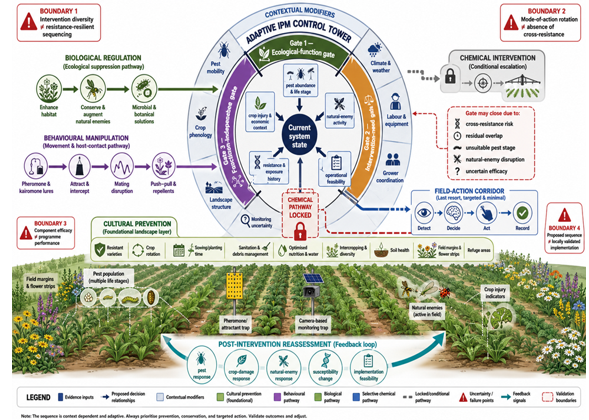
The proposed design begins with four state inputs: pest pressure and life stage, crop injury and economic context, natural-enemy function, and resistance or exposure history. Preventive cultural measures form the first layer; surveillance then determines whether biological or behavioural suppression has suitable preconditions. Chemical intervention is considered only after ecological control and threshold states are assessed. This ordering is supported by evidence that pesticides may add little pest suppression where effective natural enemies are already operating, while potentially disrupting those enemies [25]. Figure 1 presents the sequencing logic of chemical, biological, behavioural, and cultural intervention portfolios within the analytical logic developed in this section.
|
|
|
Figure 1. The sequencing logic of chemical, biological, behavioural, and cultural intervention portfolios |
Alt text
A structured conceptual diagram that presents the sequencing logic of chemical, biological, behavioural, and cultural intervention portfolios, with labelled components, directional relations, contextual modifiers, uncertainty points, and a clear boundary between observed evidence and proposed synthesis.
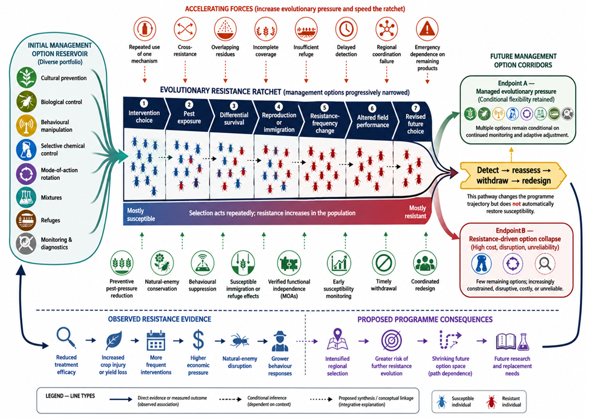
Chemical escalation passes through compatibility and functional-independence gates. Selective technologies may preserve natural-enemy functions more effectively than broad-spectrum alternatives, but they retain their own resistance-management requirements [26]. Habitat interventions such as flower strips and hedgerows enter as preventive infrastructure because their effects on pest control and crop outcomes vary with landscape, design, and ecological context [27]. After any intervention, pest density, damage, natural enemies, susceptibility, and operational feasibility are reassessed. Resistance can narrow the future option set by removing effective compounds, increasing reliance on remaining mechanisms, and intensifying selection on those mechanisms. Figure 2 shows the feedback pathways through which resistance alters future management options within the analytical logic developed in this section.
|
|
|
Figure 2. The feedback pathways through which resistance alters future management options |
Alt text
A structured conceptual diagram that shows the feedback pathways through which resistance alters future management options, with labelled components, directional relations, contextual modifiers, uncertainty points, and a clear boundary between observed evidence and proposed synthesis.
The resulting logic is a closed loop rather than a fixed ladder. Diversification can provide a preventive base and support several ecosystem services without necessarily reducing yield on average, but aggregate benefits do not validate a particular local intervention order [28]. Every component therefore requires an input condition, intended function, stop rule, failure indicator, and validation endpoint. Intervention diversity is not equivalent to resistance-resilient sequencing; component efficacy is not equivalent to programme performance; and the proposed sequence is not equivalent to locally validated implementation. The proposed components, evidence bases, boundary conditions, failure modes, and validation requirements are organized in Table 3.
Table 3. Proposed Resistance-Resilient IPM Design Logic: Components, Evidence Basis, Relations, Boundary Conditions, Failure Modes, and Validation Requirements
|
Proposed component |
Purpose |
Evidence basis |
Relation or mechanism |
Input or precondition |
Expected output |
Boundary condition or failure mode |
Validation requirement |
|
Baseline state characterization |
Establish the programme’s biological starting point |
Evolutionary and programme-level resistance evidence |
Defines pest, exposure, susceptibility, and natural-enemy states |
Reliable baseline sampling and exposure records |
Explicit initial decision state |
Incomplete histories or unrepresentative samples |
Repeated local diagnostics across relevant populations |
|
Preventive pressure-reduction layer |
Delay or reduce threshold crossing |
Crop and landscape diversification evidence |
Disrupts host continuity and supports ecological regulation |
Pest-specific agronomic and landscape fit |
Lower initial pest pressure |
Practice may not affect the target pest mechanism |
Multi-season agronomic, pest, and damage assessment |
|
Surveillance and uncertainty record |
Trigger interventions from observed states |
Monitoring and risk-prediction evidence |
Links documented observations to decision rules |
Defined effort, identification quality, and response time |
Traceable intervention trigger |
False precision, delayed detection, or unmeasured uncertainty |
Compare monitoring outputs with independent field observations |
|
Natural-enemy state gate |
Protect effective ecological mortality |
Biological-control synthesis |
Tests whether enemies are active before chemical escalation |
Adequate enemy abundance, synchrony, and residue compatibility |
Preserved biological suppression |
Climate mismatch, intraguild effects, or disruptive residues |
Measure enemy function and pest suppression together |
|
Behavioural-control gate |
Modify pest colonization or movement |
Push–pull and semiochemical evidence |
Redirects pests or concentrates them for targeted mortality |
Valid cues and spatial configuration |
Reduced crop contact or improved targeted control |
Attraction without retention or reduced damage |
Assess movement, abundance, damage, and persistence |
|
Selective chemical escalation |
Restore control when earlier layers are insufficient |
Threshold and selective-intervention evidence |
Applies chemical mortality at an explicit decision point |
Verified need, suitable pest stage, effective option |
Short-term suppression with reduced avoidable disruption |
Calendar application, poor timing, or broad ecological harm |
Compare threshold, damage, natural-enemy, and resistance outcomes |
|
Functional mode-of-action gate |
Prevent false assumptions of chemical diversity |
Cross-resistance and resistance-mechanism evidence |
Tests independence of candidate chemical options |
Current phenotypic and mechanistic susceptibility evidence |
Defensible rotation or mixture choice |
Shared metabolic or target-site resistance |
Local bioassays and diagnostic confirmation |
|
Conditional rotation or mixture branch |
Manage repeated chemical selection |
Evolutionary theory and mixture analysis |
Alternates or combines independently effective mechanisms |
Low resistance, adequate dose, and compatible persistence |
Reduced avoidable selection under stated assumptions |
Pre-existing resistance, unequal decay, or antagonism |
Longitudinal susceptibility and exposure tracking |
|
Post-intervention feedback |
Revise the next action from observed outcomes |
Monitoring and adaptive-management evidence |
Returns pest, damage, enemy, and susceptibility data to the decision process |
Timely reassessment and predefined response rules |
Stop, continue, escalate, withdraw, or redesign decision |
Monitoring that does not change decisions |
Evaluate whether feedback alters actions and outcomes |
|
End-of-cycle programme review |
Preserve future management options |
Programme and sociobiological evidence |
Examines cumulative exposure, failure, feasibility, and coordination |
Shared records and decision authority |
Revised next-cycle sequence |
Fragmented actors or unreported exposures |
Multi-season programme and implementation evaluation |
Practical trade-offs and implementation conditions
Biologically defensible strategies may be used for different reasons in operational practice. Evidence from Arizona cotton indicates that insecticide mixtures can be selected for pest-spectrum coverage, convenience, or immediate control rather than because the assumptions of resistance-management theory have been verified [29]. Programme documentation should therefore distinguish the operational purpose of a mixture from its proposed evolutionary function. The same distinction applies to rotations: changing products may solve logistical or efficacy problems without generating functionally independent selection.
Implementation also depends on institutions, communication, trust, product access, and coordination among growers, advisers, researchers, manufacturers, and public agencies. Embedding social science in resistance research can expose differences in incentives, risk perception, decision authority, and outreach effectiveness that biological optimization alone cannot resolve [30]. More ambitious reductions in pesticide dependence may require redesign of farming systems, markets, technologies, advisory structures, and research priorities rather than substitution of isolated field inputs [31]. These wider changes are relevant boundary conditions, not evidence that a particular resistance-resilient sequence has already been achieved.
Farm work imposes a final feasibility gate. A biologically preferred intervention may be unavailable during a narrow weather window, conflict with labour demands, require information that arrives too late, or depend on equipment and skills that are not locally accessible. Research on transitions toward sustainable cropping practices shows that farmers require work-related information about timing, organization, equipment, labour, and coordination, not only evidence of technical efficacy [32]. Validation should therefore compare complete candidate sequences over multiple seasons and assess pest suppression, crop damage, susceptibility, natural enemies, workload, cost, adherence, and regional coordination without collapsing these distinct outcomes into a single performance claim.
CONCLUSION
Resistance-resilient IPM is best understood as the deliberate design of changing exposure pathways rather than the accumulation of diverse interventions. Preventive cultural measures, biological regulation, behavioural manipulation, chemical timing, rotation, mixtures, and monitoring acquire resistance-management value only through their order, compatibility, biological preconditions, and feedback effects. Rotation cannot establish the absence of cross-resistance, and successful components cannot establish whole-programme durability. The strongest defensible synthesis is therefore a state-dependent, closed-loop programme in which interventions are triggered by documented pest, crop, natural-enemy, susceptibility, and feasibility conditions; chemical options pass functional-independence and compatibility gates; and every action changes the information used to select the next one. Its major boundary conditions are pest biology, landscape movement, diagnostic quality, ecological context, access to alternatives, labour, incentives, and regional coordination. The highest-priority research implication is prospective comparison of complete sequences under locally relevant, multi-season conditions while preserving separate measures of biological effectiveness, resistance trajectories, ecological effects, implementation fidelity, and operational feasibility.
ACKNOWLEDGMENTS: None
CONFLICT OF INTEREST: None
FINANCIAL SUPPORT: None
ETHICS STATEMENT: None