Entomology and
Applied Science Letters
Applied Science Letters
 2025
Volume 12
Issue 4
2025
Volume 12
Issue 4

Vector-control programmes increasingly operate under simultaneous pressures from insecticide resistance, behavioural avoidance, heterogeneous breeding habitats, changing transmission seasons, uneven household protection, and constrained implementation capacity. Although integrated vector management is intended to address this complexity, intervention packages are frequently described as integrated merely because they contain several components. This obscures the distinction between accumulating interventions and constructing a complementary portfolio. This article develops an original, explicitly non-validated conceptual logic for selecting and evaluating vector-control portfolios across larval, adult, household, environmental, biological, and community domains. The approach integrates evidence on intervention mechanisms, life-stage targets, human-exposure pathways, resistance, effective coverage, timing, operational dependencies, community participation, and programme evaluation. The synthesis indicates that portfolio performance depends less on component count than on whether interventions address distinct transmission opportunities, avoid unjustified duplication, remain active during relevant exposure periods, reach the populations and habitats that generate risk, and retain effectiveness under local resistance and implementation conditions. Evidence also demonstrates that favourable component efficacy cannot be assumed to produce programme effectiveness and that community participation does not ensure sustained or equitable implementation. Existing findings are constrained by heterogeneous endpoints, limited comparisons of marginal and joint effects, context-specific delivery systems, incomplete linkage between entomological and epidemiological outcomes, and insufficient evaluation of governance, durability, opportunity costs, and equity. The central implication is that integrated vector management should be designed and tested as an adaptive portfolio problem: each component requires an explicit function, precondition, failure mode, monitoring indicator, and rule for retention, modification, replacement, or removal. Prospective validation must determine when proposed complementarities produce additional protection and when apparent integration represents overlap, avoidable burden, or correlated failure.
INTRODUCTION
Vector control remains essential across many vector-borne disease elimination pathways, but effective programmes require locally appropriate combinations rather than a universal tool [1]. This requirement arises because vector-borne transmission is produced through interacting biological and operational processes: vectors develop in different habitats, survive and disperse under changing environmental conditions, contact hosts at different times and locations, and respond unevenly to chemical, structural, ecological, and biological interventions. Integrated Aedes management is therefore best understood as a locally adapted package linking surveillance, vector-control methods, community mobilisation, and programme capacity [2]. The practical problem is not simply which interventions are available, but how their functions, limitations, and delivery requirements should be combined under a specific transmission system.
The expanding vector-control toolbox makes this decision problem more important rather than less complex. Alternative arbovirus-control approaches broaden the mechanism set available to programmes, although many still lack direct epidemiological-effect evidence [3]. Larvicides, habitat modification, adulticides, insecticide-treated materials, structural housing improvements, spatial repellents, population replacement, reproductive suppression, and community-led environmental action intervene at different positions in the vector–pathogen–host system. Their presence within one programme does not establish that they are complementary. Components may address distinct pathways, duplicate the same protected population or exposure period, depend on the same operational infrastructure, or fail simultaneously when resistance, poor coverage, behavioural avoidance, weak maintenance, or declining participation occurs.
The evidentiary gap is consequently relational. Most studies evaluate a component, product, or defined package, whereas programme decisions require evidence about marginal contribution, interaction, timing, effective coverage, durability, and common failure modes. Cluster-randomised evidence indicates that intervention effects vary by component and endpoint, with community mobilisation showing more consistent reductions in Aedes indices than many chemical approaches [4]. Yet an entomological reduction does not necessarily demonstrate a reduction in infection or disease, and an effect obtained under a specified trial system cannot be assumed to persist under routine programme constraints. Similarly, absence of a detectable programme effect may reflect biological insufficiency, weak implementation, inappropriate timing, low statistical power, pathway mismatch, or an intervention added to an already effective component.
This article argues that integrated vector management should be treated as a portfolio-selection and portfolio-governance problem. A complementary portfolio is defined here as a deliberately selected set of interventions whose functions jointly address locally important transmission opportunities while accounting for resistance, temporal alignment, effective coverage, implementation capacity, acceptability, equity, and opportunity cost. This definition preserves four essential distinctions: more interventions are not equivalent to complementarity; coverage overlap is not equivalent to functional redundancy; component efficacy is not equivalent to programme effectiveness; and participation is not equivalent to sustained and equitable implementation. The article first examines why single-intervention control is fragile, then compares life-stage, household, environmental, biological, and community functions before developing a proposed, non-validated portfolio logic and its evaluation implications.
Why single-intervention vector control is fragile
Single-intervention control is fragile when programme performance depends heavily on one mechanism, one exposure window, one operational system, or one assumption about vector behaviour. Widespread and heterogeneous insecticide resistance in Aedes populations makes repeated dependence on a single chemical mode of action biologically fragile [5]. Resistance can reduce mortality, shorten the useful life of a product class, and increase dependence on correct dosing, formulation, and coverage. Nevertheless, resistance should not be interpreted as a binary indicator of programme failure. Long-lasting insecticidal-net protection can persist despite measured resistance, but observational evidence does not establish that rising resistance is operationally inconsequential [6]. The relevant decision question is therefore not whether resistance exists, but whether it materially weakens the intervention function under the local vector population, product, exposure pattern, and programme conditions.
Fragility also results when the intervention does not intercept the dominant human-exposure pathway. Outdoor, early, and otherwise unprotected biting creates residual exposure that indoor night-time tools cannot fully intercept [7]. Such behavioural escape may reflect species composition, local ecology, human activity, intervention-induced selection, or pre-existing biting patterns. A programme may therefore achieve high ownership or nominal coverage while leaving important times, places, or populations insufficiently protected. In a low-incidence Ethiopian setting, adding indoor residual spraying to long-lasting insecticidal nets did not produce sufficient evidence of elimination, illustrating that high nominal coverage does not guarantee programme sufficiency [8]. This result does not establish that either intervention lacks value; it shows that elimination cannot be inferred from component availability or overlapping indoor coverage alone.
Combining interventions does not automatically correct these weaknesses. Components may be complementary when they close different transmission gaps, but they may also duplicate the same mortality pathway, protected population, indoor location, or operational dependency. A factorial trial found benefits from piperonyl-butoxide nets but no simple additive effect of combining indoor residual spraying and nets, providing context-specific evidence compatible with functional redundancy [9]. Alternative explanations include insufficient incremental coverage, product-specific interaction, background protection, implementation differences, or limited power to detect a marginal effect. Functional redundancy should therefore be reserved for circumstances in which components provide deliberate backup against a defined failure, whereas simple overlap describes co-coverage without demonstrated additional function. The evidence dimensions and interpretive boundaries for single-intervention vector control is fragile are summarized in Table 1.
Table 1. Why Single-Intervention Vector Control Is Fragile: Vector Systems, Biological Mechanisms, Exposure Pathways, Evidence Requirements, Uncertainty, and Interpretive Boundaries
|
Vector or transmission domain |
Environmental or operational driver |
Biological mechanism |
Human-exposure pathway |
Evidence required |
Context dependency |
Uncertainty |
Interpretive boundary |
Representative supporting reference(s) |
|
Chemical adult control |
Repeated use of a limited insecticide class |
Selection and spread of resistance mechanisms that reduce mosquito mortality |
Continued survival and subsequent host contact |
Standardised susceptibility evidence linked to product performance, coverage, and epidemiological outcomes |
Species, resistance mechanism, formulation, dose, and use history |
Resistance phenotype may not predict the magnitude of operational loss |
Detected resistance is not automatically equivalent to programme failure |
[5] |
|
Insecticide-treated household protection |
Product use under established resistance |
Residual toxicity, physical barrier effects, deterrence, and personal protection may persist unequally |
Exposure during sleeping hours inside protected structures |
Prospective resistance, use, durability, entomological, and infection data |
Net condition, adherence, vector behaviour, housing, and resistance intensity |
Observed protection may be influenced by unmeasured programme or household factors |
Persisting protection does not prove that resistance is operationally inconsequential |
[6] |
|
Indoor night-time intervention systems |
Outdoor, early-evening, or otherwise unprotected biting |
Behavioural exposure occurs outside the time or location intercepted by indoor tools |
Outdoor activity, evening contact, unprotected household members, or non-sleeping exposure |
Time- and location-specific biting and human-behaviour measurements linked to infection risk |
Vector species, season, livelihood, housing, and human movement |
Modelled residual exposure may differ from locally measured exposure |
Modelled exposure opportunity is not a measured programme effect |
[7] |
|
High-coverage indoor packages |
Low transmission, residual foci, importation, or incomplete pathway interception |
Remaining transmission persists despite nominal indoor protection |
Residual household or community exposure not eliminated by covered tools |
Cluster-level epidemiological follow-up, implementation fidelity, and exposure-pathway analysis |
Baseline incidence, intervention quality, mobility, and local ecology |
Failure to eliminate may have several biological or operational explanations |
High nominal coverage does not guarantee elimination or programme sufficiency |
[8] |
|
Combined indoor adult interventions |
Co-delivery of nets and indoor residual spraying |
Components may share mortality pathways or protect substantially overlapping populations |
Indoor exposure among already protected households |
Factorial or otherwise interaction-sensitive designs estimating marginal and joint effects |
Product combination, resistance profile, baseline protection, and delivery quality |
A non-additive effect may reflect redundancy, implementation, or limited precision |
Coverage overlap is not equivalent to functional redundancy |
[9] |
|
Multi-component vector management |
Addition of tools without an explicit function map |
Components may target different pathways, duplicate existing functions, or share failure modes |
Multiple household and community exposure pathways |
Mechanistic mapping plus comparative programme evaluation |
Surveillance capacity, governance, financing, ecology, and local acceptability |
Programme labels may conceal poorly integrated delivery |
More interventions are not equivalent to a complementary portfolio |
[2] |
|
Alternative and emerging technologies |
Uneven evidence maturity and specialised delivery requirements |
Population suppression, replacement, repellency, or altered vector competence |
Contact or transmission may be reduced through different mechanisms |
Product-specific entomological, epidemiological, ecological, and implementation evidence |
Technology, vector species, release system, acceptance, and regulation |
Mechanistic promise may exceed field-effect evidence |
Biological plausibility is not equivalent to programme effectiveness |
[3] |
|
Community and environmental packages |
Variable participation, maintenance, and implementation intensity |
Source removal, habitat management, and behaviour change may reduce vector production |
Household and neighbourhood exposure |
Cluster studies with implementation, entomological, epidemiological, and equity outcomes |
Local institutions, resources, trust, infrastructure, and habitat ecology |
Entomological improvements may not persist or reduce disease |
Participation or activity is not equivalent to sustained and equitable implementation |
[4] |
Larval and adult mosquito interventions
Larval and adult interventions act at different positions in the mosquito life cycle and should be compared by function rather than treated as interchangeable control categories. Bacterial larvicides can reduce malaria vectors where habitats are findable and repeatedly treatable, but operational feasibility and retreatment requirements constrain transferability [10]. Their portfolio value is strongest where productive aquatic habitats can be identified with sufficient completeness, accessed at the necessary frequency, and treated before adult emergence. Large-scale Bacillus thuringiensis israelensis larval-source management reduced adult mosquito abundance in rural Burkina Faso, although the trial did not directly establish a human disease effect [11]. This distinction is critical: a reduction in larvae or adult density supports the relevant biological mechanism, but transmission effects additionally depend on adult immigration, biting behaviour, vector competence, human exposure, baseline transmission, and the contribution of untreated habitats.
Environmental modification and manipulation extend larval control beyond repeated larvicide application, but their feasibility and effect are similarly context-dependent. Evidence for aquatic habitat modification and manipulation remains heterogeneous and often low certainty, so environmental control should not be treated as universally effective [12]. Permanent drainage, filling, water-management changes, container management, and habitat manipulation differ in reversibility, maintenance burden, ecological consequence, responsible actor, and scale. A larval component is therefore complementary only when it addresses a meaningful source of adult production not already controlled by other measures and when its habitat denominator, treatment coverage, timing, and maintenance obligations can be monitored. Where breeding sites are cryptic, numerous, transient, privately controlled, or rapidly replenished, resources assigned to larval control may produce less additional protection than strengthening an adult or household function.
Adult interventions include population-killing tools and contact-protection tools, and their portfolio roles should remain analytically separate. Dual-active-ingredient nets improved malaria protection relative to pyrethroid-only nets in a high-resistance setting, but product efficacy does not by itself resolve deployment, cost, and durability questions [13]. The Uganda campaign-embedded trial similarly showed stronger short-term parasite-prevalence reduction with piperonyl-butoxide nets than conventional nets, with effects conditional on resistance ecology and operational coverage [14]. These findings support resistance-responsive product selection, not a general claim that one enhanced product will perform uniformly across settings. Adult tools must be matched to actual biting time, location, host preference, resistance profile, product decay, household use, and procurement capacity. Adding larval control may be complementary where local adult production remains important; adding another indoor adulticide may instead create overlap or deliberate redundancy. The classification depends on the pathway closed and the marginal function provided, not on the number of components delivered.
Household protection and environmental management
Household protection changes the probability that a mosquito enters a structure, reaches a person, or completes a bite, whereas environmental management attempts to alter the ecological production or local distribution of vectors. Across multi-country survey data, improved housing was associated with lower malaria infection risk, but residual confounding limits causal interpretation [15]. Housing quality is correlated with wealth, location, access to services, intervention use, construction materials, household behaviour, and environmental conditions, any of which may contribute to observed differences. A household-randomised Gambian trial did not show additional clinical protection from improved housing under the prevailing intervention context, demonstrating that observational association and programme effect are not interchangeable [16]. The contrast does not invalidate housing as a potential protective function; it indicates that structural modification must be evaluated within existing protection, local house design, vector entry behaviour, user practices, durability, and achievable implementation quality.
Household protection can also operate through repellency rather than structural exclusion or insecticidal mortality. A spatial repellent reduced Aedes-borne virus infection in Iquitos, supporting a household-level contact-interruption function whose transferability depends on local exposure patterns [17]. Such a component may be valuable where biting occurs indoors but is insufficiently intercepted by conventional tools, where users cannot maintain continuous physical barriers, or where rapid deployment is needed. Its portfolio role nevertheless differs from population suppression: mosquitoes may remain present, exposure may shift spatially or temporally, adherence may vary, and protection may be concentrated among households able to obtain or correctly use the product. Effective coverage must therefore incorporate presence, placement, duration, correct use, household occupancy, and the proportion of epidemiologically relevant exposure actually intercepted rather than relying only on the number of units distributed.
Environmental management addresses breeding opportunities and wider ecological conditions, but evidence varies with the intervention, habitat, setting, and endpoint. Environmental dengue-control studies show variable and generally limited evidence, requiring explicit specification of habitat, implementation intensity, and outcome [18]. Source reduction may fail when productive habitats are not correctly identified, removed containers are rapidly replaced, responsibility is dispersed across households and municipal authorities, or participation declines after intensive campaigns. Conversely, well-targeted environmental management may provide a distinct larval-production function that household repellents and adulticides do not supply. Integration therefore requires a clear allocation of responsibility across household, community, and municipal levels; longitudinal maintenance rather than one-time activity counts; and linked measurement of habitat change, vector abundance, human contact, infection, implementation burden, and equity. Household protection and environmental management are potentially complementary because they act on different pathways, but their co-presence does not demonstrate complementarity unless each produces a defensible marginal contribution under the local transmission system.
Biological control and community participation
Biological control can contribute a function that is distinct from conventional larval or adult insecticidal control. Wolbachia-infected mosquito deployment reduced virologically confirmed dengue in Yogyakarta, providing unusually direct epidemiological evidence for a biological intervention that reduces vector competence rather than primarily reducing human–mosquito contact [19]. Its inclusion in a portfolio nevertheless depends on successful establishment, ecological suitability, production quality, surveillance, community acceptance, and long-term programme capacity. Establishment in one setting is not evidence of universal transferability, and epidemiological efficacy under a controlled deployment system is not equivalent to routine programme effectiveness.
Population suppression offers another biological pathway. Combined incompatible and sterile insect techniques achieved strong local Aedes suppression, but specialised production, sex separation, release, and monitoring requirements constrain routine programme use [20]. Community-driven multi-component control in Cambodia also reduced entomological indices, although these outcomes did not establish sustained disease reduction or equitable implementation [21]. These examples illustrate different relations between technical and social components. Biological production or release systems may depend on community access and acceptance, while community-led source management may depend on municipal infrastructure, reliable supplies, and institutional support. Neither relation should be represented as automatically synergistic.
Community participation is therefore an enabling and governance component rather than a universally effective intervention in itself. Participation approaches in the Torres Strait were shaped by regulation, resources, relationships, and local beliefs, showing that visible community activity cannot be equated with durable inclusion or shared decision authority [22]. A proposed portfolio should specify who participates, what responsibilities are transferred, what resources are supplied, whose knowledge influences decisions, how burdens and benefits are distributed, and how participation will be maintained. Validation must assess durability, equity, acceptability, implementation fidelity, ecological outcomes, human exposure, and disease outcomes rather than relying on attendance, campaign activity, or short-term entomological improvement alone.
Complementarity, redundancy, and timing
Complementarity exists when components address different but epidemiologically relevant transmission or implementation gaps. Singapore’s dengue programme illustrates the coordinated use of environmental management, surveillance, enforcement, community action, and technological innovation, although its institutional and resource context substantially limits transferability [23]. The example supports a functional interpretation of integration: environmental action can reduce breeding opportunities, surveillance can locate changing risk, enforcement can support compliance, and community participation can sustain household-level action. It does not establish that the same configuration will perform similarly where governance capacity, housing, vector ecology, financing, or public trust differ.
Redundancy is distinct from complementarity. Deliberate redundancy provides backup against a specified failure, whereas simple overlap places multiple interventions over similar populations, spaces, times, or biological pathways without a demonstrated additional function. The indoor residual-spraying interval preferred for malaria control depends on intervention decay and local incidence dynamics rather than a fixed calendar schedule [24]. Reactive targeted spraying was non-inferior and less costly than blanket spraying in a low-transmission South African setting, but its performance depended on surveillance and response capacity [25]. These findings show that timing and targeting can change the function of an otherwise familiar intervention without changing its biological mode of action.
Portfolio relations must consequently be evaluated dynamically. A component may be complementary during one season, redundant after another intervention reaches high effective coverage, or insufficient when resistance or biting behaviour changes. Data-informed modelling indicates that preferred malaria-control packages vary with epidemiology, entomology, product characteristics, and budget [26]. Such models can clarify assumptions, identify potentially valuable combinations, and compare scenarios, but they do not validate universal portfolios. Empirical progress requires interaction-sensitive trials, repeated measurement of intervention decay and effective coverage, and designs capable of distinguishing incremental benefit from background protection, implementation variation, temporal mismatch, and opportunity cost.
Proposed vector-control portfolio logic
The proposed portfolio logic begins with a locally defined transmission problem rather than a predetermined list of tools. Larviciding models show that effective coverage, application frequency, duration, and seasonality materially alter expected impact [27]. Accordingly, the first decision stage should map productive habitats, adult survival, biting time and location, human behaviour, household protection, pathogen transmission, resistance, implementation capacity, community conditions, and existing interventions. Each candidate component should then be assigned an explicit function: immature-stage suppression, adult mortality, contact interruption, environmental prevention, biological replacement or suppression, implementation enablement, surveillance, or adaptive governance.
The second stage tests whether candidate components are complementary, deliberately redundant, merely overlapping, or operationally interfering. Greater Mekong modelling indicates that locally dominant vector bionomics and intervention characteristics determine which control functions are likely to matter [28]. Expanded control toolboxes may help address residual and behaviourally evasive transmission, but new products require efficacy, effectiveness, and operational evaluation before portfolio inclusion [29]. Integrated vector management further requires evidence-based local decision-making, coordination of chemical and non-chemical methods, surveillance, and programme capacity [30]. A component should therefore enter the portfolio only when its target pathway, preconditions, expected marginal contribution, uncertainties, costs, and failure modes are explicit.
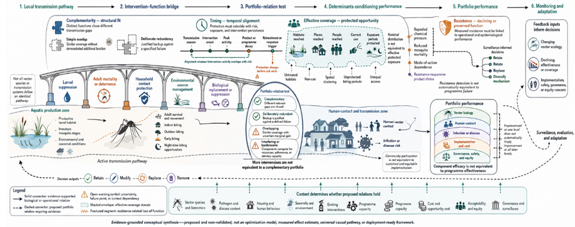
Figure 1 shows how intervention complementarity, timing, coverage, and resistance considerations determine portfolio performance within the analytical logic developed in this section.
|
|
|
Figure 1. How intervention complementarity, timing, coverage, and resistance considerations determine portfolio performance |
Alt text
A structured conceptual diagram that shows how intervention complementarity, timing, coverage, and resistance considerations determine portfolio performance, with labelled components, directional relations, contextual modifiers, uncertainty points, and a clear boundary between observed evidence and proposed synthesis.
The third stage aligns timing and effective coverage before establishing rules for monitoring and adaptation. Nominal distribution should be replaced by measurement of the proportion of relevant habitats, mosquitoes, households, people, locations, and exposure periods that actually receive the intended function. Resistance, intervention decay, behavioural change, ecological disruption, declining participation, or excessive burden should trigger reassessment. Components should be retained, modified, replaced, or removed according to predefined evidence rather than preserved because they are familiar or institutionally entrenched.
Programme design and evaluation implications
The first priority is to evaluate portfolios across linked biological, epidemiological, operational, economic, governance, safety, and equity domains. A One Health monitoring-and-evaluation approach broadens assessment beyond vector reduction to environmental, animal, human-health, governance, and implementation dimensions, but the proposed structure requires prospective validation [31]. Progress would be demonstrated by evaluations that connect component delivery to vector biology, human contact, infection or disease, cost, implementation fidelity, acceptability, distribution of benefit and burden, and adaptation decisions. Portfolio-level evaluation should estimate both individual component effects and marginal joint effects rather than treating the package as an indivisible exposure.
The second priority is to strengthen surveillance as a decision function rather than a descriptive programme activity. Drone platforms can extend habitat mapping, surveillance, and intervention reach, while permissions, cost, safety, privacy, and community acceptance remain important constraints [32]. Molecular surveillance can also guide spatially targeted outbreak response, although observational response reports cannot isolate the causal effect of each control action [33]. Evidence of progress would include prospective comparisons showing that surveillance information changes intervention selection, timing, targeting, or withdrawal and produces better epidemiological or operational outcomes than less adaptive decision systems. Surveillance value should not be inferred merely from increased data volume or spatial resolution.
The third priority is to retain null and contradictory programme evidence within portfolio development. A cluster-randomised Malaysian trial found no statistically significant reduction in overall dengue incidence from a proactive multi-component integrated vector-management package, underlining that component plausibility and entomological activity do not guarantee programme effectiveness [34]. Such findings should prompt analysis of pathway coverage, implementation fidelity, timing, baseline transmission, mobility, interaction among components, endpoint sensitivity, and statistical precision rather than automatic rejection or uncritical defence of the package. Future studies should predefine component functions, hypothesised interactions, adaptation rules, implementation indicators, and criteria for component removal. The highest-value evidence will show when a portfolio adds protection beyond its strongest component and when apparent integration produces redundancy, burden, inequity, or no measurable programme gain.
CONCLUSION
Integrated vector management is a portfolio problem because vector-control performance depends on relations among intervention functions, not on the number of tools assembled. A defensible portfolio must identify the locally important transmission opportunities, assign each component an explicit biological or implementation function, distinguish complementarity from overlap and deliberate redundancy, align intervention timing with risk and decay, measure effective rather than nominal coverage, and adapt to resistance, behavioural change, ecological conditions, implementation capacity, community legitimacy, cost, safety, and equity. The strongest synthesis is that larval, adult, household, environmental, biological, and community components can contribute distinct functions, but no component or combination is universally sufficient. Component efficacy does not establish programme effectiveness, and participation does not establish sustained or equitable implementation. The proposed logic is therefore a scholarly structure for transparent selection, testing, monitoring, and adaptation, not a validated framework or deployment-ready algorithm. Its highest-priority requirement is prospective evaluation capable of estimating marginal and joint effects while identifying the biological, temporal, spatial, operational, and governance conditions under which a portfolio adds meaningful protection.
ACKNOWLEDGMENTS: None
CONFLICT OF INTEREST: None
FINANCIAL SUPPORT: None
ETHICS STATEMENT: None