Entomology and
Applied Science Letters
Applied Science Letters
 2025
Volume 12
Issue 1
2025
Volume 12
Issue 1

Arthropod-borne infections are being reshaped by climatic warming, altered rainfall, accelerating urban growth, land conversion, biological invasion, and intensified movement of people and goods. Yet environmental suitability, vector establishment, human exposure, and realised transmission are frequently collapsed into a single narrative of expanding disease risk. This original critical review examines how environmental change redistributes arthropod vectors and modifies seasonality, vectorial capacity, and human–vector contact. It integrates evidence on temperature-dependent mosquito traits, projected and observed range change, urban host preference, deforestation-associated community reorganisation, and the surveillance systems used to detect emerging transmission frontiers. The synthesis identifies three recurring conclusions. First, climatic effects are nonlinear: warming may lengthen transmission windows or enable establishment in cooler regions while reducing suitability where thermal limits are exceeded. Second, urbanisation and land conversion act through specific pathways—including water storage, habitat fragmentation, host availability, mobility, and behavioural adaptation—rather than as uniform exposures. Third, modelled suitability and observed vector presence are necessary but insufficient indicators of disease emergence because pathogen introduction, immunity, control, and surveillance effort remain decisive. The review therefore proposes an evidence chain that separates environmental drivers, vector mechanisms, contact processes, and epidemiological outcomes. Its principal limitation is the heterogeneity of vector–pathogen systems, spatial scales, model structures, and observation quality. Climate-responsive medical entomology should combine mechanistic studies with repeated field surveillance, microclimatic measurement, cross-scale validation, and explicit uncertainty communication. Such integration can improve anticipatory research and proportionate decision support, but it does not by itself establish causal completeness, ecological safety, or operational readiness.
INTRODUCTION
Arthropod vectors occupy the intersection of environmental change, pathogen ecology, animal reservoirs, and human behaviour. Their capacity to transmit infection depends not only on where they occur, but also on abundance, survival, host choice, biting activity, pathogen development, and the probability that susceptible hosts are encountered. Recent scholarship consequently treats changing vector-borne disease risk as a coupled ecological and social problem in which climatic pressures interact with land use, infrastructure, mobility, and control [1]. This framing corrects the simpler assumption that warming alone determines future disease distributions. Global change can alter aquatic breeding sites, vegetation, host communities, the movement of vectors and pathogens, and the conditions under which people are exposed; the direction and strength of those effects vary among mosquito, tick, pathogen, and geographic systems [2]. The central scientific problem is therefore not whether the world is changing, but which pathways connect particular environmental changes to vector redistribution and which observations are sufficient to support claims about disease emergence.
Climate change nevertheless remains a foundational concern because arthropods are ectotherms and many of the traits governing transmission respond strongly to temperature, rainfall, humidity, and season length. Warming can accelerate development, extend activity periods, or permit overwintering at higher latitudes and elevations, while heat or desiccation beyond physiological limits can reduce survival and competence. These opposing processes make prevention and control an enduring challenge rather than a problem with a globally uniform trajectory [3]. Broad syntheses similarly show that climatic signals are filtered through housing, water management, health-system capacity, immunity, and intervention, so projected hazard cannot be interpreted independently of exposure and vulnerability [4]. This distinction is especially important when maps of climatic suitability are communicated as maps of future cases. A location may become more favourable for a vector without receiving an introduction, supporting a persistent population, sustaining a competent pathogen cycle, or generating detectable human disease.
Mechanistic work provides a stronger basis for separating these stages. Temperature affects several components of vectorial capacity simultaneously, including biting frequency, adult mortality, development rate, fecundity, vector competence, and the extrinsic incubation period. Because each trait has its own response curve, their combination commonly produces a bounded, unimodal relationship between temperature and transmission potential rather than a monotonic increase [5]. Distributional change is also shaped by dispersal. The historical and projected spread of Aedes aegypti and Aedes albopictus reflects climatic opportunity interacting with trade, transport, urban connectivity, and human-assisted movement [6]. Thus, climate may determine whether an introduced population can persist, whereas transport networks influence whether propagules arrive. An analytically useful review must preserve this separation between suitability, arrival, establishment, abundance, contact, and transmission instead of treating range expansion as a single event.
The evidence base is substantial but methodologically fragmented. Laboratory studies isolate temperature-sensitive mechanisms; field surveillance records presence, abundance, or infection; ecological studies compare land-use gradients; and statistical or mechanistic models extrapolate risk across unsampled places and future scenarios. These designs operate at different scales and support different inferences. Global dengue projections, for example, estimate environmental suitability and population exposure but do not directly predict local outbreaks, which remain contingent on viral introduction, immunity, surveillance, and control [7]. This original critical review therefore evaluates what recent evidence establishes, contests, and leaves unresolved across four connected domains: vector redistribution under environmental change; climatic suitability, seasonality, and vectorial capacity; urban expansion, land conversion, and human–vector contact; and emerging transmission frontiers with surveillance blind spots. Its contribution is an evidence-chain interpretation that links mechanisms to observations while marking the points at which causal, spatial, or operational claims exceed the available support.
Environmental change and the redistribution of arthropod vectors
Redistribution is often described as poleward or elevational expansion, but this language obscures a more complex geography of gains, losses, seasonal shifts, and local discontinuities. Mechanistic estimates for Aedes-borne viruses indicate that warming may expand transmission suitability in temperate regions while making some already-warm areas less suitable when temperatures move beyond vector–pathogen optima [8]. The same asymmetry applies to vector development. A phenology model for Ae. aegypti suggests that climatic change can increase the number of possible life-cycle completions and accelerate invasion potential in environmentally permissive areas [9]. Neither result establishes that a population will arrive or persist. Establishment also depends on propagule pressure, larval habitat, adult refugia, diapause or overwintering capacity, and control. Redistribution should therefore be analysed as a sequence—introduction, establishment, spread, and persistence—with climate acting differently at each stage.
Temporal redistribution can be as important as geographic expansion. Yellow-fever transmission across Africa displays strong seasonal relationships with climate and environmental conditions, but observed incidence is also filtered through vaccination coverage, immunity, mobility, and reporting [10]. A longer climatically suitable season may increase the period during which transmission is possible without proportionally increasing cases. Conversely, short windows can still produce outbreaks when vector abundance, pathogen introduction, and susceptible hosts coincide. Ensemble distribution models for Ae. albopictus identify broad agreement that European suitability is extensive and increasing, while retaining local differences among modelling approaches [11]. Agreement across models strengthens confidence in a general spatial signal, yet it does not remove uncertainty arising from occurrence bias, predictor selection, dispersal assumptions, or urban microclimates. Model consensus is consequently evidence of convergence, not empirical confirmation of establishment at every predicted site.
Tick systems reinforce the need to integrate climate with hosts and habitat. Ecological niche projections for Ixodes ricinus indicate that climate change can shift potential geographic suitability [12]. However, ticks depend on host communities across life stages, suitable vegetation and humidity near the ground, and opportunities for dispersal by wildlife or livestock. Coarse climatic surfaces may therefore misclassify local habitat, especially where canopy cover, snow, soil moisture, or land management creates microclimates that diverge from regional averages. The pathogen dimension adds another layer: vector presence does not ensure infection prevalence, competent reservoirs, or human exposure. For ticks as for mosquitoes, the most defensible interpretation of a projected range is conditional ecological opportunity. Claims about disease risk require corroborating data on establishment, density, host use, pathogen circulation, and contact.
Observed range change is essential for testing projections, but observation itself is structured by surveillance. Repeated sampling in Ontario documented rapid northward expansion of Ixodes scapularis over a relatively short interval [13]. Such longitudinal evidence is stronger than isolated occurrence records because it can distinguish persistent populations from incidental introductions. It still cannot attribute change to climate alone: host movement, habitat alteration, observer effort, and detection probability may contribute. A critical interpretation therefore asks whether sampling protocols were stable, whether absences reflect genuine effort, and whether the same life stages were detected repeatedly. The convergence of mechanistic plausibility, projected suitability, and standardised field evidence supports inference about redistribution more strongly than any component alone. Even then, attribution should remain proportionate to study design, and regional findings should not be universalised across vectors with different thermal biology, dispersal pathways, and host dependencies.
Climate suitability, seasonality, and vectorial capacity
Temperature is the most intensively modelled climatic determinant of mosquito-borne transmission, but its role is frequently overstated when a single thermal index is used as a proxy for risk. Mechanistic models of Zika, dengue, and chikungunya show that transmission potential is bounded by lower and upper thermal limits and peaks at intermediate temperatures that differ among vector–pathogen combinations [14]. These curves arise from the multiplication of traits rather than from one dominant response. Laboratory and modelling work on Zika virus further demonstrates that temperature can alter mosquito infection, viral processes, survival, and other contributors to transmission, producing a defined optimum under the conditions studied [15]. The implication is not that a universal optimum can be transferred to every population. Colony history, larval environment, fluctuating temperatures, nutrition, and local adaptation may shift trait responses, while field abundance and contact may dominate realised outcomes.
Comparative evidence nevertheless reveals useful regularities. Transmission models for West Nile virus and several other temperate mosquito-borne viruses locate peak thermal suitability within an intermediate range [16]. This convergence supports the general principle that modest warming can increase transmission potential below the optimum and decrease it beyond the upper limb. Yet shared thermal patterns do not make the systems interchangeable: vectors differ in feeding behaviour, overwintering, habitat use, and competence, and pathogens differ in their extrinsic incubation responses. Work on Ross River virus shows that temperature-dependent models can explain broad geographic and seasonal transmission patterns while leaving residual variation attributable to rainfall, hosts, immunity, and reporting [17]. Thermal suitability is therefore most informative when used to define conditional windows and generate testable expectations, not when treated as a complete forecast of incidence.
Seasonality emerges from the alignment of vector demography, pathogen development, host availability, and human behaviour. Annual mean temperature can conceal short heat events, cold constraints, and diurnal variability that alter survival or incubation. Rainfall is similarly non-monotonic: moderate precipitation may create habitat, drought may intensify household water storage, and extreme rainfall may flush larvae or disrupt sampling. Biological reviews of Ae. aegypti and Ae. albopictus document temperature effects across development, survival, fecundity, behaviour, and competence, with responses varying by species and life stage [18]. Vectorial capacity consequently changes through the season as both the number and quality of vectors change. Reliable interpretation requires time-resolved measurements of adult age structure, biting, infection, microclimate, and habitat productivity rather than reliance on a climatic average detached from mosquito biology.
Climate-response functions may also be non-stationary. Invasive Aedes populations can differ in thermal tolerance, diapause, acclimation, and local adaptation, creating variation that static species-wide curves do not capture [19]. Evolutionary change is not guaranteed to expand risk: adaptation may carry trade-offs, occur too slowly, or affect some traits more than others. Nonetheless, repeated exposure to new thermal regimes makes it unsafe to assume that current trait distributions remain fixed over long projection horizons. Stronger studies should compare populations across climatic origins, expose vectors to realistic fluctuations, and validate predictions against field abundance and infection. The interpretive structure required for such work is summarised in Table 1. Table 1 synthesises the evidence dimensions, mechanisms, boundary conditions, uncertainties, and interpretive requirements relevant to “Climate Suitability, Seasonality, and Vectorial Capacity.”
Table 1. Evidence Dimensions, Mechanisms, Boundary Conditions, and Interpretive Requirements for Climate Suitability, Seasonality, and Vectorial Capacity
|
Analytical domain |
Core question |
Evidence required |
Potential contribution |
Main limitation |
Boundary condition |
Manuscript role |
|
Thermal performance |
How do temperature-dependent traits combine to shape transmission potential? |
Trait-specific development, survival, biting, competence, and incubation measurements |
Identifies lower limits, optima, and upper limits |
Laboratory functions may not transfer directly to field settings |
Vector, pathogen, population, life stage, and thermal regime |
Establishes the nonlinear mechanistic basis of climate suitability |
|
Temperature variability |
Do daily fluctuations and extreme events change outcomes predicted from mean temperature? |
Experiments and field data using realistic diurnal and episodic exposure |
Reveals effects hidden by climate averages |
Exposure histories are difficult to standardise |
Acclimation, microhabitat use, and duration of exposure |
Tests the robustness of constant-temperature inference |
|
Rainfall and hydrology |
When does water availability create, maintain, or remove larval habitat? |
Precipitation, water-storage, container, flushing, and adult-emergence observations |
Connects climate to habitat productivity |
Rainfall has divergent effects across habitat types |
Infrastructure, drought responses, drainage, and container ecology |
Prevents monotonic rainfall–risk assumptions |
|
Seasonal alignment |
When do vector abundance, infectiousness, hosts, and human exposure coincide? |
High-frequency longitudinal entomological, climatic, host, and case data |
Defines conditional transmission windows |
Surveillance timing may miss short peaks |
Immunity, mobility, interventions, and reporting |
Distinguishes seasonal opportunity from realised outbreaks |
|
Vector competence and incubation |
How does climate affect infection, dissemination, and time to infectiousness? |
Vector–pathogen experiments across relevant temperatures and populations |
Links within-vector processes to transmission potential |
Colony and assay conditions can bias estimates |
Viral strain, mosquito genotype, microbiome, and age |
Clarifies why suitability differs among vector–pathogen pairs |
|
Abundance and age structure |
Does suitable weather produce enough long-lived, biting females? |
Repeated adult density, parity, survival, and biting measurements |
Connects individual traits to population-level capacity |
Trap counts are imperfect proxies for biting populations |
Trap type, habitat, season, and control pressure |
Marks the transition from trait suitability to entomological hazard |
|
Microclimate and behaviour |
Do vectors experience the climate represented by coarse environmental layers? |
Resting-site, breeding-site, indoor–outdoor, and activity-temperature data |
Improves local ecological realism |
Microclimates are costly to measure and map |
Housing, vegetation, shade, water storage, and behaviour |
Identifies scale mismatch in regional projections |
|
Plasticity and adaptation |
Will thermal responses shift under sustained environmental change? |
Multi-population, common-garden, genomic, longitudinal, and field validation |
Tests non-stationarity of trait-response curves |
Adaptive rate and trade-offs remain uncertain |
Gene flow, standing variation, fitness costs, and time horizon |
Defines an evolutionary boundary on long-range projections |
Urban expansion, land conversion, and human–vector contact
Urbanisation changes transmission not merely by concentrating people, but by reorganising vector habitat and host choice. Comparative work across African Ae. aegypti populations indicates that urbanisation and dry-season ecology are associated with stronger preference for human hosts [20]. This behavioural pathway matters because anthropophily can increase the proportion of bites taken from competent human hosts even when vector density is unchanged. Its interpretation should remain evolutionary and ecological rather than deterministic. Urban populations vary in ancestry, water access, vegetation, animal availability, and housing; a pattern detected across one regional gradient may not reproduce in another. The finding nevertheless demonstrates why abundance-only surveillance is incomplete. Risk assessment should include biting location, host preference, and the extent to which built environments bring vectors into repeated contact with the same human communities.
“Urban” is not a uniform exposure category. A synthesis of Aedes urbanisation studies identifies pathways involving unreliable piped water, household storage, discarded containers, drainage, waste management, construction, population density, and mobility [21]. These factors can produce sharply different habitats within the same city, and their effects may change between formal neighbourhoods, informal settlements, industrial zones, and peri-urban fringes. Bridging landscape ecology with urban science helps connect household breeding sites to neighbourhood connectivity, green space, hydrology, and human movement [22]. Such integration also makes inequality visible: households facing service deficits may bear greater exposure while having less capacity to implement control. Citywide climate layers or administrative case counts can conceal these fine-scale processes, so analyses should match spatial resolution to the mechanism and decision under consideration.
Land conversion can create bidirectional ecological and social feedbacks. In the Brazilian Amazon, longitudinal analysis found that deforestation increased malaria transmission while malaria burden subsequently reduced forest clearing in the analysed municipalities [23]. This result challenges one-way diagrams in which environmental disturbance simply produces disease. Forest removal changes edge habitat, standing water, labour migration, settlement, and contact with vectors, while disease can alter labour availability and economic activity. The causal interpretation is stronger than a cross-sectional association because the analysis addressed temporal direction, but its boundary conditions are substantial. The Amazonian malaria system, its vector species, settlement patterns, and land economy are distinctive. Extrapolation to other forests or pathogens requires evidence that the same mediating processes operate.
Across systems, forest conversion often favours disturbance-tolerant mosquitoes that exploit edges, sunlit pools, agricultural habitats, or human settlements, yet the effect on disease is not universally positive [24]. Conversion can reduce some vectors, shift host composition, change predator communities, or create habitats for different species. The relevant question is therefore which assemblage replaces the original one and how competent vectors, reservoirs, and humans are redistributed. Designs that compare only “forest” with “cleared” land risk missing the trajectory from extraction to agriculture, peri-urban settlement, and infrastructure development. They may also confuse local abundance with regional exposure if human activity changes simultaneously. Stronger evidence requires land-use histories, standardised mosquito sampling, host and pathogen measurements, and explicit evaluation of alternative explanations.
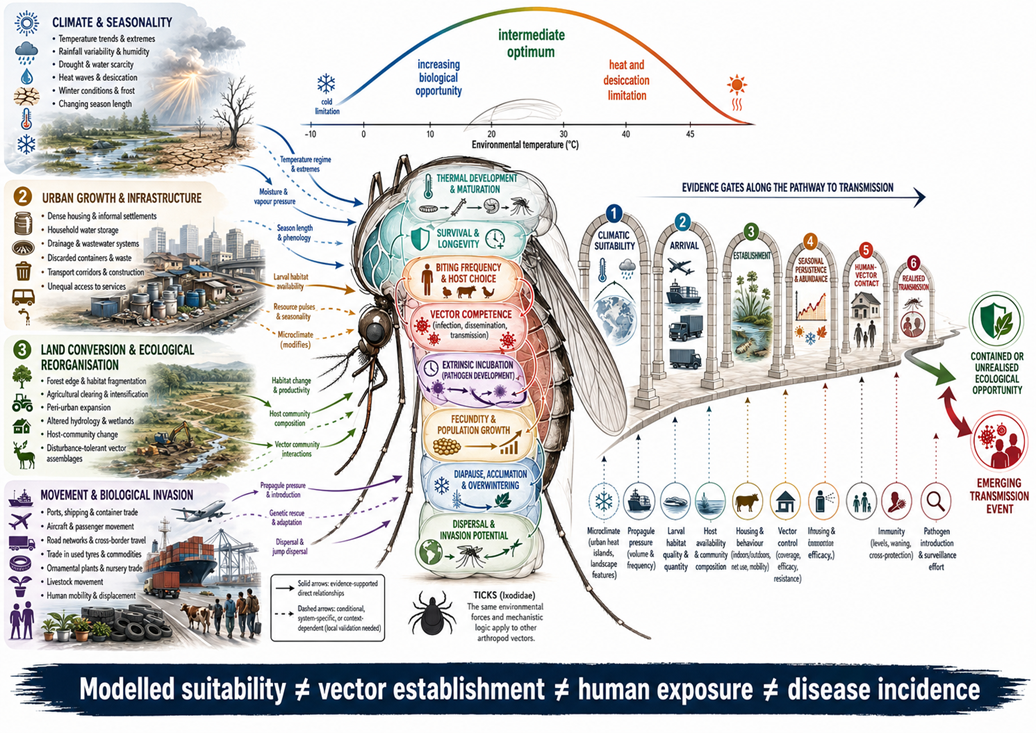
Community-level field evidence supports this pathway-based interpretation. Paired sampling across protected and human-disturbed water bodies in South Africa associated multiple anthropogenic pressures with mosquito communities increasingly dominated by known disease-vector species [25]. The study strengthens the inference that disturbance can reorganise assemblages, but it does not demonstrate that every pressure acted independently or that human infection increased. Vector dominance is an entomological warning signal whose epidemiological meaning depends on competence, abundance, host contact, and pathogen circulation. Urban growth and land conversion should thus be connected to disease risk through measured mediators rather than a direct causal arrow. Figure 1 presents a conceptual representation of how climate suitability, seasonality, urban growth, and land conversion redistribute arthropod vectors and alter vectorial capacity, while preserving the distinction between evidence-supported relationships, proposed relationships, uncertainty, and decision boundaries.
Figure 1 presents the environmental vector engine through which climatic change, urban growth, land conversion, and human-assisted movement alter vector biology and redistribution, while showing that suitability must pass through successive ecological and epidemiological gates before realised transmission can occur.
|
|
|
Figure 1. The Environmental Vector Engine: How a Changing World Creates—or Fails to Create—Transmission Opportunity |
Emerging transmission frontiers and surveillance blind spots
An emerging transmission frontier is not simply the outer edge of a climate-suitability map. It is a moving zone in which environmental opportunity, vector arrival, seasonal persistence, pathogen introduction, and human exposure may begin to overlap. Global modelling of chikungunya indicates that climate change can redistribute transmission suitability through regional gains, losses, and altered seasonal windows rather than universal expansion [26]. City-scale projections likewise suggest that future climates could permit Ae. aegypti infestation in some major European cities, but climatic permissiveness does not supply propagules, containers, overwintering refugia, or effective host contact [27]. Frontiers should therefore be described as conditional and potentially reversible. The scientifically relevant question is which stage of emergence is changing and what observation would distinguish a genuine transition from a modelled opportunity.
Population exposure estimates add decision relevance but can also amplify category errors. Mechanistic projections indicate that warming may place large additional populations within temperatures suitable for Zika transmission while reducing or shifting suitability elsewhere [28]. Such estimates describe the intersection of people and a thermal envelope, not infections that will necessarily occur. Demography, immunity, housing, mobility, vector control, viral introduction, and access to diagnosis remain unrepresented or incompletely represented. Reporting a single exposed-population total can additionally conceal seasonal duration, subnational inequality, and populations leaving suitable conditions. Transparent frontier assessment should separate hazard, exposure, vulnerability, and realised transmission, display gains and losses, and communicate how alternative climatic and demographic assumptions alter the result.
Surveillance determines whether a frontier is recognised, yet absence data are rarely equivalent to evidence of absence. VectorNet demonstrates how coordinated protocols, expert validation, and shared mapping can improve knowledge of mosquitoes, ticks, sand flies, and biting midges across Europe and surrounding regions [29]. Its value lies not only in accumulating presences but also in documenting sampling and credible absences. Nevertheless, coverage remains uneven across jurisdictions, habitats, seasons, and vector groups. Records can cluster near accessible sites or responding institutions, while range edges receive intermittent attention. A distribution map without effort metadata may therefore reproduce surveillance capacity more faithfully than vector ecology. Repeated, standardised presence–absence sampling and explicit detection models are required before apparent range stability or contraction is interpreted biologically.
Data aggregation can reveal neglected vector–pathogen associations while preserving the biases of its source material. A compiled dataset of mosquito-associated viruses and vectors in China illustrates the analytical value of georeferenced, taxonomically organised records for identifying spatial and knowledge gaps [30]. Literature-derived observations, however, inherit publication intensity, language restrictions, diagnostic change, duplicate reporting, uneven taxonomic expertise, and coarse geolocation. Molecular detection also has several meanings: viral sequence or antigen in a mosquito does not alone establish dissemination, transmissible infection, reservoir competence, or sustained circulation. Interoperable databases should retain provenance, assay type, collection method, life stage, location precision, and negative sampling. These fields permit users to distinguish an observation gap from an ecological gap and to evaluate whether records support presence, association, competence, or transmission.
Biological invasion further exposes the need for stage-specific surveillance. Global analyses show that disease-vector mosquitoes have spread through uneven transport and introduction pathways, with establishment and reporting varying strongly among regions [31]. Ports, airports, road corridors, used-tyre trade, ornamental plants, and human mobility may generate repeated arrivals, whereas climate, urban habitat, competition, and control influence persistence. A first detection is therefore neither proof of a resident population nor a negligible event. Surveillance should connect pathway monitoring to repeated local sampling, genomic or demographic inference where appropriate, pathogen testing, and rapid updating of distribution records. It should also record failed establishments and control effort, which are easily lost from presence-only datasets. Table 2 synthesises the evidence dimensions, mechanisms, boundary conditions, uncertainties, and interpretive requirements relevant to “Emerging Transmission Frontiers and Surveillance Blind Spots.”
Table 2. Evidence Dimensions, Mechanisms, Boundary Conditions, and Interpretive Requirements for Emerging Transmission Frontiers and Surveillance Blind Spots
|
Component or mechanism |
Biological or operational function |
Relevant scale |
Evidence indicator |
Uncertainty |
Failure risk |
Interpretive boundary |
|
Shifting climatic opportunity |
Alters the seasonal or geographic conditions under which vectors and pathogens could persist |
Region to global; seasonal to multidecadal |
Trait-informed suitability with gains, losses, and duration |
Scenario, parameter, adaptation, and microclimate uncertainty |
Treating a projected envelope as an inevitable frontier |
Suitability is conditional opportunity, not establishment or disease |
|
Introduction pressure |
Moves vectors or pathogens through travel, trade, transport, and animal movement |
Pathway, port, corridor, and settlement |
Interception records, travel or trade connectivity, repeated introductions |
Many arrivals are undetected and pathway data can be proprietary or incomplete |
Attributing establishment to climate without evidence of arrival |
Arrival does not establish persistence |
|
Establishment and seasonal persistence |
Converts introduction into a reproducing or overwintering population |
Household to city; generation to multiyear |
Repeated life stages, breeding evidence, overwintering, and stable occurrence |
Detection varies with season, trap, habitat, and control |
Classifying an incidental specimen as a resident population |
Repeated detection strengthens, but does not by itself prove, self-sustaining establishment |
|
Presence–absence surveillance |
Distinguishes detected occurrence from credibly sampled absence |
Site to continent; repeated survey cycles |
Standardised effort, negative records, detection probability, and quality assurance |
Sparse range-edge coverage and inconsistent protocols |
Mapping unsampled areas as absences |
Absence is interpretable only relative to documented effort and sensitivity |
|
Vector–pathogen detection |
Identifies associations requiring competence and circulation assessment |
Specimen to population and transmission system |
Assay type, infection location, vector competence, host and case linkage |
Contamination, incidental carriage, assay change, and taxonomic error |
Equating molecular detection with transmission |
Detection does not alone establish competence or sustained circulation |
|
Data integration and provenance |
Connects heterogeneous records while preserving how each was produced |
Dataset, jurisdiction, and network |
Versioned metadata, taxonomic validation, geolocation precision, and deduplication |
Publication, language, access, and reporting biases |
Increasing record volume without increasing inferential quality |
Aggregation cannot repair missing or systematically biased observation |
|
Early-warning interpretation |
Translates changing signals into proportionate investigation or preparedness |
Local decision system and forecast horizon |
Calibrated alerts, lead time, response protocol, and retrospective or prospective evaluation |
Thresholds and action capacity differ across settings |
Alarm fatigue, delayed response, or false reassurance |
Predictive skill is not equivalent to public-health utility or readiness |
Critical synthesis of evidence and methodological limitations
The reviewed evidence converges on a conditional conclusion: climatic and anthropogenic change redistribute opportunities for vectors and transmission, but estimated magnitude, timing, and location depend on model structure and endpoint. A multi-model, multi-scenario intercomparison of malaria and dengue projections found areas of directional agreement alongside substantial divergence among diseases, scenarios, and modelling approaches [32]. Agreement is informative when independent formulations recover similar large-scale patterns; disagreement identifies structural uncertainty that should remain visible. Neither resolves shared weaknesses in occurrence data, climate inputs, socioeconomic assumptions, or parameterisation. Ensemble means can obscure incompatible mechanisms and tails of risk. Critical synthesis should therefore report convergence, disagreement, and common dependence separately, relating each output to the question it can answer rather than treating consensus as validation.
Methodological plurality is valuable only when methods are matched to inferential purpose. Statistical models can represent observed associations and complex spatial structure efficiently, whereas mechanistic models can encode trait relationships and extrapolate beyond observed climates; both are limited by data quality, assumptions, and validation design [33]. Fine predictive discrimination within a historical dataset does not guarantee causal attribution or performance under novel climates. Conversely, mechanistic transparency does not ensure that the selected mechanisms are complete. Comparisons should use common endpoints, spatial supports, time horizons, and out-of-sample tests, while sensitivity analyses expose influential choices. Claims must also distinguish prediction, explanation, scenario exploration, and decision support, because these tasks impose different standards of calibration, transportability, and interpretability.
Early-warning systems illustrate the translation gap between analytical performance and practical value. Climate- and weather-informed warnings may create useful lead time when signals are reliable, locally validated, communicated clearly, and connected to feasible actions [34]. A dengue climate service developed for Machala showed how probabilistic seasonal information could be produced in a data-constrained city and interpreted with local knowledge [35]. Yet one city and season cannot establish transportability, sustained benefit, or equitable use. Prospective evaluation must examine calibration, timeliness, missed events, false alarms, user comprehension, response costs, and whether action changes outcomes. Co-production can improve relevance, but stakeholder participation does not itself prove effectiveness. Operational value emerges from the complete decision pathway, not forecast accuracy in isolation.
Non-stationarity adds a deeper limitation. Mosquito responses to warming can involve phenotypic plasticity, evolutionary adaptation, gene flow, and trade-offs that differ among traits and populations [36]. Models based on static thermal curves may consequently degrade as exposure histories and trait distributions change. The direction of change is not predictably beneficial to the vector: adaptation may be constrained, increase one fitness component while reducing another, or occur more slowly than environmental change. Longitudinal common-garden experiments, genomic sampling, field phenotyping, and realistic fluctuating exposures can test whether current response functions remain valid. Until such evidence accumulates, evolutionary change should be represented as a bounded source of uncertainty rather than invoked as a general correction to climate projections.
Temporal history and within-population heterogeneity also challenge models that assign one trait value to all vectors exposed to the same current environment. Phenotypically structured modelling of Ae. albopictus and dengue indicates that delayed environmental effects and variable phenotypes can improve representation of vector and outbreak dynamics in the analysed settings [37]. Improved fit, however, does not demonstrate that the represented mechanism is unique, complete, or transferable. It identifies a hypothesis for independent testing. Across the evidence base, the strongest inference comes from triangulating controlled mechanisms, repeated field observations, compatible epidemiological patterns, and explicit alternative explanations.
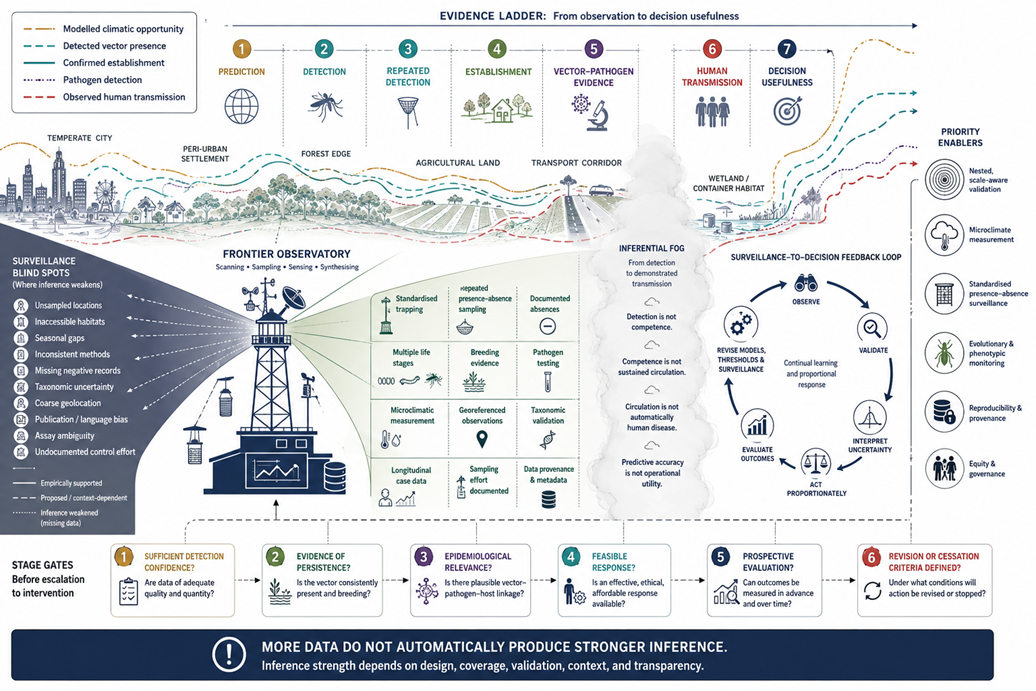
Figure 2 depicts the frontier observatory required to distinguish projected environmental opportunity from genuine transmission emergence, showing how surveillance blind spots, methodological uncertainty, and incomplete evidence can interrupt the progression from modelled suitability to proportionate public-health action.
|
|
|
Figure 2. The Frontier Observatory: Detecting Emerging Transmission Through the Fog of Surveillance |
Priorities for climate-responsive medical entomology
The first priority is conceptual discipline. Climatic suitability, vector presence, abundance, vector competence, vectorial capacity, human exposure, and disease incidence are related but non-equivalent constructs. Thermal biology can define plausible trait responses [5], while intercomparison can reveal how structural choices alter projected risk [32]; neither warrants collapsing intermediate endpoints into cases. Future studies should state a causal question, define the estimand and spatial support, and identify which links are measured, modelled, or assumed. Directed causal diagrams, negative controls, quasi-experimental contrasts, and prespecified alternative explanations can strengthen attribution where experimentation is impossible. This discipline would make disagreements interpretable and prevent the precision of an output from exceeding the precision of its underlying construct.
The second priority is nested, scale-aware validation. Household water storage, shade, vegetation, and behaviour can generate microclimates and contact patterns that regional climate surfaces miss, while global models remain useful for identifying broad shifts. City-level projections require local tests of introduction, habitat, and seasonal survival [27]. Surveillance networks require consistent effort metadata and repeated range-edge sampling if their maps are to support change detection [29]. Designs should link laboratory traits, microhabitat measurements, adult age structure, host use, pathogen testing, and cases across compatible time windows. External validation should deliberately cross seasons, populations, cities, and ecological regimes, reporting where performance fails. A model recalibrated at every new site may be useful locally, but it does not demonstrate transportability.
The third priority is to treat vector systems as dynamic ecological communities. Long-term monitoring should track distribution, phenology, behaviour, competence, insecticide susceptibility, and trait variation rather than presence alone. Evolutionary and plastic responses require repeated population sampling because static curves may become unreliable under sustained warming [36]. Environmental management and integrated vector control also require non-target assessment: disturbance can reorganise predators, competitors, hosts, and mosquito assemblages in ways that vector-only outcomes do not capture [25]. Before–after designs with matched controls, biodiversity indicators, and delayed follow-up can reveal indirect costs or compensatory responses. These requirements do not imply that every programme can measure every endpoint; they support a tiered design in which uncertainty and unmeasured ecological effects remain explicit.
The fourth priority is a surveillance-to-decision feedback architecture. Early-warning information should be co-designed around a defined action, lead time, resource constraint, and acceptable balance of missed events and false alarms [34]. Local climate-service experience shows the value of combining probabilistic forecasts with contextual knowledge while also underscoring the need for prospective evaluation across seasons and settings [35]. Feedback must update observations, model assumptions, thresholds, and response protocols after each decision cycle. Communication should present distributions, scenario disagreement, and unknowns in forms that communities and practitioners can use without implying certainty. Equity is part of validity: data gaps, service deficits, and unequal capacity to respond can concentrate both exposure and the burdens of surveillance or control.
The final priority is evidence-proportionate translation. Discovery, mechanistic testing, field validation, decision evaluation, ecological assessment, and governance review are distinct stages; success at one does not certify the next. Reproducible workflows should preserve data provenance, model versions, code, taxonomic decisions, negative observations, and sensitivity analyses. Independent prospective evaluation should use predeclared criteria for calibration, transportability, non-target effects, feasibility, and revision or cessation. These stage gates are not a claim that one universal pathway can govern every vector programme. They are a proposed safeguard against describing promising models or technologies as ready, safe, effective, or approved without corresponding evidence. Table 3 synthesises the evidence dimensions, mechanisms, boundary conditions, uncertainties, and interpretive requirements relevant to “Priorities for Climate-Responsive Medical Entomology.”
Table 3. Evidence Dimensions, Mechanisms, Boundary Conditions, and Interpretive Requirements for Priorities for Climate-Responsive Medical Entomology
|
Context or pathway |
Starting condition |
Mediating process |
Expected implication |
Alternative explanation |
Monitoring need |
Decision relevance |
|
Construct definition |
Suitability, hazard, exposure, capacity, and incidence are used inconsistently |
Explicit causal questions, estimands, endpoint dictionaries, and evidence-chain mapping |
More interpretable comparisons and fewer category errors |
Apparent disagreement may reflect endpoint choice rather than biology |
Audit definitions and assumptions through each analysis |
Determines what a result can legitimately inform |
|
Scale-aware validation |
Models and observations represent different spatial or temporal supports |
Nested sampling from microhabitat and household to city and region |
Identifies where broad models retain or lose local validity |
Recalibration may hide rather than solve poor transportability |
Out-of-site, out-of-season, and range-edge validation |
Sets geographic and temporal limits on use |
|
Standardised surveillance |
Presence records are abundant but effort and negative observations are incomplete |
Repeated protocols, detection modelling, taxonomy quality assurance, and provenance |
Stronger inference about introduction, establishment, spread, or contraction |
Increased detections may reflect increased effort |
Effort, sensitivity, negative records, and protocol changes |
Supports proportionate escalation of investigation or control |
|
Evolutionary and phenotypic change |
Trait-response functions are commonly treated as stationary |
Common-garden, genomic, field-phenotyping, and fluctuating-exposure studies |
Tests whether climate responses shift among populations and through time |
Short-term acclimation may be mistaken for adaptation |
Repeated trait distributions, gene flow, and fitness trade-offs |
Defines revision intervals for long-horizon projections |
|
Ecological and non-target assessment |
Vector-centred endpoints omit wider community responses |
Matched before–after community sampling and delayed follow-up |
Reveals indirect benefits, harms, or compensatory vector responses |
Concurrent land-use or weather change may drive community shifts |
Predators, competitors, hosts, pollinators, and biodiversity |
Prevents technical feasibility from being treated as ecological safety |
|
Early-warning co-design |
Forecasts may be skilful but disconnected from feasible action |
Decision thresholds, lead-time analysis, probabilistic communication, and feedback |
Improves relevance and permits evaluation of the full decision pathway |
Apparent benefit may arise from concurrent preparedness or reporting change |
Calibration, false alarms, missed events, action, and outcome |
Links information to a specified decision without implying readiness |
|
Reproducibility and uncertainty |
Complex pipelines conceal preprocessing, shared assumptions, and version drift |
Versioned data and code, sensitivity analysis, model comparison, and audit trails |
Makes disagreement traceable and findings independently testable |
Reproducibility does not remove structural or observation bias |
Independent reruns, calibration checks, and model-drift review |
Supports transparent revision rather than false precision |
|
Equity, governance, and staged translation |
Exposure, data quality, and response capacity are uneven |
Inclusive problem definition, burden assessment, stage gates, and no-go criteria |
Identifies who benefits, who bears risk, and what additional evidence is required |
Participation alone does not establish effectiveness or legitimacy |
Distribution of coverage, costs, unintended effects, and access |
Separates scientific promise from approval, safety, and deployment decisions |
CONCLUSION
This original critical review shows that a rapidly changing world redistributes arthropod vectors through interacting climatic, ecological, infrastructural, evolutionary, and behavioural pathways. The strongest general conclusion is conditional rather than deterministic: environmental change can alter suitability, seasonality, establishment opportunity, vectorial capacity, and human–vector contact, but realised transmission still depends on pathogen introduction, host communities, immunity, control, mobility, and observation. Evidence is most credible when mechanistic experiments, repeated field surveillance, distributional records, and epidemiological patterns converge at compatible scales. Important uncertainties remain where laboratory functions are transferred to variable field settings, coarse projections obscure microclimates, presence-only data conceal detection effort, and static models omit adaptation or phenotypic history. Climate-responsive medical entomology should therefore prioritise explicit constructs, nested validation, standardised presence–absence surveillance, evolutionary and non-target assessment, reproducibility, calibrated uncertainty communication, and decision-linked feedback. This evidence chain remains revisable as environments, vectors, pathogens, and decisions change. These priorities can make forecasts and surveillance more informative without treating association as causation, model agreement as validation, technical feasibility as ecological safety, or conceptual integration as operational readiness.
ACKNOWLEDGMENTS: None
CONFLICT OF INTEREST: None
FINANCIAL SUPPORT: None
ETHICS STATEMENT: None