Entomology and
Applied Science Letters
Applied Science Letters
 2025
Volume 12
Issue 4
2025
Volume 12
Issue 4

Insecticide mode-of-action classification is central to molecular-target interpretation, compound discovery, resistance management, and the organization of evidence for decision-making, yet a single class label often compresses biologically distinct claims. Shared target families may contain different subunits, binding sites, ligand poses, functional effects, physiological outcomes, and resistance relationships, while strong target-engagement evidence may still fail to establish organism-level efficacy. This article develops an original, explicitly non-validated insecticide mode-of-action ontology by integrating evidence on classification history, molecular-target hierarchy, binding processes, cellular and physiological consequences, resistance mechanisms, cross-class relationships, and context-dependent outcomes. The proposed approach represents mode of action as an evidence-bearing chain rather than a chemically or operationally defined category. It separates compound and chemotype, species-qualified target, binding event, functional molecular perturbation, cellular response, physiological phenotype, conditional efficacy, and resistance determinant, while attaching method, biological context, provenance, directness, and uncertainty to each relation. The strongest defensible synthesis is that mode-of-action interpretation requires convergence across these layers, but the required evidence is relation-specific and cannot be replaced by a universal threshold. Structural, biochemical, genetic, cellular, and organismal findings remain uneven across compounds and species; some mechanisms are unresolved, and the ontology has not undergone external annotation, prospective case testing, or decision-use evaluation. Its immediate value is therefore conceptual and organizational: it provides a shared structure for making non-equivalence explicit, exposing missing causal links, and generating role-specific evidence views. Future development should prioritize governed definitions, interoperable identifiers, blinded annotation exercises, competency questions, and prospective tests that evaluate reliability without treating ontology placement as regulatory or resistance-management validation.
INTRODUCTION
The Insecticide Resistance Action Committee (IRAC) mode-of-action scheme provides a common operational language for grouping insecticidal agents and supporting resistance-management choices. The current IRAC scheme is both a continuously updated resistance-management tool and the product of an industry-led historical classification process [1, 2]. Its utility depends on concise categories that can be communicated across research, product stewardship, and field-decision contexts. That compression is necessary, but it also means that an operational group should not be read as a complete molecular description of every member.
The problem is increasingly visible in discovery. Recent discovery reviews show that new insecticidal chemistry is still organized around target novelty, resistance-breaking potential, selectivity, and deployability rather than around a single mechanistic descriptor [3]. Natural-product-inspired discovery further demonstrates that chemical origin, scaffold class, and biological mechanism are analytically distinct dimensions [4]. A candidate may therefore be chemically novel without acting through a novel target, or it may engage a familiar target through a different site, pose, or physiological sequence.
A shared ontology is needed because current terminology often permits target family, binding process, functional perturbation, intoxication syndrome, and resistance-management grouping to stand in for one another. Four boundaries are foundational: a shared molecular target is not equivalent to identical binding or physiological outcome; target engagement is not equivalent to organism-level efficacy; chemical class is not equivalent to mode of action; and ontology placement is not equivalent to regulatory or resistance-management validation. These are not semantic cautions alone. They determine what evidence must be collected, how contradictory observations are represented, and when an interpretation must remain provisional.
This article therefore proposes an evidence-bearing ontology for insecticide mode-of-action interpretation. It is an original non-empirical synthesis, not a new classification standard, experimental validation, regulatory analysis, or deployment-ready management framework. The ontology is designed to represent entities, typed relations, contextual qualifiers, evidence provenance, uncertainty, and failure-return states across molecular targets, binding, cellular and physiological consequences, resistance, and conditional outcomes. Its central argument is that a useful shared ontology should preserve operational classifications as one view while preventing them from collapsing distinct biological claims.
Why current mode-of-action classifications remain fragmented
Fragmentation begins within nominally shared target groups. The nicotinic acetylcholine receptor (nAChR) family includes multiple subunits, assemblies, species contexts, and ligand-dependent pharmacologies. Within nAChR modulators, compounds assigned to a broad receptor family can differ in subtype engagement, selectivity, metabolism, resistance profile, and toxicity [5, 6]. A family-level label can therefore support broad communication while remaining insufficient to specify the molecular entity engaged, the route from receptor modulation to intoxication, or the expected relationship among compounds in a particular population.
Compound history and organismal context add further discontinuities. Sulfoxaflor illustrates why a shared receptor family cannot substitute for explicit evidence about pharmacology, metabolism, resistance, and cross-resistance [7]. Cross-kingdom target overlap further shows that target identity alone cannot define selectivity, pathway consequence, or operational mode of action [8]. Homologous proteins may participate in different physiological networks, be expressed in different tissues or stages, and be exposed to distinct toxicokinetic conditions. Consequently, neither chemical lineage nor target homology is sufficient to infer equivalent outcomes.
The evidentiary layers themselves are also non-equivalent. Radioligand assays can establish target recognition, but they do not by themselves establish functional perturbation or organism-level efficacy [9]. Binding, channel or enzyme function, cellular signalling, physiological disruption, toxic phenotype, and resistance must therefore be represented as connected but separable claims. Current fragmentation is best interpreted not as the failure of a single scheme, but as the result of different users compressing different evidence dimensions into the same label. The evidence dimensions and interpretive boundaries for current mode-of-action classifications remain fragmented are summarized in Table 1.
Table 1. Why Current Mode-of-Action Classifications Remain Fragmented: Molecular Layers, Targets, Phenotypic Connections, Validation Evidence, Evolutionary Implications, and Interpretive Boundaries
|
Molecular layer or target |
Biological process |
Required evidence |
Phenotypic connection |
Validation need |
Evolutionary or resistance implication |
Uncertainty |
Interpretive boundary |
Representative supporting reference(s) |
|
Operational mode-of-action group |
Pragmatic grouping by primary target or physiological process |
Classification history and current grouping criteria |
Supports labelling, rotation, and communication |
Test whether individual members retain relevant mechanistic distinctions |
Selection decisions may depend on within-group cross-resistance |
Groups may lag mechanistic revision |
Operational utility does not establish mechanistic identity |
Current classification purpose and limitations [1]. |
|
Chemical origin or scaffold |
Compound lineage, chemotype, and structural optimization |
Chemical characterization plus independent biological evidence |
May correlate with activity spectrum but does not determine it |
Establish target, binding, and functional consequences separately |
Scaffold similarity does not guarantee shared resistance |
Active metabolites or divergent analogues may alter action |
Chemical class is not equivalent to mode of action |
Discovery evidence separates origin, scaffold, and mechanism [4]. |
|
Target family, subunit, or receptor assembly |
Ligand interaction with a molecular-target complex |
Species-qualified binding, structural, genetic, and functional evidence |
Can initiate neural or other physiological disruption |
Resolve subunit, subtype, tissue, and species context |
Target variation may change susceptibility and selectivity |
Family labels conceal ligand- and assembly-specific effects |
A shared target is not equivalent to identical binding or physiological outcome |
nAChR heterogeneity illustrates this distinction [5]. |
|
Compound-specific pharmacology and metabolism |
Target modulation combined with toxicant uptake, transformation, and clearance |
Pharmacology, metabolic assays, resistance genetics, and population evidence |
Conditions potency and biologically realized response |
Test mechanism-specific cross-resistance in relevant genetic backgrounds |
Metabolic and target-site mechanisms may produce asymmetric relationships |
Mechanism prevalence varies among populations |
A shared receptor family cannot substitute for explicit cross-resistance evidence |
Sulfoxaflor provides a compound-specific case [7]. |
|
Homologous target across taxa |
Conserved protein embedded in different molecular and physiological pathways |
Comparative sequence, expression, structure, and organismal-function evidence |
Selectivity depends on biological context rather than homology alone |
Demonstrate target accessibility and pathway consequence in each organism |
Conserved and divergent residues may alter selection responses |
Cross-taxon extrapolation may obscure tissue and pathway differences |
Target identity alone cannot define operational mode of action |
Cross-kingdom comparison supports this boundary [8]. |
|
Binding site, recognition, or occupancy |
Ligand recognition at a defined molecular site |
Radioligand or orthogonal direct-binding evidence |
No necessary phenotype unless functional coupling is demonstrated |
Add electrophysiological, enzymatic, signalling, or genetic validation |
Binding-site changes may contribute to resistance |
Assay construct and nonspecific binding can mislead interpretation |
Target recognition is not activation, pathway failure, or efficacy |
Radioligand evidence defines recognition, not the full causal chain [9]. |
|
Downstream cellular and organismal response |
Propagation from receptor modulation to cellular dysfunction and toxicity |
Functional, cellular, time-course, and whole-insect evidence |
Behavioural impairment, developmental failure, paralysis, or mortality |
Establish temporal and mechanistic linkage to the primary target |
Compensatory responses may modify susceptibility |
Similar syndromes may arise from different mechanisms |
A phenotype cannot retrospectively define the primary target |
Receptor-family evidence shows context-dependent toxicity [6]. |
Molecular targets and binding processes
The ontology must first represent targets with greater granularity than a family label. Genomic surveys of Cys-loop ligand-gated ion channels show that target annotation must resolve paralog, subunit, isoform, and species context before pharmacological equivalence can be inferred [10]. A target record should therefore identify the organism, molecular complex, sequence or isoform, tissue and developmental context, and the evidence by which candidacy or engagement was assigned. Genomic presence indicates a possible target entity, not accessibility, binding, functional modulation, or insecticidal efficacy.
Structural evidence adds resolution but does not remove contextual dependence. Structures from pest and non-target RyR systems, together with mapped resistance substitutions, show that sequence context and structural state can materially change how a nominally shared target is interpreted [11–13]. The ryanodine receptor (RyR) evidence connects pest-species structure, beneficial-insect comparison, and mutation-associated functional resistance, yet each study addresses a different evidentiary relation. A predicted site in a recombinant domain is not a confirmed full-length binding pose, structural similarity does not quantify toxicological selectivity, and the effect of a resistance substitution may vary with receptor background and ligand.
Binding events should consequently be stored as typed relations rather than absorbed into the target name. Cryogenic electron-microscopy evidence demonstrates that different diamide families can occupy the same RyR region with distinct poses, while resistance substitutions alter local structure, affinity, and ligand orientation [14]. The ontology should distinguish binding site, pose, affinity, kinetics, reversibility, allostery, experimental construct, and ligand state, and it should link each property to its method and provenance. Direct recognition evidence remains valuable, but it requires functional coupling and biological translation before it can support a complete mode-of-action assertion [9].
Cellular and physiological consequences
After target engagement, the ontology must represent a sequence of potentially causal but separately evidenced transitions: molecular functional perturbation, cellular response, physiological disruption, and organismal phenotype. The spinosyn literature illustrates that mode-of-action attribution matures through iterative alignment of binding, receptor genetics, neuronal physiology, intoxication syndrome, and resistance evidence [15]. The input to each transition should be an evidence-qualified upstream assertion, while its output should be recorded as a distinct downstream observation rather than as automatic confirmation of the preceding mechanism. This supports an evidence-status layer in which relations may be direct, qualified, inferred, contradictory, or unresolved.
The transition from receptor action to phenotype is especially context dependent. Neonicotinoid receptor activation can recruit complex, context-dependent intracellular calcium mechanisms, preventing a one-step inference from receptor label to cellular outcome [16]. Broflanilide exposure shows why downstream endocrine and developmental disruption should be represented as consequences of target perturbation rather than as interchangeable evidence for the primary target [17]. Cellular-response records should therefore carry cell type, dose, timing, life stage, and assay context, while physiological records should describe latency, severity, reversibility, and the evidence connecting them to upstream events. Progression across the proposed chain should remain conditional when functional or temporal linkage is absent.
The proposed synthesis must also accommodate incomplete chains and explicit failure states. Nootkatone provides a useful boundary case in which reproducible toxicological effects coexist with unresolved or potentially multiple molecular mechanisms [18]. High-throughput surface plasmon resonance and molecular simulation can strengthen target-engagement claims, but receptor function and organismal causality remain separate validation steps [19]. Such cases should enter provisional or unresolved states, with return paths to target discovery or causal testing rather than false certainty. Validation would require orthogonal functional assays, temporal or rescue evidence, pathway-specific perturbation, and external tests of whether independent annotators can distinguish primary engagement, downstream response, and conditional efficacy consistently.
Resistance mechanisms and cross-class relationships
Resistance interpretation requires separation of mechanism, evolutionary origin, phenotype, and population context. Resistance ontology must distinguish the biochemical mechanism that changes susceptibility from the evolutionary origin and population context in which that mechanism becomes consequential [20]. A target-site alteration, metabolic pathway, penetration change, sequestration process, or behavioural response should therefore be represented as a determinant–mechanism relation linked to a defined compound, genotype, population, exposure history, and assay. A resistance ratio alone does not identify the mechanism that produced it.
Resistance to Bacillus thuringiensis pesticidal proteins demonstrates that an operational insecticidal class can map to multiple receptor, processing, signalling, and compensatory resistance routes [21]. The codling moth literature similarly shows that cross-class relationships are population-specific composites of target-site, metabolic, penetration, and behavioural mechanisms rather than fixed properties of chemical labels [22]. Cross-resistance should consequently be represented as a directional relation supported by matched susceptibility and mechanistic evidence, because one determinant may affect several compounds asymmetrically while apparently similar resistance phenotypes may arise from co-selected mechanisms.
Mechanistic confidence also varies among resistance assertions. Emerging sequestration and post-transcriptional mechanisms show that a resistance ontology must allow provisional mechanism classes without prematurely treating them as universally established [23]. Gene-cluster knockout provides a stronger causal basis for metabolic-resistance placement than expression association alone, while still retaining compound and genetic-background qualifiers [24]. Ontology entries should therefore distinguish measured from inferred binding changes, functional perturbation from association, and validated resistance determinants from candidates. The evidence dimensions and interpretive boundaries for resistance mechanisms and cross-class relationships are summarized in Table 2.
Table 2. Resistance Mechanisms and Cross-Class Relationships: Molecular Layers, Targets, Phenotypic Connections, Validation Evidence, Evolutionary Implications, and Interpretive Boundaries
|
Molecular layer or target |
Biological process |
Required evidence |
Phenotypic connection |
Validation need |
Evolutionary or resistance implication |
Uncertainty |
Interpretive boundary |
Representative supporting reference(s) |
|
Resistance determinant and population context |
Selection changes the frequency or expression of susceptibility-altering traits |
Genetic, biochemical, susceptibility, and population evidence |
Reduced sensitivity under defined exposure conditions |
Separate causal determinant from linkage and background effects |
Similar mechanisms may have different evolutionary origins |
Prevalence varies among populations |
Mechanism cannot be inferred from resistance magnitude alone |
Evolutionary and mechanistic context [20]. |
|
Receptor, processing, or signalling component |
Altered toxin activation, receptor interaction, trafficking, or downstream response |
Molecular characterization plus functional and organismal testing |
Survival after exposure to pesticidal proteins |
Identify the affected step and exclude alternative routes |
One operational class may contain several resistance pathways |
Compensatory mechanisms may coexist |
Class membership does not identify the resistance mechanism |
Multiple resistance routes in Bt systems [21]. |
|
Target-site, metabolic, penetration, or behavioural mechanism |
Compound-specific or cross-compound reduction in effective exposure or action |
Matched population assays and mechanism-specific tests |
Cross-resistance or class-specific resistance phenotype |
Test the same genotype against relevant compounds |
Cross-resistance may be directional or asymmetric |
Co-selection can obscure causal attribution |
Different class numbers do not guarantee independence |
Population-specific composite resistance [22]. |
|
Sequestration or post-transcriptional regulation |
Reduced free toxicant or altered translation and regulatory control |
Direct sequestration, regulatory, functional, and susceptibility evidence |
Reduced effective target exposure |
Confirm mechanism across compounds and backgrounds |
Emerging mechanisms may extend beyond established categories |
Evidence may remain preliminary |
Provisional placement is not universal validation |
Emerging resistance mechanisms [23]. |
|
Detoxification gene cluster |
Enzymatic transformation of phytochemicals or insecticides |
Gene knockout, biochemical function, and compound-specific phenotype |
Increased or decreased susceptibility after perturbation |
Replicate in relevant genetic backgrounds and exposures |
Gene families may support substrate-specific or overlapping resistance |
Redundancy can mask individual-gene effects |
Expression association is weaker than causal perturbation |
Functional gene-cluster knockout evidence [24]. |
Proposed mode-of-action ontology
The proposed ontology begins with a formal entity hierarchy. A shared insecticide ontology should adopt formal definitions, typed relations, evidence provenance, and explicit annotation status rather than relying on label similarity [25]. Its principal entities are compound, chemotype, species-qualified molecular target, target site, binding event, functional molecular perturbation, cellular consequence, physiological or behavioural phenotype, conditional efficacy, and resistance determinant. Stable identifiers and controlled synonyms are required to prevent chemical class, target family, and mechanism from being conflated.
The ontology should then connect those entities through auditable relations such as binds to, modulates, precedes, causes, is associated with, and confers resistance to. Ontology construction should be reproducible and auditable through automated reasoning, quality-control, merging, and release workflows [26]. A maintainable mode-of-action ontology requires modular source files, version control, competency tests, documented releases, and a governed change process [27]. Each relation should carry organism, population, tissue, life stage, dose, route, time, method, provenance, directness, and uncertainty.
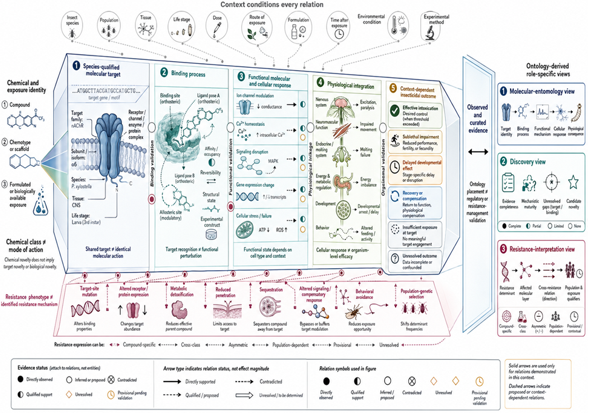
Figure 1 presents the hierarchical organization of molecular targets, physiological processes, resistance mechanisms, and insecticidal outcomes within the analytical logic developed in this section.
|
|
|
Figure 1. The hierarchical organization of molecular targets, physiological processes, resistance mechanisms, and insecticidal outcomes |
Alt text
A structured conceptual diagram that presents the hierarchical organization of molecular targets, physiological processes, resistance mechanisms, and insecticidal outcomes, with labelled components, directional relations, contextual modifiers, uncertainty points, and a clear boundary between observed evidence and proposed synthesis.
Graph representation does not itself resolve causal ambiguity. A graph representation is appropriate only if curated observations, mechanistic assertions, and machine-inferred links are stored as different relation and evidence types [28]. Evidence states should include candidate, supported, contradicted, unresolved, and deprecated, with explicit return paths when a compound has a strong phenotype but an unknown target or when molecular findings conflict. Resistance should form a cross-cutting subgraph that links each determinant to the layer it modifies rather than being treated as an attribute of class membership.
The ontology may also support prediction, but inference must remain visibly distinct from observation. Ontology-aware prediction can extend classification to unseen entities, but predicted placement must remain distinguishable from experimentally validated mechanism [29]. Validation would require competency questions, independent expert annotation, inter-rater testing, reconstruction of known cases, counterexample analysis, prospective classification, and decision-use studies performed on a frozen ontology version. The proposed components, evidence bases, boundary conditions, failure modes, and validation requirements are organized in Table 3.
Table 3. Proposed Mode-of-Action Ontology: Components, Evidence Basis, Relations, Boundary Conditions, Failure Modes, and Validation Requirements
|
Proposed component |
Purpose |
Evidence basis |
Relation or mechanism |
Input or precondition |
Expected output |
Boundary condition or failure mode |
Validation requirement |
Representative supporting reference(s) |
|
Entity hierarchy |
Separate chemistry, target, binding, response, phenotype, and resistance |
Formal ontology practice and mechanistic distinctions |
Defined classes with stable identifiers |
Agreed definitions and mappings |
Computable multi-layer representation |
Synonym collision or legacy-label ambiguity |
Competency questions and independent annotation |
Formal definitions and evidence annotation [25]. |
|
Typed relation chain |
Prevent target, binding, and outcome from collapsing into one assertion |
Structural, functional, cellular, and graph evidence |
Binds to, modulates, precedes, causes, or is associated with |
Evidence-qualified relation |
Traceable mechanistic pathway |
Association incorrectly stored as causation |
Evidence-code audit and counterexample testing |
Relation-type separation [28]. |
|
Context qualifiers |
Restrict inference to the biological and exposure setting supported |
Species-, tissue-, stage-, dose-, and time-dependent evidence |
Metadata attached to entities and relations |
Complete contextual description |
Conditional rather than universal inference |
Missing metadata creates false generality |
Annotation-completeness and replication tests |
Structural context dependence [14]. |
|
Evidence and provenance layer |
Make every assertion auditable |
Source, method, directness, and curation record |
Citation-linked evidence codes |
Verifiable evidence source |
Transparent assertion history |
Authority or reporting bias |
Provenance audit and inter-rater assessment |
Evidence-bearing ontology practice [25]. |
|
Status and uncertainty states |
Preserve unresolved or contradictory cases |
Evidence maturity and ontology-aware inference |
Candidate, supported, contradicted, unresolved, or deprecated |
Defined status rules |
Transparent mechanistic maturity |
Threshold arbitrariness or premature closure |
Blinded prospective classification |
Prediction must remain separate from validation [29]. |
|
Resistance subgraph |
Represent determinant–mechanism–compound–population relationships |
Genetic, structural, biochemical, and population evidence |
Directional confers resistance to relations |
Mechanism-qualified resistance evidence |
Conditional cross-resistance queries |
Class-wide resistance inferred from sparse data |
Known-case reconstruction and prospective testing |
Causal metabolic-resistance evidence [24]. |
|
Governance and versioning |
Control revisions, deprecation, and contested updates |
Reproducible ontology-development methods |
Versioned releases and governed change requests |
Open maintenance process |
Sustainable shared resource |
Stakeholder imbalance or uncontrolled term growth |
Release audits and governance evaluation |
Modular and governed development [27]. |
|
Validation programme |
Test reliability, utility, and transferability |
Proposed synthesis and external cases |
Retrospective, blinded, prospective, and decision studies |
Frozen ontology version |
Evidence of reproducibility and usefulness |
Circular testing or consensus mistaken for truth |
Preregistered multicentre evaluation |
Automated quality-control infrastructure [26]. |
Applications in discovery, regulation, and resistance management
For discovery, the ontology can record whether novelty is proposed from phenotype, target hypothesis, direct binding, functional perturbation, or integrated organismal evidence [30]. Discovery portfolios would benefit from separating mechanistic maturity from commercial stage, because candidate novelty and evidentiary completeness do not advance in lockstep [31]. A potent chemotype could therefore remain “mechanism unresolved,” whereas a well-characterized target interaction could remain “efficacy conditional” until biological translation is demonstrated.
An ontology can provide a common evidence layer across target-based, phenotypic, structural, computational, and chemistry-led discovery approaches without treating method novelty as mode-of-action novelty [32]. For evidence organization in regulatory settings, that layer could export consistent definitions, supporting methods, contradictory findings, and boundary conditions. Such an output would be an evidence dossier rather than an approval decision, because jurisdiction-specific standards, benefit–risk assessments, exposure evaluations, and legal requirements remain outside ontology placement.
For resistance management, mixture reasoning should query mechanism independence, resistance frequency, effective dose, joint exposure, and cross-resistance evidence rather than rely only on different class numbers [33]. The same detailed ontology may generate a simplified resistance-management view, but it should return assumptions, population scope, and uncertainty with every output. It cannot establish that a rotation or mixture will be effective under a particular programme without operational and population evidence. The evidence dimensions and interpretive boundaries for applications in discovery regulation and resistance management are summarized in Table 4.
Table 4. Applications in Discovery, Regulation, and Resistance Management: Molecular Layers, Targets, Phenotypic Connections, Validation Evidence, Evolutionary Implications, and Interpretive Boundaries
|
Molecular layer or target |
Biological process |
Required evidence |
Phenotypic connection |
Validation need |
Evolutionary or resistance implication |
Uncertainty |
Interpretive boundary |
Representative supporting reference(s) |
|
Discovery evidence chain |
Progression from phenotype to target, binding, function, and organismal response |
Stage-specific mechanistic evidence |
Tracks how candidate activity becomes mechanistically interpretable |
Test whether ontology use improves evidence completion |
Earlier mechanism resolution may inform resistance-risk hypotheses |
Confidential or incomplete evidence may limit annotation |
Phenotypic or chemical novelty is not automatically MoA novelty |
Evidence-stage recording [30]. |
|
Mechanistic maturity |
Accumulation of orthogonal evidence independent of product stage |
Binding, functional, genetic, cellular, and organismal support |
Distinguishes promising activity from established mechanism |
Prospective portfolio-use assessment |
Mature evidence may improve comparison among target spaces |
Commercial advancement can outpace mechanism resolution |
Market stage is not evidence maturity |
Discovery-portfolio distinction [31]. |
|
Cross-method evidence layer |
Integration of structural, computational, phenotypic, and chemistry-led discovery |
Method-specific provenance and convergent testing |
Supports comparison across discovery strategies |
Evaluate annotation consistency and decision usefulness |
May identify crowded or underexplored target spaces |
Missing data may create apparent novelty |
Method novelty is not target or MoA novelty |
Cross-technology integration [32]. |
|
Regulatory evidence view |
Consistent organization of claims, methods, contradictions, and scope |
Curated evidence and explicit contextual qualifiers |
Supports transparent review of mechanistic assertions |
Jurisdiction-specific external evaluation |
May clarify, but cannot determine, management implications |
Legal and evidentiary standards differ |
Ontology placement is not regulatory validation or approval |
Formal evidence representation [25]. |
|
Resistance-management query |
Evaluation of determinant, cross-resistance, exposure, and use assumptions |
Mechanistic, population-genetic, and operational evidence |
Conditional rotation or mixture rationale |
Test decisions against known and prospective cases |
Incorrect independence assumptions can accelerate selection |
Dose, coverage, compliance, and population structure vary |
Different class numbers do not establish operational independence |
Mechanism-aware mixture reasoning [33]. |
Limitations and future development
Operational implications remain assumption-dependent. Rotation value is conditional on biology, exposure, resistance genetics, and operational execution, so ontology output cannot be treated as a universal management prescription [34]. Mixture classification must preserve component dose, interaction, exposure, and resistance context because mechanistic difference alone does not establish benefit or safety [35]. A shared ontology can expose these missing conditions, but it cannot replace population surveillance, efficacy evaluation, toxicology, implementation analysis, or programme-specific judgement.
The evidence base is also uneven across targets, compounds, species, and methods. Future ontology development should accommodate new structural, screening, and molecular-design evidence while explicitly recording when methods are borrowed from domains with different biological and exposure constraints [36]. The ontology must permit a stable “mechanism unresolved” status for potent new chemotypes until target, binding, functional, resistance, and organismal evidence converge [37]. This prevents strong activity or chemical distinctiveness from being converted prematurely into a definitive mode-of-action claim.
The strongest supported inference is that a layered, evidence-bearing representation can preserve distinctions that operational classifications necessarily compress. However, reliability, validity, transferability, governance burden, and decision usefulness remain untested. Priorities are an openly governed pilot ontology, controlled definitions, interoperable identifiers, external annotation, automated reasoning tests, known-case reconstruction, prospective compound classification, and decision studies. These evaluations should test both correct relations and appropriate restraint when evidence is contradictory, context dependent, or incomplete.
CONCLUSION
A shared insecticide mode-of-action ontology should not replace practical classifications; it should reveal the evidence structure beneath them. The proposed synthesis separates chemical identity, molecular target, binding process, functional perturbation, cellular response, physiological outcome, conditional efficacy, and resistance, while qualifying every relation by context, provenance, and uncertainty. Its central contribution is to block invalid equivalences without claiming that the resulting ontology has been validated. The highest-priority next step is prospective, independently governed testing of whether this organization improves annotation consistency, mechanistic interpretation, and evidence communication while preserving the distinction between ontology placement and regulatory or resistance-management validation.
ACKNOWLEDGMENTS: None
CONFLICT OF INTEREST: None
FINANCIAL SUPPORT: None
ETHICS STATEMENT: None