Entomology and
Applied Science Letters
Applied Science Letters
 2025
Volume 12
Issue 3
2025
Volume 12
Issue 3

Biological control increasingly relies on assemblages of predators, parasitoids, pathogens, and other beneficial organisms whose combined actions may broaden pest suppression but may also generate competition, behavioural interference, intraguild predation, and unstable trophic feedbacks. The central scientific and decision problem is therefore not whether multiple natural enemies can attack the same pest, but under which ecological conditions their joint action produces complementary, persistent control rather than redundancy, antagonism, or transient suppression. This theory article develops an evidence-grounded ecological-network synthesis that integrates natural-enemy richness and composition, functional complementarity, niche partitioning, resource overlap, competition, intraguild predation, environmental context, network structure, and programme implementation. The synthesis distinguishes observed interactions from inferred mechanisms and separates species richness from complementarity, niche difference from cooperation, pairwise compatibility from network stability, and short-term additive effects from durable control. The strongest defensible conclusion is that multi-enemy performance emerges from the balance of positive and negative interaction pathways whose direction and strength vary with agent identity, pest stage, resource availability, trophic structure, spatial scale, environmental conditions, and operational practice. Current evidence remains limited by short experimental durations, incomplete interaction networks, inconsistent trait–function relationships, scale-dependent outcomes, and insufficient linkage between interaction detection and population-level pest suppression. The proposed theory therefore treats multi-agent design as a staged, context-sensitive network problem rather than a species-accumulation exercise. Progress requires mechanism-specific compatibility tests, explicit treatment of uncertainty and indirect effects, cross-scale validation, and programme governance that permits combinations to advance, be redesigned, or be discontinued according to pre-specified biological and operational evidence.
INTRODUCTION
Biological control is often described through the effects of an individual predator, parasitoid, pathogen, or antagonist on a focal pest. Yet agricultural communities rarely operate through isolated consumer–resource pairs. Several natural enemies may encounter the same pest population, attack different developmental stages, forage in different crop strata, use overlapping resources, consume one another, or respond differently to seasonal and landscape conditions. Recent syntheses indicate that natural-enemy diversity can strengthen pest suppression, but the sign and magnitude of the relationship depend on functional traits, species identity, and ecological context [1–3]. This conditional evidence creates an important distinction between the presence of multiple enemies and the existence of a biologically coherent control assemblage. A species-rich assemblage may contain complementary functions, but it may also contain redundant, competitively inferior, behaviourally disruptive, or intraguild-predatory members. Greater enemy richness is therefore not equivalent to functional complementarity.
The distinction is consequential because biological-control decisions frequently require choices among conserving resident communities, releasing one agent, combining several agents, or integrating introduced enemies with existing food webs. Experimental evidence shows that enemy composition can explain suppression more directly than richness alone [4]. The identity of the agents included, their relative densities, the pest stages they attack, and their responses to local conditions may determine whether an assemblage outperforms its strongest member. A positive mixture outcome may reflect genuine partitioning or facilitation, but it may instead arise from a dominant species, a greater total density of consumers, or a short-lived response under favourable experimental conditions. Conversely, a detected antagonistic interaction need not eliminate the possibility of useful net control if other pathways compensate for its cost. Biological interpretation must therefore move beyond categorical labels such as compatible, incompatible, synergistic, or disruptive.
The unresolved gap is the absence of a sufficiently explicit ecological-network theory connecting natural-enemy composition to mechanisms, boundary conditions, failure modes, and validation requirements. Existing evidence spans biodiversity experiments, field food webs, behavioural assays, landscape studies, molecular interaction detection, and operational release programmes. These approaches illuminate different parts of the problem but do not measure interchangeable constructs. Detection of feeding is not equivalent to a demographic effect; a demographic effect is not equivalent to crop protection; pairwise compatibility is not equivalent to network stability; and a short-term additive response is not equivalent to durable multi-agent control. Without these distinctions, multi-enemy programmes risk advancing combinations on the basis of nominal diversity or isolated efficacy tests while overlooking indirect effects, changing environmental conditions, resident enemies, and implementation constraints.
This article develops an original, explicitly non-validated ecological-network synthesis for analysing when multiple natural enemies may cooperate without destabilizing control. Its scope is limited to biological-control systems in which two or more control agents, resident enemies, pests, shared resources, or higher trophic actors form interacting ecological pathways. The central argument is that realized control emerges from a context-dependent balance among complementary attack, niche separation, competition, resource overlap, intraguild predation, behavioural interference, environmental filtering, and operational implementation. The proposed organization does not replace empirical evaluation or predict universal outcomes. Instead, it defines the constructs that must be distinguished, the relationships that require evidence, the points at which a candidate combination should be questioned, and the observations needed to test whether an apparently beneficial assemblage remains effective and stable across time and scale.
Multi-enemy biological control as a network problem
A multi-enemy system becomes a network problem when the performance of one control agent depends on the presence, behaviour, resources, or consequences of other organisms. Field evidence indicates that species diversity and food-web structure can jointly determine parasitism, hyperparasitism, and realized biological-control function [5]. This finding changes the analytical unit from a list of agents to a connected trophic structure. Nodes may include pests, predators, primary parasitoids, hyperparasitoids, alternative prey, host plants, microbial partners, and non-target organisms. Edges may represent consumption, parasitism, competition, facilitation, avoidance, resource sharing, or indirect effects. Each edge may vary in strength, direction, timing, and environmental sensitivity. Network representation is therefore useful only when it preserves these biological meanings; a diagram based solely on co-occurrence can imply interactions that were not observed. Management gradients can reorganize enemy–herbivore network properties, but co-occurrence links must not automatically be interpreted as attacks or causal control pathways [6].
Network-level reasoning also prevents local responses from being mistaken for whole-system stability. Large-scale analyses indicate that marked responses by individual taxa need not produce equivalent changes in overall network structure [7]. The reverse is also possible: apparently stable abundance patterns may conceal changes in interaction strength, trophic routing, or the identity of agents delivering suppression. Dynamic analysis further shows that antagonistic and beneficial pathways may coexist. A predator may consume parasitized hosts while predators and parasitoids still generate positive net control under particular demographic conditions [8]. Similarly, molecularly resolved diet networks can identify predators that occupy central or specialized positions in a pest-consumption network, but detection of prey DNA establishes consumption rather than the magnitude or persistence of pest-population suppression [9]. The network problem therefore requires explicit separation of interaction occurrence, interaction strength, demographic consequence, pest suppression, and durability.
The proposed synthesis organizes multi-enemy control around five linked analytical decisions. First, the system boundary must identify the agents, pest stages, shared resources, resident enemies, and higher trophic actors relevant to the intended intervention. Second, evidence must distinguish observed links from assumed links and specify whether each relationship is positive, negative, conditional, or unresolved. Third, the expected output must be stated as a biological construct, such as expanded pest-stage coverage, reduced pest growth, lower crop injury, or increased temporal stability, rather than as an undefined claim of synergy. Fourth, boundary conditions must include species identity, release density, life stage, habitat complexity, resource availability, season, landscape setting, and experimental scale. Fifth, validation must test whether the proposed network predicts outcomes beyond the conditions from which it was derived. Failure modes include missing trophic links, treating richness as a mechanism, confusing structural persistence with effective control, extrapolating pairwise results to larger assemblages, and accepting short-duration suppression as evidence of stability. The proposed components, evidence bases, boundary conditions, failure modes, and validation requirements are organized in Table 1.
Table 1. Multi-Enemy Biological Control as a Network Problem: Components, Evidence Basis, Relations, Boundary Conditions, Failure Modes, and Validation Requirements
|
Proposed component |
Purpose |
Evidence basis |
Relation or mechanism |
Input or precondition |
Expected output |
Boundary condition or failure mode |
Validation requirement |
|
Network boundary |
Define which organisms and resources belong to the analysed control system |
Field food-web evidence shows that higher trophic links can alter realized control |
Connect pests, control agents, alternative resources, and higher trophic actors |
Biologically justified system boundary |
A tractable representation of relevant direct and indirect pathways |
Excluding hyperparasitoids, resident enemies, or alternative prey can misrepresent control |
Compare predictions from reduced and expanded network boundaries |
|
Verified interaction layer |
Separate demonstrated ecological links from co-occurrence or assumed compatibility |
Field networks and molecular diet studies identify different levels of interaction evidence |
Classify feeding, parasitism, competition, facilitation, and behavioural effects |
Direct observation, diagnostic detection, or defensible mechanistic evidence |
Interaction map with explicit evidence status |
Co-occurrence or molecular detection may be mistaken for population-level control |
Link interaction evidence to demographic and suppression outcomes |
|
Agent identity and composition |
Prevent richness from functioning as a proxy for compatibility |
Experimental assemblages show that species composition can dominate richness effects |
Agent identity determines attack role, competitive ability, and trophic position |
Defined species, life stages, densities, and provenance |
Composition-specific expectation of control |
Species number is increased without testing which agents contribute |
Compare combinations with component species and the strongest single-agent treatment |
|
Dynamic interaction balance |
Integrate positive and negative pathways rather than assign a fixed compatibility label |
Dynamic predator–parasitoid analysis demonstrates that antagonism and net control can coexist |
Complementary attack is balanced against competition, intraguild predation, and indirect effects |
Time-dependent attack, survival, and reproduction information |
Estimated net contribution through time |
Static interaction signs conceal compensatory or delayed effects |
Test predictions across relevant pest and enemy generations |
|
Network structure and resilience |
Distinguish responses of individual taxa from persistence of network organization and control |
Large-scale network analysis shows that taxon-level change and network-level resilience are not equivalent |
Modularity, redundancy, and trophic routing mediate disturbance responses |
Replicated network observations under contrasting conditions |
Conditional expectation of structural and functional persistence |
Structural resilience is interpreted as proof of stable pest suppression |
Measure both network reorganization and biological-control outcomes |
|
Functional-role mapping |
Identify whether enemies provide distinct, overlapping, or antagonistic functions |
Interaction networks can reveal central and specialized consumers |
Map agents to pest stages, microhabitats, times, and alternative resources |
Verified attacks and ecologically relevant trait information |
Mechanistic hypothesis of complementarity or redundancy |
Network position is inferred from incomplete sampling |
Repeat interaction sampling and test whether mapped roles predict suppression |
|
Context-conditioned network state |
Represent interactions as environment-dependent rather than fixed |
Network properties change along management and landscape gradients |
Environmental conditions modify node performance and edge strength |
Habitat, resource, management, and landscape information |
Context-specific rather than universal compatibility prediction |
A combination is transferred without recalibration |
Validate under independent environmental and management contexts |
|
Decision and validation gate |
Prevent conceptual synthesis from being treated as operational proof |
Convergent evidence shows scale, method, and outcome non-equivalence |
Advance, redesign, or discontinue combinations according to pre-specified evidence |
Defined outcome, comparator, uncertainty, and stopping criteria |
Falsifiable programme hypothesis |
Positive short-term response is treated as durable control |
Staged laboratory, semi-field, field, and longitudinal evaluation |
Functional complementarity and niche partitioning
Functional complementarity refers to improved joint performance arising because agents contribute different, mutually useful control functions. These functions may involve attacking different pest species, developmental stages, plant strata, seasons, or behavioural states. Niche partitioning can reduce overlap and create the opportunity for such complementarity, but it does not establish that the combined assemblage suppresses pests more effectively. Complementarity may improve control when enemies partition resources or attack different pest components, yet trait diversity and realized joint efficacy remain non-equivalent [10–12]. Field evidence supports enhanced suppression in some complementary assemblages, whereas experimental work also shows that selected functional-diversity measures may fail to explain control efficiency. In greenhouse systems, contrasting within-plant preferences can broaden control when one predator performs better against flower-associated pests and another contributes more strongly in foliar habitats. The relevant mechanism is therefore not difference alone, but difference that expands effective attack without creating an equal or greater antagonistic cost.
The operational composition and release design of an assemblage can obscure this mechanism. Repetitive-release experiments demonstrate that adding multiple commercial enemies does not automatically improve control relative to a carefully selected single-agent treatment [13]. Apparent benefits may depend on release frequency, total enemy density, pest distribution, or one particularly effective member. The appropriate comparator is consequently not an untreated system alone, but also each component agent and the strongest single-agent treatment under equivalent density and timing. A further interpretive problem is that mixture overperformance is often labelled complementarity without identifying the pathway that produced it. Ecological synthesis distinguishes resource partitioning, facilitation, and biotic feedbacks as different processes that can generate superficially similar outcomes [14]. In a biological-control network, these processes should be represented separately because they imply different persistence requirements and different risks of failure.
A defensible claim of functional complementarity therefore requires three linked demonstrations. First, agents must differ in an ecologically relevant function, such as prey-stage use, plant-stratum use, host-finding period, or response to pest density. Second, that difference must alter joint attack or pest-demographic outcomes rather than merely describe trait dissimilarity. Third, the advantage must remain after accounting for identity, density, and experimental-design effects. Niche partitioning is best treated as a candidate mechanism that may reduce competitive overlap or extend pest coverage, not as evidence of cooperative suppression by itself. Complementarity may also vary over time: an initially useful division of labour may disappear if pest stages shift, resources become scarce, or one enemy excludes another. The synthesis therefore treats complementary edges as conditional and testable, with their expected contribution tied to the pest complex, crop architecture, release schedule, and environmental context in which the combination is intended to operate.
Competition and resource overlap
Competition enters multi-enemy networks when agents depend on the same limiting host, prey, refuge, oviposition site, or spatial foraging domain. Resource overlap increases the opportunity for competition but does not prove that competition is occurring or that it has a meaningful effect on control. Outcomes may involve exploitative depletion, direct interference, priority effects, intrinsic competition within a shared host, or changes in foraging behaviour. Competitive interactions among parasitoids may also be altered by microbial symbionts, making visible species traits and nominal host ranges incomplete predictors of compatibility [15]. Direct evaluation of candidate parasitoids shows that competition and intraguild predation can change their expected joint contribution against a shared pest [16]. These findings argue against fixed species-level compatibility labels. The same pair may interact differently according to host stage, sequence of attack, host quality, symbiont status, agent density, or availability of alternative resources.
Competition is especially consequential when introduced agents encounter indigenous natural enemies. Reproductive comparisons between native and imported parasitoids sharing a host indicate that classical biological-control candidates must be assessed not only for their individual performance but also for their potential to alter the contribution or persistence of resident enemies [17]. Similar constraints arise beyond predator–parasitoid systems. In multiple-agent weed biological control, intra- and interspecific interference reduced larval survival, and a mixed treatment failed to increase plant impact [18]. The absence of an additional effect in such a combination may reflect direct aggression, reduced establishment, resource limitation, or a shift in plant-mediated conditions rather than simple functional redundancy. These mechanisms require different responses: redesigning release timing may address priority effects, whereas reducing overlap, changing density, or abandoning the combination may be necessary when interference is intrinsic.
The proposed theory therefore represents resource overlap as a precondition that modifies the probability and potential strength of competitive edges. Competition itself must be demonstrated through changes in attack, development, survival, reproduction, establishment, or target suppression. This distinction matters because agents can share a nominal resource without limiting one another when the resource is abundant, spatially partitioned, or renewed quickly. Conversely, apparently different agents may compete strongly if their effective host-finding zones converge during a vulnerable pest stage. Pairwise tests remain necessary but insufficient: adding further agents can create indirect release from competition, new intraguild pathways, or altered resource use that was absent from the pair. Competition and complementarity can therefore coexist within the same assemblage, and their balance may change across pest density, crop development, season, and release sequence. A candidate programme should advance only when its expected complementary contribution exceeds demonstrated competitive costs under conditions that resemble the intended operational context.
Intraguild predation and behavioural interference
Intraguild predation must be separated into event occurrence, demographic cost, and measurement certainty because these dimensions can lead to different predictions of control [19–21]. Alternative prey may alter focal-prey consumption and parasitism without changing measured intraguild-predation intensity [19]. In other systems, intraguild feeding can reduce predator fitness while producing context-dependent consequences for pathogen transmission [20]. Diagnostic methods can establish that feeding occurred and identify the life stages involved, but detection alone cannot determine whether the event destabilized pest suppression [21].
The direction of an intraguild link is therefore insufficient for predicting programme performance. Food-web theory indicates that intraguild predation is not universally destabilizing and may support biodiversity or functioning under particular network configurations [22]. Positive net suppression can also coexist with consumption of parasitized hosts when compensatory attack pathways remain strong [8]. Behavioural interference adds a non-consumptive dimension: avoidance, disturbance, aggression, or altered foraging can reduce effective attack without generating visible mortality among enemies. These effects may intensify under confinement, high agent density, or resource scarcity and weaken under structurally complex field conditions.
The proposed interpretation treats intraguild predation, exploitative competition, and behavioural interference as separate, context-dependent edges. Compatibility assessment should measure feeding events, encounter rates, agent survival, reproduction, behavioural displacement, pest suppression, and persistence through time. Pairwise compatibility cannot establish network stability because additional agents, alternative prey, habitat structure, or higher trophic actors may alter both encounter probabilities and demographic consequences. The evidence dimensions and interpretive boundaries for intraguild predation and behavioural interference are summarized in Table 2.
Table 2. Intraguild Predation and Behavioural Interference: Agent Traits, Ecological Interactions, Persistence, Compatibility, Context Dependence, and Programme-Design Implications
|
Agent, trait, or interaction |
Target and ecological context |
Mechanism |
Expected contribution |
Persistence requirement |
Compatibility risk |
Context dependency |
Programme-design implication |
|
Predator–parasitoid intraguild predation |
Shared prey or hosts in multi-enemy systems |
Predator consumes parasitized hosts or parasitoid stages |
May retain net control when predator and parasitoid attack compensate |
Both guilds must persist sufficiently to maintain complementary attack |
Loss of parasitoids, altered host mortality, delayed control |
Pest density, attack sequence, alternative prey, habitat structure |
Compare demographic and suppression outcomes, not interaction sign alone |
|
Alternative-prey pathway |
Predator–parasitoid system with focal and alternative prey |
Resource switching alters prey consumption and parasitism |
May redistribute attack among pest components |
Alternative resources must remain available without sustaining pests |
Reduced attack on the focal pest or continued intraguild feeding |
Relative prey abundance and accessibility |
Test focal-pest control under changing resource conditions |
|
Fitness-mediated intraguild cost |
Predator and pathogen acting through a shared herbivore |
Intraguild feeding reduces predator performance |
Potential suppression through multiple mortality pathways |
Predator fitness and pathogen transmission must remain sufficient |
Lower predator persistence or altered disease transmission |
Predator stage, infection state, prey condition |
Measure reproduction and transmission as well as immediate mortality |
|
Life-stage-specific feeding detection |
Cannibalism or intraguild predation among arthropod enemies |
Diagnostic identification of consumed life stages |
Establishes which feeding links occur |
Detection must be repeatable within relevant sampling windows |
Detection may be mistaken for population-level importance |
Digestion, sampling time, secondary predation |
Pair diagnostic evidence with demographic and pest-suppression measures |
|
Network-position effect |
Complex food webs containing intraguild links |
Topology redistributes energy and interaction pressure |
May stabilize or enhance functioning under some configurations |
Relevant network structure must persist through disturbance |
General theory may not transfer to a focal crop system |
Connectance, productivity, body-size structure, interaction strength |
Test topology-specific predictions in biological-control systems |
|
Behavioural interference |
Enemies sharing foraging space or hosts |
Avoidance, aggression, disturbance, or altered searching |
Usually no direct contribution; may reveal hidden antagonism |
Behaviour must persist outside confined assays |
Reduced effective attack without direct enemy mortality |
Density, arena size, crop architecture, resource scarcity |
Include semi-field behavioural tests before combined release |
Environmental conditions that reshape interactions
Environmental context changes both node performance and interaction strength. Landscape diversity is not synonymous with effective pest control because habitats may provide resources to irrelevant species, support antagonists, or fail to connect with the crop at the spatial scale used by effective enemies [23]. Temperature, humidity, crop architecture, plant phenology, disturbance, and alternative resources can similarly alter host finding, development, retention, and encounter rates. A combination that appears complementary in one setting may become redundant or competitive when the pest distribution or resource environment changes.
Landscape configuration can restructure herbivore–parasitoid communities by altering movement, colonization, and encounter opportunities [24]. Augmentative-control efficacy can also depend on surrounding landscape context even when the nominal agent and release protocol remain unchanged [25]. Such differences may reflect dispersal from the treated crop, variation in resident enemies, background pest pressure, or resource continuity. Environmental variables should therefore be treated as mechanistic modifiers rather than descriptive covariates appended after compatibility has been assessed.
Landscape structure consequently functions as a boundary condition on realized natural pest suppression [26]. Context-conditioned network analysis should identify the spatial and temporal scale at which agents locate hosts, persist between pest generations, and encounter competitors or intraguild prey. Progress requires replication across relevant environmental states and measurement of both agent persistence and pest outcomes. Transferability should be claimed only when the same proposed relations predict performance under independent crop, season, habitat, or management conditions.
Proposed ecological-network theory
The proposed ecological-network theory treats each natural enemy as a node embedded in a multilevel system rather than as an independently acting control input. Ecological-network effects emerge across organizational levels, so local attack, pairwise interaction, community composition, and whole-network persistence cannot be assumed to vary together [27]. The theory contains four evidence layers: verified organisms and resources; observed or strongly supported interactions; context-dependent modifiers; and proposed predictions requiring validation. Its output is not a universal readiness score, but a conditional explanation of why a combination may produce complementary, redundant, antagonistic, or unstable control.
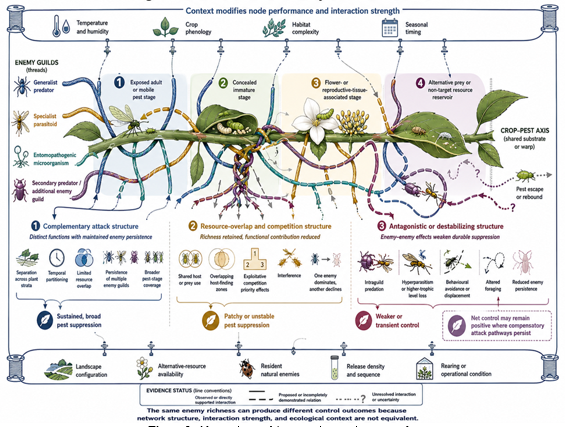
Network characterization can broaden biological-control assessment beyond isolated candidate–host pairs by including indirect and non-target pathways [28]. Molecularly resolved networks may improve candidate selection when interaction detection is combined with ecological-performance evidence [29]. Hierarchical topology can further reveal modules and cross-module connections concealed by a single aggregate compatibility measure [30]. Figure 1 shows alternative multi-enemy interaction networks within the analytical logic developed in this section.
|
|
|
Figure 1. Alternative multi-enemy interaction networks |
Alt text
A structured conceptual diagram that shows alternative multi-enemy interaction networks, with labelled components, directional relations, contextual modifiers, uncertainty points, and a clear boundary between observed evidence and proposed synthesis.
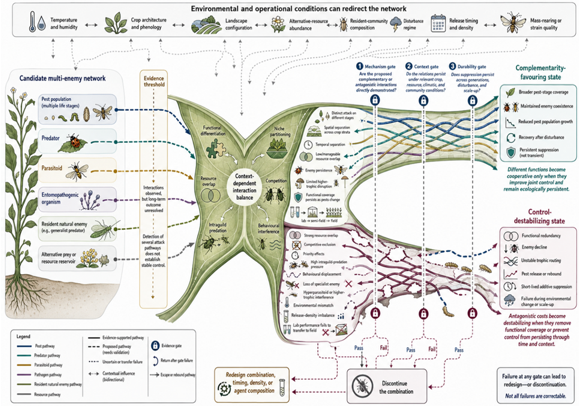
Node attributes should include agent identity, life stage, provenance, traits, population history, and operational condition because hidden demographic structure may alter contemporary trophic interactions [31]. Positive edges represent demonstrated or hypothesized mechanisms such as complementary attack, facilitation, or temporal insurance. Negative edges represent competition, interference, intraguild predation, or higher-trophic-level loss. Context modifiers alter edge direction or strength. Complementarity is favoured when distinct functions increase pest coverage, agent persistence is maintained, antagonistic costs remain limited, and the network retains those relations across relevant environments. Destabilization becomes more plausible when resource overlap intensifies, agent mortality or displacement reduces functional coverage, trophic feedbacks promote pest release, or an initially positive response fails during scale-up. Figure 2 depicts conditions favouring complementarity or control destabilization within the analytical logic developed in this section.
|
|
|
Figure 2. Conditions favouring complementarity or control destabilization |
Alt text
A structured conceptual diagram that depicts conditions favouring complementarity or control destabilization, with labelled components, directional relations, contextual modifiers, uncertainty points, and a clear boundary between observed evidence and proposed synthesis.
The theory uses staged decision points. A candidate network first requires verified nodes and ecologically relevant links. It then requires mechanism-specific evidence that positive pathways exceed antagonistic costs under controlled conditions. Semi-field and field evaluation must test whether the interaction balance persists under realistic density, habitat, resident-community, and environmental conditions. Longitudinal evaluation must finally distinguish transient suppression from durable control. Failure at any point should trigger network revision, altered release timing or density, removal of an agent, or termination of the combination. The proposed components, evidence bases, boundary conditions, failure modes, and validation requirements are organized in Table 3.
Table 3. Proposed Ecological-Network Theory: Components, Evidence Basis, Relations, Boundary Conditions, Failure Modes, and Validation Requirements
|
Proposed component |
Purpose |
Evidence basis |
Relation or mechanism |
Input or precondition |
Expected output |
Boundary condition or failure mode |
Validation requirement |
|
Multilevel node structure |
Represent agents and ecological associates across organizational levels |
Ecological-network theory |
Nodes contain species, stage, trait, population, and operational attributes |
Verified identity and relevant biological information |
Explicit network membership and node roles |
Important population or life-stage variation is omitted |
Test whether node attributes improve independent predictions |
|
Interaction-evidence layer |
Distinguish observed links from proposed relations |
Network risk assessment |
Direct and indirect links are labelled by evidence status |
Observation, molecular evidence, or defensible mechanism |
Traceable interaction architecture |
Assumed links are presented as established pathways |
Confirm links with independent ecological methods |
|
Molecularly informed network |
Improve resolution of feeding or host-use relations |
Metabarcoding-supported candidate selection |
Molecular detections identify otherwise hidden interactions |
Representative sampling and validated markers |
Refined candidate and interaction map |
Detection is interpreted as effect size or suppression |
Connect detection with abundance and demographic outcomes |
|
Hierarchical topology |
Detect modules and cross-module pathways |
Compound network topology |
Nested subnetworks organize local and system-level effects |
Sufficiently resolved network data |
Identification of structurally distinct interaction pathways |
Aggregate metrics conceal destabilizing substructures |
Compare hierarchical predictions with observed outcomes |
|
Context-modifier layer |
Make interaction strength conditional on environment and management |
Landscape and field evidence |
Habitat, resources, climate, crop stage, and management alter nodes and edges |
Defined environmental state |
Context-specific prediction |
Compatibility is treated as fixed across settings |
Replicate under independent environmental contexts |
|
Complementarity pathway |
Represent positive joint function without equating it with richness |
Mechanistic and experimental evidence |
Distinct attack functions broaden or stabilize pest coverage |
Verified functional difference and maintained agent persistence |
Improved joint suppression relative to valid comparators |
Identity, density, or transient effects imitate complementarity |
Compare with component and best single-agent treatments |
|
Antagonism pathway |
Represent competition, interference, and intraguild predation separately |
Experimental and food-web evidence |
Negative edges reduce survival, attack, or persistence |
Demonstrated encounter and consequence |
Estimated antagonistic cost |
Interaction occurrence is equated with destabilization |
Measure demographic and pest-level consequences |
|
Network-stability test |
Separate pairwise compatibility from system persistence |
Network-resilience and dynamic evidence |
Direct and indirect pathways respond to disturbance through time |
Multi-agent and longitudinal observations |
Conditional estimate of functional stability |
Stable structure without stable pest suppression |
Test recovery, persistence, and suppression after perturbation |
|
Decision and revision gate |
Prevent proposed synthesis from being treated as validation |
Cross-scale evidence and methodological gaps |
Advance, redesign, remove agents, or terminate combinations |
Pre-specified outcomes, uncertainty, and stopping conditions |
Falsifiable programme decision |
Laboratory advantage is assumed to transfer operationally |
Staged laboratory, semi-field, field, and longitudinal assessment |
Design implications for multi-agent programmes
Multi-agent design should begin with multivariate, context-explicit profiles rather than a search for a single predictive trait [32]. Candidate records should specify host-finding behaviour, attacked pest stages, spatial and temporal niches, reproductive strategy, dispersal, resource use, climatic response, symbiont status, rearing history, and known antagonistic interactions. Progress would be demonstrated when these attributes predict independent differences in establishment, interaction strength, and suppression more reliably than species identity or richness alone.
Ex-ante analysis can define falsifiable expectations and identify conditions under which an agent or combination may fail [33]. Each programme should specify its system boundary, expected complementary pathways, plausible negative edges, environmental assumptions, comparator treatments, and uncertainty. Advancement should require evidence that positive joint effects persist after controlling for total agent density and dominant-species effects. Pairwise tests should be followed by larger-network and context tests rather than interpreted as sufficient proof of stability.
Operational quality can filter or overwhelm biological potential. Long-running parasitoid programmes show that mass rearing, storage, strain quality, release timing, and monitoring are integral determinants of performance [34]. Cross-scale experiments further demonstrate that combinations performing well in the laboratory may lose their advantage in greenhouse or field conditions [35]. Programme governance should therefore include identity assurance, quality-control records, staged scale-up, monitoring of resident enemies and unintended trophic effects, and explicit revision or stopping rules. Progress is shown not by one favourable trial, but by reproducible, mechanism-consistent control across relevant scales and environmental states.
CONCLUSION
Multiple natural enemies can cooperate without destabilizing control, but cooperation cannot be inferred from species number, nominal niche difference, or pairwise coexistence. The strongest defensible synthesis is that multi-enemy performance emerges from a context-dependent balance among complementary attack, resource partitioning, competition, behavioural interference, intraguild predation, higher trophic interactions, environmental filtering, and operational implementation. Greater richness is not equivalent to functional complementarity; niche difference is not equivalent to cooperative suppression; pairwise compatibility is not equivalent to network stability; and short-term additive effects are not equivalent to durable multi-agent control. The highest-priority implication is to replace categorical compatibility judgments with staged, mechanism-specific network evaluation that links verified interactions to demographic effects, pest suppression, persistence, and cross-scale transfer. The proposed theory provides an organized and falsifiable structure for that work, but its components and relations require prospective validation before they can support operational decisions.
ACKNOWLEDGMENTS: None
CONFLICT OF INTEREST: None
FINANCIAL SUPPORT: None
ETHICS STATEMENT: None