Entomology and
Applied Science Letters
Applied Science Letters
 2026
Volume 13
Issue 1
2026
Volume 13
Issue 1

Honey-bee colonies can maintain apparently normal activity while interacting nutritional, parasitic, pathogenic, environmental, and management pressures progressively weaken the collective functions that sustain brood care, thermoregulation, defence, and resource acquisition. This buffering capacity makes early detection scientifically valuable but diagnostically difficult: many measurable deviations are nonspecific, and most candidate signals have not been shown prospectively to predict a defined colony-failure outcome with actionable lead time. This Original Horizon Review critically integrates continuous acoustic, thermal, weight, and behavioural sensing with molecular and physiological biomarkers, microbiome and pathogen signatures, and emerging data-fusion approaches. The analysis compares what each evidence class measures, the biological scale at which it operates, the contexts that alter its meaning, and the validation required before it can support management. The strongest defensible synthesis is that early warning is most plausible as longitudinal estimation of a latent colony state from complementary, biologically interpreted signals rather than as detection of a universal collapse marker. Sensor anomalies may identify departures from expected colony trajectories, whereas molecular and microbial measurements may help explain whether those departures reflect stress, adaptation, infection, resource limitation, or normal seasonal change. However, association is not prognosis, multimodal integration is not inherently interpretable, and earlier recognition cannot improve colony outcomes unless it activates a feasible and effective response. Progress therefore depends on prospective outcome-labelled cohorts, age- and context-standardized biological sampling, transparent models that preserve links to colony processes, and decision pathways evaluated for false alarms, timeliness, practicality, and outcome benefit.
INTRODUCTION
A honey-bee colony is a superorganism whose survival depends on distributed regulation across workers, brood, queen, stored resources, nest climate, microbial partners, and collective defence. Colony decline is therefore not a single lesion that can be read from one instrument or assay. It is a heterogeneous endpoint produced by interacting biological and management pressures; the relevant early-warning target is erosion of social resilience, and continuous precision-beekeeping systems offer a route to observe that erosion before routine inspection detects overt failure [1–3]. This framing shifts attention from isolated abnormalities to the colony’s capacity to compensate, recover, and preserve essential functions under changing demands.
The decision problem is not simply whether a measurement differs from a reference value. A temperature excursion may reflect weakened thermoregulation, but it may also reflect normal brood-cycle change or adaptive cooling. Reduced entrance traffic may indicate workforce loss, yet it may arise from rain, floral scarcity, or season. A molecular response may mark damaging exposure, successful compensation, or a consequence of an already-declining state. Consequently, an early-warning claim requires a defined future outcome, a specified prediction horizon, an interpretable relation between signal and colony process, and evidence that the signal adds useful information beyond weather, season, management, and known biological covariates.
Existing monitoring technologies create unprecedented temporal resolution, but the evidence remains fragmented across physical sensors, individual-bee assays, microbial ecology, pathogen diagnostics, and computational models. Precision-beekeeping platforms can collect continuous measurements with limited disturbance, although current systems are generally more mature as measurement infrastructures than as externally validated prognostic tools [3]. Biological studies, by contrast, often provide mechanistic specificity but rely on disruptive, costly, or cross-sectional sampling. The central gap is therefore not a shortage of candidate indicators; it is the absence of a sufficiently validated bridge from heterogeneous measurements to a colony-level, time-bounded, and actionable interpretation.
This horizon review examines why decline is commonly recognized late; compares acoustic, thermal, weight, and behavioural sensing; evaluates molecular, physiological, microbiome, and pathogen signatures; and considers how these sources could be fused for decision support. Its central argument is that no single anomaly should be equated with impending collapse. Early detection should instead be developed as biologically structured inference about latent colony condition, with explicit separation among measurement, association, prognosis, interpretation, and intervention. The review accordingly treats sensor anomaly as distinct from collapse, biomarker association as distinct from validated prognosis, data fusion as distinct from interpretable decision support, and early detection as distinct from improved outcomes.
Why colony decline is detected too late
Late recognition arises partly from a mismatch between the tempo of colony change and the cadence of conventional observation. Periodic inspections provide valuable direct evidence but sample only short moments in a dynamic system and can themselves disturb the colony. Between visits, thermoregulatory organization, workforce composition, resource balance, pathogen burden, and compensatory behaviour may change gradually. Continuous thermal records can reveal progressive deterioration while Varroa–virus interactions and rising parasite–pathogen burdens accumulate before weakness becomes obvious [4–6]. The convergence is important because it links a physical manifestation of homeostatic performance with biological pressures that may erode future resilience, but it does not establish a universal sequence or a common alarm threshold.
The colony can also conceal deterioration through compensation. Workers may sustain brood temperature, alter foraging allocation, increase hygienic effort, or draw down stores despite declining functional reserve. Under this condition, a normal-looking snapshot may indicate successful short-term buffering rather than durable health. Varroa destructor and associated viral pressure illustrate this distinction: their effects accumulate through interacting damage to individuals and colony demography, but the timing and severity of visible weakness remain dependent on climate, host and parasite characteristics, management, and the wider pathogen community [5]. Likewise, observed relations between deformed wing virus load, mite infestation, and colony weakness support risk interpretation without yielding a deterministic forecast date [6]. Earlier recognition therefore requires trajectories and recovery patterns, not merely the presence of a stressor.
A further delay occurs because biological changes may be measurable before their temporal meaning is known. Comparative metagenomic and host gene-expression patterns can distinguish declining from apparently healthier commercial colonies, yet such separation may reflect causes, compensatory responses, altered age structure, or consequences of decline [7]. Retrospective discrimination is therefore not equivalent to prospective prognosis. A valid early-warning target must specify the decline subtype, demonstrate that the signal precedes the outcome, distinguish reversible disturbance from loss of compensatory capacity, and show that an available response can still alter the trajectory. The evidence dimensions and interpretive boundaries for colony decline is detected too late are summarized in Table 1.
Table 1. Why Colony Decline Is Detected Too Late: Colony-Level Pathways, Diagnostic Signals, Resilience Outcomes, Management Relevance, Validation Needs, and Interpretive Boundaries
|
Colony-health component |
Signal, stressor, or resource |
Biological pathway |
Indicator or evidence |
Colony-level implication |
Management relevance |
Uncertainty |
Interpretive boundary |
Representative supporting reference(s) |
|
Composite colony condition |
Interacting biological and management pressures |
Multiple functions deteriorate at different rates |
Defined longitudinal decline trajectory |
Different failure pathways may share late visible signs |
Requires explicit outcome and syndrome definitions |
Attribution across concurrent stressors |
A risk profile does not provide a collapse date |
[1] |
|
Social resilience |
Loss of compensatory capacity |
Collective buffering sustains brood care, climate control, defence, and resource use |
Failure to recover after disturbance |
Visible activity may persist while reserve is eroding |
Prioritizes change and recovery over isolated abnormality |
Point of irreversibility is unknown |
Earlier detection does not prove an intervention will work |
[2] |
|
Thermoregulatory organization |
Internal-temperature trajectory |
Cluster strength and brood regulation shape nest climate |
Persistent change in continuous records |
Deterioration may be visible between manual inspections |
Supports targeted inspection and contextual follow-up |
Climate, sensor placement, brood state, and management |
Thermal anomaly may be adaptive rather than pathological |
[4] |
|
Parasite–virus pressure |
Varroa infestation and associated viruses |
Cumulative individual damage alters colony demography and resilience |
Parasite and viral burden interpreted over time |
Apparently functional colonies may carry increasing future risk |
Supports timely integrated parasite management |
Host, parasite, climate, and management heterogeneity |
Presence alone does not encode timing or inevitability of collapse |
[5] |
|
Pathogen burden |
Deformed wing virus load with mite infestation |
Replication and vectoring contribute to weakness |
Repeated quantitative burdens linked to colony condition |
High burden can accompany progressive weakening |
Supports combined pathogen and mite surveillance |
Regional scope and observational confounding |
Association with weakness is not a transportable forecast threshold |
[6] |
|
Molecular state |
Host gene-expression and metagenomic patterns |
Immune, metabolic, and microbial changes accompany decline pathways |
Comparative omics profile |
Latent biological change may precede obvious signs |
Identifies candidates for prospective monitoring |
Causal direction and lead time remain unresolved |
Case separation or association is not validated prognosis |
[7] |
Acoustic, thermal, weight, and behavioural sensors
Physical and behavioural sensors differ in the colony function they observe and in the specificity of their outputs. Vibrational spectra have provided genuine prospective lead time for a precisely defined event—swarming—showing that collective signals can contain temporally useful information [8]. This achievement is a methodological proof of event-specific prediction, not evidence that the same features predict health decline. Acoustic and vibration records are sensitive to queen state, colony activity, disturbance, weather, hive handling, and equipment noise; a decline-oriented model would therefore require its own labelled outcomes and external validation. Long-term temperature monitoring similarly becomes informative through trajectories rather than isolated values, because seasonal regimes and state transitions can be identified across overwintering colonies [9]. Yet departures from a fixed thermal value cannot be assumed pathological without ambient conditions, brood state, colony size, and sensor location.
Hive weight provides a complementary view of mass balance. Expected-trajectory models can identify residual changes after accounting for environmental variables, but an alarm may represent forage inflow, consumption, precipitation, feeding, honey removal, swarming, or population loss rather than a unique health process [10]. Weight is thus well suited to triage and contextualization, especially when management events are logged, but not to standalone diagnosis. Automated entrance imaging offers finer-grained behavioural phenotyping by quantifying pollen-bearing foragers and temporal activity patterns [11]. These measurements can inform resource acquisition and workforce activity, although lower traffic does not necessarily mean nutritional insufficiency or impending decline. Weather, floral availability, light, entrance geometry, colony demography, and model drift all influence interpretation.
The four sensor classes should therefore be viewed as complementary observations of communication and activity, thermoregulatory organization, resource and population dynamics, and foraging behaviour. Complementarity must be demonstrated against a predeclared colony outcome rather than assumed from the number of channels. A vibration alert should retain its event-specific meaning [8]. A weight residual should remain an unexplained mass anomaly until logs or diagnostics identify a cause [10]. A behavioural count should report both algorithmic uncertainty and uncertainty about biological meaning [11]. The most defensible near-term role for these systems is to estimate deviation from a colony-specific expected trajectory and trigger proportionate follow-up, while preserving the rule that a sensor anomaly is not equivalent to impending colony collapse.
Molecular and physiological biomarkers
Molecular and physiological biomarkers offer access to internal states that external sensors cannot name, but their apparent specificity can be misleading. Immune-related gene expression has shown potential for monitoring health-associated variation linked to pathogen and parasite pressure, yet candidate panels remain associative and require prospective, independently replicated, age-standardized validation [12]. Nutritional and landscape conditions further shape individual physiology and colony performance; colonies near resource-supporting landscapes have displayed differences in health and performance measures that demonstrate why biomarker baselines cannot be interpreted apart from forage context [13]. Biomarker development must therefore begin with standardized tissue, age, season, colony role, resource, and management metadata rather than with a universal threshold.
Transportability is a second constraint. Stress-indicator responses to sublethal pesticide exposure differed across laboratory and field contexts, showing that a candidate signal may weaken, disappear, or change direction when exposure pattern, colony organization, and environmental conditions change [14]. Age composition can also alter pathophysiological interpretation sufficiently to mimic or obscure differences attributed to colony disorder [15]. These findings make single-gene alarms especially vulnerable to false specificity. Physiological outputs may represent damage, adaptive compensation, exposure without functional impairment, or a consequence of altered worker demography. Biomarker association is therefore not equivalent to validated prognosis, and retrospective discrimination after a syndrome has emerged does not establish useful lead time.
As a proposed synthesis, a colony-oriented biomarker pathway should contain four linked components: a defined future outcome; standardized repeated sampling of host pathways and functional physiology; contextual inputs describing age, tissue, season, nutrition, pathogens, exposures, and management; and a decision layer that determines whether the result warrants observation, targeted diagnostic testing, or intervention. The evidence supports immune and stress pathways as candidate indicators [12], environmental context as a necessary interpretive input [13], and laboratory-to-field transportability and age structure as major failure points [14]. Age-stratified sampling remains essential because mixed cohorts can distort apparent colony differences [15]. The expected output should be a calibrated, pathway-specific estimate of latent state rather than a universal disease score. Validation requires preregistered prospective cohorts in which sampling precedes explicitly defined colony outcomes, models are tested externally, missingness and sampling disturbance are reported, and alerts are evaluated for lead time, false-alarm burden, actionability, and outcome utility. The staged organization is an original conceptual synthesis; it is not a validated framework or a deployment-ready diagnostic system.
Microbiome and pathogen signatures
Microbial communities participate in nutrition, immune regulation, and resistance to pathogen colonization, but their diagnostic meaning is ecological rather than taxonomically fixed. Honey-bee gut health is best interpreted through functional capacity and context-dependent dysbiosis, while controlled microbiome disruption can worsen survival and susceptibility to infection [16–18]. Diet, age, social transmission, antimicrobial exposure, season, and hive environment can all shift composition. A departure from a reference profile may therefore reflect dysfunction, normal variation, or another stressor; it cannot establish that collapse is approaching.
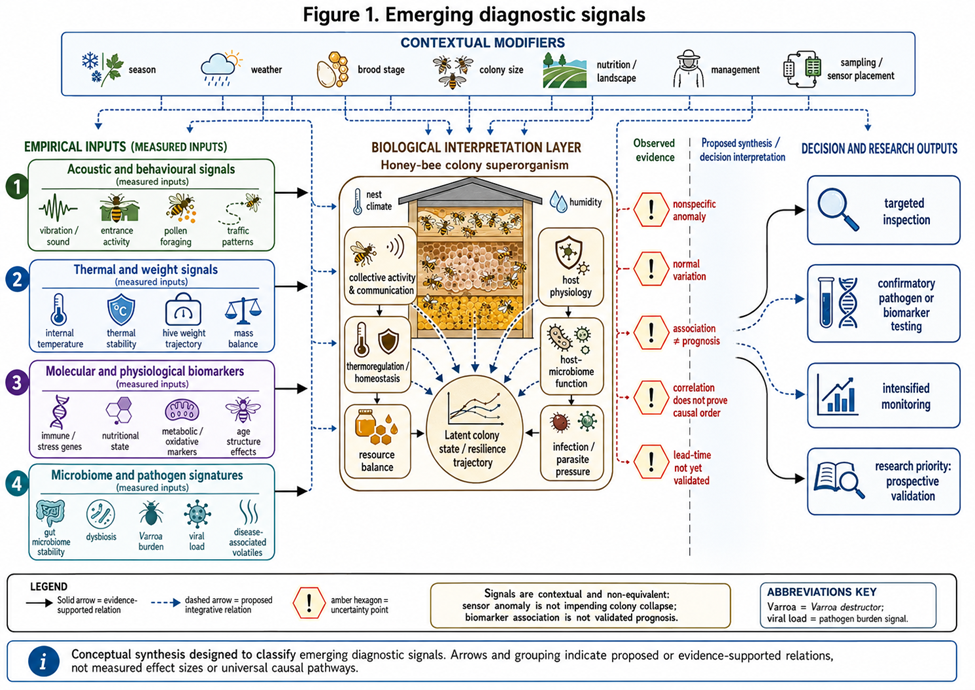
Pathogen signatures address a different construct. Parasite or viral burdens identify specified pressures, while disease-associated metabolites may enable non-invasive, pathway-specific detection. Volatile compounds associated with American foulbrood-infected larvae illustrate this potential, but only for a particular disease process and controlled analytical context [19]. Microbiome profiles describe host–microbial state, pathogen assays identify infectious pathways, and sensors indicate collective activity or homeostasis. These signals are not interchangeable, and correlation does not establish causal order. Figure 1 classifies emerging diagnostic signals within the analytical logic developed in this section.
|
|
|
Figure 1. Emerging diagnostic signals |
Alt text
A structured conceptual diagram that classifies emerging diagnostic signals, with labelled components, directional relations, contextual modifiers, uncertainty points, and a clear boundary between observed evidence and proposed synthesis.
Temporal ordering remains decisive. Microbial or pathogen differences may precede deterioration, follow changed colony conditions, or reflect worker demography and exposure. Comparative molecular evidence can separate declining and apparently healthier colonies without establishing lead time [7]. Pathogen burden may explain a sensor anomaly, but detection is not colony failure and should trigger disease-specific confirmation rather than a generic collapse alert [5]. Longitudinal, age-standardized sampling is needed to distinguish stable variation, reversible perturbation, and changes that precede defined outcomes.
Data fusion and decision-support opportunities
Data fusion is most credible when streams are aligned to biological observations and outcome labels. Combining in-hive sensors, weather, and apiary inspections has supported supervised forecasting of labelled colony-health status within a studied dataset [20]. Context can disambiguate nonspecific signals, but local labels, limited apiaries, missingness, management, and temporal leakage may impair transfer. A fused model should therefore declare its target, horizon, calibration, missing-data behaviour, and each input’s incremental contribution.
Synchronized acquisition of temperature, humidity, weight, sound, and environmental variables is technically feasible [21]. A biologically structured architecture would organize inputs by collective activity, thermoregulation, resource balance, host physiology, microbial function, pathogen activity, and external context. Fusion should preserve these distinctions, estimate latent colony state with uncertainty, and map it transparently to observation, inspection, targeted sampling, or intervention.
Forecasting an internal variable remains one step removed from forecasting an adverse outcome. Models can predict hive temperature, humidity, or weight and flag departures from expected trajectories [22]. Decision support additionally requires a validated relation among deviation, plausible cause, urgency, and value of action. Multi-source data fusion is therefore not equivalent to interpretable decision support. Alerts should report calibration and failure modes, preserve links to colony processes, and state what changed, which alternatives remain plausible, and what confirmation is needed.
Validation, interpretability, and adoption challenges
Validation begins by defining purpose. Operational monitoring, event detection, health-state classification, and prospective early warning require different evidence [23]. A genuine early-warning model must predict a predeclared future outcome before an actionable horizon using temporally separated, externally tested data. Retrospective classification, concurrent disease detection, and sensor-variable prediction do not establish prognosis. Evaluation should include calibration, false alarms, missed events, lead time, cross-season and cross-apiary robustness, and performance after management alters the trajectory.
Interpretability requires computational features to remain anchored to observable bee behaviour, colony organization, and context [24]. A frequency band, thermal residual, or learned embedding is not a biological mechanism merely because it predicts. Mechanistic experiments, synchronized observations, ablation analyses, and diagnostic follow-up are needed to identify causal, contextual, redundant, or artifactual features. Shared benchmarks also require consistent metadata, outcome definitions, intervention records, and protection of sensitive apiary information.
Adoption depends on practical benefit as well as accuracy. Cost, power, connectivity, maintenance, calibration, beekeeper skill, trust, and response capacity determine usability [25]. Nonspecific alerts may increase inspection burden without improving health. Implementation studies should measure decisions and colony outcomes, not device use alone, across varied apiaries. Early detection is not equivalent to improved outcomes without an effective response. The evidence dimensions and interpretive boundaries for validation interpretability and adoption challenges are summarized in Table 2.
Table 2. Validation, Interpretability, and Adoption Challenges: Colony-Level Pathways, Diagnostic Signals, Resilience Outcomes, Management Relevance, Validation Needs, and Interpretive Boundaries
|
Colony-health component |
Signal, stressor, or resource |
Biological pathway |
Indicator or evidence |
Colony-level implication |
Management relevance |
Uncertainty |
Interpretive boundary |
Representative supporting reference(s) |
|
Monitoring purpose |
Sensor or assay output |
Measurement is mapped to an operational, investigative, classificatory, or predictive purpose |
Explicit target and use case |
Determines the evidence required for a claim |
Prevents event detection from being presented as prognosis |
Purpose may shift during development |
A proposed predictive category is not validated forecasting |
[23] |
|
Temporal validation |
Multimodal forecast |
A locked model predicts a predeclared future colony outcome |
External prospective calibration, lead time, false alarms, and missed events |
Establishes whether information arrives early enough to matter |
Supports proportionate inspection or diagnostic follow-up |
Intervention, censoring, season, and site effects |
Retrospective classification is not early warning |
[20, 22] |
|
Biological interpretability |
Acoustic, thermal, weight, behavioural, or latent features |
Computational patterns are linked to observable colony processes |
Event-linked replication, ablation, and mechanistic follow-up |
Clarifies why an alert may represent risk |
Improves explanation and selection of confirmatory tests |
Feature drift and multiple plausible causes |
Saliency or feature importance is not a biological mechanism |
[24] |
|
Biological sampling |
Molecular or physiological marker |
Age, tissue, nutrition, exposure, and field context shape response |
Standardized repeated sampling across settings |
Reduces confounding in colony-level inference |
Supports targeted confirmation of sensor anomalies |
Sampling burden and individual-to-colony translation |
Biomarker association is not validated prognosis |
[14, 15] |
|
Operational adoption |
Cost, power, connectivity, calibration, skill, and response capacity |
Technical performance interacts with implementation conditions |
Effectiveness and workflow studies |
Determines whether alerts change management and outcomes |
Identifies feasible users and response pathways |
Unequal infrastructure and uncertain return on investment |
Adoption is not evidence of improved colony health |
[25] |
|
Evidence-to-action chain |
Alert and management response |
Measurement, inference, explanation, action, and outcome are separate links |
Prospective impact-oriented evaluation |
Tests whether early information produces benefit |
Compares observation, inspection, diagnosis, and intervention pathways |
An effective response may be unavailable or mistimed |
Early detection is not equivalent to improved outcomes |
[23] |
Horizon synthesis and research priorities
The evidence converges on longitudinal measurement while separating measurement validity from health interpretation. Automated counters must first measure traffic reliably and then establish what traffic change means biologically [26]. The same distinction applies to acoustic, thermal, weight, and imaging systems. Priorities are standardized, event-labelled benchmarks reporting hardware error, domain shift, missingness, and contextual value before decline-specific prognosis is tested.
A second horizon is the transition from warning to testable response. A robotic honeycomb integrates sensing and controlled interaction with colony organization in a biohybrid research system [27]. Such platforms could test reversibility and response effects, but remain intrusive, specialized, and uncertain in field scalability. Closed-loop studies must evaluate disturbance and unintended effects separately from detection accuracy and compare intervention with observation-only and conventional-management pathways.
The next challenge is biological structure rather than indiscriminate multimodality. A systems framework linking hive sensors with molecular and environmental evidence offers a horizon for connecting collective phenotypes to mechanisms [28]. Modular models should preserve the meanings of physical signals, host pathways, microbial function, pathogens, and context. Research should identify the smallest informative combination, use explicit decline subtypes and standardized sampling, test externally, and distinguish observed evidence from proposed causal explanation.
Climate-responsive interpretation is urgent because adaptation can resemble deterioration. Under heat, colony water allocation supports brood provisioning and evaporative cooling, so thermal change may reflect regulatory demand rather than failure [29]. Models should condition expected envelopes on weather, brood, colony size, water, forage, and management. The highest-priority test is a multicentre evaluation of whether alerts precede defined outcomes, remain calibrated, enable feasible responses, avoid undue burden or harm, and improve colony results. Until then, complementary longitudinal signals support earlier investigation, not reliable collapse prediction.
CONCLUSION
Honey-bee colony decline may become detectable before visible collapse when continuous physical and behavioural trajectories are interpreted together with carefully standardized molecular, physiological, microbiome, and pathogen evidence. The defensible target is not a universal collapse marker but an uncertainty-qualified estimate of changing colony resilience linked to a defined outcome and actionable horizon. Sensor anomalies require biological explanation, biomarker associations require prospective prognostic validation, and fused data require transparent decision logic. The principal priority is therefore prospective, context-rich evaluation of the entire pathway from measurement to interpretation, response, and colony outcome. Early warning will become valuable only when it reliably identifies a meaningful change soon enough for a feasible intervention to improve what follows.
ACKNOWLEDGMENTS: None
CONFLICT OF INTEREST: None
FINANCIAL SUPPORT: None
ETHICS STATEMENT: None