Entomology and
Applied Science Letters
Applied Science Letters
 2026
Volume 13
Issue 1
2026
Volume 13
Issue 1

Botanical insecticides are increasingly considered components of more sustainable pest-management systems because they offer chemically diverse active constituents, renewable feedstock possibilities and alternatives to repeated dependence on a limited range of conventional insecticides. Their ability to produce mortality, repellency, developmental disruption or crop protection under controlled conditions, however, does not establish reliable control at operational scale. This evidence-synthesis review examines the conditions under which botanical insecticides may progress from promising biological activity to sustainable use. The analytical approach separates laboratory efficacy, semi-field performance, field effectiveness, environmental persistence, chemical variability, product consistency, mode-of-action evidence, resistance relevance, ecotoxicological effects, non-target compatibility and scalability. Across these domains, the strongest defensible synthesis is that botanical insecticides can contribute meaningful pest suppression in selected systems, particularly when plant material is chemically characterized and delivery systems are designed for the intended exposure environment. Nevertheless, efficacy rankings are sensitive to assay media, botanical source, extraction procedures, carrier properties, release behaviour, target species and application context. Encapsulation and emulsification can improve dispersion or prolong biological activity, but chemical consistency is not equivalent to environmental persistence, and persistence enhancement may change non-target exposure or selection pressure. Evidence concerning resistance durability and ecosystem-level safety remains especially incomplete. Sustainable translation therefore requires specification-led development that connects plant-source control, batch chemistry, formulation identity, realistic efficacy testing, resistance stewardship and exposure-relevant safety assessment. Botanical origin should be treated as a source of candidate chemistry rather than as evidence of effectiveness, ecological safety or readiness for large-scale implementation.
INTRODUCTION
Botanical insecticides encompass crude plant preparations, extracts, essential oils, isolated phytochemicals and formulated products developed to suppress insects through toxic, repellent, antifeedant, developmental or behavioural effects. Their attraction lies partly in the breadth of plant-derived chemistry and in opportunities to connect local biological resources with lower-residue or diversified pest-management strategies. Yet this diversity also creates a fundamental specification problem: two materials carrying the same botanical name may differ in accession, plant organ, harvest conditions, extraction procedure, constituent profile and delivery behaviour. Botanical insecticides offer chemically diverse control options, but their sustainable value depends on reproducible composition, usable delivery systems and context-specific performance rather than natural origin alone [1, 2].
The scientific literature contains abundant demonstrations of activity against agricultural, stored-product and public-health pests, but most candidate materials do not become dependable interventions. Controlled assays can identify biological potential, establish concentration–response relations and support initial mechanism hypotheses, whereas farm-scale control depends additionally on application quality, crop architecture, pest pressure, weathering, reapplication requirements, product storage and user feasibility. The central translational problem is the persistent gap between abundant laboratory activity reports and comparatively limited evidence of reliable farm-scale control [3]. This gap cannot be closed simply by increasing the number of plant-screening studies because repeated documentation of acute toxicity does not resolve whether an intervention remains chemically stable, environmentally available, economically reproducible or biologically effective in the intended use system.
Sustainability introduces a further set of non-equivalent questions. A botanical product may be potent but too volatile for useful residual control; chemically standardized but rapidly degraded after application; persistent but harmful to pollinators, biological-control organisms or aquatic receptors; or mechanistically diverse but still capable of selecting metabolic or behavioural adaptation under repeated exposure. Accordingly, sustainability must be assessed across efficacy, persistence, consistency, safety and implementation feasibility as separate but interacting constructs [4]. This multidimensional interpretation prevents natural origin from functioning as a surrogate for safety and prevents formulation improvement from being treated automatically as a net environmental benefit.
This review therefore asks whether botanical insecticides deliver sustainable control at scale and, more specifically, which evidence supports, qualifies or contradicts that proposition. Its central argument is that sustainable value emerges only when several independent requirements converge: biologically relevant efficacy, durability in the intended exposure environment, traceable chemical and formulation identity, resistance-aware use, acceptable non-target effects and feasible production and application. The article does not rank botanical sources or propose a universally applicable product-development score. Instead, it compares evidence classes and identifies the boundaries that separate laboratory promise from operational control, compositional reproducibility from field persistence, chemical diversity from resistance durability and selected safety observations from ecological acceptability.
Evidence-synthesis scope and analytical categories
The review question was operationalized around sustainable insect control rather than botanical activity alone. Eligible evidence therefore had to inform at least one defined construct: laboratory efficacy, semi-field performance, field effectiveness, environmental persistence, botanical-source variability, formulation identity, mechanistic inference, resistance relevance, non-target effects or scalability. Interventions included farmer-prepared extracts, essential oils, purified plant-derived constituents and formulated botanical products, provided that the material, preparation or exposure system was sufficiently described for claim-level interpretation. Homemade botanical preparations cannot be compared meaningfully unless extraction, concentration, comparator, exposure route and outcome definition are made explicit [5]. Studies reporting only a plant name and an unqualified positive effect were consequently unsuitable for strong comparative inference.
Evidence classes were distinguished according to what their methods could establish. Controlled mortality, repellency or developmental assays were treated as biological-efficacy evidence; residual tests under partially realistic exposure conditions were treated as semi-field evidence; crop damage, pest pressure, yield or operational outcomes under cultivation conditions were treated as field-effectiveness evidence. Chemical profiling established the composition of the tested batch but did not independently identify the causal constituent, whereas biochemical responses and expression changes were classified as mechanistic associations unless supported by direct functional target evidence. Mechanistic evidence must also be classified by inferential strength because observed mortality, biochemical response and validated molecular targeting are not interchangeable [6].
The eligible evidence base included critical syntheses, controlled bioassays, formulation comparisons, chemical-characterization studies, mechanistic investigations, semi-field experiments, field studies and exposure-relevant non-target assessments. Each source was interpreted according to its biological system, life stage, intervention identity, comparator, exposure duration, endpoint and scale. Acute mortality was not used as a proxy for crop protection, and laboratory residual activity was not relabelled as environmental persistence without information on weathering, volatilization, photodegradation, wash-off or transformation. Likewise, a lack of detected harm in one test organism was treated as a bounded selectivity observation rather than evidence of generalized ecological safety.
Quality appraisal was claim specific rather than converted into an unsupported numerical score. Principal concerns included incomplete chemical identity, vehicle effects, inadequate comparator design, limited replication or reporting, exposure conditions that poorly represented intended use, selective endpoint coverage and extrapolation across species or environments. Contradictory findings were interpreted through differences in plant source, formulation, assay design, pest biology and exposure context rather than averaged into a single effectiveness conclusion. The review questions, eligibility boundaries, search and screening logic, evidence-classification rules, and bias controls are specified in Table 1.
Table 1. Evidence-Synthesis Scope and Analytical Categories: Review Questions, Eligibility Boundaries, Search Logic, Screening Rules, Evidence Classification, and Bias Controls
|
Review-method element |
Operational definition |
Inclusion rule |
Exclusion rule |
Search or screening implementation |
Evidence-classification rule |
Bias-control measure |
Reporting requirement |
|
Review question |
Whether a botanical insecticide provides effective, durable, reproducible and acceptably safe control in its intended use system |
Evidence addressing at least one defined sustainability construct |
Activity reports with no interpretable relation to control or translation |
Search botanical materials with efficacy, persistence, formulation, resistance, safety and scale concepts |
Separate biological activity from operational effectiveness |
Prevent construct substitution |
State which construct each claim addresses |
|
Intervention identity |
Plant preparation, extract, essential oil, constituent or formulated product as actually tested |
Sufficient botanical, processing and exposure description |
Unspecified mixtures or unusable preparation details |
Screen title, abstract and methods for material identity |
Treat preparation and carrier as part of the intervention |
Flag missing composition, concentration or vehicle data |
Report source, preparation, carrier and comparator |
|
Biological boundary |
Target insects and operationally relevant non-target organisms |
Named species or system with interpretable life stage and setting |
Non-insect-control pharmacological evidence |
Combine material terms with pest, crop, storage, vector or beneficial-organism terms |
Keep species- and life-stage-specific findings bounded |
Avoid cross-taxon generalization |
Identify target, life stage and ecological context |
|
Outcome boundary |
Mortality, repellency, development, reproduction, crop protection, persistence, chemistry, mechanism or non-target response |
Defined endpoint and observation period |
Unsupported claims or endpoints lacking interpretable methods |
Screen for measurable outcomes and timing |
Classify acute efficacy, residual effect and field effectiveness separately |
Do not use mortality as an automatic proxy for control |
Report endpoint, timing and inferential limit |
|
Mechanistic evidence |
Evidence concerning biochemical pathways, molecular targets or structure–activity relations |
Mechanistic observations linked to a defined intervention and organism |
Speculative target claims lacking supporting measurements |
Add mechanism, target, detoxification and structure–activity concepts |
Separate association, model-based inference and target validation |
Require cautious causal language |
State whether evidence is observed, associative or validated |
|
Eligible study designs |
Reviews, bioassays, chemical studies, formulation studies, semi-field and field evaluations, and non-target tests |
Peer-reviewed studies with claim-relevant methods |
Non-peer-reviewed and purely promotional material |
Verify bibliographic identity and methodological relevance |
Compare unlike designs rather than pooling them |
Match each citation to the claim its design supports |
Identify design and unit of inference |
|
Screening rule |
Retain a source only when it supports a planned claim, limitation, table relation or synthesis implication |
Distinct claim-level contribution |
Topical proximity or redundant reporting |
Check DOI uniqueness, relevance and section fit |
Assign direct, qualified or contextual support |
Exclude sources that cannot justify manuscript wording |
Preserve fixed first-use placement |
|
Bias appraisal |
Claim-specific assessment of identity, comparator, exposure realism, endpoint relevance and transferability |
Sufficient information to identify material limitations |
Formal scoring unsupported by source reporting |
Extract limitations together with findings |
Qualify inference according to design and context |
Avoid false precision and evidence-grade invention |
Report the limitation that changes interpretation |
Laboratory and semi-field efficacy
Laboratory efficacy is produced by an exposure system, not by botanical chemistry in isolation. Solvents, surfactants, dilution media, droplet properties and carrier architecture can affect dispersion, contact, ingestion, volatilization and the duration for which a target organism encounters an active constituent. Controlled studies show that assay medium and formulation architecture can materially change apparent potency, exposure duration and biological outcome [7-9]. These findings support formulation-sensitive comparison, but they also show why mortality values generated with different vehicles or exposure routes should not be treated as interchangeable measurements of intrinsic botanical potency. A more effective emulsion may improve delivery of an unchanged oil, while an unsuitable diluent may suppress or exaggerate activity.
The strongest controlled evidence indicates that encapsulation and emulsification can protect volatile constituents, improve aqueous dispersion and prolong biological exposure in particular systems. Such effects may be valuable where the intended environment is relatively contained or where release can be matched to the pest’s exposure pathway. A nanoemulsion that performs in a stored-product system provides practical evidence for that application context but does not establish comparable persistence in open-field environments [10]. Storage environments reduce some sources of weathering and allow more controlled contact than crop canopies, aquatic habitats or exposed surfaces. Consequently, practical performance in a postharvest system should not be extrapolated to open-field durability without matched deposition, degradation and residual-effect testing.
Semi-field studies occupy an important but limited position between laboratory potency and operational effectiveness. They can test residual action, surface deposition or controlled release under conditions that incorporate selected environmental variables while retaining experimental control. Their interpretive value depends on whether the tested conditions reproduce relevant temperature, light, rainfall, substrate and application patterns. Mechanistic claims should remain equally bounded: prolonged mortality may reflect slower release or improved retention rather than greater inherent toxicity [6]. Similarly, a favourable honeybee result under one defined exposure does not establish safety for other pollinators, chronic exposures or field contact routes [9]. Laboratory and semi-field efficacy can therefore support candidate advancement, but neither constitutes evidence of control at scale without field-relevant durability and ecological assessment.
Field performance and environmental persistence
Field evidence provides the most direct test of whether botanical activity survives the interaction of crop structure, pest dynamics, application practice and environmental loss. In legume systems, farmer-relevant plant extracts have been associated with pest suppression, crop-yield benefits and no detected harm to the beneficial arthropods measured under the study conditions [11]. This evidence demonstrates that botanical control can function beyond the laboratory, but its inference remains bounded by the evaluated crops, preparation methods, pest pressure, location and observation period. A field result establishes effectiveness in the studied system; it does not create a universal ranking of the plant source or prove that the same preparation will perform consistently under different seasons or production systems.
Scaling also depends on how plant material is obtained and converted into a reproducible intervention. Locally abundant invasive plants may provide pesticidal feedstocks, yet ecological sourcing, compositional consistency and governance remain separate scaling questions [12]. Abundance can lower material-access barriers, but it does not ensure stable constituent profiles, responsible harvest, predictable preparation or acceptable incentives around cultivation and spread. Formulation can address a different part of the translation problem. Semi-field controlled-release evidence indicates that encapsulation can extend residual activity, while still leaving multi-season field durability unresolved [13]. Longer residual biological effect under partially realistic conditions is encouraging, but it must be distinguished from measured chemical persistence and from reliable control after rainfall, ultraviolet exposure, canopy redistribution and repeated application.
The delivery system itself can change both the magnitude and phenotype of biological response. Polymeric nanocarriers can alter lethal and sublethal effects, confirming that the delivery system forms part of the intervention rather than serving as an inert container [14]. This has two implications for field translation. First, an active ingredient cannot be evaluated independently of the formulation that determines deposition, release and environmental availability. Second, formulation complexity may improve performance while introducing manufacturing, storage, cost or exposure constraints that simpler farmer-prepared extracts do not share. The central field-performance question is therefore not whether complex formulations are inherently superior, but whether a defined product maintains adequate control, composition and usability under its intended conditions. Chemical consistency remains necessary for reproducibility, yet it is not equivalent to field persistence, and neither alone establishes sustainable control [3]. The evidence dimensions and interpretive boundaries for field performance and environmental persistence are summarized in Table 2.
Table 2. Field Performance and Environmental Persistence: Chemical Identity, Mechanism, Standardization, Formulation, Safety, Resistance, and Translation Requirements
|
Candidate or product factor |
Chemical or biological basis |
Required characterization |
Potential contribution |
Formulation implication |
Safety implication |
Resistance implication |
Development boundary |
|
Farmer-prepared plant extract |
Multiple constituents delivered through a locally feasible preparation |
Plant identity, plant part, extraction procedure, concentration and application method |
Accessible field suppression in defined crop systems |
Simplicity may support use but constrain storage and dose reproducibility |
Beneficial-organism observations remain crop- and exposure-specific |
Variable dosing may create inconsistent selection pressure |
Field benefit must be replicated across sites and seasons |
|
Locally abundant feedstock |
Regional plant availability and pesticidal activity |
Source traceability, harvest conditions, composition and supply practice |
Lower material-access barriers and possible local production |
Preparation must accommodate source variability |
Harvest and cultivation may create ecological trade-offs |
Unstandardized chemistry complicates susceptibility monitoring |
Availability is not evidence of sustainable sourcing or product consistency |
|
Encapsulated volatile oil |
Carrier protection and controlled release reduce rapid loss |
Active loading, particle properties, release behaviour and residual activity |
Longer exposure and improved semi-field performance |
Carrier design becomes a critical product attribute |
Extended release may prolong non-target exposure |
Concentration–time profiles may alter selection conditions |
Semi-field residual action is not multi-season field durability |
|
Polymeric nanoparticle system |
Particle-mediated deposition, retention and release |
Polymer identity, loading efficiency, stability and lethal/sublethal endpoints |
Modification of effect magnitude and duration |
Nanocarrier is part of the active intervention |
Carrier and active require joint assessment |
Sublethal exposure may be evolutionarily relevant |
Indoor or controlled performance cannot be assumed outdoors |
|
Stored-product nanoemulsion |
Improved dispersion of volatile essential-oil constituents |
Droplet properties, storage stability and application-specific efficacy |
Practical protection in a comparatively contained environment |
Formulation may reduce handling and volatility constraints |
Food-chain and worker exposure remain application specific |
No durability inference without repeated-use evidence |
Storage performance does not establish open-field persistence |
|
Environmental persistence |
Retention of active chemistry or biologically effective exposure over time |
Weathering, volatilization, photodegradation, wash-off, transformation and residual effect |
Reduced reapplication and more stable control |
Release must be matched to the intended environment |
Longer availability may expand exposure to non-target receptors |
Longer or heterogeneous exposure can change selection opportunity |
Chemical persistence and biological residual activity must be reported separately |
|
Translation fit |
Alignment among efficacy, product identity, application, cost and user conditions |
Batch reproducibility, storage, delivery, field effectiveness and feasible use |
Movement from candidate activity to dependable intervention |
No formulation architecture is optimal for every setting |
Safety must reflect the deployed product and exposure scenario |
Stewardship must accompany repeated operational use |
Laboratory efficacy is not equivalent to control at scale |
Chemical variability and product consistency
Botanical identity cannot be defined adequately by a species name. Genetics, geography, soil, climate, plant organ, phenological stage, harvest timing and postharvest handling can alter the relative abundance of active and inactive constituents. Chemotypic variation in Lippia javanica demonstrates that a botanical species name is not an adequate specification for a reproducible active ingredient [15]. Chemical profiling linked to biological testing is therefore necessary at the batch level. Even then, an association between a constituent pattern and insecticidal activity does not establish which compounds are causal, whether minor constituents contribute synergistically or whether the profile will remain stable across production cycles.
A chemically characterized oil provides evidence for the tested material rather than for every preparation obtained from that species. A chemically characterized Mentha rotundifolia oil establishes batch-specific activity, not a stable species-wide efficacy profile [16]. Product consistency consequently requires traceable source material, validated analytical markers and biologically relevant release criteria. For formulated products, compositional control must extend beyond the botanical active. Nanoscale botanical-pesticide formulations require specifications for particle properties, release, storage stability and environmental behaviour in addition to active-ingredient chemistry [17]. Equivalent nominal concentrations cannot be assumed to produce equivalent exposure when droplet size, surface charge, carrier composition or release kinetics differ.
Formulation is thus part of product identity rather than a neutral container. Emulsion composition can change solubilization, volatility, release and contact, making physicochemical design a direct determinant of product identity [18]. Standardization may improve reproducibility, but chemical consistency is not equivalent to field persistence. A compositionally consistent product may still degrade rapidly under ultraviolet radiation, rainfall or high temperature, whereas a persistent carrier may alter the duration of low-level exposure without ensuring effective pest suppression. Product development should therefore connect botanical-source specifications, formulation attributes and storage stability with independent tests of deposition, environmental fate, residual efficacy and use feasibility.
Resistance risk and mode-of-action diversity
Botanical insecticides are frequently described as resistance-managing tools because they contain multiple constituents or affect several physiological pathways. Such diversity may broaden management options, but mode-of-action evidence varies substantially in inferential strength. Ryanodine-receptor expression changes associated with wilforine exposure identify a plausible mechanistic pathway but do not alone prove direct target engagement [19]. Expression responses may reflect downstream toxicity, compensatory physiology or generalized stress. Strong target claims require convergent evidence from binding, functional perturbation, target modification and organism-level response rather than pathway association alone.
Mixture interactions further complicate resistance interpretation. Detoxification and synergy results for haedoxan A and phrymarolin I show that mixture interactions can modify toxicity without guaranteeing resistance durability [20]. Synergy may suppress metabolic defence during short-term assays, yet repeated use can still select enhanced detoxification, behavioural avoidance or reduced penetration. Even studies that jointly report efficacy, biochemical mode indicators and safety limits must keep those evidence domains analytically distinct [21]. Acute potency, a biochemical response and an acceptable endpoint in one safety model do not collectively establish evolutionary durability.
Computational approaches can help prioritize constituents and chemical profiles but cannot replace experimental validation. Quantitative structure–activity associations can prioritize active chemical profiles, but model-based structure–activity inference is not equivalent to experimental target validation [22]. More importantly, chemical or target diversity is not equivalent to negligible resistance risk. Resistance depends on exposure frequency, dose heterogeneity, inheritance, fitness costs, cross-resistance and operational use. Controlled-release formulations may improve efficacy while extending selection windows, whereas rapidly degrading products may generate repeated sublethal exposures. Baseline susceptibility, multigenerational selection experiments and field failure investigations are therefore required before resistance-management claims can be made.
Ecotoxicological and non-target trade-offs
Natural origin cannot be used as evidence of environmental safety. Botanical constituents can affect conserved physiological systems, and formulation may change environmental availability, uptake or exposure duration. Non-target studies show that botanical origin, nanoencapsulation and by-product valorization do not by themselves establish ecological safety [23-25]. Effects observed in honeybees, beneficial nematodes or other receptors demonstrate that safety must be evaluated for the complete product, relevant application route and plausible exposure scenario. Conversely, laboratory hazard does not alone establish unacceptable landscape risk because exposure magnitude, timing and ecological recovery also shape consequences.
Favourable selectivity results must remain bounded by the organisms and endpoints evaluated. The absence of effects in selected invertebrate assays supports only species-, life-stage-, dose- and endpoint-bounded selectivity claims [26]. Acute survival in one receptor does not exclude chronic, behavioural, reproductive or community-level effects, and compatibility with one beneficial organism does not ensure compatibility with pollinators, predators, parasitoids, soil organisms or aquatic species. Environmental persistence may also create a trade-off: prolonged delivery can reduce application frequency while increasing the duration of non-target exposure.
The proposed synthesis therefore separates target benefit, non-target hazard, environmental exposure, ecosystem function and scale-dependent uncertainty. Candidate advancement requires defined product identity, realistic exposure assumptions, receptor selection aligned with the use system and explicit decision points for redesign or additional testing. Failure modes include evaluating only the unformulated active, selecting convenient rather than exposed organisms, interpreting laboratory no-effect observations as universal safety and advancing persistence-enhanced products without time-resolved non-target assessment. The proposed components, evidence bases, boundary conditions, failure modes, and validation requirements are organized in Table 3.
Table 3. Ecotoxicological and Non-Target Trade-Offs: Components, Evidence Basis, Relations, Boundary Conditions, Failure Modes, and Validation Requirements
|
Proposed component |
Purpose |
Evidence basis |
Relation or mechanism |
Input or precondition |
Expected output |
Boundary condition or failure mode |
Validation requirement |
|
Product-identity definition |
Ensure that safety evidence applies to the deployed intervention |
Formulation can alter exposure independently of nominal active concentration |
Active chemistry, carrier and release jointly determine receptor exposure |
Traceable batch and complete formulation description |
Product-specific test material |
Testing only the unformulated active |
Comparative characterization of active and formulated product |
|
Target-benefit assessment |
Establish whether exposure provides biologically relevant control |
Insecticidal activity can coexist with non-target hazard |
Benefit must be interpreted against exposure and ecological cost |
Relevant pest, endpoint and application scenario |
Bounded efficacy statement |
Advancing a candidate from acute mortality alone |
Field-relevant target efficacy testing |
|
Beneficial-organism compatibility |
Protect organisms contributing to biological control |
Essential oils can affect parasitic and entomopathogenic nematodes |
Direct toxicity may weaken complementary control services |
Identification of exposed beneficial taxa |
Compatibility boundary for integrated pest management |
Testing only the target pest |
Acute, sublethal and functional assays |
|
Pollinator assessment |
Detect formulation-dependent pollinator effects |
Botanical nanopesticides can produce measurable bee responses |
Carrier and active influence contact or ingestion exposure |
Crop use pattern and pollinator exposure route |
Pollinator-specific risk characterization |
Generalizing from one species or endpoint |
Exposure-relevant laboratory and semi-field validation |
|
Environmental-fate assessment |
Relate persistence to realistic non-target exposure |
Controlled release changes availability through time |
Persistence may improve control and prolong receptor exposure |
Release profile and environmental conditions |
Concentration–time and residual-effect profile |
Treating longer activity as an unqualified benefit |
Weathering, transformation and exposure measurements |
|
Selectivity boundary |
Prevent overgeneralization from favourable tests |
No-effect findings are restricted to evaluated organisms and conditions |
Selectivity varies with species, stage, route and dose |
Representative receptor set |
Qualified safety statement |
Equating selected no-effect observations with ecosystem safety |
Tiered testing across relevant taxa and endpoints |
|
Scale-dependent validation |
Evaluate consequences of expanded manufacture and use |
Larger deployment changes production volume and environmental loading |
Scale modifies exposure frequency, distribution and lifecycle burden |
Defined commercial-use scenario |
Responsible-use boundary |
Extrapolating small experimental exposures to widespread use |
Multi-site, lifecycle and post-use monitoring |
Sustainability synthesis and translation priorities
The evidence converges on a conditional rather than categorical answer. Botanical insecticides can deliver useful pest suppression, and formulation can improve dispersion, retention or residual activity, but these benefits do not establish sustainability independently. Biorational products can generate unintended effects and selection pressures, so sustainability requires stewardship rather than simple substitution [27]. The strongest candidates are those for which botanical source, chemical identity, delivery system, target efficacy and exposure context are defined together. Remaining uncertainty is greatest where promising controlled results have not been tested across seasons, environments, manufacturing batches or realistic ecological receptors.
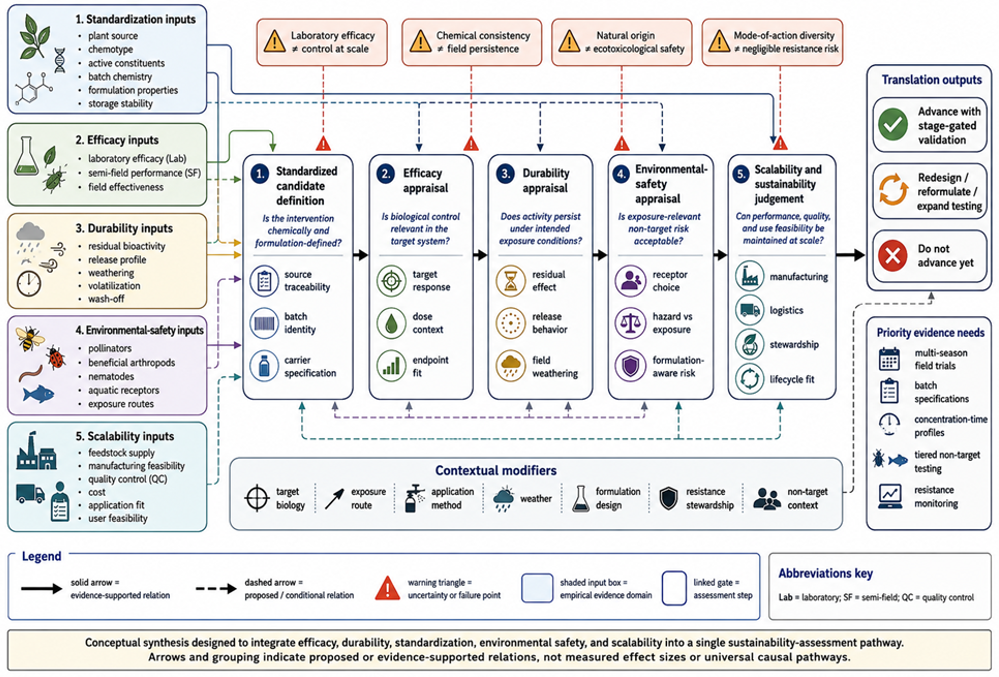
A sustainable assessment pathway must therefore integrate five independent dimensions: efficacy, durability, standardization, environmental safety and scalability. A failure in one dimension cannot be cancelled by success in another. For nano-enabled products, ecological-risk problem formulation must consider whether the carrier changes fate, exposure, bioavailability or receptor sensitivity relative to the unformulated active [28]. Figure 1 integrates efficacy, durability, standardization, environmental safety, and scalability into a single sustainability-assessment pathway within the analytical logic developed in this section.
|
|
|
Figure 1. Efficacy, durability, standardization, environmental safety, and scalability into a single sustainability-assessment pathway |
Alt text
A structured conceptual diagram that integrates efficacy, durability, standardization, environmental safety, and scalability into a single sustainability-assessment pathway, with labelled components, directional relations, contextual modifiers, uncertainty points, and a clear boundary between observed evidence and proposed synthesis.
Translation should test performance and safety concurrently rather than treating ecotoxicology as a final screening step. Integrated testing of a hemp-oil nanoemulsion against pests and aquatic microcrustaceans illustrates why efficacy optimization and non-target assessment should proceed together [29]. Comparative testing of Persea venosa oil and its nanoemulsion against a pest and pollinator bees similarly supports paired formulation-benefit and safety evaluation [30]. These studies remain pre-field and receptor limited, but they demonstrate a stronger development logic: formulation advancement should be conditional on evidence that increased delivery does not create disproportionate exposure or hazard.
The highest-priority research need is specification-led, stage-linked translation. The next translational step is a specification-led programme linking capsule chemistry and controlled release to storage, weathering, field effectiveness, exposure and lifecycle safety [31]. This programme should include multi-batch chemical characterization, harmonized vehicle controls, concentration–time measurements, multi-season effectiveness studies, baseline susceptibility and resistance monitoring, operator and non-target exposure assessment, and feasibility evaluation under intended use conditions. The unresolved question is not whether botanical materials can kill insects, but which defined products can maintain sufficient control without unacceptable ecological or implementation costs. No single laboratory endpoint, mechanistic observation, chemical specification or safety assay can answer that question independently.
CONCLUSION
Botanical insecticides can contribute to sustainable pest management at scale, but only conditionally. The evidence supports meaningful efficacy in selected laboratory, semi-field, stored-product and crop systems and shows that formulation can improve delivery or residual action. It does not support treating laboratory activity as operational control, chemical consistency as environmental persistence, natural origin as ecological safety or mode-of-action diversity as resistance immunity. The strongest defensible pathway is product specific and evidence gated: traceable plant sources, reproducible chemistry, characterized formulation, field-relevant efficacy, resistance stewardship, exposure-based non-target assessment and feasible implementation must converge. The highest priority is therefore not broader unsystematic screening, but integrated validation across batches, environments, seasons, receptors and use systems before claims of sustainable control are made.
ACKNOWLEDGMENTS: None
CONFLICT OF INTEREST: None
FINANCIAL SUPPORT: None
ETHICS STATEMENT: None