Entomology and
Applied Science Letters
Applied Science Letters
 2025
Volume 12
Issue 1
2025
Volume 12
Issue 1

Ecological intensification is promoted as a means of suppressing crop pests while reducing insecticide dependence, yet it often combines interventions and outcomes that are not biologically equivalent. This systematic review evaluates how crop diversification, habitat management, and natural-enemy conservation influence pest regulation across field and landscape scales. The synthesis separates diversification from the mechanisms it may activate, distinguishes natural-enemy abundance from realized control, and treats pest density, crop damage, yield, and pesticide use as related but non-interchangeable outcomes. Evidence was classified by intervention, mechanism, scale, pest and enemy guild, outcome, and strength of inference. Ecological intensification most consistently improved habitat availability, resource continuity, and beneficial-arthropod responses. Stronger evidence for reduced pest pressure or damage occurred when interventions matched crop phenology, target-pest biology, enemy movement, and landscape configuration. Effects weakened where resources were poorly timed, simplified or pesticide-intensive landscapes constrained recolonization, or intermediate biodiversity responses were assumed to imply agronomic benefit. Crop diversification and habitat management therefore function less as universal treatments than as context-dependent components of integrated pest management. The review proposes an evidence-to-decision pathway requiring explicit support for each link from intervention design to mechanism, realized suppression, and production outcome. Priorities include longer studies, standardized functional outcomes, trait-informed moderator analysis, multiscale designs, and economic evaluation.
INTRODUCTION
Ecological intensification redesigns crop production so biodiversity and ecological processes contribute directly to pest regulation and production stability. Its appeal is practical: insecticide-dependent protection selects resistance and can disrupt beneficial organisms, whereas diversified systems may distribute control across several functions. Broad synthesis shows that agricultural diversification can improve ecosystem services without a consistent yield penalty, while habitat-management research indicates that non-crop resources can support enemies and sometimes reduce pests [1, 2]. The unresolved question is whether these ecological changes become reliable, agronomically meaningful suppression.
That question is obscured when unlike constructs are treated as equivalent. More plant species do not necessarily generate greater control; more enemies do not prove consequential pest mortality; local effects do not establish landscape regulation; and short observations do not demonstrate durability. Pest-suppressive systems therefore require integrated design linking crop arrangement, resource timing, enemy traits, pest biology, disturbance, and production objectives [3]. This is especially important when ecological intensification is proposed as a substitute for insecticides, because premature input reduction may expose crops to unacceptable damage.
The practical issue is conditional: which combinations of crop diversity, habitat structure, landscape context, and pest-enemy biology change management decisions? Crop diversity may reduce pesticide dependence, but ecological effects must be accompanied by feasible practices, monitoring, coordination, and institutional support [4]. An intervention can be biologically promising yet operationally weak if it demands excessive land, labor, or cross-farm coordination. Conversely, modest effects may be valuable when they delay treatment, preserve selective chemistries, or stabilize control within integrated pest management.
This review evaluates crop diversification, habitat management, and natural-enemy conservation as linked but distinct domains. It identifies convergent findings, disagreements, moderators, and measurement substitutions, then integrates them into a pathway from intervention to mechanism, suppression, and production outcome. The aim is not to claim universal chemical replacement, but to establish when ecological intensification can strengthen resistance-resilient crop protection and what evidence is needed before transfer across systems.
Review questions and eligibility criteria
The review addressed five questions: how spatial and temporal crop diversification affects pests and production; when habitat features conserve enemies and generate realized control; how crop, landscape, guild, season, and disturbance modify effects; which conclusions are supported by experiments, observation, models, or synthesis; and which evidence gaps limit responsible management use.
Eligibility was claim-based rather than title-based. Crop-diversification research is unevenly distributed across strategies, regions, systems, and measured services [5]. Articles therefore had to support a defined comparison, mechanism, limitation, or implication in a crop-pest-enemy system. Direct pest outcomes, damage, exclusion-based control, parasitism, predation, insecticide use, yield, and clearly labeled intermediate enemy responses were eligible. Biodiversity-only findings were not used to infer suppression.
Interventions included intercrops, cultivar mixtures, rotations, crop mosaics, flower strips, hedgerows, grasslands, agroforestry, and landscape configuration. Because associational effects vary with environment, herbivore traits, and plant identity or arrangement, moderator information was required whenever evidence supported transfer beyond its focal system [6]. This prevented broad claims from resting on results dependent on specialization, dispersal, climate, crop phenology, or experimental scale.
Outcomes were hierarchical: enemy abundance, richness, activity, and diet were intermediate; mortality, parasitism, predation, exclusion-based control, and lower pest density were functional; damage, yield, quality, and insecticide use were agronomic or operational. Table 1 summarizes the review boundaries.
Table 1. Eligibility, evidence classes, and interpretation boundaries used in the systematic review
|
Domain |
Included evidence |
Validity question |
Interpretive boundary |
Use |
|
Intervention |
Diversified crops, habitat features, and landscape structure |
Is composition, timing, geometry, and management specified? |
Diversification strategies are not interchangeable. |
Compare intervention-specific mechanisms. |
|
Biological response |
Enemies, interactions, and pest density |
Does the measure capture presence or realized control? |
Enemy abundance alone is not suppression. |
Separate intermediate and functional outcomes. |
|
Agronomic response |
Damage, yield, quality, and insecticide use |
Is the response operationally consequential? |
Lower pest density may not reduce damage. |
Assess decision relevance. |
|
Scale and duration |
Field, farm, landscape, seasonal, and multiyear evidence |
Does scale match organism movement and the claim? |
Plot or short-term effects do not prove durable landscape control. |
Judge persistence and transferability. |
|
Inference class |
Experiments, observation, models, and syntheses |
Which alternatives remain? |
Association and model output are not intervention proof. |
Calibrate claim strength. |
Search strategy, screening, and evidence classification
The final search protocol was fixed on 18 July 2026. Web of Science used TS=(("ecological intensification" OR "crop diversification" OR intercropping OR "crop mosaic*" OR "flower strip*" OR hedgerow* OR agroforestry) AND ("pest suppression" OR "biological control" OR parasit* OR predat* OR "pest damage" OR insecticide*) AND (crop* OR agroecosystem*) AND (landscape OR field OR context OR guild)). Scopus used the same blocks in TITLE-ABS-KEY; CAB Abstracts used them in ti,ab,kw; AGRICOLA used phrase and truncation searching across title, abstract, and subject fields; and PubMed used Title/Abstract tags for the diversification, control, and crop blocks. Journal-article, language, and protocol-defined publication filters were applied. Publication details, DOI, disciplinary relevance, and journal standing were verified. Duplicates were identified by DOI and then title-year matching.
Screening moved from title and abstract to full-text claim matching. Eligibility required enough information to identify crop system, pest or guild, intervention, comparator where applicable, outcome, scale, duration, and main validity limitation. Appraisal considered replication, comparator adequacy, confounding, outcome validity, temporal coverage, scale matching, model validation, and reporting completeness. Numerical quality scores were avoided because experiments, landscape studies, syntheses, and models cannot be ranked meaningfully on one scale.
Landscape variables were separated because composition and configuration affect dispersal, edge exposure, encounter rates, and resource complementation differently. A generic complexity index can therefore weaken causal interpretation [7]. Evidence was classified by crop diversity, field size, edge density, semi-natural cover, hedgerow cover, temporal continuity, and biologically relevant radius whenever reported.
Models were used to clarify mechanisms and prediction requirements, not to replace observed control. Natural-pest-control models differ in dispersal, trophic structure, management representation, calibration, and validation [8]. Model conclusions were labeled as inference unless supported by field outcomes. Evidence was then grouped as direct suppression, intermediate response, agronomic outcome, landscape association, mechanism, or implementation evidence.
Evidence confidence was judged from convergence rather than publication count. A repeated association across similar observational studies remained weaker than a smaller body combining manipulation, mechanism, and agronomic outcomes. Conversely, a null yield response did not erase demonstrated biological regulation when yield was limited by weather, fertility, or another pest. This approach retained both positive and null evidence while preventing unrelated endpoints from being pooled into a misleading average.
Crop diversification and pest-regulation outcomes
Crop diversification can act through bottom-up and top-down pathways. Mixing crops may reduce host concentration, disrupt host finding, alter plant quality, or interrupt pest movement; rotations and crop mosaics may provide enemies with complementary prey and refuges. Landscape crop diversity has been associated with stronger cereal-aphid control, showing that crop composition beyond the focal field can contribute to regulation [9]. The relevant variable is not simply crop number but crop identity, arrangement, and resource continuity.
Spatial and temporal heterogeneity create different mechanisms. In cereal landscapes, their interaction influenced aphid control, indicating that a diverse snapshot may not represent the resource history experienced by enemies [10]. Sequential crops can maintain alternative prey between vulnerable stages, but they may also bridge polyphagous pests. Rotations should therefore be judged by pest interruption and enemy continuity rather than species counts alone.
The surrounding matrix modifies within-field diversification. Crop diversity benefited beneficial arthropods in landscapes containing semi-natural habitat, but effects depended on landscape composition [11]. A diversified field in a hostile matrix may not be colonized by effective enemies, whereas a modestly diversified field may receive strong spillover from nearby refuges. Recommendations should specify the landscape conditions under which they were tested.
Seasonal resource continuity is a plausible mechanism. Molecular-diet and community evidence indicates that diversified cropping can stabilize prey availability and strengthen predator-mediated herbivore regulation [12]. This connects diversification to trophic use and pest response, but diet detection does not quantify mortality imposed on each pest. Longitudinal exclusion studies remain necessary to distinguish durable control from predator redistribution.
Agronomic interpretation requires another step. Herbivore prevalence was a poor predictor of yield across contrasting diversified systems [13]. Crop tolerance, compensatory growth, pest identity, timing, and management can decouple pest presence from loss. Lower abundance should not be the sole endpoint, and greater prevalence should not imply greater damage without threshold or yield evidence.
Diversification may also redistribute rather than uniformly reduce herbivores. Generalists can exploit several crops, specialists may respond strongly to host dilution, and enemy communities can switch among prey. Evaluation should therefore retain species or guild identity and record whether one pest declines while another increases. Multifunctional benefits remain relevant, but they cannot compensate automatically for greater damage by the focal pest.
Table 2 shows the evidence needed to move from diversification response to management inference. Crop diversification can strengthen regulation when crop identity, sequence, enemy access, and pest traits align, but diversity itself is not a decision criterion.
Table 2. Crop-diversification pathways, expected responses, and decision boundaries
|
Pathway |
Mechanism |
Best outcome |
Common failure mode |
Decision rule |
|
Intercrops or mixtures |
Host dilution, disrupted host finding, and enemy access |
Pest density plus damage or yield |
Crop density, architecture, or input differences |
Specify crop-pest combination and geometry. |
|
Rotations |
Pest-cycle interruption and seasonal enemy resources |
Carry-over pests, enemy activity, damage, and inputs |
Alternative hosts bridge polyphagous pests |
Evaluate sequences across years. |
|
Crop mosaics |
Regional host dilution and dispersal support |
Multiscale control and insecticide use |
Covariation with habitat and farm intensity |
Match radius to organism movement. |
|
Crop plus non-crop diversity |
Complementary within- and off-field resources |
Enemy function and realized control |
Colonization limits or disturbance |
Treat field and landscape measures as interacting. |
|
Yield-based assessment |
Tolerance and compensation |
Damage, yield stability, and treatment need |
Pest abundance poorly predicts injury |
Use thresholds and crop performance. |
Habitat management and natural-enemy conservation
Habitat management alters resources and movement pathways around crops. Flower strips, hedgerows, grasslands, tree rows, and managed margins can provide nectar, pollen, alternative prey, refuge, and favorable microclimates, but may also support pests or concentrate enemies outside crop interiors. In organic apple, combining semiochemicals with habitat manipulation changed pests and enemies differently, showing that attract, reward, and disruption components should not be assumed equivalent [14].
Flower strips illustrate the difference between recruitment and control. Cabbage-adjacent strips increased green-lacewing activity and pollen use, supporting conservation-control plausibility [15]. Yet attraction does not establish crop retention, target-pest attack, lower damage, or sufficient spatial reach. Designs must align bloom timing, resource accessibility, crop vulnerability, and the risk of supporting pests.
Structural diversification expands the mechanism. Alley-cropping can increase spider functional diversity, diverse flower strips commonly promote enemies, and targeted strips can reduce aphid pressure and improve yield in particular systems [16–18]. These findings represent different inference levels: community response indicates potential, meta-analysis estimates average recruitment, and direct pest-yield evidence is agronomically stronger. Combining them without distinction would overstate certainty.
Habitat effects are spatially uneven. Benefits may decline from strips or woody boundaries toward field centers, especially for small or weakly dispersing enemies. Large fields, poor connectivity, and pesticide exposure can prevent colonization or survival. Highly mobile enemies may respond more to landscape composition than to a local feature. Design should therefore follow enemy movement and pest distribution, not a fixed habitat percentage.
Community composition also matters. Richness may increase response diversity, but communities include competitors, intraguild predators, hyperparasitoids, and taxa that consume alternative prey without affecting the target. Dispersal, hunting mode, phenology, diet breadth, thermal tolerance, and pesticide susceptibility may predict function better than total abundance.
Compatibility with other tactics determines whether habitat benefits persist. Broad-spectrum applications can convert a well-designed strip into an ecological sink, whereas selective products and threshold-based timing may preserve recruited enemies. Maintenance also matters: mowing, irrigation, reseeding, weed control, and replacement costs influence floral continuity and farmer adoption. These requirements should be treated as part of the intervention rather than omitted from efficacy claims.
Table 3 translates these principles into design requirements. Habitat management is most defensible when crop, enemy, timing, spatial reach, maintenance, and functional outcomes are explicit; it is weakest when generic floral diversity is assumed to create control regardless of landscape or pesticide regime.
Table 3. Habitat-management options and evidence required for conservation biological control
|
Option |
Function |
Evidence beyond abundance |
Key dependency |
Boundary |
|
Flower strips |
Nectar, pollen, prey, and attraction |
Retention, attack, spatial reach, damage, and yield |
Plant identity, bloom timing, crop duration, and distance |
Avoid pest-supporting or unmeasured designs. |
|
Hedgerows |
Overwintering, refuge, and corridors |
Colonization, parasitism or predation, and pest pressure |
Continuity, age, composition, and adjacent management |
Benefits may require long-term connectivity. |
|
Grasslands or refuges |
Persistent shelter and alternative resources |
Carry-over enemies and subsequent control |
Mowing, drift, and regional land cover |
May complement rather than replace crop diversity. |
|
Agroforestry |
Structure, microclimate, and refuge |
Functional activity, pest response, and crop performance |
Tree-crop competition and field geometry |
Weigh control potential against agronomic trade-offs. |
|
Habitat plus semiochemicals |
Attraction, reward, repellence, or disruption |
Factorial attribution of effects |
Timing and compound specificity |
Do not attribute bundled success to habitat alone. |
Context dependence across crops, landscapes, and pest guilds
Context dependence is the structure of the evidence, not a residual explanation. Vineyard studies show that landscape simplification can increase outbreaks and insecticide use, but relevant components and pathways differ among pests and regions [19]. Perennial crops may support stable enemy communities yet also chronic pest reservoirs; annual systems depend more on recolonization and temporal continuity. Architecture, harvest schedule, and economic thresholds determine whether a given level of control is sufficient.
Landscape components provide different resources. Long-term grasslands and crop diversity can contribute complementarily to limiting pest and weed infestations [20]. Persistent habitat may support overwintering, while crop mosaics alter host concentration and seasonal sequences. Their interaction may be synergistic, redundant, or antagonistic depending on organisms and timing.
Specific features may outperform aggregate metrics. Greater hedgerow cover has been associated with lower pest pressure and insecticide use [21], suggesting that quality and connectivity can matter more than total semi-natural cover. Observational gradients remain confounded, however, because hedgerow-rich farms may differ in field size, crop choice, pesticide intensity, or management philosophy. Repeated measures and mechanistic indicators are needed.
Disturbance can override habitat benefits. Pesticide use and large patch size reduced the magnitude and temporal stability of natural control in vineyards [22]. Broad-spectrum or poorly timed applications may remove recruited enemies, while large fields can exceed dispersal distances. Selective products, threshold timing, refuges, and recolonization routes are therefore part of the ecological intervention.
Pest guild and control mode constrain transfer. Landscape simplification reduced parasitism and yield in a classical-control system, but this cannot be generalized to every parasitoid or crop [23]. Specialists, generalist predators, mobile aphids, sedentary larvae, and pests using non-crop hosts respond differently. Trait-informed synthesis is therefore preferable to pooling all pests or enemies.
Scale and time interact rather than operate independently. A local resource may influence short-range enemies during one crop stage, while landscape crop turnover determines overwintering and recolonization. Studies using one buffer radius or one sampling date can therefore miss the operative scale. Multiscale, repeated designs are more informative when radii and dates are chosen from organism biology rather than selected after results are known.
Four moderators recur: resource-organism match, movement scale, temporal alignment of resources and disturbance, and propagation from biological response to damage or yield. These explain why the same practice can produce control, neutrality, or trade-offs across systems.
Systematic evidence synthesis
The evidence supports a graded conclusion. Ecosystem services and agrochemicals jointly influence yield, so ecological and chemical components should be treated as interacting rather than mutually exclusive [24]. Diversification may reduce treatment frequency without eliminating applications. Selective insecticides can preserve enemies, while ecological control may delay resistance and protect chemical modes of action. The relevant outcome is improved reliability and reduced unnecessary exposure.
Evidence strength differs by design. Administrative datasets reveal landscape correlates of insecticide use at large scale but cannot identify whether lower use resulted from enemies, pest colonization, crop choice, farmer behavior, or other factors [25]. Experiments provide stronger attribution but cover fewer sites and years; syntheses broaden inference but inherit heterogeneity. Convergence across evidence classes is therefore more persuasive than any class alone.
Quantitative synthesis shows average benefits of flower strips and hedgerows, while pest-control and yield responses remain variable [26]. Resource provisioning occurs early in the causal chain; its translation to yield depends on retention, attack rate, crop tolerance, weather, disturbance, and other limiting factors. Certainty therefore declines as claims move from mechanism to durable, economically sufficient suppression.
Landscape synthesis likewise indicates that herbivores, enemies, and yield respond through pathways differing among crops and guilds [27]. Cotton evidence shows that crop diversity and multispecies interactions can alter whitefly and aphid abundance differently [28], while diverse landscapes may increase bat activity without uniform prey responses [29]. These are not simple failures; they demonstrate the need to match intervention, organism, and outcome.
The synthesis also distinguishes confidence in direction from confidence in magnitude. Evidence may support that a practice usually increases enemy activity while remaining unable to predict whether pest density falls by an agronomically sufficient amount. Management decisions require both: direction identifies a plausible tactic, whereas magnitude and variability determine whether it can alter thresholds, treatment timing, or acceptable risk.
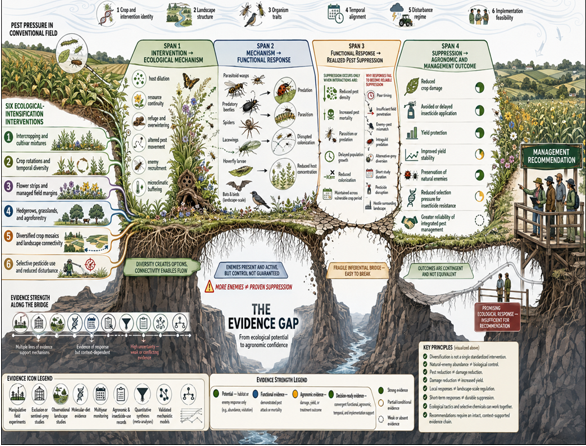
Figure 1 presents the evidence-to-decision pathway. Each link must be supported or qualified: intervention to mechanism, mechanism to pest-enemy response, response to suppression, and suppression to damage, yield, input use, or reliability. Moderators act at every transition.
|
|
|
Figure 1. Evidence-to-decision pathway for evaluating ecological intensification as pest suppression |
Alt text
A five-stage horizontal pathway runs from diversification intervention through ecological mechanism, enemy and pest response, realized pest suppression, and damage, yield, and input outcome. Five dashed moderator boxes below represent crop identity, landscape structure, organism traits, temporal continuity and disturbance, and feasibility and coordination.
Exact placement: immediately after the Figure 1 callout paragraph in Section 9, before Table 4.
Table 4 converts this logic into confidence statements. Confidence is highest where independent evidence classes converge on mechanism and functional outcome, and lower where studies rely on proxies, short duration, single sites, or observation.
This calibration matters for publication and practice. Strong language is justified when pest mortality, damage, and management outcomes align across settings; qualified language is required when only enemy response or landscape association is available. Reporting the exact endpoint behind each conclusion makes the evidence usable without converting uncertainty into either advocacy or dismissal.
Table 4. Cross-domain synthesis, confidence, and management boundaries
|
Domain |
Convergent finding |
Main uncertainty |
Confidence |
Boundary or priority |
|
Crop diversification |
Can reduce host concentration and improve enemy resource continuity |
Depends on crop identity, arrangement, pest traits, and habitat |
Moderate with direct pest outcomes |
Specify strategy and test damage or treatment outcomes. |
|
Habitat management |
Often increases enemy activity and sometimes control |
Spatial reach, timing, plant identity, and maintenance vary |
Moderate for recruitment; variable for yield |
Design for target organisms and monitor beyond edges. |
|
Landscape structure |
Shapes dispersal, overwintering, colonization, and treatment use |
Scale choice and correlated management can bias inference |
Moderate with multiscale convergence |
Separate composition and configuration. |
|
Enemy conservation |
Resources and reduced disturbance can stabilize functional communities |
Abundance may not predict target mortality |
Moderate with functional evidence |
Measure diet, exclusion, parasitism, or predation. |
|
Production resilience |
Ecological control can complement selective inputs |
Durability, economics, labor, and coordination are underreported |
Low to moderate for substitution claims |
Evaluate multiyear risk, cost, and resistance value. |
Management implications and research gaps
Management should begin with the target pest and failure mode, not a preferred practice. Regional host concentration may call for landscape crop diversity; a short resource gap may call for targeted floral or refuge resources; poor field penetration may require smaller fields, better edge connectivity, or combined local and landscape measures. Crop diversity and edge density can support suppression through distinct bottom-up and top-down processes [30].
Seasonal continuity deserves operational attention. Off-season crop cover and landscape composition can shape predator diversity and later control potential [31]. Plans should map reproduction, overwintering, dispersal, alternative prey, and crop vulnerability. Because continuity can also maintain pests, multiyear monitoring should record both trophic groups, applications, damage, and yield.
Terminology must be precise. Biological control includes distinct mechanisms and intervention modes; enemy presence should not be labeled control unless functional effects are demonstrated [32]. Reports should distinguish conservation potential, predation, parasitism, exclusion-based control, pest reduction, damage reduction, and yield.
Context dependence should be tested prospectively. Plant-diversity studies need pre-specified moderators such as crop architecture, resource timing, herbivore specialization, enemy traits, pesticide disturbance, field size, and configuration [33]. Multilandscape, multiyear studies should be powered for interactions and combine standardized core outcomes with system-specific measures.
A portfolio approach is supported because diversification has positive average but variable effects across strategies and services [34]. Managers should combine complementary mechanisms, preserve selective chemical options for threshold exceedance, and adapt the portfolio through monitoring. Ecological intensification is most useful when it reduces avoidable treatments, suppresses pest growth before thresholds, protects enemies, and retains fallback tactics.
Implementation should use adaptive monitoring. Baseline pest and enemy levels, intervention costs, crop damage, treatment decisions, and yield should be recorded before and after adoption. Predefined triggers can specify when ecological control is judged sufficient, when a selective intervention is needed, and when the habitat design should be revised. Such monitoring converts ecological intensification from a fixed prescription into a learning process and limits the risk of persisting with an ineffective practice.
Landscape interventions also raise coordination questions. The farm establishing habitat may bear costs while neighboring farms receive part of the benefit, and poorly synchronized pesticide use can undermine shared enemy populations. Research should therefore test incentive structures, cooperative monitoring, and spatial targeting alongside ecological performance. These are implementation conditions, not proof that a practice works biologically, but they determine whether landscape-scale control can be maintained.
Research priorities are longer interventions; direct links among enemies, pest mortality, damage, yield, and pesticide use; standardized reporting of composition and geometry; trait-informed and multiscale analysis; economic and labor assessment; and cross-farm coordination. Null and adverse outcomes, including pest support, intraguild predation, land competition, and yield penalties, must also be reported.
CONCLUSION
Ecological intensification can strengthen pest suppression, but not automatically. Evidence is strongest when interventions provide resources or structure matched to target pests and effective enemies, disturbance does not erase benefits, and studies measure functional regulation and agronomic outcomes rather than abundance alone. Crop diversification, flower strips, hedgerows, grasslands, agroforestry, and landscape redesign should therefore be treated as mechanism-based components of integrated pest management.
The practical standard is a complete evidence chain: intervention, mechanism, pest-enemy response, suppression, and production or input outcome. Missing links require qualified claims and monitoring. Under this standard, ecological intensification can reduce unnecessary insecticide use, protect enemies, and support resistance resilience while retaining selective interventions when thresholds are exceeded.
ACKNOWLEDGMENTS: None
CONFLICT OF INTEREST: None
FINANCIAL SUPPORT: None
ETHICS STATEMENT: None