Entomology and
Applied Science Letters
Applied Science Letters
 2025
Volume 12
Issue 3
2025
Volume 12
Issue 3

Engineering insect-associated microorganisms offers a route to suppress pathogens, alter vector competence, or reduce insect survival without relying exclusively on conventional chemical control. However, demonstrating an engineered microbial function does not establish that the organism will remain stable, restricted, containable, or ecologically reversible after movement beyond controlled laboratory systems. This article develops an original safety-by-design synthesis for paratransgenesis, microbial replacement, and related symbiont-engineering strategies. The approach integrates evidence concerning microbial colonization, functional mechanisms, host responses, transmission pathways, ecological persistence, host-range uncertainty, environmental acquisition, community interactions, containment, reversibility, and monitoring. The synthesis indicates that efficacy and ecological safety must be evaluated as distinct but interacting dimensions. A symbiont may express a desired antipathogen or insecticidal function while exhibiting uncertain persistence, altered host compatibility, indirect environmental exposure, or effects on resident microbial communities. Likewise, successful host association cannot establish host-range restriction, laboratory containment cannot establish environmental containment, and construct inactivation cannot guarantee reversal of prior ecological or community effects. The proposed structure therefore organizes symbiont engineering around explicit chassis–host compatibility, function-specific causal validation, transmission-ecology characterization, environmental exposure analysis, community-response testing, and staged evidence gates. Current limitations include strong dependence on a small number of host–symbiont systems, limited long-term ecological observation, incomplete assessment of non-target exposure, and difficulty separating microbial effects from environmental and host-mediated mechanisms. Progress requires integrating ecological failure analysis into early engineering decisions rather than treating biosafety as a final pre-release test.
INTRODUCTION
Insect symbionts can be modified, introduced, or selectively established to interfere with pathogen development, alter host physiology, or deliver biologically active molecules. Paratransgenesis uses genetically modified insect-associated microorganisms to deliver antipathogen functions within a vector, while making colonization, transmission, fitness and ecological safety part of the intervention problem [1]. This dual character distinguishes symbiont engineering from a conventional delivery technology: the microbial chassis is both a functional platform and a living ecological participant whose replication, movement, interaction partners, and environmental survival may influence the intervention’s consequences.
The scientific challenge is intensified by the context dependence of insect microbiomes. Mosquito-associated microbial communities influence vector physiology and pathogen susceptibility, but their composition and effects vary with life stage, habitat, diet and experimental method [2]. Consequently, detection of a microbial taxon does not prove stable colonization, and an observed association with pathogen inhibition does not by itself establish causation. Functional claims require intervention-based tests, appropriate microbial and host controls, and evaluation across biologically relevant compartments and life stages.
Symbiont-based control is nevertheless attractive because it may exploit mechanisms unavailable to conventional vector-management tools, including inherited pathogen blocking, microbial effector secretion, immune activation, niche competition, and delivery of gene-silencing molecules. Recent symbiont-based strategies can suppress several mosquito-borne pathogens, yet their responsible use still depends on evidence for durability, ecological behavior, monitoring and controllability [3]. The principal gap is therefore not simply whether an engineered or replacement symbiont can work, but whether its function, exposure pathways, persistence, host range, community effects, and failure modes can be evaluated without treating one successful endpoint as evidence for all others.
This article proposes a non-validated safety-by-design structure in which functional performance and ecological behavior are assessed through linked but non-equivalent evidence domains. Microbiome engineering is most defensible when desired function, ecological stability, interaction structure and validation are treated as separate design dimensions rather than collapsed into a single performance claim [4]. The central argument is that engineered function is not equivalent to ecological stability; host association is not equivalent to host-range restriction; laboratory containment is not equivalent to environmental containment; and reversibility of a construct is not equivalent to reversibility of community effects. These distinctions guide the comparison of paratransgenesis and microbial replacement and the subsequent analysis of persistence, transfer, containment, monitoring, and governance.
Symbiont engineering as an insect-control strategy
Symbiont engineering begins with a definable biological objective, but an intervention cannot be characterized solely by the intended endpoint. Engineered Serratia AS1 provided direct proof that a transmissible mosquito symbiont can express antiparasitic effectors and sharply reduce Plasmodium development under controlled conditions [5]. Serratia-mediated refractoriness can operate through activation of mosquito immune responses, showing that engineered outcomes may depend on host-mediated pathways as well as microbial effector production [6]. A credible design must therefore identify whether the proposed function is produced directly by a microbial molecule, indirectly through host physiology, or through an interaction between both mechanisms.
Mechanistic resolution is particularly important when a candidate symbiont combines colonization, transmission, and pathogen inhibition. The naturally occurring Serratia ureilytica Su_YN1 links a defined antimalarial lipase to parasite killing and demonstrates vertical and horizontal dissemination in mosquito populations under controlled conditions [7]. A multiplexed engineered symbiont can suppress both malaria parasites and arboviruses in experimental mosquitoes, although broader functional scope also expands the set of ecological and evolutionary failure modes that must be tested [8]. Functional breadth may improve intervention utility, but it can also increase selection pressure, expand off-target questions, complicate construct stability, and create dependencies that are not visible in single-pathogen assays.
Exposure context must consequently be designed alongside biological function. Engineered gut bacteria can deliver RNA interference to mosquito larvae and reduce survival, demonstrating a control route whose aquatic exposure profile differs materially from adult transmission-blocking paratransgenesis [9]. The proposed synthesis therefore separates five design questions: whether the chassis can colonize the intended host and compartment; whether the proposed function has been causally demonstrated; whether transmission is sufficient but not uncontrolled; whether the relevant life stage creates additional environmental exposure; and whether efficacy, persistence, community effects, and containment have independent validation plans. These are analytical requirements rather than evidence that any current system is environmentally ready. The proposed components, evidence bases, boundary conditions, failure modes, and validation requirements are organized in Table 1.
Table 1. Symbiont Engineering as an Insect-Control Strategy: Components, Evidence Basis, Relations, Boundary Conditions, Failure Modes, and Validation Requirements
|
Proposed component |
Purpose |
Evidence basis |
Relation or mechanism |
Input or precondition |
Expected output |
Boundary condition or failure mode |
Validation requirement |
|
Chassis–host compatibility |
Establish biologically credible colonization without assuming ecological restriction |
Paratransgenesis depends on colonization and transmission; symbiont effects may be host-mediated |
Microbial establishment interacts with host immunity, physiology, and tissue environment |
Defined microbial strain, insect genotype, life stage, tissue target, and delivery route |
Reproducible colonization with characterized host effects |
Natural association does not prove engineering suitability, host-range restriction, or negligible fitness effects |
Reciprocal colonization tests, tissue localization, shedding assessment, and host-fitness evaluation |
|
Function-specific causal validation |
Demonstrate that the intended outcome arises from the proposed microbial mechanism |
Engineered effectors and a defined antimalarial lipase reduce parasite development under controlled challenges |
Secreted molecules act directly on pathogen stages, with construct and pathway controls |
Stable construct or naturally characterized functional gene; appropriate microbial controls |
Reproducible pathogen inhibition attributable to a defined mechanism |
Endpoint reduction may reflect altered colonization, immunity, or unmeasured experimental conditions |
Gene disruption, complementation, effector quantification, and pathogen-challenge controls |
|
Transmission characterization |
Determine whether movement supports intervention coverage without being interpreted as containment |
Vertical and horizontal dissemination can occur in controlled mosquito populations |
Maternal, sexual, social, or environmental movement connects hosts and generations |
Detectable microbial marker, defined donor–recipient system, and transmission route |
Measured transmission efficiency in the intended host system |
Cage dissemination does not establish field stability, ecological restriction, or reversibility |
Multigenerational tracking, viable-cell detection, route-specific controls, and environmental sampling |
|
Multiplex functional architecture |
Evaluate systems designed to act against more than one pathogen |
Engineered symbionts can express multiple pathogen-targeting functions |
Combined effectors broaden biological activity within a colonized host |
Construct stability, compatible expression burden, and relevant pathogen challenges |
Concurrent pathogen suppression under specified conditions |
Broader activity may increase metabolic burden, selection, off-target effects, and evolutionary escape |
Longitudinal construct testing, separate mechanism controls, and non-target functional assays |
|
Life-stage and exposure alignment |
Match the engineering strategy to the ecological compartment in which exposure occurs |
Larval gut bacteria can deliver RNA interference and alter mosquito survival |
Oral acquisition in aquatic habitats enables microbial delivery to larval tissues |
Defined larval habitat, bacterial dose, target gene, and exposure duration |
Target-gene suppression and altered larval phenotype |
Aquatic release may expose environmental microorganisms and non-target organisms differently from adult applications |
Environmental-fate testing, target-specificity assays, persistence measurement, and non-target exposure analysis |
|
Evidence-separation architecture |
Prevent functional success from being treated as proof of ecological safety |
Microbiome engineering requires separate evaluation of function, stability, interaction structure, and validation |
Evidence domains remain connected but are not interchangeable |
Explicit problem formulation and predefined claims for efficacy, exposure, persistence, and safety |
A traceable, claim-specific evidence package |
A single positive endpoint can conceal instability, context dependence, or untested ecological pathways |
Tiered tests with independent acceptance criteria and stated uncertainty |
Paratransgenesis and microbial replacement
Paratransgenesis and microbial replacement alter vector biology through different intervention logics. Paratransgenesis generally modifies a culturable symbiont to express a desired function, whereas replacement establishes a microorganism whose inherited biological properties alter population-level vector competence. A cluster-randomized field trial showed that establishment of wMel-infected Aedes aegypti populations substantially reduced dengue incidence and hospitalization, providing direct evidence for the public-health potential of microbial replacement [10]. This evidence establishes that a symbiont-based population intervention can produce epidemiologically relevant benefit, but it does not establish the environmental safety of engineered extracellular bacteria or make replacement and paratransgenesis biologically interchangeable.
Persistence is similarly strategy-specific. Longitudinal field surveillance found that wMel infection and relevant phenotypes remained stable in Aedes aegypti populations for roughly a decade, illustrating the timescale on which persistence claims may need to be evaluated [11]. Urban wMel spread was spatially heterogeneous and shaped by local population structure and movement barriers, showing that dissemination cannot be inferred from release success at a single site [12]. These findings make persistence neither inherently beneficial nor inherently hazardous. Persistence can sustain pathogen blocking, yet the same durability may complicate intervention withdrawal. Conversely, spatial barriers may limit coverage while also constraining spread. The relevant question is therefore whether the observed persistence and movement correspond to the intervention’s predefined ecological and decision boundaries.
Replacement also affects a host–microbiome system rather than an isolated symbiont–pathogen pair. Wolbachia density covaried with Aedes aegypti microbiome composition, indicating that replacement interventions should monitor the wider community while avoiding causal claims from compositional association alone [13]. Wolbachia-mediated virus blocking is mechanistically heterogeneous and sensitive to symbiont strain, density, mosquito genotype, virus and environment, so replacement performance should not be treated as invariant [14]. Paratransgenesis and replacement should consequently be compared through mechanism, inheritance, environmental acquisition, spatial spread, community interaction, and controllability rather than through efficacy alone. Field success in one replacement system can inform the timescale and breadth of evaluation, but it cannot substitute for evidence about an engineered chassis with different transmission and environmental-survival properties.
Ecological persistence and host-range uncertainty
Ecological persistence refers to continued presence or repeated reacquisition within the host–environment system, not merely detectable survival during a laboratory assay. Host range must likewise be treated as an experimentally testable property. Experimental transfers and evolution showed that symbiont host compatibility can extend beyond the original association and can change through adaptation, making host-range restriction an empirical rather than taxonomic assumption [15]. Comparative genomics of insect-associated Asaia revealed convergent genome reduction alongside retention of an insecticide-degrading gene, illustrating how ecological selection can preserve functions unrelated to the engineered objective [16]. A chassis may therefore possess adaptive or metabolic capacities that shape survival under environmental pressures even when those capacities are not part of its intended design.
Community context can also change whether colonization and host responses observed in the laboratory remain informative outside it. Aedes aegypti responded differently to microbiome transplants from field-caught and laboratory mosquitoes, showing that laboratory community compatibility cannot be assumed to represent field ecological interactions [17]. Foliar-feeding insects acquired substantial microbial input from soil rather than directly from the host plant, demonstrating that environmental reservoirs can connect engineered microbes to hosts through indirect pathways [18]. These findings do not establish that a particular engineered insect symbiont will cross species or persist environmentally. They establish that plausible exposure networks extend beyond the initially selected host and that laboratory containment is not equivalent to environmental containment.
Persistence assessment should therefore begin by defining the chassis’s transmission ecology. Insect gut symbioses range from vertically inherited partnerships to environmentally reacquired associations, so persistence must be defined according to the actual transmission ecology of the proposed chassis [19]. The proposed synthesis distinguishes continuous within-host survival, vertical inheritance, repeated horizontal acquisition, environmental reseeding, and spatial recolonization. Each can produce recurring detection while implying different intervention dynamics and control options. Host association is not evidence of host-range restriction, and disappearance of an engineered construct would not necessarily reverse earlier competitive, functional, or community-level changes. The proposed components, evidence bases, boundary conditions, failure modes, and validation requirements are organized in Table 2.
Table 2. Ecological Persistence and Host-Range Uncertainty: Components, Evidence Basis, Relations, Boundary Conditions, Failure Modes, and Validation Requirements
|
Proposed component |
Purpose |
Evidence basis |
Relation or mechanism |
Input or precondition |
Expected output |
Boundary condition or failure mode |
Validation requirement |
|
Host-range testing |
Determine whether compatibility extends beyond the intended host |
Symbiont compatibility can differ among hosts and change through adaptation |
Host and bacterial genotypes jointly determine colonization and functional compatibility |
Candidate chassis, intended host, ecologically plausible non-target hosts, and controlled inoculation routes |
Empirical compatibility profile rather than assumed taxonomic restriction |
Failure to colonize one tested species does not establish broad restriction; laboratory adaptation may alter compatibility |
Reciprocal inoculation, serial passage, non-target host testing, and measurement of viable persistence |
|
Ecological-function inventory |
Identify microbial traits that may influence survival or selection beyond the intended engineered function |
Insect-associated Asaia retain environmentally relevant functions despite genome reduction |
Conserved metabolic genes may alter fitness under insecticide or environmental exposure |
Genome-resolved chassis characterization and relevant environmental stressors |
Defined set of intended and ancillary functional capacities |
Genomic presence does not establish expression or ecological consequence |
Functional assays under relevant stresses, transcript or protein confirmation, and competitive-fitness testing |
|
Community-provenance challenge |
Test whether laboratory community compatibility transfers to field-like microbiomes |
Field-derived and laboratory-derived microbiota produce different host transcriptional responses |
Community composition and history modify host–microbe interactions |
Standardized host background and contrasting microbial-community sources |
Context-specific host-response and colonization profile |
Transcriptomic differences do not alone establish adverse outcomes or long-term instability |
Controlled transplantation, longitudinal community profiling, host-phenotype assays, and replication across donor contexts |
|
Environmental-reservoir mapping |
Identify indirect pathways connecting the chassis to intended and non-target hosts |
Soil and plant compartments can route microbial acquisition into insect communities |
Environmental substrates act as reservoirs and transmission bridges |
Defined receiving environment, candidate reservoirs, and viable-strain detection methods |
Exposure map linking host, substrate, and environmental compartments |
Detection of microbial DNA does not prove viability, transfer, establishment, or function |
Viability assays, source tracking, route interruption controls, and repeated environmental sampling |
|
Transmission-ecology definition |
Distinguish inherited persistence from repeated environmental reacquisition |
Insect symbioses include vertical, horizontal, and environmentally renewed associations |
Host filtering and recurring acquisition can maintain association without continuous lineage persistence |
Chassis-specific transmission hypothesis and markers capable of distinguishing routes |
Route-specific explanation for recurring detection |
Treating all recurring detection as stable inheritance can misstate spread and reversibility |
Multigenerational lineage tracking, environmental controls, transmission-route experiments, and strain-resolved surveillance |
|
Spatial persistence and spread |
Determine how local establishment relates to wider ecological distribution |
Long-term infection can remain stable, while spread varies across urban structure |
Inheritance, host movement, population structure, and barriers jointly govern distribution |
Longitudinal sampling design and spatially explicit host-population information |
Time- and location-specific persistence estimate |
Stability in one replacement system does not generalize to engineered extracellular symbionts; local establishment does not predict unrestricted spread |
Repeated spatial sampling, population-genetic analysis, phenotypic monitoring, and explicit assessment of barriers |
Horizontal transfer and community-level effects
Horizontal transfer must be separated into exposure, viable transfer, colonization, persistence, and functional expression. Plant tissues can mediate horizontal movement of intracellular insect symbionts between feeding hosts, creating a transfer route that is not captured by maternal-transmission models alone [20]. Experimental work in Drosophila identified mechanisms by which Wolbachia can move horizontally between cells, demonstrating that intracellular residence is not equivalent to absolute transfer containment [21]. These observations establish biological plausibility, but neither cellular transfer competence nor detection on a shared substrate quantifies transfer probability in an open ecological network.
Controlled whitefly experiments demonstrated plant-mediated horizontal transmission of Wolbachia between insect hosts, confirming that shared substrates can bridge species boundaries [22]. The implication for paratransgenesis is conditional: an engineered extracellular symbiont may encounter different barriers and opportunities from an intracellular maternally inherited organism. Transfer analysis should therefore include the intended insect, plausible non-target hosts, shared feeding substrates, aquatic or terrestrial reservoirs, and routes through which viable cells or genetic material could move. Host association cannot be used as a proxy for host-range restriction, particularly where environmental compartments connect otherwise separated insect populations.
Community effects represent a distinct endpoint from focal-strain transfer. Experimental manipulation of bacterial dispersal altered natural community diversity and composition, supporting the need to evaluate community restructuring separately from focal-strain persistence [23]. Introduced symbionts may affect communities through competition, host immune modulation, altered resources, mass effects, or indirect environmental selection, but compositional change alone does not establish ecological harm. Conversely, stable abundance of the engineered organism does not demonstrate community stability. Testing should combine strain-resolved surveillance with functional measurements and controls capable of distinguishing intervention effects from host genotype, habitat, density, laboratory adaptation, and shared environmental drivers.
Containment, reversibility, and monitoring
Containment should be defined as measurable reduction of survival, replication, dissemination, or genetic escape under specified conditions. CRISPR-based kill switches achieved low escape frequencies and improved genetic stability in engineered bacteria, illustrating that containment performance must be measured under evolutionary challenge rather than inferred from circuit design [24]. Escape frequency, mutation routes, fitness costs, environmental dependencies, and performance after prolonged propagation are therefore more informative than the mere presence of a containment cassette. Laboratory containment remains evidence about a bounded test environment, not proof of environmental containment across heterogeneous habitats.
Organismal containment and genetic containment also require separate analysis. Cas9-assisted containment constrained both an engineered commensal bacterium and associated genetic elements, emphasizing that organismal survival and genetic-material escape require separate safeguards [25]. Ecological firewalls propose restricting engineered organisms through designed dependencies and niche constraints, offering a complementary containment layer whose effectiveness remains contingent on real ecological networks [26]. Multiple safeguards may reduce particular failure probabilities, but construct shutdown cannot demonstrate that transferred genes, altered host phenotypes, displaced community members, or changed resource conditions have been reversed.
Monitoring must consequently track more than the continued detection of the introduced strain. A terrestrial mesocosm platform enabled simultaneous measurement of introduced-microbe persistence and community response, illustrating an intermediate evidence tier between laboratory tests and environmental release [27]. For insect symbionts, a monitoring design should distinguish viable organisms from residual DNA, host colonization from transient passage, vertical inheritance from environmental reacquisition, and focal efficacy from community change. It should also define decision triggers for unexpected persistence, non-target detection, loss of construct integrity, altered function, or ecological restructuring. The evidence dimensions and interpretive boundaries for containment reversibility and monitoring are summarized in Table 3.
Table 3. Containment, Reversibility, and Monitoring: Host Context, Microbial Functions, Causal Evidence, Community Stability, Ecological Risk, and Interpretive Boundaries
|
Microbial component or intervention |
Host context |
Proposed function |
Evidence required |
Causal test |
Stability or transmission issue |
Ecological risk |
Interpretive boundary |
|
Engineered paratransgenic chassis |
Intended insect and target tissue |
Effector delivery or host-phenotype modification |
Colonization, expression, efficacy, shedding, persistence, and non-target exposure |
Construct loss, complementation, and matched control strains |
Vertical, horizontal, or environmental movement |
Spread beyond intended hosts or compartments |
Controlled colonization does not establish environmental containment |
|
CRISPR-based kill switch |
Engineered bacterial chassis |
Limit survival after defined conditions |
Escape frequency, mutation spectrum, fitness burden, and long-term stability |
Serial passage and challenge under permissive and restrictive conditions |
Selection for escape or circuit inactivation |
Persistence of escape variants |
Low laboratory escape does not prove ecological containment |
|
Organism-and-DNA containment |
Engineered bacterium and mobile genetic elements |
Restrict cells and associated genetic material |
Cell viability and transfer-capable DNA measured separately |
Recipient assays and genetic-element tracking |
Horizontal gene transfer despite loss of the original cell |
Functional genes entering other microorganisms |
Cell elimination is not equivalent to genetic containment |
|
Ecological firewall |
Chassis within a defined habitat or dependency network |
Restrict establishment through niche or resource dependence |
Dependency strength across relevant environmental conditions |
Removal or substitution of required resources and partners |
Environmental bypass or compensatory adaptation |
Establishment outside the designed niche |
Modelled dependency requires empirical ecological testing |
|
Mesocosm evidence tier |
Introduced microorganism in a semi-realistic community |
Measure persistence and community response together |
Longitudinal abundance, viability, function, and community profiling |
Introduced-strain treatment with matched community controls |
Persistence under fluctuating environmental conditions |
Community displacement or altered ecosystem function |
Mesocosms do not reproduce unrestricted release networks |
|
Post-intervention monitoring |
Intended hosts, non-target hosts, and environmental reservoirs |
Detect spread, failure, or ecological change |
Strain-resolved, viability-aware, spatial and temporal surveillance |
Baseline comparison and predefined trigger analysis |
Reacquisition may resemble continuous persistence |
Delayed or indirect community effects |
Construct disappearance does not prove community reversibility |
Proposed safety-by-design principles
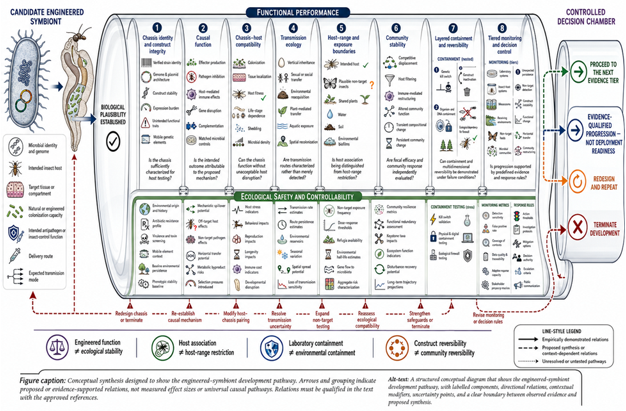
The first principle is separation of evidence domains. Automated design of synthetic microbial communities demonstrates that membership, interaction, and stability can be treated as explicit engineering variables rather than as uncontrolled background conditions [28]. Strategies for tailoring synthetic communities emphasize division of labor, interaction structure, and environmental validation, supporting a principle that engineered function and ecological stability must be tested as distinct outcomes [29]. The development pathway should therefore move through independently documented gates for chassis selection, causal function, host compatibility, transmission ecology, environmental exposure, community response, containment, and monitoring rather than through a single efficacy threshold. Figure 1 shows the engineered-symbiont development pathway within the analytical logic developed in this section.
|
|
|
Figure 1. The engineered-symbiont development pathway |
Alt text
A structured conceptual diagram that shows the engineered-symbiont development pathway, with labelled components, directional relations, contextual modifiers, uncertainty points, and a clear boundary between observed evidence and proposed synthesis.
The second principle is mechanism-bounded functional design. Venom-derived effectors can expand the functional repertoire of paratransgenesis, but their potency makes dose, tissue exposure, non-target activity, and expression burden indispensable safety variables [30]. Wolbachia-mediated dengue inhibition persisted despite substantial microbiome manipulation in Aedes aegypti, showing that an efficacy mechanism can be independent of community composition even though community effects still require separate assessment [31]. Functional success should therefore be attributed only to the demonstrated mechanism and context; it should not be extended to ecological stability, broad safety, or the absence of community effects.
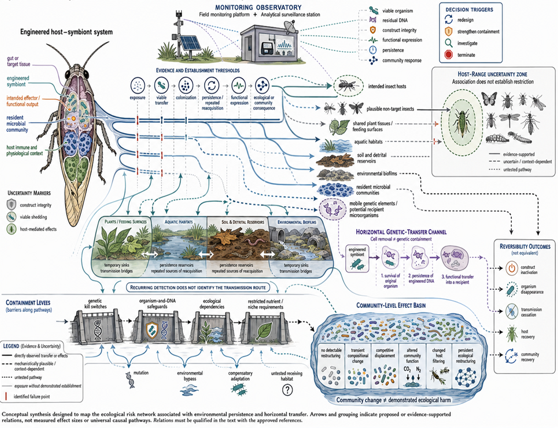
The third principle is reciprocal host–environment assessment. Mosquito hosts can construct environmental niches that reshape bacterial communities in aquatic habitats, supporting reciprocal monitoring of host-associated and external microbial compartments [32]. Persistence and horizontal transfer should be mapped as a network linking engineered cells, hosts, non-target organisms, shared substrates, genetic material, and resident communities. Each connection should be classified as observed, mechanistically demonstrated, inferred, or untested. Figure 2 maps the ecological risk network associated with environmental persistence and horizontal transfer within the analytical logic developed in this section.
|
|
|
Figure 2. The ecological risk network associated with environmental persistence and horizontal transfer |
Alt text
A structured conceptual diagram that maps the ecological risk network associated with environmental persistence and horizontal transfer, with labelled components, directional relations, contextual modifiers, uncertainty points, and a clear boundary between observed evidence and proposed synthesis.
The fourth principle is staged controllability with ecological follow-through. Design decisions should specify failure modes, evidence gates, monitoring indicators, and responses before environmental exposure. Containment should combine genetic and ecological safeguards where appropriate, while reversibility should be divided into construct inactivation, organism removal, cessation of transmission, restoration of host phenotype, and recovery of microbial-community structure. None should be inferred from another. The proposed components, evidence bases, boundary conditions, failure modes, and validation requirements are organized in Table 4.
Table 4. Proposed Safety-by-Design Principles: Components, Evidence Basis, Relations, Boundary Conditions, Failure Modes, and Validation Requirements
|
Proposed component |
Purpose |
Evidence basis |
Relation or mechanism |
Input or precondition |
Expected output |
Boundary condition or failure mode |
Validation requirement |
|
Evidence-domain separation |
Prevent efficacy from substituting for stability or safety |
Microbiome function, interactions, stability, and validation are separable engineering variables |
Independent evidence gates connected by explicit decision logic |
Defined intervention objective and claim-specific endpoints |
Traceable efficacy, exposure, persistence, and safety claims |
One positive endpoint may conceal failure in another domain |
Independent acceptance criteria for each evidence domain |
|
Chassis and host-range qualification |
Test compatibility without assuming restriction |
Host compatibility can extend or evolve beyond the original association |
Genotype, life stage, tissue, and environment shape colonization |
Intended host and plausible non-target panel |
Empirical compatibility and shedding profile |
Natural association may be mistaken for ecological restriction |
Reciprocal inoculation, serial passage, and non-target testing |
|
Mechanism-bounded function |
Limit claims to demonstrated biological pathways |
Engineered effectors can provide potent antipathogen functions |
Effector expression acts directly or through host-mediated pathways |
Stable expression, dose characterization, and causal controls |
Reproducible function attributable to a defined mechanism |
Potency may increase non-target activity or expression burden |
Gene disruption, complementation, exposure, and toxicity testing |
|
Transmission-ecology mapping |
Characterize movement among cells, hosts, and reservoirs |
Plants and cellular processes can mediate horizontal movement |
Vertical inheritance, substrate-mediated transfer, and environmental reacquisition |
Route-specific markers and defined donor–recipient systems |
Transfer network with evidence status assigned to each route |
Detection may be mistaken for viable transfer or establishment |
Viability-aware, route-specific, multigenerational experiments |
|
Community-response separation |
Assess ecological effects independently of focal efficacy |
Community composition may change without explaining the efficacy mechanism |
Competition, host filtering, dispersal, and niche construction |
Baseline community and matched intervention controls |
Functional and compositional community-response profile |
Covariation may be misread as causation or harm |
Longitudinal profiling with host and environmental controls |
|
Layered containment |
Reduce organismal and genetic escape through complementary safeguards |
Genetic kill switches, DNA containment, and ecological dependencies address different routes |
Circuit control plus resource or niche restriction |
Stable safeguards tested under evolutionary and environmental stress |
Measured reduction in escape across specified conditions |
Safeguards may mutate, be bypassed, or fail in untested habitats |
Escape-frequency, mutation, transfer, and ecological-challenge testing |
|
Multidimensional reversibility |
Avoid treating construct shutdown as ecological restoration |
Biological interventions can leave effects after the focal construct disappears |
Inactivation, removal, transmission cessation, and community recovery are distinct |
Predefined recovery endpoints and baseline data |
Separate evidence for technical and ecological reversal |
Prior gene transfer or community restructuring may persist |
Longitudinal recovery testing across host and environmental compartments |
|
Tiered environmental monitoring |
Detect persistence, spread, functional change, and community effects |
Mesocosms and ecological screening can target higher-realism tests |
Laboratory, host, mesocosm, and context-specific environmental tiers |
Validated markers, baselines, spatial design, and decision triggers |
Actionable evidence linked to continuation, modification, or termination |
Mesocosms and predictions cannot validate open-environment safety |
Repeated viability-aware surveillance and predefined response rules |
Governance and research implications
Environmental release governance is strongest when engineering choices, expected ecological behavior, monitoring evidence, and regulatory decision points are linked from the design stage rather than evaluated only after product development [33]. The first priority is therefore a claim-to-evidence dossier that separately documents function, host compatibility, transmission, environmental exposure, persistence, genetic stability, community effects, containment, and reversibility. Progress would be demonstrated by testable acceptance criteria, explicit uncertainty statements, and decision triggers linked to each domain rather than a single aggregate readiness claim.
Biocontainment technologies for environmentally applied engineered microbes must be considered alongside fitness, environmental context, regulation, and public perception rather than treated as a stand-alone proof of safety [34]. The second priority is to evaluate safeguards under biologically relevant failure conditions, including mutation, prolonged propagation, altered resources, non-target hosts, mixed communities, and environmental reservoirs. Risk-assessment guidance for gene drive-modified organisms reinforces a transferable principle: potentially spreading biological interventions require case-specific problem formulation, tiered testing, and explicit exposure pathways [35]. Progress would be shown by evidence that testing tiers reproduce the principal routes through which the proposed symbiont could persist, transfer, or produce indirect effects.
The third priority is adaptive surveillance that connects pre-exposure screening with post-exposure evidence. EcoGenoRisk illustrates how genomic similarity and predicted ecological relationships can prioritize receiving environments for follow-up testing, while remaining a screening tool rather than a validation of environmental safety [36]. Computational prioritization should guide, not replace, host-range experiments, mesocosm assessment, viability-aware environmental sampling, and community-function measurements. Governance should also specify who interprets monitoring signals and what actions follow unexpected persistence, non-target establishment, construct change, or community disruption. Because regulatory pathways differ among engineered extracellular symbionts, inherited replacements, and other spreading systems, the proposed principles organize evidence without claiming universal approval criteria.
CONCLUSION
Safety-by-design engineering of insect symbionts requires more than combining an effective microbial chassis with an antipathogen or insect-control function. The strongest defensible synthesis is that function, colonization, transmission, persistence, host range, community response, containment, reversibility, and monitoring form connected but non-equivalent evidence domains. Engineered function is not equivalent to ecological stability; host association is not equivalent to host-range restriction; laboratory containment is not equivalent to environmental containment; and reversibility of a construct is not equivalent to reversibility of community effects. The highest-priority implication is to move ecological failure analysis into the earliest stages of chassis and construct design, using tiered causal tests, realistic exposure pathways, explicit uncertainty, and predefined monitoring responses. The resulting structure is a proposed scholarly organization for research and decision design, not a validated framework or evidence that any engineered-symbiont system is ready for environmental deployment.
ACKNOWLEDGMENTS: None
CONFLICT OF INTEREST: None
FINANCIAL SUPPORT: None
ETHICS STATEMENT: None