Entomology and
Applied Science Letters
Applied Science Letters
 2026
Volume 13
Issue 1
2026
Volume 13
Issue 1

Insect biology increasingly depends on heterogeneous molecular, organismal, and environmental observations that cannot be interpreted reliably through isolated analytical models. Genome assemblies, single-cell transcriptomes, proteomic and metabolomic measurements, chemical structures, images, behavioural trajectories, and ecological records describe different biological objects at different spatial and temporal scales. Yet current artificial-intelligence applications in entomology are commonly developed around one modality, one species, one laboratory setting, or one narrowly defined prediction task. This architecture article addresses the resulting representational gap by proposing a non-validated multimodal foundation-model structure for insect molecular biology. The approach organizes evidence-supported computational capabilities into modality-specific encoders, biologically conditioned alignment layers, shared and modality-private representations, provenance and uncertainty controls, and task-specific outputs. The synthesis integrates genomic and transcriptomic representation, proteomic and metabolomic learning, chemical-space modelling, computer vision, behavioural time series, ecological context, pretraining, transfer, and biological alignment. The strongest defensible conclusion is that broadly pretrained models may support reusable insect representations only when modality-specific meaning, taxonomy, life stage, tissue, environment, measurement process, and uncertainty remain explicit. Multimodal scale is therefore not equivalent to biological understanding; pretraining performance is not downstream scientific validity; representational alignment is not causal mechanism; and benchmark performance is not evidence of transfer across species, modalities, or environments. Major limitations include taxonomic imbalance, incomplete molecular annotation, sparse cross-modal observations, laboratory–field divergence, leakage, reference-atlas bias, and insufficient biologically independent validation. The central implication is that insect foundation models should be developed as auditable, context-conditioned scientific infrastructures whose outputs can be rejected, qualified, or experimentally tested rather than treated as universal biological explanations or deployment-ready digital twins.
INTRODUCTION
Insect molecular biology is entering a period in which the volume and diversity of available data increasingly exceed the organizing capacity of conventional task-specific analysis. Genome assemblies now span a growing range of insect lineages, while transcriptomic atlases, mass-spectrometric profiles, chemical assays, imaging systems, behavioural platforms, and environmental monitoring generate additional views of biological state. These sources are not interchangeable. A genomic sequence describes inherited molecular structure; a transcriptome records condition-dependent expression; a proteome reflects translation, degradation, localization, and trafficking; and an image or movement trajectory records observable organismal outcomes. Their joint value therefore depends on preserving their distinct biological meanings. Insect genome resources have expanded rapidly, but taxonomic imbalance and assembly-quality heterogeneity mean that sequence scale alone does not create a representative biological substrate [1].
Foundation models offer a possible computational response because they are pretrained on broad data collections and subsequently adapted to multiple tasks. In principle, such a model could reduce dependence on independently engineered pipelines for species identification, molecular annotation, functional prediction, phenotype recognition, behavioural classification, or ecological forecasting. In practice, however, the foundation-model label can conceal important differences among corpus size, self-supervised objectives, modality coverage, transfer procedures, and scientific validation. A system trained on many records may still learn dominant species, laboratory protocols, database conventions, or technical artefacts rather than transferable insect biology. Foundation-model paradigms suggest that self-supervised representations can be reused across modalities and tasks, although that proposition remains unvalidated for insect biology [2].
The central problem is consequently not the absence of algorithms capable of combining data. It is the absence of an insect-specific representational logic that determines what should be combined, what must remain separate, which contextual variables condition interpretation, and what evidence is required before an aligned representation can support a biological claim. Multimodal integration methods show that complementary measurements can improve state resolution when modality-specific structure is retained. Nevertheless, a joint latent space can also erase biologically meaningful differences, absorb batch effects, or create numerical proximity between observations that are not mechanistically connected. Multimodal integration can improve cellular-state resolution by retaining modality-specific neighbourhood structure rather than collapsing all measurements into one undifferentiated representation [3].
This article therefore develops an original, explicitly non-validated foundation-model architecture for insect molecular biology. Its scope extends from genomic and transcriptomic representations to proteins, metabolites, chemical space, phenotypes, behaviour, ecological context, pretraining, transfer, and biological alignment. The proposed contribution is not a new experiment, benchmark, field evaluation, regulatory framework, or deployment programme. It is an evidence-grounded scholarly structure that specifies candidate components, relations, boundary conditions, failure modes, validation requirements, and decision points. Transfer-learning evidence indicates why such reuse may be scientifically valuable under limited labelled data, while simultaneously demonstrating why successful adaptation in one biological domain cannot establish cross-species entomological validity. Large-scale transcriptomic pretraining can improve limited-data adaptation, but successful transfer within human network biology cannot be assumed to extend across insect species and environments [4].
Why insect biology requires multimodal foundation models
A foundation model for insect biology is justified only if it addresses a biological problem that separate specialist models cannot resolve adequately. The proposed synthesis begins with the fragmentation of insect evidence across species, repositories, molecular layers, measurement technologies, and observational scales. Genomic data may be available for one lineage, behavioural video for another, and ecological time series for a third, with little direct pairing among them. The architecture must therefore learn reusable structure without implying that missing relationships have been empirically observed. It also requires provenance-aware ingestion because public availability does not ensure consistent annotation, licensing, assembly quality, or taxonomic coverage. Open arthropod genomics has expanded the available sequence substrate, yet uneven coverage and inconsistent accessibility still constrain comparative learning across insect lineages [5].
Biological context must enter the representation as an active conditioning layer rather than descriptive metadata appended after prediction. Insect genomes reflect lineage history, symbiosis, population structure, and environmental selection, while transcriptomic states vary among cells, tissues, ages, sexes, developmental stages, and challenges. A chromosome-level leafhopper genome demonstrates that insect genomic representation is inseparable from ecological history and microbial symbiosis, even though one species cannot define a general architecture [6]. At finer resolution, embryonic cell states illustrate why one aggregate expression vector cannot represent a developing organism. Single-cell resolution in the Drosophila embryo shows that bulk transcriptomic summaries can obscure spatially organized developmental states that a biologically aligned model must preserve [7]. The proposed model must consequently distinguish inherited sequence, dynamic molecular state, developmental identity, and ecological conditioning rather than allowing one modality to stand in for the others.
Phenotypic and behavioural modalities are equally necessary because molecular measurements do not directly specify what an insect looks like, how it moves, which resources it uses, or how it interacts with conspecifics, hosts, vectors, predators, or environments. Imaging and video can scale detection, identification, morphology, pose estimation, and behavioural observation, but visual models are particularly vulnerable to background cues, imaging hardware, annotation conventions, occlusion, and taxonomic imbalance. Their outputs must therefore retain confidence estimates and acquisition context and must be validated beyond the cameras, sites, seasons, and taxa represented during training. Entomological computer vision can scale observations of identity, abundance, traits, and behaviour, but its value depends on representative labels and validation beyond the acquisition environment [8].
Ecological information completes the proposed multimodal structure by defining the conditions under which molecular and organismal states are expressed. Temperature, habitat, land use, resource availability, microbial exposure, chemical exposure, geography, season, and sampling effort can alter both the observed biological state and the probability that it is recorded. These variables cannot be reduced to a universal environmental embedding without risking the conversion of spatial or temporal confounding into apparent biological structure. Insect population change reflects interacting pressures whose effects vary across taxa, habitats, and time, making ecology a conditioning modality rather than decorative metadata [9]. Accordingly, the proposed architecture requires modality-specific encoders, explicit contextual modifiers, shared and private representations, uncertainty and rejection mechanisms, and validation across biologically independent units. Its outputs should be treated as conditional representations or hypotheses whose scientific meaning depends on the data, scale, and validation supporting them.
The proposed components, evidence bases, boundary conditions, failure modes, and validation requirements are organized in Table 1.
Table 1. Why Insect Biology Requires Multimodal Foundation Models: Components, Evidence Basis, Relations, Boundary Conditions, Failure Modes, and Validation Requirements
|
Proposed component |
Purpose |
Evidence basis |
Relation or mechanism |
Input or precondition |
Expected output |
Boundary condition or failure mode |
Validation requirement |
|
Insect foundation-model backbone |
Learn reusable representations across related insect tasks |
Broad pretraining may support adaptation, but insect corpora remain taxonomically uneven |
Self-supervised learning within curated biological modalities, followed by task-specific adaptation |
Versioned, licensed, provenance-rich data from diverse insect lineages |
Reusable base representations with calibrated uncertainty |
Corpus size may amplify dominant-species, repository, or protocol bias |
Contamination-controlled tests on independently held-out taxa and tasks |
|
Genomic representation |
Encode inherited sequence, genome structure, annotation, and lineage context |
Insect assemblies differ in contiguity, completeness, and taxonomic coverage |
Long-context sequence encoding conditioned on assembly quality and orthology |
Genome sequence, annotations, chromosome context, and quality metadata |
Genome embeddings linked to explicit lineage and provenance |
Availability is not comparability; fragmented assemblies can create artefacts |
Hold out species, genomic regions, and sequencing technologies |
|
Transcriptomic representation |
Preserve dynamic cell, tissue, developmental, and challenge states |
Single-cell insect atlases resolve states obscured by bulk measurements |
Hierarchical encoding of genes, cells, tissues, stages, and conditions |
Expression matrices, cell ontology, tissue, stage, sex, and treatment context |
Contextual cell- and tissue-state representations |
Batch effects or reference labels may be mistaken for stable biology |
Cross-study mapping, novelty detection, and orthogonal marker confirmation |
|
Proteomic representation |
Separate protein sequence, structure, abundance, localization, and trafficking |
Protein measurements can differ from local transcription and may reflect inter-organ movement |
Typed relations connect protein sequence, predicted structure, tissue origin, abundance, and function |
Proteomic data, sequence, structure confidence, tissue provenance, and matched context |
Protein representations with explicit origin and confidence |
Detection or structural similarity is not equivalent to physiological function |
Cross-family and cross-species testing with functional confirmation |
|
Metabolomic and chemical-space representation |
Represent partially identified metabolites, xenobiotics, and molecular relations |
Chemical evidence often supports probabilistic classes rather than exact identities |
Spectral and molecular encoders connect compounds to chemical ontologies and assay context |
Raw spectra or structures, platform metadata, biological context, and reference standards |
Calibrated chemical-class or molecular-relation predictions |
Chemical similarity or class assignment is not mechanism, efficacy, or safety |
Instrument-, scaffold-, and assay-held-out evaluation with targeted confirmation |
|
Phenotype vision encoder |
Capture morphology, traits, body configurations, and observable condition |
Computer vision can scale insect detection and trait measurement |
Images or video are converted into confidence-aware morphology and pose features |
Representative annotations, camera metadata, taxonomic labels, and acquisition conditions |
Morphological and pose representations |
Background, equipment, occlusion, or species morphology may drive predictions |
Independent cameras, field sites, annotators, and taxa |
|
Behavioural sequence encoder |
Model longitudinal movement, interactions, and responses |
Automated observation can produce time-resolved behavioural data |
Temporal models and interaction graphs link identities, poses, events, and interventions |
Identity-linked trajectories, timestamps, environmental context, and intervention provenance |
Behavioural sequences and interaction representations |
Motion or proximity is not equivalent to behavioural mechanism or intent |
Longitudinal validation, blinded annotation, perturbation, and field comparison |
|
Ecological-context adapter |
Condition molecular and organismal predictions on place, time, habitat, and sampling |
Insect outcomes vary across taxa, ecosystems, pressures, and observation designs |
Environmental variables modify rather than replace modality-specific representations |
Site, season, climate, habitat, land use, exposure, and sampling-effort metadata |
Context-specific predictions and uncertainty estimates |
Spatial or temporal correlation may be mistaken for causal environmental influence |
Leave-site, leave-year, and leave-ecosystem-out validation |
|
Provenance, uncertainty, and abstention layer |
Preserve traceability and prevent unsupported interpretation |
Heterogeneous data quality and missing modalities limit defensible inference |
Every representation retains source, transformation, missingness, confidence, and out-of-distribution indicators |
Versioned data, computational records, quality metrics, and predefined rejection rules |
Auditable predictions, uncertainty, or refusal to predict |
Imputed or aligned representations may be reported incorrectly as observations |
Independent reproducibility, calibration, leakage, and missing-modality audits |
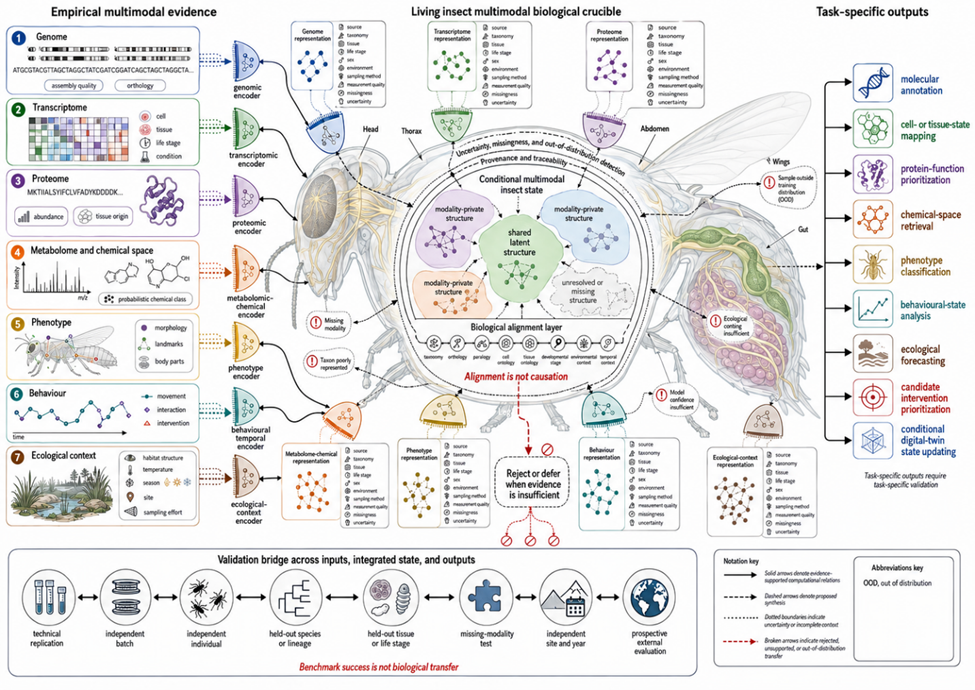
Figure 1 shows conceptual synthesis designed to show the multimodal learning architecture for insect foundation models. Arrows and grouping indicate proposed or evidence-supported relations, not measured effect sizes or universal causal pathways. Relations must be qualified in the text with the approved references.
|
|
|
Figure 1. The multimodal learning architecture for insect foundation models |
Abbreviations key: OOD, out of distribution.
Uncertainty notation: Solid arrows denote evidence-supported computational relations; dashed arrows denote proposed integrative relations; bordered warning symbols denote uncertainty, missingness, or possible failure.
Genomic and transcriptomic representation
Genomic representation must capture more than short sequence motifs. Regulatory relationships may depend on long-range sequence context, chromosome organization, gene-family structure, assembly quality, and lineage-specific evolutionary history. Long-context architectures developed in regulatory genomics demonstrate that predictive information can be distributed across extensive sequence windows, but their assumptions, training organisms, and regulatory distances cannot be transferred automatically to insects. Sequence encoders can benefit from long-range regulatory context, although architectures calibrated to mammalian genomes require explicit revalidation before insect use [10]. Nucleotide pretraining further suggests that a shared sequence model may be adaptable to several genomic tasks, yet insect genomes introduce major differences in genome size, repeat composition, chromosome organization, annotation completeness, and lineage-specific gene expansion. Nucleotide language models show that broad pretraining can support varied genomic tasks, but insect deployment requires lineage-aware tokenization and held-out-species tests [11]. The appropriate genomic component is therefore a long-context encoder conditioned on taxonomy, assembly quality, orthology, paralogy, and annotation provenance rather than a universal sequence representation detached from its biological source.
Transcriptomic representation requires a different hierarchy because expression is dynamic, compositional, and context-dependent. A gene-expression profile is shaped by cell type, tissue composition, developmental stage, age, sex, physiological state, exposure, infection, and sampling time. A model that collapses these distinctions may generate a stable numerical embedding while misrepresenting the biological object that was measured. The aging Drosophila brain contains cell-type-specific transcriptional trajectories that would be lost if tissue, age, and cell identity were treated as interchangeable labels [12]. Accordingly, the proposed transcriptomic encoder should preserve nested biological identifiers and distinguish directly observed labels from transferred or inferred labels. It should also represent uncertainty where reference atlases are incomplete, where marker genes are ambiguous, or where technical batch is associated with biological condition.
Mosquito immune-cell studies illustrate both the promise and the boundary of cross-species transcriptomic alignment. Mosquito single-cell profiling reveals immune-cell states and differentiation structure that require species, cell-state, and challenge context to remain explicit in the representation [13]. Independent profiling provides convergent evidence that mosquito hemocytes are heterogeneous, but it also shows that subtype boundaries and differentiation signatures depend on assay design, sampled conditions, and validation strategy. Independent mosquito hemocyte profiling further supports immune-cell heterogeneity while showing that cell labels and differentiation signatures remain conditional on assay and biological context [14]. A foundation model should therefore align transcriptomic states through confidence-scored orthology and ontology relations while retaining a novelty-detection option. Similarity between expression profiles may support a hypothesis of correspondence, but it cannot by itself establish cell homology, shared function, differentiation mechanism, or causal immune activity. Genomic and transcriptomic alignment must remain connected to, but analytically distinct from, protein abundance, metabolism, phenotype, and organismal outcome.
Proteomic, metabolomic, and chemical-space learning
Proteomic learning must separate at least five constructs: amino-acid sequence, predicted structure, measured abundance, tissue origin, and biological function. These constructs are related, but none is a universally reliable substitute for another. Integrated insect evidence shows why provenance and spatial origin are essential. Multi-omic mapping of Drosophila secretomes shows that protein abundance must be linked to tissue origin and trafficking rather than treated as a direct proxy for local transcription [15]. The proposed proteomic encoder should consequently represent proteins as linked objects that retain sequence, structural confidence, post-translational or abundance measurements, tissue and cellular provenance, and evidence for movement between organs. This structure would permit cross-modal reasoning while preventing a circulating protein from being attributed automatically to the tissue in which it was detected.
Large protein-sequence models provide an enabling representation layer because they can encode statistical regularities associated with structure and function. Protein language modelling can recover structure- and function-related information from sequence, but those embeddings still require insect-specific functional and interaction validation [16]. For insect biology, this requirement is especially important where rapid gene-family expansion, paralogy, symbiotic interaction, venom or salivary specialization, detoxification, or lineage-specific proteins weaken simple transfer from broadly represented families. A sequence embedding may prioritize candidate relations, support retrieval, or guide downstream experiments, but it cannot establish expression, localization, molecular interaction, physiological effect, ecological fitness, or safety. Protein representations should therefore expose family novelty and out-of-distribution status and should be linked to experimentally observed functions only through traceable evidence.
Metabolomic and chemical-space learning introduce additional uncertainty because many detected compounds lack complete structural identification, and measured profiles depend on extraction, instrument platform, ionization, diet, sex, stage, infection, microbiota, and environment. Mass-spectral learning can classify unknown compounds at the chemical-class level, but class assignment must not be reported as exact structural identification or biological mechanism [17]. This makes probabilistic chemical ontologies more defensible than forced exact labels, particularly when spectra are unmatched to authenticated standards. In mosquitoes, the interpretive problem is compounded by strong biological context dependence. Mosquito metabolomic profiles vary with life stage, diet, infection, sex, and analytical platform, so chemical representations require explicit biological and technical context [18]. The proposed architecture should therefore connect spectra, candidate structures, chemical classes, proteins, assays, and phenotypes through typed relations carrying uncertainty and provenance. Chemical similarity may guide hypothesis generation, but it does not establish shared target activity, efficacy, toxicity, ecological consequence, or causal metabolic mechanism.
Phenotypes, behaviour, ecology, and environmental context
Molecular representations become biologically useful only when they can be related cautiously to observable organismal states. Images and video can encode morphology, body configuration, locomotion, feeding, courtship, host seeking, social interaction, and responses to experimental or environmental change. Markerless pose-estimation systems demonstrate that fine-grained body-part trajectories can be extracted with relatively limited manual annotation, but their predictions remain dependent on camera geometry, occlusion, morphology, training labels, and recording conditions. Markerless pose estimation makes fine-grained behavioural phenotyping scalable, but the learned landmarks remain conditional on annotation quality and imaging conditions [19]. A foundation model should therefore preserve keypoint confidence, image provenance, acquisition conditions, and taxonomic context rather than converting visual outputs directly into biological interpretations.
Behavioural representation requires temporal continuity and reliable identity tracking. Multi-animal systems can represent individual movement and interaction structure, but crowding, identity switching, and unfamiliar environments can weaken apparent behavioural patterns. Multi-animal tracking extends phenotype representation to interaction structure, although identity continuity and social interpretation remain vulnerable to occlusion and domain shift [20]. Longitudinal platforms add another layer by recording repeated behavioural states and experimentally controlled interventions. High-throughput Drosophila ethomics demonstrates the value of longitudinal behavioural streams, while also exposing the boundary between controlled laboratory behaviour and field expression [21]. Accordingly, pose, movement, interaction, and behaviour should remain separate analytical constructs: a coordinate is not an action, proximity is not a social mechanism, and laboratory activity is not automatically an ecologically expressed phenotype.
Ecological context defines where, when, and under which sampling conditions molecular and behavioural states are observed. Habitat, season, climate, resource availability, land use, exposure history, and sampling effort can alter both insect biology and the probability of detection. Contrasting terrestrial and freshwater abundance trends show why ecosystem type, geography, and sampling design must condition any population-level representation [22]. Ecological variables should therefore modify predictions through explicit spatial and temporal context rather than being compressed into an unqualified environmental score. Generalization must be tested across independent sites, years, ecosystems, cameras, taxa, and behavioural settings. The evidence dimensions and interpretive boundaries for phenotypes behaviour ecology and environmental context are summarized in Table 2.
Table 2. Phenotypes, Behaviour, Ecology, and Environmental Context: Data Inputs, Analytical Tasks, Biological Representations, Validation, Explainability, Generalization, and Decision Boundaries
|
Analytical component or task |
Input data |
Model or representation |
Expected output |
Validation requirement |
Explainability or interpretation need |
Generalization risk |
Decision boundary |
|
Morphology and pose estimation |
Images, video, body-part annotations, camera metadata |
Confidence-aware visual and keypoint representation |
Body-part locations and morphological features |
Independent cameras, annotators, taxa, backgrounds, and field conditions |
Show keypoint confidence and image regions influencing prediction |
Occlusion, equipment cues, morphology, and background shift |
Pose coordinates are not behaviour, condition, or fitness |
|
Multi-individual tracking |
Video, identity labels, trajectories, interaction events |
Temporal multi-instance representation |
Identity-linked movement and interaction sequences |
Crowded scenes, independent densities, species, and recording systems |
Expose identity confidence, track breaks, and uncertainty |
Identity swaps and unfamiliar social configurations |
Proximity or synchronized motion is not a social mechanism |
|
Longitudinal ethomics |
Continuous observations, timestamps, interventions, environmental conditions |
Behavioural time-series representation |
Repeated activity states and intervention-linked trajectories |
Repeated experiments, blinded labels, perturbation, and field comparison |
Retain observable events and intervention provenance |
Laboratory apparatus and constrained environments |
Laboratory behaviour is not automatically field behaviour |
|
Ecological conditioning |
Site, habitat, climate, season, land use, exposure, and sampling effort |
Spatial-temporal context representation |
Context-specific predictions and uncertainty |
Leave-site, leave-year, and leave-ecosystem-out testing |
Identify influential contextual variables and missing covariates |
Spatial leakage, uneven sampling, and unmeasured pressures |
Ecological association or trend is not causal attribution |
|
Molecular–phenotype linkage |
Molecular profiles paired with images or behavioural records |
Typed cross-modal correspondence |
Candidate relations between molecular state and observed phenotype |
Matched individuals, tissues, times, and independent interventions |
Distinguish observed pairing from inferred alignment |
Different individuals or time points may be aligned spuriously |
Representation similarity is not a molecular mechanism |
|
Decision-support output |
Phenotypic, behavioural, ecological, and uncertainty representations |
Task-specific calibrated head with abstention |
Conditional classification, forecast, prioritization, or rejection |
Independent operational context and prospective evaluation |
Report uncertainty, coverage, provenance, and failure conditions |
Benchmark data may not represent target environments |
Model output is not field effectiveness or management readiness |
Pretraining, transfer, and biological alignment
Pretraining should be understood as learning reusable statistical structure within large data collections, not as demonstrating biological validity. Reference-atlas transfer provides one model for adapting representations to new cellular datasets, but it can also force unfamiliar states into existing categories. Reference-atlas transfer can organize new cellular data efficiently, but novelty detection is essential to prevent genuinely new insect states from being forced into inherited labels [23]. For insect applications, donor and target distributions should be characterized by taxonomy, phylogenetic distance, tissue, life stage, sex, environment, assay technology, and sampling design. Adaptation should permit rejection when target observations are insufficiently represented rather than assigning every record to the nearest known class.
Generative single-cell pretraining shows how one representation may support annotation, integration, and perturbation-related tasks. Generative single-cell pretraining supports multiple downstream tasks, yet insect use must test whether token semantics survive changes in genome annotation, cell ontology, and species [24]. Similar caution applies to protein representations. Accurate protein-structure prediction can enrich molecular representations, but structure must remain analytically separate from function, interaction, and insect fitness [25]. A biologically aligned architecture should therefore retain the distinctions among predicted structure, measured abundance, tissue localization, interaction evidence, and organismal consequence. Alignment may identify correspondence or shared statistical structure, but it does not establish causal mechanism or functional equivalence.
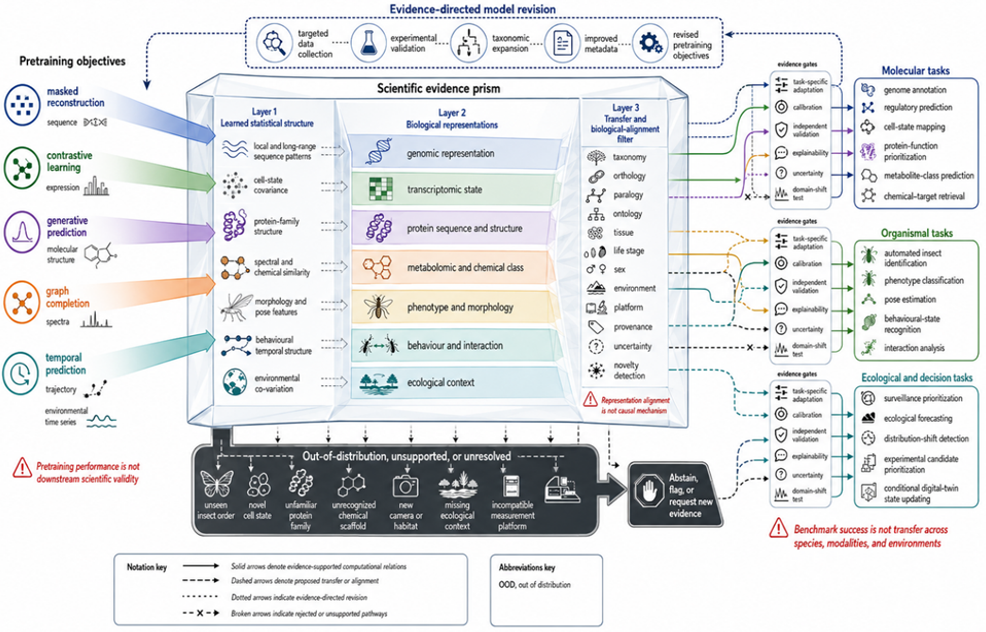
Generative protein models further illustrate why model capability and scientific justification must be evaluated separately. Protein language models can generate functional sequences within learned families, although family-specific activity does not establish ecological safety or general insect utility [26]. The proposed insect architecture consequently separates pretraining objectives, transfer procedures, alignment operations, and downstream validation. Pretraining may include masked reconstruction, contrastive learning, generative prediction, or graph completion within individual modalities. Transfer may use adapters or task-specific heads. Biological alignment should use taxonomy, orthology, ontology, tissue, life stage, and context information while preserving modality-private variation. Each stage requires its own success criterion, stress test, uncertainty estimate, and prohibited inference.
Proposed foundation-model architecture
The proposed architecture begins with independent encoders for genomic sequence, transcriptomic state, protein sequence and structure, proteomic abundance, metabolomic spectra, chemical structures, phenotype imagery, behavioural trajectories, and ecological context. These encoders should not be merged through unrestricted early fusion because some variation is shared across modalities while other variation remains biologically specific. A latent-factor framework demonstrates the value of separating common from modality-specific information. The proposed architecture therefore preserves both shared and modality-specific latent factors, following evidence that forcing all signals into one common space can erase informative variation [27]. Each encoded observation also retains taxonomy, tissue, life stage, sex, environment, sampling method, data quality, and provenance.
The fusion layer is probabilistic and uncertainty-aware. It should estimate a shared biological state only where supported while retaining modality-private residuals and explicit missingness. A probabilistic fusion layer should represent measurement noise and posterior uncertainty explicitly rather than returning a single deterministic aligned state [28]. The resulting structure is surrounded by an orthology and ontology graph, a provenance ledger, an out-of-distribution detector, and an abstention mechanism. Task-specific heads may support annotation, retrieval, classification, forecasting, candidate prioritization, or conditional digital-twin state updating, but each output remains limited by its validation evidence.
Figure 2 maps the relationship between pretraining objectives, biological representations, and downstream entomological tasks within the analytical logic developed in this section.
|
|
|
Figure 2. The relationship between pretraining objectives, biological representations, and downstream entomological tasks |
Abbreviations key: OOD, out of distribution.
Uncertainty notation: Solid arrows denote evidence-supported computational relations; dashed arrows denote proposed transfers or alignments; warning boundaries mark tasks for which biological, ecological, or external validation is incomplete.
Relational information can be represented through graphs connecting genes, proteins, metabolites, organisms, observations, and environments. Graph-based fusion offers a way to preserve relations among samples and molecular features, but predictive graph structure must not be interpreted automatically as biological mechanism [29]. Missing modalities, sparsity, batch effects, and unpaired measurements must also be treated as central design problems. The architecture must treat missing modalities, batch effects, heterogeneity, scalability, and interpretability as design constraints rather than post hoc corrections [30]. Imputed representations should be marked as inferred, accompanied by posterior uncertainty, and excluded from claims requiring direct observation.
Cross-species alignment is organized through confidence-scored orthology, paralogy, taxonomy, and cell-ontology relations. Cross-species atlas mapping supports an orthology-aware alignment layer, provided that conserved expression is not equated automatically with homologous function [31]. The architecture therefore produces conditional representations rather than a universal insect state. It should support abstention when taxonomic distance, missing modalities, unfamiliar chemical space, novel cell states, or environmental shift exceeds the evidence represented during training. The proposed components, evidence bases, boundary conditions, failure modes, and validation requirements are organized in Table 3.
Table 3. Proposed Foundation-Model Architecture: Components, Evidence Basis, Relations, Boundary Conditions, Failure Modes, and Validation Requirements
|
Proposed component |
Purpose |
Evidence basis |
Relation or mechanism |
Input or precondition |
Expected output |
Boundary condition or failure mode |
Validation requirement |
|
Modality-specific encoders |
Preserve distinct biological objects before integration |
Shared and private variation can coexist across biological modalities |
Separate sequence, expression, protein, chemical, visual, behavioural, and ecological encoders |
Versioned modality data with quality and context metadata |
Modality-specific embeddings |
Early fusion may erase meaningful variation |
Modality-ablation and independent task validation |
|
Shared and private latent state |
Represent convergent evidence without removing modality-specific information |
Latent-factor integration separates shared and modality-specific structure |
Gated fusion estimates common state while retaining private residuals |
Paired or partially paired modalities with missingness indicators |
Joint state plus modality-private information |
Shared factors may capture batch or confounding |
Negative controls, batch holdouts, and orthogonal assays |
|
Probabilistic fusion and missingness layer |
Represent noise, incomplete observations, and uncertainty |
Joint probabilistic models can separate biological signal from technical variation |
Posterior inference integrates observed modalities and marks inferred values |
Measurement models, quality metrics, and explicit missingness |
Posterior representations, uncertainty, or rejection |
Imputation may be mistaken for observation |
Masking experiments and genuinely missing-modality tests |
|
Biological relation graph |
Preserve relations among genes, proteins, chemicals, samples, and organisms |
Graph learning can encode relational structure across heterogeneous data |
Typed nodes and edges connect modalities through traceable evidence |
Curated relations, provenance, confidence, and negative examples |
Relational embeddings and candidate links |
Predictive connectivity is not causal mechanism |
Independent relation tests and experimental confirmation |
|
Context adapter |
Condition outputs on taxonomy, stage, tissue, environment, site, and time |
Biological and technical heterogeneity changes representation meaning |
Context variables modulate rather than replace core modality representations |
Complete contextual metadata |
Context-specific predictions and uncertainty |
Missing context may produce confident but invalid transfer |
Leave-context-out and prospective external validation |
|
Orthology and ontology layer |
Support cross-species correspondence without assuming equivalence |
Cross-species atlas mapping can identify conserved relationships |
Confidence-scored mappings connect genes, cells, tissues, and taxa |
Orthology, paralogy, taxonomy, cell ontology, and annotation quality |
Traceable candidate correspondences |
Expression similarity may reflect convergence or annotation bias |
Phylogenetically blocked tests and functional confirmation |
|
Provenance and uncertainty ledger |
Make predictions auditable and scientifically qualified |
Every integration step can introduce transformation, leakage, or uncertainty |
Record source, version, preprocessing, model, split, confidence, and inferred status |
Reproducible computational environment and data lineage |
Auditable output with uncertainty and abstention |
Traceability alone does not establish validity |
Independent rerun, calibration, and leakage audit |
|
Task-specific heads |
Adapt the shared infrastructure to distinct scientific questions |
Transfer is task- and distribution-dependent |
Separate heads perform annotation, retrieval, forecasting, or prioritization |
Defined target labels, claim limits, and independent evaluation data |
Task output with calibration or rejection |
One benchmark cannot validate all downstream tasks |
Task-specific external and prospective validation |
|
Conditional digital-twin updater |
Integrate repeated observations into a changing insect-state estimate |
Longitudinal multimodal data can support state updating |
Time-stamped observations update a conditional representation |
Repeated molecular, phenotype, behavioural, and ecological observations |
Uncertainty-aware state estimate or forecast |
A state estimator is not a validated causal digital twin |
Prospective temporal prediction and intervention testing |
Validation, bias, and research implications
The first priority is to replace random record-level validation with biologically independent evaluation. Genomic and multimodal observations may share individuals, species, homologous sequences, sampling sites, processing batches, reference atlases, or temporal structure across training and test sets. Validation must split data at biologically independent levels because random records can leak species, lineage, site, batch, or individual information into both training and testing sets [32]. Progress would be demonstrated by preregistered evaluations that hold out entire species, lineages, gene families, tissues, life stages, sites, years, instruments, or modalities according to the intended claim. Performance should be accompanied by calibration, abstention, subgroup uncertainty, and explicit statements of the largest defensible inference.
The second priority is auditable reproducibility and leakage control. Reproducibility requires versioned data, executable code, model specifications, environments, and reporting that make each result traceable to its computational and biological inputs [33]. Such transparency must extend to preprocessing, feature construction, reference atlases, pretrained checkpoints, homology searches, data exclusions, and all transformations performed before splitting. Leakage auditing must extend beyond duplicate records to preprocessing, feature construction, reference atlases, phylogeny, and temporally overlapping sampling [34]. Progress would be shown by independent reruns, contamination reports, data-lineage records, and evaluation designs that remain valid after correlated biological units are removed.
The third priority is representation governance across taxa, geography, life stage, sex, tissue, environment, and measurement platform. Taxonomic bias must be measured explicitly because underrepresented insect lineages can be invisible in aggregate benchmarks while still defining the model's largest deployment failures [35]. Dataset documentation should report which lineages and contexts are represented, which are missing, how licensing and access shape the corpus, and where uncertainty prevents meaningful evaluation. Research investment should prioritize paired multimodal observations from underrepresented insects, independent field datasets, experimentally validated molecular relations, negative results, and prospective transfer studies. These measures would not validate a universal insect model, but they would make failure visible and establish whether a proposed representation transfers beyond the species, modalities, and environments from which it was learned.
CONCLUSION
A scientifically defensible foundation model for insect molecular biology cannot be built by pooling heterogeneous records and treating the resulting scale as understanding. It must preserve the different biological objects represented by genomes, transcriptomes, proteins, metabolites, chemical structures, phenotypes, behaviours, and ecological observations while making their conditional relations explicit. The proposed architecture therefore combines modality-specific encoders, shared and private representations, biological context adapters, orthology and ontology relations, probabilistic uncertainty, provenance, abstention, and task-specific validation. Its strongest implication is methodological: insect foundation models should be judged by whether they retain biological meaning and withstand independent species, lineage, life-stage, modality, site, and environmental shifts—not by aggregate pretraining or benchmark performance alone. The architecture remains a non-validated scholarly proposal whose relations require prospective testing, experimental confirmation, and transparent governance before it can support consequential scientific or decision applications.
ACKNOWLEDGMENTS: None
CONFLICT OF INTEREST: None
FINANCIAL SUPPORT: None
ETHICS STATEMENT: None