Entomology and
Applied Science Letters
Applied Science Letters
 2026
Volume 13
Issue 1
2026
Volume 13
Issue 1

Gene drives offer a powerful means of altering inheritance to suppress harmful insect populations or introduce traits intended to reduce pathogen transmission. Their development has nevertheless advanced faster than the evidence needed to determine whether molecular success can be translated into durable, spatially predictable, controllable, and publicly legitimate environmental action. This critical review examines the evidentiary gap between proof-of-concept performance and defensible release decision-making. It integrates comparative evidence concerning gene-drive architectures and intended population effects, molecular efficiency and inheritance performance, resistance-allele formation and evolutionary escape, ecological uncertainty and spatial spread, containment and reversal, monitoring, and release governance. The evidence supports a central distinction between demonstrating an inheritance mechanism and establishing readiness for environmental use. High transmission or population suppression in contained systems may establish technical plausibility, but it does not demonstrate stable population modification, predictable movement through heterogeneous landscapes, ecological reversibility, or acceptable release conditions. Results remain contingent on construct architecture, target-site conservation, expression timing, repair outcomes, fitness costs, genetic background, demographic structure, migration, environmental variability, and the quality of monitoring and governance arrangements. The principal limitations of the evidence base are its concentration in laboratory and cage systems, incomplete representation of wild genetic and ecological heterogeneity, short evolutionary observation periods, and limited integration between technical studies and decision processes. Responsible progression therefore requires claim-specific evidence gates rather than a single readiness score. Molecular performance, evolutionary durability, ecological prediction, containment credibility, monitoring capacity, legitimacy, and formal authorization should be evaluated as separate but connected requirements, with explicit uncertainty, failure pathways, and return-to-design conditions.
INTRODUCTION
Engineered gene drives are designed to alter inheritance so that a genetic construct, associated phenotype, or population effect can increase more rapidly than expected under ordinary Mendelian transmission. Proposed applications include suppressing disease-vector or agricultural-pest populations and modifying populations by spreading traits that reduce their capacity to transmit pathogens. Recent reviews converge that engineered gene drives can bias inheritance for vector control, but architecture, fitness costs, resistance, and confinement determine whether laboratory promise translates into durable population effects [1-3].
The central difficulty is not whether biased inheritance can be engineered, but what can legitimately be inferred from each class of evidence. Molecular cleavage, inheritance distortion, multigenerational frequency change, cage suppression, modelled spatial spread, ecological risk assessment, and release authorization represent different constructs measured at different biological and decision scales. A broader synthesis therefore treats gene-drive performance as a multiscale problem spanning molecular design, population dynamics, mitigation, and responsible implementation [4].
Several recurrent equivalences obscure this multiscale problem. High inheritance efficiency is frequently interpreted as evidence of stable population modification even when fitness burdens or resistant alleles alter later trajectories. Laboratory performance is sometimes treated as evidence of spatially predictable spread despite the absence of migration, seasonal forcing, habitat structure, and ecological interactions. Molecular countermeasures may be described as reversal even though removal or inhibition of a construct does not demonstrate restoration of the previous ecological state. Similarly, stakeholder engagement may strengthen the quality and legitimacy of research, but engagement is not equivalent to authorization for environmental release.
This critical review therefore examines how evidence concerning mechanism, performance, evolutionary escape, ecological uncertainty, containment, monitoring, and governance should be connected without collapsing their differences. Its central argument is that progression beyond proof of concept requires independent, claim-specific assessments. A construct may be technically effective yet evolutionarily fragile, spatially uncertain, incompletely containable, operationally unmonitorable, or insufficiently governed. Responsible evidence-to-action translation consequently depends on identifying what each experiment or analysis establishes, which boundary conditions restrict the inference, what competing explanations remain plausible, and what additional evidence is required before movement to a less contained decision stage.
Gene-drive mechanisms and intended population effects
Gene-drive architectures link inheritance bias to population outcomes through different causal mechanisms, and those differences determine what should be measured. Homing suppression drives may copy themselves into a homologous chromosome while disrupting a fertility or viability function. Targeting a conserved female-development locus produced complete suppression in caged Anopheles gambiae populations, establishing proof of principle without demonstrating field robustness [5]. Sex-distorting systems use a different route, increasing the transmission or production of males rather than directly imposing female sterility. A sex-distorter drive linked inheritance bias to male-biased progeny, illustrating that suppression can be mediated through altered sex ratio rather than direct female sterility [6]. Both approaches can reduce reproductive capacity in containment, but their sensitivity to mating structure, target conservation, sex-specific fitness, and resistant genotypes is not interchangeable.
Population modification requires another evidentiary distinction because increasing construct frequency is only an intermediate outcome. Population-modification experiments showed that a cargo-bearing drive can rise to high frequency in cages, while leaving field durability and transmission impact unresolved [7]. A cargo must remain genetically linked to the drive, retain biological activity, and generate the intended epidemiological or ecological effect under relevant exposure conditions. Recoded rescue architecture demonstrated one route for coupling drive inheritance to restoration of an essential function, thereby penalizing some nonfunctional resistance outcomes [8]. This design can modify the selective consequences of disruptive repair, but it cannot remove uncertainty associated with functional resistant variants, fitness effects, migration, or ecological competition.
Threshold dependence further changes the relation between molecular action and intended population effect. A toxin-antidote drive produced threshold-dependent dynamics, showing that intended population modification can be coupled to a more localized invasion profile [9]. The resulting localization is conditional rather than absolute: establishment depends on release frequency, fitness, mating, population connectivity, and migration between target and non-target populations. Low-threshold homing systems, high-threshold toxin-antidote systems, recoded rescue systems, cargo-bearing drives, and sex-distorting constructs should therefore not be ranked by a common inheritance measure. Each architecture requires evidence connecting its molecular mechanism to its intended effect, evolutionary failure modes, ecological behavior, monitoring needs, and governance boundary.
The evidence dimensions and interpretive boundaries for gene-drive mechanisms and intended population effects are summarized in Table 1.
Table 1. Gene-Drive Mechanisms and Intended Population Effects: Technical Evidence, Ecological Safeguards, Governance Requirements, Monitoring, Residual Risk, and Decision Boundaries
|
Decision stage or safeguard |
Evidence required |
Technical function |
Ecological function |
Governance requirement |
Failure or escape risk |
Monitoring or learning need |
Decision boundary |
Representative supporting reference(s) |
|
Architecture definition |
Verified target, inheritance mechanism, phenotype, fitness effects, and repair pathways |
Establishes how inheritance bias is produced |
Identifies the population process expected to change |
Require an architecture-specific claim rather than a generic gene-drive label |
Mechanisms with different thresholds and burdens may be treated as equivalent |
Track construct integrity, inheritance, phenotype, and fitness separately |
Mechanistic characterization permits contained testing, not environmental-readiness claims |
[4] |
|
Homing suppression through female-function disruption |
Multigenerational inheritance, fertility, population trajectory, and resistance data |
Copies the drive while disrupting a female-development or fertility locus |
Seeks population decline through reduced female reproductive output |
Require evidence that suppression is not an artefact of cage structure |
Functional resistance, fitness compensation, migration, or ecological density feedback |
Sequence target sites and follow sex-specific reproduction and abundance |
Complete cage suppression does not establish predictable field suppression |
[5] |
|
Sex-ratio distortion |
Transmission, chromosome-targeting performance, sex ratio, fertility, and population response |
Biases progeny production toward males |
Seeks suppression through scarcity of reproductive females |
Define whether the decision claim concerns sex distortion or durable population reduction |
Resistant targets, incomplete distortion, mating compensation, or sex-specific fitness costs |
Monitor sex ratio, mating success, fertility, and resistant genotypes |
Male bias is evidence of mechanism, not by itself evidence of population elimination |
[6] |
|
Cargo-bearing population modification |
Drive frequency, cargo stability, effector function, pathogen phenotype, and fitness |
Spreads an linked antipathogen or modifying trait |
Seeks reduced vector competence without necessarily reducing abundance |
Require separate evidence for construct spread and the public-health or ecological endpoint |
Cargo loss, linkage breakdown, resistance, fitness costs, or insufficient biological effect |
Track drive frequency, cargo sequence, expression, phenotype, and pathogen outcomes |
High cage frequency is not equivalent to stable modification or transmission reduction |
[7] |
|
Recoded rescue |
Rescue-function validation, inheritance, resistance classification, and multigenerational fitness |
Restores an essential function while disadvantaging some disruptive repair products |
Seeks durable replacement by changing selection against nonfunctional resistance |
Require explicit assessment of functional resistant alleles and residual fitness effects |
Functional escape variants, target polymorphism, migration, or ecological selection |
Distinguish molecular repair outcomes from organismal function and population fitness |
Molecular rescue does not establish ecological persistence or reversibility |
[8] |
|
Threshold-dependent toxin-antidote modification |
Release-threshold, fitness, migration, and genotype-frequency evidence |
Couples a disruptive genetic function to a rescuing antidote |
Seeks regional rather than unrestricted population modification |
Define the intended geographic and population boundary before testing |
Establishment outside the target population or loss within it under different migration conditions |
Monitor release frequency, spatial genotype gradients, migration, and local fitness |
Threshold dependence supports conditional localization, not guaranteed geographic containment |
[9] |
Molecular efficiency and inheritance performance
Molecular performance is produced by linked processes rather than a single conversion percentage. Cleavage efficiency, the balance between homology-directed and end-joining repair, promoter timing, guide-target complementarity, construct stability, sex and life stage, and the fitness of resulting genotypes all contribute to observed inheritance. Large-cage testing increased ecological realism relative to small laboratory cages, yet still measured performance in a closed and intensively monitored system [10]. Greater population size and environmental complexity can strengthen evidence that a construct functions beyond simplified crosses, but large cages do not reproduce open migration, climatic variability, community interactions, or the spatial arrangement of natural breeding populations.
Inheritance measurements must also be interpreted as trajectories rather than isolated peaks. Experimental population modification showed that super-Mendelian inheritance can coexist with fitness and resistance dynamics that prevent stable fixation [11]. A drive may initially increase because of strong inheritance bias and subsequently plateau or decline when resistant alleles, cargo burdens, mating disadvantages, or genotype-specific fitness costs accumulate. Separating Cas9 from the guide-RNA cassette preserved inheritance bias while reducing autonomous persistence, demonstrating that efficiency and confinement can be co-designed [12]. Nevertheless, component separation provides conditional confinability, not absolute containment, because performance still depends on component frequencies, genetic linkage, accidental co-occurrence, and the receiving population.
Molecular characterization should consequently address both intended activity and unintended genetic effects. Genome-scale analysis found limited detectable off-target activity for the tested construct, but the inference remains specific to its guide design, assay sensitivity, and genetic backgrounds [13]. Failure to detect substantial off-target change in one construct cannot be generalized to different guides, species, genomic backgrounds, or longer periods of selection. A multiplexed split drive propagated in caged Aedes aegypti despite fitness costs, indicating that measured inheritance performance reflects the combined architecture rather than cleavage rate alone [14]. Multiplexing, component separation, cargo effects, and fitness can interact in ways that preserve short-term propagation while leaving long-term persistence unresolved. High inheritance efficiency is therefore not equivalent to stable population modification, and molecular efficiency should be reported alongside genotype-specific fitness, repair outcomes, resistance composition, duration, and population trajectory.
Resistance alleles and evolutionary escape
Resistance begins with molecular variation but becomes consequential through function and selection. Cleavage may be followed by intended copying of the drive, precise or in-frame repair that retains target-gene function, disruptive repair that reduces function, or mosaic outcomes generated by temporally or spatially variable nuclease activity. Longitudinal cage experiments directly showed that cleavage-resistant mutations can be generated and then selected as drive frequency increases [15]. Comparative construct testing demonstrated that resistance formation and conversion efficiency vary with both guide architecture and host genetic background [16]. These findings show why mutation detection, functional resistance, organismal fitness, and population-level escape must be treated as separate claims.
Engineering strategies can alter the probability of particular escape routes without eliminating evolution. Multiplexing and altered expression reduced resistant-allele formation in a model system, but did not convert evolutionary escape into a closed problem [17]. Multiple guides may reduce dependence on a single target site, yet guide interactions, incomplete cleavage, standing polymorphism, and multi-site repair can introduce additional dependencies. Resistance evolution in a sex-conversion system altered the population outcome, showing that the same molecular architecture can shift from suppression toward persistence or failure [18]. An intended mechanism may therefore remain technically active while its population consequence is eroded by the relative fitness and transmission of resistant, wild-type, and drive-bearing genotypes.
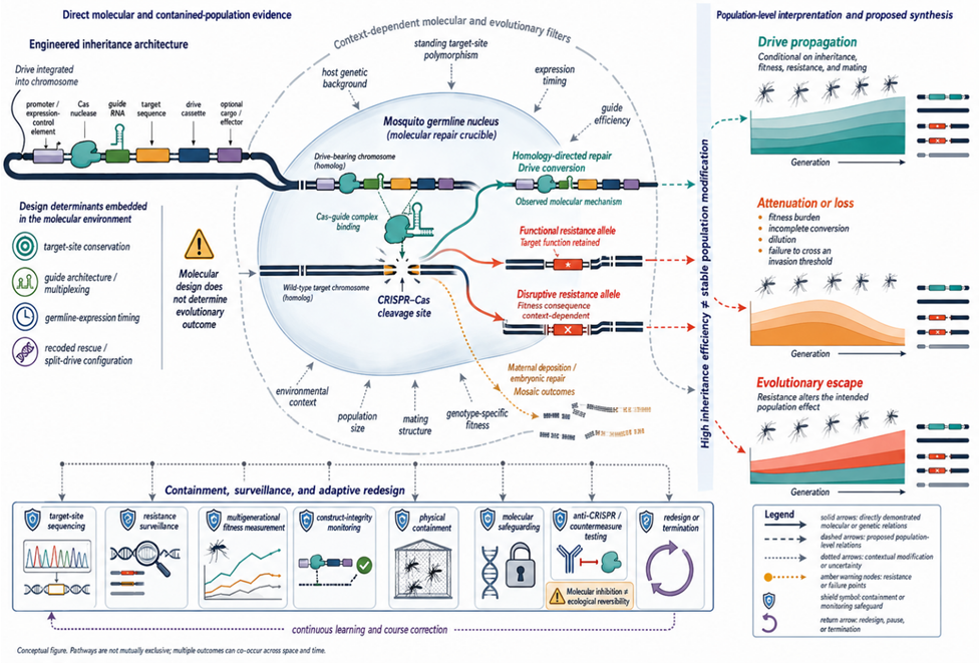
Expression timing connects molecular design to both inheritance and evolutionary selection. Restricting nuclease expression to favorable germline windows reduced embryo end joining and improved drive performance, identifying expression timing as an evolutionary design variable [19]. Germline restriction may favor copying over resistant repair, whereas maternal deposition or embryonic activity may increase mosaicism and end joining. The population importance of each outcome then depends on whether resistance preserves target-gene function, its fitness relative to the drive and wild type, and the demographic and ecological conditions under which selection operates. Figure 1 depicts gene-drive mechanisms and resistance pathways within the analytical logic developed in this section.
|
|
|
Figure 1. Gene-drive mechanisms and resistance pathways |
Alt text
A structured conceptual diagram that depicts gene-drive mechanisms and resistance pathways, with labelled components, directional relations, contextual modifiers, uncertainty points, and a clear boundary between observed evidence and proposed synthesis.
Ecological uncertainty and spatial spread
The transition from contained inheritance to environmental spread is governed by population and landscape processes that molecular measurements do not capture. Population-genetic analysis indicates that low-threshold homing drives may move beyond a release population even when conversion is incomplete or drive-associated fitness is reduced [20]. This finding challenges assumptions that imperfect performance necessarily produces geographic restriction, but it remains model-based and conditional on migration, mating, selection, and population structure. The relevant output is therefore not a universal prediction of invasion but a set of architecture-specific possibilities requiring empirical parameterization.
Spatial structure can also change the qualitative form of advance. Mathematical analysis shows that gene-drive spread may operate as a pushed genetic wave whose movement depends on local frequency, population density, release size, and barriers rather than inheritance advantage alone [21]. Comparative modelling further demonstrates that localized or nominally self-limiting architectures respond differently to migration: movement between demes may initiate establishment, maintain an otherwise declining construct, or dilute it below its invasion threshold [22]. Localization must consequently be treated as threshold- and context-dependent, not as a permanent property inferred from the architecture’s name.
At broader scales, seasonality, habitat connectivity, local abundance, and release geography can produce different suppression and spread outcomes from similar molecular-performance assumptions [23]. The proposed synthesis therefore connects construct-specific inputs to demographic, evolutionary, and spatial processes while retaining explicit uncertainty at every transition. Its outputs are conditional distributions of establishment, persistence, suppression, boundary crossing, and failure rather than a deterministic map. Validation requires longitudinal ecological data, alternative model structures, site-specific dispersal evidence, sensitivity analysis, and prospective comparison between predictions and observed contained or staged outcomes. Laboratory performance is not equivalent to spatially predictable spread. The proposed components, evidence bases, boundary conditions, failure modes, and validation requirements are organized in Table 2.
Table 2. Ecological Uncertainty and Spatial Spread: Components, Evidence Basis, Relations, Boundary Conditions, Failure Modes, and Validation Requirements
|
Proposed component |
Purpose |
Evidence basis |
Relation or mechanism |
Input or precondition |
Expected output |
Boundary condition or failure mode |
Validation requirement |
Representative supporting reference(s) |
|
Architecture-specific invasion potential |
Prevent different drives from being assigned one spatial behavior |
Experimental architecture studies and population models |
Homing, threshold-dependent, and split systems generate different establishment conditions |
Defined mechanism, fitness burden, and invasion threshold |
Architecture-conditioned spread scenarios |
Treating every drive as equally invasive or equally localizable |
Compare architectures under common demographic and migration conditions |
[9, 20, 22] |
|
Population trajectory |
Translate inheritance into changes in genotype and abundance |
Longitudinal cage evidence and ecological modelling |
Transmission is filtered through mating, survival, fecundity, density dependence, and competition |
Sex- and stage-specific inheritance and fitness distributions |
Time-varying genotype and population trajectories |
Using peak inheritance as a constant long-term parameter |
Calibrate models with multigenerational data across relevant backgrounds |
[10, 11, 14] |
|
Resistance emergence and spatial sorting |
Represent evolutionary escape within heterogeneous populations |
Experimental evolution and population-genetic modelling |
Resistant alleles arise locally, differ in fitness, and move between populations |
Repair-outcome distributions, standing variation, and genotype fitness |
Spatial scenarios for resistance establishment and replacement |
Assuming uniform resistance rates or functions |
Obtain baseline target-site diversity and test alternative resistance functions |
[15, 16, 20] |
|
Density and mating structure |
Identify population processes that change establishment or suppression |
Spatial theory and ecological modelling |
Local density and mating probabilities determine whether an invasion threshold is crossed |
Abundance, mating range, reproductive timing, and release configuration |
Conditional establishment, wave formation, or loss |
Well-mixed mating assumptions in structured populations |
Measure mating and density processes at the decision-relevant scale |
[21, 24] |
|
Seasonality and habitat connectivity |
Connect drive dynamics to changing landscapes |
National-scale malaria-vector modelling |
Seasonal habitat and movement networks alter local persistence and recolonization |
Habitat suitability, climate, connectivity, and release timing |
Seasonal and geographically differentiated outcomes |
Static landscapes or poorly supported dispersal assumptions |
Validate habitat, abundance, and connectivity inputs over multiple seasons |
[23] |
|
Boundary crossing |
Estimate movement beyond the intended population or jurisdiction |
Invasiveness, wave, and connected-deme models |
Migration interacts with threshold, fitness, and release frequency |
Plausible migration distribution and geographic boundary definition |
Probability and timing of movement across boundaries |
Equating self-limitation with immobility |
Stress-test rare migration and uncertain connectivity |
[20-22] |
|
Monitoring-linked updating |
Convert uncertainty into adaptive learning |
Risk pathways and prospective monitoring frameworks |
Observations update model assumptions and activate predefined responses |
Baselines, detectable indicators, responsibilities, and decision triggers |
Revised forecasts and conditional management action |
Surveillance that documents change without enabling response |
Test detection limits, reporting pathways, and response capacity before release |
[25, 26] |
Containment, reversal, and monitoring
Containment, genetic countermeasures, and monitoring act at different points in a possible failure sequence and should not be collapsed into a single safeguard claim. Molecular safeguarding can reduce accidental propagation during laboratory research, modelled reversal constructs may alter drive-frequency trajectories, and anti-CRISPR inhibition can constrain an active drive in cages; however, each intervention acts primarily on construct genetics rather than demonstrating restoration of a prior ecological state [27-29]. Synthetic targets, component separation, physical barriers, and molecular inhibitors may be complementary, but their dependencies and joint failure modes must be examined explicitly.
Large-cage experiments provide stronger evidence than simple crosses that anti-CRISPR mosquitoes can inhibit drive spread under challenging mating and behavioral conditions [30]. Even so, the experiment does not resolve whether a countermeasure could be produced, distributed, and established at the necessary locations and frequencies after environmental spread. Countermeasure success may depend on relative fitness, release timing, mating behavior, spatial access, target compatibility, and the initial drive distribution. Molecular reversal is therefore not equivalent to ecological reversibility: changing allele frequencies does not demonstrate recovery of population structure, community interactions, disease dynamics, or other ecological conditions affected before intervention.
Monitoring is a third function rather than proof that containment or reversal will succeed. Genomic surveillance may detect construct integrity, resistance, or boundary crossing; demographic monitoring may detect suppression, rebound, or replacement; ecological indicators may reveal indirect change; and social or institutional monitoring may identify implementation burdens or failures of accountability. These activities become decision-relevant only when baselines, detection limits, reporting responsibilities, triggers, and feasible responses are specified in advance. A monitoring system that identifies change without enabling timely interpretation or action supplies information but not mitigation. Responsible development therefore requires layered safeguards evaluated separately, with predefined redesign, pause, response, and termination conditions.
Governance, legitimacy, and release decisions
Release governance begins before environmental authorization because design choices determine persistence, reversibility claims, affected populations, and the evidence that later institutions must evaluate. Peer-reviewed guidance characterizes stakeholder engagement as an early, iterative, and context-specific development practice rather than a one-time communication exercise [31]. Reciprocal knowledge engagement can allow local expertise, priorities, and concerns to alter problem definitions, research questions, comparators, and safeguards [32]. These processes may improve relevance and procedural legitimacy, but neither information exchange nor participation independently establishes acceptable risk or permission to release.
Empirical evidence also cautions against treating expressed support as a unified public mandate. A multi-country survey identified conditional support alongside substantial knowledge gaps and concerns about controllability, consequences, and decision authority [33]. Such findings are important for identifying contested assumptions and communication needs, but they remain sensitive to sampling, framing, institutional trust, and the hypothetical character of the technology. Public engagement is not equivalent to authorization for release, just as a favorable or unfavorable survey response is not a substitute for jurisdiction-specific risk assessment and accountable decision-making.
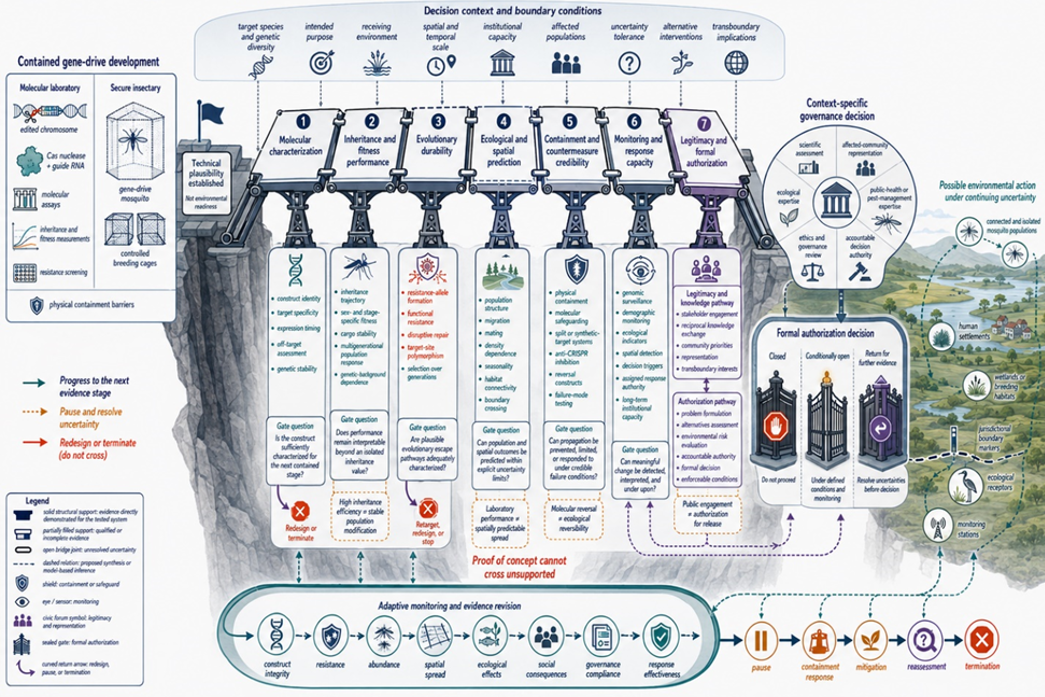
Engagement becomes institutionally consequential when governance arrangements specify how stakeholder knowledge can change environmental assessment, alternatives, release conditions, monitoring obligations, or the decision not to proceed [34]. The progression from laboratory development to an environmental decision should therefore contain distinct gates for molecular characterization, inheritance and fitness, evolutionary durability, ecological and spatial prediction, containment and countermeasure credibility, monitoring capacity, legitimacy, and formal authorization. Evidence can move between these gates, but no technical metric or composite score can replace their separate judgments. Figure 2 shows the progression from laboratory development to governance and environmental decision-making within the analytical logic developed in this section.
|
|
|
Figure 2. The progression from laboratory development to governance and environmental decision-making |
Alt text
A structured conceptual diagram that shows the progression from laboratory development to governance and environmental decision-making, with labelled components, directional relations, contextual modifiers, uncertainty points, and a clear boundary between observed evidence and proposed synthesis.
Critical synthesis and research priorities
Across the reviewed evidence, the strongest convergence concerns conditionality rather than environmental readiness. Molecular architecture determines how inheritance is biased; fitness and repair determine whether that advantage persists; demography and migration determine how it changes populations; and institutions determine whether the remaining uncertainty is acceptable for a particular decision. Regional problem-formulation exercises demonstrate that credible assessment begins by defining protection goals, valued entities, plausible harms, and relevant comparators before molecular performance is treated as decision-sufficient evidence [35]. This ordering prevents technical achievement from defining the public purpose or acceptable boundary of an intervention by default.
A pathways-to-harm analysis strengthens this approach by making the causal sequence between release and a harmful endpoint explicit [25]. Its value lies in identifying what would have to occur, what evidence could test each step, and where monitoring or mitigation could intervene. A plausible pathway is not evidence that harm will occur, whereas an incomplete observation is not evidence that the pathway is impossible. Environmental risk-assessment recommendations similarly support comparative, problem-formulated, tiered evaluation with explicit treatment of uncertainty [36]. These proposals organize evidence but should not be represented as empirically validated release frameworks.
Monitoring and modelling are priority areas because both are frequently asked to support decisions that exceed their present validation. Prospective monitoring pathways connect indicators to predefined triggers, responsibilities, and response options [26]. Their implementation will require durable funding, interoperable data systems, geographic coverage, validated detection limits, and authority to act when thresholds are crossed. Ecological modelling must likewise incorporate demography, density dependence, mating, dispersal, spatial structure, seasonality, and uncertainty, while avoiding the assumption that additional complexity automatically produces greater predictive validity [24]. Models should discriminate among scenarios, identify influential uncertainties, and be tested against evidence collected at the scale of the intended inference.
Research priorities should therefore be organized around failed equivalences. Stable modification requires longitudinal evidence beyond high inheritance; spatial predictability requires ecological and dispersal validation beyond laboratory performance; ecological reversibility requires recovery endpoints beyond molecular inhibition; and legitimate authorization requires traceable decision authority beyond engagement activity. Priority studies should challenge constructs across genetically diverse populations, extended evolutionary periods, realistic mating and demographic conditions, and alternative model structures. Parallel governance research should examine whose knowledge changes decisions, how transboundary effects alter representation, whether monitoring triggers activate feasible responses, and who retains responsibility for delayed outcomes. The convergent findings, context-dependent results, methodological limitations, and remaining uncertainties are synthesized in Table 3.
Table 3. Critical Synthesis and Research Priorities: Convergent Findings, Context Dependence, Methodological Limitations, Evidence Confidence, and Residual Uncertainty
|
Evidence domain |
Convergent finding |
Contradictory or context-dependent finding |
Study-design basis |
Main methodological limitation |
Strength of inference |
Residual uncertainty |
Implication |
|
Gene-drive mechanisms |
Architecture determines the route from inheritance bias to suppression or modification |
Different systems pursuing similar outcomes have different thresholds, burdens, and failure pathways |
Molecular experiments, cage studies, and critical reviews |
Concentration in a limited number of constructs and insect systems |
Direct for tested mechanisms; restricted for cross-architecture transfer |
Performance of each architecture in diverse wild populations |
Maintain architecture-specific claims, safeguards, and evidence requirements |
|
Inheritance performance |
Super-Mendelian inheritance is repeatedly demonstrable in contained systems |
Persistence and fixation vary with resistance, cargo burden, fitness, and population structure |
Genetic crosses and multigenerational cage experiments |
Short horizons and closed populations |
Direct for contained inheritance; uncertain for environmental durability |
Long-term trajectories under ecological and genetic heterogeneity |
Report distributions, fitness, repair outcomes, and trajectories rather than peak inheritance alone |
|
Molecular efficiency |
Guide choice, target sequence, expression timing, and architecture affect conversion and specificity |
Low off-target activity or high conversion remains construct- and assay-specific |
Molecular assays, sequencing, and promoter comparisons |
Detection limits and dependence on laboratory genetic backgrounds |
Direct for the assayed construct and conditions |
Environmental modulation and transfer across target populations |
Develop construct-specific molecular dossiers with explicit assay limits |
|
Resistance and evolutionary escape |
Repair-generated resistance can emerge and be selected |
Multiplexing, target constraint, rescue, and germline regulation reduce some pathways but do not eliminate escape |
Experimental evolution, engineering studies, and population models |
Limited duration and incomplete representation of standing wild variation |
Direct for resistance mechanisms in tested systems |
Field frequencies, functional effects, and long-term selection |
Stress-test across diverse genomes and define durability failure conditions |
|
Ecological and spatial dynamics |
Demography, migration, density, mating, seasonality, and connectivity can change outcomes |
Models differ because structures and assumptions represent different ecological conditions |
Population-genetic, wave, connected-deme, and national-scale models |
Sparse ecological validation and structural uncertainty |
Useful for conditional scenario comparison; insufficient for deterministic prediction |
Dominant processes and boundary-crossing behavior at candidate sites |
Use model ensembles linked to field ecology and prospective validation |
|
Containment and countermeasures |
Molecular safeguards and anti-CRISPR systems can reduce specific propagation pathways |
Effectiveness depends on architecture, frequency, timing, fitness, and delivery |
Laboratory safeguarding, modelling, small-cage, and large-cage studies |
Rare failures, operational deployment, and ecological recovery remain untested |
Direct for specific genetic effects in containment |
Performance after spatial spread and recovery of ecological states |
Use redundant safeguards while keeping containment, inhibition, and recovery claims separate |
|
Monitoring |
Preplanned monitoring can connect observations to adaptive decisions |
Detection may be delayed, geographically incomplete, ambiguous, or disconnected from response authority |
Problem-formulation and monitoring-framework studies |
Absence of post-release experience with gene-drive mosquitoes |
Strong as planning logic; unvalidated as an operational system |
Indicator sensitivity, response feasibility, and long-term institutional capacity |
Fund, test, and assign authority for monitoring before any release decision |
|
Governance and legitimacy |
Early reciprocal engagement and structured assessment are broadly supported |
Representation, authority, institutional uptake, and public views vary by context |
Guidance, governance analysis, consultations, and surveys |
Hypothetical technology, bounded samples, and jurisdictional differences |
Supports procedural principles, not generalized authorization |
How participation changes final decisions and accountability |
Separate engagement, risk evaluation, legitimacy, and formal authorization |
CONCLUSION
Gene drives have moved beyond the question of whether inheritance can be biased, but they have not moved beyond the need for construct-specific, multiscale, and decision-specific evidence. The strongest defensible synthesis is that molecular performance establishes technical plausibility only within the tested architecture and context. Evolutionary durability remains conditional on repair, fitness, target variation, and selection; ecological and spatial behavior remains conditional on demography, migration, seasonality, and landscape structure; and safeguards remain conditional on delivery, compatibility, monitoring, and institutional response. Consequently, high inheritance efficiency is not stable population modification, laboratory performance is not spatial predictability, molecular reversal is not ecological reversibility, and engagement is not authorization. The highest-priority implication is to replace generalized readiness narratives with independent evidence gates that specify the claim being evaluated, its boundary conditions, its failure pathways, and the evidence required for progression, redesign, pause, or termination. Such an approach does not presume that environmental release is warranted or unwarranted. It establishes the disciplined reasoning needed to decide what has been demonstrated, what remains uncertain, and which uncertainties must be resolved before less contained action can be responsibly considered.
ACKNOWLEDGMENTS: None
CONFLICT OF INTEREST: None
FINANCIAL SUPPORT: None
ETHICS STATEMENT: None