Entomology and
Applied Science Letters
Applied Science Letters
 2025
Volume 12
Issue 4
2025
Volume 12
Issue 4

Mosquito host recognition is often described as attraction to carbon dioxide, human odour, warmth, humidity, or visible targets, yet this cue-by-cue framing does not explain how a mosquito converts incomplete and changing sensory information into approach, landing, probing, or abandonment. This distinction matters because detecting a host-associated signal is not equivalent to selecting a host, laboratory attraction is not equivalent to field contact, and landing is not equivalent to blood feeding. This article develops an original conceptual synthesis of mosquito host recognition as a state-dependent, temporally organized process of host construction. Evidence concerning multisensory host seeking, carbon dioxide, skin odours, peripheral and central olfactory processing, thermal and humidity sensing, visual contrast, movement, internal physiological state, learning, and prior experience is integrated around successive behavioural transitions. The strongest defensible synthesis is that mosquitoes do not rely on a universal hierarchy of independently attractive cues. Instead, sensory inputs can activate searching, gate the use of other modalities, specify candidate-host identity, confirm proximity, interrupt an approach, or modify the probability of proceeding to contact. The importance of each input therefore depends on distance, cue reliability, species and population history, reproductive and nutritional state, previous encounters, and environmental conditions. Evidence remains constrained by heterogeneous laboratory apparatuses, simplified odour plumes and visual backgrounds, inconsistent behavioural endpoints, and limited validation under natural host competition. The proposed host-construction model is consequently presented as an evidence-grounded but non-validated scholarly structure. Its principal implication is that experiments, traps, repellents, and control tools should target explicitly defined behavioural transitions and should be evaluated across multimodal, state-dependent, and environmentally variable conditions rather than through isolated cue responses alone.
INTRODUCTION
Female mosquito contact with humans is not produced by continuous, undifferentiated attraction. Host-seeking responsiveness is regulated by reproductive and nutritional programs that determine whether available environmental information is acted upon, ignored, or actively suppressed. A recently blood-fed mosquito and a host-seeking female may encounter the same carbon-dioxide plume or visible object but exhibit different behavioural consequences. Host recognition must therefore be understood as a regulated decision process rather than as a fixed sensory reflex. Host-seeking readiness establishes the conditions under which a cue can influence behaviour, but it does not identify the source, determine host acceptance, or guarantee biting [1].
The external evidence used during host seeking is similarly heterogeneous. Carbon dioxide, skin-derived volatile compounds, visual contrast, thermal radiation, convective warmth, humidity, movement, and contact-associated information differ in range, intermittency, specificity, and susceptibility to environmental interference. Their behavioural effects also depend on whether the measured endpoint is activation, orientation, source localization, attraction, landing, probing, or engorgement. Syntheses of human-attractive cues support a multisensory account, but they also reveal that evidence has been generated across different species, assay geometries, stimulus intensities, and definitions of response [2]. A mosquito entering a plume, turning toward a contrasting object, or landing on a warm surface has completed only one part of a larger sequence.
Species-level variation further limits the use of a single generalized mechanism. Mosquito taxa differ in olfactory receptor repertoires, sensory-neuron organization, host specialization, ecological history, and responsiveness to chemical and physical signals. Even when homologous receptor families or sensory structures are present, their contribution to host preference can differ because the relevant ligands, neural combinations, motivational states, and behavioural ecologies are not identical. Comparative evidence on mosquito olfactory systems therefore supports mechanistic transfer only when taxonomic and functional boundaries are made explicit [3]. Findings from a laboratory strain of Aedes aegypti, for example, can inform but cannot automatically define the host-recognition process of an anopheline population exposed to different hosts and environmental conditions.
A useful synthesis must also account for the changing availability of evidence as the mosquito approaches a candidate host. Volatile and visual information may operate over longer or intermediate distances, whereas thermal, humidity, taste, and contact cues become increasingly informative near or on the skin [4]. The conceptual gap is not simply the absence of another inventory of cues. It is the absence of a sufficiently bounded explanation of how cues are temporally combined, how internal state and previous experience modify their influence, and how evidence accumulated during one behavioural stage affects the next. This article therefore examines host seeking as multisensory decision-making, evaluates the chemical and physical evidence streams involved, and develops a proposed host-construction model in which sensory weighting is conditional, reversible, and explicitly separated from validated prediction.
Host seeking as multisensory decision-making
Direct experimental evidence shows that the effect of one host-associated cue can depend on the prior or simultaneous presence of another. In Aedes aegypti, carbon-dioxide exposure gates sustained visually directed flight toward high-contrast objects, indicating that the visible target does not function as an independently sufficient representation of a host [5]. A brief carbon-dioxide encounter can also induce a persistent host-seeking state that outlasts the stimulus and maintains responsiveness to subsequently encountered information [6]. The behavioural role of a cue therefore includes temporal modulation: a signal may alter the probability that later evidence will be investigated even after the original signal is no longer present. This persistence should not be interpreted as completed host choice, because the mosquito may remain in a generalized search state without identifying, landing on, or feeding from a particular source.
The function of physical cues also changes across the approach sequence. Visual targets can recruit general orientation, whereas host-like warmth becomes effective more conditionally at close range, suggesting that visual localization and thermal confirmation contribute to different behavioural operations [7]. Thermal infrared likewise increases host-seeking responses when presented with human odour and carbon dioxide, but the combined response does not establish that infrared is independently sufficient or universally weighted [8]. These findings support a stage-sensitive interpretation in which a mosquito first becomes activated, then localizes candidate objects, and subsequently evaluates whether chemical and physical evidence remains spatially and temporally congruent. An apparent cue synergy may nevertheless reflect increased arousal, improved source localization, reduced ambiguity, or altered persistence; distinguishing these explanations requires measurements that separately resolve locomotion, orientation, attraction, landing, and feeding.
Host seeking can consequently be framed as a sequence of conditional evidence updates rather than a sum of independent attractions. Internal readiness determines whether searching occurs, carbon dioxide can create a persistent investigatory state, odour contributes information about biological identity, visual contrast provides candidate-object location, and thermal or humidity signals can increase confidence that living tissue is nearby. Movement or conflicting signals may interrupt the sequence, while the disappearance of one cue may be partly tolerated if other information remains sufficiently reliable. Host seeking is therefore stateful and multisensory rather than a direct translation of cue intensity into choice [1, 2, 5]. This synthesis does not imply that all modalities are always integrated, that a universal cue hierarchy exists, or that evidence from a controlled arena predicts field contact under competing plumes, visual clutter, wind variation, and alternative hosts. The evidence dimensions and interpretive boundaries for host seeking as multisensory decision-making are summarized in Table 1.
Table 1. Host Seeking as Multisensory Decision-Making: Vector Systems, Biological Mechanisms, Exposure Pathways, Evidence Requirements, Uncertainty, and Interpretive Boundaries
|
Vector or transmission domain |
Environmental or operational driver |
Biological mechanism |
Human-exposure pathway |
Evidence required |
Context dependency |
Uncertainty |
Interpretive boundary |
|
Human-seeking Aedes mosquitoes |
Intermittent carbon-dioxide plumes |
Activation and persistent host-seeking state |
Increased probability of investigating later host-associated signals |
Time-resolved cue presentation followed by separate orientation, landing, and feeding measurements |
Background concentration, plume timing, physiological state, wind structure |
Whether increased response reflects host-specific search or generalized arousal |
Carbon-dioxide detection and activation are not human-host choice |
|
Human-seeking Aedes mosquitoes |
Carbon dioxide combined with visible contrast |
Olfactory gating of visually directed flight |
Orientation toward candidate objects associated with a potential host |
Factorial visual-only and carbon-dioxide-plus-visual experiments with trajectory analysis |
Illumination, background clutter, object size, contrast, prior cue exposure |
Whether the object is treated as a host, landmark, or obstacle |
Visual orientation is not human recognition, landing, or feeding |
|
Human-seeking Aedes mosquitoes |
Visual object and host-like warmth |
Sequential localization and near-field thermal confirmation |
Transition from candidate-object approach toward close-range inspection |
Distance-sensitive visual and thermal manipulations with distinct behavioural endpoints |
Ambient temperature, target geometry, distance, airflow |
Relative contribution of thermal contrast and absolute temperature |
Attraction to a warm object is not completed blood feeding |
|
Human-seeking Aedes mosquitoes |
Human odour, carbon dioxide, and thermal infrared |
Multimodal enhancement of host-seeking orientation |
Increased investigation of a source carrying spatially aligned host-associated information |
Cue-removal and sensory-perturbation experiments under combined stimulation |
Source distance, emitter properties, odour composition, environmental temperature |
Effective range and field importance of infrared |
A contribution within a cue combination does not establish independent sufficiency |
|
Medical mosquitoes across taxa |
Human-derived chemical and physical cues |
Integration of signals differing in range, specificity, and reliability |
Sequential activation, localization, approach, contact, and possible feeding |
Comparable assays that define and separate each behavioural transition |
Species, population, sex, age, gonotrophic state, habitat |
Transferability across taxa and natural settings |
Detection, attraction, landing, probing, and feeding are non-equivalent outcomes |
|
Mosquito olfactory systems |
Species-specific receptor and neural organization |
Taxon-dependent detection and coding of host-associated volatiles |
Variation in which host odours are detected and acted upon |
Comparative receptor, neural, and behavioural evidence across vector species |
Receptor repertoire, ecological history, host availability |
Functional equivalence of homologous pathways |
Shared receptor families do not establish identical host preferences |
Carbon dioxide, skin odours, and olfactory processing
Carbon dioxide and skin odours contribute different kinds of evidence. Carbon dioxide can activate searching and alter responsiveness to later visual or odour information, but it provides limited information about whether a source is human or acceptable. Skin odours provide richer compositional evidence, although no single volatile can be assumed to encode the whole host. Disruption of the ionotropic receptor co-receptor Ir8a impairs detection of acidic human volatiles and reduces attraction to human odour, demonstrating that carboxylic-acid sensing contributes directly to human-associated olfactory behaviour [9]. The residual capacities available after receptor disruption are equally important: a reduced response does not make Ir8a either necessary for every host-directed action or sufficient to explain host choice under intact multisensory conditions.
Peripheral odour coding is more distributed than a simple one-receptor–one-neuron arrangement would predict. Individual mosquito olfactory neurons can co-express receptors from multiple receptor classes, creating overlapping channels through which complex odour mixtures can be represented [10]. At the central level, Aedes aegypti antennal-lobe activity distinguishes human from animal odour through a sparse combination of glomerular responses associated with host-seeking behaviour [11]. Human-odour recognition thus uses distributed receptor and neural codes rather than one universal ligand–receptor channel [9–11]. This architecture may help explain why host-directed behaviour can remain partly robust after disruption of one receptor pathway, but neural representation should not be treated as equivalent to behavioural acceptance. A neural pattern can indicate discrimination or salience without establishing that the mosquito will land, probe, or complete a blood meal.
Human odour also varies among individuals. Repeated sampling of human participants showed stable differences in relative attractiveness associated with the abundance of several skin-derived carboxylic acids [12]. This finding supports a relationship between skin chemistry and differential mosquito attraction, but it does not establish a complete causal signature of attractiveness. Carboxylic-acid abundance may interact with other volatile classes, microbial metabolism, emission rate, humidity, temperature, and the mosquito’s physiological state. It is therefore more defensible to interpret skin odour as a structured and variable evidence stream than as a fixed list of universally attractive compounds. Within host construction, carbon dioxide can open or extend a search window, while odour composition can narrow the set of candidate sources and modify the expected value of approaching them. Whether that chemical evidence produces contact depends on its alignment with visual, thermal, humidity, and movement information, as well as on the spatial structure of the plume and the behavioural state of the mosquito.
Heat, humidity, vision, and movement
Physical signals become especially important when a mosquito must determine whether an odour-associated source corresponds to a nearby living host. Heat seeking depends in part on an ancestral cooling-activated receptor pathway that enables mosquitoes to respond to relative thermal change rather than merely to an absolute high temperature [13]. This mechanism makes host warmth inherently context-dependent because the informative contrast varies with ambient temperature, surface temperature, airflow, distance, and the mosquito’s recent thermal history. Humidity is detected through distinct antennal pathways responsive to moist and dry air, and those pathways contribute to behaviours associated with both nearby hosts and oviposition environments [14]. Humidity can therefore strengthen evidence of a biologically relevant microenvironment without uniquely identifying a human host.
Vision contributes candidate-object localization, but its influence is regulated by olfactory context. Carbon dioxide alters spectral preferences and increases orientation toward long-wavelength and skin-like visual targets [15]. Such effects demonstrate that visual weighting is contingent on chemical activation and cannot be reduced to a universal preference for a particular colour or contrast. Laboratory spectra, backgrounds, object sizes, and illumination conditions simplify the visual structure encountered around clothed, moving humans in natural environments. The same physical target may consequently produce different responses when odour context, ambient light, background contrast, or mosquito state changes. Short-range localization therefore combines thermal, humidity, and olfactory-gated visual evidence, but the relative contribution of each channel remains conditional rather than fixed [13–15].
Movement adds a further decision problem because dynamic visual change can indicate either a viable host or an immediate threat. Host-seeking Aedes aegypti exposed to moving shadows rapidly interrupt their ongoing behaviour and can subsequently resume host-directed activity [16]. Movement should therefore not be classified as a uniformly attractive cue. Its effect depends on speed, direction, scale, visual background, distance, and whether the change resembles host motion, environmental clutter, or defensive action. Together, the evidence supports a model in which vision identifies and tracks candidate objects, heat and humidity contribute proximity information, and movement can reinforce, redirect, pause, or terminate approach. None of these laboratory responses alone establishes field host choice. Natural host recognition occurs within turbulent plumes, variable climates, heterogeneous backgrounds, moving bodies, competing hosts, and repeated opportunities to abandon or restart the sequence.
Internal state, learning, and previous experience
Host-associated signals do not have invariant behavioural meanings because mosquitoes encounter them through a changing physiological and experiential state. Previous encounters can alter the expected consequences of approaching a particular odour. Aedes aegypti can learn associations between host odours and aversive mechanical disturbance, with dopaminergic signalling contributing to the resulting avoidance response [17]. This evidence demonstrates that at least some host-associated odours can acquire learned value rather than acting exclusively through innate attraction. It does not establish permanent rejection of a person or host category under natural conditions, because retention, generalization, competing rewards, and repeated field encounters may differ substantially from laboratory conditioning. Learning should therefore be treated as an update to the expected value of a cue configuration, not as proof that innate host preference has been replaced.
Physiological state can suppress or redirect host-directed behaviour even when sensory signals remain detectable. Pharmacological activation of the Aedes aegypti neuropeptide Y-like receptor NPYLR7 suppresses host seeking and biting, indicating that internal signalling can override otherwise available host evidence [18]. Blood feeding also changes visual attention: carbon dioxide increases visual tracking in host-seeking females, whereas the post-feeding state alters or reverses aspects of that response [19]. These observations distinguish sensory availability from behavioural willingness. A mosquito may detect carbon dioxide, odour, contrast, or warmth without acting on those signals because the threshold for initiating or sustaining host seeking has changed. At the same time, reduced response must be separated from non-specific motor impairment, sedation, or altered locomotion through experiments that measure sensory detection, movement, orientation, landing, and biting independently.
Learning mechanisms and state effects also vary across mosquito taxa. Comparative evidence indicates that learning performance and dependence on neuromodulatory pathways differ among species [20]. A conditioning effect demonstrated in one laboratory strain therefore cannot be treated as a universal property of human-seeking mosquitoes. Ecological history, receptor repertoire, typical host availability, lifespan, and the frequency with which a mosquito survives defensive host behaviour may all influence whether learning provides a meaningful advantage. The defensible synthesis is that internal state and prior experience modify sensory weighting by changing motivation, attention, persistence, and expected outcome, but the selected evidence does not establish fixed coefficients for those modifications. The evidence dimensions and interpretive boundaries for internal state learning and previous experience are summarized in Table 2.
Table 2. Internal State, Learning, and Previous Experience: Vector Systems, Biological Mechanisms, Exposure Pathways, Evidence Requirements, Uncertainty, and Interpretive Boundaries
|
Vector or transmission domain |
Environmental or operational driver |
Biological mechanism |
Human-exposure pathway |
Evidence required |
Context dependency |
Uncertainty |
Interpretive boundary |
|
Human-seeking Aedes aegypti |
Host odour paired with defensive disturbance |
Dopamine-associated formation of an aversive odour memory |
Reduced probability of reapproaching a previously penalized odour |
Conditioning controls, retention tests, generalization tests, and separate locomotor measurements |
Odour identity, reinforcement strength, interval, age, and subsequent reward |
Persistence and field relevance of learned avoidance |
Laboratory conditioning is not durable field host switching |
|
Human-seeking Aedes aegypti |
Nutritional and reproductive signalling |
NPYLR7-mediated suppression of host seeking and biting |
Reduced initiation or completion of human contact |
Receptor-specific manipulation with separate host seeking, locomotion, landing, and feeding endpoints |
Dose, delivery, gonotrophic state, and time since feeding |
Specificity, duration, and reversibility of suppression |
Biological biting suppression is not operational vector control |
|
Human-seeking Aedes aegypti |
Carbon dioxide before and after a blood meal |
State-dependent modulation of visual attention |
Altered tracking of candidate host-associated objects |
Factorial carbon-dioxide and feeding-state experiments with trajectory analysis |
Time after feeding, reproductive stage, visual background, and activity level |
Whether altered tracking reflects attention, motivation, or motor state |
A change in visual tracking is not a complete change in host choice |
|
Medical mosquitoes across taxa |
Prior sensory experience and species-specific ecology |
Differential learning and neuromodulatory dependence |
Taxon-specific persistence or avoidance during repeated host encounters |
Standardized comparative conditioning across species and ecologically relevant cues |
Host breadth, life history, sensory repertoire, and colony history |
Generalizability across wild populations and natural hosts |
Learning in one species cannot be presumed in another |
Temporal integration during approach and landing
A host-directed encounter is composed of distinguishable behavioural transitions rather than one continuous measure of attraction. High-resolution observation platforms can separately record landing, probing, engorgement, departure, and the timing between these events [21]. This separation is essential because a cue that increases source approach may have little effect on landing, while another cue may operate only after tarsal or proboscis contact. Treating all of these outcomes as “attraction” obscures where an approach fails and can overstate the biological meaning of an experimental response. A mosquito that reaches a target but departs without probing has not completed the same decision sequence as one that engorges.
Human-odour compounds can influence attraction and landing, but the two responses need not change identically [22]. This indicates that odour evidence continues to be evaluated after initial orientation rather than being used only to initiate upwind flight. Three-dimensional tracking of Anopheles gambiae further shows that human foot odour combined with carbon dioxide changes plume-following trajectories and source localization, whereas carbon dioxide alone does not reconstruct the complete approach sequence [23]. Carbon dioxide may therefore establish or sustain searching, while the composition and spatial continuity of the odour plume help determine which source is followed. Laboratory wind tunnels remain simplified representations of field turbulence, however, and source localization within them is not equivalent to contact with a naturally moving, clothed, and defensive human.
Temporal integration also includes compensation when one sensory pathway becomes unavailable or unreliable. Experimental disruption of individual olfactory or thermal pathways can lead remaining modalities to assume greater influence and preserve a degree of attraction to humans [24]. Such compensation does not mean that sensory channels are fully redundant or equally weighted. It may reflect developmental adjustment, acute changes in attention, altered environmental reliability, or the availability of unusually strong laboratory cues. The most defensible interpretation is that host construction is repeatedly updated from plume encounter through approach, near-field evaluation, landing, and possible probing. At each transition, evidence can be strengthened, contradicted, replaced, or abandoned. Consequently, experiments should report the temporal order of cue exposure and identify the exact transition measured rather than infer completed feeding from early-stage orientation.
Proposed host-construction model
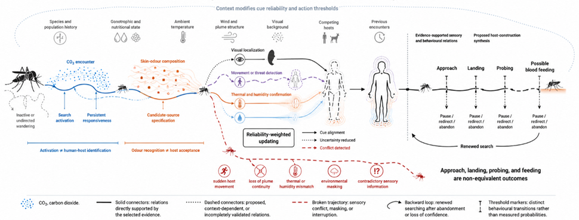
The proposed host-construction model organizes the evidence into four operations: activation, candidate specification, reliability-weighted updating, and stage-gated action. Activation describes the transition into a state in which host-associated information can guide behaviour. Candidate specification describes the use of odour composition and spatially aligned physical signals to distinguish a potential host from background sources. Reliability-weighted updating describes the conditional influence of each signal according to range, environmental quality, state, and prior experience. Stage-gated action describes reversible transitions from search to approach, landing, probing, feeding, or abandonment. Chemosensory ionotropic receptors provide evidence-supported inputs to this architecture by contributing to the detection of acids and other host-associated chemical or physical information, but receptor participation alone does not determine whole-animal choice [25].
The first operation is therefore not the construction of a complete human representation but the formation of an actionable host hypothesis. Carbon dioxide can increase readiness; skin odour can provide identity and quality information; visual contrast can locate candidate objects; and heat, infrared, and humidity can strengthen evidence of nearby living tissue. These signals enter the sequence at different distances and can overlap, disappear, or conflict. The proposed relation between them is conditional rather than additive: one cue can gate another, extend a search state, reduce uncertainty, or trigger a reversal. Broader synthesis of mosquito blood-feeding behaviour likewise indicates that internal physiology, external environment, and anthropogenic conditions interact dynamically rather than through a universal hierarchy [26]. Figure 1 shows the sequence of sensory integration during host seeking within the analytical logic developed in this section.
|
|
|
Figure 1. The sequence of sensory integration during host seeking |
Alt text
A structured conceptual diagram that shows the sequence of sensory integration during host seeking, with labelled components, directional relations, contextual modifiers, uncertainty points, and a clear boundary between observed evidence and proposed synthesis.
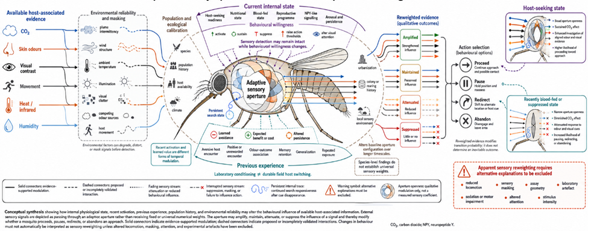
The second organizing principle is that sensory weighting is modified before and during the approach. Nutritional and reproductive condition can raise or suppress the probability of searching; a recent carbon-dioxide encounter can maintain responsiveness; previous positive or aversive encounters can alter expected value; and species or population history can influence which host-associated configurations are most salient. Human preference in Aedes aegypti populations varies geographically and is associated with climatic and urbanization gradients, indicating that host specialization cannot be treated as a universal species constant [27]. These modifiers do not merely add another cue to the sequence. They change how available evidence is interpreted and how much uncertainty is tolerated before the mosquito proceeds. Figure 2 depicts how internal state and prior experience modify sensory weighting within the analytical logic developed in this section.
|
|
|
Figure 2. How internal state and prior experience modify sensory weighting |
Alt text
A structured conceptual diagram that depicts how internal state and prior experience modify sensory weighting, with labelled components, directional relations, contextual modifiers, uncertainty points, and a clear boundary between observed evidence and proposed synthesis.
The model’s expected output is not a numerical probability or a deployment-ready prediction. It is a bounded account of why a mosquito may proceed, pause, redirect, or abandon a particular behavioural transition. Failure can occur when cues are spatially misaligned, environmental noise masks a signal, one sensory pathway is impaired, a candidate object lacks confirming near-field evidence, host movement is interpreted as threat, or internal state suppresses action. Odour context can also change spectral preference, directly demonstrating that visual influence is contingent rather than fixed [28].
Implications for traps, repellents, and control
Interventions should be designed around the particular host-construction operation they are intended to disrupt. Repellents may prevent access to human-odour information rather than acting only as intrinsically aversive chemicals. Commonly used repellents can reduce the availability of human odours to Anopheles mosquitoes, supporting perceptual masking as one mechanism of action [29]. Progress should therefore be assessed through more than receptor activation or short-range avoidance. Relevant endpoints include plume acquisition, source orientation, landing, probing, protection duration, response under competing host odours, and possible interference with odour-baited surveillance. A compound that masks odour in a controlled assay has demonstrated a biological mechanism, not operational protection under variable dose, airflow, clothing, user behaviour, and environmental persistence.
Trap and host-decoy design must likewise integrate lure chemistry with geometry and physical presentation. Visual properties alter the capture of Aedes aegypti by host-decoy traps, showing that successful interception depends on how an activated mosquito encounters the device rather than on attractant composition alone [30]. Visual and thermal target properties can also affect close-range orientation and landing differently, identifying separate design variables for attracting a mosquito to a device and converting approach into contact [31]. Device development should consequently report which behavioural transition is improved, whether gains persist across visual backgrounds and climates, and how trap performance compares with nearby humans or alternative hosts. Increased laboratory orientation to a colour, warm surface, or odour blend should not be presented as evidence of field capture, feeding prevention, or reduced transmission.
A further intervention strategy is to alter the mosquito’s internal host-seeking state. Next-generation NPYLR7 agonists inhibit live-host blood feeding at lower concentrations than earlier compounds, providing a mechanistic basis for pharmacological suppression of biting [32]. The corresponding implementation gap is substantial: delivery route, duration, uptake by wild mosquitoes, non-target effects, resistance, ecological consequences, manufacturing, and population-level impact remain unresolved. Across traps, repellents, sensory disruption, and state manipulation, the highest-priority research need is therefore transition-specific validation under multimodal and environmentally variable conditions. A credible development pathway should establish mechanism, distinguish attraction from landing and feeding, demonstrate performance in competition with natural hosts, evaluate persistence and behavioural compensation, and only then test whether the intervention changes human contact or transmission-relevant outcomes.
CONCLUSION
Mosquitoes construct a human host by conditionally combining sensory evidence across time rather than by following a universal hierarchy of independently attractive cues. Carbon dioxide can activate and prolong searching; skin odours can provide identity and quality information; vision can locate candidate objects; heat, infrared, and humidity can strengthen near-field evidence; movement can recruit, interrupt, or redirect action; and internal state and previous experience can alter whether any of these signals is followed. The strongest synthesis is therefore a state-dependent and reversible sequence from activation through candidate specification, approach, landing, probing, and possible feeding. Its principal boundaries are equally important: detecting a cue is not choosing a host, attraction is not landing or blood feeding, laboratory responses do not establish field behaviour, and multisensory integration does not establish fixed cue weights across species, physiological states, experiences, and environments. The proposed host-construction model is an evidence-grounded conceptual organization rather than a validated predictive framework. The most important next step is to evaluate competing models of gating, dynamic weighting, compensation, and stage-transition failure using naturalistic cue combinations and clearly separated behavioural and operational endpoints.
ACKNOWLEDGMENTS: None
CONFLICT OF INTEREST: None
FINANCIAL SUPPORT: None
ETHICS STATEMENT: None