Entomology and
Applied Science Letters
Applied Science Letters
 2026
Volume 13
Issue 1
2026
Volume 13
Issue 1

Integrated pest management must increasingly operate under conditions in which future pest pressure, intervention performance, ecological feedback, and implementation capacity cannot be represented by a single reliable forecast. Climate volatility can alter pest phenology, geographic suitability, crop susceptibility, and natural-enemy performance, while biological invasions can introduce unfamiliar species combinations for which historical thresholds and management assumptions are unreliable. At the same time, farmers differ in labour, capital, knowledge, service access, and tolerance of uncertain losses, meaning that theoretically preferable strategies may not be operationally feasible. This article develops an original, explicitly non-validated governance synthesis for adaptive integrated pest management under such deep uncertainty. The approach integrates evidence concerning uncertainty classification, climate-sensitive pest-system instability, biological invasion, novel pest assemblages, farmer constraints, intervention choice, monitoring, learning, resistance, and institutional coordination. The central synthesis is that uncertainty should neither be treated as a reason for decision paralysis nor concealed through false precision. Instead, integrated pest-management decisions should be organized as conditional and revisable choices: uncertainty is characterized, feasible intervention portfolios are selected, biological and operational signals are monitored, and actions are retained or revised through explicit decision rules. This logic preserves four essential distinctions: forecast uncertainty is not an absence of actionable information; theoretical optimality is not farmer feasibility; monitoring is not adaptive learning unless it changes or prospectively justifies retaining a decision; and short-term pest suppression is not evidence of resilient programme performance. The evidence base remains heterogeneous across crops, pests, regions, modelling approaches, and institutional settings, and many proposed relations have not been evaluated prospectively. The principal implication is therefore to design pest-management governance around robustness, reversibility, feasibility screening, calibrated monitoring, transparent trade-offs, and institutional capacity for repeated learning rather than around fixed prescriptions.
INTRODUCTION
Integrated pest management is commonly understood as the coordinated use of preventive, biological, cultural, mechanical, behavioural, and chemical tactics according to pest pressure, crop conditions, and acceptable economic and ecological consequences. Its defining feature is therefore not the presence of several control methods, but the deliberate integration of compatible interventions within a decision system that includes prevention, monitoring, interpretation, and revision. A conceptual treatment of integrated pest management accordingly emphasizes coordination among tactics rather than independent optimization of each intervention [1]. This systems orientation becomes especially important when future conditions are unstable, because the value of an intervention depends not only on its immediate biological effect but also on timing, interactions with other tactics, farmer capacity, resistance selection, and the possibility that ecological or economic conditions will change.
The practical history of integrated pest management nevertheless reveals a persistent gap between its systems logic and its implementation. Research and policy frequently present integrated pest management as a technically coherent alternative to pesticide dependence, while farmers encounter fragmented advice, uncertain efficacy, narrow operational windows, market pressures, and limited access to independent support. Critical synthesis shows that these barriers arise from interactions among research priorities, institutions, advisory structures, commercial incentives, and production constraints rather than from a simple shortage of available technologies [2]. Consequently, implementation failure cannot automatically be attributed to inadequate farmer knowledge or unwillingness. A tactic may be biologically plausible but incompatible with labour availability, equipment, service access, crop contracts, or the farmer’s tolerance of uncertain yield loss. Governance must therefore evaluate how scientific recommendations are translated into implementable decisions.
The need for such translation is intensified by uncertainty concerning the scale and distribution of pest damage. Global assessments establish that pathogens and animal pests impose substantial losses on major food crops, but estimated burdens vary among crops, production regions, and elicitation or measurement approaches [3]. These estimates are indispensable for establishing the importance of pest management, yet they do not directly identify the correct local intervention or the acceptable balance among yield protection, pesticide exposure, biodiversity, cost, and resistance. Aggregated loss burdens can conceal differences in pest identity, life stage, crop condition, surveillance intensity, and farmer vulnerability. They should therefore guide prioritization without being interpreted as universal thresholds or as evidence that stronger suppression is always the preferred response.
Climate change further destabilizes the assumptions on which pest-management calendars, thresholds, and intervention portfolios have been built. Mechanistic global modelling projects that warming can increase insect-related losses in major grain crops through effects on insect metabolism and population growth [4]. However, the magnitude and local expression of that risk remain conditional on crop, region, demographic assumptions, microclimate, adaptation, trophic interactions, and future management. The problem addressed here is thus not merely uncertainty about whether pest pressure may change. It is the governance problem of choosing, implementing, monitoring, and revising pest-management actions when several plausible biological and socioeconomic futures remain open. This article develops an evidence-grounded but explicitly non-validated synthesis for adaptive integrated pest-management governance under deep uncertainty. It focuses on climate volatility, pest-system instability, biological invasion, novel assemblages, farmer resources, risk tolerance, monitoring, learning, and institutional responsibility, while maintaining that uncertainty should be made decision-relevant rather than eliminated rhetorically.
Deep uncertainty in contemporary pest management
Deep uncertainty arises when decision makers cannot confidently agree on the model that represents a pest system, the probabilities of relevant future conditions, the consequences of alternative interventions, or the values by which outcomes should be compared. It differs from ordinary sampling error because collecting more observations may not resolve disagreements about model structure, spatial transfer, behaviour, future climate, or acceptable trade-offs. Crop–pest models can organize evidence and compare potential outcomes, but their decision value depends on integration with crop processes, appropriate input data, evaluation against observations, and explicit acknowledgement of structural limitations [5]. A model output is therefore an inference generated under defined assumptions rather than a direct biological observation. Divergence among model projections does not mean that no action is possible; it indicates that decisions should be tested across alternative assumptions and paired with monitoring capable of revealing when those assumptions no longer remain credible.
Information uncertainty also has an institutional dimension. Farmers do not encounter ecological evidence in an abstract form but through advisers, extension programmes, input suppliers, peers, commercial messages, and previous experience. Simplified narratives that portray pesticide application as the most reliable response can reinforce prophylactic use and weaken recognition of natural regulation, pest thresholds, and delayed ecological effects [6]. Yet knowledge deficits should not be treated as the sole explanation for pesticide dependency. Farmers may understand ecological risks while still facing legitimate concerns about yield loss, labour, market penalties, or the uncertain performance of alternatives. Probabilistic analysis of boll-weevil management illustrates how strategies can be compared without assuming that costs, efficacy, timing, and production outcomes are precisely known [7]. Such analyses are useful because they expose ranges and downside risks, but the option with the highest expected profitability is not automatically feasible or acceptable to every farmer.
Evolutionary feedback makes the consequences of short decision horizons particularly important. Pesticide resistance is not only a biological response to selection but also a collective-action problem in which individually rational attempts to secure immediate control can degrade the future effectiveness of shared control technologies [8]. This creates a conflict between short-term suppression and long-term programme resilience. A treatment may reduce current pest abundance while accelerating resistance, disrupting natural enemies, or narrowing future options. Conversely, a diversified strategy may appear less decisive in the short term while preserving ecological regulation and control durability. Deep uncertainty in contemporary pest management therefore concerns interacting model, measurement, behavioural, evolutionary, and institutional uncertainties. Adaptive governance should identify which uncertainty may be reduced through improved evidence, which must be managed through robust or reversible action, and which represents a conflict among values or responsibilities. The evidence dimensions and interpretive boundaries for deep uncertainty in contemporary pest management are summarized in Table 1.
Table 1. Deep Uncertainty in Contemporary Pest Management: Uncertainty Sources, Farmer Constraints, Adaptive Choices, Monitoring, Learning, Trade-Offs, and Governance Requirements
|
Decision domain |
Uncertainty or disturbance |
Available response |
Monitoring requirement |
Revision trigger |
Farmer-feasibility condition |
Ecological or resistance trade-off |
Governance implication |
|
Integrated intervention portfolio |
Compatibility and performance of tactics vary across crop–pest contexts |
Combine preventive and responsive tactics conditionally rather than optimizing each in isolation |
Pest pressure, crop condition, tactic performance, non-target effects |
Evidence that a tactic conflicts with another intervention or no longer contributes to the portfolio |
Required tactics must be affordable, timely, understandable, and operationally compatible |
Diversification may reduce pesticide dependence but can increase management complexity |
Responsibilities for portfolio design, advice, and review must be explicit |
|
Crop–pest modelling |
Structural assumptions, parameters, scale, and input data alter projections |
Compare outcomes under alternative models and document assumptions |
Predicted versus observed pest and crop outcomes |
Persistent prediction error, changed system state, or invalidated assumptions |
Model outputs must be translated into feasible actions rather than delivered as abstract forecasts |
Incorrect models can prompt unnecessary intervention or delayed control |
Require transparent evaluation, uncertainty communication, and model updating |
|
Advisory information |
Ecological processes may be simplified or distorted by advisory systems |
Strengthen independent ecological advice and experiential interpretation |
Farmer understanding, pesticide routines, natural-enemy observations |
Repeated prophylactic use, advice–outcome mismatch, or emerging ecological harm |
Advice must fit farmers’ time, knowledge, language, and production constraints |
Better ecological interpretation may reduce non-target harm; poor advice may deepen pesticide dependence |
Separate public-interest advice from narrow product promotion |
|
Farm-level strategy choice |
Costs, efficacy, timing, yield, and prices are uncertain |
Use probabilistic comparison and retain reversible alternatives |
Realized costs, pest pressure, yield response, and implementation delays |
Strategy ranking changes or downside risk becomes unacceptable |
Choice must match liquidity, labour, equipment, and risk tolerance |
Expected profitability may conflict with ecological durability or pesticide reduction |
Provide decision support that reports ranges and assumptions rather than one optimum |
|
Resistance management |
Evolutionary response and collective use patterns undermine durability |
Diversify modes of action and coordinate stewardship |
Resistance indicators, treatment performance, and pesticide-use patterns |
Declining efficacy, rising resistance frequency, or narrowing control options |
Alternative tactics and coordinated rules must be practically accessible |
Immediate suppression can accelerate long-term resistance and externalize costs |
Align private incentives with collective preservation of control effectiveness |
|
Climate-sensitive preparedness |
Pest losses may increase, but magnitude varies by crop, region, and biological assumptions |
Use directional projections for preparedness while retaining conditional decisions |
Local climate, pest phenology, crop condition, and observed losses |
Local observations diverge from projected timing or severity |
Farmers require feasible contingency options, not warnings alone |
Pre-emptive intensification may increase non-target and resistance risks |
Couple climate information with locally revisable IPM portfolios |
Climate volatility and pest-system instability
Climate volatility affects pest management through more than a gradual change in average temperature. Extreme heat, variable rainfall, altered seasonality, drought, crop stress, and fine-scale refugia can change insect development, mortality, dispersal, host suitability, and exposure to natural enemies. Forecasting invasive-pest distributions is particularly sensitive to whether models include behavioural and physiological responses that allow insects to mitigate environmental stress [9]. Shade seeking, altered activity periods, acclimation, and other responses may reduce exposure to conditions represented by coarse climatic data. Models that omit these processes can overstate range expansion, whereas models that assume excessive adaptive capacity can understate risk. The appropriate inference is not that projections are unusable, but that suitability estimates should be interpreted as conditional evidence rather than direct predictions of establishment or damage.
The effects of climate change also vary among biomes because thermal conditions interact with host availability, land use, natural enemies, dispersal pathways, and the baseline climatic position of the pest population [10]. Consequently, a directional global association between warming and increasing pest losses cannot be translated into a universal local response. The climate recorded at a regional weather station may differ substantially from the temperature and moisture experienced by insects within crop canopies, soil, stored products, or forest stands. Mechanistic microclimate models can improve biological realism, but they introduce distinct physical, mathematical, and organism-response errors that must be diagnosed separately [11]. Greater spatial resolution therefore does not guarantee greater predictive accuracy. It is useful only when the microclimate estimate, biological response function, and decision scale are each appropriately validated.
Climate-induced instability can also alter interactions between pests and biological-control agents. Scenario modelling in Eastern Africa indicates that future stem-borer control by natural enemies may vary with the climate scenario, model structure, location, pest species, and agent response [12]. Such findings support anticipatory planning, but they do not establish that biological control will universally decline or that chemical substitution will become necessary. Apparent instability may arise from altered pest phenology, disrupted enemy synchrony, crop changes, land-use shifts, or limitations in the model itself. The governance task is therefore to monitor pest and natural-enemy performance together, compare observations with projected relationships, and revise tactics when predefined evidence indicates that the system has changed. Forecast uncertainty is not equivalent to an absence of actionable information: directional evidence can justify surveillance, diversification, contingency planning, and preservation of reversible options even when the exact future state remains unknown. At the same time, decisions should avoid converting uncertain climate risks into routine preventive pesticide use, because such intensification can create resistance and ecological costs before the projected threat materializes.
Biological invasion and novel pest assemblages
Biological invasions create deep uncertainty because detection, establishment, spread, crop injury, yield loss, and wider ecological consequence are related but non-equivalent stages. Estimating losses from invasive insects is particularly difficult when density–damage relationships are sparse, climate inputs are uncertain, management responses vary, and observations are collected after the invasion has already altered production practices [13]. Presence alone does not establish damaging impact, and crop injury does not automatically quantify yield loss. Conversely, the absence of measured damage during an early stage does not establish that future consequences will be negligible. An adaptive invasion component should therefore begin by classifying the evidence available for pest identity, establishment, spatial extent, host association, injury, economic consequence, and ecological interaction. The initial output is not a definitive intervention but a provisional risk state linked to specified surveillance and response options.
Once an alien pest is detected, management commonly involves delimitation, eradication, containment, buffer zones, suppression, or combinations of these responses. Reviews of European plant-health practice show that zoning is already adapted to different outbreak objectives, yet the evidence supporting particular zone widths, durations, and comparative cost-effectiveness remains uneven [14]. A proposed governance sequence should therefore connect verified detection to delimiting surveillance, spatial classification, selection of a reversible initial response where possible, and explicit escalation or de-escalation rules. Surveillance quality is critical because raw public reports are spatially biased by observer density, awareness, accessibility, and willingness to report. Statistical analysis of citizen surveillance demonstrates that reporting probabilities are non-uniform, meaning that an absence of reports cannot be interpreted as an absence of the target pest [15]. Failure to account for this distinction can create false reassurance in poorly observed locations and excessive confidence in apparent distribution boundaries.
Novel assemblages add a second layer of uncertainty because introduced pests may interact with crops, resident herbivores, natural enemies, microbial associates, and landscapes in ways that lack a close historical analogue. The proposed synthesis therefore treats these interactions as conditional hypotheses rather than established universal mechanisms. Its principal inputs are verified pest records, pathway information, host distribution, climate and microclimate conditions, pest and natural-enemy observations, crop injury, farmer capacity, and the expected consequences of both action and delay. Its decision points concern whether to intensify surveillance, modify spatial zones, implement containment, deploy biological or cultural controls, use selective chemical suppression, or retain a monitored non-intervention position. Its expected outputs are not merely lower pest counts but better-justified decisions, reduced irreversible error, and preservation of future management options. Biological control can sometimes produce benefits extending beyond farm-level yield, as illustrated by evidence linking cassava-pest suppression to avoided pressure on tropical forests [16]. However, such landscape benefits depend on pest identity, agent specificity, establishment, ecological context, and the validity of the counterfactual land-use pathway. The proposed invasion logic would fail if it treated detection as impact, absence of reports as pest absence, short-term suppression as durable control, or a successful historical biological-control case as universally transferable. Validation would require prospective comparisons of surveillance designs, zoning rules, intervention sequences, ecological consequences, farmer burdens, and decision revisions across multiple invasion contexts.
Farmer resources, risk tolerance, and feasibility
Farmer feasibility is not an external implementation detail added after an intervention has been judged technically effective. It is a constitutive part of the decision itself because labour, capital, knowledge, equipment, service access, market obligations, and tolerance of uncertain loss determine whether an intervention can be implemented at the required time and intensity. Behavioural evidence indicates that changes in pesticide use arise from interacting individual, social, material, and institutional conditions rather than from a single universal motivation [17]. Consistent with this interpretation, farmers’ reported constraints on integrated pest-management adoption include time demands, knowledge requirements, uncertain efficacy, economic considerations, and the organization of advisory support [18]. These findings do not establish one causal hierarchy across farms, but they demonstrate why non-adoption should not automatically be interpreted as ecological illiteracy or resistance to innovation.
Risk tolerance further differentiates strategies that appear similar when evaluated only by expected biological or financial performance. A farmer with limited liquidity may rationally prefer a familiar intervention with predictable immediate costs over a biologically promising alternative whose benefits are delayed or variable. Experiential learning can reduce some uncertainty, but participation in a learning programme is not itself evidence that decisions or practices have changed. Evaluations of Farmer Field Schools indicate that outcomes depend on the quality of participation, facilitation, experimentation, and the trajectory through which practices are reconsidered [19]. Operational arrangements also matter. Farmers’ decisions to hire pest-management spraying services are influenced by timeliness, machinery and labour constraints, service availability, and risk aversion [20]. A theoretically efficient intervention can therefore become infeasible when weather windows are narrow, contractors are unavailable, monitoring information arrives late, or the farmer cannot absorb the consequences of control failure.
Adaptive governance should consequently apply a feasibility screen before presenting any intervention as a preferred option. That screen should identify required labour, cash flow, equipment, knowledge, service support, timing, compatibility with other farm activities, and exposure to downside risk. It should also distinguish perceived barriers from demonstrated constraints without dismissing either: perceptions influence action, while resource and institutional conditions can make those perceptions reasonable. Probabilistic comparison may help farmers and advisers consider outcome ranges, but an option with the highest expected return is not automatically acceptable to a farmer facing severe downside consequences [7]. Governance responses should therefore include differentiated advisory support, access to credible services, risk-sharing mechanisms, locally relevant demonstrations, and fallback options when preferred tactics cannot be implemented. The evidence dimensions and interpretive boundaries for farmer resources risk tolerance and feasibility are summarized in Table 2.
Table 2. Farmer Resources, Risk Tolerance, and Feasibility: Uncertainty Sources, Farmer Constraints, Adaptive Choices, Monitoring, Learning, Trade-Offs, and Governance Requirements
|
Decision domain |
Uncertainty or disturbance |
Available response |
Monitoring requirement |
Revision trigger |
Farmer-feasibility condition |
Ecological or resistance trade-off |
Governance implication |
|
Pesticide-use reduction |
Farmers respond differently to behavioural, social, economic, and institutional conditions |
Combine advisory, economic, social, and practical support rather than relying on one adoption lever |
Actual pesticide use, intervention uptake, abandonment, and farmer-reported barriers |
Persistent non-adoption, rebound use, or mismatch between support and constraints |
Measures must fit farm resources, objectives, perceived control, and production context |
Reduced pesticide use may lower environmental pressure, but poorly supported change may expose farmers to unacceptable loss |
Design differentiated intervention packages and evaluate effects by farm type |
|
Adoption of integrated pest management |
Time, knowledge, efficacy, costs, and advisory arrangements constrain adoption |
Simplify implementation, strengthen advice, and provide locally credible demonstrations |
Adoption trajectories, tactic combinations, labour requirements, and perceived effectiveness |
Repeated implementation failure or evidence that an advised tactic is incompatible with farm operations |
Farmers require sufficient time, skills, equipment, and confidence in expected performance |
Diversification can improve ecological and resistance outcomes but may increase management complexity |
Treat adoption barriers as design and institutional problems, not solely farmer deficits |
|
Experiential learning |
Participation does not guarantee experimentation, learning, or sustained practice change |
Use facilitated field learning, peer exchange, and iterative experimentation |
Changes in decisions and practices rather than attendance alone |
No change in decision rules, abandonment after facilitation ends, or poor transfer to farm conditions |
Participation must be accessible, relevant, and supported over sufficient time |
Learning may enable less pesticide-intensive strategies, but benefits depend on implementation quality |
Evaluate learning programmes through trajectories of decision change |
|
Spraying-service choice |
Weather windows, contractor availability, machinery, labour, and risk preferences affect timing |
Compare own application, custom services, delayed treatment, and nonchemical alternatives |
Service delays, application timing, cost, efficacy, and crop outcomes |
Repeated missed windows, rising service costs, or unacceptable performance variability |
Reliable services and contracting arrangements must exist locally |
Timely treatment may improve efficacy, but service dependence may reinforce chemical-centred responses |
Support dependable service markets while maintaining access to diversified tactics |
|
Strategy profitability |
Costs, pest pressure, yield effects, and prices are uncertain |
Use probabilistic comparison and retain reversible alternatives |
Realized costs, pest outcomes, yields, and downside losses |
Strategy ranking changes or downside exposure exceeds farmer tolerance |
Liquidity and acceptable loss must be considered alongside expected value |
Profitable options may differ in pesticide use, ecological consequence, and resistance risk |
Communicate distributions and assumptions rather than a single optimum |
|
Advisory credibility |
Information may be incomplete, commercially biased, or poorly matched to local ecology |
Strengthen independent advice and combine scientific with experiential evidence |
Advice followed, farmer interpretation, pest outcomes, and unintended effects |
Repeated advice–outcome mismatch or increasing pesticide dependency |
Advice must be understandable, timely, trusted, and operationally relevant |
Simplified advice can intensify pesticide use and weaken natural regulation |
Maintain transparent advisory responsibilities and conflict-of-interest safeguards |
Adaptive decisions, monitoring, and learning
Monitoring supports adaptive pest management only when the observed signal is sufficiently reliable, reaches an authorized decision maker, and is connected to a rule for retaining or changing action. Camera-equipped traps can increase observation frequency and reduce some field visits, but their value remains conditional on cost, power, connectivity, image quality, species classification, maintenance, and field validation [21]. More frequent data do not necessarily produce better decisions when detection errors are unknown or when the monitored variable is weakly related to crop injury, intervention efficacy, or economic consequence. Monitoring design should therefore specify what latent biological state is being estimated, how uncertainty enters the signal, and which management choice could reasonably change in response.
Digital systems can integrate automated pest detection, environmental sensing, remote reporting, and farm-management tasks. Long-term deployment of an artificial-intelligence-and-networked-sensor system in protected cropping demonstrates the practical possibility of connecting repeated pest observations with management support [22]. Nevertheless, observed programme improvement cannot be attributed to sensing alone when monitoring, advice, training, and other management changes occur together. Forecasting presents a related boundary. One-week-ahead ensemble models can improve prediction of western flower thrips abundance in the studied greenhouse system, but forecast performance does not by itself define an intervention threshold or establish that forecast-guided management improves biological or economic outcomes [23]. Forecast uncertainty is therefore not an absence of information, but its usefulness depends on a feasible action, an appropriate lead time, and a decision rule that has been evaluated separately from predictive accuracy.
Measurement processes can also create apparent biological change. Variation in pheromone release and local trap position can produce substantial uncertainty in bark-beetle catches, limiting direct inference from trap counts to population pressure [24]. Similar concerns apply to camera angle, lure condition, sensor placement, classifier drift, missing data, and changes in sampling effort. Adaptive learning begins when decision makers compare expectations with observations, determine whether disagreement reflects biological change or measurement error, and revise a model, threshold, portfolio, or institutional arrangement. Retaining an existing action can count as learning only when retention is prospectively justified against an explicit rule; passive continuation cannot. A decision-linked monitoring record should therefore contain the prior hypothesis, expected signal, observed signal, measurement uncertainty, action taken, outcome observed, and reason for revision or retention. Without that chain, monitoring remains surveillance rather than adaptive governance.
Proposed governance logic for uncertain IPM
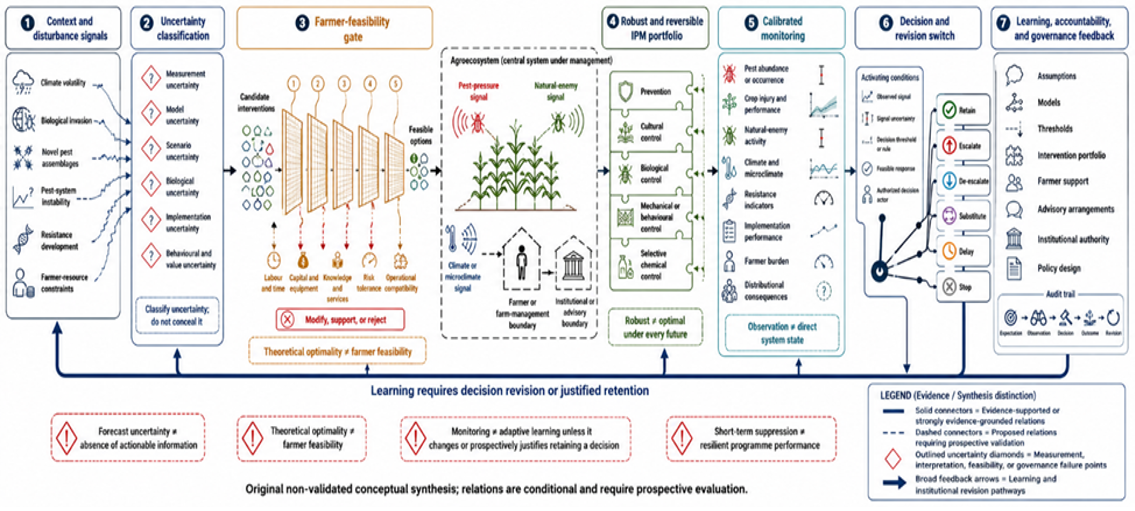
The proposed governance logic is an original, non-validated scholarly synthesis organized as a repeated decision cycle. Its first component defines the decision context by identifying the crop–pest system, relevant spatial and temporal scale, decision actor, available interventions, farmer constraints, ecological dependencies, and institutional responsibilities. The second component classifies uncertainty as measurement, model, scenario, behavioural, implementation, or value uncertainty. The third screens interventions for biological plausibility, compatibility, reversibility, resource requirements, timing, and downside risk. Climate-smart pest management provides evidence for anticipatory, diversified, and landscape-aware preparation rather than the simple adjustment of routine pesticide schedules [25]. A theoretical framework for greener integrated pest-management adoption similarly indicates that perceived performance, compatibility, feasibility, risk, and behavioural conditions operate as sequential filters, although the proposed relations remain to be validated across production systems [26].
The fourth component selects a robust and revisable portfolio rather than a single presumed optimum. Robustness here means acceptable performance across several plausible futures, not superior performance in every future. The fifth component specifies calibrated monitoring of pests, crops, natural enemies, environmental conditions, resistance, implementation, and distributional consequences. The sixth links those signals to retain, escalate, de-escalate, substitute, delay, or stop decisions. In invasion management, both intervention and non-intervention can produce ecological, economic, and social consequences; governance should therefore compare the consequences of action and inaction symmetrically [27]. At broader scales, expected outcomes of pest-management transformation vary among productivity, economic, environmental, health, and distributional indicators, demonstrating why no single aggregate metric can represent programme success [28]. The seventh component returns evidence from decisions and outcomes to the assumptions, models, thresholds, portfolio, farmer support, and institutional rules that generated the action.
Figure 1 depicts adaptive IPM as a repeated decision cycle involving uncertainty assessment, intervention choice, monitoring, learning, and revision within the analytical logic developed in this section.
|
|
|
Figure 1. Adaptive IPM as a repeated decision cycle involving uncertainty assessment, intervention choice, monitoring, learning, and revisio |
Alt text
A structured conceptual diagram that depicts adaptive IPM as a repeated decision cycle involving uncertainty assessment, intervention choice, monitoring, learning, and revision, with labelled components, directional relations, contextual modifiers, uncertainty points, and a clear boundary between observed evidence and proposed synthesis.
The cycle is adaptive only when responsibilities and revision rules are explicit. Failure modes include presenting forecasts as certainty, selecting theoretically optimal but infeasible interventions, treating raw monitoring counts as direct biological states, accumulating data without changing decisions, and evaluating programmes only through immediate pest suppression. Boundary conditions include species biology, crop stage, landscape, climate, surveillance quality, market requirements, farmer resources, institutional authority, and the reversibility of potential harm. Validation would require prospective multi-site studies comparing decision quality, implementation, ecological effects, resistance, farmer burden, and distributional consequences under alternative governance arrangements. It would also require evidence that monitoring changed or justified retaining a decision, rather than merely producing additional observations. The proposed components, evidence bases, boundary conditions, failure modes, and validation requirements are organized in Table 3.
Table 3. Proposed Governance Logic for Uncertain IPM: Components, Evidence Basis, Relations, Boundary Conditions, Failure Modes, and Validation Requirements
|
Proposed component |
Purpose |
Evidence basis |
Relation or mechanism |
Input or precondition |
Expected output |
Boundary condition or failure mode |
Validation requirement |
|
Decision-context definition |
Establish the biological, operational, spatial, temporal, and institutional scope |
Systems-oriented integrated pest management and implementation evidence |
Specifies which actors, outcomes, interventions, and scales belong in the decision |
Identified crop–pest system, decision actor, intervention set, and responsibilities |
Bounded decision problem |
Failure occurs when relevant farmers, ecological interactions, or institutional constraints are omitted |
Test whether explicit context definition improves decision consistency and transferability |
|
Uncertainty classification |
Distinguish uncertainties requiring data, robustness, deliberation, or precaution |
Crop–pest modelling, probabilistic analysis, climate projections, and monitoring-error evidence |
Separates measurement, model, scenario, behavioural, implementation, and value uncertainty |
Transparent assumptions, data provenance, and plausible alternatives |
Decision-relevant uncertainty profile |
Treating every uncertainty as reducible error or as complete ignorance |
Compare decisions made with and without explicit uncertainty classification |
|
Farmer-feasibility screen |
Exclude or modify options that cannot be implemented under local conditions |
Behavioural, adoption, learning, and service-choice evidence |
Filters tactics through labour, cash, timing, equipment, knowledge, services, and risk tolerance |
Farm-resource profile and tactic requirements |
Implementable option set and required support |
Theoretical optimality mistaken for operational feasibility |
Evaluate adoption, timing, abandonment, and outcomes across farm types |
|
Robust and reversible portfolio |
Preserve acceptable performance across plausible futures |
Climate-smart management, resistance governance, and invasion-response evidence |
Combines preventive, biological, cultural, mechanical, and selective chemical tactics while retaining alternatives |
Compatible interventions and plausible system scenarios |
Conditional portfolio with fallback options |
Robustness mistaken for universal optimality; irreversible action taken prematurely |
Compare regret, resilience, resistance, and ecological outcomes over time |
|
Calibrated monitoring |
Produce decision-grade biological and operational signals |
Camera traps, networked sensing, forecasting, citizen reporting, and pheromone-trap evidence |
Estimates latent pest-system states while accounting for detection and measurement error |
Validated sampling design, maintenance, data interpretation, and access |
Signal accompanied by uncertainty and decision relevance |
Raw reports or counts treated as pest absence, census, injury, or impact |
Field calibration and comparison of alternative monitoring designs |
|
Decision and revision rules |
Link evidence to retain, escalate, de-escalate, substitute, delay, or stop choices |
Forecasting, zoning, and action–inaction evidence |
Predefines the conditions under which management changes |
Authorized decision maker, actionable lead time, thresholds, and fallback options |
Transparent, auditable action or justified retention |
Monitoring accumulates without changing or prospectively justifying a decision |
Audit compliance with triggers and compare outcomes with alternative rules |
|
Multi-outcome evaluation |
Prevent short-term pest suppression from dominating all other outcomes |
Resistance, landscape, and global transition evidence |
Assesses biological control, yield, cost, health, ecology, resistance, and distribution together |
Repeated outcome measurement and explicit priorities |
Balanced programme-performance assessment |
Short-term suppression interpreted as resilient programme performance |
Longitudinal evaluation across ecological, economic, resistance, and equity outcomes |
|
Institutional learning and accountability |
Revise models, support, authority, and policy after outcomes are observed |
Integrated pest-management implementation and policy evidence |
Records assumptions, actions, outcomes, deviations, and responsibility for revision |
Audit trail, review schedule, authority, and stakeholder representation |
Updated decisions and institutional arrangements |
Post hoc narrative replaces prospective learning; responsibility remains fragmented |
Compare repeated decision cycles and document whether rules improve |
Implementation and policy implications
The first implementation priority is to redirect research and innovation from isolated tactic substitution toward coordinated redesign of pest-management systems. A pesticide-free research paradigm emphasizes the need to integrate cropping-system design, breeding, biological control, equipment, economics, markets, and public policy rather than expecting one technology to displace pesticide dependence [29]. Progress should therefore be assessed through portfolios that connect biological efficacy with labour, timing, service requirements, farmer risk, ecological consequence, and durability. Longitudinal evidence from commercial farms indicates that reduced pesticide reliance is associated with combinations and sequences of management changes rather than a universally sufficient single tactic [30]. Because this evidence is observational, it does not identify one causal package; it does show that implementation research should examine trajectories, interactions, reversals, and the support required to sustain change.
The second priority is to align institutions across the farm, advisory, market, landscape, and policy levels. A multi-level crop-protection framework places innovation, farmer behaviour, risk, market incentives, environmental effects, and regulation within the same analytical structure [31]. Practical progress would be demonstrated by clearer responsibility for monitoring and revision, stronger independent advisory capacity, reliable access to biological and mechanical alternatives, support for farms facing transition costs, and performance indicators extending beyond pesticide volume or immediate suppression. Climate and invasion surveillance should be linked to feasible contingency portfolios, while resistance monitoring should trigger coordinated responses before control failure becomes widespread. Distributional analysis is essential because transition costs, surveillance access, service availability, and exposure to pest damage are unlikely to be equal across farms or regions.
The third priority is to make policy choice under uncertainty transparent and revisable. Participatory multicriteria analysis can compare pesticide-risk policy mixes while incorporating uncertain consequences and stakeholder preferences, but the resulting rankings depend on selected objectives, weights, risk attitudes, and deliberative design [32]. Such methods should not be presented as discovering a universally optimal policy. Their value lies in exposing assumptions, value conflicts, trade-offs, and conditions under which a preferred option changes. Progress would be indicated by published assumptions, sensitivity analyses, representation of differently affected groups, pre-specified review dates, and evidence that monitoring altered policy or justified its retention. Policy mixes should be evaluated through ecological, economic, health, resistance, feasibility, and distributional outcomes over sufficient time to distinguish temporary suppression from resilient programme performance.
CONCLUSION
Adaptive integrated pest-management governance under deep uncertainty requires decisions that remain scientifically grounded without claiming greater predictive or causal certainty than the evidence permits. The strongest defensible synthesis is that climate volatility, biological invasion, resistance, farmer constraints, and measurement error should be governed through conditional and repeated choices rather than fixed prescriptions. Forecasts can support preparedness even when their magnitude is uncertain; biologically attractive interventions must pass a farmer-feasibility screen; monitoring becomes learning only when it changes or prospectively justifies retaining a decision; and immediate suppression must be evaluated alongside resistance, ecological effects, implementation burden, and long-term resilience. The proposed cycle of context definition, uncertainty classification, feasibility screening, portfolio choice, calibrated monitoring, decision revision, and institutional learning is an original conceptual organization rather than a validated framework. Its transferability will depend on crop, pest, life stage, spatial and temporal scale, climate, farm resources, surveillance design, market context, and institutional authority. The highest-priority implication is to evaluate adaptive governance prospectively through documented decision cycles that connect assumptions, observations, actions, outcomes, revision rules, and distributional consequences.
ACKNOWLEDGMENTS: None
CONFLICT OF INTEREST: None
FINANCIAL SUPPORT: None
ETHICS STATEMENT: None