Entomology and
Applied Science Letters
Applied Science Letters
 2025
Volume 12
Issue 4
2025
Volume 12
Issue 4

Urban mosquito control commonly treats water-holding objects as discrete breeding sites, although their capacity to produce epidemiologically relevant adult mosquitoes depends on changing interactions among aquatic microecology, urban infrastructure, weather, human water management, and larval development. This article addresses the conceptual gap between detecting potential larval habitat and explaining how particular urban aquatic systems become persistent sources of adult vectors. It develops an original spatial-ecological theory by integrating evidence on habitat structure, aquatic microbiota, detrital and nutritional resources, density-dependent competition, water storage, drainage, weather-driven hydroperiods, and larval carryover effects on adult phenotypes. The synthesis indicates that larval habitats should be understood as dynamically activated components of urban disease infrastructure rather than as uniformly hazardous containers. Water presence, larval occupancy, pupal productivity, adult emergence, human exposure, and disease transmission constitute related but non-equivalent states. Built structures influence mosquito production only when their physical configuration and management interact with biologically suitable and sufficiently persistent aquatic conditions. The resulting adults may also differ in survival, fecundity, physiological condition, insecticide response, and pathogen-related traits because larval developmental environments leave carryover effects. The proposed theory remains non-validated and is limited by inconsistent habitat definitions, mismatched spatial and temporal scales, incomplete linkage between immature and adult surveillance, and restricted evidence connecting adult production to observed transmission. Its central implication is that research and management should classify habitat states, not merely container types, and should align surveillance indicators with the specific ecological or epidemiological inference required.
Urbanisation changes mosquito-borne disease ecology by reorganising water access, housing, waste, vegetation, infrastructure, human density, and vector–host contact. These processes do not produce a single or uniform “urban effect”; instead, they generate heterogeneous combinations of habitat availability, environmental suitability, vector dominance, and exposure opportunity [1]. Consequently, urban larval habitats should not be considered isolated biological sites detached from the services, structures, behaviours, and weather regimes that continually create or deactivate them.
Urban environments contain numerous natural and artificial water-holding structures, yet their mere presence does not establish productive larval habitat [2]. Productivity is often concentrated in particular habitat classes, because container function, water persistence, access by ovipositing females, nutrient inputs, and maintenance differ substantially among sites [3]. A city may therefore contain many water-positive objects while receiving most of its adult mosquito production from a smaller subset of persistently suitable aquatic systems.
The distinction becomes more important when immature-stage observations are used to infer adult abundance. Relationships between larvae, pupae, and adult mosquitoes can vary across taxa, neighbourhoods, seasons, and surveillance methods, and immature indices do not consistently function as substitutes for adult measurements [4]. Larval abundance may reflect recent oviposition without indicating successful development, whereas adult trap counts may reflect dispersal from habitats outside the sampled area. Adult emergence itself also remains biologically upstream from human contact, pathogen exposure, and observed disease.
This article proposes that urban larval habitats be interpreted as dynamic disease infrastructure: distributed aquatic systems whose ecological functioning is conditioned by built form, human operation, weather, microbial and nutritional processes, competition, and stage-specific survival. The aim is not to validate a universal causal model, but to organise evidence-supported relations and explicit boundary conditions linking potential aquatic structures to adult mosquito production. The central argument is that reliable inference requires movement through distinct states—from water availability to productive habitat, adult recruitment, human exposure, and transmission—without treating those states as interchangeable.
Larval habitats as ecological and infrastructural systems
A larval habitat acquires ecological function when a physical structure contains accessible water for sufficient time and provides conditions compatible with mosquito development. Household container studies show that container use, management, water characteristics, and local setting influence immature abundance [5]. The relevant analytical unit is therefore not simply a bucket, tank, drain, or discarded object, but a time-specific habitat state produced by interactions among structure, water, organisms, resources, and human practice.
This functioning is spatially embedded. Roads, vegetation, water-storage systems, and urban configuration can influence mosquito movement and redistribute the adult consequences of local larval production [6]. Urbanisation may also reduce mosquito-community diversity while increasing the dominance of container-adapted vectors [7]. These findings support an infrastructural interpretation in which neighbourhood form affects both where aquatic sites occur and how mosquitoes emerging from those sites move through human environments. They do not demonstrate that identical built features produce identical biological effects across cities.
The proposed synthesis separates potential habitat, occupied habitat, productive habitat, and disease-relevant infrastructure. Longitudinal evidence indicates that macrohabitat and microhabitat conditions jointly structure immature occurrence within heterogeneous cities [8], while operational surveillance shows that a restricted set of aquatic habitat classes may account for a disproportionate share of observed larvae and pupae [9]. Validation therefore requires repeated linkage among habitat state, stage progression, emergence, and adult distribution rather than one-time water or larval inspection. The proposed components, evidence bases, boundary conditions, failure modes, and validation requirements are organized in Table 1.
Table 1. Larval Habitats as Ecological and Infrastructural Systems: Components, Evidence Basis, Relations, Boundary Conditions, Failure Modes, and Validation Requirements
|
Proposed component |
Purpose |
Evidence basis |
Relation or mechanism |
Input or precondition |
Expected output |
Boundary condition or failure mode |
Validation requirement |
|
Potential aquatic structure |
Identify physical water-holding opportunity |
Urban habitat inventories |
Built or natural form permits water accumulation |
Structure capable of retaining water |
Potential habitat |
Dry, inaccessible, frequently emptied, or unsuitable structures may produce nothing |
Repeated water-state and accessibility assessment |
|
Activated larval habitat |
Distinguish water presence from biological suitability |
Household and longitudinal habitat studies |
Water persistence, access, resources, and microclimate permit colonisation |
Accessible water of sufficient duration |
Eggs or larvae present |
Occupancy may be temporary and need not lead to pupation |
Cohort and hydroperiod monitoring |
|
Productive habitat |
Identify sites contributing to adult recruitment |
Larval and pupal productivity studies |
Stage survival converts immature occupancy into pupal or adult output |
Suitable conditions through development |
Pupae or emerging adults |
High larval abundance may coincide with density-dependent mortality |
Pupal counts, emergence traps, and cohort survival |
|
Spatially connected habitat system |
Link local production to neighbourhood ecology |
Landscape and movement evidence |
Built form, vegetation, and roads influence dispersal and redistribution |
Productive sites within a connected landscape |
Local or displaced adult abundance |
Adults may be trapped away from their natal habitat |
Marking, spatial modelling, or paired habitat–adult surveillance |
|
Vector-dominant urban assemblage |
Explain community reorganisation |
Urban-gradient evidence |
Urban conditions favour selected container-adapted species |
Repeated anthropogenic habitat availability |
Greater relative dominance of vector species |
Species responses vary across climates and regional communities |
Multicity community comparisons |
|
Disease-relevant infrastructure |
Prevent direct inference from habitat to disease |
Conceptual integration of ecological stages |
Adult production contributes to risk only through contact, pathogen, and host pathways |
Productive habitat plus downstream epidemiological conditions |
Conditional contribution to exposure |
Adult emergence is not equivalent to human disease risk |
Linked entomological, behavioural, pathogen, and epidemiological data |
Aquatic microbiota, food resources, and competition
Aquatic microorganisms contribute more than passive biomass to mosquito development. Experimental evidence indicates that bacterial respiration can create hypoxic signals involved in larval development [10]. This establishes a direct mechanistic role for microbial activity, but it does not imply that the detection of particular bacterial taxa in field water is sufficient to predict productivity. Community composition, metabolic activity, water chemistry, larval feeding, and host genotype may produce similar taxonomic observations with different functional consequences.
Larval microbial exposure can also extend beyond the aquatic stage. Different bacterial environments have been associated experimentally with variation in pupation, adult size, immune traits, and dengue-virus dissemination [11]. Field comparisons further show overlap, but not complete equivalence, between microorganisms in habitat water and those found in adult mosquitoes [12]. Aquatic microbiota should therefore be represented as a filtered developmental exposure: some organisms or functions may be acquired, others may be lost, and adult traits may reflect both direct microbial effects and correlated nutritional conditions.
Food quantity alone is likewise insufficient to define habitat quality. Competition changes according to the timing and distribution of resource inputs, even when cumulative food availability appears similar [13]. Urban environmental heterogeneity can also influence detritus, nutrients, larval density, biomass, and nutritional composition within containers [14]. These findings suggest that larval competition should be interpreted relative to resource renewal and cohort development, not simply larval counts. High density may indicate a favourable oviposition site, severe resource limitation, or both; only stage-specific survival and adult emergence can distinguish these possibilities.
Urban form, water storage, and drainage
Urban form influences mosquito production through the spatial arrangement and operation of water-holding infrastructure. Modelling of unsealed rainwater tanks indicates that tank availability can interact with street and block configuration to facilitate the establishment and spread of Aedes aegypti [15]. This relation is conditional rather than universal: the same tank may remain biologically inactive when sealed, frequently emptied, poorly accessible, or exposed to unsuitable water conditions, while nearby unmanaged containers may sustain production.
Water-storage risk is therefore a management state rather than an inherent property of container size. Effective lids are associated with reduced larval presence, but their performance depends on fit, durability, frequency of use, and household practice [16]. Socio-demographic conditions and water-management behaviour can further influence whether stored water becomes productive [17]. These observations show why interventions directed at containers must evaluate sustained functional coverage rather than distribution or installation alone.
Large domestic storage containers may dominate pupal production in some settings [18], whereas underground drainage systems can create markedly different biological outcomes. Storm-drain water may support Culex development while inhibiting Aedes survival because retention, nutrients, chemistry, flushing, and structural access differ within the same infrastructural category [19]. Drainage should consequently be treated neither as uniformly productive nor as uniformly protective. Its contribution must be established through species-specific measurements extending beyond larval detection. The evidence dimensions and interpretive boundaries for urban form water storage and drainage are summarized in Table 2.
Table 2. Urban Form, Water Storage, and Drainage: Vector Systems, Biological Mechanisms, Exposure Pathways, Evidence Requirements, Uncertainty, and Interpretive Boundaries
|
Vector or transmission domain |
Environmental or operational driver |
Biological mechanism |
Human-exposure pathway |
Evidence required |
Context dependency |
Uncertainty |
Interpretive boundary |
|
Urban Aedes establishment |
Rainwater tanks and block configuration |
Persistent water and spatial connectivity support colonisation and spread |
Greater adult presence near occupied urban space |
Tank status, movement, emergence, and spatial data |
Street design, climate, sealing, and invasion history |
Model assumptions may not match realised movement |
Simulated establishment is not field validation |
|
Household water storage |
Lid condition and container operation |
Access restriction and water turnover alter oviposition and development |
Reduced production near households |
Repeated lid-function, larval, pupal, and adult measurements |
Water-service reliability and household practice |
Containers may be reopened or poorly sealed |
Lid possession is not effective coverage |
|
Domestic water management |
Storage behaviour and socioeconomic conditions |
Cleaning, refilling, retention, and accessibility regulate habitat persistence |
Household-centred adult production |
Behavioural observation linked to entomological outcomes |
Village, culture, services, and season |
Self-reported behaviour may differ from practice |
Socioeconomic association is not a fixed causal effect |
|
High-output storage containers |
Large drums, tanks, or cement vessels |
Persistent water permits completion of development |
Concentrated production close to residents |
Pupal productivity and emergence by container type |
Seasonal use and alternative habitat availability |
Productivity rankings can change after intervention |
Numerous containers need not contribute equally |
|
Underground drainage |
Retention, chemistry, nutrients, and flushing |
Species-specific survival and pupation within drain water |
Adult emergence into densely populated areas |
Water chemistry, larvae, pupae, emergence, and adult linkage |
Drain design, maintenance, rainfall, and species |
Larvae may occur without successful development |
Drain occupancy is not adult production |
|
Neighbourhood habitat portfolio |
Combined storage, drainage, vegetation, roads, and buildings |
Spatial clustering and connectivity redistribute habitats and adults |
Unequal exposure among neighbourhoods |
Multiscale built-form and entomological surveillance |
Climate, inequality, maintenance, and vector community |
Different mechanisms may generate similar spatial patterns |
Urban form is not a uniform habitat effect |
Weather variability and habitat persistence
Weather does not act on larval habitats independently of their physical structure. Habitat size and hydroperiod can shape container-mosquito populations even when no detectable predator-mediated pathway is present [20]. Rainfall may activate a dry container, refill a managed vessel, flush a drain, dilute nutrients, or create a short-lived aquatic site that disappears before development is completed. The biological consequence therefore depends on the interaction between an event and the receiving infrastructure.
Longitudinal monitoring shows that temperature, water characteristics, surrounding conditions, and sampling time have species-specific associations with urban larval occupancy [21]. These associations should not be interpreted as fixed climatic responses because correlated factors may represent different mechanisms. Rising temperature may accelerate development while increasing evaporation; rainfall may expand habitat availability while flushing exposed systems; drought may eliminate transient habitats while increasing household water storage.
Relationships among weather, immature indices, and adult abundance also operate through temporal lags. Larval indices and meteorological variables may predict aspects of later adult Aedes albopictus density without becoming equivalent measures of adult production [22]. Longer-term evidence similarly indicates that climate, landscape, and species life history jointly structure mosquito phenology [23]. Seasonal surveys confirm that habitat type and persistence influence when and where larvae occur [24]. Habitat persistence should therefore be measured against species-specific development time rather than inferred from a single wet inspection.
Carryover effects on adult mosquito phenotypes
A productive habitat is not defined only by how many adults emerge. Larval microbial exposure can induce metabolic changes that remain detectable in adults and influence fitness-related traits [25]. The adult population generated by an aquatic site may consequently differ in physiological condition even when emergence totals appear similar. This developmental memory makes larval habitat quality relevant to adult performance as well as recruitment.
Larval substrate composition can affect development, survival, fecundity, and traits related to vectorial capacity [26]. Persistent adult effects can also follow sublethal larval exposure: mosquitoes exposed to spinosad during development may emerge with midgut damage and reduced fecundity [27]. These examples demonstrate carryover, but they should not be combined into a universal direction of effect. Nutritional enrichment, microbial exposure, toxic stress, and crowding act through different pathways and may produce opposing adult outcomes.
Larval environmental stress may alter the adult transcriptional response to dengue-virus infection [28], while larval density can modify observed adult knockdown resistance and its relationship with resistance genotype [29]. Neither molecular response nor insecticide phenotype alone establishes altered field transmission. Carryover effects require evidence connecting a defined larval exposure to adult survival, behaviour, reproduction, pathogen-related traits, or control response under relevant conditions. The evidence dimensions and interpretive boundaries for carryover effects on adult mosquito phenotypes are summarized in Table 3.
Table 3. Carryover Effects on Adult Mosquito Phenotypes: Vector Systems, Biological Mechanisms, Exposure Pathways, Evidence Requirements, Uncertainty, and Interpretive Boundaries
|
Vector or transmission domain |
Environmental or operational driver |
Biological mechanism |
Human-exposure pathway |
Evidence required |
Context dependency |
Uncertainty |
Interpretive boundary |
|
Adult fitness |
Larval bacterial exposure |
Developmental metabolic reprogramming |
Changes in adult survival or reproductive contribution |
Cohort-linked microbial exposure and adult fitness assays |
Bacterial identity, host genotype, and adult environment |
Persistence under natural conditions |
Metabolic change is not automatically greater transmission |
|
Life-history performance |
Larval substrate quality |
Nutritional and physicochemical effects on development |
Changes in adult longevity, fecundity, or population renewal |
Substrate characterisation, emergence, and adult life-history measurement |
Species, resource quality, density, and temperature |
Individual traits may have opposing epidemiological effects |
A component trait is not complete vectorial capacity |
|
Delayed toxicological effects |
Sublethal larval insecticide exposure |
Persistent tissue injury and altered reproductive allocation |
Reduced adult contribution or changed intervention response |
Larval dose, adult tissue, survival, and fecundity data |
Compound, dose, exposure duration, and strain |
Field exposure may differ from laboratory treatment |
Larval toxicity cannot be generalized to natural habitat stress |
|
Pathogen-related phenotype |
Larval environmental stress |
Altered adult transcriptional response to infection |
Possible change in infection or dissemination processes |
Viral challenge, molecular response, infection, dissemination, and transmission measures |
Stress type, mosquito genotype, virus strain, and adult conditions |
Molecular changes may not alter infectiousness |
Transcriptional response is not transmission evidence |
|
Adult insecticide response |
Larval crowding and density dependence |
Developmental stress modifies resistance phenotype |
Changed effectiveness of adult chemical control |
Density treatment, genotype, adult bioassay, and field validation |
Resources, resistance background, and insecticide |
Selection during development may change cohort composition |
Knockdown resistance is not survival or programme effectiveness |
|
Adult mosquito production |
Combined larval environment |
Stage-specific mortality plus adult-quality modification |
Number and phenotype of adults entering human environments |
Larval cohort, pupal survival, emergence, dispersal, and adult phenotype |
Habitat, season, species, and neighbourhood |
Adult traps may sample mosquitoes produced elsewhere |
Larval abundance is not equivalent to adult vector production |
Proposed disease-infrastructure theory
The proposed theory defines larval habitat disease infrastructure as a distributed set of built or natural aquatic systems whose physical form, operation, ecological state, and persistence condition the production and phenotype of adult mosquitoes. Global synthesis shows that landscape anthropisation has heterogeneous effects on mosquito abundance and diversity [30]. The theory therefore rejects urbanisation as a uniform exposure and instead treats each neighbourhood as a changing portfolio of potential, activated, occupied, productive, and inactive habitat states.
Human practices influence which aquatic opportunities persist and which mosquito species become abundant [31]. Within the proposed structure, urban form and services generate physical opportunities; water management and weather activate or terminate them; microbiota, resources, chemistry, and competition regulate larval performance; and stage-specific survival determines adult recruitment. These relations are evidence-grounded, but their organisation as a unified disease-infrastructure theory remains a conceptual contribution requiring prospective validation.
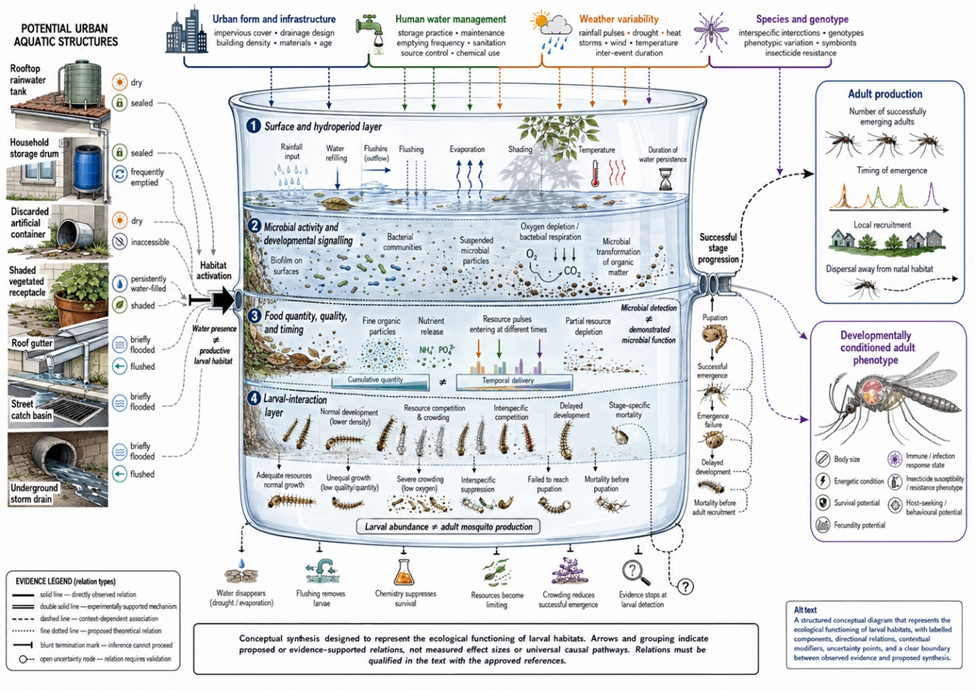
Figure 1 represents the ecological functioning of larval habitats within the analytical logic developed in this section.
|
|
|
Figure 1. The ecological functioning of larval habitats |
Alt text
A structured conceptual diagram that represents the ecological functioning of larval habitats, with labelled components, directional relations, contextual modifiers, uncertainty points, and a clear boundary between observed evidence and proposed synthesis.
Across the central loom, integrate restrained cutaway representations of a rooftop tank, household drum, discarded container, vegetated receptacle, gutter, and underground drain. Each structure should contain interwoven ecological threads representing water persistence, aquatic microbiota, detrital resources, nutrients, larval density, competition, water chemistry, temperature, flushing, evaporation, and human maintenance. Show some threads strengthening development, some weakening it, and some terminating the pathway before pupation.
At the left, place empirical inputs—urban form, water-storage practice, drainage design, weather events, and habitat accessibility. At the centre, distinguish ecological processing from simple water presence. At the right, show separate outputs for larval survival, pupal production, adult emergence, and adult phenotype. Do not connect emergence directly to disease. Use broken or gated arrows where relations remain conditional.
Include an uncertainty legend distinguishing: directly observed relation; experimentally supported mechanism; context-dependent association; proposed theoretical relation; and inference boundary. Use a restrained colour-blind-safe palette, high-contrast typography, consistent line weights, concise scientific labels, vector-style graphics, editable text, generous white space, and a balanced landscape composition legible at journal-page width. Do not use photorealism, decorative clip art, 3D perspective, logos, real maps, invented numerical values, unverified species details, or arrows implying universal causation.
Adult mosquito production is only an intermediate output. Spatial transmission models show that vector abundance contributes to risk through its relationship with human density and contact opportunity [32]. Empirical evidence likewise indicates that the association between adult Aedes abundance and dengue transmission is conditional rather than governed by a universal threshold [33]. Adult phenotypes may further change the contact pathway because climate and urbanisation can influence mosquito preference for human hosts [34]. Adult emergence is therefore not equivalent to human disease risk.
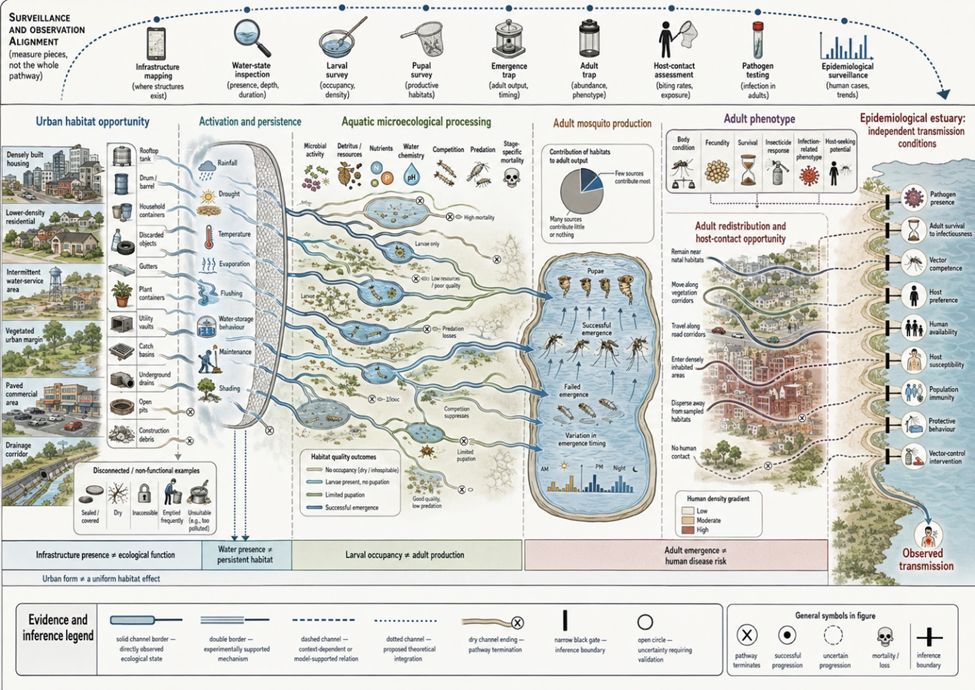
On the left, integrate a stylized urban landscape containing water-storage tanks, domestic containers, vegetated parcels, gutters, underground drainage, roads, housing density, and uneven municipal services. From this landscape, show several aquatic sites entering separate evidence spans: accessible water; sufficient habitat persistence; larval occupancy; larval survival; pupal production; adult emergence; local adult abundance; dispersal and host contact; pathogen compatibility; and observed transmission.
Make the spans physically unequal. Some aquatic structures should stop at water presence, some at larvae, some at pupae, and only a small subset should proceed to adult production. Beyond adult emergence, place independent modifiers for human density, host preference, mosquito survival, pathogen presence, vector competence, host susceptibility, immunity, and intervention. These modifiers must visually prevent a direct or automatic connection between emergence and disease.
Distinguish empirical inputs, proposed relationships, contextual modifiers, uncertainty points, and decision outputs through a clear legend. Use directional arrows only where the manuscript supports directionality; use dashed connectors for proposed or context-dependent relations and termination marks where inference must stop. Use a restrained colour-blind-safe palette, consistent line weights, concise labels, editable vector-style graphics, high-contrast typography, and generous white space. Exclude photorealism, decorative clip art, 3D rendering, real geographic maps, logos, invented numerical values, fabricated risk scores, and causal arrows implying universal effects.
The theory has four principal decision points: whether a structure is activated as habitat; whether occupancy progresses to adult production; whether larval conditions alter adult phenotype; and whether produced adults enter a transmission-compatible human environment. Its main failure modes are classifying all wet sites as productive, using larval abundance as adult output, treating adult emergence as disease evidence, and assigning one urban-form effect across contrasting neighbourhoods and weather regimes. Validation requires linked, repeated observations across these decision points rather than isolated correlations.
Surveillance and control implications
Surveillance should distinguish habitat opportunity, occupancy, productivity, adult recruitment, and epidemiological relevance. Pupal productivity can identify high-output containers and reveal seasonal intervention effects that conventional positivity measures may obscure [35]. However, pupae remain proxies for later adult recruitment. Progress should be demonstrated through paired stage-specific observations showing whether prioritised habitat classes consistently contribute to emergence and local adult abundance.
Immature and adult Aedes densities may correspond differently through time and space, supporting complementary rather than substitutive surveillance [36]. Habitat inspection is suited to identifying actionable aquatic sites; pupal or emergence measurements are better suited to estimating production; adult traps measure local adult presence but may capture mosquitoes originating elsewhere. A surveillance programme should therefore state the decision each indicator supports and stop its inference where the next biological stage has not been observed.
Spatial technologies may improve access to dispersed or difficult-to-observe aquatic systems. Drone-supported surveillance can assist habitat mapping, but detection requires ground validation, appropriate sensors, lawful operation, and integration with field entomology [37]. Larval source management should likewise be selected according to local habitat ecology, operational capacity, coverage, sustainability, and an evaluable epidemiological purpose [38]. The priority is not universal treatment of water-holding sites, but adaptive intervention against repeatedly validated sources while monitoring habitat replacement, behavioural adaptation, ecological side effects, adult outcomes, and equity in service delivery. Figure 2 shows the spatial pathway from urban infrastructure to adult mosquito production and disease risk within the analytical logic developed in this section.
|
|
|
Figure 2. The spatial pathway from urban infrastructure to adult mosquito production and disease risk |
Alt text
A structured conceptual diagram that shows the spatial pathway from urban infrastructure to adult mosquito production and disease risk, with labelled components, directional relations, contextual modifiers, uncertainty points, and a clear boundary between observed evidence and proposed synthesis.
CONCLUSION
Larval habitats can be understood most defensibly as dynamic components of urban disease infrastructure when their physical form, human operation, aquatic microecology, weather-mediated persistence, larval development, and spatial connection to adult mosquitoes are analysed together. The strongest synthesis is not that water-holding structures uniformly cause disease, but that selected structures repeatedly acquire productive ecological states under specific biological and infrastructural conditions. The theory remains bounded by species, climate, neighbourhood form, water-management practice, measurement scale, and incomplete linkage between immature stages, adults, human contact, and transmission. Its highest-priority implication is to replace static container classification with longitudinal habitat-state surveillance that measures only as far along the ecological and epidemiological pathway as the intended decision requires.
ACKNOWLEDGMENTS: None
CONFLICT OF INTEREST: None
FINANCIAL SUPPORT: None
ETHICS STATEMENT: None