Entomology and
Applied Science Letters
Applied Science Letters
 2025
Volume 12
Issue 3
2025
Volume 12
Issue 3

Insect microbiome research increasingly links microbial composition to host development, nutrition, immunity, behaviour, pathogen susceptibility, and environmental adaptation. Yet an observed association between a microbial feature and a host phenotype does not by itself establish that the microorganism colonizes the relevant host compartment, remains present for a biologically meaningful period, performs the proposed function in situ, mediates the phenotype, or acts independently of environmental and host-derived confounders. This article develops an original, explicitly non-validated standards structure for moving from microbiome association to defensible biological causation in insects. The approach integrates evidence requirements across microbial detection, colonization, persistence, functional activity, mediation, mechanistic validation, phenotypic attribution, contextual control, and experimental reproducibility. The central synthesis is that causal confidence should increase only when successive evidence domains are connected: spatially and temporally resolved microbial presence; evidence of establishment rather than transient passage; demonstration of molecular or metabolic activity; perturbation and restoration of the proposed microbial function; identification of host or pathogen pathways linking that function to an outcome; and replication across relevant biological and environmental contexts. No individual experiment is treated as universally decisive. Axenic, gnotobiotic, reconstitution, genetic, metabolic, imaging, and community-manipulation approaches each resolve different causal questions while introducing distinct artefacts and boundary conditions. Phenotypic rescue strengthens attribution but does not necessarily identify a complete mechanism, and statistical mediation remains inferential until the proposed mediator is experimentally manipulated. The proposed standards therefore emphasize staged validation, explicit alternative explanations, ecological relevance, and transparent limits on generalization. Their primary implication is that insect microbiome experiments should be designed around predefined causal claims and discriminating tests rather than around taxonomic association alone.
INTRODUCTION
Microbiome profiling has expanded the range of microorganisms associated with insects, but the ease of detecting microbial DNA has outpaced the ability to determine whether detected organisms are biologically established, functionally active, or causally responsible for host outcomes. Experimental technologies for generating axenic and gnotobiotic insects, together with simplified animal models and discipline-specific methodological guidance, have created tractable routes for testing host–microbe relationships rather than merely cataloguing them [1–3]. These approaches are especially valuable because insects combine short generation times, experimentally accessible life stages, diverse symbiotic arrangements, and strong environmental exposure. Nevertheless, methodological tractability does not eliminate interpretive risk. Sterilization, artificial diets, antibiotic treatment, laboratory rearing, microbial inoculation, and reduced-complexity communities may alter host physiology or ecological context in ways that produce phenotypes unrelated to the proposed microbial mechanism.
The causal problem is therefore not whether a microorganism and phenotype co-occur, but whether the evidence establishes an ordered biological relation between microbial presence, microbial activity, host response, and the observed outcome. Mechanistic syntheses of insect gut symbiosis show that host–microbe interactions can involve nutrient exchange, niche construction, immune regulation, chemical transformation, intermicrobial competition, and host signalling [4]. These processes operate at different spatial and temporal scales and cannot be inferred interchangeably. A microorganism detected in a whole-insect homogenate may be absent from the tissue where the proposed function must occur. A taxon that persists in a rearing container may be repeatedly reacquired rather than stably colonizing the host. A community shift associated with a phenotype may be a consequence of altered host physiology rather than its cause.
A further difficulty is that microbiome evidence often crosses analytical levels without making the transition explicit. Sequence abundance is treated as a proxy for population size; population size is treated as a proxy for activity; activity is treated as a proxy for functional importance; and functional importance is treated as proof of phenotypic mediation. Each transition requires additional evidence. Microbiome association is not equivalent to biological causation, colonization is not equivalent to functional activity, phenotypic rescue is not equivalent to a fully identified mechanism, and statistical mediation is not equivalent to experimentally verified mediation. These distinctions matter for basic symbiosis research as well as for engineered microbial systems, because an intervention based on a misidentified causal relation may fail, generate context-specific effects, or alter non-target microbial interactions.
This article proposes a staged standards structure for causal attribution in insect microbiome research. It is not presented as a validated framework, universal checklist, or evidence-grading instrument. Instead, it organizes the inferential questions that must be addressed when moving from association to colonization, persistence, function, mediation, mechanism, and host-phenotype attribution. The analysis focuses on why association remains dominant, how colonization and persistence should be demonstrated, what constitutes functional evidence, how mediation and mechanism should be separated, which confounders and alternative explanations require testing, and how experimental designs can be aligned with the specific causal claim being made. The central argument is that causal attribution should be treated as a chain of claim-specific tests whose strength depends on convergence across complementary methods and contexts rather than on any single experimental result.
Why association dominates insect microbiome research
Association dominates partly because insect microbiomes are biologically dynamic and technically difficult to localize across development. Metamorphosis can restructure tissues, feeding behaviour, gut architecture, immune conditions, and opportunities for microbial reacquisition, making continuity across life stages difficult to infer from cross-sectional detection [5]. Even within one insect species, microbiome composition and host effects may vary with genotype, developmental state, diet, geography, rearing conditions, and the resident microbial community [6]. These sources of variation make observational datasets valuable for discovering candidate relations but limit the extent to which compositional differences alone can identify direction, persistence, or mechanism. A microbial pattern may reflect host filtering, environmental exposure, developmental turnover, microbial competition, or sampling design rather than a stable causal contribution to phenotype.
Association is also favoured because sequencing can reveal broad community patterns without requiring cultivation, controlled reconstitution, tissue-resolved imaging, or genetic manipulation. In experimentally tractable insects such as Drosophila melanogaster, microbiome studies have clarified important links among microbial composition, host homeostasis, nutrition, and disease-related phenotypes [7]. Yet tractability can create its own inferential shortcut: a phenotype observed after antibiotic treatment or microbial supplementation may be attributed to a named taxon without separating the effects of microbial removal, drug exposure, altered food chemistry, community restructuring, microbial dose, or host developmental delay. Observational and perturbational studies therefore answer different questions. Association identifies covariation; perturbation tests whether changing a microbial feature alters an outcome; neither alone necessarily identifies the biological process connecting them.
Analytical structure further encourages overinterpretation. Correlation analyses in microbial ecology are vulnerable to compositional dependence, multiple testing, indirect associations, shared environmental drivers, and uncertainty about whether measured relative abundance reflects absolute microbial change [8]. A correlation network may generate hypotheses about co-occurrence or exclusion, but it does not distinguish direct interaction from a common response to host or environmental conditions. Stronger causal claims require evidence that competing explanations have been actively discriminated, not simply omitted from discussion. Association should therefore be treated as an entry point that defines candidate organisms, functions, compartments, and contexts for subsequent tests. The evidence dimensions and interpretive boundaries for association dominates insect microbiome research are summarized in Table 1.
Table 1. Why Association Dominates Insect Microbiome Research: Host Context, Microbial Functions, Causal Evidence, Community Stability, Ecological Risk, and Interpretive Boundaries
|
Microbial component or intervention |
Host context |
Proposed function |
Evidence required |
Causal test |
Stability or transmission issue |
Ecological risk |
Interpretive boundary |
|
Whole-community taxonomic profile |
Field-collected or conventionally reared insects |
Community state associated with host condition |
Compartment-resolved sampling, absolute or validated abundance estimates, temporal replication, host and environmental covariates |
Manipulate the candidate community feature while controlling diet, host state, and exposure |
A repeated profile may result from repeated environmental acquisition rather than host colonization |
Community manipulation may disrupt non-target interactions |
Community association does not establish that any member causes the phenotype |
|
Microbe detected across development |
Holometabolous insects undergoing metamorphosis |
Developmentally persistent symbiosis |
Stage-specific localization, viability evidence, transmission tracking, and exclusion of environmental reacquisition |
Follow labelled or distinguishable strains across stages and rearing environments |
Tissue turnover and gut remodelling may interrupt continuity |
Artificial maintenance may create persistence not found in natural settings |
Detection before and after metamorphosis does not prove uninterrupted persistence |
|
Axenic or antibiotic-treated host |
Laboratory insect model |
Removal of microbiota reveals microbial contribution |
Verification of microbial depletion, host physiological controls, treatment controls, and restoration experiments |
Compare untreated, treatment-control, axenic or depleted, and selectively reconstituted hosts |
Recolonization may depend on dose, timing, diet, and environmental reservoirs |
Treatment may select resistant organisms or alter host susceptibility |
A treatment-associated phenotype is not automatically a microbiome-mediated phenotype |
|
Single-strain supplementation |
Gnotobiotic insect or simplified community |
Candidate strain provides a defined function |
Confirmed colonization, strain activity, dose-response context, and exclusion of medium or inoculum effects |
Reconstitute with wild-type and function-deficient strains under matched conditions |
Transient passage can resemble colonization when exposure is continuous |
Introduced strains may interact unpredictably with resident or environmental microbes |
Exposure to a strain is not equivalent to stable functional integration |
|
Relative-abundance correlation |
Cross-sectional microbiome dataset |
Taxon or community covaries with phenotype |
Appropriate compositional analysis, absolute quantification where feasible, confounder adjustment, and independent replication |
Perturb the candidate taxon or function and test the predicted downstream change |
Temporal instability can reverse or obscure correlations |
Misidentified associations may motivate ineffective or disruptive interventions |
Correlation does not establish direction, direct interaction, or mediation |
|
Model-organism microbiome phenotype |
Drosophila melanogaster or another tractable laboratory insect |
Microbes influence nutrition, homeostasis, immunity, or disease-related traits |
Replication across genotypes, diets, developmental stages, and microbial backgrounds |
Factorial host-by-microbe-by-environment experiments with targeted reconstitution |
Laboratory persistence may depend on frequent environmental reseeding |
Simplified systems may not capture natural community competition |
Mechanistic evidence in one model cannot be generalized automatically across insects |
|
Environmentally acquired community |
Insects exposed to food, nest, soil, water, or plant surfaces |
Recurrent exposure contributes to host-associated functions |
Source tracking, spatial localization, viability, persistence after exposure removal, and transmission analysis |
Remove the environmental reservoir and test whether the host association and phenotype persist |
Horizontal reacquisition may maintain apparent stability |
Environmental release or community engineering may affect non-target hosts |
Repeated acquisition can be biologically important without constituting stable colonization |
Establishing colonization and microbial persistence
Colonization should be defined as the establishment of a viable microbial population in a specified host compartment under stated biological and environmental conditions. This definition separates colonization from one-time ingestion, surface contamination, residual microbial DNA, or repeated exposure from food and the rearing environment. In Drosophila, probabilistic invasion has been shown to influence whether microorganisms become established within an existing gut community, indicating that microbial entry and persistence depend on ecological interactions rather than exposure alone [9]. Colonization evidence should therefore identify the compartment occupied, confirm viability or replication where feasible, establish the time interval over which the population remains detectable, and document whether persistence continues after the external source is removed. The evidentiary threshold must be aligned with the claim: transient residence may be sufficient for a short-lived metabolic effect, whereas developmental programming or transmission claims require stronger temporal continuity.
Stable association also depends on compatibility between microbial traits and host-created niches. A species-specific mutualistic interaction in Drosophila melanogaster has been linked to bacteria capable of stable gut association, distinguishing resident-like behaviour from the environmentally maintained presence often observed in laboratory flies [10]. Subsequent work identified a physical niche that supports stable association of a multispecies gut microbiota, illustrating how host anatomy and spatial organization can regulate microbial retention [11]. These findings show why whole-host abundance measurements are insufficient for colonization claims. A microorganism may be numerically detectable yet absent from the anatomical site that permits persistence or interaction with host tissues. Conversely, a low-abundance population occupying a protected niche may exert a reproducible function that is obscured in whole-organism averages.
Host-derived chemistry can also determine whether a symbiont establishes successfully. In the honey bee, host-derived organic acids enable gut colonization by Snodgrassella alvi, directly connecting a host environmental condition to symbiont establishment [12]. Such evidence supports a relational view of colonization: neither microbial inoculation nor microbial genotype alone determines success; colonization emerges from compatibility among microbial capabilities, host substrates, physical niches, resident community interactions, developmental timing, and exposure conditions. Consequently, persistence should be tested under ecologically relevant perturbations, including altered diet, life-stage transition, removal of repeated inoculation, and competition from resident microorganisms. Colonization is not equivalent to functional activity. It establishes the opportunity for interaction, but additional measurements are required to show that the colonizing population expresses the proposed pathway, produces the relevant molecule, or changes a host process.
Demonstrating functional activity
Functional evidence requires more than predicting metabolic potential from taxonomy or gene content. In honey bees, complementary studies have connected gut bacterial composition to metabolic transformations, host weight gain, hormonal signalling, and cooperative degradation of dietary substrates, demonstrating how microbial function can be resolved through combinations of metabolic measurements, community manipulation, and host phenotyping [13–15]. These studies illustrate three distinct levels of evidence. First, a microorganism or community possesses genes consistent with a function. Second, the pathway is active under the tested host conditions and produces measurable metabolites or transformations. Third, perturbing the pathway changes a host-relevant outcome in the predicted direction. Causal confidence is highest when these levels converge, but even then the conclusion remains specific to the microbial configuration, host state, diet, developmental stage, and experimental context tested.
Functional attribution must also account for interactions between microbial metabolism and host nutritional requirements. Drosophila-associated bacteria can differentially shape host nutritional needs during juvenile growth, showing that a microbial effect may depend on the composition of the diet rather than representing an invariant property of the microorganism [16]. A strain that benefits development under one nutrient limitation may have little effect, or a different effect, under another. Functional tests should therefore include the substrates, cofactors, environmental conditions, and community partners necessary for the proposed pathway. Measurements should distinguish pathway expression from pathway capacity and should determine whether the relevant product reaches the host tissue, pathogen, or microbial partner through which the phenotype is expected to arise.
A defensible functional claim can be structured as a sequence: the candidate microorganism is present in the relevant compartment; it remains present over the interval required for action; the proposed pathway is expressed or chemically evidenced; selective disruption of the pathway changes the proximal biological output; and restoration of the pathway or its product recovers that output under controlled conditions. This sequence is stronger than taxonomic prediction, but it still does not automatically establish complete phenotypic mediation. A metabolite may be sufficient to rescue one endpoint while additional microbial activities contribute to the broader phenotype. Host compensation, parallel pathways, altered community interactions, and treatment effects may also reproduce the same outcome. Demonstrating functional activity is therefore a necessary bridge between colonization and mechanism, not a substitute for testing how the function is transmitted through host or pathogen biology to the final phenotype.
Mediation, mechanism, and host phenotype
Microbial effects on insect phenotypes can arise through metabolites, nutrient transformation, immune modulation, neuroendocrine signalling, detoxification, or interactions with other microorganisms. Distinct studies have linked gut microorganisms to honey-bee learning and memory through tryptophan metabolism and to insecticide resistance in the diamondback moth through microbiota-dependent processes [17, 18]. These findings support biologically plausible mediation, but they do not justify treating every microbiome–phenotype association as mechanistic evidence. A mediation claim requires a defined microbial feature, a measurable intermediate process, a temporally ordered host response, and an outcome that changes when the proposed mediator is selectively manipulated.
Mechanistic attribution becomes stronger when a microbial partner is connected to a specific host pathway. In cotton mealybugs, the endosymbiont Tremblaya phenacola has been associated experimentally with reproductive effects involving mechanistic target of rapamycin signalling [19]. Even such pathway-level evidence requires bounded interpretation. Removing or disrupting an obligate symbiont may alter nutrition, development, cellular homeostasis, and community structure simultaneously. A pathway response may therefore participate in the phenotype without constituting the sole causal route. Demonstrating pathway involvement is stronger than documenting covariance, but complete mechanism identification additionally requires evidence of necessity, sufficiency, temporal order, and exclusion of plausible parallel pathways.
Community-level phenotypes present further attribution problems because microbial effects may be distributed across taxa or emerge from host–community interactions. Variation in honey-bee foraging intensity has been linked to gut microbiota, supporting a contribution of microbial state to behavioural heterogeneity [20]. However, behavioural outcomes are also shaped by age, nutritional state, colony environment, host genotype, task allocation, and prior experience. Phenotypic rescue after microbiota restoration can strengthen causal attribution when treatment controls and colonization verification are included, but rescue is not equivalent to a fully identified mechanism. Likewise, statistical mediation can prioritize candidate pathways, but it is not equivalent to experimentally verified mediation unless the mediator itself is manipulated and the predicted causal sequence is observed.
Confounding, context, and alternative explanations
Insect microbiomes respond to season, diet, chemical exposure, developmental stage, social environment, and microbial source pools. Seasonal restructuring and exposure-dependent disturbance have both been documented in honey-bee gut communities [21, 22]. Such findings demonstrate context sensitivity but also complicate causal interpretation: a microbial difference may be produced by the same environmental factor that causes the host phenotype. Causal studies should therefore specify whether context is treated as a confounder, effect modifier, exposure condition, or component of the proposed mechanism. Combining these roles without distinction can make a microbial variable appear causal when it is primarily a marker of altered host ecology.
Intervention artefacts constitute another major alternative explanation. Antibiotic exposure can perturb the honey-bee microbiota while also increasing mortality [23]. A mortality difference following treatment cannot be assigned automatically to the loss of a particular symbiont because antibiotics may produce direct toxicity, alter microbial metabolites, select resistant organisms, change food intake, or restructure multiple community members. Appropriate controls may include vehicle-only exposure, treatment without microbial depletion where feasible, microbial-load verification, host physiological measurements, selective reconstitution, and restoration with treatment-resistant or genetically defined strains. The required controls depend on the claim and cannot be replaced by a generic untreated comparison.
Microbial interactions can also determine whether an introduced organism colonizes and whether a host phenotype emerges. In mosquitoes, resident-community interactions influence Serratia colonization and blood-feeding propensity [24]. Consequently, an effect attributed to an introduced strain may depend on facilitation, competition, niche availability, or displacement of resident taxa. Replication in a simplified community establishes only what occurs within that constructed system. Transferability requires testing across host genotypes, resident communities, environmental conditions, developmental stages, and exposure routes. Evidence of context dependence should not be interpreted as evidence of no microbial effect; instead, it defines the conditions under which the proposed causal relation is more or less likely to operate.
Proposed standards for causal attribution
The proposed standards organize causal attribution as a sequence of claim-specific evidence domains rather than as a single decisive experiment. Broader microbiome scholarship has repeatedly argued that causal claims should move beyond community-wide association through controlled perturbation, restoration, mechanistic analysis, and explicit consideration of model limitations [25–27]. Causal-inference principles further require that the exposure, mediator, outcome, temporal order, and competing pathways be specified before analysis [28]. Because microbiome data are compositional, apparent taxonomic changes must also be interpreted without assuming that relative abundance directly represents absolute population change [29]. These principles are reorganized here for insect systems but are not presented as a validated scoring framework.
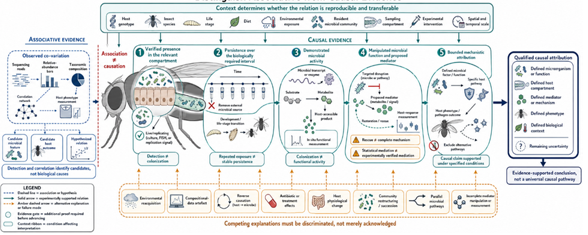
The first distinction separates observed evidence from causal evidence. Detection and covariance generate candidates; localization and viability support colonization; persistence establishes a temporal opportunity for action; molecular or metabolic measurements support activity; selective perturbation tests functional necessity; restoration tests reversibility or sufficiency under the specified conditions; and pathway manipulation evaluates mediation and mechanism. Contextual modifiers—including life stage, diet, host genotype, resident community, environmental exposure, and compartment—must remain visible throughout this sequence. Figure 1 distinguishs associative from causal evidence within the analytical logic developed in this section.
|
|
|
Figure 1. Distinguish associative from causal evidence |
Alt text
A structured conceptual diagram that distinguishs associative from causal evidence, with labelled components, directional relations, contextual modifiers, uncertainty points, and a clear boundary between observed evidence and proposed synthesis.
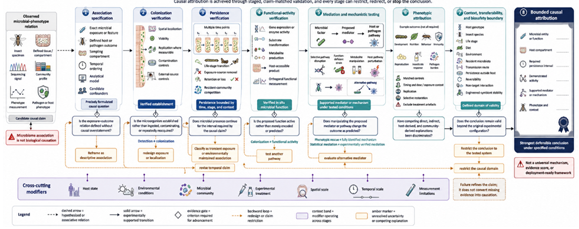
The second distinction concerns progression between evidence stages. Advancement should occur only when the next claim is supported directly: association to colonization requires spatial and viability evidence; colonization to persistence requires temporal continuity after controlling external reacquisition; persistence to function requires in situ activity; function to mediation requires manipulation of the proposed intermediate; and mediation to phenotypic attribution requires discrimination among alternative causal routes. Failure at one stage does not invalidate earlier observations, but it constrains the permissible conclusion. Figure 2 illustrates a staged causal-validation pathway within the analytical logic developed in this section.
|
|
|
Figure 2. A staged causal-validation pathway |
Alt text
A structured conceptual diagram that illustrates a staged causal-validation pathway, with labelled components, directional relations, contextual modifiers, uncertainty points, and a clear boundary between observed evidence and proposed synthesis.
The third distinction separates evidence-supported relations from the original organization proposed here. The standards do not assign universal thresholds, numerical grades, or automatic decisions. Instead, they require investigators to define the intended causal claim, identify the minimum discriminating evidence, document failure modes, and state the biological domain across which the conclusion is expected to hold. A result can therefore provide strong evidence for transient metabolic activity while remaining insufficient for stable colonization, vertical transmission, complete mechanism, or ecological safety. The proposed components, evidence bases, boundary conditions, failure modes, and validation requirements are organized in Table 2.
Table 2. Proposed Standards for Causal Attribution: Components, Evidence Basis, Relations, Boundary Conditions, Failure Modes, and Validation Requirements
|
Proposed component |
Purpose |
Evidence basis |
Relation or mechanism |
Input or precondition |
Expected output |
Boundary condition or failure mode |
Validation requirement |
|
Association specification |
Define the observed microbial–host relation without causal overstatement |
Taxonomic, functional, or community covariance |
Candidate microbial feature covaries with a host or pathogen outcome |
Defined compartment, population, phenotype, and analytical model |
Reproducible candidate relation |
Shared environmental drivers, compositional artefacts, or reverse causation |
Independent replication and explicit confounder analysis |
|
Colonization verification |
Distinguish establishment from ingestion or contamination |
Localization, viability, replication, and host-niche evidence |
Microorganism occupies a specified host compartment |
Controlled exposure and contamination exclusion |
Verified establishment in the relevant site |
Continuous environmental reseeding or residual DNA |
Spatially resolved and viability-sensitive confirmation |
|
Persistence verification |
Establish whether microbial presence continues for the required biological interval |
Longitudinal detection after source removal |
Population remains through time, development, or perturbation |
Defined observation interval and exposure history |
Bounded persistence claim |
Reacquisition, stage-specific loss, or sampling gaps |
Temporal tracking with source controls |
|
Functional-activity verification |
Separate pathway activity from taxonomic or genomic potential |
Metabolites, transcripts, proteins, substrates, or transformations |
Microbial process generates a proximal biological output |
Colonization or controlled exposure under relevant conditions |
Evidence of in situ activity |
Predicted genes are not expressed or products do not reach the target |
Orthogonal functional measurement and selective perturbation |
|
Mediation test |
Determine whether a specified intermediate carries an effect |
Manipulation of metabolite, pathway, signal, or host response |
Microbial feature alters mediator, which alters outcome |
Temporally ordered exposure, mediator, and outcome |
Experimentally supported mediation |
Correlated mediator, parallel pathway, or host compensation |
Direct mediator manipulation and predicted response |
|
Mechanistic validation |
Identify the causal biological route |
Genetic, biochemical, physiological, or cellular intervention |
Defined microbial activity engages a specified host or pathogen pathway |
Functionally characterized strains and measurable pathway |
Bounded mechanism under tested conditions |
Pleiotropy, incomplete pathway control, or off-target effects |
Necessity, sufficiency where feasible, and alternative-pathway tests |
|
Community-context control |
Determine dependence on resident microbiota |
Competition, facilitation, niche exclusion, or metabolite exchange |
Resident community modifies colonization or function |
Defined community background |
Context-specific estimate of effect |
Simplified community fails to represent natural interactions |
Replication across relevant community states |
|
Phenotypic attribution |
Connect microbial action to a defined host or pathogen endpoint |
Perturbation, restoration, dose, timing, and pathway evidence |
Microbial process contributes to the observed phenotype |
Validated phenotype and matched controls |
Qualified causal attribution |
Rescue without mechanism, multiple simultaneous changes, or indirect effects |
Selective restoration and discrimination among causal routes |
|
Compositional-data control |
Prevent relative-abundance artefacts from being treated as biological change |
Compositional statistical principles |
Changes in one component alter apparent proportions of others |
Appropriate data structure and measurement design |
Interpretable microbial-change estimate |
Relative abundance mistaken for absolute expansion or loss |
Suitable compositional analysis and absolute quantification where feasible |
|
Ecological and biosafety boundary |
Limit generalization and evaluate intervention consequences |
Host range, persistence, transmission, community interaction, and reversibility |
Introduced or engineered microorganisms interact with hosts and environments |
Defined use context and containment assumptions |
Bounded assessment of transferability and risk |
Unintended persistence, non-target transfer, or community disruption |
Context-specific ecological testing before broader application |
|
Claim-matched validation decision |
Align conclusions with the evidence actually obtained |
Convergence across preceding components |
Each causal claim advances only when its required evidence is present |
Predefined claim and decision criteria |
Transparent conclusion with stated uncertainty |
Universal checklist use or automatic readiness inference |
Prospective application and independent evaluation of the proposed standards |
Implications for experimental design
Experimental design should begin with the causal claim rather than with a sequencing platform or intervention. Axenic and gnotobiotic mosquitoes provide valuable systems for separating host and microbial contributions, but their interpretation depends on sterilization controls, nutritional equivalence, recolonization verification, and recognition that laboratory microbial exposure may not reproduce natural acquisition [30]. Progress should be demonstrated by experiments that identify which stage of attribution they test and which stages remain unresolved. For example, a colonization experiment should not be presented as functional validation unless microbial activity and a relevant proximal output are also measured.
Engineered symbionts illustrate why efficacy, mechanism, persistence, and biosafety must be evaluated separately. Engineered honey-bee symbionts can activate host immunity and reduce pathogen burden under experimental conditions [31]. Such findings establish a proof of biological action in the tested system, not automatic ecological transferability or deployment readiness. Subsequent designs should examine genetic stability, dependence on resident-community structure, duration of persistence, transmission routes, reversibility, non-target effects, and the possibility that immune activation produces context-dependent costs. Evidence of pathogen limitation should therefore be distinguished from evidence of long-term colony benefit or environmental safety.
Methodological guidance for honey-bee microbiome research emphasizes controlled sampling, compartment definition, cultivation, community manipulation, and functional characterization [32]. Experimental programmes should combine these practices with longitudinal and strain-resolved measurements because antibiotic exposure can reduce genetic diversity within core gut species even when broad taxonomic categories remain detectable [33]. A meaningful indicator of progress is not merely increased data volume, but improved discrimination among transient exposure, colonization, persistence, activity, mediation, mechanism, and phenotype. Prospective preregistration of causal diagrams, controls, exclusion criteria, and alternative explanations would further reduce post hoc reinterpretation and make cross-study synthesis more reliable.
CONCLUSION
Causal attribution in insect microbiome research requires a disciplined transition from microbial association to evidence of colonization, persistence, functional activity, mediation, mechanism, and bounded phenotypic attribution. No single sequencing result, depletion experiment, reconstitution, rescue, or statistical model can establish this complete sequence. The strongest defensible conclusions arise when spatial, temporal, functional, perturbational, and mechanistic evidence converge while host state, environment, community context, and intervention artefacts are explicitly tested. The proposed standards provide an original organizational structure for matching causal claims to the evidence needed to support them, but they remain non-validated and should not be treated as a universal score or deployment framework. The highest-priority implication is to design insect microbiome studies around discriminating causal questions and predefined alternative explanations, thereby preserving the boundaries between association and causation, colonization and activity, rescue and complete mechanism, and statistical versus experimentally verified mediation.
ACKNOWLEDGMENTS: None
CONFLICT OF INTEREST: None
FINANCIAL SUPPORT: None
ETHICS STATEMENT: None