Entomology and
Applied Science Letters
Applied Science Letters
 2025
Volume 12
Issue 1
2025
Volume 12
Issue 1

Honey-bee colonies function as integrated biological systems whose survival depends on coordinated nutrition, brood production, division of labour, immune defence, thermoregulation, and resource storage. This organization can buffer temporary disturbances, but it also permits stress originating in particular workers, life stages, or food-processing pathways to propagate through the colony. Evidence concerning honey-bee decline is distributed across reviews of nutritional limitation, landscape simplification, pesticide exposure, parasitic infestation, infectious disease, immune disruption, and climatic stress. These literatures frequently employ different endpoints and analytical scales, making apparent agreement difficult to interpret and preventing individual-level responses from being treated automatically as predictors of colony failure. This umbrella review critically integrates review-level evidence across the principal stressor domains while using selected mechanistic and colony-level studies to clarify biological pathways and interpretive boundaries. The synthesis indicates that nutritional scarcity, chemical exposure, parasites, pathogens, and adverse climatic conditions can each erode components of colony function, but their consequences depend strongly on exposure duration, season, colony demography, resource availability, infection pressure, and compensatory social mechanisms. Co-occurring stressors therefore should not be assumed to interact synergistically, and early molecular, physiological, or behavioural changes should not be interpreted as inevitable colony collapse. The strongest evidence supports a resilience-centred perspective in which colony risk reflects the balance between accumulated stress load and the superorganism’s capacity to redistribute labour, regulate the nest environment, sustain brood care, preserve food quality, and control infection. Progress requires longitudinal colony-scale studies, explicit evaluation of overlapping evidence among reviews, and digital phenotyping systems that connect early biological signals with later functional outcomes without overstating predictive certainty.
INTRODUCTION
A honey-bee colony is not merely an aggregation of exposed insects. It is a superorganism in which queens, workers, drones, brood, stored food, nest architecture, and collective behaviours form an interdependent physiological and organizational system. Environmental disturbance can therefore affect colony health through direct worker toxicity, altered nursing or foraging, impaired glandular function, disrupted brood provisioning, or weakened regulation of the nest environment. Conversely, social organization may buffer substantial individual damage before an externally visible colony-level deficit appears. Toxicological interpretation must consequently consider both the exposed individual and the colony processes through which an effect may be amplified, compensated for, or concealed [1].
Contemporary evidence does not support a universal single-cause explanation for elevated colony losses. Varroa infestation and associated viruses, inadequate nutrition, pesticides, management conditions, queen problems, and weather may contribute in combinations that differ among regions and seasons. Even the outcome “colony loss” is not fully uniform: mortality, queen failure, dwindling populations, absconding, and beekeeper-mediated colony replacement can represent biologically different trajectories. This heterogeneity makes attribution difficult because a stressor associated with loss may operate as a primary driver, an aggravating condition, a marker of another process, or a context-dependent exposure whose importance changes with colony state [2].
The concept of colony resilience provides a more informative organizing principle than a simple inventory of hazards. Resilience encompasses the ability to absorb disturbance, reorganize activity, maintain essential functions, and recover without crossing into persistent decline. Division-of-labour flexibility, behavioural immunity, brood regulation, food storage, thermoregulation, and demographic replacement may delay or prevent failure. However, these mechanisms are finite. A colony facing sustained or simultaneous demands may progressively lose buffering capacity, particularly when the stressors affect long-lived workers, brood production, queen function, nutritional reserves, or the worker populations responsible for collective defence [3].
This article evaluates how review-level evidence characterizes nutritional, chemical, parasitic, pathogenic, and climatic threats, and whether reported effects can defensibly be connected to colony-scale resilience. Previous quantitative synthesis demonstrates that honey-bee stress research varies markedly in experimental unit, life stage, exposure design, duration, endpoint, and environmental realism [4]. Such variation is not statistical noise alone; it defines what each study can establish. The central argument developed here is that credible synthesis requires explicit separation of stressor presence from demonstrated interaction, individual impairment from colony decline, review convergence from independent confirmation, and early biological disruption from inevitable collapse.
Umbrella review scope and review-level evidence
The review was structured as a synthesis of existing reviews addressing managed Apis mellifera colony health, supplemented selectively by primary evidence where it clarified mechanisms, exposure pathways, scale transitions, or unresolved disagreements. The analytical population was the honey-bee colony and its constituent life stages; the principal exposures were nutritional limitation, landscape resource loss, pesticides, parasites, pathogens, immune disturbance, heat, and drought. Outcomes were classified as molecular or microbial signals, individual physiological and behavioural effects, intermediate colony functions, and colony-level performance or survival. This hierarchy prevents endpoints at different biological scales from being treated as interchangeable. Umbrella-review methodology requires a clearly bounded question and systematic assessment of review-level evidence rather than an unstructured collection of narrative conclusions [5].
Eligible evidence had to provide sufficient information to identify the biological system, stressor or resource condition, study design, endpoint, and major limitation affecting interpretation. Reviews centred exclusively on non-Apis pollinators, unsupported management opinion, or isolated sensor outputs without colony-health interpretation were outside the analytical core. Searches were organized around combinations of the biological system, stressor domain, mechanism, outcome, evidence type, and colony scale. Review conclusions were extracted alongside their underlying study designs and contextual conditions. Primary studies were not used to inflate review-level agreement; they were used to determine whether a proposed pathway had direct support and whether a review conclusion remained consistent with colony-scale evidence.
Methodological quality and primary-study overlap were treated as determinants of evidentiary confidence. Two reviews may reach similar conclusions because they examine independent bodies of evidence, but they may also repeatedly include the same influential experiments. Reviews can likewise differ because of search dates, eligibility criteria, endpoint definitions, or quality-appraisal methods rather than genuine biological contradiction. Guidance for overviews emphasizes that scope alignment, methodological quality, currency, and study overlap constrain what can be concluded from apparent convergence [6]. The present synthesis therefore uses qualitative confidence language tied to design and consistency rather than invented numerical grades.
The review questions, eligibility boundaries, search and screening logic, evidence-classification rules, and bias controls are specified in Table 1.
Table 1. Umbrella Review Scope and Review-Level Evidence: Review Questions, Eligibility Boundaries, Search Logic, Screening Rules, Evidence Classification, and Bias Controls
|
Review-method element |
Operational definition |
Inclusion rule |
Exclusion rule |
Search or screening implementation |
Evidence-classification rule |
Bias-control measure |
Reporting requirement |
Representative supporting reference(s) |
|
Review question |
How major stressor domains affect honey-bee colony function and resilience |
Evidence addressing a named stressor, colony process, or interpretive boundary |
Broad pollinator commentary lacking direct honey-bee relevance |
Combine Apis mellifera, colony, stressor, mechanism, outcome, and review terms |
Direct support, qualified support, contextual support, or proposed synthesis |
Maintain predetermined construct and scale boundaries |
State what is supported, uncertain, or contradicted |
[5] |
|
Biological boundary |
Managed honey-bee colonies and biologically relevant constituent stages |
Colony evidence and individual evidence with a plausible colony pathway |
Non-Apis evidence without transferable colony relevance |
Screen species, caste, life stage, and experimental unit |
Molecular, individual, social-process, or colony level |
Do not equate individual impairment with colony decline |
Identify the biological scale of every principal claim |
[1] |
|
Exposure boundary |
Nutritional, landscape, chemical, parasitic, pathogenic, immune, and climatic stress |
Defined exposure or resource condition |
Undefined “environmental stress” without interpretable exposure |
Search each domain separately and in combination |
Single stressor, co-occurrence, or tested interaction |
Do not label co-occurrence as interaction |
Specify exposure duration and relevant context |
[2] |
|
Outcome boundary |
Colony function, resilience, performance, or survival and their mechanistic precursors |
Outcomes connected to a defined biological pathway |
Isolated measurements with no colony-health interpretation |
Extract endpoint, timing, and analytical scale |
Early signal, intermediate function, or colony outcome |
Avoid treating biomarkers as deterministic predictions |
State the inferential distance to colony-level consequences |
[3] |
|
Eligible evidence |
Peer-reviewed reviews and claim-relevant primary studies |
Reviews for synthesis; primary studies for mechanism and boundary testing |
Non-peer-reviewed and non-journal evidence |
Screen article type and claim relevance |
Review-level or primary evidence |
Keep the two evidence classes analytically distinct |
Identify when a claim relies on primary rather than review evidence |
[5] |
|
Evidence overlap |
Reuse of the same primary studies across reviews |
Reviews with extractable evidence bases |
Reviews whose support cannot be traced sufficiently |
Compare scope, dates, major included studies, and conclusions |
Independent convergence or potentially overlapping convergence |
Do not count overlapping reviews as independent confirmation |
Report overlap as an uncertainty affecting confidence |
[6] |
|
Contradictory evidence |
Differences in direction, magnitude, or colony relevance |
Conflicts that can be examined through context or design |
Selective omission of inconvenient findings |
Compare season, exposure, nutrition, infection, demography, and endpoint |
Genuine contradiction or context dependence |
Retain competing explanations |
State what evidence could discriminate among explanations |
[4] |
|
Confidence appraisal |
Qualitative judgement based on relevance, consistency, scale, and design |
Claims with traceable supporting evidence |
Unsupported numerical ranking |
Integrate design quality and transferability |
Higher, moderate, limited, or indeterminate confidence expressed narratively |
No invented scores or certainty estimates |
Explain the basis and limitations of confidence statements |
[6] |
Nutritional limitation and landscape resource loss
Honey-bee nutrition involves more than the presence or absence of forage. Nectar supplies carbohydrates, whereas pollen provides proteins, lipids, sterols, vitamins, minerals, and other compounds required for brood rearing and adult physiology. Workers regulate nutrient intake individually and collectively, transform pollen and nectar into stored foods, and redistribute nutrients through glandular secretions. Consequently, dietary quality, diversity, timing, and accessibility may be as important as gross resource abundance. Nutritional physiology also changes with worker role, age, reproductive demand, and season, making a diet adequate under one colony state insufficient under another [7].
Landscape resource loss can create temporal gaps even when flowers remain locally abundant during short crop-bloom periods. Mapping studies demonstrate that forage supply varies across land-cover types and seasons, requiring analysis at spatial scales relevant to colony foraging [8]. Field evidence across agricultural gradients further indicates that worker nutritional condition can differ with surrounding land use, but landscape associations should not be interpreted as simple causal effects because weather, management, colony strength, and resource phenology may covary [9]. A nutritionally poor worker sample signals biological strain; it does not by itself demonstrate that a colony will decline.
Colony consequences emerge when resource shortages persist long enough to constrain brood production, worker replacement, storage, or the physiological quality of long-lived bees. Mechanistic modelling shows that crop identity, diversity, spatial arrangement, and flowering continuity can alter predicted colony viability by changing when and where food is available [10]. Nutritional stress may also reshape the gut microbial community and immune responses and can modify susceptibility to Nosema ceranae, illustrating a pathway through which diet can condition responses to another stressor [11]. Nevertheless, altered microbiota or infection intensity in sampled workers remains an intermediate outcome. Demonstrating reduced colony resilience requires longitudinal evidence connecting these changes to sustained functional impairment.
The evidence dimensions and interpretive boundaries for nutritional limitation and landscape resource loss are summarized in Table 2.
Table 2. Nutritional Limitation and Landscape Resource Loss: Colony-Level Pathways, Diagnostic Signals, Resilience Outcomes, Management Relevance, Validation Needs, and Interpretive Boundaries
|
Colony-health component |
Signal, stressor, or resource |
Biological pathway |
Indicator or evidence |
Colony-level implication |
Management relevance |
Uncertainty |
Interpretive boundary |
Representative supporting reference(s) |
|
Nutrient acquisition |
Nectar and pollen availability |
Foraging and transfer of carbohydrates, proteins, lipids, and micronutrients |
Resource maps, pollen intake, food stores |
Determines the material base for maintenance and brood production |
Preserve seasonally complementary forage |
Resource accessibility may differ from mapped abundance |
Floral presence does not establish nutritional adequacy |
[7, 8] |
|
Diet quality |
Nutrient composition and botanical diversity |
Nutrient balancing and physiological allocation |
Pollen composition, worker nutrient status |
May influence worker condition and brood-support capacity |
Evaluate quality as well as quantity of forage |
Colony requirements vary by season and demographic state |
Greater plant diversity is not automatically a complete diet |
[7, 9] |
|
Temporal continuity |
Gaps between flowering periods |
Depletion of stores and reduced incoming forage |
Seasonal resource curves and colony food dynamics |
Persistent gaps may constrain brood rearing and worker replacement |
Design landscapes for continuous forage rather than isolated bloom |
Weather and management alter realized shortages |
Short resource gaps need not cause irreversible decline |
[8, 10] |
|
Landscape structure |
Crop composition and semi-natural habitat |
Alters foraging distance, choice, and resource continuity |
Land-cover associations and mechanistic models |
Can modify exposure to nutritional deficits and other stressors |
Retain or restore forage-rich habitat near apiaries |
Associations may be confounded; models depend on assumptions |
Landscape composition is not a deterministic predictor of survival |
[9, 10] |
|
Immune competence |
Nutritional restriction |
Reduced investment in immune and maintenance processes |
Immune markers, infection response, survival |
May lower tolerance or resistance under pathogen pressure |
Avoid severe nutritional restriction during high disease risk |
Marker changes vary with diet, age, and infection conditions |
Immune change is not equivalent to colony disease |
[11] |
|
Microbial homeostasis |
Diet-associated microbiota alteration |
Changes in gut-community structure and host–microbe interactions |
Microbiota composition and pathogen burden |
May influence individual health and stress responsiveness |
Treat microbial indicators as contextual diagnostic signals |
Direction and functional meaning of microbial shifts may be unclear |
Microbiome difference is not proof of colony dysfunction |
[11] |
|
Resilience reserve |
Stored food and healthy long-lived workers |
Buffers temporary resource shortage and seasonal stress |
Store levels, demography, worker physiology |
Determines how long essential functions can be maintained |
Integrate forage planning with colony-demographic monitoring |
Buffering thresholds are colony- and season-specific |
Early nutritional strain does not imply inevitable collapse |
[7, 10] |
Pesticides and chronic chemical exposure
Honey-bee colonies encounter chemicals through contaminated pollen, nectar, water, wax, stored food, and in-hive treatments. National monitoring demonstrates that real-world exposure is characterized by changing mixtures rather than a single constant compound [12]. Residue detection establishes contact but not biological harm: interpretation requires concentration, frequency, duration, route, compound toxicity, life stage, food processing, and colony condition. Conversely, low concentrations should not be dismissed automatically when exposure is prolonged or when the affected function is essential to brood care, navigation, reproduction, or social immunity.
Field-realistic work near treated crops has linked chronic neonicotinoid exposure with worker mortality, weakened social-immunity indicators, and increased queenlessness, while also demonstrating that co-exposure to a fungicide can modify toxicity [13]. Mixture experiments have reported changes in worker activity and foraging efficiency that would not be captured by acute mortality alone [14]. These findings establish biologically plausible routes to colony impairment, but neither behavioural inefficiency nor altered worker lifespan alone specifies the final colony trajectory. Colonies may compensate through recruitment and demographic reorganization, or may fail to compensate when exposure overlaps with nutritional scarcity, infection, or critical seasonal transitions.
Chemical exposure can also operate indirectly through social food production. Colony-level exposure to a pesticide mixture has been associated with altered royal-jelly quantity and nutritional composition, indicating that nurse-bee physiology can transmit effects to queen developmental nutrition even when residues are not the only relevant endpoint [15]. This pathway is consequential because queen performance influences brood production and colony continuity, yet altered jelly composition should not be treated as proof of subsequent queen failure without longitudinal confirmation. Reviews of pesticide assessment consequently recommend expanding beyond lethality to behavioural and reproductive endpoints while emphasizing standardization and ecological relevance [16]. A defensible colony-level assessment must combine such sensitive endpoints with exposure realism, temporal follow-up, and direct measures of colony function rather than assuming that every sublethal change predicts loss.
Parasites, pathogens, and immune disruption
Among biological threats, Varroa destructor is especially consequential because it combines direct parasitism with virus amplification and transmission. Infestation alters worker and brood condition, changes pathogen dynamics, and can weaken the demographic foundations of overwintering success [17]. The mite’s principal feeding target is honey-bee fat-body tissue, which performs functions analogous to nutrient storage, detoxification, metabolism, and immune regulation; damage therefore extends beyond the removal of circulating fluids [18].
Pathogenic effects may remain hidden before visible deformity or colony deterioration occurs. Covert deformed-wing-virus infection has been associated with reduced foraging performance and shortened worker survival under natural conditions [19]. Nosema ceranae intensity has also been linked to particular gut bacterial taxa, although its relationship with overall microbiome structure appears comparatively weak and context dependent [20]. These findings support mechanistic concern but do not make infection detection a deterministic forecast of colony loss.
Colony resistance depends partly on grooming, hygienic removal of infested brood, suppressed mite reproduction, virus tolerance, and other socially organized defences. Evidence for these traits varies among populations and measurement protocols, and no single phenotype fully captures survival capacity [21]. Parasite control, pathogen burden, host genotype, colony demography, and environmental resources must therefore be evaluated jointly. Immune-marker changes may indicate altered defence, but they do not independently establish immune failure or irreversible colony decline.
Heat, drought, and climate-related stress
Climate-related stress operates through both direct thermal exposure and indirect changes in floral phenology, water availability, forage continuity, parasite dynamics, and management conditions. Review-level evidence remains dominated by individual-bee experiments conducted over relatively short temporal and spatial scales, limiting inference about long-term colony adaptation and regional beekeeping outcomes [22]. Climatic suitability should therefore not be inferred from isolated temperature responses alone.
Colonies can respond to temporary heat waves by modifying fanning, water collection, worker activity, and brood-area thermoregulation, although these responses impose energetic and labour costs [23]. Heat-shock-protein expression further demonstrates physiological responses whose magnitude can vary among worker roles and locally adapted or imported bee lineages [24]. Climate stress thus intersects with nutrition, chemical exposure, infection, demography, and social regulation rather than operating as an isolated hazard.
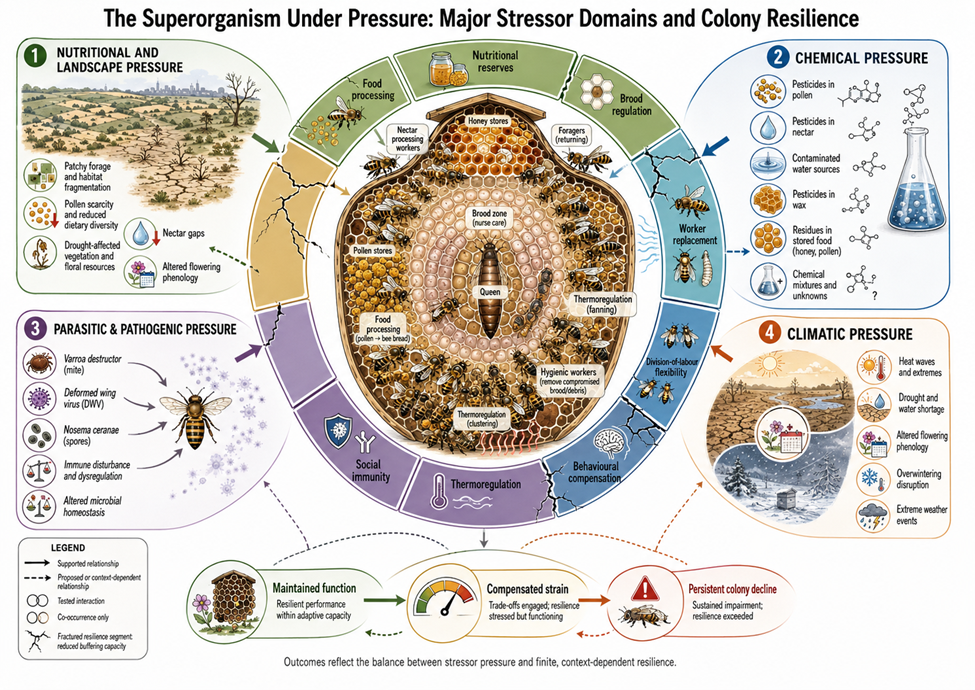
Figure 1 classifies major stressor domains within the analytical logic developed in this section.
|
|
|
Figure 1. Major stressor domains |
Alt text
A structured conceptual diagram that classifies major stressor domains, with labelled components, directional relations, contextual modifiers, uncertainty points, and a clear boundary between observed evidence and proposed synthesis.
Extreme weather may affect losses through temperature anomalies, altered overwintering conditions, resource deficits, and interactions with parasites or pesticide exposure. Large-scale observational analysis has associated colony loss with extreme weather alongside biological and chemical stressors, but such associations cannot identify a universal causal sequence or exclude differences in management and land use [25]. Drought is particularly difficult to isolate because its effects are often mediated through forage quantity, nutritional quality, water demand, and seasonal timing.
Multiple-stressor interactions at colony scale
A demonstrated interaction requires comparison of the combined response with an explicitly defined additive or independent expectation. Controlled experiments have shown that nutritional restriction can intensify neonicotinoid-associated mortality in individual workers [26]. Pathogen–pesticide combinations have likewise produced interactive effects on survival and immunity under particular laboratory conditions [27]. These studies establish biological plausibility, but their results cannot be generalized automatically across compounds, pathogens, diets, exposure schedules, or whole colonies.
Colony-level responses may differ because workers redistribute tasks, adjust brood production, regulate food use, and replace impaired individuals. A large field study found that colonies could buffer short-term effects of pollen restriction and fungicide exposure, although temporary changes in development and microbiome-related outcomes remained detectable [28]. Buffering is therefore an active biological response rather than evidence that exposure was harmless, and its energetic or reproductive costs may emerge outside a short observation period.
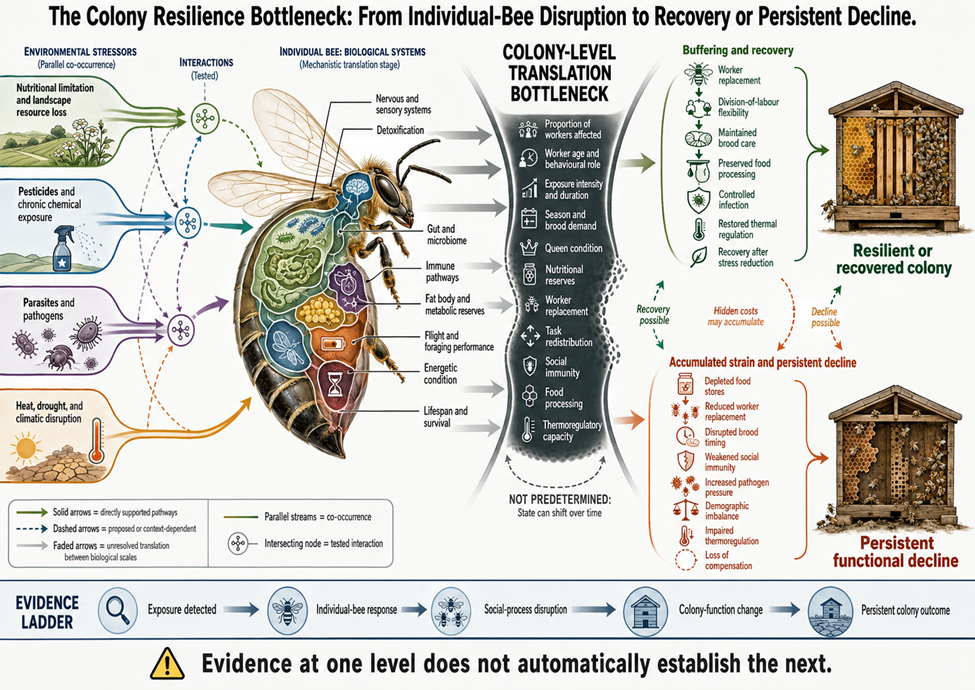
Resilience can decline when stress alters the timing of brood rearing, worker emergence, growth, or reproduction and thereby weakens the colony’s capacity to reorganize [29]. Colony state is consequently both an outcome and a modifier of future exposure. The evidence dimensions and interpretive boundaries for multiple-stressor interactions at colony scale are summarized in Table 3. Figure 2 shows pathways through which interacting stressors affect individual bees and colony-level resilience within the analytical logic developed in this section.
Table 3. Multiple-Stressor Interactions at Colony Scale: Colony-Level Pathways, Diagnostic Signals, Resilience Outcomes, Management Relevance, Validation Needs, and Interpretive Boundaries
|
Colony-health component |
Signal, stressor, or resource |
Biological pathway |
Indicator or evidence |
Colony-level implication |
Management relevance |
Uncertainty |
Interpretive boundary |
Representative supporting reference(s) |
|
Nutritional reserve |
Food restriction plus pesticide exposure |
Reduced energetic capacity to tolerate toxic stress |
Survival and physiological responses |
May narrow the colony’s compensatory margin |
Maintain forage during exposure periods |
Colony translation remains context dependent |
Individual synergy is not proof of colony collapse |
[26] |
|
Immune defence |
Pathogen plus pesticide |
Altered immune response and survival |
Infection, immune markers, mortality |
Could increase pressure on worker replacement |
Integrate disease and exposure management |
Effects vary by agent and design |
A tested interaction is not universal |
[27] |
|
Colony buffering |
Pollen restriction plus fungicide |
Task redistribution and demographic compensation |
Brood development and microbiome signals |
Short-term function may be maintained |
Monitor recovery after exposure |
Delayed costs may be missed |
Buffering does not mean absence of harm |
[28] |
|
Social resilience |
Accumulated stress load |
Disrupted timing of brood, emergence, and reproduction |
Colony growth, survival, reproduction |
Reduced capacity to absorb further disturbance |
Track trajectories rather than snapshots |
Thresholds vary among colonies |
Early disruption is not inevitable collapse |
[29] |
|
Climate interaction |
Heat, drought, parasites, and chemicals |
Increased energetic demand and altered exposure context |
Weather, infestation, residues, colony loss |
Risk may rise under unfavourable combinations |
Couple environmental and biological monitoring |
Observational attribution is limited |
Co-occurrence is not demonstrated interaction |
[25] |
|
Demographic reserve |
Worker abundance and age structure |
Replacement of impaired individuals |
Adult population and brood balance |
Determines compensatory capacity |
Assess worker and brood structure together |
Hidden costs may precede visible decline |
Stable size can conceal internal strain |
[28] |
|
Recovery capacity |
Resource return or stress removal |
Restoration of food, labour, and homeostasis |
Post-exposure development |
Distinguishes transient disturbance from persistent decline |
Extend monitoring beyond exposure |
Recovery time is poorly standardized |
A reversible response is not colony failure |
[29] |
|
|
|
Figure 2. Pathways through which interacting stressors affect individual bees and colony-level resilience |
Alt text
A structured conceptual diagram that shows pathways through which interacting stressors affect individual bees and colony-level resilience, with labelled components, directional relations, contextual modifiers, uncertainty points, and a clear boundary between observed evidence and proposed synthesis.
Review-level synthesis and evidence confidence
Across reviews, the most consistent conclusion is that colony health is shaped by multiple biological and environmental pressures whose relative importance changes across regions, seasons, and management systems. Varroa destructor and associated viruses receive particularly strong support, while nutrition, pesticides, weather, queen condition, and management modify vulnerability [30]. Agreement on multifactorial causation does not, however, prove that every factor interacts or contributes equally in every colony.
The superorganism perspective explains why decline may be nonlinear. Population models show that stress-mediated reductions in worker function can generate threshold behaviour: colonies may appear stable while compensation remains possible and then deteriorate rapidly after positive social feedbacks weaken [31]. Such models identify plausible dynamics rather than forecast inevitable outcomes for individual colonies, because parameters and initiating stressors remain context dependent.
Experimental evidence similarly demonstrates that individual impairment and colony performance can diverge. Colonies exposed to clothianidin partly compensated for reduced larval survival through increased brood initiation, preserving capped-brood numbers over the short term while potentially incurring longer-term reproductive costs [32]. This illustrates why colony resilience should be measured through both maintained function and the cost of maintaining it.
Confidence decreases when laboratory biomarkers, short exposure periods, or restricted colony conditions are extrapolated to field loss. Imidacloprid-associated gene-expression responses differed between laboratory and field contexts, emphasizing environmental modulation [33]. Broad synthesis also identifies substantial variation in stressor definitions, biological scales, and interaction evidence [34]. The convergent findings, context-dependent results, methodological limitations, and remaining uncertainties are synthesized in Table 4.
Table 4. Review-Level Synthesis and Evidence Confidence: Convergent Findings, Context Dependence, Methodological Limitations, Evidence Confidence, and Residual Uncertainty
|
Evidence domain |
Convergent finding |
Contradictory or context-dependent finding |
Study-design basis |
Main methodological limitation |
Strength of inference |
Residual uncertainty |
Implication |
Representative supporting reference(s) |
|
Nutrition and landscape |
Resource continuity supports colony function |
Landscape effects vary with season, weather, and management |
Field studies and models |
Resource availability and accessibility are difficult to separate |
Moderate |
Nutritional thresholds remain unclear |
Measure quality, timing, and accessibility together |
[7, 10] |
|
Pesticides |
Sublethal exposure can alter behaviour, physiology, or reproduction |
Colony outcomes vary with compound, exposure, and compensation |
Laboratory and field experiments |
Exposure realism and follow-up differ |
Moderate |
Long-term colony consequences remain unevenly resolved |
Link sensitive endpoints to colony trajectories |
[13, 32] |
|
Parasites and pathogens |
Varroa–virus pressure is a major threat |
Survival differs among host populations and management contexts |
Reviews, mechanistic studies, and field evidence |
Pathogen and mite effects are difficult to disentangle |
Relatively strong |
Contributions of tolerance and resistance vary |
Integrate infestation, viruses, and colony demography |
[17, 21] |
|
Climate stress |
Heat and extreme weather can challenge colony regulation |
Colonies may buffer temporary events; regional responses differ |
Experiments, reviews, and observational analyses |
Long-term and large-scale studies remain limited |
Moderate to limited |
Adaptation under repeated extremes is uncertain |
Use longitudinal climate–colony monitoring |
[22, 25] |
|
Multiple stressors |
Interactions occur under defined combinations |
Additive, synergistic, and antagonistic outcomes all remain possible |
Factorial experiments and field studies |
Many studies test individuals or few combinations |
Limited to specific contexts |
Transferability across exposures is low |
Require explicit interaction models |
[26, 27] |
|
Colony resilience |
Social regulation can delay functional decline |
Compensation may carry delayed demographic costs |
Colony experiments and models |
Recovery and compensation are inconsistently measured |
Moderate |
Failure thresholds are colony specific |
Measure resilience costs and recovery |
[29, 32] |
|
Review-level confidence |
Several reviews identify common threat domains |
Primary-study overlap may inflate apparent convergence |
Umbrella-review comparison |
Review quality, scope, and currency differ |
Conditional |
Independence of evidence is often unclear |
Report overlap and scale explicitly |
[5, 6] |
Future priorities for honey bee health
The first priority is longitudinal digital phenotyping that connects continuous signals with inspected biological states. Internal temperature can contribute to estimates of colony strength, but its interpretation depends on sensor placement, season, brood status, and external conditions [35]. Entrance imaging and temporal models may support early warning from population-loss patterns, yet predictions require validation across apiaries, climates, colony types, and management systems [36].
A second priority is multimodal validation. Molecular indicators should be assessed alongside infestation, pathogen burden, nutrition, demography, behaviour, temperature regulation, and subsequent colony outcomes. Immune-gene profiles have shown potential as markers of how colonies respond to Varroa and deformed wing virus, but the evidence remains preliminary and context specific [37]. Biomarkers should therefore support diagnosis and hypothesis generation rather than be presented as stand-alone predictions of failure.
A third priority is interoperable, transparently documented monitoring infrastructure. Open longitudinal datasets containing hive weight, temperature, humidity, management records, and confirmed colony events can support reproducibility and cross-site testing [38]. Future studies should predefine interaction hypotheses, distinguish exposure from effect, measure compensatory costs, document review overlap, and retain negative or mixed findings. Progress should be judged by improved transferability and earlier recognition of recoverable stress, not merely by increased sensor or biomarker sensitivity.
CONCLUSION
Honey-bee colony health cannot be understood by counting hazards independently or by treating every altered worker-level endpoint as evidence of impending collapse. Nutritional limitation, landscape resource loss, pesticides, parasites, pathogens, immune disruption, heat, and drought can all weaken components of superorganism function, but their consequences are conditioned by timing, duration, demography, resource reserves, infection pressure, management, and the colony’s capacity for social compensation. The strongest synthesis is therefore resilience centred: colony risk emerges when accumulated demands erode the collective mechanisms that sustain brood care, food processing, thermoregulation, defence, worker replacement, and recovery. Co-occurrence must remain distinct from demonstrated interaction, early biological change from inevitable collapse, and review agreement from independent evidentiary confirmation. The highest-priority advance is longitudinal, multimodal colony monitoring that links mechanistic signals to later functional outcomes while preserving uncertainty and context.
ACKNOWLEDGMENTS: None
CONFLICT OF INTEREST: None
FINANCIAL SUPPORT: None
ETHICS STATEMENT: None