Entomology and
Applied Science Letters
Applied Science Letters
 2025
Volume 12
Issue 3
2025
Volume 12
Issue 3

Honey-bee colonies can experience nutritionally consequential changes well before conspicuous losses of adult population, brood, productivity, or overwintering capacity become visible. Management decisions are nevertheless often triggered by floral abundance, hive appearance, or the availability of supplemental feed, even though these observations do not directly establish nutritional adequacy, nutrient assimilation, or resilience. This article develops an original, non-validated decision logic for nutrition-sensitive colony management by integrating evidence on nutritional landscapes, floral-resource continuity, protein, lipid and micronutrient requirements, seasonal resource gaps, colony vulnerability, supplemental feeding, habitat intervention, and sensor-supported phenotyping. The synthesis treats the colony as a superorganism in which foraging, storage, nurse physiology, brood demand, immune challenge, and collective buffering interact across time. The strongest defensible conclusion is that nutrition-sensitive decisions require sequential separation of landscape opportunity, actual colony exposure, dietary composition, changing biological demand, vulnerability, intervention uptake, and subsequent response. Neither abundant flowers nor high pollen intake alone demonstrates an adequate diet, and a short-term feeding response does not establish durable colony resilience. Important limitations include geographically bounded field studies, heterogeneous feeding formulations and outcomes, incomplete measures of assimilation, multicausal colony decline, and limited validation of automated indicators as nutrition-specific signals. The central implication is that feeding and habitat actions should be selected through a staged, reversible process that records uncertainty and demands evidence appropriate to each inferential step. The proposed logic is therefore a research and design structure for prospective testing, not a universal prescription for feeding or landscape management.
INTRODUCTION
Honey-bee nutrition is commonly discussed as though colonies receive food in the same way that individual animals consume a diet. In reality, colony nutrition is distributed across foragers that select resources, workers that transform and store them, nurse bees that provision brood, and demographic groups whose requirements change with age and task. Nectar and pollen availability therefore become biologically meaningful only through collective acquisition, processing, allocation, and use. This superorganism perspective makes nutritional status a dynamic colony property rather than a simple reflection of food presence. Honey-bee nutrition accordingly links individual physiology with social organization, brood production, worker replacement, and the maintenance of colony functions [1].
The consequences of nutritional limitation are also conditioned by other stressors. Poor or imbalanced diets can constrain immune function and alter the outcome of viral infection, while infection can modify appetite, metabolism, and nutrient allocation [2]. Controlled evidence further shows that diet quality can change the consequences of virus exposure, supporting an interaction-sensitive interpretation rather than a model in which nutrition acts independently [3]. These relations are important for management because a weak colony, elevated pathogen burden, reduced brood area, or altered activity may be compatible with nutritional stress without being uniquely caused by it. Nutrient intake is therefore not equivalent to colony resilience, and an apparent nutritional signal should be interpreted alongside disease, weather, colony demography, and recent management.
The practical problem is that common decision cues sit at different points in the causal sequence. A flowering landscape represents potential opportunity; pollen entering the hive represents exposure; nutrient composition represents only part of dietary quality; consumption is not identical to assimilation; and an immediate physiological or behavioural response is not evidence of sustained colony recovery. These distinctions become especially consequential when managers must choose among continued observation, supplemental feeding, habitat enhancement, disease investigation, or combined action. Supplemental feeding may address an acute and correctly identified shortage, but it cannot recreate the diversity, continuity, spatial accessibility, and ecological functions of a restored floral landscape. Conversely, long-horizon habitat improvement may not protect a colony already passing through a severe, time-sensitive resource gap.
The precise gap addressed here is the absence of an integrated scholarly structure that preserves these distinctions while linking landscape exposure, nutrient-specific evidence, seasonal vulnerability, intervention choice, and digital monitoring. The article therefore develops a proposed nutrition-sensitive decision logic for honey-bee colonies. Its aim is not to formulate universal thresholds or to present a validated management framework, but to organize evidence-supported relations and explicit uncertainty gates. The central argument is that action should follow a staged assessment of resource opportunity, actual exposure, nutritional adequacy, changing colony demand, vulnerability, intervention uptake, and response. The following sections first examine how nutritional landscapes become colony exposures, then distinguish major nutrient dimensions and seasonal vulnerability before evaluating feeding, habitat action, and monitoring-supported decisions.
Nutritional landscapes and colony exposure
A nutritional landscape is not merely the land-cover composition surrounding an apiary. It is the temporally changing set of floral resources that colonies can detect, reach, collect, process, and use. Field evidence shows that season can shape the amount and diversity of collected pollen even when broad landscape-diversity measures do not explain those outcomes [4]. This finding limits the use of static habitat indices as proxies for nutrition: two landscapes with similar apparent diversity may differ in bloom timing, floral identity, accessibility, competition, weather exposure, or the nutritional complementarity of available plants. Floral abundance is therefore not equivalent to nutritional adequacy. A defensible exposure assessment must distinguish potential floral supply from the pollen and nectar that actually enter colonies, while also recognizing that colony preference and foraging range can alter the relationship between mapped habitat and collected food.
Landscape interventions can nevertheless affect biologically relevant colony conditions. Comparisons across enriched and semi-natural habitats have found improvements in selected worker physiological indicators, although the responses vary with intervention type and environmental context [5]. Such evidence supports the proposition that landscape quality can influence colony biology, but the measured biomarkers are intermediate outcomes rather than direct demonstrations of long-term resilience. Stronger inference requires a temporal connection between landscape exposure, incoming food, nutrient composition, colony physiology, demography, and later performance. Evidence of pollen shortage in farmland provides this temporal warning: a temporary deficit may carry over into reduced subsequent colony survival even after immediate floral conditions have changed [6]. The management implication is that current hive appearance cannot erase exposure history; a colony may remain vulnerable after a dearth because worker cohorts, brood replacement, stores, or disease interactions were altered earlier.
Spatial resource mapping adds a useful but bounded layer to this assessment. Catchment-scale mapping can identify likely forage opportunities and periods or locations of scarcity, helping managers target field inspection and sampling [7]. Yet a map estimates flowering potential under assumptions about land cover, phenology, access, and foraging distance; it does not measure nutrient intake. Landscape composition, habitat quality, and temporal resource continuity must therefore be evaluated together rather than treated as interchangeable representations of colony exposure [4–6]. Within a nutrition-sensitive decision process, mapped resources should function as an exposure prior that is checked against bloom observations, pollen entry, stored food, colony activity, and relevant contextual modifiers. A mismatch between the landscape model and hive evidence should increase uncertainty rather than trigger automatic feeding or habitat action.
Protein, lipid, and micronutrient requirements
Pollen quality is often compressed into crude protein concentration, but colony nutritional adequacy is multidimensional. Seasonal pollens vary in protein, amino acids, lipids, fatty acids, sterols, and other constituents, while colony demand changes with brood production, worker age structure, and environmental stress [8]. A high-protein pollen may therefore remain incomplete, poorly balanced, weakly digested, or mismatched to current needs. Composition also does not show how much is consumed or assimilated, and incoming pollen may be buffered by stored bee bread. Protein assessment should consequently consider quality-adjusted supply, intake, stores, brood demand, and context rather than a single concentration. This is a central interpretive boundary: a measured nutrient and the colony function it may support belong to different evidentiary stages.
Lipid evidence demonstrates why nutrient-specific assessment is necessary. Colonies experimentally deficient in an essential fatty acid increased recruitment to pollen that complemented the deficit, indicating that foraging behaviour can respond to nutrient balance rather than pollen mass alone [9]. The result supports a colony-level mechanism of compensatory demand, but dance intensity is not proof that the deficit was fully corrected or that resilience improved. Micronutrient evidence adds another distinct dimension. Stable-isotope work shows that dietary phytosterols are progressively assimilated into worker tissues and influence physiological indicators [10]. These findings establish biological relevance, yet individual-level assimilation cannot define a universal colony requirement, optimal dose, or intervention threshold. Nutrient-specific mechanisms must therefore be retained without converting each laboratory or behavioural response into a field prescription.
Colony feeding experiments provide stronger evidence that formulation completeness matters. A nutritionally designed pollen-replacing diet supported brood production under defined pollen-limited commercial conditions, whereas omission of a critical sterol or use of an incomplete comparator produced different outcomes [11]. The defensible inference is not that one product or sterol profile should be prescribed universally, but that crude protein alone cannot establish dietary adequacy and that ingredient balance may determine whether a substitute performs as intended. Protein composition, essential-fatty-acid balance, and phytosterol availability represent distinct nutritional dimensions that may impose different physiological and behavioural constraints [8–10]. The appropriate research progression is therefore from compositional measurement to intake, assimilation, proximal physiology, brood and worker responses, and finally longitudinal colony outcomes. Until that chain is tested across environments and colony states, nutrient requirements should be treated as context-dependent decision inputs rather than fixed operational thresholds.
Seasonal resource gaps and colony vulnerability
Season changes both sides of the nutritional balance: the resources available to colonies and the demands generated within them. Seasonal comparisons show that pollen composition, consumption, and utilization vary with time and place, meaning that the same pollen source or nutrient ratio need not have identical biological value throughout the year [12]. Brood expansion can increase demand just as floral continuity weakens, while stored pollen may delay the visible consequences of declining intake. Conversely, a low incoming-pollen count may not indicate an active deficit when stores are sufficient and brood demand is limited. Progress in diagnosis therefore requires repeated measures that connect resource phenology, collected and stored pollen, nutrient composition, colony demography, and subsequent outcomes. A useful seasonal indicator must show not only that supply changed, but that the change was relevant to demand and preceded a biologically coherent response.
Colony vulnerability describes reduced capacity to buffer such mismatches, not merely the presence of a resource gap. Long-term field analysis associates surrounding landscape composition with winter mortality, but overwintering remains a distal, multicausal endpoint influenced by pathogens, weather, colony strength, and management [13]. Continuous and repeated observations can narrow this ambiguity. Measurements of brood, adult-bee mass, hive weight, and internal temperature vary as colonies encounter changing agricultural landscapes, revealing trajectories that static inspection may miss [14]. However, none of these indicators is intrinsically nutrition-specific. The methodological priority is to test whether combined exposure and colony-state histories improve prediction beyond either landscape or hive measurements alone, and whether identified trajectories remain informative after accounting for disease, weather, beekeeper intervention, and sensor error.
Integrated studies illustrate both the value and the limits of that approach. Landscape structure, pollen diversity, pollen protein-to-lipid balance, colony density, and pathogen indicators can covary across apiaries [15]. Such integration is necessary because colony vulnerability may emerge from interactions among resource conditions, competition, nutritional balance, and infection. It is not sufficient because covariance does not identify causal direction: pathogens may alter foraging and colony demography, weak colonies may collect different pollen, or unmeasured management may shape both exposure and outcome. The highest-priority research design is therefore a prospective, multi-season sequence that records landscape opportunity, actual colony exposure, dietary composition, intake and stores, physiological and pathogen states, demographic demand, and delayed colony performance. Progress would be shown by reproducible, externally validated evidence that specific combinations predict vulnerability early enough to support a reversible decision, without treating uncertainty as proof of no effect or converting a proposed decision logic into a universally validated feeding prescription.
Supplemental feeding and habitat intervention
Supplemental feeding is most defensible when it is treated as a targeted response to a defined nutritional problem rather than as routine insurance against uncertainty. The feeding literature does not describe one uniform intervention: formulations differ in protein sources, amino-acid balance, lipids, sterols, texture, palatability, timing, dose, and exposure to natural forage. Reviews consequently report uneven outcomes across studies and caution against classifying all pollen substitutes as functionally equivalent [16]. Field evidence reinforces that caution. Providing supplemental pollen did not consistently increase colony strength or reduce Nosema infection under the conditions examined in one intervention study [17]. Such findings should not be read as evidence that feeding is ineffective in all settings. They instead show that an intervention may fail when no substantial deficit exists, when disease or environmental constraints dominate, when the formulation does not match the limiting nutrient, or when the response window is poorly aligned with colony demand.
Even a biologically plausible formulation cannot be evaluated solely by the amount placed inside a hive. Patties may be consumed, removed, redistributed, desiccated, contaminated, or left largely untouched, making feed disappearance an ambiguous measure of nutritional delivery [18]. Supplemental-feeding efficacy depends not only on what is provided but also on formulation, background forage, colony condition, uptake, and the outcome selected for evaluation [16–18]. Comparisons among spring protein feeds further show that colonies differ in consumption and subsequent growth responses [19]. Palatability may therefore influence exposure, but high consumption does not establish nutritional completeness, assimilation, or durable benefit. A rigorous feeding decision should pass through a sequence of questions: Is a plausible shortage present? Does the proposed feed address the suspected deficiency? Is it accepted and ingested? Do proximal biological indicators change? Is any response maintained at the colony level? Failure at one stage should prompt reassessment rather than automatic continuation.
Habitat intervention operates on a different temporal and ecological plane. Floral enrichment and semi-natural habitats can improve selected physiological indicators, but the effect depends on the identity, continuity, and accessibility of resources rather than the visual abundance of flowers alone [5]. Habitat action may reduce future exposure to nutritional gaps, diversify forage pathways, and support ecological functions extending beyond a single colony. It cannot, however, be assumed to rescue an already vulnerable colony during an immediate dearth. Conversely, supplemental feeding can temporarily deliver selected nutrients but does not recreate phenological continuity, plant diversity, landscape connectivity, or the wider ecological value of restored forage. Supplemental feeding is therefore not equivalent to landscape restoration. The choice between them should depend on where the failure occurs: acute lack of usable food may justify a monitored feeding response, whereas recurrent or spatially structured shortages indicate a need for longer-horizon habitat change. Where both problems coexist, combined action may be reasonable, but each intervention requires its own evidence of uptake and benefit.
Proposed nutrition-sensitive decision logic
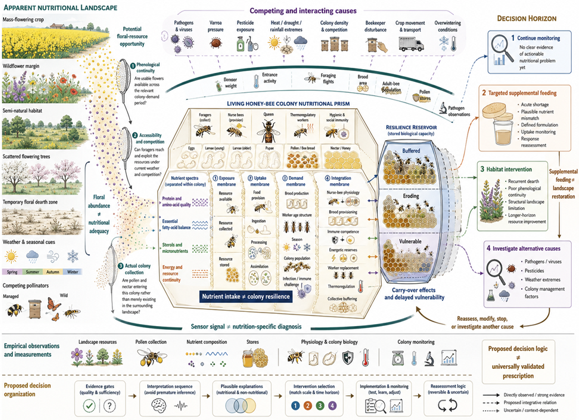
The proposed decision logic begins by refusing to collapse a complex colony state into a single trigger. Its first layer asks what the landscape could supply, its second asks what the colony actually encountered, and its third asks whether the collected diet plausibly matched current biological demand. Only then does the logic consider whether the colony appears vulnerable and whether intervention is justified. Continuous monitoring can help connect landscape exposure with changing colony state, but sensor outputs remain indirect and biologically ambiguous [20]. Within-day hive-weight patterns, for example, may reveal altered activity that periodic inspections miss, yet those patterns also reflect departures, arrivals, evaporation, weather, food movement, and management [21]. Digital phenotyping is therefore positioned as an evidence amplifier rather than an automated nutritional diagnosis. Figure 1 links landscape-level floral resources, colony nutritional status, physiological resilience, and management decisions within the analytical logic developed in this section.
|
|
|
Figure 1. Link landscape-level floral resources, colony nutritional status, physiological resilience, and management decisions |
Alt text
A structured conceptual diagram that links landscape-level floral resources, colony nutritional status, physiological resilience, and management decisions, with labelled components, directional relations, contextual modifiers, uncertainty points, and a clear boundary between observed evidence and proposed synthesis.
The logic next separates measurement from interpretation. Raw sensor values, biological state estimates, management judgements, and intervention decisions should remain visibly distinct because evidence becomes less direct as it moves along that chain. A framework for sensor-based hive monitoring similarly emphasizes the need to define what a device measures, what biological process is inferred, and how that inference could support management [22]. Automated flight monitoring offers candidate indicators of altered colony activity, but flight patterns remain conditional on weather, floral availability, colony size, season, disease, and equipment performance [23]. The proposed logic therefore uses contextual modifiers as explicit gates. A decline in flight activity during poor weather should not be interpreted in the same way as a sustained decline during suitable foraging conditions. Likewise, a reduction in hive weight may justify closer examination without identifying whether the cause is nutritional shortage, swarming, robbing, disease, or management disturbance.
The complete sequence consists of context, exposure, adequacy, demand, vulnerability, intervention selection, uptake, response, and reassessment. At each point, the logic permits four outcomes: advance to the next evidentiary stage, collect additional evidence, choose a reversible intervention, or stop because the nutritional interpretation is unsupported. Its principal safeguard is inferential separation. Landscape opportunity is not colony intake; intake is not assimilation; assimilation is not resilience; and a response to supplementation is not proof that habitat conditions are adequate. Feeding should therefore be selected only when evidence suggests an acute or compositional deficit that the proposed formulation could plausibly address. Habitat action should be selected when the evidence identifies recurrent, seasonal, or spatial resource failure. Sensor-supported alerts may accelerate inspection, but they should not independently activate treatment. The proposed components, evidence bases, boundary conditions, failure modes, and validation requirements are organized in Table 1.
Table 1. Proposed Nutrition-Sensitive Decision Logic: Components, Evidence Basis, Relations, Boundary Conditions, Failure Modes, and Validation Requirements
|
Proposed component |
Purpose |
Evidence basis |
Relation or mechanism |
Input or precondition |
Expected output |
Boundary condition or failure mode |
Validation requirement |
|
Context gate |
Define the biological and management setting before interpreting evidence |
Seasonal and landscape-dependent variation |
Climate, crop system, colony purpose, management, and disease alter the meaning of later observations |
Location, season, weather, management history, colony role |
Context profile |
Applying evidence from a non-equivalent season or production system |
Prospective testing across contrasting apiaries and seasons |
|
Landscape-opportunity gate |
Estimate potential resource supply |
Spatial floral-resource mapping |
Land cover and flowering phenology shape potential forage |
Current landscape and bloom information |
Resource-opportunity estimate |
Treating mapped flowers as proof of colony exposure |
Comparison with pollen collection and foraging data |
|
Colony-exposure gate |
Determine whether resources actually entered the colony |
Pollen collection and continuity evidence |
Accessibility, competition, weather, and forager choice mediate landscape use |
Pollen influx, stored food, foraging observations |
Exposure classification |
Inferring intake from floral abundance alone |
Repeated landscape–pollen matching |
|
Nutritional-adequacy gate |
Distinguish food quantity from dietary quality |
Protein, lipid, fatty-acid, and sterol evidence |
Multiple nutrients contribute through different biological pathways |
Representative diet composition and intake information |
Provisional adequacy profile |
Using crude protein as a complete diet measure |
Links among composition, assimilation, and colony outcomes |
|
Colony-demand gate |
Relate supply to changing superorganism requirements |
Nutritional physiology and brood-demand evidence |
Brood production, worker demography, infection, and season alter demand |
Brood area, adult population, stores, stressor context |
Demand estimate |
Applying one nutritional threshold to every colony |
Longitudinal demand–response studies |
|
Vulnerability gate |
Identify reduced buffering capacity before visible collapse |
Carry-over and overwintering evidence |
Earlier shortages may alter later demography, stores, and survival |
Exposure history, colony trajectory, pathogen and weather information |
Vulnerability judgement |
Attributing multicausal decline to nutrition alone |
Multivariable prospective validation |
|
Intervention-selection gate |
Match action to the diagnosed failure point |
Feeding and habitat evidence |
Acute deficits may justify feeding; recurrent resource failure may justify habitat action |
Plausible deficit, urgency, formulation, landscape constraints |
Feed, habitat, combined action, monitoring, or no action |
Treating supplementation as landscape restoration |
Comparative intervention studies with equivalent baselines |
|
Uptake gate |
Verify that an offered feed becomes a biological exposure |
Feed-fate and consumption studies |
Provision, disappearance, ingestion, and assimilation are separate stages |
Documented feed placement and colony access |
Confirmed, uncertain, or absent uptake |
Assuming supplied feed was consumed |
Tracing, consumption, and assimilation studies |
|
Response gate |
Determine whether intervention changes relevant biology |
Colony feeding and pollination studies |
Proximal responses may or may not extend to colony resilience |
Baseline and follow-up indicators |
Beneficial, absent, adverse, or ambiguous response |
Treating short-term activity as long-term resilience |
Multi-season colony-level evaluation |
|
Digital-evidence gate |
Use monitoring without automating unsupported diagnoses |
Continuous weight, temperature, and activity monitoring |
Sensors can identify deviations requiring interpretation |
Calibrated devices plus biological context |
Alert or evidence request |
Sensor drift or non-nutritional causes |
External validation against direct colony measurements |
|
Reassessment and stopping gate |
Prevent ineffective or indefinite intervention |
Heterogeneous feeding and monitoring evidence |
Decisions are revised when uptake, response, or causal interpretation fails |
Predefined follow-up interval and stopping criteria |
Continue, modify, stop, or investigate another cause |
Repeating an action despite absent support |
Decision-impact trials comparing management pathways |
Practical and research implications
The first implementation priority is to replace broad landscape labels with temporally resolved evidence of usable forage. Pollen diversity differs among commercial crop environments, indicating that colonies moved for pollination do not encounter equivalent resource conditions [24]. Yet taxonomic diversity alone remains insufficient because diverse pollen can still be temporally discontinuous or nutritionally imbalanced. Practical monitoring should therefore combine crop stage, surrounding bloom, pollen entry, stored food, and colony demand. Supplemental pollen may increase pollinating activity in particular crops [25], but increased activity is not equivalent to improved resilience. Future field studies should define their intended outcome before intervention: sustaining brood, correcting a nutrient deficit, supporting pollination, improving overwintering preparation, or reducing vulnerability are separate aims. Progress would be demonstrated when an intervention produces the prespecified response without worsening another relevant colony function and when the result is reproducible beyond one crop or season.
The second priority is to compare short-horizon feeding with structural habitat action under equivalent baseline conditions. Inter-row floral cover in almond systems has been associated with stronger colony performance and benefits extending beyond the immediate bloom period [26]. This supports the possibility that habitat interventions can influence resource continuity and produce carry-over effects. It does not establish that every flowering mixture, crop system, or climate will yield the same outcome. Comparative studies should therefore record the composition and phenology of planted resources, actual colony use, natural forage outside the intervention area, colony condition at entry, and subsequent movement. Feeding, habitat enhancement, combined intervention, and no-intervention groups should be evaluated using the same outcomes and observation periods. Evidence of progress would include replicated findings that identify which type of shortage each strategy addresses, how long benefits persist, and when combined action offers an advantage over either intervention alone.
The third priority is methodological governance of inference. Pollen preference and collection frequency do not reliably reveal nutritional adequacy because foragers also respond to accessibility, odour, handling costs, prior experience, recruitment, and current colony demand [27]. Decision systems should consequently document which variables are directly observed and which are inferred. Sensor alerts, landscape models, nutrient analyses, and colony inspections should retain separate provenance rather than being merged into an opaque score. Data quality, calibration, missing observations, seasonal transferability, and alternative explanations should be visible to the user. The proposed decision logic should be tested prospectively against ordinary management, with predefined outcomes, stopping rules, and adverse-result reporting. Its value would be demonstrated not by perfect prediction, but by better-timed investigation, fewer unsupported feeding actions, clearer selection between feeding and habitat intervention, and more transparent recognition of uncertainty. Until such evidence exists, a nutrition-sensitive decision logic is not equivalent to a universally validated feeding prescription.
CONCLUSION
Honey-bee colonies can enter a nutritionally vulnerable state before visible decline makes the problem obvious, but early action is defensible only when the evidence chain remains intact. Landscape resources create opportunities rather than guaranteed diets; collected food represents exposure rather than complete nutritional status; nutrient intake does not itself establish physiological resilience; and short-term intervention responses do not prove durable colony recovery. The strongest synthesis is therefore sequential: interpret landscape and seasonal context, verify actual colony exposure, examine nutritional composition relative to changing demand, assess vulnerability alongside competing causes, select the least assumptive intervention, confirm uptake, and reassess biological response. Supplemental feeding may be appropriate for an acute and plausible shortage, whereas habitat intervention addresses recurrent and structural limitations; neither should be treated as a substitute for the other. The proposed decision logic makes these distinctions explicit and offers a disciplined architecture for research and management reasoning. Its highest-priority requirement is prospective validation across environments, colony states, and intervention types while preserving uncertainty, alternative explanations, and stopping criteria. Until that work is completed, the logic should guide better questions and more transparent decisions rather than claim universal authority.
ACKNOWLEDGMENTS: None
CONFLICT OF INTEREST: None
FINANCIAL SUPPORT: None
ETHICS STATEMENT: None