Entomology and
Applied Science Letters
Applied Science Letters
 2026
Volume 13
Issue 1
2026
Volume 13
Issue 1

Mosquito-associated microorganisms can alter host development, immunity, reproduction, survival, pathogen susceptibility, and other components of vectorial capacity, creating opportunities to interrupt pathogen transmission through deliberate microbiome manipulation. Translation remains constrained, however, because microbial detection or colonization is frequently treated as evidence of stable function, while reductions in pathogen abundance within individual mosquitoes are sometimes interpreted as population-level transmission control. This scoping review maps and critically compares recent evidence on Wolbachia-based transmission blocking, paratransgenesis, engineered symbionts, microbial metabolites, immune modulation, synthetic communities, persistence, evolutionary stability, and biosafety. Peer-reviewed evidence was identified through structured bibliographic searching, citation chaining, and verification of article metadata and journal eligibility. Studies were charted according to mosquito host, microbial component, anatomical compartment, intervention, transmission route, persistence, causal-validation method, pathogen outcome, biological scale, contextual modifiers, and ecological or safety boundary. The strongest evidence supports the capacity of selected Wolbachia strains to reduce arbovirus transmission and, under defined deployment conditions, lower human dengue incidence. Paratransgenic bacteria can deliver antipathogen effectors and can be engineered for conditional or self-limiting expression, but field-relevant persistence, competition with resident microbiota, genetic stability, containment, and effects on non-target organisms remain incompletely resolved. Evidence for metabolites, immune pathways, and community engineering is mechanistically promising but uneven across mosquito species, microbial taxa, pathogens, and environmental settings. The synthesis therefore supports a staged evaluation logic linking colonization, functional causality, transmission blocking, ecological stability, and epidemiological effect rather than treating these outcomes as interchangeable. Future development should combine causal microbial ecology with longitudinal field validation, evolutionary testing, environmental risk assessment, and governance proportionate to the transmissibility and persistence of each intervention.
INTRODUCTION
Mosquitoes harbour bacteria, fungi, viruses, protists, and other microorganisms that may influence nutrition, development, fecundity, survival, immune activity, pathogen incubation, and vector competence. These effects create a potential intervention space extending beyond conventional insecticidal suppression: microbial taxa or functions may be introduced, enriched, engineered, or reorganized to reduce the probability that an exposed mosquito becomes infectious. Yet vectorial capacity is a population-level property shaped by biting, survival, abundance, competence, and pathogen development, so a microbial effect on one component cannot be assumed to reduce transmission without evidence connecting biological scales [1].
The mosquito microbiota is dynamic rather than a fixed host attribute. Community composition varies with species, developmental stage, sex, diet, rearing environment, geography, tissue compartment, and exposure history. Bacteria occupying the midgut may interact directly with ingested pathogens, whereas intracellular symbionts or microorganisms in reproductive tissues can influence immunity, resource competition, reproduction, or inheritance. Reviews of mosquito-associated bacteria, fungi, and viruses consequently identify multiple candidate mechanisms for disease control but also emphasize that taxonomic association alone does not establish functional direction, reproducibility, or causal importance [2].
Microbiome manipulation also differs fundamentally across intervention classes. Wolbachia population-replacement approaches exploit inherited intracellular infection, pathogen blocking, and cytoplasmic incompatibility to promote spread through mosquito populations. Paratransgenesis instead modifies cultivable symbionts to produce antipathogen molecules in relevant tissues, while community engineering seeks to assemble interacting microorganisms or functions rather than rely on a single strain. These strategies differ in biological mechanism, transmissibility, reversibility, spatial reach, and containment requirements; they should not be treated as interchangeable forms of “microbial control” [3].
A further complication is that the mosquito microbiome includes persistent insect-specific viruses and other components that can modify arbovirus replication in context-dependent directions. Experimental evidence that resident viral infections alter dengue competence demonstrates why microbiome function must be tested rather than inferred from bacterial abundance or community profiles alone [4]. This review therefore asks what recent evidence establishes about deliberate microbiome reprogramming, where findings remain conditional or contradictory, and which validation steps are required before colonization, pathogen reduction, inheritance, or engineered specificity can be interpreted as durable and responsible transmission blocking.
Scoping review questions and evidence boundaries
The review was designed to map heterogeneous concepts, mechanisms, study designs, and translation stages rather than estimate a pooled intervention effect. Scoping-review reporting principles were used to structure the questions, eligibility criteria, search description, study selection, evidence charting, and presentation of gaps [5]. The central questions concerned what is directly established for each intervention class, which biological and methodological conditions explain divergence, which outcomes are incorrectly treated as equivalent, and which missing evidence most limits causal inference, transferability, ecological stability, or biosafety.
The evidence base was assembled through structured PubMed/MEDLINE searches using combinations of mosquito, microbiome, symbiont, Wolbachia, paratransgenesis, engineered bacteria, metabolite, immunity, synthetic community, persistence, evolution, biosafety, pathogen blocking, vector competence, and transmission terms. Citation chaining and publisher-record verification were used to confirm relevance and metadata. The choice of a scoping design reflected the breadth of interventions and outcomes, the coexistence of reviews, laboratory experiments, semi-field studies, field deployments, and epidemiological evaluations, and the need to distinguish evidence mapping from effectiveness estimation [6].
Eligible evidence directly addressed mosquito-associated microorganisms, microbial products, engineered symbionts, or community manipulation relevant to pathogen transmission. Sequence-only surveys without functional or ecological relevance were excluded. Extraction separated colonization, persistence, mechanism, mosquito phenotype, pathogen infection, infectiousness, and human disease outcomes. Evidence was classified as observational, experimentally causal, field-operational, epidemiological, or synthetic. Interpretation was bounded by mosquito species, microbial strain, pathogen, tissue, life stage, environment, intervention design, and follow-up duration. Microbial colonization was not accepted as durable transmission blocking, and uncertainty was not classified as evidence of no effect. The review questions, eligibility boundaries, search and screening logic, evidence-classification rules, and bias controls are specified in Table 1.
Table 1. Scoping Review Questions and Evidence Boundaries: Review Questions, Eligibility Boundaries, Search Logic, Screening Rules, Evidence Classification, and Bias Controls
|
Review-method element |
Operational definition |
Inclusion rule |
Exclusion rule |
Search or screening implementation |
Evidence-classification rule |
Bias-control measure |
Reporting requirement |
Representative supporting reference(s) |
|
Review question and construct definition |
Evidence for deliberate microbiome manipulation and transmission blocking |
Claim maps to a named intervention or boundary |
Generic microbiome description without relevance |
Concepts translated into intervention–mechanism–outcome blocks |
Direct finding separated from synthesis |
Predefined non-equivalence rules |
State established, uncertain, and unresolved claims |
[5] |
|
Biological boundary |
Mosquito hosts and associated microorganisms |
Mosquito species, life stage, or tissue identified |
Human-only or unrelated insect microbiomes |
Host and compartment terms applied |
Evidence retained at tested biological scale |
No cross-species generalization without support |
Report species, stage, tissue, and setting |
[6] |
|
Intervention boundary |
Natural, introduced, selected, or engineered microbial components |
Wolbachia, paratransgenesis, metabolites, immunity, or communities |
Unrelated genetic or chemical control |
Intervention-specific search blocks |
Intervention class recorded separately |
Avoid combining non-equivalent strategies |
Describe mechanism and delivery route |
[1] |
|
Outcome boundary |
Colonization through epidemiological effect |
At least one relevant biological or transmission outcome |
Detection without functional relevance |
Outcome terms included in screening |
Colonization, function, blocking, and transmission separated |
No surrogate escalation |
Report the exact measured outcome |
[1] |
|
Eligible designs |
Reviews, controlled experiments, field studies, epidemiological evaluations |
Methods permit interpretation of the cited claim |
Unsupported opinion or non-peer-reviewed material |
Title, abstract, and full-text relevance screening |
Design classified before synthesis |
Claims limited by study design |
Identify evidence class in prose |
[6] |
|
Publication boundary |
Peer-reviewed recent journal evidence meeting journal criteria |
Verified article, DOI, and eligible journal |
Preprints, websites, chapters, and unverified records |
Publisher and bibliographic metadata cross-check |
Source type documented |
Duplicate and metadata checks |
Do not expose execution metadata in article prose |
[5] |
|
Search logic |
Biological system plus intervention, mechanism, outcome, and limitation |
Meaningful combined concepts |
Title-word repetition alone |
Boolean combinations and citation chaining |
Search route recorded |
Multiple concept blocks reduce terminology bias |
Describe databases and supplementary searching |
[5] |
|
Screening rule |
Claim-level relevance to a section, table, figure, or boundary |
Source supports a planned analytical use |
Topical proximity without claim support |
Relevance checked against extraction fields |
Direct, qualified, or contextual support |
Ambiguous support excluded or qualified |
Explain major evidence boundaries |
[6] |
|
Evidence classification |
Observation, causal experiment, field operation, epidemiology, or synthesis |
Design and outcome identifiable |
Evidence class cannot be determined |
Classification during charting |
Association separated from causation |
Scale-specific interpretation |
Use cautious causal language |
[6] |
|
Bias and quality control |
Appraisal proportional to the claim and design |
Methods sufficient to judge validity |
Uninterpretable or inadequately described evidence |
Confounders, controls, follow-up, and comparators charted |
Uncertainty separated from no effect |
No invented numerical grading |
State limitations affecting each inference |
[5] |
Wolbachia-based transmission blocking
Wolbachia-based replacement combines intracellular colonization with reproductive drive and pathogen interference. Laboratory transinfection studies show that blocking is not a universal property of the genus but depends on the Wolbachia strain, mosquito background, pathogen, tissue distribution, and symbiont density. The wAu strain, for example, produced strong blocking of dengue and Zika viruses in experimentally infected Aedes aegypti, demonstrating that strain selection can materially change the transmission-blocking phenotype [7]. Such results establish biological potential under controlled conditions; they do not alone establish spread, persistence, epidemiological effectiveness, or equivalence across environments.
Evolutionary and ecological context further modifies interpretation. Artificial selection in Aedes aegypti revealed host genetic variation affecting Wolbachia-mediated dengue blocking and associated fitness, indicating that blocking strength is partly an emergent host–symbiont phenotype rather than an immutable bacterial trait [8]. At the field scale, area-wide releases in Pacific island settings achieved sustained high prevalence of wMel infection in most deployment locations, supporting the feasibility of introgression across distinct urban and island contexts [9]. Nevertheless, vertical transmission and high prevalence are evidence of inheritance and establishment, not proof that blocking magnitude remains constant in every mosquito generation, season, or pathogen context.
The strongest bridge from mosquito phenotype to public-health outcome comes from epidemiological evaluation. A cluster-randomized trial in Yogyakarta showed that deployment of wMel-infected Aedes aegypti reduced virologically confirmed dengue and dengue hospitalization, providing direct evidence that a Wolbachia replacement intervention can lower human disease under the tested implementation conditions [10]. Operational evidence from Malaysian high-rise settings using wAlbB also associated higher Wolbachia frequencies with reduced dengue incidence [11]. These studies strengthen the case for transmission reduction but do not make pathogen reduction in mosquitoes universally equivalent to population protection. Coverage, spatial movement, local transmission intensity, strain stability, community acceptance, surveillance quality, and untreated-area contamination remain part of the causal pathway between microbial blocking and epidemiological effect.
Paratransgenesis and engineered symbionts
Paratransgenesis modifies mosquito-associated microorganisms so that they express or deliver molecules capable of interfering with pathogen development. Candidate symbionts must be cultivable and genetically tractable, colonize the relevant mosquito compartment, tolerate the physiological conditions encountered there, express the effector at an appropriate time and dose, and retain sufficient fitness to compete with resident microorganisms. They may also require horizontal or vertical transmission, depending on the intended delivery strategy. Reviews of insect-vector systems show substantial laboratory development but emphasize that environmental release, genetic stability, non-target exposure, regulation, and containment remain unresolved translational requirements [12].
Engineered Serratia AS1 provides an important proof of mechanism. The bacterium can colonize anopheline mosquitoes, move between individuals and generations, and be engineered to secrete antiplasmodial effector molecules that suppress Plasmodium falciparum development [13]. This integrates colonization, transmission, genetic engineering, effector delivery, and pathogen inhibition more completely than studies based only on microbial association. However, efficient microbial transmission does not establish ecological stability, and parasite suppression in experimentally colonized mosquitoes does not establish reduced malaria transmission in natural populations. Resident-community competition, environmental persistence, genetic change, pathogen resistance, delivery coverage, and exposure outside the target host remain separate evidentiary questions.
Engineering can also reduce biological burden and improve control over effector expression. Blood-meal-inducible promoters in Asaia restricted antiplasmodial expression to a relevant physiological context, improving bacterial competitiveness and mosquito-gut colonization relative to constitutive expression while inhibiting parasite development [14]. Combining mosquito transgenesis with paratransgenesis produced stronger parasite-blocking activity in a controlled system, illustrating potential complementarity while increasing system complexity and validation requirements [15]. Self-limiting engineered bacteria provide another design direction by allowing effector-bearing organisms to lose the engineered construct without continued selection, potentially restricting persistence [16]. None of these design features independently demonstrates biosafety: conditional expression, combined specificity, or self-limitation must be tested for mutation, leakage, horizontal gene transfer, non-target exposure, persistence beyond intended settings, and failure under field conditions. The evidence dimensions and interpretive boundaries for paratransgenesis and engineered symbionts are summarized in Table 2.
Table 2. Paratransgenesis and Engineered Symbionts: Host Context, Microbial Functions, Causal Evidence, Community Stability, Ecological Risk, and Interpretive Boundaries
|
Microbial component or intervention |
Host context |
Proposed function |
Evidence required |
Causal test |
Stability or transmission issue |
Ecological risk |
Interpretive boundary |
Representative supporting reference(s) |
|
Candidate paratransgenic symbiont |
Mosquito tissue overlapping pathogen development |
Deliver antipathogen effector |
Colonization, expression, and pathogen outcome |
Engineered versus control strain |
Competition and inheritance |
Non-target colonization or gene transfer |
Candidate suitability is not field readiness |
[12] |
|
Engineered Serratia AS1 |
Anopheline gut and reproductive transmission routes |
Secrete antiplasmodial molecules |
Effector expression and reduced parasite development |
Engineered and non-engineered bacterial controls |
Horizontal and vertical spread require longitudinal testing |
Environmental dissemination and construct transfer |
Microbial spread is not ecological stability |
[13] |
|
Blood-meal-inducible Asaia |
Blood-fed Anopheles midgut |
Time effector production to pathogen exposure |
Induction, fitness, colonization, and parasite inhibition |
Conditional versus constitutive expression |
Construct retention without selection |
Exposure beyond intended physiological context |
Conditional expression is not containment |
[14] |
|
Combined transgenesis and paratransgenesis |
Engineered mosquito plus engineered symbiont |
Layer distinct antiparasitic mechanisms |
Independent and combined intervention controls |
Factorial comparison of components |
Stability of two engineered systems |
Expanded failure and exposure pathways |
Stronger laboratory blocking is not operational effectiveness |
[15] |
|
Self-limiting paratransgenesis |
Engineered symbiont with transient construct maintenance |
Restrict duration of engineered function |
Loss kinetics, residual function, and escape testing |
Self-limiting versus stable construct |
Persistence varies with selection and ecology |
Mutation, rescue, or unintended transfer |
Self-limitation is not demonstrated biosafety |
[16] |
Microbial metabolites and immune modulation
Microbial effects on vector competence can arise through host signalling rather than direct antagonism of a pathogen. In Aedes aegypti, Wolbachia can engage innate immune and redox pathways that help establish the symbiosis while producing an antiviral physiological state. This evidence supports immune modulation as one component of transmission blocking, but it does not establish a single universal mechanism: immune activation may vary with symbiont strain, density, mosquito genotype, tissue, age, and infection history. Moreover, elevated expression of immune-associated genes is not itself proof that the measured pathway causes pathogen restriction; causal interpretation requires perturbation of the candidate pathway followed by restoration or loss of the blocking phenotype [17].
Metabolic competition and membrane biology provide a second mechanistic class. Wolbachia-infected Aedes aegypti cells exhibit altered cholesterol handling and vesicular trafficking associated with dengue-virus restriction, indicating that intracellular symbionts can reshape host resources required for viral entry, replication, or egress [18]. These findings connect symbiont presence to identifiable cellular processes, but association between metabolic disturbance and reduced virus does not establish that one metabolite or pathway is solely responsible. Cholesterol availability, lipid transport, organelle organization, immune signalling, and cellular stress may operate jointly. Mechanistic validation therefore requires pathway-specific manipulation, measurement in intact mosquito tissues, and evidence that restoring the affected resource also restores pathogen development.
Experiments with axenic and gnotobiotic mosquitoes clarify why microbial function cannot be inferred from taxonomic presence alone. Aedes aegypti can complete development under carefully supplemented axenic conditions, showing that living bacteria are not invariably required when microbial nutritional functions are experimentally replaced [19]. Other work nevertheless demonstrates that gut microbiota can affect fecundity, longevity, and vector competence under conventional biological conditions, meaning that the contribution of microorganisms depends on diet, developmental environment, microbial composition, and the host outcome measured [20]. A more direct metabolite-to-phenotype chain has been demonstrated for symbiont-derived sphingosine, which modulates vector competence in Aedes mosquitoes and provides a tractable example of a microbial molecule influencing pathogen susceptibility [21]. Together, these studies support metabolite-centred causal analysis, but neither microbial colonization nor detection of a candidate metabolite is equivalent to durable transmission blocking. The relevant molecule must be produced at the required anatomical site and time, remain active under realistic environmental conditions, and reduce infectiousness rather than only an intermediate measure of infection.
Synthetic communities and community engineering
Synthetic-community approaches shift the unit of intervention from a single microbial strain to a defined assemblage whose members provide complementary or redundant functions. Axenic and gnotobiotic mosquito models make this strategy experimentally accessible because investigators can introduce known microorganisms individually or in combinations and compare their effects against microbe-free or conventional controls [22]. Such models can distinguish whether development, immune activity, pathogen restriction, or other phenotypes depend on one taxon, an interaction between taxa, community biomass, or a diffusible product. They also create a route for testing community assembly rules before more complex environmental exposure is introduced.
Community function, however, cannot be separated from the conditions under which a community assembles. Abiotic characteristics of larval habitats can alter both mosquito development and microbiome composition, and the same locally available microorganisms may produce different host outcomes across resource or environmental contexts [23]. This context dependence is central to synthetic-community design. A consortium that performs reproducibly in a standardized laboratory diet may fail to establish in field water, be displaced during metamorphosis, or express a different metabolic profile after adult blood feeding. Consequently, defined membership is not sufficient evidence of a defined function, and short-term coexistence is not evidence of persistent community organization.
A credible community-engineering programme should therefore test at least four linked propositions: that the proposed members can colonize the intended compartment; that their interactions produce the hypothesized function; that the function persists through the relevant developmental, dietary, and environmental transitions; and that the resulting mosquito phenotype reduces pathogen transmission under appropriate challenge conditions. Experiments should compare individual strains with the complete consortium, use removal or replacement tests to identify indispensable members, and assess whether resident microbiota alter establishment or function. Community engineering may improve robustness through functional redundancy, but it can also create emergent interactions, metabolic cross-feeding, instability, or expanded environmental exposure. Synthetic construction is thus a proposed design strategy rather than a validated transmission-blocking framework, and its translational value depends on longitudinal tests that connect assembly, function, persistence, and infectiousness.
Stability, evolution, and biosafety
The stability of a mosquito–microorganism association has multiple non-equivalent dimensions. Genetic stability concerns change in the microbial genome or engineered construct; phenotypic stability concerns continued expression of colonization, reproductive, metabolic, or pathogen-blocking traits; demographic stability concerns prevalence across mosquito generations; and ecological stability concerns persistence under environmental variation and competition. Long-term comparison of wAlbB-infected Aedes aegypti lines found that the association retained density and cytoplasmic-incompatibility characteristics over an extended laboratory history, while virus blocking still varied with arbovirus and mosquito genetic background [24]. The finding illustrates both robustness and contingency: persistence of an inherited infection can coexist with variation in the intervention phenotype that matters for transmission.
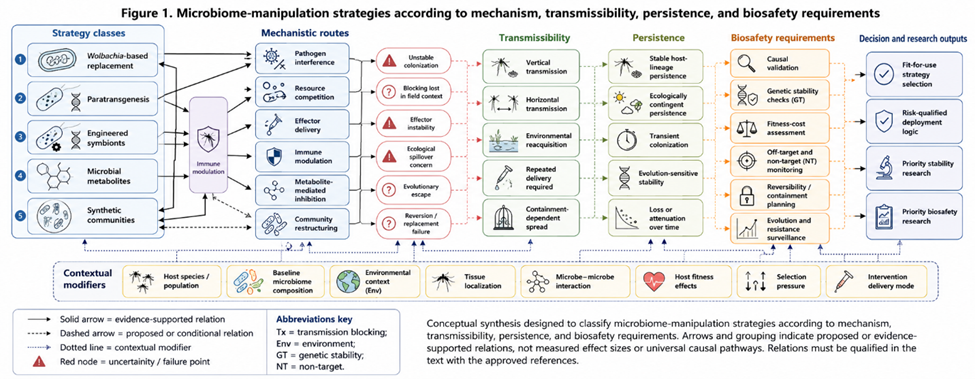
These distinctions become more important as microbial interventions become more transmissible or less reversible. Wolbachia replacement depends on maternal transmission and reproductive drive; paratransgenic systems may spread through mating, contact, breeding water, or environmental reservoirs; metabolite-based approaches may be transient unless production is sustained; and synthetic communities may require repeated ecological assembly. Each intervention must therefore be characterized simultaneously by its mechanism, route of transmission, expected duration, susceptibility to evolutionary change, potential for horizontal transfer, and available means of detection or reversal. Figure 1 classifies microbiome-manipulation strategies according to mechanism, transmissibility, persistence, and biosafety requirements within the analytical logic developed in this section.
|
|
|
Figure 1. Microbiome-manipulation strategies according to mechanism, transmissibility, persistence, and biosafety requirements |
Alt text
A structured conceptual diagram that classifies microbiome-manipulation strategies according to mechanism, transmissibility, persistence, and biosafety requirements, with labelled components, directional relations, contextual modifiers, uncertainty points, and a clear boundary between observed evidence and proposed synthesis.
Biosafety assessment must extend beyond whether an engineered microorganism preferentially colonizes a target mosquito. Relevant questions include survival outside the host, exposure of non-target organisms, horizontal gene transfer, mutation of control circuits, persistence of secreted products, effects on resident microbial networks, and consequences of incomplete or spatially heterogeneous establishment. Evolutionary responses may occur in the symbiont, mosquito, pathogen, or wider community, and selection may favour reduced effector expression, microbial competitors, host resistance, or pathogen escape. Engineered specificity is therefore not equivalent to biosafety, just as vertical transmission is not equivalent to ecological stability. The evidence dimensions and interpretive boundaries for stability evolution and biosafety are summarized in Table 3.
Table 3. Stability, Evolution, and Biosafety: Host Context, Microbial Functions, Causal Evidence, Community Stability, Ecological Risk, and Interpretive Boundaries
|
Microbial component or intervention |
Host context |
Proposed function |
Evidence required |
Causal test |
Stability or transmission issue |
Ecological risk |
Interpretive boundary |
Representative supporting reference(s) |
|
Inherited Wolbachia infection |
Aedes population replacement |
Reproductive drive with arbovirus blocking |
Maternal transmission, density, incompatibility, blocking, and field prevalence |
Infected and uninfected lines across host and virus backgrounds |
Blocking can vary despite stable infection |
Population spread beyond release area; ecological interactions |
Vertical transmission is not ecological stability |
[24] |
|
Paratransgenic bacterium |
Mosquito gut, reproductive tract, or breeding habitat |
Continuous antipathogen-effector delivery |
Construct retention, expression, colonization, and pathogen inhibition |
Engineered strain versus parental and inactive-effector controls |
Horizontal and vertical movement may differ by environment |
Horizontal gene transfer and non-target colonization |
Engineered specificity is not biosafety |
[13] |
|
Conditional-expression symbiont |
Blood-fed mosquito compartment |
Restrict effector expression to relevant physiological state |
Induction specificity, functional dose, leakage, and fitness |
Inducible versus constitutive and non-induced controls |
Promoter performance may change across host or environment |
Off-state leakage or activation outside intended context |
Conditional expression is not containment |
[14] |
|
Self-limiting engineered symbiont |
Temporally bounded colonization strategy |
Reduce long-term persistence of engineered function |
Construct-loss dynamics and escape testing |
Self-limiting versus stable constructs over serial transmission |
Mutation or ecological selection may prolong persistence |
Rescue, recombination, or transfer of functional elements |
Designed loss is not demonstrated reversibility |
[16] |
|
Microbial metabolite intervention |
Tissue-specific host–microbe interaction |
Modify immunity or pathogen-supporting metabolism |
Molecule identity, concentration, localization, and causal rescue |
Metabolite addition, depletion, and pathway restoration |
Production may depend on diet and community context |
Off-target host or environmental effects |
Metabolite detection is not durable blocking |
[21] |
|
Synthetic microbial community |
Larval habitat or adult mosquito compartment |
Deliver complementary or redundant functions |
Defined membership, interaction tests, persistence, and pathogen outcome |
Full consortium versus individual-member and omission treatments |
Community assembly may change across environments |
Emergent interactions and displacement of resident taxa |
Initial assembly is not stable community function |
[22] |
|
Surveillance and failure response |
Laboratory-to-field translation |
Detect loss of function or unintended spread |
Genomic, phenotypic, ecological, and epidemiological monitoring |
Longitudinal comparison against baseline and controls |
Failure can occur at different biological scales |
Delayed recognition of persistence or non-target effects |
Absence of detected harm is not proof of safety |
[25] |
Scoping synthesis and research gaps
Across the evidence base, the clearest convergence is that mosquito-associated microorganisms can causally modify traits relevant to pathogen transmission, but the strength of inference declines when evidence is extrapolated across biological scales. Wolbachia studies provide the most complete chain, extending from intracellular infection and mechanistic blocking to population introgression and reduced human dengue incidence in defined settings. Paratransgenesis provides direct experimental evidence that engineered bacteria can deliver antipathogen effectors, whereas metabolite studies demonstrate that specific microbial products can modify vector competence. Gnotobiotic systems additionally show that microbiome functions can be dissected experimentally. The common conclusion is not that all microbiome manipulations are effective, but that causal functions can be identified when colonization, mechanism, pathogen outcome, and context are measured separately [25].
The strongest unresolved problem is translation between these stages. Microbial colonization is not equivalent to durable transmission blocking because establishment may be transient, anatomically misplaced, or functionally silent. Pathogen reduction in mosquitoes is not equivalent to reduced population transmission because infectiousness, mosquito survival, coverage, movement, and local epidemiology intervene between laboratory infection measures and human exposure. Vertical transmission is not equivalent to ecological stability because an inherited microorganism may change in density, function, host association, or environmental performance. Engineered specificity is not equivalent to biosafety because target preference does not rule out mutation, horizontal transfer, environmental persistence, or non-target effects. Technologies that spread through populations therefore require evaluation frameworks proportionate to their persistence, reversibility, and capacity for spatial dissemination [26].
Research priorities follow directly from these discontinuities. First, mechanistic studies should use perturbation, rescue, and orthogonal validation to distinguish causal microbial functions from correlated community change. Second, longitudinal experiments should follow microorganisms and engineered constructs through larval development, metamorphosis, adult feeding, mating, reproduction, and environmentally realistic stress. Third, pathogen outcomes should progress from infection prevalence or load to dissemination, salivary-gland infection, infectious saliva, and, where justified, population-level transmission measures. Fourth, community-engineering studies should compare individual strains, complete consortia, omission communities, and resident-microbiota backgrounds. Finally, biosafety studies should examine non-target hosts, horizontal gene transfer, environmental reservoirs, evolutionary escape, detectability, and credible failure responses before claims of operational readiness are made.
The resulting evidence hierarchy is therefore relational rather than simply ordinal. A laboratory mechanism may be strong evidence for biological causality while remaining weak evidence for ecological persistence; a field prevalence study may establish population invasion without resolving blocking mechanisms; and an epidemiological evaluation may demonstrate effectiveness in one implementation context without proving universal transferability. The most defensible synthesis is that microbiome manipulation can interrupt mosquito-borne pathogen transmission, but confidence is intervention-specific and depends on an unbroken evidentiary chain from colonization to function, infectiousness, stability, and population effect. The convergent findings, context-dependent results, methodological limitations, and remaining uncertainties are synthesized in Table 4.
Table 4. Scoping Synthesis and Research Gaps: Convergent Findings, Context Dependence, Methodological Limitations, Evidence Confidence, and Residual Uncertainty
|
Evidence domain |
Convergent finding |
Contradictory or context-dependent finding |
Study-design basis |
Main methodological limitation |
Strength of inference |
Residual uncertainty |
Implication |
Representative supporting reference(s) |
|
Wolbachia transmission blocking |
Selected strains can reduce arbovirus competence and support population replacement |
Blocking varies with strain, virus, host genotype, density, and environment |
Mechanistic experiments, field establishment, epidemiological evaluation |
Uneven linkage between laboratory blocking and local transmission |
Strong for specified strain–host–setting combinations |
Long-term functional evolution and transferability |
Maintain strain-specific genomic, phenotypic, and epidemiological surveillance |
[24] |
|
Epidemiological effect |
Wolbachia deployment can reduce dengue incidence under tested conditions |
Magnitude and operational performance may differ across settings |
Cluster-randomized and observational field evaluations |
Limited direct comparability across deployment designs |
Strong in evaluated populations |
Durability, spatial spillover, and performance under different ecologies |
Treat population protection as an empirical outcome, not a laboratory inference |
[10] |
|
Paratransgenesis |
Engineered symbionts can colonize mosquitoes and deliver antipathogen effectors |
Persistence and competitiveness depend on host, strain, expression burden, and environment |
Controlled colonization and pathogen-challenge experiments |
Few environmentally realistic longitudinal evaluations |
Moderate for laboratory causal efficacy |
Field spread, construct stability, and non-target exposure |
Advance only with staged ecological and safety testing |
[13] |
|
Conditional and self-limiting engineering |
Expression timing and construct loss can reduce fitness burden or intended persistence |
Control circuits may leak, mutate, or behave differently outside laboratory conditions |
Comparative engineering experiments |
Short follow-up and simplified microbial communities |
Moderate for design feasibility |
Evolutionary escape and environmental reversibility |
Validate control systems over serial passage and ecological challenge |
[16] |
|
Immune modulation |
Microorganisms can alter immune and redox pathways associated with pathogen restriction |
Immune signatures vary and may be consequences rather than causes |
Molecular perturbation and expression studies |
Pathway activation sometimes treated as causal without rescue |
Moderate where perturbation supports mechanism |
Relative contribution of immunity versus metabolism or competition |
Require pathway-specific loss-and-restoration experiments |
[17] |
|
Metabolic mechanisms |
Symbionts and microbial metabolites can alter host resources relevant to pathogen replication |
Effects depend on tissue, diet, microbial source, and host physiology |
Cell, tissue, metabolite-addition, and depletion experiments |
Concentrations and localization may not reflect field conditions |
Moderate to strong for selected mechanisms |
Persistence and generalizability across systems |
Link molecule production to infectiousness under realistic conditions |
[21] |
|
Gnotobiotic and synthetic communities |
Defined microbiota enable causal testing of member and community functions |
Community outcomes shift with abiotic environment and resident taxa |
Axenic, monoassociated, and defined-consortium experiments |
Simplified communities may omit ecological competitors and environmental reservoirs |
Strong for controlled causal contrasts |
Assembly, persistence, and function in open systems |
Use laboratory communities as testable models, not deployment-ready products |
[22] |
|
Stability and evolution |
Some symbiont associations retain key traits over extended periods |
Stable inheritance may coexist with variable pathogen blocking |
Longitudinal genomic and phenotypic comparison |
Few studies span both long duration and diverse field conditions |
Moderate to strong for specific associations |
Coevolution of host, symbiont, pathogen, and community |
Monitor genetic and functional traits independently |
[24] |
|
Biosafety |
Risk depends on transmissibility, persistence, gene mobility, and ecological exposure |
Specificity or self-limitation may reduce but cannot eliminate risk |
Experimental containment studies and conceptual synthesis |
Sparse non-target and environmental follow-up |
Limited for field-scale engineered releases |
Horizontal transfer, escape, reversibility, and delayed effects |
Match governance and surveillance intensity to spread potential |
[26] |
|
Cross-domain translation |
Causal microbial functions can be identified and engineered |
Few interventions have complete evidence from mechanism to population effect |
Scoping comparison across experimental and field evidence |
Heterogeneous outcomes and biological scales |
Strong for the existence of potential; variable for implementation |
Which designs retain function while remaining controllable |
Require an explicit colonization–function–blocking–stability–impact chain |
[25] |
CONCLUSION
Mosquito-associated microorganisms can be reprogrammed to interfere with pathogen transmission, but the evidentiary maturity of available strategies is highly unequal. Wolbachia provides the strongest demonstration that a microbial intervention can connect stable mosquito-population establishment with reduced human disease under defined conditions. Paratransgenesis, microbial metabolites, immune modulation, and synthetic communities offer increasingly precise ways to alter host–pathogen interactions, yet most remain constrained by incomplete evidence on persistence, ecological competition, evolutionary change, delivery, non-target exposure, and population-level effect. The central conclusion is therefore conditional: microbiome manipulation is a credible transmission-blocking platform only when colonization, causal function, reduction of mosquito infectiousness, ecological and evolutionary stability, and epidemiological impact are demonstrated as distinct links rather than assumed equivalents. The highest-priority task is to build this complete evidentiary chain while matching biosafety assessment, monitoring, reversibility, and governance to each intervention’s capacity to persist and spread.
ACKNOWLEDGMENTS: None
CONFLICT OF INTEREST: None
FINANCIAL SUPPORT: None
ETHICS STATEMENT: None