Entomology and
Applied Science Letters
Applied Science Letters
 2025
Volume 12
Issue 1
2025
Volume 12
Issue 1

Insects live in continuous contact with microorganisms that may be transient passengers, environmentally reacquired associates, persistent symbionts, or experimentally engineered partners. Distinguishing among these states is essential because microbial detection does not itself demonstrate biological function, and similar taxonomic patterns may conceal different metabolic activities or host consequences. This integrative review examines how insect-associated microbiota contribute to nutrition and development, immune regulation, xenobiotic metabolism, insecticide responses, and pathogen acquisition and transmission. Evidence is compared across descriptive surveys, defined-community experiments, host- and microbial-genetic manipulations, chemical-tracing studies, and population-level interventions. The strongest evidence arises when microbial membership is localized, persistence is demonstrated, perturbation is followed by controlled restoration, and microbial activity is linked to a measurable host or pathogen phenotype. Nutritional and developmental effects are often conditional on diet, microbial strain, host genotype, and life stage. Immune interactions are bidirectional: host pathways regulate microbial communities, whereas native or introduced microbes can stimulate, stabilize, or disrupt immune homeostasis. Microbial transformation of xenobiotics can reduce or enhance toxicity, but metabolic conversion should not be equated with durable insecticide resistance without evidence of persistence and causal contribution under relevant exposure conditions. Similarly, inhibition of pathogen growth in an assay is not equivalent to reduced transmission. A functional insect holobiont is therefore best treated as a bounded, testable biological system rather than a universal property of insects. Future progress depends on strain-resolved experimentation, longitudinal colonization evidence, chemically explicit functional measurements, ecologically realistic validation, and proportionate biosafety assessment for engineered microbial systems.
INTRODUCTION
The insect holobiont has become a useful organizing concept for examining how hosts interact with bacteria, fungi, viruses, protists, and other associated microorganisms. Its value, however, depends on whether microbial membership, persistence, spatial localization, activity, and host consequence are treated as measurable properties. Holobiont terminology should not convert co-occurrence into integration, because community structure may reflect host filtering, environmental dispersal, ecological drift, or interactions among microbes rather than a stable host-controlled consortium [1–3]. Insect systems make this distinction especially important: some contain highly conserved, socially or vertically transmitted symbionts, whereas others repeatedly acquire microbes from food, breeding water, soil, plant surfaces, or conspecifics.
Functional claims have nevertheless expanded rapidly across insect biology. Microbes have been implicated in nutrient provisioning, digestion, developmental signaling, immune maturation, detoxification, insecticide tolerance, pathogen interference, behavior, and reproduction. Evidence from herbivorous insects further suggests that intestinal microorganisms can participate in digestion and the transformation of plant allelochemicals, potentially modifying both host performance and plant–insect relations [4]. Yet these domains differ substantially in evidentiary strength. Metagenomic detection of a pathway identifies functional potential, not necessarily expression or metabolic flux; community shifts after exposure identify covariation, not the microbial mechanism responsible for the phenotype.
The central problem is therefore not whether insects contain microorganisms, but when those microorganisms can defensibly be considered functional components of a host-associated biological system. Strong inference requires alignment among the biological construct, experimental manipulation, measured outcome, and scale of interpretation. A bacterium may alter larval development under a chemically defined diet without contributing similarly under natural feeding conditions. A symbiont may degrade an insecticide in vitro without persisting at sufficient abundance to modify population-level susceptibility. A microbial isolate may inhibit a pathogen in culture without reducing vector infection, infectiousness, or human disease.
This review develops an evidence-grounded account of functional insect holobiont biology across four interconnected domains: nutrition and development, immune regulation, detoxification and xenobiotic metabolism, and pathogen acquisition and transmission. Rather than treating these domains as interchangeable manifestations of microbiome importance, the review compares the forms of evidence used to support each claim, the biological scales at which conclusions remain valid, and the contextual variables that explain divergent findings. The central argument is that functional holobiont status should be assigned conditionally, through demonstrated relationships among microbial presence, persistence, activity, host response, environmental context, and—in engineered systems—ecological and biosafety constraints.
The insect holobiont as a functional biological unit
The strongest boundary against universal holobiont claims comes from insects in which detectable microorganisms do not form a stable resident community. Caterpillars can contain low bacterial loads dominated by microbes associated with ingested foliage, with limited evidence that a resident gut microbiota is required for growth under tested conditions [5]. Natural Drosophila populations provide a different but complementary case: their community composition can vary markedly among individuals and locations, with passive dispersal and ecological drift explaining substantial variation [6]. These findings do not establish that microbes are irrelevant. They show instead that residence, host selection, and functional dependence must be demonstrated separately.
Functional characterization must also move beyond taxonomic composition. In wild Drosophila, microbial functional potential, community membership, and host transcription may vary along different ecological axes, demonstrating that taxonomic similarity cannot be assumed to represent equivalent activity [7]. Tractable systems such as the honey bee provide a stronger experimental model because conserved gut lineages can be cultivated, localized, assembled into defined communities, and studied through microbial genetics, host-response assays, metabolomics, and controlled recolonization [8]. The comparison reveals that the functional holobiont is not defined by microbial richness but by the ability to specify partners, compartments, processes, and consequences.
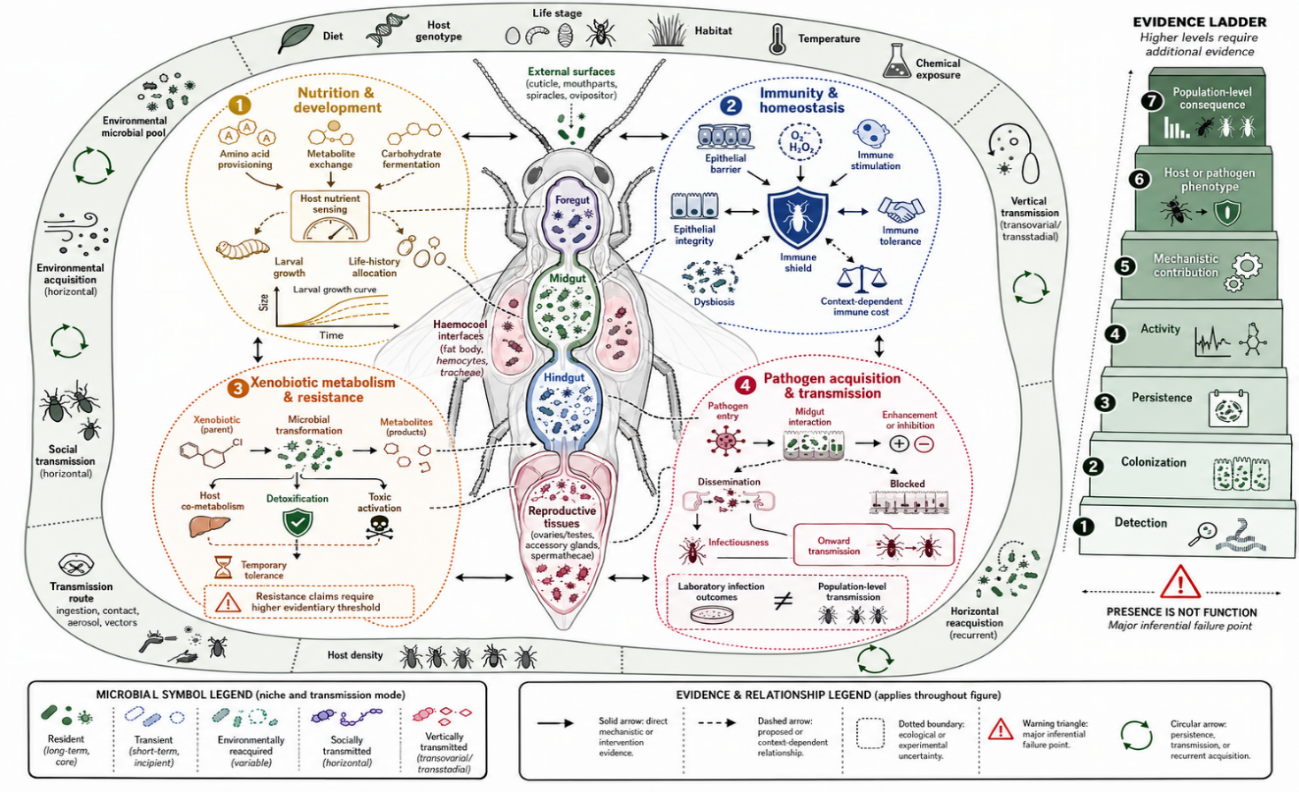
Figure 1 presents the insect holobiont as a nested functional system in which microbial membership, activity, host response, environmental context, and cross-host persistence must align before a functional relationship can be inferred.
|
|
|
Figure 1. The functional architecture of the insect holobiont across biological scales |
The proposed components, evidence bases, boundary conditions, failure modes, and validation requirements are organized in Table 1.
Table 1. The Insect Holobiont as a Functional Biological Unit: Components, Evidence Basis, Relations, Boundary Conditions, Failure Modes, and Validation Requirements
|
Proposed component |
Purpose |
Evidence basis |
Relation or mechanism |
Input or precondition |
Expected output |
Boundary condition or failure mode |
Validation requirement |
|
Host organism |
Define the biological recipient of microbial effects |
Host-genetic, physiological, and ecological studies |
Host anatomy, immunity, diet, and behavior filter microbial exposure and activity |
Specified insect species, genotype, sex, and life stage |
Measurable host phenotype |
Host effects mistaken for microbial effects |
Matched host controls and factorial host–microbe designs |
|
Microbial membership |
Identify the organisms participating in the system |
Quantitative profiling, cultivation, and localization |
Exposure followed by establishment in a defined compartment |
Biomass above detection artefact and spatially resolved sampling |
Reproducible membership profile |
Transient food-derived or contaminant organisms |
Quantification, negative controls, microscopy, or cultivation |
|
Persistence and transmission |
Determine whether association extends through time or between hosts |
Longitudinal, social-transmission, and inheritance evidence |
Vertical, horizontal, social, or environmental reacquisition |
Repeated sampling and strain-resolved tracking |
Stable or predictably reacquired association |
Loss across metamorphosis, diet change, or host transfer |
Time-series and transmission experiments |
|
Microbial activity |
Distinguish functional activity from genetic potential |
Transcriptomic, proteomic, metabolomic, and biochemical evidence |
Expression and flux through microbial pathways |
Relevant substrate and active microbial population |
Detectable metabolite or biochemical transformation |
Pathway genes present but inactive |
Activity measurement and substrate–product tracing |
|
Host–microbe functional relation |
Connect microbial activity to a host consequence |
Gnotobiotic reconstruction and perturbation–restoration studies |
Microbial product or signal changes host physiology |
Defined community or isolate and appropriate controls |
Growth, metabolic, immune, or behavioral change |
Antibiotic or handling effects misattributed to microbes |
Depletion, restoration, and mechanistic complementation |
|
Environmental context |
Represent diet, habitat, temperature, chemicals, and microbial reservoirs |
Field and controlled-environment comparisons |
Context modifies colonization, activity, and phenotype |
Explicit environmental metadata |
Conditional, interpretable effect |
Laboratory result generalized beyond its exposure setting |
Replication across ecologically relevant conditions |
|
Cross-host functional stability |
Determine whether effects persist at population or community scale |
Transmission and metacommunity evidence |
Host connectivity maintains or disrupts microbial spread |
Sufficient transmission and acceptable fitness effects |
Population-level persistence |
Association remains confined to experimental individuals |
Population monitoring and ecological-network analysis |
|
Validation boundary |
Prevent proposed synthesis from being presented as universal causation |
Comparative evidence across resident and transient systems |
Evidence tier determines claim strength |
Predefined construct and outcome |
Calibrated causal statement |
Detection, abundance, or prediction treated as mechanism |
Independent replication and convergent evidence classes |
Microbial contributions to nutrition and development
Nutritional effects are among the most mechanistically developed areas of insect microbiome research, particularly in Drosophila and honey bees. These studies show that microbes influence growth not as autonomous nutritional supplements but through interactions among diet composition, microbial metabolism, and host nutrient-sensing pathways. Defined bacterial associations can alter which amino acids or other nutrients limit juvenile growth, while colonization of microbiota-depleted honey bees can modify carbohydrate metabolites, endocrine signaling, and weight gain [9–11]. The causal inference is strongest when microbial status, dietary composition, host age, and metabolic products are measured within the same experimental design.
The direction of benefit cannot be generalized independently of diet. In adult Drosophila, the effect of microbial presence on lifespan changes across nutritional environments, demonstrating that identical microbial exposure can be beneficial, neutral, or costly depending on dietary composition [12]. Such context dependence also complicates interpretation of developmental acceleration. Faster growth may improve competitive performance under one ecological condition but impose later costs through altered maintenance, stress tolerance, or reproductive allocation. Microbial contributions should therefore be interpreted through multidimensional host outcomes rather than a single measurement such as body mass, developmental time, or survival.
Microbial identity further influences life-history strategy. Defined Drosophila-associated bacteria can shift investment between early reproduction and somatic maintenance, while field associations between bacterial abundance and latitude suggest—but do not prove—ecological relevance [13]. The evidence supports a conditional model: microorganisms can reshape nutrient availability, metabolic signaling, and resource allocation, but the resulting phenotype depends on strain-level functions, host genotype, life stage, and environmental resources. Microbial association is thus not equivalent to nutritional contribution, and functional potential is not equivalent to demonstrated metabolite production or host uptake.
Microbiome–immunity interactions
Interactions between insect immunity and the microbiota are bidirectional. Host immune pathways filter microbial communities, whereas resident or repeatedly acquired microorganisms influence immune maturation and epithelial homeostasis. In Drosophila, constitutive immune activation interacts with familial microbial transmission to restructure gut communities, showing that host immune state and exposure history cannot be separated [14]. At the epithelial level, the Mesh–Duox pathway regulates reactive oxygen production and bacterial control, providing a molecular mechanism through which the host restricts microbial overgrowth while maintaining gut integrity [15].
Microbial stimulation of immunity is similarly context-dependent. Colonization of microbiota-free honey bees with their native gut community increases expression of immune-related genes, supporting a role in immune maturation [16]. A single native symbiont, Frischella perrara, can also induce a pronounced localized melanization response in the gut [17]. These findings illustrate why immune activation should not automatically be described as beneficial. The same response may represent controlled recognition, tissue stress, immunopathology, or an adaptive defense, depending on its intensity, location, duration, and effect on subsequent pathogen challenge.
Perturbation studies provide evidence that community disruption can reduce host resilience, but they also expose important causal limitations. Antibiotic-treated honey bees show altered gut communities and elevated mortality after re-entry into the hive environment [18]. Nevertheless, direct drug toxicity, altered feeding, incomplete microbiota restoration, and changed pathogen exposure remain plausible contributors. Stronger attribution therefore requires microbiota depletion followed by defined restoration, measurement of antibiotic-independent effects, and pathogen-specific challenge. The evidence dimensions and interpretive boundaries for microbiome immunity interactions are summarized in Table 2.
Table 2. Microbiome–Immunity Interactions: Host Context, Microbial Functions, Causal Evidence, Community Stability, Ecological Risk, and Interpretive Boundaries
|
Microbial component or intervention |
Host context |
Proposed function |
Evidence required |
Causal test |
Stability or transmission issue |
Ecological risk |
Interpretive boundary |
|
Native gut community |
Newly emerged honey bee workers |
Immune maturation and basal immune stimulation |
Controlled microbiota-free and colonized comparison |
Recolonization with native community followed by immune and challenge outcomes |
Social transmission and age-dependent establishment |
Community disruption through husbandry or antimicrobial exposure |
Immune-gene induction is not equivalent to pathogen protection |
|
Frischella perrara |
Adult honey bee pylorus |
Localized epithelial stimulation and melanization |
Strain-resolved localization and host-response measurements |
Monoassociation with strain or gene-level complementation |
Colonization varies among individuals and colonies |
Persistent inflammation or tissue cost |
Visible immune activation is not automatically beneficial |
|
Familially transmitted microbiota |
Drosophila family lines |
Interaction with constitutive immune state |
Controlled transmission histories and host immune genotypes |
Crossed immune-genotype × microbial-transmission design |
Community composition depends on inherited exposure |
Dysbiosis under persistent immune activation |
Community change does not identify the responsible microbial function |
|
Commensal-controlled Duox signaling |
Drosophila or mosquito gut epithelium |
Reactive oxygen regulation and epithelial homeostasis |
Pathway activity, bacterial burden, tissue integrity, and host survival |
Host-gene perturbation followed by microbial challenge and rescue |
Continuous regulation is required despite community turnover |
Excess oxidative activity may damage host tissue |
Conserved signaling does not imply identical community effects in every insect |
|
Antibiotic-perturbed bee microbiota |
Adult honey bees returned to colony conditions |
Loss of colonization resistance or metabolic support |
Community profiling, drug controls, restoration, and pathogen exposure data |
Antibiotic treatment followed by defined-community rescue |
Recovery may be incomplete or environmentally altered |
Selection for antimicrobial resistance and disruption of beneficial strains |
Antibiotic-associated mortality cannot be attributed entirely to microbiota |
|
Diet-modified microbiota |
Drosophila and other diet-sensitive insects |
Integration of nutritional and immune signaling |
Factorial diet × microbiota × immune-challenge experiments |
Defined diet and microbes with tissue-resolved immune outcomes |
Effects may disappear after dietary change |
Misclassification of nutritional stress as immune dysfunction |
Metabolic change is not itself evidence of immune protection |
Detoxification, xenobiotic metabolism, and resistance
Microbiome-mediated detoxification is most convincing when a microbial taxon is isolated, its chemical activity is demonstrated, and the host phenotype changes after depletion and restoration. In the oriental fruit fly, a gut bacterium associated with resistant insects degraded an insecticide and increased survival after recolonization [19]. This design supports microbial contribution under defined exposure conditions, but it does not by itself establish stable resistance across populations, generations, compounds, or environmental settings.
The bean bug–Burkholderia association provides stronger mechanistic resolution. In this system, the bacterial symbiont degrades fenitrothion while the host processes a bactericidal degradation product, producing resistance through reciprocal metabolism rather than microbial detoxification alone [20]. Silkworm studies similarly connect gut microorganisms with glucosylation of plant toxins and reduced toxicity [21]. These examples demonstrate chemical function, but their specialized host–microbe relationships cannot be generalized to every insect gut community.
Microbial transformations may either detoxify compounds or generate products with equal or greater toxicity. Consequently, changes in microbial abundance after pesticide exposure do not prove metabolism, and metabolism does not prove resistance. Chemical mass balance, product identification, microbial-gene manipulation, host controls, persistence measurements, and restoration experiments are needed to determine direction and causal contribution [22]. Durable insecticide resistance should be claimed only when the microbial effect is reproducible, sufficiently stable, and distinguished from host target-site, behavioral, or endogenous metabolic mechanisms.
Microbial effects on pathogen acquisition and transmission
Microbiota can enhance or suppress pathogen acquisition through direct antagonism, resource competition, epithelial-barrier modification, immune regulation, or secreted microbial products. A defined mosquito commensal, for example, can increase arbovirus permissiveness by weakening midgut protective functions, whereas other microbial configurations inhibit parasite or virus development. Reviews of mosquito–Plasmodium interactions and microbiota-based disease control therefore emphasize that effect direction depends on the microbial strain, vector species, pathogen, tissue, diet, temperature, and experimental design [23–25].
Translation from altered infection to reduced transmission requires additional evidence. Laboratory measurements such as pathogen growth, oocyst burden, viral titre, or dissemination are important intermediate endpoints but do not establish infectiousness or epidemiological impact. Wolbachia deployment in Aedes aegypti provides an unusually strong example because stable microbial establishment was evaluated alongside reduced virologically confirmed dengue and hospitalization in a cluster-randomized field trial [26]. This outcome should not be generalized to other microorganisms that lack comparable persistence and population-level evidence.
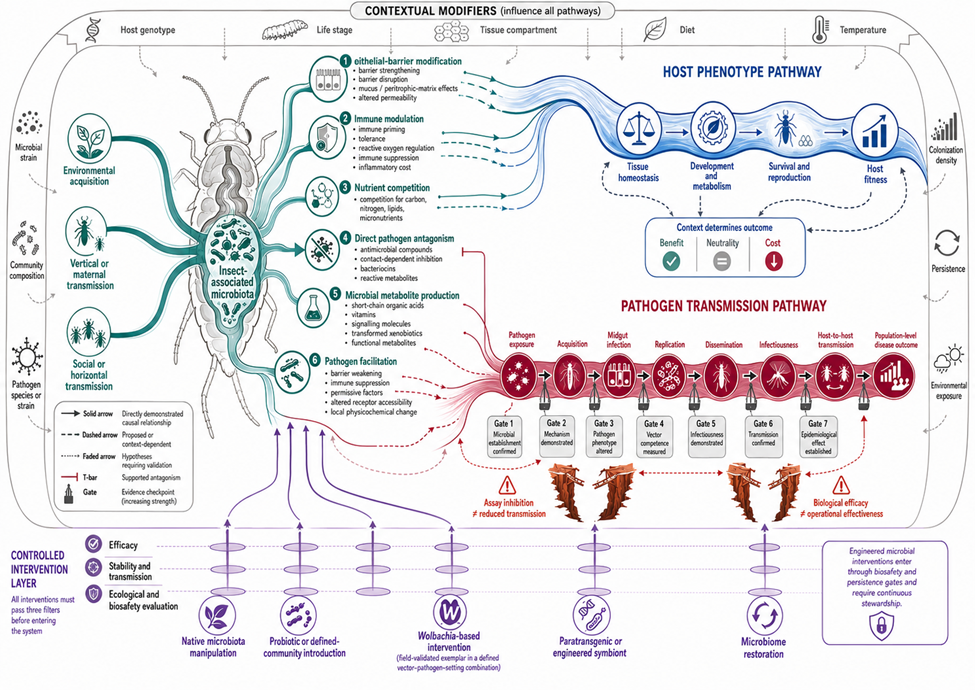
Figure 2 maps the causal pathways through which microbiota can alter host and pathogen phenotypes while showing the evidentiary transitions required to move from microbial interaction to reduced transmission.
|
|
|
Figure 2. From microbial interaction to transmission outcome: causal pathways, evidence gates, and intervention boundaries |
The evidence dimensions and interpretive boundaries for microbial effects on pathogen acquisition and transmission are summarized in Table 3.
Table 3. Microbial Effects on Pathogen Acquisition and Transmission: Host Context, Microbial Functions, Causal Evidence, Community Stability, Ecological Risk, and Interpretive Boundaries
|
Microbial component or intervention |
Host context |
Proposed function |
Evidence required |
Causal test |
Stability or transmission issue |
Ecological risk |
Interpretive boundary |
|
Native mosquito commensal |
Adult mosquito midgut |
Alter epithelial barrier and increase viral acquisition |
Defined colonization, localization, barrier assay, and viral challenge |
Remove and restore the candidate bacterium or its active factor |
Persistence may vary among populations |
Enhanced vector competence |
Increased infection is not automatically increased human transmission |
|
Native community affecting Plasmodium |
Anopheles midgut |
Immune stimulation, competition, or direct antagonism |
Community-resolved manipulation and parasite-stage measurements |
Defined-community or isolate restoration |
Community changes across life stage and environment |
Unintended facilitation of parasite development |
Reduced oocyst burden is not proof of reduced infectiousness |
|
Engineered or introduced microbe |
Mosquito vector |
Deliver antipathogen activity |
Stable colonization, effector expression, fitness, and transmission data |
Engineered strain compared with matched control |
Horizontal or vertical spread must be quantified |
Environmental dissemination and evolutionary instability |
Laboratory pathogen inhibition is not operational effectiveness |
|
Wolbachia population replacement |
Urban Aedes aegypti |
Reduce dengue transmission |
Stable establishment and epidemiological outcomes |
Cluster-level intervention comparison |
Maternal transmission and population coverage are essential |
Ecological and implementation context must be monitored |
Evidence applies to the tested strain, vector, and setting |
Integrative synthesis across insect functional systems
Across functional domains, the strongest studies share a common structure: they define the microbial component, localize it, characterize persistence, manipulate its presence or activity, and connect that manipulation to a specific host or pathogen phenotype. Reliable comparison additionally requires appropriate metadata, controls, compositional analysis, and independent validation across molecular and ecological data layers [27].
Methodological vulnerability is greatest in low-biomass tissues, where reagent contaminants can resemble rare symbionts or pathogens [28]. Technical variation in extraction, primer selection, sequencing, and bioinformatics can also produce apparent disagreement among studies [29]. Such effects are particularly consequential when taxonomic shifts are used to infer metabolism, immune function, or pathogen interference without direct functional measurements.
Conceptual consistency is equally important. The microbiota denotes the organisms present, whereas the microbiome may encompass those organisms, their genes, products, activities, and surrounding habitat [30]. Treating these constructs as interchangeable obscures the difference between taxonomic abundance, functional potential, active metabolism, and host-level consequence.
Simple insect models allow defined-community reconstruction and genetic testing, but experimental tractability is achieved by reducing ecological complexity [31]. The most defensible synthesis is therefore conditional: microorganisms can materially influence insect nutrition, development, immunity, chemical tolerance, and pathogen transmission, but no universal microbiome architecture or mechanism applies across insects.
The convergent findings, context-dependent results, methodological limitations, and remaining uncertainties are synthesized in Table 4.
Table 4. Integrative Synthesis across Insect Functional Systems: Convergent Findings, Context Dependence, Methodological Limitations, Evidence Confidence, and Residual Uncertainty
|
Evidence domain |
Convergent finding |
Contradictory or context-dependent finding |
Study-design basis |
Main methodological limitation |
Strength of inference |
Residual uncertainty |
Implication |
Representative supporting reference(s) |
|
Holobiont organization |
Some insects maintain persistent, functionally testable associations |
Other insects contain sparse or transient communities |
Comparative ecology and defined models |
Residency often inferred from detection |
Moderate |
Minimum criteria for functional-unit status |
Require localization, persistence, activity, and consequence |
[5] |
|
Nutrition and development |
Defined microbes alter metabolism and growth |
Direction depends on diet, strain, host genotype, and life stage |
Gnotobiotic and defined-diet experiments |
Simplified laboratory diets |
Strong in model systems |
Transfer to natural populations |
Test natural diets and mixed communities |
[11] |
|
Immunity |
Host pathways shape microbes and microbes alter immune tone |
Activation may indicate protection, stress, or pathology |
Host-genetic and colonization studies |
Proxy immune endpoints |
Moderate to strong |
Pathogen-specific protection |
Add restoration and challenge experiments |
[18] |
|
Xenobiotic metabolism |
Specific symbionts transform specific compounds |
Metabolism may detoxify or activate toxicity |
Chemical tracing and isolate studies |
Limited compound and taxon coverage |
Strong in selected systems |
Field prevalence and durability |
Quantify products and relative host contribution |
[21] |
|
Pathogen transmission |
Microbial interventions can change vector competence |
Most evidence remains below epidemiological scale |
Laboratory challenge and field intervention |
Non-equivalent infection endpoints |
Strong only in selected settings |
Generalizability and persistence |
Require transmission and population-level outcomes |
[27] |
|
Cross-system inference |
Causal reconstruction improves functional interpretation |
Methods and ecological contexts remain heterogeneous |
Multi-omics, perturbation, and synthesis |
Contamination and technical variability |
Moderate |
Standardized evidence hierarchy |
Separate composition, potential, activity, and consequence |
[28] |
Knowledge gaps and experimental priorities
Engineered symbionts extend functional microbiome research from observation to deliberate intervention. Engineered Snodgrassella alvi can colonize honey bees, express RNA-interference effectors, stimulate host defenses, and suppress viral or parasitic targets under experimental conditions [32]. Such studies establish feasibility, not readiness. Genetic stability, fitness effects, microbial competition, transmission, reversibility, and environmental escape require separate investigation.
Paratransgenic strategies face the same translational boundary. Candidate symbionts must be culturable, genetically tractable, sufficiently persistent, capable of producing an effective molecule, and compatible with the host and surrounding microbial community [33]. An engineered bee symbiont has also been shown to inhibit a microsporidian parasite and improve host survival, while transmission to cohoused bees illustrates both delivery potential and containment risk [34]. Future experiments should therefore integrate efficacy and biosafety rather than treating them as sequential concerns.
The highest priorities are strain-resolved longitudinal studies, defined-community restoration, chemically explicit metabolite tracing, standardized pathogen-transmission endpoints, and validation across natural diets, environmental variability, host genotypes, and microbial backgrounds. For engineered systems, these requirements should be supplemented by genetic safeguards, monitoring of horizontal transfer, evolutionary-stability testing, ecological exposure assessment, and reversible governance procedures [35]. Progress should be measured by improved causal discrimination and ecological validity, not by increasing descriptive complexity alone.
CONCLUSION
Functional insect holobiont biology is best understood as a conditional relationship among a specified host, microbial partner or community, environmental context, biological activity, and measurable consequence. The reviewed evidence supports causal microbial contributions in selected systems, particularly when defined colonization, restoration, host or microbial genetics, chemical tracing, and field-level outcomes are available. It also shows why taxonomic detection, pathway prediction, immune activation, xenobiotic transformation, and pathogen inhibition must not be treated as equivalent to function, benefit, resistance, or reduced transmission. The central priority is therefore an evidence hierarchy that joins mechanistic precision with ecological realism and proportionate biosafety evaluation.
ACKNOWLEDGMENTS: None
CONFLICT OF INTEREST: None
FINANCIAL SUPPORT: None
ETHICS STATEMENT: None