Entomology and
Applied Science Letters
Applied Science Letters
 2025
Volume 12
Issue 3
2025
Volume 12
Issue 3

Managed honey-bee health is commonly assessed through worker pathology, parasite counts, brood measures, food stores, behaviour, or sensor outputs considered separately. Yet the biologically relevant unit that survives, reproduces, regulates its internal environment, and absorbs disturbance is the colony. This article develops an evidence-grounded colony-as-patient synthesis that treats individual-bee observations as nested signals within a time-dependent superorganismal state. The approach integrates social immunity and collective defence, nutrition and energetic regulation, thermoregulation and behavioural homeostasis, pathogen pressure, resilience, and colony-level monitoring. The strongest defensible synthesis is that colony health cannot be inferred from a favourable value in any single domain: colonies may compensate for impaired workers, preserve brood temperature while consuming reserves, maintain activity while task organization deteriorates, or display defence behaviour during intensifying challenge. Conversely, an abnormal worker or sensor signal may precede dysfunction without establishing colony-level disease. The proposed model therefore distinguishes stress exposure, compensatory response, reserve depletion, recovery capacity, and systemic breakdown, and requires interpretation through repeated, cross-domain observations. Its principal limitations are the uneven transferability of field studies, the scale gap between worker experiments and colony outcomes, limited prospective validation of early-warning indicators, and uncertain causal direction among interacting stressors. The central implication is methodological rather than diagnostic: colony monitoring should be designed around trajectories, contextual normalization, signal concordance, and inspection-based corroboration. The colony-as-patient model is an original conceptual organization of existing evidence, not a clinically validated diagnostic system, and its value depends on future longitudinal testing against clearly defined colony outcomes.
INTRODUCTION
A honey-bee colony is simultaneously a reproductive unit, a distributed workforce, a thermoregulatory system, a nutritional economy, and a host environment for parasites and pathogens. These functions are produced by interactions among workers, brood, queen, stored resources, nest structure, microbial and pathogen communities, and the surrounding landscape. Colony losses arise from interacting, context-dependent stressor networks in which Varroa-pathogen dynamics are prominent but not singular [1-3]. A health concept centred only on diseased workers or one dominant stressor therefore underrepresents the scale at which persistence, recovery, and failure occur.
The decision problem is not simply to detect abnormality, but to determine whether a colony is maintaining function, compensating at increasing cost, recovering after disturbance, or moving toward systemic breakdown. A worker may show infection, altered metabolism, or behavioural impairment while the colony temporarily buffers that deficit through task redistribution, brood adjustment, reserve use, or recruitment. The reverse is also possible: sampled workers may appear physiologically adequate while the colony is losing brood, stores, demographic balance, or social organization. Individual-bee pathology is therefore not equivalent to colony-level disease, and colony compensation is not equivalent to absence of stress.
Current monitoring practices also create an interpretive asymmetry. Molecular assays, hygienic-behaviour tests, parasite measurements, hive temperature, weight, acoustics, entrance activity, and visual inspection each capture a biologically meaningful slice of colony state, but they differ in scale, specificity, timing, and susceptibility to context. A stable temperature may reflect effective regulation or costly thermal work; high defensive activity may indicate strong capacity or intense challenge; low foraging may reflect disease, weather, forage scarcity, treatment, or normal seasonality. Treating any one indicator as a diagnosis risks confusing an observable output with the hidden system processes that produced it.
This article develops a colony-as-patient model as an original, explicitly non-validated scholarly synthesis. Its aim is to organize evidence across social immunity, collective defence, nutrition, energetic regulation, thermoregulation, behaviour, pathogens, resilience, and digital phenotyping into a common interpretive logic. The central argument is that colony health should be represented as a time-dependent relation among functional state, stress load, compensatory capacity, reserves, and recovery, assessed through concordant observations at multiple biological scales. This framing does not convert beekeeping into clinical medicine, assign universal thresholds, or claim validated prognosis. It provides a bounded structure for asking which signals belong together, which non-equivalences must be preserved, and what evidence is required before monitoring outputs can support management decisions.
Why individual-bee measures are not enough
Worker-level measures remain indispensable because nutrition, infection, toxic exposure, immune activity, and task performance are expressed through individual organisms. Their diagnostic meaning, however, depends on the colony and environment in which those workers are embedded. Landscape-linked worker physiology becomes diagnostically meaningful only when interpreted alongside colony performance, forage context and season [4]. The relevant question is not whether a biomarker differs, but whether that difference is concordant with changes in brood, adult population, stores, productivity, pathogen pressure, behaviour, or subsequent recovery. Without this linkage, worker variation may reflect age, task, diet, sampling location, or transient exposure rather than a colony-health transition.
Whole-colony evidence can also overturn expectations formed from isolated practices or single measurements. Longitudinal colony outcomes can diverge from expectations based on isolated practices, showing why health assessment must integrate survival, productivity, brood and parasite trajectories [5]. This does not imply that every domain carries equal information at every time. Rather, different measures answer different questions: a parasite count characterizes one pressure; brood pattern reflects reproductive and care processes; stores indicate accumulated resources; and population trajectory reflects the net result of birth, maturation, mortality, and movement. Their interpretation becomes stronger when they change coherently and weaker when a single value is detached from season, management history, or baseline.
Worker lipidomic profiles can register nutritional perturbation, but their colony-level meaning remains conditional on feeding context, sampling design and concurrent colony performance [6]. Likewise, simulation results identify brood trajectories as plausible early-warning signals, but the signal remains model-based rather than a prospectively validated prognosis [7]. These examples define the proper role of individual and component measures: they can identify mechanisms, generate warnings, or direct inspection, but they do not independently establish systemic disease. The colony should be the primary unit of health interpretation, with worker measures retained as nested evidence and compensation assessed through repeated observations of function and reserve. The evidence dimensions and interpretive boundaries for individual-bee measures are not enough are summarized in Table 1.
Table 1. Why Individual-Bee Measures Are Not Enough: Colony-Level Pathways, Diagnostic Signals, Resilience Outcomes, Management Relevance, Validation Needs, and Interpretive Boundaries
|
Colony-health component |
Signal, stressor, or resource |
Biological pathway |
Indicator or evidence |
Colony-level implication |
Management relevance |
Uncertainty |
Interpretive boundary |
|
Landscape-linked nutritional physiology |
Forage access and landscape resource context |
Resource availability shapes worker physiology and colony performance over time |
Worker physiological markers interpreted with colony productivity and seasonal context |
Concordant worker and colony responses may indicate resource-mediated health effects |
Evaluate forage context before acting on worker biomarkers |
Residual landscape and management confounding; regional transferability |
A favourable worker biomarker is not equivalent to robust colony function |
|
Integrated colony trajectory |
Management package, parasites, brood, survival, and productivity |
Multiple practices jointly alter colony performance across seasons |
Longitudinal survival, brood, parasite, population, and production measures |
Whole-colony outcomes may differ from expectations based on one practice or input |
Compare management systems through multiple repeated colony outcomes |
Climate, treatment regimen, and local management constrain generalization |
One management input or isolated measure is not equivalent to colony health |
|
Worker molecular nutritional signal |
Limited supplementary feeding and lipid metabolism |
Feeding context alters worker lipid profiles nested within colony condition |
Lipidomic patterns paired with feeding regime and colony-health measures |
Molecular change may reveal nutritional perturbation but not its systemic consequence |
Use molecular profiles for hypothesis generation and targeted follow-up |
Cohort, season, assay, and feeding protocol may alter signatures |
A molecular signature is not a validated colony diagnosis |
|
Brood-based early warning |
Brood deficit and delayed demographic propagation |
Reduced brood production can precede adult-population decline |
Modelled brood and adult population trajectories |
Brood change may provide lead time before simulated colony loss |
Prioritize brood trends for inspection and prospective validation |
Dependence on model assumptions, parameterization, and seasonal scenarios |
A simulated warning is not a prospectively validated prognosis |
Social immunity and collective defence
Social immunity is not a single trait but a distributed set of behaviours and organizational processes through which colony members detect, remove, avoid, or contain biological threats. Hygienic assays are useful because they make one component observable, yet categorical labels can conceal broader response capacity. The capacity to remove compromised open brood is not confined to colonies labeled hygienic, so a single assay cannot represent the full collective-defence phenotype [8]. Removal under an experimental cue may demonstrate responsiveness without establishing equivalent control of naturally infected brood, reduced pathogen transmission, or improved colony survival.
Collective defence also depends on where capable workers are positioned within the social system. Allogroomers combined elevated immunocompetence with network centrality, linking individual capacity to collective defence without demonstrating that either measure alone predicts colony protection [9]. This convergence supports a mechanistic proposition: defence may depend on the interaction between worker competence, task participation, and contact structure. However, centrality may arise because particular workers encounter more nestmates or parasites, and elevated immune measures may reflect exposure rather than protective causation. Individual immunocompetence is therefore not equivalent to social immunity, and network centrality is not equivalent to effective suppression.
Pathogens may impair the behaviours on which colony defence and maintenance depend before overt colony failure becomes visible. Viral infection can alter brood-care behavior before a colony-level outcome is established, illustrating both the value and the scale limitation of behavioral phenotypes [10]. Hygienic workers can occupy distinctive positions in colony social networks, indicating that collective defence depends on task organization as well as individual response capacity [11]. Together, these findings justify treating behavioural organization as a colony-health domain, but not as a self-sufficient diagnosis. High defence activity may indicate strong capacity, elevated challenge, or both; reduced activity may reflect infection, demographic change, nutritional limitation, or altered task demand. The clinically relevant analogue is therefore defence capacity relative to challenge intensity, energetic reserve, and downstream brood or pathogen outcomes, not the presence of a favourable worker phenotype alone.
Nutrition and energetic regulation
Colony nutrition is a dynamic balance among resource supply, nutrient quality, stored reserves, current demand, and allocation to brood production, maintenance, defence, and environmental regulation. Nutrition and disease interact bidirectionally, and experimental diet-virus evidence shows that outcomes depend on diet quality and infection context [12-14]. Nutritional limitation can modify immunity, infection tolerance, worker performance, brood development, and mortality, while infection can alter feeding, metabolism, behaviour, and resource demand. Because these directions can reinforce one another, reduced stores or altered worker physiology may be a cause, consequence, or amplifier of disease rather than an isolated nutritional diagnosis.
Energetic regulation concerns how the colony deploys finite resources while preserving essential outputs. Under stress, a colony may reduce brood investment, change worker allocation, consume carbohydrate or pollen reserves, or maintain core functions at the expense of future flexibility. Temporary maintenance of activity or brood does not show that reserves are adequate; it may represent compensation that narrows the capacity to respond to the next disturbance. Nutritional assessment should therefore pair supply and stores with demand-sensitive measures such as brood burden, workforce activity, thermal work, pathogen pressure, and recent weather. High food quantity at one observation may coexist with limited diversity, poor accessibility, inappropriate nutrient balance, or a rapidly increasing energetic load.
Landscape structure determines whether resource sufficiency persists through time. Native habitat can buffer seasonal feast-famine conditions, emphasizing that colony nutrition is a temporal resource-continuity problem rather than a single forage measurement [15]. This finding is management-relevant without establishing a universal landscape prescription, because crop phenology, climate, floral composition, colony density, and supplementation can alter the relation. Within a colony-as-patient logic, nutrition should therefore function as an interacting system domain rather than a dominant standalone score. Evidence of inadequate nutrition should modify interpretation of immunity, behaviour, thermoregulation, and pathogen response, while evidence of apparently adequate stores should not erase signs of declining function or reserve. The key diagnostic target is the trajectory of resource balance and compensatory burden, not a snapshot of forage abundance or stored food.
Thermoregulation, behaviour, and colony homeostasis
Thermoregulation is an emergent colony function produced through clustering, metabolic heat generation, fanning, evaporative cooling, water collection, movement within the nest, and adjustment of brood distribution. Brood-nest temperature is an actively regulated colony output, so apparent thermal stability may reflect successful but energetically costly compensation rather than absence of stress [16]. A stable sensor trace can therefore have two contrasting meanings: adequate regulation supported by sufficient workers and resources, or intensified regulatory effort that preserves brood conditions while consuming reserves. Interpretation requires external temperature, brood status, colony size, food availability, and the duration of regulatory demand.
Chronic thermal challenge may alter both physical nest organization and resource allocation. Chronic heat reorganized brood-comb structure and reduced carbohydrate stores, demonstrating that homeostatic compensation can preserve a regulated state while depleting resilience reserves [17]. Behavioural homeostasis is similarly dependent on flexible task allocation rather than the maintenance of a fixed activity level. Chronic stress can reorganize division of labour while reducing social resilience, showing that continued activity may coexist with declining capacity to absorb further disturbance [18]. Increased fanning, water collection, or task switching may be adaptive responses, but prolonged reorganization can also reduce brood care, foraging efficiency, defence, or the availability of workers for future challenges.
Temperature is consequently informative because it records the outcome of interacting brood, workforce, weather, resource, and behavioural processes. Continuous temperature trajectories can reveal brood status and predict overwintering mortality, but their interpretation remains dependent on climate, sensor placement and colony state [19]. Temperature should therefore be treated as a contextualized trajectory rather than a universal health score. An anomaly may indicate brood change, declining population, inadequate insulation, altered clustering, sensor displacement, or normal seasonal transition. Colony homeostasis is better inferred from whether temperature, activity, brood, and resource signals remain coordinated and recover after disturbance. A single thermal indicator is not equivalent to systemic diagnosis, and maintained thermal output is not proof that compensatory capacity remains intact.
Pathogen pressure and systemic breakdown
Pathogen pressure is generated not only by the presence of infectious agents but also by parasite-mediated injury, transmission, virulence, host condition, co-infection, and interacting chemical or nutritional stress. Varroa causes direct tissue damage, reshapes deformed wing virus epidemiology, and can interact with insecticide exposure to amplify harm [20-22]. These mechanisms operate across scales: feeding damage occurs in individual bees, viral dynamics propagate through hosts and colonies, and combined exposures may increase consequences beyond those expected from either stressor alone. Nevertheless, neither mite presence, viral genotype, nor experimental synergism independently defines colony-level disease or a universal threshold for collapse.
Systemic breakdown becomes a colony-level construct when interacting pressures are accompanied by persistent deterioration in coordinated function. Pathogen-web dynamics covary with productivity, health and social-immunity behaviors, making systemic breakdown a network and trajectory problem rather than a single-pathogen state [23]. Such covariation can reveal biologically meaningful connections, but it does not by itself establish causal direction. High pathogen burden may impair defence and productivity, declining nutrition may increase susceptibility, or a shared environmental disturbance may simultaneously alter pathogens, behaviour, and resources. Temporal ordering, repeated measurements, and response to targeted intervention are needed to discriminate among these explanations.
Within the colony-as-patient perspective, pathogen detection should therefore be separated from pathogen pressure, host response, and functional consequence. A colony may tolerate or compensate for infection while maintaining brood and activity, whereas another may deteriorate at a lower measured burden because nutritional, demographic, or thermal reserves are already constrained. Conversely, intense hygienic or grooming activity may represent effective defence or increased challenge. Systemic breakdown should be provisionally recognized through concordant and persistent deterioration across domains, failure to recover after a relevant observation interval, or escalating compensatory cost. Pathogen presence is not equivalent to colony-level disease, and low detected burden is not proof of systemic health.
Proposed colony-as-patient model
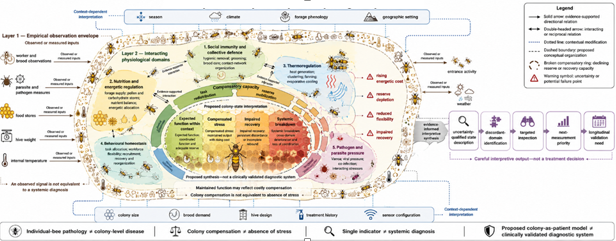
The proposed model defines the colony as a layered physiological system in which social defence, nutritional and energetic regulation, thermoregulation, behavioural organization, and pathogen pressure interact through time. Social resilience is best treated as a time-dependent colony capacity to absorb disturbance, reorganize and recover, rather than as a favorable value on one health indicator [24]. Empirical inputs occupy the lower layer of the model: worker and brood observations, food stores, pathogen and parasite measures, temperature, activity, weather, management history, and landscape context. These inputs inform interacting functional domains, which in turn contribute to a temporal colony-state interpretation. The resulting state is not an average of worker measurements but a bounded judgment about function, compensatory burden, reserve direction, and recovery capacity.
Figure 1 presents the honey bee colony as a layered physiological system within the analytical logic developed in this section.
|
|
|
Figure 1. The honey bee colony as a layered physiological system |
Alt text
A structured conceptual diagram that presents the honey bee colony as a layered physiological system, with labelled components, directional relations, contextual modifiers, uncertainty points, and a clear boundary between observed evidence and proposed synthesis.
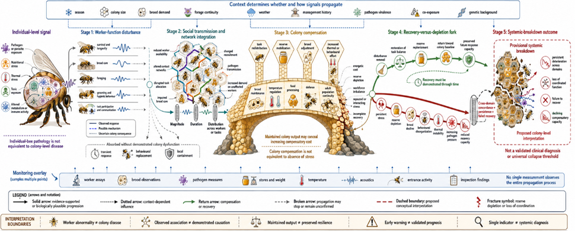
The model also represents stress propagation as a sequence rather than an automatic conversion from worker abnormality to colony disease. Individual exposure or pathology may alter metabolism, survival, brood care, foraging, grooming, or task participation. The colony may then redistribute work, alter brood investment, increase thermal effort, or consume reserves to preserve essential outputs. Experimental manipulation of nest architecture shows that resilience can be observed as a recovery process, although recovery in one domain cannot be assumed to represent whole-colony health [25]. Propagation toward dysfunction is therefore conditional on the magnitude and duration of disturbance, workforce composition, resource continuity, defence capacity, and whether compensation restores function or progressively depletes reserve.
The proposed architecture distinguishes four provisional states: expected function within context, compensated stress, impaired recovery, and systemic breakdown. Infection models indicate how social immunity could modify colony-level transmission trajectories, but modeled relations must remain hypotheses until parameterized and validated against longitudinal colonies [26]. Multimodal fusion of in-hive sensors, weather and inspections can forecast colony status, supporting the architecture of the proposed model while not establishing a universally transferable diagnosis [27]. Inputs must therefore undergo data-quality assessment and normalization to colony baseline, season, weather, hive configuration, and management history. Outputs should be limited to an uncertainty-qualified state description, identification of discordant domains, and prioritization of the next inspection or measurement.
Decision points arise when signals persist, converge across domains, or fail to return toward baseline after a relevant disturbance. Failure modes include false reassurance when stable outputs conceal reserve depletion, false alarms caused by weather or normal seasonality, over-aggregation that hides brood or worker subpopulation effects, and automation bias when forecasts are treated as diagnoses. Validation must test construct reproducibility, temporal lead time, discrimination between seasonal change and pathological transition, transferability across regions and hive designs, and whether model-guided inspection improves decisions without causing unnecessary intervention. The colony-as-patient model remains a proposed synthesis rather than a clinically validated diagnostic system. The proposed components, evidence bases, boundary conditions, failure modes, and validation requirements are organized in Table 2.
Table 2. Proposed Colony-as-Patient Model: Components, Evidence Basis, Relations, Boundary Conditions, Failure Modes, and Validation Requirements
|
Proposed component |
Purpose |
Evidence basis |
Relation or mechanism |
Input or precondition |
Expected output |
Boundary condition or failure mode |
Validation requirement |
|
Colony-as-patient unit |
Correct scale mismatch between worker findings and colony function |
Colony-level social-resilience synthesis |
Emergent colony capacity is interpreted through function, reserve, and recovery |
Defined colony identity, season, and management history |
Contextualized colony-state description |
Aggregation may conceal important worker or brood heterogeneity |
Reproducibility and construct validation across colonies |
|
Social-immunity domain |
Integrate distributed defence rather than isolated assays |
Colony infection modelling |
Collective behaviours may modify transmission and exposure |
Pathogen challenge, workforce composition, and behavioural observations |
Defence-capacity interpretation |
Modelled relations may not reproduce field dynamics |
Prospective linkage to pathogen reduction and colony outcomes |
|
Collective-defence domain |
Prevent overinterpretation of a favourable behavioural trait |
Social-resilience and infection evidence |
Removal, grooming, and care interact with challenge and resources |
Relevant brood cues, workforce, and resource availability |
Contextualized defence phenotype |
High activity may indicate intense challenge rather than effective control |
Field-challenge and cross-assay validation |
|
Nutrition and reserve domain |
Replace static food-store interpretation with temporal resource balance |
Multimodal colony-status evidence |
Supply, quality, continuity, demand, and allocation shape reserve |
Stores, forage context, brood demand, and weather |
Resource and reserve trajectory |
High quantity may coexist with poor quality or limited accessibility |
Region- and season-specific calibration |
|
Energetic-regulation domain |
Identify hidden cost during maintained performance |
Social-resilience evidence |
Resource allocation buffers disturbance until compensatory capacity declines |
Demand-sensitive function and reserve observations |
Compensatory-burden interpretation |
Stable output may conceal depletion |
Validation against recovery after disturbance |
|
Thermoregulation domain |
Contextualize temperature as a regulated output |
Multimodal sensor and inspection evidence |
Temperature reflects brood, weather, workforce, resources, and behaviour |
Calibrated internal and external temperature with brood context |
Thermal-state trajectory and anomaly confidence |
Sensor placement or weather may create false alerts |
External validation across climates and hive designs |
|
Behavioural-homeostasis domain |
Distinguish activity volume from adaptive organization |
Experimental recovery evidence |
Task flexibility and reorganization influence response and recovery |
Repeated activity or behavioural observations |
Coordination and recovery indicators |
Normal seasonal reorganization may resemble dysfunction |
Link behavioural trajectories to adjudicated outcomes |
|
Pathogen-pressure domain |
Separate detection from realized disease |
Colony infection modelling |
Burden, transmission, virulence, and host response jointly shape risk |
Standardized parasite and pathogen sampling |
Contextualized pathogen-pressure profile |
Detection alone does not establish functional consequence |
Longitudinal dose-response and intervention testing |
|
Systemic-breakdown state |
Define transition from compensation to decompensation |
Social-resilience synthesis |
Persistent cross-domain deterioration and failed recovery indicate loss of coordination |
Comparable baseline and sufficient observation interval |
Bounded decompensation classification |
Seasonal contraction may be misclassified as breakdown |
Prospective validation using pre-specified outcomes |
|
Colony-level monitoring layer |
Convert disconnected signals into inspectable evidence |
Sensor, weather, and inspection data fusion |
Quality-controlled multimodal trajectories support triage |
Calibrated sensors, weather, inspections, and assays |
Uncertainty-qualified risk tier and next observation |
Forecasting may encourage automation bias or domain drift |
Prospective external and decision-impact validation |
Figure 2 shows how stress signals propagate from individual bees to colony-level dysfunction within the analytical logic developed in this section.
|
|
|
Figure 2. How stress signals propagate from individual bees to colony-level dysfunction |
Alt text
A structured conceptual diagram that shows how stress signals propagate from individual bees to colony-level dysfunction, with labelled components, directional relations, contextual modifiers, uncertainty points, and a clear boundary between observed evidence and proposed synthesis.
Monitoring and management implications
Colony-level monitoring should be organized around biological questions rather than the accumulation of devices. Smart hive systems can collect multiple continuous signals, but measurement precision alone does not establish the biological meaning of an alert [28]. Weight, temperature, humidity, acoustics, entrance traffic, weather, inspections, and pathogen assays describe different parts of the colony system and operate at different temporal resolutions. Their value depends on calibration, missing-data checks, colony-specific baselines, seasonal normalization, and explicit uncertainty. Monitoring should identify change, persistence, concordance, and recovery rather than convert one deviation into a categorical diagnosis.
Specific technologies should retain correspondingly specific interpretations. Computer vision can estimate Varroa infestation as a specific surveillance domain, but it cannot represent nutritional, thermal or behavioral resilience by itself [29]. Foraging-flight metrics can contribute short-interval health indicators, provided weather, season, treatment and population context are incorporated [30]. These tools can prioritize inspection, reveal trends between visits, and reduce reliance on isolated snapshots. They cannot determine by themselves whether altered activity reflects infection, forage shortage, temperature, pesticide exposure, demographic change, robbing, treatment, or ordinary phenology. Progress requires biological construct validation in which digital features are compared with direct measures of the process they are intended to represent.
Temporal forecasting should support staged and reversible decisions. Temporal convolutional models can generate early warnings of population loss, but warnings should trigger inspection and corroboration rather than automatic diagnosis or treatment [31]. A defensible workflow would move from observation, to targeted inspection, to management response, followed by post-action reassessment. Research priorities are prospective external validation, cross-device calibration, transparent handling of missingness and model drift, pre-specified colony outcomes, and tests of whether additional lead time improves management. Governance priorities include human review, traceable data processing, uncertainty communication, and safeguards against autonomous treatment recommendations. Evidence of progress would include reliable performance across independent apiaries and seasons, discrimination between normal transitions and harmful decline, and demonstrable improvement in decisions without unnecessary colony disturbance.
CONCLUSION
Treating the honey bee colony as the patient shifts health interpretation from isolated worker abnormalities and disconnected hive measurements toward the coordinated state of a living superorganism. The strongest defensible synthesis is that colony health is expressed through interactions among social defence, nutrition, energetic reserve, thermal regulation, behavioural organization, pathogen pressure, and recovery through time. Individual-bee pathology can reveal exposure or mechanism but is not equivalent to colony-level disease. Maintained brood, temperature, or activity may reflect compensation rather than absence of stress, and no single biomarker, assay, sensor, or forecast establishes systemic diagnosis. The proposed model therefore separates biological inputs, functional domains, compensatory burden, recovery, and breakdown while requiring contextualized trajectories and corroborating evidence. Its principal limitation is that the integrated state structure and decision logic have not been prospectively validated. The highest priority is longitudinal testing across climates, management systems, and colony histories using independently defined outcomes and transparent uncertainty. Until such evidence exists, the colony-as-patient model should guide disciplined observation, hypothesis formation, and targeted inspection rather than be treated as a clinical or deployment-ready diagnostic system.
ACKNOWLEDGMENTS: None
CONFLICT OF INTEREST: None
FINANCIAL SUPPORT: None
ETHICS STATEMENT: None