Entomology and
Applied Science Letters
Applied Science Letters
 2025
Volume 12
Issue 2
2025
Volume 12
Issue 2

An infectious vector bite is the endpoint of a longer process in which biological readiness, behaviour, environmental opportunity, and human accessibility must converge. Research and control frequently represent transmission risk through isolated indicators such as vector abundance, climatic suitability, host-seeking activity, or laboratory competence. These indicators describe different constructs and cannot independently establish that infectious contact has occurred. This theory article develops a multiscale conceptual synthesis of the determinants operating before an infectious bite. It integrates pathogen development within the vector, temperature-sensitive vector traits, physiological motivation, sensory host detection, feeding progression, local microclimate, human–vector overlap, and personal protection. The evidence indicates that these determinants function as conditional filters: each may enable, constrain, redirect, or terminate progression toward pathogen inoculation. Temperature can affect vector survival, activity, pathogen development, and transmission-related traits, but suitability is bounded and system-specific. Host cues can activate orientation and attraction, but sensory response does not establish landing, probing, blood acquisition, or infectious delivery. Microclimate can create localized opportunities for vector activity, yet opportunity becomes exposure only when infectious vectors and accessible humans coincide. The synthesis is limited by differences among vector–pathogen systems, experimental designs, environmental scales, behavioural measurements, and definitions of contact. The central implication is that transmission research should link measurements across scales rather than substitute one proxy for the complete pre-bite process. The proposed structure offers a basis for hypothesis development, measurement design, and intervention mapping, but it remains a non-validated conceptual pathway rather than a predictive transmission model.
INTRODUCTION
Vector-borne transmission is commonly represented as an interaction among a pathogen, a vector, and a susceptible host. Although biologically necessary, this representation compresses the sequence through which these components must become connected. Environmental change can alter vector ranges, seasonal activity, pathogen-development conditions, and opportunities for human exposure [1]. Vector occurrence, however, does not demonstrate pathogen readiness, and environmental suitability does not establish that an infectious vector has contacted and fed on an accessible person.
This distinction has practical consequences because interventions act at different points before transmission. Habitat modification can affect vector production, repellents can interfere with host approach, housing can restrict entry, insecticides can alter survival during searching or feeding, and pathogen-blocking approaches can reduce infectiousness. Basic vector biology therefore contributes to control by identifying the specific processes on which interventions depend [2]. An effect on one process should not automatically be interpreted as equivalent to prevention of the complete infectious-bite event.
Temperature illustrates the difficulty of relying on isolated proxies. It can affect vector development, survival, biting-related traits, pathogen incubation, and competence, but these traits do not respond identically or peak under the same conditions [3]. Climatic suitability is consequently a composite and conditional construct. It may identify an environment in which parts of the transmission process are possible while leaving human availability, vector motivation, feeding completion, and pathogen delivery unmeasured.
This article develops a multiscale theory of what occurs before an infectious bite. Its central argument is that transmission opportunity emerges through a sequence of conditional filters operating across molecular, organismal, household, and landscape scales. The article distinguishes pathogen readiness from realized exposure, host-seeking activation from completed feeding, and microclimatic opportunity from contact. The proposed synthesis is intended to organize evidence and generate testable questions; it is not presented as a validated transmission model or a universal causal sequence.
The infectious bite as the endpoint of a longer process
An infectious bite requires more than the presence of a vector under broadly suitable environmental conditions. Temperature-dependent changes in mosquito survival, feeding-related traits, parasite development, and transmission potential can alter the probability that a vector reaches an infectious state [4]. These traits represent distinct parts of the pathway. A temperature that accelerates pathogen development may also reduce vector longevity, while conditions favouring survival may not maximize feeding activity or pathogen replication. The terminal event therefore depends on the combined consequences of multiple traits rather than on any single thermal response.
Pathogen development within the vector introduces an additional temporal filter. The extrinsic incubation period is often treated as a fixed delay between pathogen acquisition and infectiousness, yet parasite development can vary with temperature and other biological conditions [5]. A vector that acquires a pathogen is not immediately ready to transmit it, and some infected vectors may die before pathogen development is completed. Infection prevalence, incubation estimates, and infectious-bite probability must therefore remain analytically distinct.
Evidence from arbovirus systems similarly shows that transmission-related traits respond nonlinearly to temperature. Empirical and modelling work on Zika virus demonstrated that temperature can influence several components contributing to transmission potential [6]. Comparative analysis across temperate mosquito-borne viruses also identified bounded thermal optima rather than an assumption that progressively warmer conditions continuously increase transmission [7]. These studies establish that environmental conditions can regulate biological readiness, but they do not establish human contact, feeding completion, or pathogen inoculation. The evidence dimensions and interpretive boundaries for infectious bite as the endpoint of a longer process are summarized in Table 1.
Table 1. The Infectious Bite as the Endpoint of a Longer Process: Vector Systems, Biological Mechanisms, Exposure Pathways, Evidence Requirements, Uncertainty, and Interpretive Boundaries
|
Vector or transmission domain |
Environmental or operational driver |
Biological mechanism |
Human-exposure pathway |
Evidence required |
Context dependency |
Uncertainty |
Interpretive boundary |
|
Mosquito survival and activity |
Experienced temperature and temporal variation |
Temperature modifies longevity and transmission-related vector traits |
Longer survival may permit later contact with humans |
Longitudinal survival, activity, infection, and feeding observations |
Vector species, life stage, nutrition, humidity, and thermal regime |
Trait responses may differ in direction and optimum |
Survival opportunity is not evidence of an infectious bite |
|
Parasite development within the vector |
Temperature during the incubation period |
Pathogen development proceeds over a variable extrinsic incubation interval |
Transmission becomes possible only after the pathogen reaches a transmissible state |
Repeated measures of infection, dissemination, and infectiousness |
Parasite genotype, mosquito population, dose, and environmental conditions |
Fixed incubation assumptions may conceal substantial variation |
Pathogen acquisition is not equivalent to pathogen readiness |
|
Zika virus transmission potential |
Temperature-dependent effects across vector and viral traits |
Temperature jointly modifies competence, development, survival, and biting-related parameters |
A biologically ready vector may later create exposure through feeding |
Linked empirical trait measurements and validated transmission observations |
Mosquito population, virus strain, temperature regime, and model structure |
Composite model outputs depend on selected traits and assumptions |
Modelled transmission potential is not realized human exposure |
|
Temperate mosquito-borne viruses |
Environmental temperature |
Multiple transmission traits produce bounded thermal suitability |
Contact becomes consequential only when vector infectiousness and human accessibility coincide |
Virus-specific competence, survival, activity, and contact measurements |
Vector–virus pairing and local seasonal conditions |
Cross-system averages may conceal species-specific responses |
Thermal suitability is not equivalent to contact |
|
Host-seeking and feeding completion |
Human availability, vector motivation, and access to exposed skin |
Orientation, landing, probing, and blood acquisition occur as separable behaviours |
Direct vector–human interaction creates a possible inoculation opportunity |
Behavioural observations linked to vector infection status and human presence |
Vector ecology, host behaviour, time, place, and protection |
Many thermal studies do not measure actual contact or feeding |
Host seeking is not equivalent to a completed infectious bite |
|
Complete infectious-bite pathway |
Combined molecular, organismal, household, and landscape conditions |
Biological readiness must align with successful host contact and inoculation |
Viable pathogen is delivered during a completed feeding interaction |
Integrated measurements across pathogen, vector, environment, and host |
Disease system, spatial scale, intervention setting, and study method |
Missing stages are frequently represented by indirect proxies |
A conceptual pathway is not a validated transmission model |
Vector motivation, host seeking, and feeding behaviour
Host seeking begins with a physiological state that permits or promotes responsiveness to host-associated cues. This state may vary with circadian timing, reproductive condition, nutritional status, previous blood feeding, and experience. Experimental work has shown that Aedes aegypti can learn associations involving host-related odours and subsequently modify its behavioural response [8]. Such plasticity means that host seeking is not produced solely by a fixed attraction programme. Nevertheless, behavioural activation or learned preference remains an intermediate endpoint and does not establish that a vector will locate, land on, or feed from a human.
Sensory orientation depends on the integration of several cue classes. Acidic components of human odour are detected through the IR8a-associated olfactory pathway in Aedes aegypti, and disruption of this pathway reduces attraction to human odour [9]. Neural representations also allow mosquitoes to distinguish features of human scent from those of other animals [10]. These findings establish mechanisms contributing to host recognition, but cue detection is neither necessary nor sufficient evidence of a completed infectious bite in the field. Redundant sensory pathways, visual information, heat, moisture, wind, host density, and competing odour sources may all modify the progression from detection to contact.
Humans also differ in their attractiveness to mosquitoes. Persistent variation in Aedes aegypti attraction has been associated with differences in skin-derived carboxylic acids [11]. This provides a plausible biological basis for heterogeneous encounter rates, but attraction measured in an assay should not be equated with infectious exposure. An attractive person may be protected, unavailable during peak activity, or located where few infectious vectors occur. Conversely, a less attractive individual may experience substantial exposure because of occupation, housing, or repeated unprotected presence. Host-seeking activation is therefore not equivalent to a completed infectious bite, and attraction is only one conditional filter within a longer feeding pathway.
Microclimate and contact opportunity
Vectors respond to environmental conditions at the scale of the places they occupy rather than necessarily to averages recorded by distant meteorological stations. Vegetation, shade, surface materials, water availability, and built structures generate fine-scale differences in temperature and humidity. Field evidence from an urban landscape showed that local microclimatic variation was associated with differences in Aedes albopictus population dynamics and estimated arbovirus-transmission potential [12]. The finding supports the importance of experienced environmental conditions, but estimated potential remains dependent on assumptions about vector infection, feeding, survival, and human accessibility.
Land cover can also redistribute thermal suitability within a city. Tree cover, buildings, and impervious surfaces modify local temperatures and thereby alter conditions relevant to vector abundance and arbovirus transmission [13]. These relationships may change between seasons and among neighbourhoods, meaning that a single urban temperature estimate can conceal biologically important heterogeneity. Yet a suitable microhabitat may contain few accessible humans, while a less favourable site may generate substantial contact because of human congregation, housing permeability, or repeated occupational exposure.
Climate can predict broad geographic and temporal variation in mosquito-borne disease dynamics, but its influence is mediated through specific vector, pathogen, ecological, and social processes [14]. Macroclimatic association should therefore not be treated as a direct observation of local exposure. Establishing contact requires concurrent or defensible evidence concerning vector presence, activity, pathogen readiness, human occupancy, protection, and feeding. Microclimatic opportunity is not equivalent to contact, just as a climate-associated risk pattern is not proof of the mechanism that produced each infection.
Vector immunity and pathogen readiness
A vector does not become transmission-ready merely by acquiring a pathogen. Acquisition initiates a within-vector process in which the pathogen encounters physiological barriers, resident microorganisms, immune responses, tissue environments, and resource constraints. The mosquito microbiota contributes to nutrition, development, immune maturation, and susceptibility to infection, making the vector more appropriately understood as a context-dependent holobiont than as an isolated host organism [15]. Microbial effects may inhibit or facilitate infection depending on the mosquito population, microbial taxon, pathogen, tissue, and environmental conditions. Consequently, detecting a microbial association cannot establish its direction of effect on pathogen readiness, and microbiome composition cannot be interpreted as a universal marker of vector competence.
Mosquito immune function provides another set of conditional filters. Cellular, humoral, tissue-specific, and intracellular responses can affect pathogen establishment, replication, dissemination, and access to the salivary glands [16]. Pathogens may also evade, tolerate, or modify these responses, while immune activation may impose physiological costs that alter survival or feeding behaviour. The relevant transmission construct is therefore not simply whether an immune pathway is activated, but whether the combined vector–pathogen interaction permits viable pathogen development through successive internal barriers. Measurements restricted to transcriptional responses or whole-body pathogen detection may indicate biological activity without demonstrating dissemination, infectious saliva, or subsequent inoculation.
Competence also varies within nominal vector species because genotype and environment interact. Experimental infection of geographically distinct Aedes aegypti populations showed that dengue infection depended on the interaction between mosquito genotype and temperature [17]. This finding challenges the treatment of competence as a fixed species-level constant and indicates that environmental changes may affect vector populations differently. Nevertheless, laboratory infection under defined temperatures does not establish the rate of infectious human contact in natural settings. Pathogen readiness remains only one gate: an infectious vector must still become host-seeking, encounter an accessible person, complete feeding, and deliver a viable inoculum. Vector competence is therefore not equivalent to realized human exposure.
Human availability, protection, and exposure
Human availability is a dynamic property of the encounter environment rather than a fixed population count. People move between indoor and outdoor spaces, change activities through the day, sleep at different times, use protection inconsistently, and differ in occupational or domestic exposure. Human exposure cannot therefore be inferred from indoor and outdoor biting rates alone, because the relevant quantity depends on hourly overlap among vector activity, human location, sleep, and protection [18]. A high biting rate measured where few people are present may generate less exposure than a lower rate occurring where unprotected people congregate. Conversely, household-based measurements may omit exposure associated with travel, work, social activity, or temporary sleeping arrangements.
At a broader scale, residual malaria transmission reflects the temporal and spatial alignment of mosquito feeding with periods during which people remain outside effective protection [19]. The fraction of bites occurring indoors is not identical to the fraction preventable by an indoor intervention, because intervention use, sleeping time, mosquito entry, feeding location, and behavioural heterogeneity all intervene between these quantities. Apparent shifts toward outdoor or early feeding may represent species composition, pre-existing behavioural variation, sampling differences, or responses to intervention pressure. Evidence of biting outside protected periods therefore identifies a potential residual pathway but does not, by itself, establish behavioural adaptation or quantify its epidemiological contribution.
Operational observations confirm the importance of jointly measuring the two sides of the encounter. In Namibia, behaviour-adjusted exposure differed from raw biting rates and varied among sites according to human activity, vector behaviour, species composition, and bed-net use [20]. This illustrates why intervention coverage cannot be interpreted as effective protection without information on use, timing, integrity, vector susceptibility, and exposure occurring beyond the intervention’s reach. Human availability does not cause a bite unless a motivated vector is present and can approach and feed; personal protection does not guarantee elimination when uncovered pathways remain. Realized exposure emerges from the alignment of vector activity, pathogen readiness, human accessibility, and the actual performance of barriers in a specified setting.
Proposed multiscale pre-bite theory
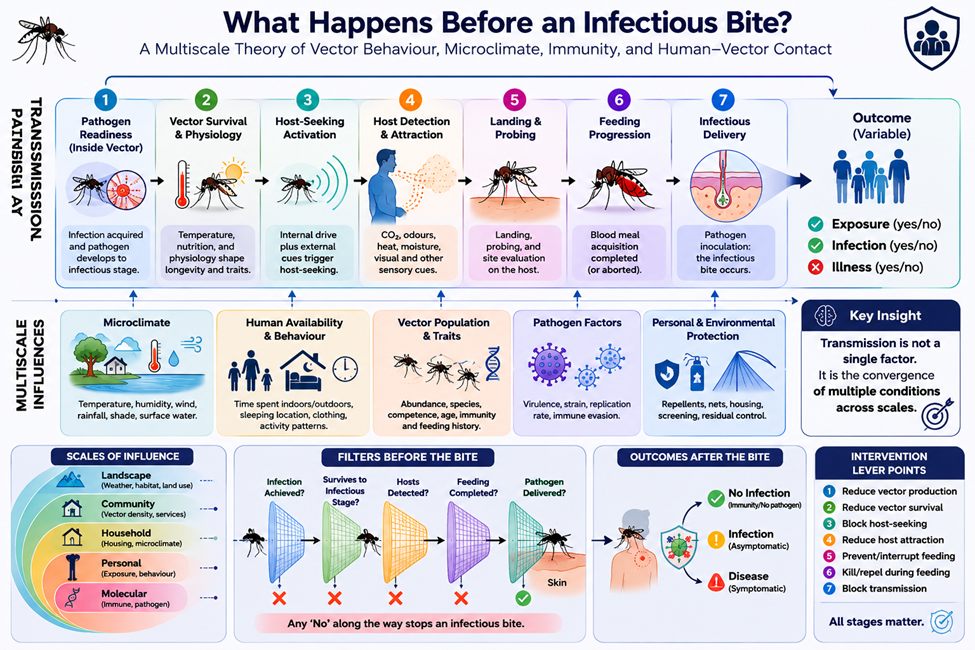
The proposed Multiscale Pre-Bite Gate Theory conceptualizes an infectious bite as the outcome of conditionally dependent gates rather than the direct product of any single transmission proxy. The principal gates are: pathogen acquisition and within-vector readiness; physiological activation of host seeking; multisensory detection and orientation; microclimatic permission for movement and survival; spatial and temporal co-presence with an accessible human; modification by physical, behavioural, or chemical protection; landing, probing, and feeding completion; and delivery of a viable inoculum. These gates are nested across molecular, organismal, household, and landscape scales. Their ordering may differ among vectors and transmission systems, and feedbacks may occur between earlier experience, host preference, environmental exposure, feeding, and subsequent physiological state. Population differences in Aedes aegypti preference for humans are associated with climate and urbanization, providing evidence that landscape conditions can become linked to organismal host-choice phenotypes [21]. Figure 1 organizes pre-bite transmission determinants across molecular, organismal, household, and landscape scales within the analytical logic developed in this section.
|
|
|
Figure 1. Pre-bite transmission determinants across molecular, organismal, household, and landscape scales |
Alt text
A structured conceptual diagram that organizes pre-bite transmission determinants across molecular, organismal, household, and landscape scales, with labelled components, directional relations, contextual modifiers, uncertainty points, and a clear boundary between observed evidence and proposed synthesis.
Q1-journal-publication-ready figure prompt
Create a clean, publication-ready conceptual figure for a Q1 journal in medical entomology and vector-borne disease ecology. The figure must organize pre-bite transmission determinants across molecular, organismal, household, and landscape scales. Use the argument of Section 9, Proposed Multiscale Pre-Bite Theory, as the organizing logic. Include only elements directly relevant to multiscale determinants before an infectious bite, drawing as appropriate on these article-specific domains: pre-bite transmission determinants, vector motivation, host seeking, feeding behaviour, microclimate, contact opportunity, vector immunity, pathogen readiness, human availability, personal protection. Use a restrained colour-blind-safe palette, high-contrast typography, consistent line weights, short scientific labels, directional arrows with an explicit legend, and a balanced landscape layout that remains legible at single-page journal width. Visually distinguish empirical inputs, proposed relationships, contextual modifiers, uncertainty or failure points, and decision or research outputs. Use vector-style scientific graphics and editable text. Maintain this visual language: medical-entomology, vector-ecology, disease-ecology, epidemiological-evidence, and surveillance-science. Do not use decorative clip art, photorealistic imagery, screenshots, logos, commercial branding, real geographic maps, unverified species depictions, invented numerical values, fabricated performance claims, or causal arrows that are not qualified by the manuscript. The figure must stand alone with its title, caption, abbreviations key, and uncertainty notation.
The theory distinguishes landscape opportunity from local encounter. Human mobility, transport networks, urbanization, and climatic suitability have contributed to the historical spread and projected redistribution of Aedes aegypti and Aedes albopictus [22]. These forces can expand the geographical domain in which pre-bite processes may occur, but vector occurrence or establishment is not evidence of local pathogen circulation, infectiousness, or contact. Within the proposed theory, landscape-scale conditions define the availability and connectivity of potential encounter environments. They do not bypass the organismal, within-vector, household, or behavioural gates required for an infectious bite.
The same distinction applies to projected climatic suitability. Climate change is expected to redistribute rather than uniformly expand the suitability of locations and seasons for transmission by Aedes vectors [23]. A location may gain thermal opportunity for vector activity while losing suitability for survival, or it may remain biologically suitable but have limited human–vector overlap. Socioeconomic conditions, housing, water management, mobility, control coverage, and pathogen introduction can further modify the pathway. The theory therefore treats macroclimate as a contextual modifier that influences several gates rather than as an autonomous causal endpoint. Microclimatic opportunity is not equivalent to contact, and projected suitability is not equivalent to future incidence.
The protection gate separates individual bite prevention from population-level interruption. Interventions aimed at personal protection may leave transmission pathways intact when vectors feed on animals, bite outdoors, feed before protection is used, or sustain populations through alternative hosts [24]. The same intervention may therefore block one encounter route while leaving another available. Failure at the protection gate may reflect inadequate use, damaged materials, insecticide resistance, behavioural mismatch, or exposure occurring outside the protected domain. Conversely, reduced personal exposure does not necessarily demonstrate vector-population suppression. The proposed components, evidence bases, boundary conditions, failure modes, and validation requirements are organized in Table 2.
Table 2. Proposed Multiscale Pre-Bite Theory: Components, Evidence Basis, Relations, Boundary Conditions, Failure Modes, and Validation Requirements
|
Proposed component |
Purpose |
Evidence basis |
Relation or mechanism |
Input or precondition |
Expected output |
Boundary condition or failure mode |
Validation requirement |
|
Pathogen-readiness gate |
Separate pathogen acquisition from transmissibility |
Vector immunobiology and infection studies |
Pathogen must survive internal barriers, disseminate, and become available in viable form for inoculation |
Pathogen acquisition by a susceptible vector |
Probability of a transmissible infection |
Infection or whole-body detection may occur without infectious saliva |
Longitudinal infection, dissemination, saliva, and transmission measurements |
|
Microbiome and physiological-context gate |
Represent context-dependent biological modulation |
Mosquito-holobiont evidence |
Microbial and physiological states may alter development, immunity, and infection susceptibility |
Defined vector, microbial, pathogen, nutritional, and environmental context |
Conditional modification of pathogen readiness or vector performance |
Microbiome associations may be descriptive, non-causal, or system-specific |
Perturbation studies with competence and transmission endpoints |
|
Host-seeking activation gate |
Distinguish internal motivation from later contact |
Behavioural-learning evidence |
Circadian, nutritional, reproductive, and experiential states permit or suppress search |
Physiologically capable vector at an appropriate activity phase |
Initiation of host-oriented behaviour |
Activation does not establish orientation, landing, feeding, or inoculation |
State-resolved behavioural studies under naturalistic conditions |
|
Sensory orientation gate |
Separate cue detection from completed feeding |
Olfactory and neural-coding evidence |
Multiple sensory channels guide host recognition and approach |
Detectable host cues and an activated vector |
Arrival within potential encounter range |
Cue redundancy, plume disruption, competing hosts, or sensory failure |
Free-flight and field tests linking cue response to contact |
|
Microclimatic-opportunity gate |
Link local environmental conditions to vector activity and pathogen development |
Fine-scale environmental studies |
Temperature, humidity, shelter, and land cover modify activity, survival, and development |
Vector presence within a characterized microhabitat |
Time- and place-specific biological opportunity |
Regional climate may misrepresent experienced conditions; suitability is not contact |
Sensor-linked vector, pathogen, and exposure observations |
|
Human-availability gate |
Prevent vector activity from being treated as exposure |
Integrated human–vector measurement frameworks |
Exposure requires temporal and spatial overlap with an accessible person |
Vector activity and human co-presence |
Conditional encounter opportunity |
Population presence or raw biting rates may conceal individual heterogeneity |
Concurrent time-use, mobility, and entomological measurement |
|
Protection and accessibility gate |
Represent barriers between opportunity and feeding |
Behaviour-adjusted exposure evidence |
Housing, bed nets, repellents, clothing, and behaviour alter access to hosts |
Human presence plus a functioning and appropriately used intervention |
Reduced probability of landing, probing, or feeding |
Coverage may overstate use, integrity, susceptibility, or protected duration |
Joint measurement of intervention efficacy, use, condition, and residual exposure |
|
Feeding-completion gate |
Distinguish approach and landing from blood acquisition |
Feeding-behaviour evidence |
Host defence, interruption, diversion, and intervention contact determine whether feeding is completed |
Vector within contact range of accessible skin |
Completed or interrupted blood meal |
Landing or probing may occur without successful feeding |
Direct observation, blood-meal analysis, or validated feeding biomarkers |
|
Viable-inoculation gate |
Define the terminal infectious-bite event |
Combined pathogen-readiness and feeding logic |
A competent feeding event must deliver viable pathogen material to a susceptible host |
Infectious vector completing an appropriate feeding interaction |
Completed infectious inoculation opportunity |
Feeding by an uninfectious vector or infectiousness without contact cannot complete the pathway |
Linked vector saliva, feeding, host exposure, and infection endpoints |
|
Landscape-context gate |
Connect climate, urbanization, mobility, and vector redistribution to local pathways |
Global vector-spread analyses |
Macroenvironmental processes redistribute vector occurrence and potential encounter environments |
Suitable habitat, connectivity, introduction, and establishment |
Changed spatial distribution of pre-bite opportunity |
Vector establishment does not establish local pathogen transmission |
Prospective occurrence, infection, contact, and disease surveillance |
|
Multiscale Pre-Bite Gate Theory |
Preserve non-equivalent constructs within one testable synthesis |
Evidence integrated across biological and operational domains |
Conditional gates and failure exits link within-vector readiness to inoculation |
Defined vector–pathogen, environmental, human, and intervention context |
Traceable hypotheses about where progression is enabled or interrupted |
Gate ordering and dependence may vary; the theory is not validated |
Prospective multisite data, multistate models, intervention perturbations, and external validation |
Implications for transmission modelling and control
The first implication is that interventions should be mapped to the specific pre-bite gate they are intended to modify. Vector control remains essential across major vector-borne diseases, but intervention selection must fit local vector biology, ecology, and operational capacity [25]. Larval-source management targets vector production; repellents target approach or landing; housing modifications target entry and accessibility; insecticidal nets target protected-period contact; population-replacement approaches target pathogen readiness; and surveillance may characterize one or more gates without directly modifying them. Evaluations should therefore specify the intended mechanism, the observable intermediate endpoint, the expected effect on later gates, and the conditions under which this translation could fail. Entomological change alone should not be treated as proof of epidemiological impact.
The second implication is that dependencies between gates should be measured rather than assumed independent. Feeding time may interact with fluctuating temperature to modify vector competence and the estimated residual impact of bed nets [26]. Such interactions are obscured when models use a single average temperature, a fixed biting schedule, or a species-level competence value. Progress would be demonstrated by longitudinal designs that connect mosquito physiological state, infection progression, experienced microclimate, feeding time, human protection, and contact. Models should compare alternative dependency structures, propagate measurement uncertainty, and test whether added detail improves prediction outside the calibration setting. A more complicated model is not necessarily a more valid one.
Third, surveillance and control must become adaptive to changing environmental opportunity. Climate change can alter vector distributions, seasonal transmission windows, and the reliability of intervention strategies calibrated to historical patterns [27]. Adaptation requires more than updating climatic suitability maps. It requires determining whether changing conditions alter pathogen readiness, host-seeking periods, human behaviour, housing exposure, intervention durability, or vector community composition. Progress should be assessed through repeated, scale-matched surveillance capable of detecting changes in the locally limiting gate. Climatic hazard should remain analytically separate from realized risk because contact, protection, pathogen introduction, susceptibility, and health-system conditions may strengthen or weaken the final pathway.
Fourth, integrated control portfolios should be evaluated according to complementary gate coverage and plausible failure modes. Alternative arbovirus-control strategies target different mosquito life stages and biological mechanisms, but their epidemiological value depends on context-specific efficacy, coverage, durability, and evaluation [28]. Combining interventions may reduce dependence on a single vulnerable mechanism, yet combination alone does not guarantee synergy. Components may overlap, interfere, impose new selection pressures, or leave critical exposure pathways uncovered. Evaluation should therefore test the complete intervention logic: whether each component reaches its intended vector population, whether gate-specific effects persist, whether vectors or humans alter behaviour, and whether reductions in contact or pathogen readiness translate into fewer infections. Governance should require explicit uncertainty statements and prevent conceptual gate maps from being represented as deployment-ready decision systems.
CONCLUSION
What happens before an infectious bite is neither a single preparatory stage nor a simple accumulation of favourable conditions. It is a multiscale progression in which pathogen readiness, vector physiological state, sensory orientation, local microclimate, human availability, protection, feeding completion, and viable inoculation must align. Each component can be measured, modified, or modelled, but none should be treated as interchangeable with the terminal event. Host-seeking activation is not equivalent to a completed infectious bite; vector competence is not equivalent to realized human exposure; and microclimatic opportunity is not equivalent to contact. The proposed Multiscale Pre-Bite Gate Theory provides an explicit structure for retaining these distinctions, identifying failure points, and connecting biological evidence to modelling and control questions. Its relations remain conditional on vector–pathogen system, environment, scale, method, human behaviour, and intervention context. It is therefore a proposed conceptual pathway rather than a validated transmission model. The highest-priority research need is prospective, linked measurement across gates so that transmission opportunity can be attributed to observed biological and behavioural processes instead of inferred from isolated proxies.
ACKNOWLEDGMENTS: None
CONFLICT OF INTEREST: None
FINANCIAL SUPPORT: None
ETHICS STATEMENT: None