Entomology and
Applied Science Letters
Applied Science Letters
 2025
Volume 12
Issue 2
2025
Volume 12
Issue 2

Insecticide resistance is increasingly detected in mosquito populations targeted by public-health interventions, yet the operational meaning of a resistant classification remains difficult to determine. Standard bioassays provide essential evidence of survival under controlled exposure, but they do not reproduce the insecticide dose, contact duration, mosquito behaviour, product condition, intervention coverage, or transmission environment encountered during implementation. This critical methods review examines how resistance evidence should be translated into operational decisions by integrating four connected domains: what mosquito bioassays measure, the biological mechanisms underlying resistance, resistance intensity in relation to operational exposure, and the evidential pathway from laboratory phenotype to intervention failure. The synthesis distinguishes resistance frequency from resistance intensity, mechanism detection from field-level contribution, biological efficacy from operational effectiveness, and observed associations from causal evidence. The strongest defensible conclusion is that no single phenotype, molecular marker, intensity category, or product bioassay can independently establish control failure. Decision-relevant interpretation instead requires linked evidence describing the assay construct, vector population, physiological and behavioural mechanisms, product-specific performance, realized exposure, implementation conditions, and relevant entomological or epidemiological outcome. Important limitations include uneven surveillance, non-equivalent assay systems, incomplete calibration of intensity categories, uncertain contributions of co-occurring mechanisms, and weak linkage between laboratory measurements and programme outcomes. Resistance-informed vector control should therefore use staged evidence integration rather than universal thresholds, with uncertainty retained explicitly at each transition from detection to mechanism attribution, product evaluation, and operational action. The central implication is that resistance surveillance becomes operationally valuable only when measurements are interpreted within defined products, populations, exposure pathways, intervention objectives, and decision contexts.
INTRODUCTION
Mosquito insecticide resistance has become a geographically extensive but biologically heterogeneous challenge for vector control. Resistance phenotypes occur across major Aedes vectors and African malaria-vector populations, but their prevalence, intensity, mechanisms, and temporal trajectories vary among species and settings [1, 2]. This heterogeneity matters because a resistant classification does not represent a uniform biological state. The same mortality result may arise from different combinations of target-site alteration, detoxification, reduced penetration, physiological condition, or assay exposure, while populations carrying apparently similar mechanisms may experience different operational insecticide doses.
The central interpretive problem is therefore not whether resistance exists, but what a particular measurement establishes. Diagnostic-dose mortality can indicate that a population no longer responds like a susceptible reference population under a specified protocol. It does not directly quantify the strength of resistance, identify the responsible mechanism, predict the efficacy of a particular formulation, or determine whether an intervention will fail to protect people. These are distinct constructs situated at different biological and operational scales. Treating them as interchangeable compresses uncertainty and encourages decisions that are more precise than the evidence permits.
Field evidence reinforces this non-equivalence. Long-lasting insecticidal nets may retain protective value in areas where phenotypic resistance is detected, while their effectiveness may also be weakened by resistance in combination with poor physical condition, inconsistent use, inadequate coverage, altered vector behaviour, ecological change, or declining insecticide availability. Field effectiveness therefore cannot be inferred from bioassay mortality alone because net use, physical integrity, coverage, mosquito behaviour, and transmission ecology jointly shape outcomes [3, 4]. Conversely, preserved epidemiological protection in one context does not show that resistance is operationally unimportant elsewhere or that increasing resistance intensity will remain inconsequential.
This review develops a decision-centred interpretation of mosquito insecticide-resistance evidence. It critically compares bioassay constructs, target-site, metabolic, behavioural, and cuticular mechanisms, resistance intensity, operational exposure, product performance, and control outcomes. Its central argument is that translation from laboratory phenotype to operational action requires an explicit chain of evidence. Bioassay resistance is not equivalent to operational control failure; resistance frequency is not equivalent to resistance intensity; a detected mechanism is not equivalent to its field-level contribution; and laboratory exposure is not equivalent to the dose, behaviour, coverage, and environment of operational use.
What mosquito resistance bioassays measure
A resistance bioassay measures mosquito survival or mortality after a defined experimental exposure. Its result is conditional on the insecticide, concentration, exposure duration, delivery surface, route of uptake, post-exposure observation period, mosquito species, age, physiological state, and handling conditions. Diagnostic-dose assays are useful for identifying reduced susceptibility relative to a standardized expectation, whereas escalating-dose assays probe the strength of survival beyond that diagnostic exposure. Escalating-dose intensity assays consequently add information that frequency-based classification cannot provide, but their categories remain laboratory phenotypes rather than direct epidemiological thresholds [5]. A population with many survivors at the diagnostic dose may contain resistance of different strengths, and identical resistance frequencies can conceal markedly different dose–response relationships.
Assay design also determines the exposure construct being measured. Tests based on treated papers, coated bottles, direct topical application, or contact with insecticidal netting differ in how insecticide reaches the mosquito and in the uniformity of the delivered dose. Alternative contact formats can reveal effects of long-lasting insecticidal nets that may be underestimated or obscured by short standardized exposures [6]. Similarly, comparisons among the Centers for Disease Control and Prevention bottle assay, the World Health Organization tube assay, and topical application demonstrate differences in delivered exposure and mortality variability; their classifications should not be treated as interchangeable simply because all report mortality [7]. Agreement between methods may strengthen confidence in a phenotype, but disagreement may reflect assay geometry, dose distribution, absorption route, or experimental variability rather than a biological contradiction.
Interpretation is further weakened when mortality percentages are converted into coarse categories without retaining dose–response shape or uncertainty. Continuous probabilistic analysis can preserve information about the estimated dose–mortality relationship and the uncertainty surrounding resistance intensity, whereas broad low, moderate, or high labels may imply boundaries that have not been calibrated to product performance or disease outcomes [8]. A bioassay result should therefore be reported as a method-specific observation, not as an autonomous decision rule. At minimum, interpretation requires the assay protocol, delivered exposure, mosquito characteristics, replication, uncertainty, and the operational question to which the measurement is being applied. The evidence dimensions and interpretive boundaries for mosquito resistance bioassays measure are summarized in Table 1.
Table 1. What Mosquito Resistance Bioassays Measure: Vector Systems, Biological Mechanisms, Exposure Pathways, Evidence Requirements, Uncertainty, and Interpretive Boundaries
|
Vector or transmission domain |
Environmental or operational driver |
Biological mechanism |
Human-exposure pathway |
Evidence required |
Context dependency |
Uncertainty |
Interpretive boundary |
|
Anopheles malaria vectors assessed with diagnostic-dose assays |
Routine susceptibility surveillance using a standardized insecticide exposure |
Composite survival phenotype integrating all mechanisms active under the test conditions |
Indirect; the assay estimates potential loss of insecticidal killing rather than human protection |
Protocol-specific mortality, controls, mosquito age and physiological state, insecticide identity, and test quality |
Species, population, season, insecticide, and laboratory conditions |
Relative contributions of biological resistance and procedural variation |
Detection of reduced susceptibility does not establish resistance intensity or operational failure |
|
Anopheles malaria vectors assessed with escalating-dose assays |
Need to distinguish weak survival at a diagnostic dose from survival under stronger exposure |
Increasing dose challenges the strength of the composite resistance phenotype |
Indirect; stronger laboratory survival may indicate greater concern but does not define disease risk |
Mortality across multiple concentrations, reproducible dose delivery, and uncertainty around the dose–response relation |
Reference strain, population composition, physiological state, and insecticide class |
Calibration between assay multiples and operationally encountered doses |
Resistance frequency is not equivalent to resistance intensity |
|
Anopheles vectors tested against insecticidal netting |
Product evaluation and concern that standardized short contact may misrepresent net interaction |
Combined effects of contact time, surface insecticide availability, uptake, irritation, and delayed mortality |
Contact during host seeking through or upon treated net material |
Product identity and condition, contact format, exposure duration, immediate and delayed outcomes, and susceptible comparison |
Net formulation, textile condition, mosquito strain, and contact behaviour |
Artificial exposure may not reproduce natural duration, repetition, or avoidance |
Laboratory net bioefficacy is not equivalent to household or community effectiveness |
|
Aedes aegypti assessed using bottle, tube, or topical assays |
Selection of surveillance method and comparison among laboratories or programmes |
Each method exposes mosquitoes through a different surface, route, and dose distribution |
Indirect; results inform susceptibility to control insecticides but do not measure actual human–vector contact |
Within-method replication, delivered concentration, baseline mortality, variance, and method-specific controls |
Colony or field origin, insecticide, solvent, handling, and assay platform |
Cross-method differences may reflect measurement design rather than biological change |
Mortality values from different assay systems are not automatically interchangeable |
|
Malaria vectors analysed with continuous intensity models |
Need to avoid information loss from categorical intensity classifications |
Estimated dose–response describes the probability of mortality across increasing exposure |
Indirect; probabilistic estimates may improve comparison but require operational calibration |
Adequate observations across doses, model checking, transparent assumptions, and uncertainty intervals |
Data quality, dose spacing, sample size, population heterogeneity, and model assumptions |
Dependence on priors, sparse responses, and external validation |
A modelled intensity estimate is not a validated intervention-failure threshold |
|
Aedes resistance surveillance across geographic settings |
Local insecticide selection pressure, control history, and uneven surveillance coverage |
Variable combinations of target-site, metabolic, and other resistance processes contribute to observed mortality |
Potentially reduced efficacy of adulticides or treated materials used to limit human–vector contact |
Repeated local phenotype data supported by mechanism and intervention-performance evidence |
Species, geography, insecticide history, and surveillance density |
Incomplete spatial coverage and heterogeneous testing practices |
Widespread resistance does not imply uniform severity or identical control consequences |
|
African malaria-vector surveillance across space and time |
Changing intervention pressure, ecology, test distribution, and vector composition |
Population-level changes in phenotypic susceptibility |
Potential modification of protection provided by indoor insecticidal interventions |
Standardized longitudinal surveillance with spatial, temporal, species, and intervention information |
Sparse observations, non-random sampling, changing vector composition, and shifting test coverage |
Model uncertainty where observations are limited |
Modelled resistance probability is not observed product or programme failure |
Target-site, metabolic, behavioural, and cuticular mechanisms
Target-site resistance modifies the mosquito protein upon which an insecticide acts, thereby reducing toxicodynamic sensitivity. Even within this apparently discrete category, interpretation is not straightforward. Population-genomic evidence in African Anopheles gambiae and Anopheles coluzzii shows that target-site resistance is structured by multiple variants and haplotypes whose phenotypic meanings depend on species, genetic background, and geography [9]. Allele frequency can therefore support mechanistic surveillance, but it is not a substitute for phenotypic testing, resistance-intensity measurement, or product evaluation. A frequent allele may be weakly predictive in one background and more consequential in another, particularly when metabolic or penetration mechanisms co-occur.
Metabolic resistance acts before sufficient insecticide reaches its target, commonly through increased detoxification or sequestration. Functional evidence demonstrates that particular cytochrome P450 alleles can increase pyrethroid survival and reduce mortality caused by pyrethroid-treated nets [10]. Such evidence provides a stronger causal chain than expression data alone because it connects a defined genetic variant to phenotype and product response. Nevertheless, the field-level contribution of a validated allele remains population- and product-dependent. Multiple detoxification enzymes may be co-expressed, substrate specificity may differ among active ingredients, and apparent metabolic resistance may interact with target-site or cuticular processes. Mechanism detection consequently indicates biological plausibility, not a universal or quantitatively fixed contribution to control loss.
Cuticular and behavioural processes further complicate mechanism attribution. Reduced penetration can delay insecticide uptake while enzymatic detoxification removes part of the absorbed dose, allowing the two pathways to act jointly rather than independently [11]. Measuring only enzyme activity may consequently overattribute resistance to metabolism, whereas measuring cuticular change without uptake kinetics may not establish its functional importance. Behaviour operates at a different point in the exposure pathway by altering whether, when, where, and for how long mosquitoes contact treated surfaces. Physiological resistance and shifts in biting or resting behaviour have been observed together after long-lasting insecticidal-net deployment, but temporal co-occurrence does not identify a single causal mechanism [12]. Environmental change, host availability, vector-species turnover, or human behaviour may produce similar patterns. Forced-contact bioassays cannot measure this behavioural component of operational exposure.
Resistance intensity and operational exposure
Resistance frequency describes the proportion of mosquitoes surviving a specified diagnostic exposure; resistance intensity describes how survival changes as exposure increases. The distinction is operationally important because two populations with similar diagnostic-dose mortality may differ in their susceptibility at higher concentrations and in their response to particular formulations. In Accra, high pyrethroid-resistance intensity occurred alongside low mortality in tests of pyrethroid-only long-lasting insecticidal nets, providing a coherent entomological warning signal [13]. However, this concurrence does not independently establish loss of population protection. The evidence remains specific to the tested vector population, products, exposure methods, and ecological setting, and it does not quantify intervention use, coverage, physical barrier effects, or disease outcomes.
Intensity is also dynamic rather than a fixed property of a species or region. Surveillance across Kinshasa and other provinces of the Democratic Republic of Congo showed substantial variation among insecticides, locations, and survey periods, demonstrating that diagnostic-dose frequency cannot stand in for a stable or spatially uniform estimate of resistance strength [14]. Variation may represent different selection histories, vector composition, mechanism combinations, or sampling conditions. Mosquito physiological state further modifies observed intensity: age and blood feeding can change apparent resistance and subsequent longevity [15]. Comparisons made with non-equivalent age structures, feeding states, rearing histories, or environmental conditions may therefore misclassify biological differences as geographic or temporal changes in resistance.
Operational exposure is the insecticide dose actually encountered by a mosquito during intervention use. It depends on contact probability, duration, route, repetition, product condition, active-ingredient availability, household use, coverage, and mosquito behaviour. Laboratory intensity assays deliberately standardize these factors to improve comparison, but standardization does not create equivalence with field contact. Longitudinal evidence from Malawi linked increasing resistance intensity partly to greater expression of P450 alleles and declining entomological performance of tested nets, while leaving the magnitude of population-level epidemiological effect unresolved [16]. The defensible interpretation is therefore exposure–response based: resistance intensity identifies the strength of survival under specified laboratory challenge, whereas operational significance emerges only when that phenotype is connected to product-specific dose, natural contact, intervention condition, coverage, vector ecology, and an explicitly defined control objective.
From laboratory phenotype to control failure
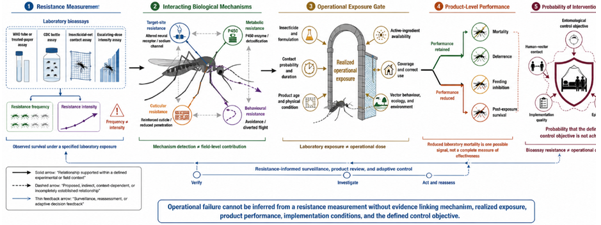
Translation from a resistant laboratory phenotype to operational failure requires several evidential transitions. The phenotype must first affect the performance of a relevant product under a realistic contact pathway; the resulting reduction in killing, deterrence, or feeding inhibition must then persist at the coverage achieved by the programme; and that change must be sufficient to alter an explicitly defined entomological or epidemiological objective. In Kinshasa, reduced net-induced mortality co-occurred with high Plasmodium infection in resistant vectors, a concerning field pattern that does not alone establish a causal resistance-to-transmission pathway [17]. Figure 1 integrates the sequential evidence transitions linking laboratory resistance measurements, interacting biological mechanisms, realized operational exposure, product performance, and the probability that a vector-control objective will not be achieved.
|
|
|
Figure 1. Resistance measurement, biological mechanisms, operational exposure, and the probability of intervention failure |
Product-specific evidence can strengthen the translation chain without completing it. In southeast Côte d’Ivoire, poor conventional-net bioefficacy was associated with intense pyrethroid resistance and overexpression of several P450 genes, whereas next-generation nets retained greater activity [18]. In Mozambique, escalating P450-associated resistance reduced mortality even to a piperonyl-butoxide–pyrethroid net, demonstrating that a product intended to mitigate one resistance pathway can be overtaken by sufficiently strong or complex resistance [19]. These findings connect phenotype, mechanism, and product response, but they remain entomological evidence. They do not independently establish inadequate household use, reduced community coverage, increased human exposure, or higher disease incidence.
Epidemiological evidence can also diverge from entomological warning signals. Health-facility data from Benin did not reveal a simple association between standard phenotypic-resistance frequency and clinical malaria incidence, underscoring the limits of a single-marker failure rule [20]. Such a result should not be interpreted as evidence that resistance is operationally harmless; routine-data quality, ecological linkage, intervention coverage, immunity, healthcare access, climate, and vector composition can obscure an effect. Control failure should instead be defined as failure to achieve a specified objective under documented implementation conditions, with evidence identifying where the chain from product contact to population protection weakened. The evidence dimensions and interpretive boundaries for from laboratory phenotype to control failure are summarized in Table 2.
Table 2. From Laboratory Phenotype to Control Failure: Vector Systems, Biological Mechanisms, Exposure Pathways, Evidence Requirements, Uncertainty, and Interpretive Boundaries
|
Vector or transmission domain |
Environmental or operational driver |
Biological mechanism |
Human-exposure pathway |
Evidence required |
Context dependency |
Uncertainty |
Interpretive boundary |
|
Resistant Anopheles populations with reduced net mortality |
Use of insecticidal nets in settings with multiple resistant vector species |
Combined target-site, metabolic, penetration, or behavioural resistance may reduce insecticidal killing |
Surviving infected mosquitoes may retain opportunities for human contact |
Resistance phenotype, product bioefficacy, infection measurements, contact data, and transmission outcomes |
Vector species, infection prevalence, product condition, net use, and local transmission |
Direction and magnitude of the resistance–infection relationship |
Co-occurrence of poor net mortality and mosquito infection is not proof that resistance caused transmission failure |
|
Anopheles coluzzii exposed to conventional and next-generation nets |
Product choice under intense pyrethroid resistance |
Overexpression of CYP6P4, CYP6P3, and CYP6Z1 contributes to reduced pyrethroid susceptibility |
Lower insecticidal mortality may increase the probability of continued host seeking |
Molecular expression, intensity assays, comparative net bioefficacy, and field-contact evidence |
Active ingredient, synergist, resistance intensity, vector population, and net condition |
Relative contribution of each enzyme and co-occurring mechanisms |
Association between P450 expression and reduced bioefficacy does not quantify population-health impact |
|
Anopheles funestus exposed to PBO–pyrethroid nets |
Escalation of metabolic resistance after deployment of pyrethroid-based tools |
Strong or complex P450-mediated detoxification can erode synergist-supported efficacy |
Surviving mosquitoes may continue contact attempts, but natural exposure is not reproduced by forced assays |
Longitudinal phenotype, validated mechanisms, product-specific bioassays, durability, use, and epidemiological outcomes |
Resistance strength, enzyme profile, PBO availability, product age, and contact duration |
Whether efficacy loss persists under household and community conditions |
Loss of laboratory bioefficacy is not identical to operational programme failure |
|
Malaria transmission assessed through routine clinical data |
Net coverage, healthcare use, climate, immunity, vector ecology, and resistance surveillance |
Resistance may affect transmission through reduced mosquito mortality, but multiple pathways intervene |
Human infection depends on mosquito survival, biting, intervention use, and host factors |
Linked entomological, implementation, clinical, temporal, and spatial data |
Surveillance quality, ecological matching, diagnostic practice, and baseline transmission |
Confounding and measurement error may conceal or exaggerate associations |
Absence of a simple resistance–incidence association is not evidence of no resistance effect |
|
Programme-level determination of control failure |
Product degradation, incomplete use, poor coverage, behavioural avoidance, or biological resistance |
Several failures can produce similar reductions in intervention effect |
Reduced personal protection or community-level suppression can increase exposure |
Defined objective, comparator, implementation fidelity, product quality, vector outcomes, and human outcomes |
Intervention type, target vector, transmission setting, resources, and evaluation period |
Attribution among biological and implementation causes |
A resistant bioassay classification alone cannot establish control failure |
Decision thresholds and evidence interpretation
A decision threshold is a rule linking evidence to an action, not a universal biological constant. The consequences of acting too early or too late, the availability of alternative products, the reversibility of the decision, and the uncertainty of the evidence should determine how much support is required. Decision rules should therefore distinguish technical resistance detected under standardized exposure from practical resistance that materially changes control performance in a defined programme context [21]. A diagnostic-dose result may appropriately trigger confirmation or intensified surveillance without automatically triggering product withdrawal.
Threshold interpretation also depends on the intervention being evaluated. A mortality value obtained from an insecticidal net can reflect net sampling, washing, storage, manufacturing variation, active-ingredient migration to the surface, textile condition, and mosquito susceptibility. These factors may change during transport and field use, so product and vector measurements must be interpreted jointly [22]. Separate thresholds are consequently needed for assay validity, resistance alert, product investigation, operational action, and post-decision review. Collapsing these functions into one mortality cutoff hides the evidential transition between detection and action.
Molecular and model-based indicators can extend surveillance but do not remove the need for calibration. Target-site allele-frequency maps can support anticipatory surveillance, although their operational meaning remains conditional on vector species, genetic background, phenotype, product, and local exposure [23]. Data-informed deployment models can combine resistance, ecology, intervention efficacy, cost, and resource constraints, but their rankings remain dependent on structural assumptions and setting-specific inputs [24]. Decision thresholds should therefore be tiered: an alert threshold initiates verification, an investigation threshold triggers product and exposure assessment, and an action threshold requires evidence that the expected benefit of changing strategy exceeds its costs and risks.
Critical methodological synthesis
The most consistent finding across the evidence base is non-equivalence between resistance detection and operational failure. Bioassays, molecular markers, product tests, field entomology, and epidemiological outcomes measure different parts of the causal chain. Across synthesis and cluster-randomized evidence, piperonyl-butoxide–pyrethroid nets can improve entomological or epidemiological outcomes in high-resistance settings, but the magnitude and persistence of benefit vary by product, setting, coverage, and time since deployment [25–27]. These findings demonstrate that mechanism-aware products can restore part of the effect lost to resistance; they do not establish that one product class is universally superior or evolutionarily durable.
Comparative intervention evidence further shows that next-generation nets cannot be treated as a homogeneous category. A four-arm trial in Tanzania found that some dual-active-ingredient nets improved malaria outcomes and cost-effectiveness relative to pyrethroid-only nets [28]. The inference is product- and setting-specific because active ingredients differ in mode of action, resistance vulnerability, wash durability, manufacturing characteristics, price, and dependence on sustained household use. A positive result for one combination cannot be transferred automatically to another combination or to a population with a different mechanism profile.
Time since deployment is a central but often undermeasured modifier. Third-year follow-up of a cluster-randomized trial showed that the advantage of piperonyl-butoxide nets weakened as net use and piperonyl-butoxide content declined [29]. This finding illustrates why laboratory susceptibility cannot be isolated from operational exposure. Textile deterioration, declining surface availability of active ingredients, loss of synergist, net attrition, inconsistent use, and replacement practices may alter effectiveness even when the underlying mosquito phenotype is unchanged.
The strongest supported inference is therefore conditional rather than threshold-based: resistance becomes operationally important when a defined phenotype and mechanism reduce the performance of a relevant product under realized exposure sufficiently to compromise a specified programme objective. The unresolved question is which combinations of assay phenotype, intensity, mechanism, product condition, contact behaviour, coverage, and ecology best predict that transition. Comparative models can help organize these variables, but their recommendations remain dependent on local inputs and assumptions [24]. The convergent findings, context-dependent results, methodological limitations, and remaining uncertainties are synthesized in Table 3.
Table 3. Critical Methodological Synthesis: Convergent Findings, Context Dependence, Methodological Limitations, Evidence Confidence, and Residual Uncertainty
|
Evidence domain |
Convergent finding |
Contradictory or context-dependent finding |
Study-design basis |
Main methodological limitation |
Strength of inference |
Residual uncertainty |
Implication |
|
Resistance bioassays |
Standardized assays detect survival under defined exposure |
Assay platforms deliver non-equivalent doses and variability |
Comparative laboratory and intensity-bioassay studies |
Limited external validity for natural contact |
Strong for measurement differences; limited for operational prediction |
Which assay characteristics best predict product performance |
Preserve method, dose–response, mosquito-state, and uncertainty data |
|
Target-site resistance |
Variants and haplotypes can contribute to reduced toxicodynamic sensitivity |
Phenotypic meaning varies with species, background, geography, and co-mechanisms |
Population genomics and spatiotemporal modelling |
Incomplete genotype–phenotype–product linkage |
Strong genetic inference; moderate operational inference |
Product-specific predictive value of allele trends |
Validate markers against intensity and product response |
|
Metabolic resistance |
Functionally validated P450 pathways can reduce pyrethroid and net efficacy |
Enzyme combinations and resistance strength differ among populations and products |
Functional molecular, expression, and field-bioefficacy studies |
Expression alone does not quantify causal contribution |
Strong for selected alleles and settings |
Generalizability and capacity to overcome synergists |
Pair molecular diagnostics with product-specific monitoring |
|
Behavioural and cuticular resistance |
Avoidance and reduced penetration can lower the internal dose received |
Relative effects depend on contact opportunity, duration, ecology, and mosquito state |
Longitudinal field observation and physiological experiments |
Difficult causal attribution under natural exposure |
Moderate mechanistic inference |
Persistence and transmission relevance |
Measure contact behaviour and uptake kinetics separately from forced mortality |
|
Resistance intensity |
Escalating-dose assays add information beyond diagnostic-dose frequency |
Measured intensity changes with site, insecticide, age, feeding state, and assay design |
Dose–response, surveillance, and physiological studies |
No universal epidemiological calibration |
Strong measurement inference |
Operationally relevant exposure range |
Report continuous response and sample-state modifiers |
|
Operational exposure |
Coverage, use, product chemistry, durability, and behaviour determine realized dose |
High laboratory resistance may coexist with retained protection, while product advantage may decay |
Cohorts, product-method studies, and trial follow-up |
Individual contact histories are rarely measured directly |
Strong evidence of multifactoriality |
Contribution of each exposure component |
Monitor product condition, use, contact, and phenotype jointly |
|
Control failure |
Resistance can reduce product mortality and weaken intervention effect |
Epidemiological outcomes do not show a universal monotonic relationship with assay mortality |
Field entomology, observational cohorts, routine data, and trials |
Confounding and incomplete linkage across scales |
Strong for context dependence |
Predictive combination of evidence layers |
Define the objective and comparator before declaring failure |
|
Decision thresholds |
Action requires consideration of consequences, alternatives, feasibility, and uncertainty |
Marker cutoffs and model rankings are setting- and assumption-dependent |
Critical methods analysis and deployment modelling |
Limited prospective validation of action thresholds |
Moderate decision-level inference |
False-positive and false-negative performance |
Separate alert, investigation, action, and review thresholds |
|
Resistance-informed products |
Mechanism-aware and dual-active tools can improve outcomes in resistant settings |
Benefit varies with formulation, mechanism, durability, coverage, cost, and time |
Evidence synthesis and cluster-randomized trials |
Transferability between products and ecological settings |
Strong for selected product–setting combinations |
Evolutionary durability and long-term comparative value |
Use adaptive product portfolios with continuing surveillance |
Recommendations for resistance-informed vector control
Resistance-informed control should be local, mechanism-aware, and integrated rather than reduced to changing insecticides after a single resistant classification [30]. Programmes should begin by defining the operational objective and the product or strategy under consideration. Standardized phenotype and intensity testing can then function as an alert, followed by confirmatory assays, mechanism characterization, product-specific bioefficacy testing, assessment of product condition, and measurement of coverage and vector-contact patterns. A strategy change should be linked to pre-specified review criteria so that ineffective or impractical decisions can be revised.
Genetic surveillance can improve timeliness by detecting the emergence and spread of resistance variants before conventional phenotype data become geographically dense. Its decision value is greatest when markers are connected to measured phenotype, resistance intensity, active-ingredient vulnerability, and product performance rather than reported as isolated molecular detections [31]. A real-time diagnostic for a rapidly spreading triple-mutant haplotype associated with high-level metabolic resistance illustrates the potential for anticipatory monitoring, but intervention decisions still require evidence that the haplotype is prevalent and functionally important in the local vector population and relevant to the products being used [32].
Operational choice should be framed as a transparent trade-off among expected effectiveness, resistance mechanism, product durability, achievable coverage, cost, implementation feasibility, supply continuity, and evolutionary risk [33]. Immediate protection may justify deploying a more effective product even when its long-term resistance-management value is uncertain, whereas rotation, mixtures, mosaics, or integrated non-chemical measures may be preferred when comparable protection can be preserved. Programmes should document the rationale, uncertainty, expected failure modes, monitoring indicators, and conditions for changing course. This is an adaptive decision process, not a deployment-ready universal framework.
CONCLUSION
Mosquito insecticide resistance becomes operationally meaningful only through its interaction with a specific product, realized mosquito exposure, implementation quality, vector ecology, and a defined control objective. Bioassay resistance is therefore not equivalent to operational control failure; resistance frequency is not equivalent to resistance intensity; a detected mechanism is not equivalent to its field-level contribution; and laboratory exposure is not equivalent to the dose, behaviour, coverage, and environment of operational use. The strongest defensible approach is staged evidence integration, beginning with standardized detection and progressing through intensity, mechanism, product performance, operational exposure, and outcome assessment. The highest-priority research need is prospective linkage of these evidence layers within the same populations and intervention settings. Until such calibration is available, resistance-informed decisions should remain product-specific, locally revisable, explicit about uncertainty, and proportionate to the consequences of both action and delay.
ACKNOWLEDGMENTS: None
CONFLICT OF INTEREST: None
FINANCIAL SUPPORT: None
ETHICS STATEMENT: None