Entomology and
Applied Science Letters
Applied Science Letters
 2025
Volume 12
Issue 3
2025
Volume 12
Issue 3

Natural products offer substantial chemical diversity for insect-control discovery, but bioactivity screening generates many more promising observations than development-ready candidates. The central difficulty is therefore not merely identifying plant-derived materials that affect insects, but deciding which chemically defined candidates justify continued investment. Acute laboratory potency is often privileged even when chemical identity, target relevance, selectivity, mixture interactions, environmental stability, formulation feasibility, and resistance liability remain uncertain. This article develops an original, explicitly non-validated prioritization structure that integrates these domains into a staged decision logic for natural-product insecticides. The approach distinguishes discovery evidence from development evidence and treats candidate value as conditional on the intended pest, life stage, exposure route, production system, formulation, environmental setting, and non-target compartments. The synthesis indicates that credible candidates combine reproducible chemical definition with biologically relevant activity, mechanism-supported but not overclaimed target evidence, an exposure-aware selectivity profile, manageable stability and delivery characteristics, and a resistance assessment that considers both the active substance and the complete formulated product. Synergy may increase activity or reduce the required amount of one component, but it does not inherently lower resistance risk and may enlarge uncertainty when interaction mechanisms, component ratios, or non-target responses are insufficiently characterized. Major limitations include heterogeneous assay designs, incomplete chemical standardization, limited cross-species testing, and weak linkage between laboratory effects and realistic use conditions. The principal implication is that candidate advancement should occur through sequential evidence gates rather than a potency-led ranking. Such a structure can improve transparency in research investment while remaining subject to prospective validation across chemically, taxonomically, and operationally diverse insect-control systems.
INTRODUCTION
Natural products occupy an important but difficult position in insecticide discovery. They provide diverse molecular scaffolds, multi-constituent mixtures, volatile compounds, feeding deterrents, growth disruptors, neuroactive substances, and other biologically active materials that may support direct pest control or inspire semisynthetic development. Nevertheless, the volume of reported botanical activity has not produced a corresponding number of consistently formulated and widely adopted products. Botanical bioactivity becomes developmentally meaningful only when chemical reproducibility, practical efficacy, safety, and delivery can be demonstrated together [1]. The relevant question is therefore not whether a plant extract, essential oil, metabolite, or derivative can affect an insect under at least one experimental condition. It is whether the candidate possesses a sufficiently coherent combination of chemical, biological, technological, and risk-related properties to justify progression.
This distinction separates discovery value from development priority. Natural products may function as direct active ingredients, sources of optimized derivatives, synergists, repellents, or templates for identifying insect-relevant targets. Each route, however, carries different requirements for chemical supply, analytical control, formulation, exposure, toxicology, intellectual development, and resistance management. Natural products provide both direct pesticidal actives and chemical starting points, yet their development value depends on properties extending well beyond initial potency [2]. A compound with moderate activity but reproducible chemistry, a plausible delivery route, and a credible safety margin may be more developable than a highly potent extract whose active constituents, source variability, persistence, or non-target effects remain unresolved.
The natural origin of a candidate does not resolve these uncertainties. Botanical materials may vary with genotype, chemotype, plant organ, developmental stage, geography, cultivation, storage, extraction procedure, and analytical definition. Their constituents can volatilize, oxidize, photodegrade, interact antagonistically or synergistically, or change biological availability after formulation. The same intervention may consequently produce different target and non-target effects across laboratory, greenhouse, storage, aquatic, soil, and field contexts. A sustainable botanical insecticide cannot be inferred from plant origin alone because composition, delivery, persistence, and environmental exposure jointly shape its performance and risk [3]. Sustainability is therefore an evidence-dependent property of a defined product and use pattern, not an intrinsic property conferred by botanical provenance.
This article addresses the absence of an integrated decision structure linking early natural-product discovery to insecticide development priority. Its purpose is not to present a validated scoring system, prescribe universal thresholds, or claim that every candidate should follow an identical commercial pathway. Instead, it organizes the selected evidence around seven connected questions: whether the candidate is chemically and biologically reproducible; whether its mechanism is sufficiently characterized and relevant to the intended target; whether its selectivity is credible under plausible exposure; whether synergy, stability, and formulation improve or complicate its profile; whether resistance and cross-resistance liabilities are understood; which criteria should govern progression; and which studies are needed to reduce the most decision-relevant uncertainties. The central argument is that development priority should be assigned through staged evidence integration. In vitro potency is not equivalent to development priority, mechanistic novelty is not equivalent to target validation, natural origin is not equivalent to selectivity, and synergy in a mixture is not equivalent to reduced resistance risk.
The candidate-selection problem in natural-product discovery
Natural-product discovery commonly begins with ethnobotanical knowledge, whole-plant materials, crude extracts, essential oils, fractions, isolated metabolites, or structurally related derivatives. These entry points are not interchangeable. Traditional use can identify biologically plausible plants and locally relevant application practices, but it may involve variable material, informal preparation, uncertain dose, multiple modes of exposure, or context-specific effectiveness. Traditional or local pesticidal use is a valuable discovery signal, but it does not by itself establish a reproducible, scalable, or safe product candidate [4]. Candidate selection must therefore preserve the informational value of local use while requiring botanical authentication, defined plant material, traceable processing, chemical profiling, supply feasibility, and testing under an explicitly stated use context. Otherwise, apparent efficacy may not be reproducible across harvests, production sites, extraction procedures, or intended users.
Potency-centred screening creates a second problem. A low lethal concentration or rapid laboratory response may appear to provide a convenient ranking variable, yet candidates tested under different routes, durations, life stages, carriers, environmental conditions, or endpoints cannot be ordered credibly through potency alone. An impressive laboratory response remains a screening result until it survives realistic exposure, formulation, persistence, and field-performance tests [5]. Development decisions must also account for effects that acute mortality assays do not capture. The biorational label does not remove the need to examine sublethal effects, behavioral disruption, life-stage sensitivity, and ecological consequences [6]. Reduced feeding, impaired development, repellency, delayed reproduction, altered movement, or disruption of beneficial-organism performance may be relevant outcomes, but their interpretation depends on whether they improve pest suppression, merely redistribute insects, or create unintended effects elsewhere in the system.
A defensible candidate-selection process should therefore begin with an intended product profile rather than with a decontextualized list of active plants. The target insect, life stage, crop or stored commodity, application route, exposure duration, required persistence, user setting, and principal non-target compartments should be specified before comparing candidates. Candidate ranking should be anchored to a defined pest, life stage, exposure route, and intended use rather than to generic claims of biopesticidal activity [7]. Within that context, chemical identity, mechanism, selectivity, formulation, stability, and resistance relevance become connected decision dimensions rather than independent desirable attributes. Recent syntheses converge that commercial progress depends on standardization, realistic efficacy, safety, delivery, and manufacturability rather than assay potency alone [1, 2]. This convergence supports a multidimensional selection logic, but it does not establish universal weights or prove that a single candidate profile will be optimal across production systems.
The evidence dimensions and interpretive boundaries for candidate-selection problem in natural-product discovery are summarized in Table 1.
Table 1. The Candidate-Selection Problem in Natural-Product Discovery: Chemical Identity, Mechanism, Standardization, Formulation, Safety, Resistance, and Translation Requirements
|
Candidate or product factor |
Chemical or biological basis |
Required characterization |
Potential contribution |
Formulation implication |
Safety implication |
Resistance implication |
Development boundary |
|
Botanical source and plant material |
Genotype, chemotype, organ, growth stage, environment, and processing can alter composition |
Taxonomic authentication, plant part, provenance, harvest conditions, storage, and processing history |
Establishes traceability and enables reproducible sourcing |
Source variability may require blending, specification limits, or controlled cultivation |
Different source profiles may alter hazard and exposure |
Variable composition may create inconsistent selection pressure |
Traditional use or species identity alone does not define a reproducible candidate |
|
Crude extract or essential oil |
Activity may arise from one constituent, several constituents, or nonspecific physicochemical effects |
Extraction method, yield, chromatographic profile, major and minor constituents, and batch consistency |
Preserves potentially useful multi-constituent activity |
Volatility, solubility, oxidation, viscosity, and carrier compatibility affect delivery |
Whole-mixture testing is needed because constituent safety cannot simply be added |
Multiple constituents do not automatically prevent resistance |
Crude-mixture potency does not establish chemical identity, stability, or product consistency |
|
Isolated active constituent |
A defined molecule improves attribution of activity and analytical control |
Structure confirmation, purity, dose–response, stability, and source or synthesis feasibility |
Supports mechanism studies, standardization, and quality control |
Isolation may simplify formulation but can remove useful mixture interactions |
Defined exposure supports clearer toxicological testing |
A single dominant target may create concentrated selection pressure |
Isolation does not guarantee superior efficacy, selectivity, or commercial feasibility |
|
Mechanism and target evidence |
Effects may involve target engagement, detoxification interference, membrane disruption, behavioral modification, or multiple pathways |
Functional assays, biochemical evidence, target engagement, temporal response, and alternative-mechanism testing |
Improves biological plausibility and informs optimization |
Delivery must achieve biologically relevant exposure at the proposed site of action |
Conserved targets or broad modes of action may affect beneficial organisms |
Mechanistic information can guide cross-resistance hypotheses |
Mechanistic novelty is not equivalent to target validation |
|
Target-context efficacy |
Biological response depends on species, life stage, route, dose pattern, and environmental setting |
Comparative assays using the intended pest, relevant stage, realistic route, and suitable controls |
Determines whether activity is relevant to the intended use |
Formulation must preserve contact, ingestion, fumigant, or systemic availability as required |
Higher effective exposure may also increase non-target contact |
Sublethal exposure may intensify selection without delivering adequate control |
In vitro or controlled-assay potency is not equivalent to development priority |
|
Standardization and quality control |
Batch variation can change efficacy, stability, and risk |
Marker compounds, constituent ranges, impurities, degradation products, and validated analytical methods |
Enables reproducible manufacture and interpretable testing |
Specifications must apply to the formulated product, not only the source extract |
Hazard can change when constituent ratios or degradation products vary |
Inconsistent batches may create variable selection intensity |
A chemically unstandardized material cannot support reliable product-level conclusions |
|
Stability and environmental persistence |
Light, oxygen, temperature, moisture, surfaces, and microorganisms may alter active chemistry |
Storage stability, photostability, thermal stability, oxidation, release behavior, and residue profile |
Identifies whether activity can persist for the required use period |
Encapsulation or other delivery systems may protect actives or control release |
Increased persistence can extend non-target exposure |
Residual low-dose exposure may affect resistance selection |
Greater persistence is not automatically preferable |
|
Selectivity and non-target profile |
Observed safety reflects intrinsic sensitivity together with route, magnitude, and duration of exposure |
Lethal, sublethal, behavioral, reproductive, and functional endpoints across relevant organisms |
Supports an exposure-specific benefit–risk judgment |
Carriers and delivery systems can alter organismal and environmental exposure |
Beneficial arthropods, soil organisms, aquatic biota, and other compartments may require testing |
Non-target effects can undermine integrated pest-management value |
Natural origin is not equivalent to selectivity |
|
Mixture interaction and synergy |
Components may interact through penetration, metabolism, target action, volatility, or delivery |
Defined component ratios, appropriate null models, reproducibility, and mechanistic follow-up |
May increase activity, broaden effects, or reduce the amount of one component |
Formulation can create, amplify, suppress, or destabilize interactions |
Mixture safety cannot be inferred solely from component-level tests |
Interaction does not inherently diversify resistance selection |
Synergy in a mixture is not equivalent to reduced resistance risk |
|
Resistance and cross-resistance liability |
Selection depends on target, metabolism, exposure pattern, persistence, and existing resistance mechanisms |
Baseline susceptibility, selection studies, inheritance, stability, mechanism, and cross-resistance testing |
Clarifies durability and fit with resistance-management strategies |
Release profile and residual exposure influence selection conditions |
Resistance-management benefits must not be assumed at the expense of safety |
Novel origin does not exclude shared detoxification or target-based resistance |
Absence of documented resistance is not evidence of low resistance risk |
|
Translation and intended use |
Candidate value depends on performance, supply, manufacturing, cost, application, and user constraints |
Intended product profile, realistic efficacy, manufacturability, storage, compatibility, and use conditions |
Connects discovery evidence to a defined development pathway |
Product form must match equipment, handling, storage, and exposure requirements |
Use pattern determines which safety evidence is decision-relevant |
Operational use determines the actual selection regime |
Promising biological activity is not equivalent to a viable insect-control product |
Mechanistic novelty and target relevance
Mechanistic evidence can reduce uncertainty about why a natural product affects an insect, but the value of such evidence depends on the chemical definition of the candidate. A crude extract can produce a reproducible phenotype while leaving uncertain whether activity arises from a dominant constituent, several interacting compounds, degradation products, or general physicochemical stress. Chemical identification coupled to mechanism-focused testing provides stronger candidate evidence than activity attributed only to a crude botanical source [8]. Bioassay-guided fractionation and structural characterization can therefore strengthen attribution, enable dose-consistent testing, and support comparison across batches. These advantages do not mean that isolated compounds should automatically outrank mixtures. Isolation may remove stabilizing, delivery-enhancing, antagonistic, or synergistic interactions and may produce a candidate that is less practical or less selective than the original material.
The identification of a plausible target should also be separated from validation of its relevance. A receptor, ion channel, enzyme, or developmental pathway may be considered interesting because it is insect-associated, structurally distinctive, or affected under experimental conditions. However, target naming, molecular docking, sequence similarity, or correlation between exposure and pathway disruption does not demonstrate that engagement of that target causes the insecticidal phenotype in the intended pest. Mechanistic novelty should be separated from target validation, which requires functional evidence in the relevant insect rather than target naming or sequence similarity alone [9]. Target relevance becomes stronger when perturbation, pharmacological characterization, biochemical binding, genetic manipulation, rescue experiments, or consistent structure–activity relationships connect target engagement to the observed effect. A natural-product scaffold gains mechanistic credibility when target engagement is supported experimentally, but that evidence remains distinct from proof of operational value [10]. Even a causally supported molecular target does not establish that sufficient exposure will occur in the insect under practical application or that homologous targets in beneficial organisms will remain unaffected.
Mechanistic prioritization should consequently operate as a chain of increasingly demanding claims. The first claim concerns chemical identity: the tested candidate must be sufficiently defined for the effect to be attributed reproducibly. The second concerns mechanism plausibility: the observed temporal, physiological, or biochemical response should be compatible with a proposed pathway. The third concerns causal target relevance in the intended pest. The fourth concerns product-level relevance, including delivery to the site of action, persistence for the required period, selectivity, and efficacy under realistic conditions. Environmental and formulation variables may alter this chain substantially. When carrier behavior and post-application temperature alter efficacy, the observed outcome cannot be attributed to active-ingredient potency or mechanistic novelty alone [11]. A candidate may therefore possess a biologically interesting mechanism while remaining unsuitable for development because exposure is unstable, formulation dependence is excessive, the target is not sufficiently validated, or the same mechanism creates unacceptable non-target concern.
Selectivity and non-target considerations
Selectivity should be treated as an exposure-specific relationship rather than as an inherent label attached to a natural substance. A candidate may be more toxic to a pest than to one tested beneficial species yet still affect other predators, parasitoids, pollinators, soil organisms, aquatic communities, vertebrates, or ecological processes. Differences in route, timing, body size, metabolism, behavior, target conservation, and internal dose can all shape the apparent selectivity margin. A candidate should not be called selective unless target efficacy is compared with lethal and sublethal responses in relevant beneficial organisms [12]. Such comparisons should use endpoints, exposure periods, and routes that are sufficiently aligned to support interpretation. A large effect difference generated by unrealistic exposure in the pest or negligible exposure in the beneficial organism does not establish intrinsic biological selectivity.
Acute mortality is especially inadequate when a non-target organism contributes through behavior, reproduction, predation, parasitism, or population persistence. Compatibility screening should include sublethal outcomes because survival can coexist with altered behavior or performance in a beneficial predator [13]. A surviving natural enemy may consume fewer pests, change movement patterns, reproduce less successfully, or become more vulnerable to subsequent stress. Conversely, a laboratory-detected sublethal effect does not automatically establish loss of biological-control function in the field. Its importance depends on exposure frequency, recovery, behavioral avoidance, population replacement, resource availability, and the ecological function represented by the measured endpoint. The appropriate interpretation is therefore conditional: sublethal evidence identifies a plausible risk that requires ecological contextualization, whereas absence of acute death cannot be interpreted as evidence of compatibility.
Formulation can further change the selectivity profile by modifying release, persistence, deposition, uptake, and environmental transport. The persistence gained through nano-enabled delivery can extend non-target exposure, making formulation durability a benefit–risk variable rather than an automatically favorable trait [14]. A formulation that protects a volatile active substance may improve target control while also increasing the duration or spatial reach of exposure in aquatic or terrestrial compartments. Selectivity assessment must therefore follow the formulated candidate and intended use pattern rather than stop at the unformulated active ingredient. A defensible selectivity profile must extend beyond the target pest to organisms occupying other exposure compartments, including soil biota [15]. This does not require identical testing of every taxon during early discovery, but it does require a reasoned selection of representative organisms based on application method, environmental fate, ecological function, and plausible exposure. Natural origin is not equivalent to selectivity, and uncertainty about untested compartments is not evidence of no effect.
Synergy, stability, and formulation potential
Natural-product candidates are frequently constrained by low water solubility, volatility, oxidation, photodegradation, thermal sensitivity, limited surface retention, or poor penetration into the target insect. These properties can cause a compound that performs well in a sealed laboratory assay to lose activity rapidly under storage, greenhouse, field, or open-environment conditions. Formulation is therefore not merely a late-stage packaging exercise; it can determine whether the active chemistry reaches the target, remains available for the required interval, and can be applied safely and consistently. Nanoemulsification and related delivery approaches can improve dispersion and stabilize essential-oil preparations, but their developmental value must be judged through product-level characterization rather than formulation novelty alone [16]. Required evidence includes particle or droplet characteristics where relevant, active-content retention, release behavior, storage stability, compatibility with application equipment, and biological performance after realistic handling. A formulation that increases nominal stability but causes unacceptable persistence, carrier toxicity, manufacturing complexity, or batch variability should not automatically advance.
Synergy presents a related prioritization challenge because multi-constituent natural products are often assumed to derive durability or breadth from chemical complexity. Demonstrated synergy requires more than observing that a mixture is active. The components must be chemically defined, tested individually and in combination, evaluated at explicit ratios, and compared using an appropriate model of expected additivity. Mechanistic work on basil and mandarin essential oils illustrates how mixture activity may reflect coordinated effects on penetration, detoxification, or physiological targets rather than a generic benefit of combining botanical constituents [17]. Such evidence can justify preserving a mixture or designing a formulated combination, but it remains system-specific. Interaction strength may change with component ratio, pest species, life stage, route, temperature, carrier, and endpoint. Antagonism may also occur when one component reduces uptake, accelerates detoxification, changes volatility, or competes at a biological target.
Stability and synergy must consequently be assessed together at the level of the proposed product. Essential-oil nano-biopesticides can retain or modify activity through altered delivery, but the biological outcome remains contingent on formulation composition and exposure context [18]. A mixture that is synergistic immediately after preparation may become additive, antagonistic, or chemically different during storage or after environmental release. Conversely, controlled release may alter the temporal ratio of components even when the initial formulation is chemically correct. The broader synergy literature therefore supports caution: interaction can improve efficacy, reduce the amount of one constituent, or broaden biological effects, but it can also introduce mechanistic and toxicological uncertainty [19]. Synergy in a mixture is not equivalent to reduced resistance risk. It should be treated as a testable product property whose value depends on reproducibility, stability, exposure, selectivity, and the resistance mechanisms affected by each component.
Resistance liability and cross-resistance
Natural origin does not protect an insecticide candidate from resistance evolution. Selection occurs when heritable variation allows some insects to survive or reproduce under exposure, regardless of whether the active substance is botanical, microbial, semisynthetic, or fully synthetic. Resistance liability depends on the molecular target, detoxification pathways, penetration barriers, behavioral avoidance, exposure heterogeneity, residual activity, dose distribution, and frequency of use. Experience with spinosyn insecticides demonstrates that resistance to a naturally derived insecticide class can be inherited and can produce cross-resistance within related compounds [20]. The implication is not that all natural products share the same liability, but that novelty of origin cannot substitute for resistance-specific evidence.
Cross-resistance is particularly important when a candidate is proposed for populations already exposed to related targets or metabolic selection pressures. In resistant stored-product insects, changes in susceptibility can persist, decline, or interact with biochemical traits after selection, making resistance status a dynamic population property rather than a fixed label [21]. Candidate testing should therefore include susceptible and relevant resistant populations whenever plausible target-site or metabolic overlap exists. A candidate may retain activity against one resistant strain while failing against another because the underlying resistance mechanisms differ. Similarly, apparent absence of cross-resistance in a short-term assay does not demonstrate low evolutionary risk. It only indicates that the tested population, mechanism, exposure route, and endpoint did not reveal cross-resistance under those conditions.
Long-term evidence from spinosyn use shows that resistance and cross-resistance patterns are shaped by target changes, metabolism, inheritance, fitness effects, and deployment history [22]. These lessons support a staged resistance assessment for natural-product candidates: baseline susceptibility should be established; existing resistant populations should be tested; plausible target-site and metabolic overlap should be examined; selection experiments should be conducted where justified; and resistance stability, inheritance, and fitness consequences should be characterized before durability claims are made. For chemically complex extracts, the contribution of each major active constituent should also be considered because a mixture can impose shared, sequential, or uneven selection pressures. Studies of botanically derived candidates against Spodoptera frugiperda illustrate the importance of connecting efficacy with biochemical and physiological responses rather than treating activity as evidence of resistance-breaking capacity [23]. A natural product should therefore be prioritized for resistance management only when its activity against resistant insects, mechanism profile, exposure pattern, and selection consequences are directly examined.
Proposed natural-product prioritization criteria
The proposed prioritization structure begins with intended-use definition and chemical identity. The intended pest, life stage, crop or stored-product setting, application route, required persistence, and principal non-target exposure pathways should be stated before comparative ranking. Candidate identity should then be established at the level appropriate to the proposed product: authenticated plant material, standardized extract, essential oil, fraction, isolated compound, derivative, or defined mixture. Activity that combines behavioral modification with toxicity may be valuable, but its contribution depends on whether repellency, attraction, feeding disruption, or mortality supports the intended control objective [24]. A behaviorally active candidate should not advance merely because it changes movement in a laboratory arena; the direction, duration, operational consequence, and possibility of pest redistribution must be determined.
The next stage integrates efficacy, mechanism, selectivity, interaction, stability, resistance, and formulation. Candidates should progress only when each domain is sufficiently characterized for the intended decision, rather than when a single favorable property compensates silently for several unresolved liabilities. Defined plant-oil mixtures may offer useful activity against difficult pests, but their component ratios, delivery conditions, and biological interactions must remain reproducible [25]. Commercial development further requires scalable sourcing, analytical specifications, manufacturing consistency, storage stability, application compatibility, and a defensible use pattern [26]. These relations form a staged pathway rather than a universal numerical score: failure at an early identity or reproducibility gate can invalidate later comparisons, whereas uncertainty at a later gate may justify targeted investigation rather than immediate rejection.
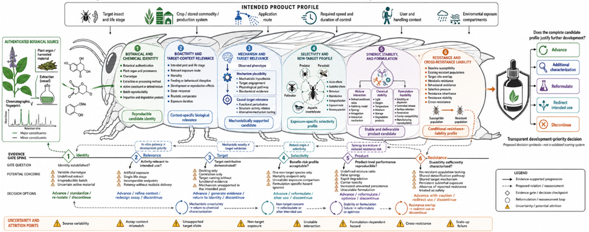
Figure 1 presents a staged candidate-prioritization pathway from chemical discovery to insect-control relevance within the analytical logic developed in this section.
|
|
|
Figure 1. A staged candidate-prioritization pathway from chemical discovery to insect-control relevance |
Alt text
A structured conceptual diagram that presents a staged candidate-prioritization pathway from chemical discovery to insect-control relevance, with labelled components, directional relations, contextual modifiers, uncertainty points, and a clear boundary between observed evidence and proposed synthesis.
The final stage is a transparent advancement decision. A candidate may advance, require reformulation, return for mechanism or safety clarification, be redirected to a different use, or be discontinued. The decision should be based on the remaining uncertainty that is most capable of changing development priority. Formulation strategies can improve delivery and stability, but they can also introduce new exposure pathways, materials, manufacturing demands, and validation requirements [27]. Consequently, a candidate should not be described as development-ready unless the evidence applies to the complete product under the intended use conditions. The proposed structure is an organizing synthesis, not a validated framework, and it does not prescribe fixed thresholds or universal weights. Its purpose is to make the basis of prioritization explicit and to prevent potency, novelty, natural origin, or mixture complexity from functioning as unsupported proxies for overall merit.
The proposed components, evidence bases, boundary conditions, failure modes, and validation requirements are organized in Table 2.
Table 2. Proposed Natural-Product Prioritization Criteria: Components, Evidence Basis, Relations, Boundary Conditions, Failure Modes, and Validation Requirements
|
Proposed component |
Purpose |
Evidence basis |
Relation or mechanism |
Input or precondition |
Expected output |
Boundary condition or failure mode |
Validation requirement |
|
Intended-use definition |
Anchor all subsequent comparisons to a practical insect-control need |
Target biology, production setting, exposure route, required duration, and user context |
Determines which efficacy, safety, stability, and delivery evidence is relevant |
Defined pest, life stage, setting, application method, and desired outcome |
Intended product profile |
Generic pesticidal activity may not fit the intended use |
Prospective testing under conditions representing the defined use |
|
Botanical and chemical identity |
Establish what material is being evaluated |
Taxonomic, analytical, and processing characterization |
Links biological effects to a reproducible candidate |
Authenticated source, defined extraction or isolation, and analytical profile |
Traceable candidate specification |
Chemotype, harvest, processing, or degradation variability can invalidate comparisons |
Independent batch characterization and reproducibility testing |
|
Bioactivity relevance |
Determine whether activity supports the intended control objective |
Mortality, development, reproduction, feeding, behavior, or other relevant endpoints |
Connects exposure to a biologically and operationally meaningful response |
Appropriate pest, life stage, route, comparator, and exposure duration |
Context-specific efficacy profile |
High potency in an artificial assay may not translate to practical control |
Realistic laboratory, semi-field, storage, greenhouse, or field evaluation as appropriate |
|
Mechanism plausibility |
Explain how the candidate produces the observed effect |
Physiological, biochemical, molecular, and pharmacological evidence |
Narrows competing explanations and guides optimization |
Chemically defined candidate and reproducible phenotype |
Supported mechanistic hypothesis |
Correlation, docking, or target naming may be mistaken for causation |
Functional perturbation, target-engagement, rescue, or convergent mechanistic evidence |
|
Target relevance |
Establish whether the proposed target contributes causally in the intended pest |
Target-specific functional evidence |
Links molecular engagement to insecticidal phenotype |
Plausible mechanism and accessible target |
Target-supported candidate profile |
Novel target description may lack causal or operational relevance |
Genetic, biochemical, pharmacological, or structure–activity validation in the relevant system |
|
Selectivity profile |
Compare desired pest effects with plausible non-target effects |
Target and non-target lethal, sublethal, behavioral, and functional endpoints |
Integrates intrinsic sensitivity with exposure |
Defined formulation and intended application pattern |
Exposure-specific benefit–risk profile |
Testing one non-target species or only acute mortality may create false reassurance |
Tiered testing across relevant beneficial and environmental compartments |
|
Mixture-interaction characterization |
Determine whether combinations are additive, synergistic, or antagonistic |
Defined-component and ratio-specific experiments |
Components may alter penetration, metabolism, target action, volatility, or release |
Known composition and individually tested constituents |
Reproducible interaction profile |
Undefined ratios or inappropriate additivity models can produce false synergy claims |
Independent replication, ratio analysis, mechanistic follow-up, and formulated-mixture testing |
|
Stability characterization |
Determine whether active chemistry remains usable during storage and application |
Chemical, physical, thermal, oxidative, and photolytic stability evidence |
Governs retained active content and temporal exposure |
Defined candidate, packaging, storage conditions, and use environment |
Stability and degradation profile |
Stabilization may increase unwanted environmental persistence |
Product-level storage, release, degradation, and residue studies |
|
Formulation feasibility |
Deliver the candidate safely and effectively to the intended target |
Solubility, dispersion, release, adhesion, penetration, compatibility, and manufacturability |
Converts active chemistry into an applicable product |
Defined active material and intended application method |
Reproducible prototype formulation |
Carrier toxicity, complexity, scale-up limitations, or altered exposure can outweigh efficacy gains |
Comparative product testing, process reproducibility, and application-system compatibility |
|
Resistance-liability assessment |
Determine potential durability and fit with resistance management |
Baseline susceptibility, mechanism overlap, selection, inheritance, and cross-resistance evidence |
Links target and exposure pattern to evolutionary selection |
Defined active profile and relevant insect populations |
Conditional resistance-risk characterization |
Absence of reported resistance may be mistaken for low risk |
Resistant-population testing, selection studies, mechanistic analysis, and longitudinal monitoring |
|
Integrated advancement decision |
Determine whether development, reformulation, redirection, or discontinuation is justified |
Combined chemical, biological, safety, formulation, and resistance evidence |
Makes trade-offs, uncertainty, and evidence gaps explicit |
Completed domain-specific assessment appropriate to the decision stage |
Transparent advancement rationale |
One favorable domain may obscure decisive uncertainty elsewhere |
Prospective application of the criteria across diverse candidates and independent decision settings |
Development and research implications
The first development priority is infrastructure for reproducible candidate definition. Botanical biopesticide research requires stronger links among plant authentication, chemotype documentation, cultivation or collection conditions, extraction, analytical profiling, formulation, and biological testing. Regional assessments of botanical-biopesticide development show that scientific potential coexists with limitations in standardization, product development, commercialization, and evidence transfer [28]. Progress would be demonstrated not by a larger number of active extracts, but by a larger proportion of candidates that can be reproduced across laboratories and batches using explicit chemical specifications. Shared reporting expectations should therefore include source identity, processing history, extraction yield, full or marker-based chemical profiles, storage conditions, formulation composition, and testing of independent batches.
The second priority is comparative biological validation across target and non-target contexts. Candidate studies should move beyond single-species acute assays toward designs that compare relevant pest stages, resistant populations where appropriate, beneficial organisms, and environmental compartments under aligned exposure scenarios. Essential oils proposed against aphids illustrate both the breadth of available chemistry and the difficulty of translating laboratory activity into consistent pest-management value [29]. Progress would be indicated by reproducible performance across realistic exposure conditions, identification of the life stages and routes for which the candidate is most suitable, and demonstration that target control is compatible with biological-control organisms and other relevant non-targets. Negative or context-dependent findings should be reported because they clarify boundaries and prevent repeated investment in unsuitable use patterns.
The third priority is integration of mechanism, formulation, and resistance research. Molecular investigation can identify targets, detoxification responses, and structure–activity relations, while formulation research can determine whether relevant exposure can be achieved and maintained. These strands should be evaluated together because a validated target is of limited development value if the compound cannot reach it under practical conditions, and an effective formulation is difficult to manage responsibly if its mechanism and resistance liabilities remain obscure. Molecular insight into plant–insect interactions can guide candidate optimization, but it must be linked to chemical reproducibility, ecological context, and product-level exposure [30]. Progress would be demonstrated by prospective studies in which chemically defined candidates pass through explicit evidence gates and by independent testing of whether the proposed prioritization structure improves the consistency, transparency, or predictive value of advancement decisions. Until such validation is performed, the structure should remain a scholarly decision aid rather than a deployment-ready framework.
CONCLUSION
Natural products merit development as insecticides when their promise extends beyond an isolated observation of bioactivity. The strongest candidates are chemically reproducible, relevant to a defined pest and use context, supported by appropriately bounded mechanistic evidence, selectively effective under plausible exposure, compatible with a feasible and stable formulation, and accompanied by a resistance assessment that considers existing and potential cross-resistance. No single domain is sufficient: in vitro potency is not equivalent to development priority, mechanistic novelty is not equivalent to target validation, natural origin is not equivalent to selectivity, and synergy in a mixture is not equivalent to reduced resistance risk. Candidate advancement should therefore proceed through transparent evidence gates that identify which uncertainties are tolerable, which require targeted resolution, and which undermine the proposed product concept. The highest-priority implication is to evaluate natural products as complete, intended-use-specific candidates rather than as chemically or biologically interesting substances in isolation. The proposed structure offers an explicitly non-validated basis for organizing such decisions and should be tested prospectively across different botanical materials, insect taxa, formulations, and production systems.
ACKNOWLEDGMENTS: None
CONFLICT OF INTEREST: None
FINANCIAL SUPPORT: None
ETHICS STATEMENT: None